Category Archives: 60’s Movies

Village of the Damned (1960)

village of the damned 2

By Richard Winters

My Rating: 6 out of 10

4-Word Review: The eyes have it.

Remade in 1995 and based on the John Wyndham novel ‘The Midwich Cuckoos’ the story centers on a small English village where one day everyone mysteriously falls asleep for several hours while under the spell of some invisible, odorless gas. When they awaken everything seems normal, but later on all the women become pregnant, even those that were not married or were still virgins. When the babies are born they are found to be different from their human counterparts as they have a higher intelligence, odd shaped heads and bright blonde hair. Later on these same children gain the ability to read other people’s minds and dispose of those that they don’t like penetrating them with the spell of their glowing eyes. As the rest of the village panics one man (George Sanders) feels that he may have the ability to stop them, but only if he can somehow control his own thoughts, so they won’t be able to tell what he is actually up to.

As a sci-fi thriller it’s not bad. The film’s short running time has a nice compact style to it with a story that evolves at a fast pace and continues to add new twists. The special effects for its day are realistic enough to be passable and the violence is surprisingly high. Sanders is effective in the lead and Martin Stephens as the leader of the children is quite creepy.

I found it a bit baffling though that the townspeople wouldn’t have quarantined the strange children from the start as it becomes quite obvious from the beginning that they aren’t normal. Instead they are allowed to roam freely even as they become increasingly more sinister. I would’ve also have thought that some of the mothers who gave birth to these strange beings would’ve disowned them and even refused to take care of them once their unnatural and frightening oddities became apparent.

The ending is frustrating as the film does not supply any answer as to who these kids where and what type of alien presence impregnated the women and why. The movie tells us that other places have been effected with these strange children as well, which leads one to believe that this is only a part of some other more sinister plot with far reaching consequences that never gets tackled. Instead we get left with a short film that acts like a small chapter to a fascinating idea with broad potential variables that unfortunately never gets followed through on.

My Rating: 6 out of 10

Released: July 5, 1960

Runtime: 1Hour 17Minutes

Not Rated

Director: Wolf Rilla

Studio: MGM

Available: DVD, Amazon Instant Video
The Raven (1963)

raven 2

By Richard Winters

My Rating: 6 out of 10

4-Word Review: The search for Lenore.

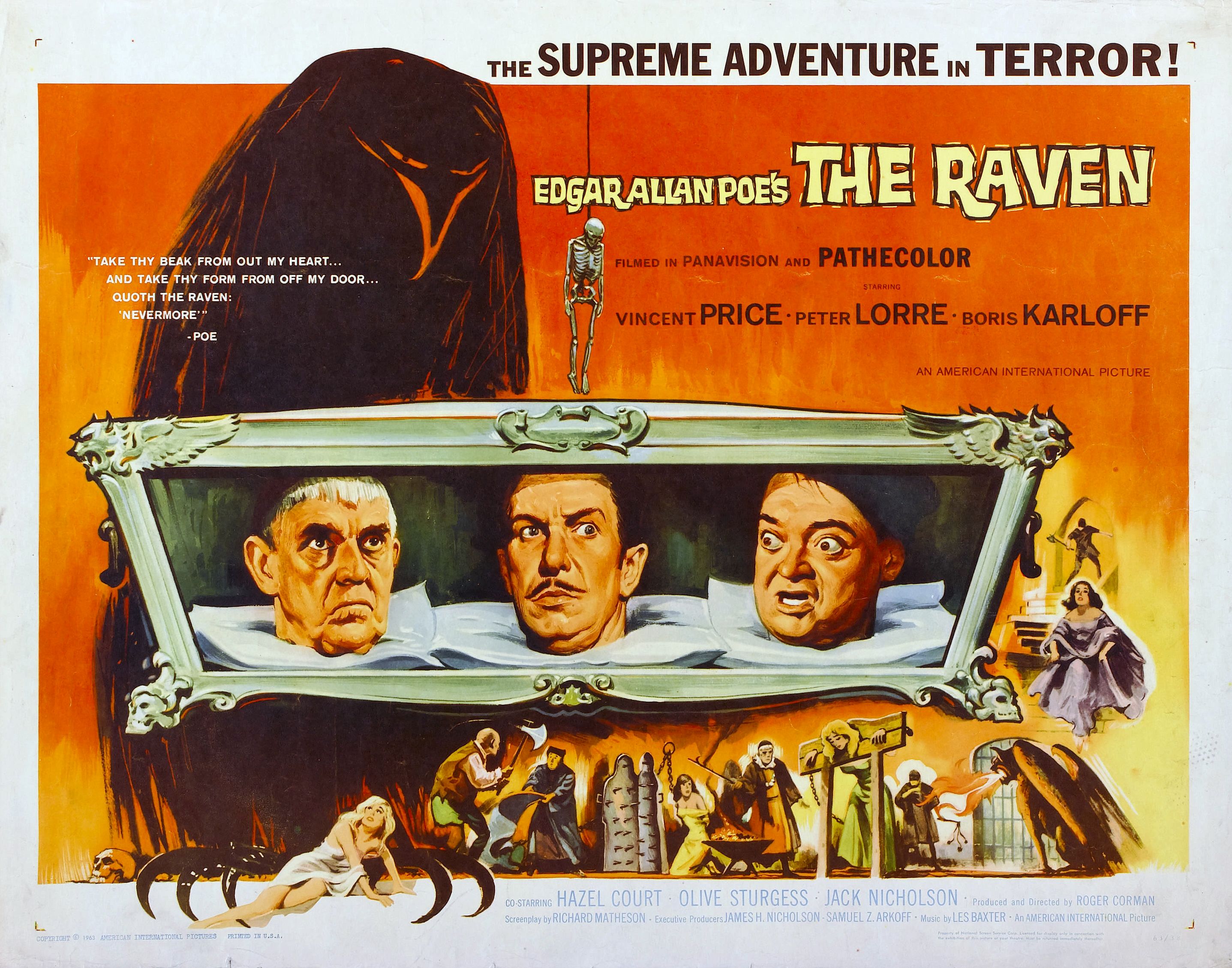
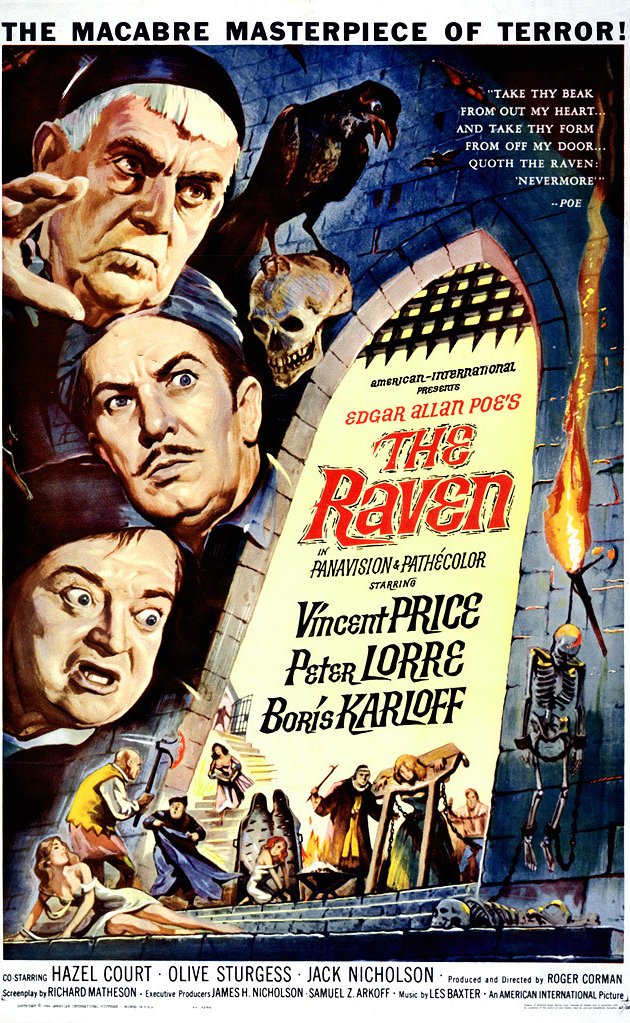
Dr. Craven (Vincent Price) is a former sorcerer who one night is visited by a talking raven. The raven is actually Dr. Bedlo (Peter Lorre) who has been turned into a bird by the evil Dr. Scarabus (Boris Karloff). Craven manages to concoct a potion that allows Bedlo to turn back into his human form and in appreciation he tells Craven that he has seen Lenore (Hazel Court), who Craven was once married to and was thought to be dead, living with Scarabus in his castle. Craven decides to pay Scarabus a visit to see if this is true and brings along his daughter Estelle (Olive Sturgess) as well as Bedlo and Bedlo’s son Rexford (Jack Nicholson). When they arrive they are greeted by the conniving wizard who at first denies any wrongdoing, but it soon becomes clear that he is jealous of Craven’s powers and wants to attain them for himself, which leads to a climactic cosmic duel between the two sorcerers.

This film marked the fourth collaboration between writer Richard Matheson and director Roger Corman and for the most part it is an entertaining success. The two apparently had so much fun creating the comic story of ‘The Black Cat’ in Tales of Terror trilogy that they decided to do a feature length horror/comedy that is very loosely based on the Edgar Allan Poe poem. Despite being shot in only 15 days the film isn’t as limited by Corman’s usual low budget constraints and I was genuinely surprised how imaginative the special effects where and the overall impressive background sets.

The film’s biggest boost is clearly the three lead actors who are all at their absolute peak. I especially enjoyed Lorre who brazenly steals every scene he is in and ad-libbed many of his funny lines much to the consternation of his co-stars. In fact if Lorre wasn’t in this it wouldn’t have been half as enjoyable. A young Nicholson as his son is equally entertaining and the frosty relationship that the two characters have was apparently a carry-over from how they felt about each other from behind-the-scenes.

Some of the effects are clearly animated, which looks tacky and as the group arrive at Scarabus’ castle one can see that the place is merely a painting matted on the screen. The story also does have its share of lulls, but all of this gets forgiven by the climactic sorcerer’s duel, which is the film’s highlight.

raven

My Rating: 6 out of 10

Released: January 25, 1963

Runtime: 1Hour 26Minutes

Not Rated

Director: Roger Corman

Studio: American International Pictures

Available: VHS, DVD, Amazon Instant Video
Promise Her Anything (1966)

promise her anything

By Richard Winters

My Rating: 6 out of 10

4-Word Review: Bachelor becomes a babysitter.

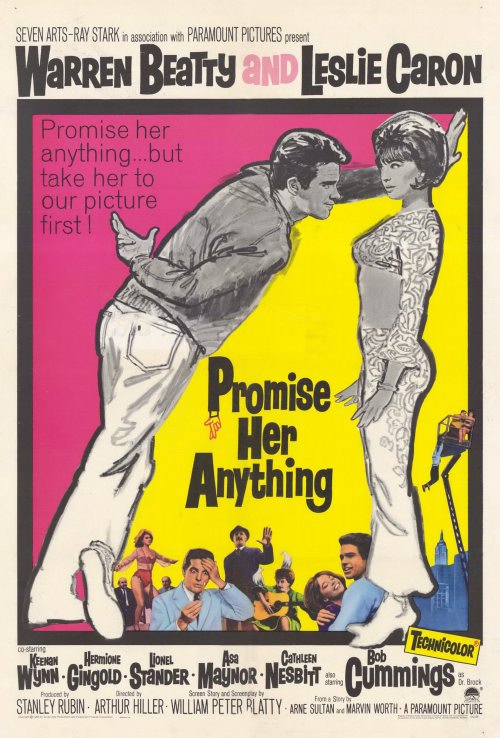
Harley (Warren Beatty) is a struggling filmmaker living alone in a rundown Greenwich Village apartment where he makes low-grade blue movies to pay the rent. Michele (Leslie Caron) moves into the apartment next door. She is a recently widowed mother who has Harley babysit her 2-year-old (Michael Bradley) while she romances the child psychologist (Robert Cummings) that she works for whom she feels will also make for a good father. The problem is that Harley falls for Michele and soon makes a play for her affections as well.

After recently reviewing other bachelor themed films from the ‘60s I felt this was a definite upgrade. Instead of portraying young single men living in plush pads and having cushy jobs this one shows a more realistic side with a character that struggles to make ends meet while also harboring a beatnik philosophy that young men of that time were starting to embrace. Arthur Hiller’s direction has shades of the offbeat and irreverent while Tom Jones’ singing gives it hipness.

I also enjoyed Beatty’s presence and felt this was one of his better comedies as the scenario takes full advantage of his detached, glib manner while also tapping into his notorious lady’s man image. The scenes where he talks about enjoying  the benefits of marriage, but without being married or expounding on the virtues of socialized medicine made the character seem downright ahead-of-his-time.

Cummings, in one of his last film appearances, is also fun and his stuffy, uptight ways makes for a great contrast to Beatty. Why someone who hates kids would ever decide to become a child psychologist makes little sense, but it’s still funny as is his banter with his more modern thinking mother (Cathleen Nesbitt).

Caron seemed miscast as she was already in her mid-30s at the time and an actress who was in her 20s and more Beatty’s age would’ve been a better fit. I also didn’t care for the character’s dated, old-school ways of thinking including the idea of marrying a man simply for the security that he could offer even if she didn’t love him or that children must have a father figure in their life or they will turn out ‘psychologically abnormal’ if raised only by a single parent. Her attempts at hiding the fact that she had a child until after the Cummings character had proposed to her and she’d securely ‘snared’ him is equally offensive.

The plot is paper thin and I’ll admit I watched this on my Amazon fire tablet and halfway in I accidently kicked the table it was sitting on and in my attempt to catch the tablet before it dropped to the ground I inadvertently jumped the film ahead by 20 minutes, but had no idea I had done so until it had ended. When I went back to review what I had missed I realized it hadn’t been much.

The undernourished script by William Peter Blatty has a few amusing bits, but nothing that’s laugh-out-loud funny. The climactic sequence in which Beatty tries to heroically save the child who’s trapped on a moving crane might’ve been more exciting had it not been so obviously done in front of blue screen.

My Rating: 6 out of 10

Released: February 22, 1966

Runtime: 1Hour 38Minutes

Not Rated

Director: Arthur Hiller

Studio: Paramount

Available: VHS, Amazon Instant Video, YouTube

Boeing, Boeing (1965)

boeing boeing

By Richard Winters

My Rating: 2 out of 10

4-Word Review: Fooling around with stewardesses.

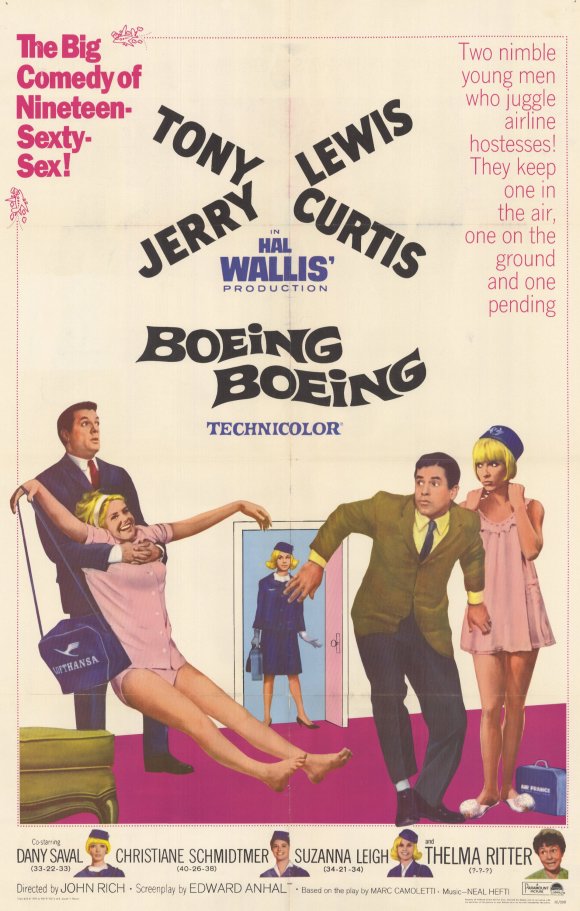
Bernard (Tony Curtis) thinks he’s come up with the perfect plan where as a confirmed bachelor he can enjoy the ‘benefits’ of a relationship without ever having to take the ultimate plunge. Using the timetables of all the airlines he has devised a way where he can date three different stewardesses (Dany Saval, Christiane Schmidtmer, Suzanna Leigh) simultaneously without any of them knowing of the other ones. When one of them is on layover from their flights they come over to his pad for romance and passion and then promptly leave for their jobs only to have another one arrive from another layover. It works for a while before the expected complications ensue. Things get even worse when Bernard’s out-of-town friend Robert (Jerry Lewis) arrives and wants to get in on the action while Bertha (Thelma Ritter) Bernard’s long suffering maid feels that she’s had enough and wants to quit.

The flimsy premise kills itself from the beginning by having a main character that is unlikable. I’m as open-minded as the next person, but if one wants to enjoy the swinger’s lifestyle then they must be open and honest with their partner(s) for it to work. This guy lies to them at every turn, manipulates with their emotions and views them solely as sexual playthings for his own pleasure, which is about as callous and self-centered as they come. His scheme is full of potential holes and any halfway intelligent person would’ve known it wouldn’t work and avoided even attempting it from the start.

The women are portrayed as being painfully naïve and stupid and falling for every pathetic lie and story that the men tell them. I was hoping at some point they would wise up and turn-the-tables, which would’ve been really funny, but that never happens. Instead the viewer gets treated to one ‘madcap’ scheme after another as they try desperately to keep their ridiculous ploy going, which becomes tiring and annoyingly redundant.

The three actresses at least have some acting ability and aren’t just the usual wide-eyed models mouthing their lines, which helps a little. Ritter certainly makes for a good anchor, but even she becomes stifled by the story’s derivative theme. Lewis surprisingly is the best thing about the film and this is mainly due to the fact that he is much more restrained and not allowed to fall into his over-the-top shtick.

Based on the stage play by Marc Camoletti this thing might’ve at one time been considered a fresh and funny bedroom farce, but by today’s standards it is tame and dated and not good for even a few chuckles.

boeing boeing 2

My Rating: 2 out of 10

Released: December 22, 1965

Runtime: 1Hour 42Minutes

Not Rated

Director: John Rich

Studio: Paramount

Available: DVD, Amazon Instant Video, YouTube

Come Blow Your Horn (1963)

come blow your horn

By Richard Winters

My Rating: 5 out of 10

4-Word Review: Kid brother moves in.

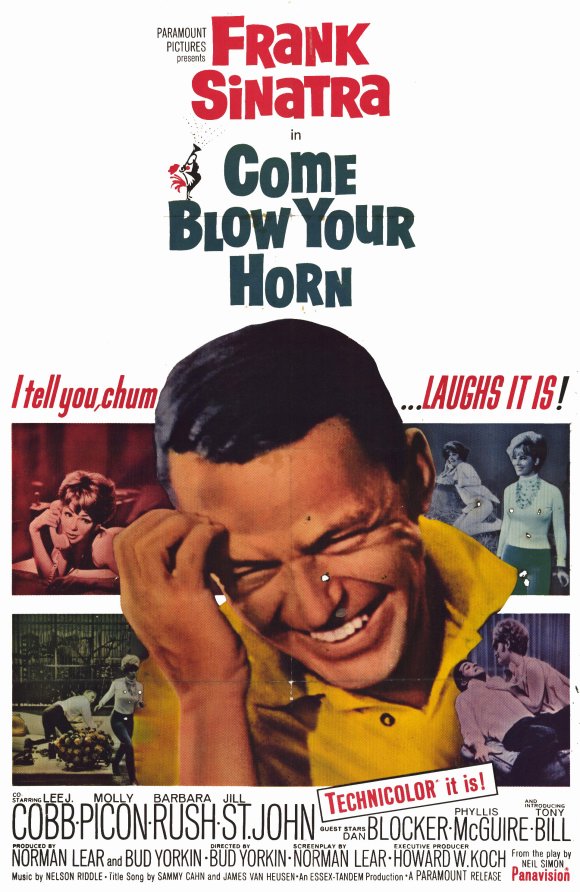
Buddy Baker (Tony Bill) has just turned 21 and is looking to get out into the world by moving in with his older brother Alan. Alan (Frank Sinatra) is living the bachelor’s dream by residing in a luxurious apartment in the heart of Manhattan while entertaining wild parties and a wide array of lovely ladies. Their parents (Lee J. Cobb, Molly Picon) do not feel that Alan and his lifestyle will be a good influence on Buddy and forbid him from doing it, but he does it anyways, which drives the father to disown his sons and cut out all communications with them.

This was the first Neil Simon play to be turned into a movie and it was loosely based on Neil’s relationship with his older brother Danny. For the most part it is talky and stagy while lacking Simon’s patented one-liners and humorous exchanges. It also has for some bizarre reason a musical number that comes out of nowhere at the 40-minute mark where Sinatra sings the film’s title tune and then just as quickly it goes back to being a straight comedy, which came off as jarring, out-of-place and misguided.

I did enjoy the film’s set design, which got nominated for an Academy Award, especially the interiors of Alan’s swanky apartment. However, I was confused why Buddy had to sleep in the same room as Alan as I would think such a large and fancy place would have more than just one bedroom. The movie also strongly implies that Alan is having sexual trysts with his lady friends, which would then imply that he must have a king sized bed somewhere, so why are only twin beds shown? He also has five telephones in the living room, which seemed beyond absurd and made me feel that if he had purchased a few less phones then he might’ve been able to afford a double bed.

Sinatra’s presence is the film’s weakest link as this type of comedy doesn’t mesh well with his otherwise caustic personality. He was too old for the part as he was not only pushing 50, but also only 4 years younger than Cobb who plays his father. I didn’t like Jill St. John’s ditzy character either as she was too dumb to be believable, which was not only painfully unfunny, but stereotypical and insulting to women.

I did like Tony Bill in his film debut and his nicely understated performance helps keep the film balanced. Dan Blocker is also great as a jealous husband and Molly Picon is a scene stealer as the mother. You can even spot Dean Martin as a wino in an uncredited cameo.

The fact that Alan doesn’t want to give up his swinging lifestyle despite the pressures from his girlfriend Connie (Barbara Rush) is the story’s one and only redeeming quality. I could never understand why a single man, who’s enjoying the bachelorhood at its most ideal, such as it is portrayed here, would want to suddenly throw it all for the married life. Most of the of films from that era with a similar theme would portray it as simply being the ‘magic of love’, but here the character is much, much more resistant to the idea and doesn’t change his ways until having a life altering event where he sees things from a different perspective, which made more sense.

Sinatra fans may want to check this out, but it is far from his best stuff and although the material is agreeable it is only slightly engaging and barely worth the time.

My Rating: 5 out of 10

Released: June 5, 1963

Runtime: 1Hour 52Minutes

Not Rated

Director: Bud Yorkin

Studio: Paramount

Available: VHS, DVD, Blu-ray, Amazon Instant Video
Kes (1969)

kes 1

By Richard Winters

My Rating: 6 out of 10

4-Word Review: Boy trains a kestrel.

Billy (David Bradly) is a poor working class youth living in Yorkshire who finds his existence to be bleak and pointless. He is bullied constantly by his older brother Jeb (Freddie Fletcher) and ignored by his burdened mother (Lynne Perrie) while also being picked on at school. As means of some solace he finds a nest of baby kestrels inside an abandoned building. He takes one of them and keeps it in his backyard shed where he trains it, which in return gives him a sense of purpose.

The film is based on the novel by Barry Hines who also wrote the screenplay and although the plot is basically the same it does vary in two major ways. The first one being that in the book everything takes place in one day and with a lot of use of flashbacks to explain the backstory, which I liked better, but here it’s given a linear narrative. The book also explains a bit more about the otherwise absentee father and even has one scene involving him while here the character is non-existent and never even mentioned.

On a purely cinematic level it is well made and nicely exposes Billy’s hopeless working class world without ever being heavy-handed. The drama is fresh and natural with each scene and character ringing true. The segments involving the training of the bird is the most engaging and I wished had been extended.

The children are fantastic without being too cute or precocious and respond to things in ways that are honest to their nature. The adult cast is good as well although not as likable. The teachers and school administrators, with their very old fashioned approach to discipline, come off as genuine jerks. At one point one of them even raps the open palms of the children’s hands with a cane, which makes their eyes well up with tears and is unpleasant to watch.

The worst is the segment involves Billy’s physical ed. teacher Mr. Sugden, which is played by Brian Glover who was an actual high school instructor at the time as well as a former wrestling. Here he plays a coach who brutally bullies his students in a scene that makes its point and then goes on too long with it. I also didn’t like that director Kenneth Loach superimposes the score of the soccer (football) game that the students are playing onto the screen, which wasn’t necessary as who wins the game was not important at all and hurt the film’s realism by distracting the viewer and taking them out of the story.

Some have complained about the thick dialect of the characters, which makes it hard at times to understand what they are saying. Certain American versions have been dubbed to make the lines uttered clearer although the version I watched, which was from the Criterion Collection, seemed to have the original accents intact, which I preferred as it kept it more authentic and for the most part I didn’t have any problem with it.

Spoiler Alert!

The only real issue that I had with the film is its downbeat ending. I realize that it is the same as the one in the book, but felt a bit frustrated that every time there is a movie dealing with a child taking care of an animal it always for some reason has to end in tragedy, which made it a bit formulaic. The kid never gets a break and having the falcon get killed at the end was like rubbing salt into the wound. The bird that actor Bradly buries apparently died of ‘natural causes’ but at the time he was under the belief that it had been killed simply to suit the purposes of the film and the angry reaction that you see on his face was very real.

End of Spoiler Alert!

kes 2

My Rating: 6 out of 10

Released: November 16, 1969

Runtime: 1Hour 50Minutes

Rated GP

Director: Kenneth Loach

Available: DVD, Blu-ray, Amazon Instant Video

30 is a Dangerous Age, Cynthia (1968)

30 is a dangerous age

By Richard Winters

My Rating: 6 out of 10

4-Word Review: Life crisis at 30.

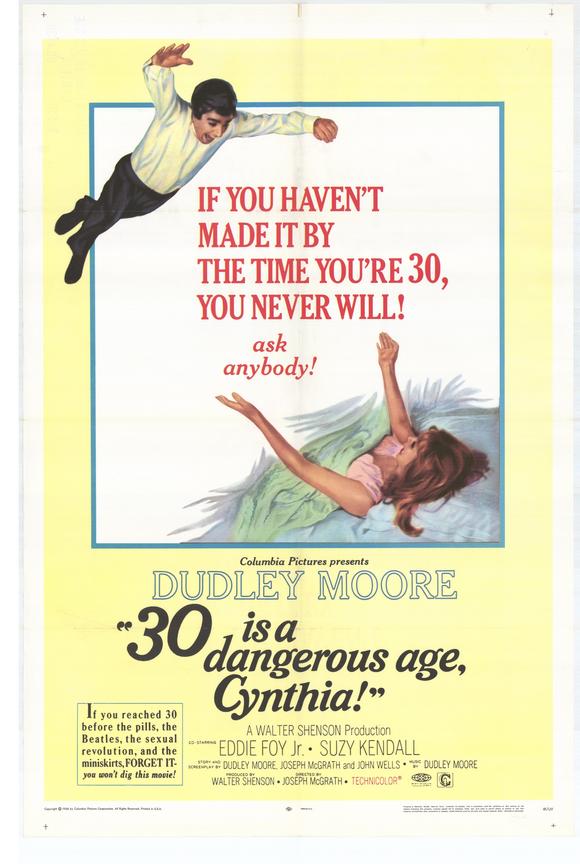
Rupert Street (Dudley Moore) is a struggling pianist and composer who with only six weeks until his thirtieth birthday feels that his life has been a failure. He sets out to change that by setting some very lofty goals, which is to write a musical and have it produced as well as getting married even though he has yet to find a girlfriend.

The film, which was directed by Joseph McGrath is filled with the wonderfully drool British humor that manages to be both lightly satirical and imaginative all at the same time. The rampant cutaways in which a character will be talking about something and then it cuts to show them doing what they are imagining or discussing lends a nice surreal quality. The banter that Moore has with a Registrar (Frank Thornton) where he tries to get a marriage license before even having picked out a woman is the high point of the film and a perfect example of the wacky humor of that era from that region of the world that balances being both subtle and over-the-top that I wish more American movies would be better able to replicate.

The supporting cast helps a lot and is full of comic pros. The elderly Eddie Foy Jr. is a scene stealer as Rupert’s best friend and so is Duncan Macrae, whose last film this was, as Rupert’s boss. Patricia Routledge is great as his kooky landlady and Suzy Kendall is highly attractive as his fiancée. There is also an amusing parody of 1940’s detective movies featuring John Bird as a self-styled film noir-like private eye.

Unfortunately the script, which was co-written by Moore, suffers from too much of loose structure. The jokes are poorly paced and many times the comic bits go on longer than they should. There is also an intermixing of musical numbers that features Moore at the piano, which does not work well with the rest of the film. Yes, Moore was also an excellent pianist, but this was no place to be showing it off and these segments only help to bog the film down as a whole. The ending, which features Moore having to witness the desecration of his musical by an overzealous director who has a different ‘vision’ for it is priceless, but in-between there are a lot of lulls and the film would’ve been helped immensely by having a tighter script and a more structured, plot driven story.

My Rating: 6 out of 10

Released: March 4, 1968

Runtime: 1Hour 25Minutes

Not Rated

Director: Joseph McGrath

Studio: Columbia Pictures

Available: VHS

The Flight of the Phoenix (1965)

flight of the phoenix 1

By Richard Winters

My Rating: 8 out of 10

4-Word Review:  Fighting the desert elements.

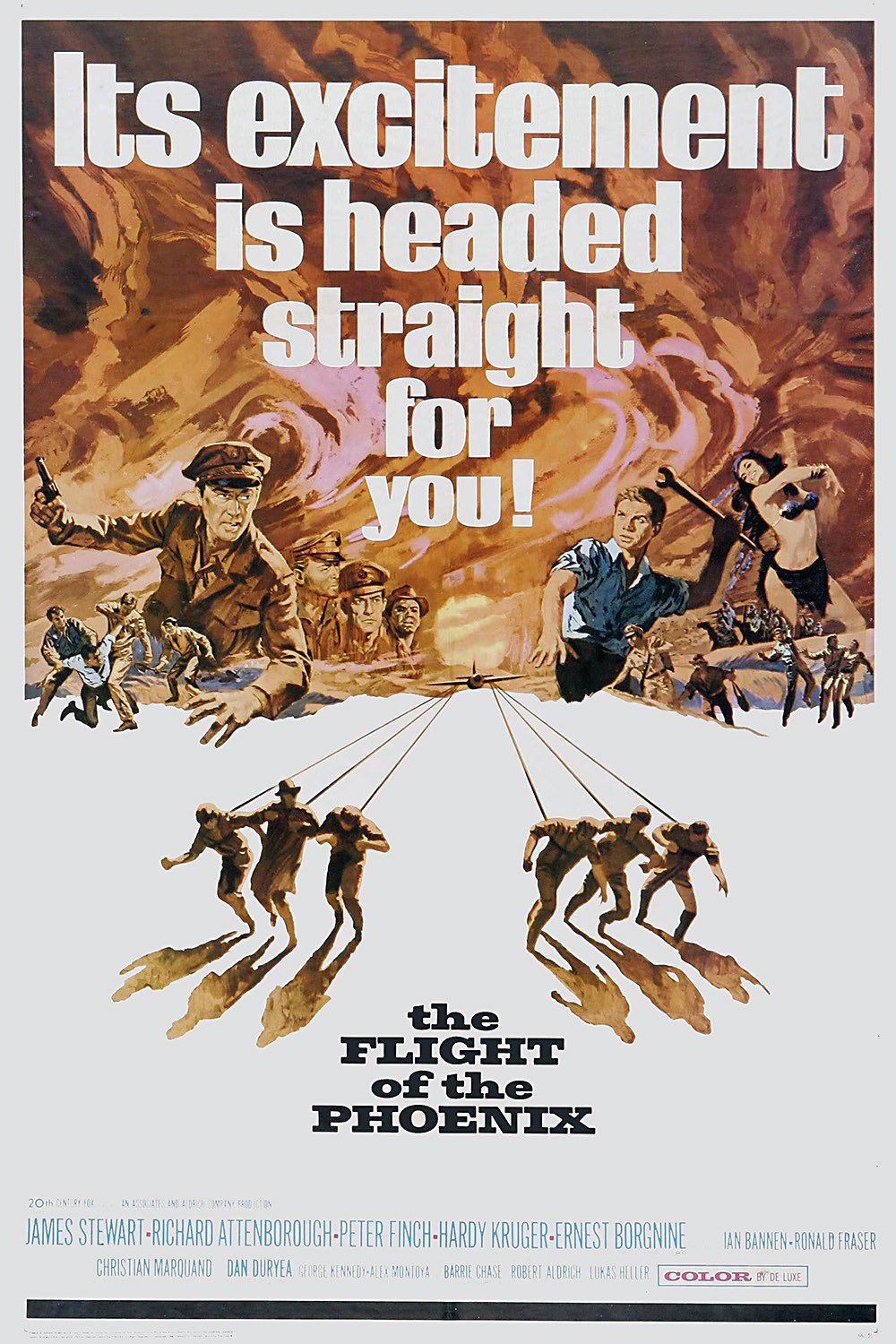
A cargo plane flying to Benghazi and piloted by Frank Towns (James Stewart) is forced to make a crash landing in the middle of the Sahara desert when a freak sand storm shuts down the plane’s engines. Of the 14 men on board two are killed instantly when several oil drums break loose during the crash which also injures a third. The rest of the men find themselves stranded in the searing heat with only dates as their food and a 2 week supply of water. The radio communication was destroyed during the crash and they are too far off their main route for anyone to find them. One of the passengers, Heinrich Dorfmann (Hardy Kruger) who works as a plane designer believes he has a way to take what’s left of the wreckage and build it into a new plane, which will then be able to fly the men out of there. Initially everyone else is skeptical, but eventually they begin working during the night to put it together while continuing to fight the elements and themselves in the process.

What makes this film stand out from the rest of the epic adventures is the fact that there is no good guy versus bad guy here. Every one of the individuals has their own unique character flaws and must learn to overcome them and their egos in order to work together as a team. The characterizations are realistic and multi-faceted making their conflicts believable from start to finish and helping to create a story that is gripping on both an adventure level and a psychological one.

Stewart is outstanding in the lead and I enjoyed seeing him play a part that is cynical and savvy and with less of the humble, country boy charm that he is known for. Kruger is solid in support and watching his confrontations with Stewart and then their eventual respect for each is the film’s main highlight. Richard Attenborough is also good as the sort-of moderator between the two and I also enjoyed Peter Finch as the brave and honorable Captain as well as Ronald Fraser as his sergeant who doesn’t quite share his same courage or sense of duty.

I was disappointed to some extent that it wasn’t filmed on-location in the Sahara and instead in Arizona and California although the desert locales look authentic enough even though eventually after two hours it becomes monotonous visually. Director Robert Aldrich keeps things believable including having the men visibly slow down physically as the days wear on as well as growing beards, which is something that sometimes gets overlooked in other stranded dramas although I was still confused why the Finch character formed a goatee instead of a full beard.

The climactic sequence is both nerve-wracking and exhilarating particularly the scene where Stewart tries to start the plane with only 7 cartridges remaining and with each one failing. Whether the logistics of this could actually occur is a big question, but it still remains grand entertainment.

flight of the phoenix 2

My Rating: 8 out of 10

Released: December 15, 1965

Runtime: 2Hours 22Minutes

Not Rated

Director: Robert Aldrich

Studio: 20th Century Fox

Available: VHS, DVD

Manos: The Hands of Fate (1966)

manos 2

By Richard Winters

My Rating: 1 out of 10

4-Word Review: Worst movie ever made.

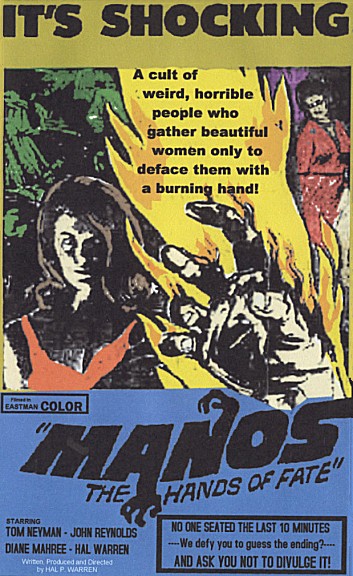
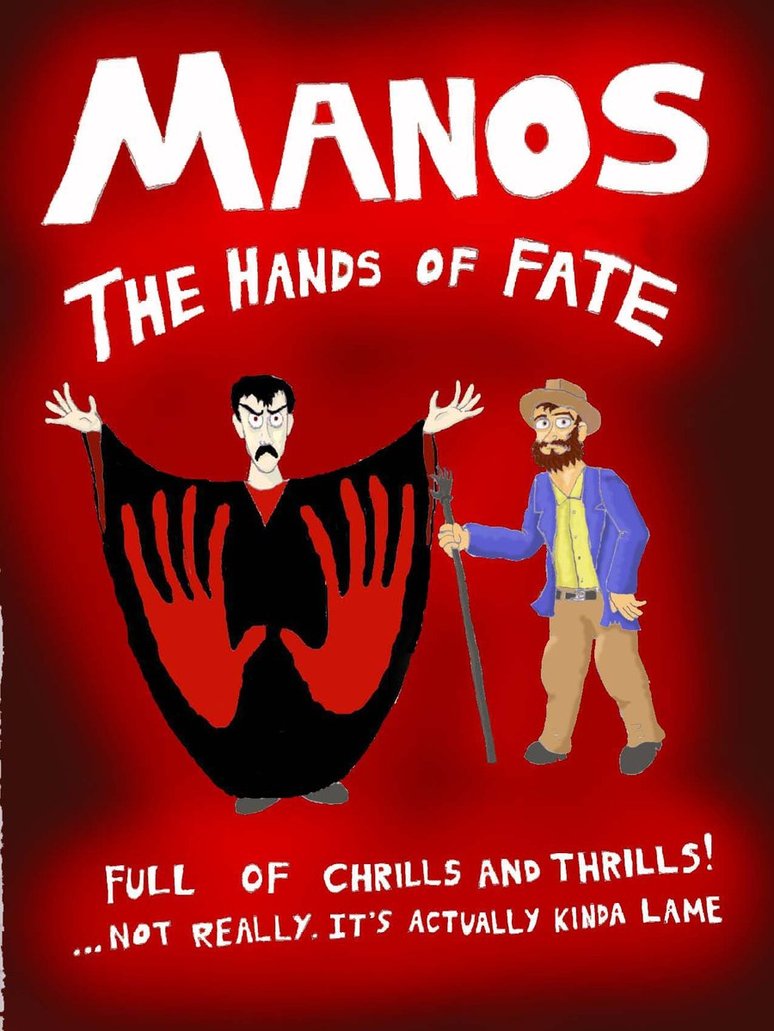
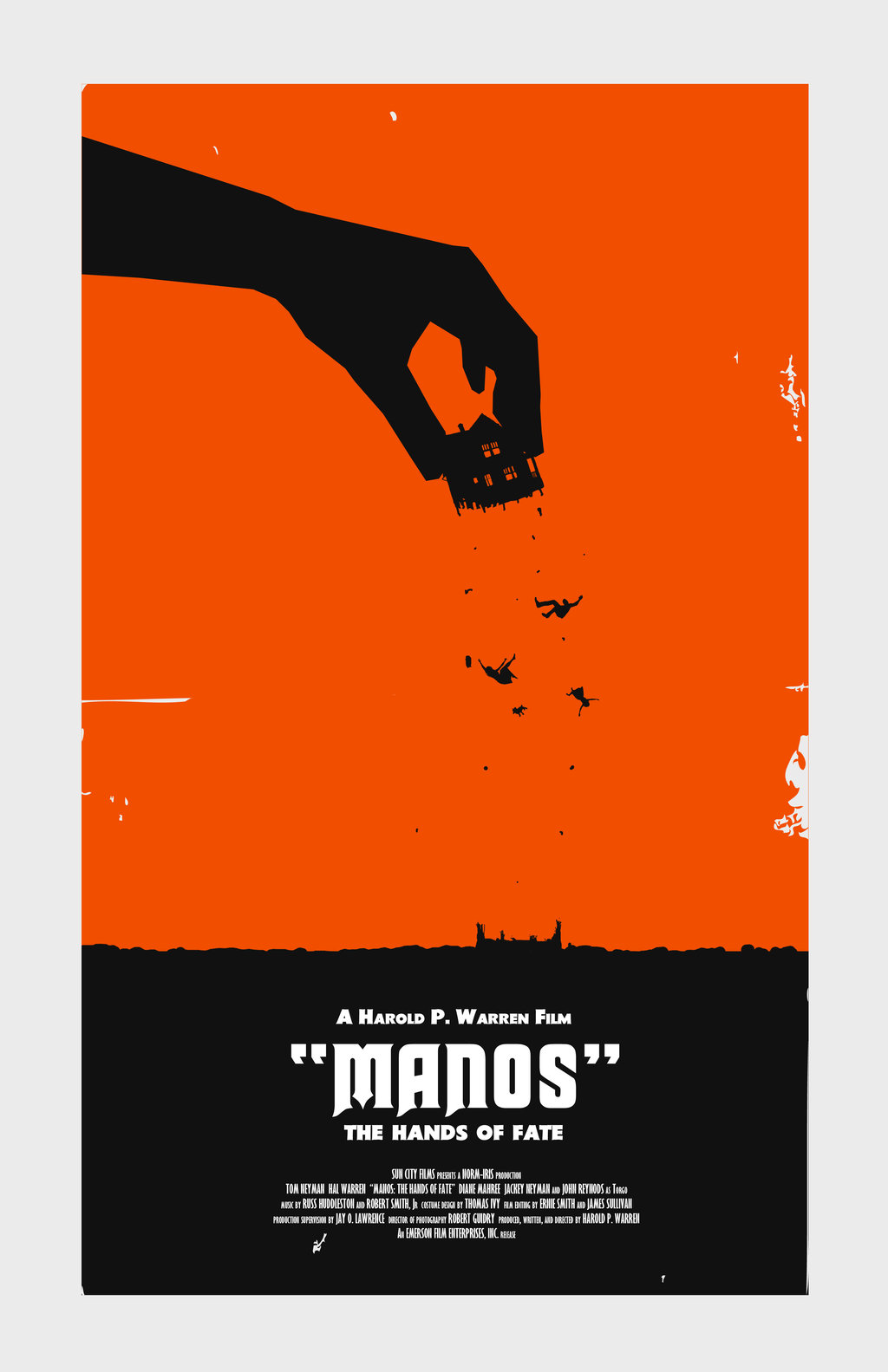
Husband and father Michael (played by the film’s writer/director Harold P. Warren) takes his wife Margaret (Diane Adelson) and their young daughter Debbie (Jackey Neyman) on a trip. Along the way they become lost in the middle of the west Texas desert and after driving around for hours finally come upon an isolated building in the middle of nowhere. Standing guard outside is a strange man named Torgo (John Reynolds) who invites them inside. Feeling they have no choice the family agrees to go in unbeknownst that the place is managed by an evil devil worshipping man known as The Master (Tom Neyman) who is already married to six wives and looking to add another to his ‘flock’.

This film came about as a bet between insurance salesman Warren and award winning screenwriter Stirling Silliphant who was in the El Paso, Texas area scouting locations for his next movie. Warren met him by chance at a local café and then proceeded to tell him that ‘anyone’ could make a movie and bet him that he could successfully do one without having any prior experience or budget. Warren even wrote the majority of the film’s screenplay on his napkin at the restaurant before the two had even left. He was then able to secure $19,000, which even for the time period wasn’t very much as well as a hand-held camera that could only shoot 32 seconds worth of film at a time. He rounded up some actors from a local theater for the cast and unable to pay them upfront promised that they would receive reimbursement for their efforts once the film was released and made a profit, which never happened.

manos 1

The result of all of this is a film that many critics and viewers consider to be the worst ever made. The film’s biggest problem is that there was no sound recorded during the filming and it all had to be dubbed in later causing it to come off like a silent movie with music used throughout the whole thing in order to help ‘narrate’ the mood and scene much of which is jazz sounding that doesn’t really connect with the horror genre to begin with. The takes go on waaaay longer than they should including a long stretch at the beginning where we see nothing but passing scenery of a barren Texas landscape that goes on endlessly.

manos 4

The filmed bombed upon its initial release and was only seen at a few theaters in the El Paso area before being forgotten completely. When Jackey Neyman attended collage during the early 80’s and told friends that she had at one point been in a film as a child her friends set out to find a copy and were unable to. It wasn’t until 1993 when this film was shown on an episode of ‘Mystery Science Theater 3000’ that it garnered the cult following that is has now including a Blu-ray release that is set to come out on October 13th of the this year that will have as a bonus not one, but three featurettes included, which I guess proves that these days bad is now the new good.

For my part I liked the general premise, which if put in more competent hands and with a better budget might’ve been interesting. I also enjoyed Adelson as the wife who is beautiful and went on to have a career as a model. The twist ending is also kind of neat, but without some sort of rifftax attached this otherwise boring thing is not worth catching.

manos 5

manos 6

My Rating: 1 out of 10

Released: November 5, 1966

Runtime: 1Hour 14Minutes

Not Rated

Director: Harold P. Warren

Studio: Emerson Film Enterprises

Available: DVD, Blu-ray (Release date October 13, 2015)

Goldstein (1964)

goldstein2

By Richard Winters

My Rating: 4 out of 10

4-Word Review: Prophet emerges from lake.

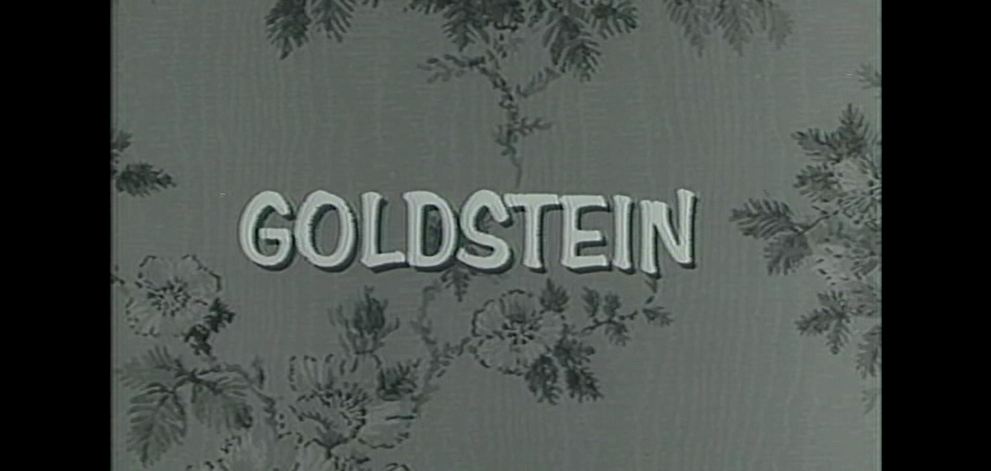
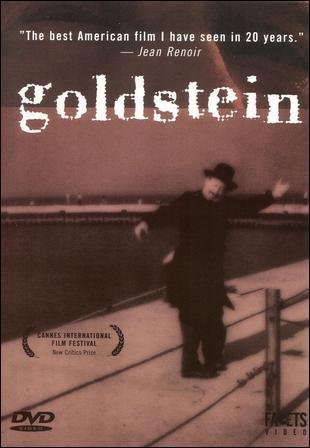
An old man (Lou Gilbert) emerges from Lake Michigan and wanders the streets of Chicago making friends and enemies along the way. His aurora captures the imagination of a local artist (Tom Earhart) and he seeks the old man out for advice and inspiration, but then loses sight of him and spends the rest of the movie trying to chase him down, but becoming more lost in the process.

This film’s biggest claim to fame is that it is the directorial debut of Philip Kaufman who along with co-director Benjamin Manaster penned this tale that is supposedly a loose, modern-day interpretation of the prophet Elijah. The film has an engaging cinema verite style that is enough to hold some interest, but story wise it is vague and confusing. Too much is thrown in that seems to having nothing to do with the central character or theme. Much of it was clearly ad-libbed, which creates a certain freshness, but also allows it to go even more on a tangent that it ultimately cannot recover from.

The best moments come from the scenes involving Gilbert’s character who surprisingly doesn’t have as much screen time as you’d expect despite being supposedly the central point of the story. The scenes where he comes out of the water and then befriends a homeless man and wheels him down a busy street while holding up traffic is funny I also loved the part where he takes a bath in an apartment and is unable to work the faucet knobs or even know what they are for. His foot chase through a meat plant is nicely captured and edited as is his shadow dancing along the shores of Lake Michigan, but he disappears too quickly and the movie is weak and directionless without him.

This movie also marks the acting debuts of several famous comic character actors including Jack Burns who was part of a comic team with George Carlin for a while and then later with Avery Schrieber before becoming famous as the voice for the crash test dummies. Here he has an amusing bit as an ambivalent desk sergeant. Severn Darden and Anthony Holland are both seen on the screen for the first time playing a sort-of Laurel and Hardy-like traveling abortionists who perform the operation on one woman (Ellen Madison) inside an empty apartment that is quite edgy, explicit and darkly humored for its time period.

The on-location shooting in Chicago is great especially with the way it captures the Marina Towers, which are two residential buildings resembling corncobs that sit in the downtown and had just been completed when filming took place. The flimsy, wide-eyed story though cannot equal its creative execution making this interesting as a curio only.

goldstein 1

My Rating: 4 out of 10

Released: May 4, 1964

Runtime: 1Hour 25Minutes

Not Rated

Director: Philip Kaufman, Benjamin Manaster

Studio: Altura Films International

Available: DVD