Category Archives: 60’s Movies

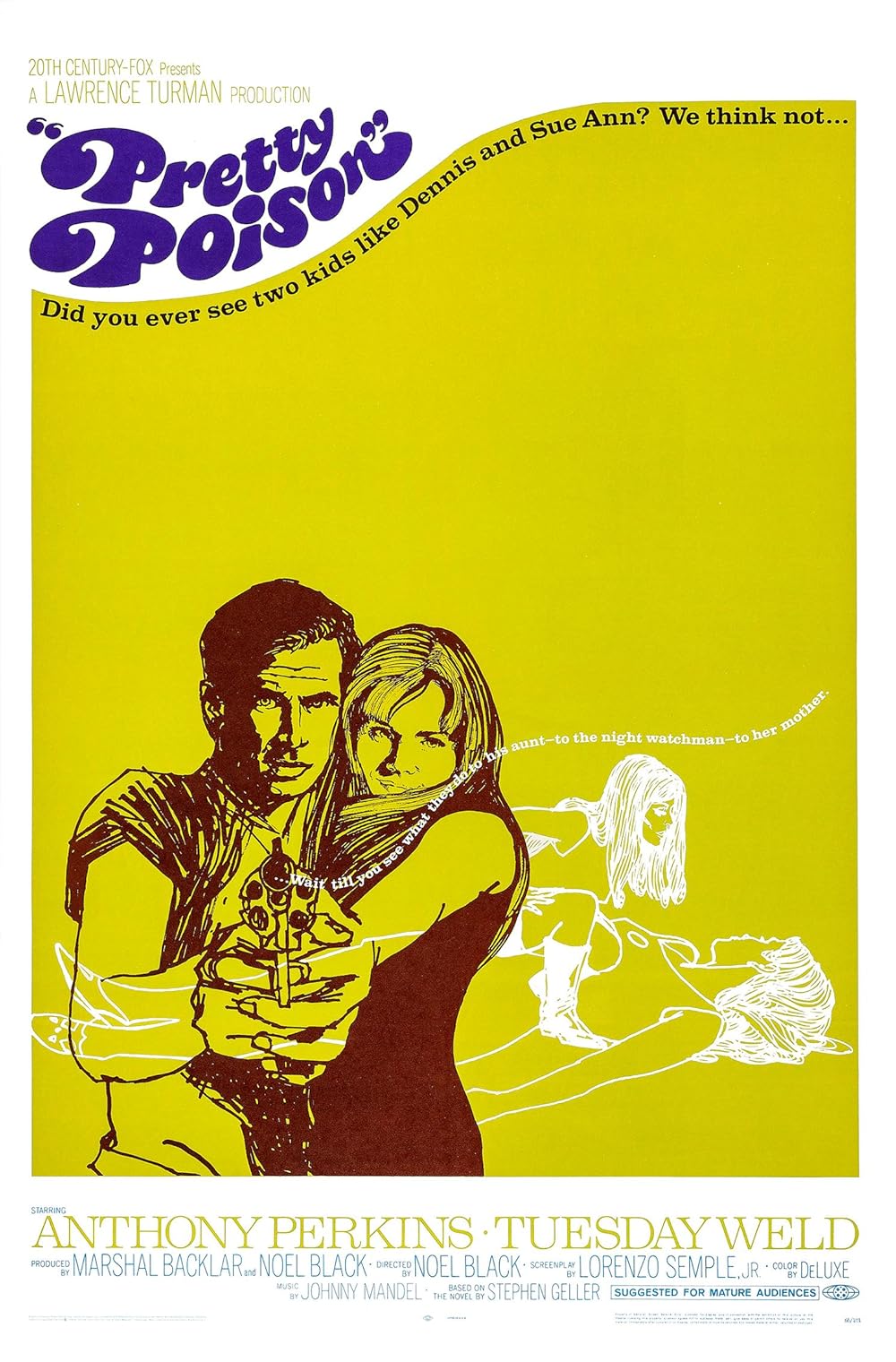
Pretty Poison (1968)

By Richard Winters

My Rating: 7 out of 10

4-Word Review: Manipulated by attractive teen.

Dennis (Anthony Perkins) has been released from the mental institution after serving several years there for setting a home on fire. He gets a job at the local factory but finds it boring and begins to escape into fantasies. He spots pretty 17-yeard-old Sue Ann (Tuesday Weld) while she rehearses with her high school marching band and immediately becomes smitten. He’s never had experience dating anyone, so he decides he’ll pretend to be a CIA agent on a secret mission as a way to impress her and get her attention. He’s disgusted at the way the factory where he works at dumps pollution into the river and thus comes up with a scheme to destroy it using her help, but when a security guard spots them, Sue Ann kills him. Dennis is shocked with Sue Ann’s brazenness and realizes she’s not as innocent as she appears. He tries to cover-up the killing but finds that Sue Ann’s only getting started as her next target is her mother (Beverly Garland). Will Dennis try and stop it, or figure that appeasing her murderous desires may be the only way to keep her from going after him?

The film is based on the 1966 debut novel ‘She Let Him Continue’ by Stephen Geller and directed by Noel Black, who was just coming off the success of his award winning short Skaterdater and this was considered perfect material for his feature film debut. He described the story as “a Walter Mitty type who comes up against a teenybopper Lady MacBeth”. It was shot on-location in Great Barrington, Massachusetts, which gives it a quant small town atmosphere where supposedly ‘nothing ever happens’ and Beverly Garland gives a terrific supporting performance as the caustic mother.

However, Black had no background in working with actors leading to many confrontations behind-the-scenes between he and Weld and keeping the shooting production on schedule proved equally challenging, which got the studio to believe they’d hired a director who was in over-his-head and helped bring in added pressures. When the movie finally did get released, it fared poorly at the box office. Black felt this was because of the recent assassinations of Martin Luther King and Robert Kennedy, which made the studio timid to distribute it and thus few people saw it though in recent years its acquired a small cult following. 

One of the elements that really makes it work is Perkins who gives a splendid performance. Initially I thought it was a mistake to cast him as he would seem too much like his earlier, more famous character of Norman Bates, but he plays this part much differently. Here he comes off as smarter and less crazy. He does dabble in make believe at times but only does it to mask his insecurities and lack of life experience. Watching his emotional arc where he goes from feeling confident, thinking he’s in control with this supposedly naive young teen, only to ultimately have to grapple with his slow realization that it’s really she who’s pulling-the-strings is the most captivating thing in the movie. 

Weld seemed initially to be perfectly cast as she had already shown a propensity at playing characters quite similar to this one in classic episodes of ‘Route 66’ TV-show and ‘The Fugitive’. However, her age clearly belies her as she was 24 at the time it was filmed and looking nowhere near 17. Having a true teen playing the role may have made what she does even more shocking. She later said in interviews that she hated working on this project mainly because Black wouldn’t let her improvise her lines and you could see she just wasn’t fully into it, and it diminishes somewhat the full effect.  

Spoiler Alert!

While it’s intriguing the whole way the ending, which has Dennis calling the police and allowing himself to be put into jail, didn’t have quite the bang I was hoping for. Dennis had fallen hard for Sue Ann to the extent he felt she had ‘changed his life’ and gave meaning to his otherwise lonely existence. When people are in love with someone, they tend not to see the same red flags that others do, so even though she does some evil things I was expecting him to make excuses for it. Like she killed the nightwatchman not so much because she was a sociopath, but more because of her ‘love’ for him and knowing it would help him in his ‘secret mission’. The murder of the mother could’ve been approached the same way in his mind. She killed her only so they could be together, and he would view it as an ‘unselfish’ act versus a selfish one.

Seeing someone who starts out a bit cocky thinking he can ‘trap’ others with his fantasies only to learn that his own fantasy had trapped him would’ve been quite ironic. He could still be convinced of her love even as he’s arrested and thus his final meeting with her, in which he realizes that she’s betrayed him by going to the police, would’ve had more of an impact.

I didn’t feel that Dennis should’ve had to spoon-feed to his psychiatrist, played by John Randolph, that Sue Ann was really the killer, as the doctor should’ve been smart enough to figure this out for himself. Watching the psychiatrist then follow Sue Ann around in his car as she finds another man (Ken Kercheval) that she intends to manipulate leaves things too wide open. What exactly will this lead to? Will the doctor stop her from killing again before it’s too late, or will Sue Ann realize she’s being followed and have the doctor killed? This is something I feel the film should’ve answered. 

My Rating: 7 out of 10

Released: September 18, 1968

Runtime: 1 Hour 29 Minutes

Rated R

Director: Noel Black

Studio: 20th Century Fox

Available: DVD, Blu-ray, Amazon Video, YouTube
Psycho (1960)

psycho

By Richard Winters

My Rating: 9 out of 10

4-Word Review: Don’t take a shower.

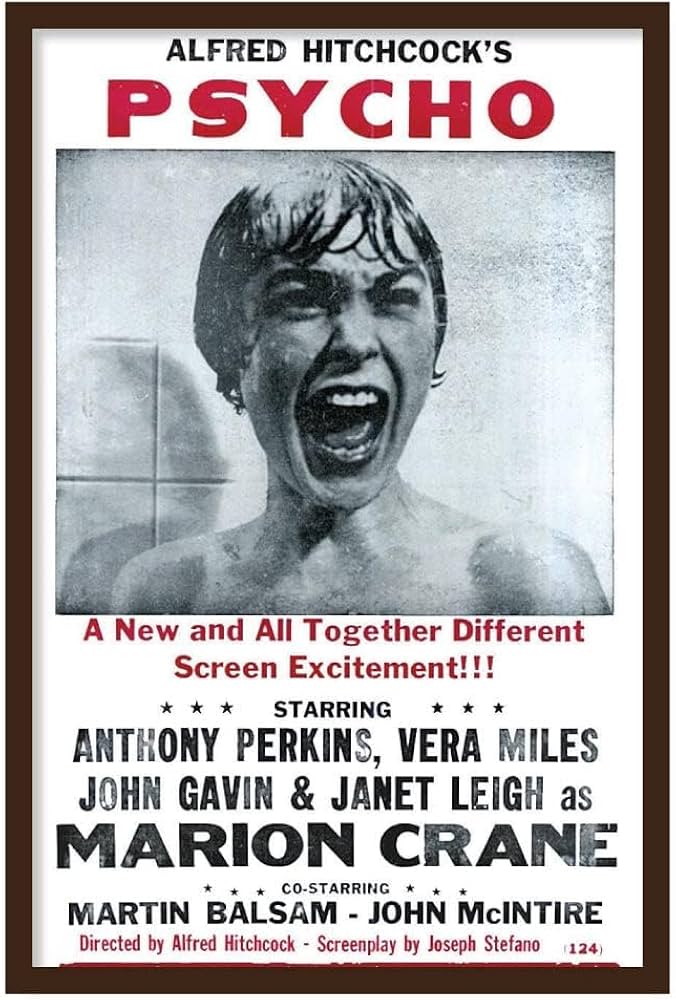
Marion Crane (Janet Leigh), who works as a secretary at a real estate firm, steals $40,000 in cash from her boss (Vaughn Taylor), who trusted her to take the money to the bank, in order to help her boyfriend Sam (John Gavin) pay off his debts. As she’s traveling to where he lives she encounters a rainstorm causing her to take the nearest exit. There she drives into the lot of a isolated lodge called Bates Motel, run by a young man named Norman (Anthony Perkins) who’s still living with his mother in an old rundown house that sits ominously on a hill behind the hotel rooms.  Norman becomes immediately smitten to the woman, who signs the hotel ledger under an assumed name, and invites her to have dinner with him in the hotel office. Marion, who sees him as a awkward, but otherwise harmless guy who’s still dominated by his mother, agrees. After they eat she departs back to her room and takes a shower when what appears to be his mother, who considers all women to be ‘whores’, stabs and kills her. Norman then cleans-up the evidence by submerging the dead body and her car in a nearby swamp. Soon a private detective named Arbogast (Martin Balsam) begins investigating the case and what he finds out leads Marion’s boyfriend Sam and her sister Lila (Vera Miles) to the property where they’ll unravel a shocking secret.

The film, which at the time was considered ‘too tawdry and salacious’ to be made into a movie and thus the studio refused to give director Alfred Hitchcock the required funding and forcing him to use his own funds and crew to produce it, was based on the novel of the same name by Robert Bloch. Bloch began writing it in 1957 when coincidentally in the neighboring town not more than 35 miles from his came to the light the criminal activities of Ed Gein who killed two people while also digging up dead bodies and then skinning them in an effort to create a ‘woman suit’ he could wear so he’d ‘become his dead mother’ who had dominated him for the majority of his life. Rumors were that Gein’s crimes had inspired the book, but Bloch insisted that he had almost finished with the manuscript before he became aware of the real-life case and then became shocked with how closely it resided with his story.

While the film follows the book pretty closely there are a few differences. In the book the Marion character dies from decapitation while in the movie it’s from stab wounds. The Norman character is described as an overweight man in his 40’s while in the movie he’s thin and in his 20’s, which I felt was an improvement as it made more sense why Marion would feel less guarded around him and put herself in a more vulnerable position than she might otherwise as she still viewed him as a ‘wet-behind-the-ears’ kid. It also helps explain why Norman blunders his interview with the detective and virtually incriminates himself because he was too sheltered and not worldly-wise enough to handle pressure situations.

The film is full of a lot of firsts. It was the first to show a toilet or use the word transvestite, but what I really liked though is that it takes a different spin on the character of the victim. Typically, even today, victims are portrayed as being virginal and angelic beings particularly women, but here it works against that. Right away with the opening scene in the hotel room we see she’s definitely no virgin and what’s more she’s having sex outside of wedlock in an era where ‘good girls saved themselves for marriage’. Having her then be susceptible to corruption by stealing from her employer, or not feel frightened initially by Norman and even superior to him further works against the grain of the ‘sweet, fragile damsel in distress’ cliche and makes her seem more human since she’s not perfect and vulnerable to the same vices as everyone else, which in-turn gives the more an added darker dimension.

The film’s hallmark though is its memorable camera work from a close-up of the victim’s unblinking eye, still not sure how Leigh could’ve kept her eyes open for as long as she does, to the interesting way the house gets captured from the ground looking upward on a hill towards the sky with the creepy night clouds floating behind it.  My favorite one though is the tracking shot showing Norman walking into his mother’s room and then having the camera stop right at the top of the door frame and then spin around towards the hallway as he then leaves the room and carries his mother down the stairs. The only shot that I didn’t care for is when the Martin Balsam character gets stabbed at the top of the stairs, but instead of immediately falling over backwards and then rolling down the stairs, which is what would happen 99% of the time, he instead somehow ‘glides’ down an entire flight of stairs backwards while remaining upright and only finally falling to the floor once he hits the bottom, which goes against the basic laws of physics and to me looks fake and goofy, but other than that it’s a classic and still holds-up amongst the best horror movies made.

My Rating: 9 out of 10

Released: June 16, 1960

Runtime: 1 Hour 49 Minutes

Director: Alfred Hitchcock

Studio: Paramount

Available: DVD, Blu-ray, Amazon Video, YouTube
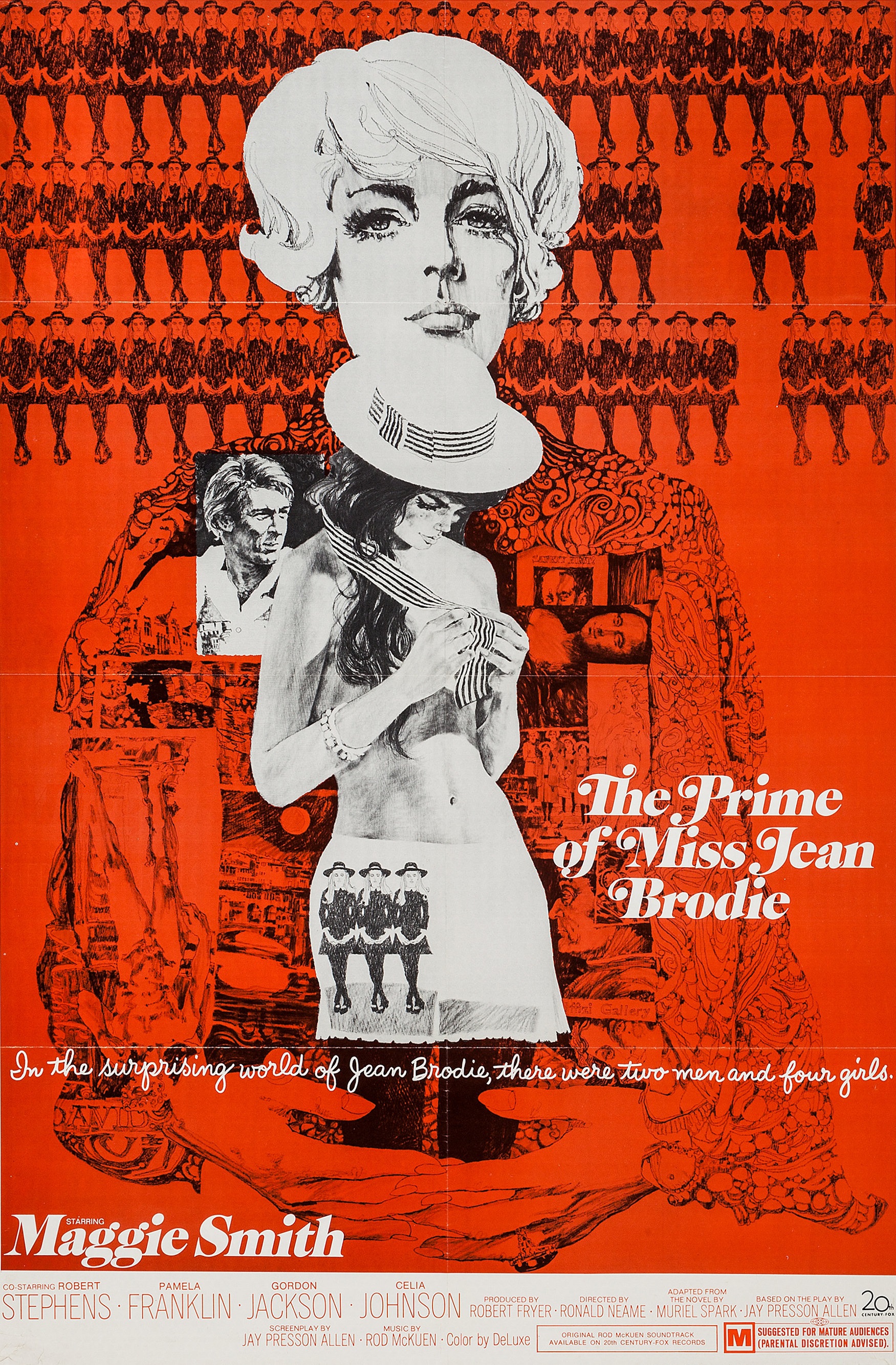
The Prime of Miss Jean Brodie (1969)

prime1

By Richard Winters

My Rating: 8 out of 10

4-Word Review: Teacher influences her students.

Jean Brodie (Maggie Smith) is a teacher at an all-girls school in Edinburgh, Scotland in 1932.  She routinely strays from the core curriculum and instead instills her own quirky value system, like her admiration for fascist dictators, onto her students. She views them as empty vessels there to be programmed to her liking as she routinely will say: “give me a girl at an impressionable age and she’s mine for life”. The school’s Headmistress, Miss Mackay (Celia Johnson) is aware of Brodie’s unorthodox teaching methods, but unable to do much about it, despite the repeated warnings that she gives to her, due to the fact that Brodie has tenure and been at the school longer than she. Sandy (Pamela Franklin) is one of Brodie’s students, who used to admire her teacher, but now has turned on her and comes up with a way to have her fired, which leads to a dramatic confrontation between the two.

One of the first things that struck me about the story, which is based on the play of the same name by Jay Presson Allen that was based on the novel by Muriel Spark that some feel was inspired by a teacher named Christina Kay who taught at James Gillispies School that Muriel went to as a child, is that it works against the grain of most films. In our individualistic culture the modern day movie centers around the rebel, or those that choose to work outside the system of an autocratic institution and the people that uphold those rules and enforce them are usually the villains. Here though it’s the stuffy authoritarians that ultimately become the makeshift heroes while the non-conformist gets exposed as a ‘loon’ that got too far off-base and needed a serious reeling-in.

It’s also the perfect study of someone who seeks control over others and cannot function in relationships were both sides are on equal footing. We see this not only with the way Jean openly humiliates her students by ridiculing them for even minor infractions like having their shirt sleeves rolled-up, but also in her maladjusted love life. Since she cannot have a healthy relationship with them as that would require selfless behavior from her, which she can’t give, so instead she emotionally manipulates two men (Robert Stephens, Gordon Jackson). She enjoys the attention they give her and gives them just enough incentive to keep on doing it, but never more than that. When the Jacskon character finally does get married to someone else, her sad expression isn’t about losing a person she loved, but more upset that she could no longer have this simp at her convenient disposal.

The recreation of the 1930’s girl school atmosphere was impeccable. Too many times I feel movies dealing with a bygone era don’t recreate it in an accurate way, or it gets viewed through a warped modern lens, but here I came away convinced it was accurate and this in large part could be credited to director Ronald Neame, who was alive when the story took place and therefore better able to feed-off his memory and experience. The scene where the girls all get up out of their seats and stand at attention the second the headmistress walks into the room is one of my favorite moments. To some degree it would be nice if kids today could show that kind of respect to an adult figure, but on the other hand it also reveals the dark side to extreme obedience to authority, which creates an atmosphere that allows someone like Jean to incorporate her will and beliefs onto the students without them ever questioning it.

In the end this is a terrific portrait of how teacher’s where viewed back in the day and the tremendous amount of influence they could hold over their pupils. There were no teen idols, singers, celebrities, or social media influencers back then, so the teacher was the center of most children’s lives sometimes even more so than their parents. While some things have changed the debate about what a teacher chooses to convey in the classroom and how far they should be allowed to stray from the core curriculum rages on today. No matter what side of that issue you may stand it just proves that this story is even more relevant now as it was back then.

My Rating: 8 out of 10

Released: February 24, 1969

Runtime: 1 Hour 56 Minutes

Rated M

Director: Ronald Neame

Studio: 20th Century Fox

Available: DVD/Blu-ray

The Magic Christian (1969)

magic2

By Richard Winters

My Rating: 8 out of 10

4-Word Review: Everybody has a price.

Sir Guy Grand (Peter Sellers) is a billionaire with an eccentric side, who wants to prove the powerful influence money has over other people. He meets Youngman (Ringo Starr),a homeless man in a park, and decides to adopt him as his son. Together they proceed to play elaborate pranks on the public by watching how far they can push their theory and what humiliating lengths people will go to get their hands on some money.

The film is based on the 1959 novel of the same name written by Terry Southern, who also wrote the screenplay, and while the novel was considered a success the movie, at least when it was first released, wasn’t. My critics complained of the film’s heavy-handed satirical nature and unrelenting jabs at capitalism even though all the same pranks done in the movie were also in the book. The film also has the exact same satirical theme as O Lucky Man, which starred Malcom McDowell and came out just a few years later that also took numerous potshots at capitalism and yet many of the same critics adored that one, but came down hard on this one.

Fortunately through the years the film has managed to find a cult following. I supposed if one has more of a socialist bent they may enjoy it more, but it has such a surreal, creative vibe to it that it’s fun to watch no matter if you agree with it’s message, which is kind of muddled anyways, or not. Some of my favorite bits included snotty, rich aristocrats boarding a ship cruise that puts them in increasingly more humorously challenging and bizarre situations. The final segment, which has the classic song ‘Something in the Air’ by Thunderclap Newman playing during it, features a giant outdoor vat filled with urine, blood, and animal feces and then having Grand throw money into it and challenging onlookers to jump into the mess in order to get at the money, which despite the awful stench they readily do.

There’s many cameo appearances by famous stars who agreed to take small roles as a favor to Sellers who at the time was a top star and friends with many of the big headliners of the day. Some of the best bits here include Laurence Harvey who does a striptease while onstage and in front of a packed house of onlookers while reciting ‘Hamlet’. Yul Bryner, looking almost unrecognizable in a female wig, is great as a transvestite who comes-onto a shy Roman Polanski while at a bar. Spike Milligan is hilarious as a traffic cop who agrees to eat his own traffic ticket for the right price as well as Raquel Welch as a slave commander with a whip, Wilfred Hyde-White as a drunken ship captain, and John Cleese as a perplexed auctioneer.

The problems that I had with the film dealt mainly with the relationship between Sellers and Starr. Sellers meets Starr one day in a park by chance and then begins to have a conversation with him, but there’s music playing over this, so we never hear what they’re saying, which is frustrating as the having a rich man suddenly offer a poor man the chance to be his adopted son seemed like dialogue that should be heard. Starr is also not given much to do and it seemed almost pointless for having even in the movie. In the novel there was only the Grand character creating the pranks, but it was decided for the movie to make it a two man show, but Ringo has so little to do that it didn’t seem worth it and this reportedly was due to Sellers’ insecurity of being upstaged and thus insisting that all the best lines had to go to him.

It’s also never clear why the Sellers’ character does what he does. What’s the motivation for why this rich man feels the need to expose other people’s foibles and vanities? Does he feel guilty about being so rich and therefore has decided to ‘take-it-to’ the others in his own social circle? None of this gets explained or analyzed at all, which on the character end makes the film quite superficial and confusing.

My Rating: 8 out of 10

Released: December 12, 1969

Runtime: 1 Hour 32 Minutes

Rated M

Director: Joseph McGrath

Studio: Commonwealth United Entertainment

Available: DVD, Blu-ray, Amazon Video

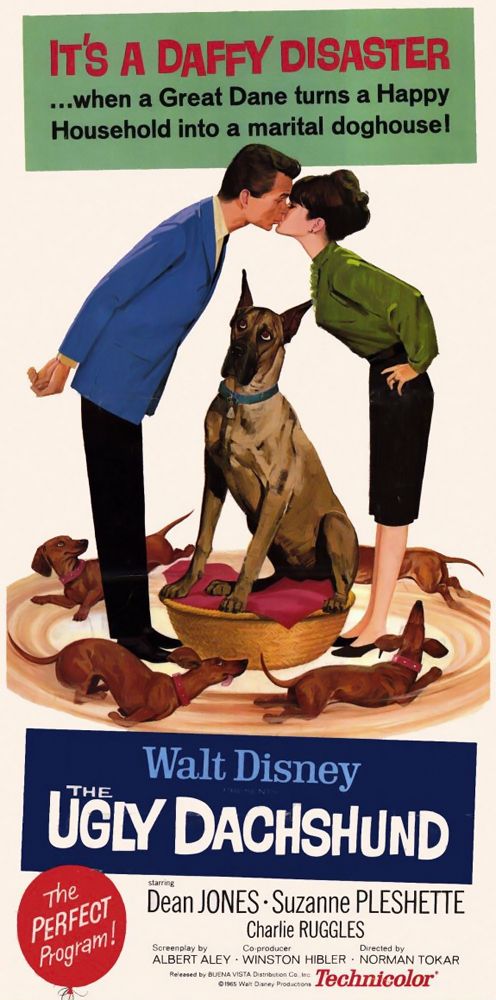
The Ugly Dachshund (1966)

By Richard Winters

My Rating: 7 out of 10

4-Word Review: Dog has identity crisis.

Fran (Suzanne Pleshette) and Mark (Dean Jones) are a married couple who are proud owners of a dachshund named Danke. When they take her to the pet hospital to give birth to her liter the veterinarian (Charlie Ruggles) mentions to Mark that he has a Great Dane on hand that has also given birth, but pushed away one of  her puppies due to having a lack of milk for him. Mark decides to take the pup home and pretend that he’s one of the liter, but it soon becomes apparent to Fran that he isn’t. The dog, who Mark names Brutus, starts to think that he’s a dachshund like the others and even tries to walk like them, but his large size causes many problems for the homeowners as he inadvertently destroys much of the home, which is usually at the instigation of the other dogs who never get blamed. Fran pressures Mark to get rid of the dog, but he continually refuses, which eventually puts a strain on their marriage.

For a Disney movie this one, which is based on the 1938 novel of the same name by Gladys Bronwyn Brown, isn’t too bad and has much better character development than many of the others that the studio produced. The distinction between their personalities is clear as is the dynamics of the marriage where each learns, like in any real union, to begrudgingly give-and-take in order to make the other partner happy. The film though comes off as quite dated in the fact that they sleep in separate beds, I guess seeing them in the same bed would’ve been considered by some in that era as ‘racy’, but what’s the use of getting married if you still end up having to sleep alone?

The comedy starts out a bit slow and young children may get bored with it at the beginning, but it does redeem itself once the dogs proceed to destroy everything in sight. It’s refreshing change to see animals causing the chaos instead of goofy people like in the other Disney flicks and they’re a lot funnier at it too, but the adult side of me had to cringe a bit knowing all the money it was costing the homeowners seeing their place and everything in it turned to shreds. It also hurts the humor that Brutus is always constantly getting blamed for the mess when it’s really the bratty dachshund’s that cause it, but are never adequately punished. Certain modern viewers may also be uncomfortable with the Japanese themed party that the couple hold at their home, which also gets destroyed by the dogs, as it features a lot of cultural appropriation, which in this era has become a big no-no.

The three acts serve as three distinctly different stories. The first one deals with the couple feuding over the dog, the second one has a cat burglar on the prowl, and the third centers on Mark training Brutus for a dog show. While the cat burglar thread does feature a funny scene where Brutus forces a policeman, played by Kelly Thordsen, up a tree and traps him there the entire night, we never get to see the actual burglar. The story would’ve been stronger had the dog caught the real bad guy instead of just scaring an innocent man due to mistaken identity. The third story is weak too as Brutus had very little training before he enters the contest, which seemed rushed and unrealistic.

The only real complaint that I had with the movie, which I overall found to be kind of cute,  was that the two main characters should’ve been children instead of adults. This is a kids movie and kids relate better to protagonists who are their same age. Having a sister into her dachshunds and a brother in love with a Great Dane would’ve entered in some interesting variables though Jones and Pleshette play their parts well and they reteamed 10 years later as another married couple in the The Shaggy D.A. 

My Rating: 7 out of 10

Released: February 4, 1966

Runtime: 1 Hour 33 Minutes

Not Rated

Director: Norman Tokar

Studio: Buena Vista

Available: DVD, Amazon Video, YouTube

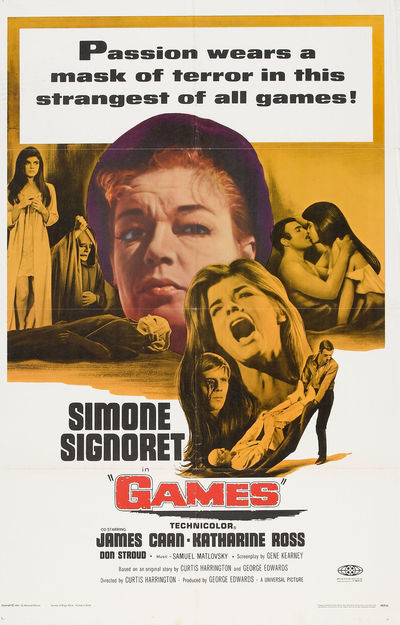
Games (1967)

By Richard Winters

My Rating: 5 out of 10

4-Word Review: Playing tricks on others.

Paul (James Caan) and his wife Jennifer (Katharine Ross) are an affluent upper East Side couple who are into illusion/magic trick shows and entertain their friends at posh parties that they hold inside their spacious townhome. One day Lisa (Simone Signoret) arrives at their door selling cosmetics only to fall ill when she gets inside the home. A doctor (Ian Wolfe) comes over and finds her condition to be only temporary and says she’ll recover in a day if given plenty of rest, so they decide to let her stay the night, which then becomes an extended visit as Lisa and Jennifer begin to bond. The two then start playing tricks on Paul by pretending that Jennifer is having an affair with their delivery boy named Norman (Don Stroud). Eventually Paul realizes he’s been duped, but wants to get revenge by pretending to catch Norman coming onto Jennifer the next day. This time Paul accidently shoots and kills him forcing the couple to get rid of the body without Lisa becoming aware, which they’re able to do, until Jennifer begins seeing what she believes to be Norman’s ghostly presence.

The film has potential, but consistently misses-the-mark and ultimately becomes a misfire. The games the two play are amusing, but nothing special though it’s enough to hold interest particularly at the beginning during the party scenes with all of their pretentious friends. The townhouse the two live in is ritzy and I enjoyed the design, but if you’re going to have a story take place in Manhattan then you better film it there and not on a sound stage in Los Angeles as the ambience of the neighborhood is missing and having almost all of the action take place in one setting eventually becomes claustrophobic.

The real problem though is with the characters. Signoret is fantastic and her presence helps immensely, but the way she enters into the story is ridiculous. What kind of couple would let a strange woman stay overnight in their home? If she’s sick then let her spend it at a hospital. Turning her one night visit into an extended stay is equally farfetched and where exactly did she find this wardrobe to wear when she initially just came over to peddle perfumes?

Ross’s character is a big mess too and it’s no wonder that she has referred to this film as being ‘terrible’ and it’s not her fault either. She’s quite beautiful as always and if you need an actress to give off the perfect scared expression she’s tops, but I didn’t understand why her character allowed herself to be so taken in. This was a couple used to playing tricks not only on their friends, but on each other, so why didn’t she have a more jaded reaction and presume that her husband really didn’t kill Norman and it was all some elaborate game?

Spoiler Alert!

The twist ending is a complete letdown as it hinges on Paul meeting Lisa a year earlier by chance and then springing this idea on her of scaring Jennifer to death to the point that she inadvertently kills someone, so that he can get at her fortune and split it with Lisa, but how would he know that he could trust Lisa to keep this secret and not go to the authorities, or tell Jennifer? It might’ve worked better had the third person been a lifelong friend/family member to Paul, and not just someone he met at random, and therefore not likely to betray him.

A double-ending would’ve been more satisfying as Lisa poisons Paul and walks away with the money, but Paul should’ve been cunning enough to try and poison Lisa first, or through mutual mistrust they poison each other and no one gets the money. An even better idea would’ve had Jennifer only pretending to fall victim to the ruse, so when Lisa walks outside with the suitcase full of money, after having killed Paul, Jennifer and the police squad could’ve been there waiting for her.

My Rating: 5 out of 10

Released: September 17, 1967

Runtime: 1 Hour 40 Minutes

Not Rated

Director: Curtis Harrington

Studio: Universal

Available: DVD-R (Universal Vault Series), Blu-ray

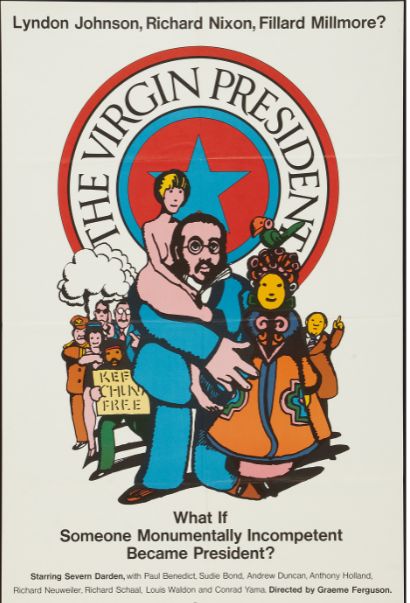
The Virgin President (1968)

By Richard Winters

My Rating: 4 out of 10

4-Word Review: The President is incompetent.

The current President (Severn Darden) has become too elderly and can no longer handle the job, but because term limits have been vanquished he keeps getting elected anyways. His staff decide he needs to go and the only way to do it is to have him killed, but make it look like an accident, so they set-it-up to where he gets bitten by a poisonous parrot. Once he is gone his young son, Fillard Millmore (also played by Darden) takes over. Fillard has lived a very sheltered life and is not privy to the corrupt ways of Washington and his advisors try to use this to their advantage. To help improve their international relations with China they have him get married to a Chinese bride (L’nelle Hamanaka), but because he’s inexperienced with sex he is unable to please her on their wedding night, which angers the Chinese officials who threaten nuclear retaliation, but the President’s advisors plan on striking China first.

The film is a low budget effort cast with members from Chicago’s Second City Improv group that has its moments, but doesn’t completely come together. One of the main issues is that it was directed by Graeme Ferguson, who specialized in doing documentaries and the opening sequence, which shows the behind-the-scenes footage of the actors getting ready for a scene underneath the credits is quite awkward. It made me feel like I was watching somebody’s home movie and not a feature film and does not in anyway help grab the viewer. It was also filmed in black-and-white and by the late 60’s almost all movies were done in color and this one should’ve been too because it just accentuates it’s amateurish quality otherwise.

Once the film gets going with the plot it does have some inspired moments. Darden is quite funny as the old man especially his death scene. I got a kick out of the little electronic box hidden inside a cabinet at the White House that would allow any American President to dial-up any country he wanted to bomb and pick the number of casualties, including a switch for ‘bonus kills’. Darden’s attempts to ‘make friends’ with the protestors outside the White House who are against his policies is amusing too.

They are unfortunately some bits that don’t work including Paul Benedict’s character who gets sexually aroused watching flowers pollinate. The pacing is off too with some scenes going on longer than they should and too much emphasis on the actors improvising their lines with dialogue that at times veers off from the main story.

The thing though that got me most annoyed, as a person who likes to be very fact oriented, was the scene where the President and his advisors are discussing which American city to nuke, which they hope to make it look like China did it and then give them the excuse to nuke China in return. Darden says they should bomb some ‘insignificant city’ like Fargo, South Dakota, but anyone familiar with geography would know that Fargo is in North Dakota and not South Dakota. What I found even more irritating is that another character instead of correcting the President on his mistake just reiterates the same thing making me believe that the entire cast and crew didn’t know what state Fargo was really in, which I found to be rather pathetic.

While this is clearly not a perfect movie and does have its share of drawbacks I still found it a fun watch simply as a relic of its era. It’s surprising in many ways how little has changed in Washington. The politicians back-in-the-day still had American imperialism on their minds and everything revolved around how to ‘brainwash the masses’ so they could remain in power, which unfortunately isn’t any different from how it is now.

My Rating: 4 out of 10

Released: November 18, 1968

Runtime: 1 Hour 11 Minutes

Not Rated

Director: Graeme Ferguson

Studio: CMB Films

Available: None at this time.

The Rain People (1969)

By Richard Winters

My Rating: 8 out of 10

4-Word Review: Needing to find herself.

Natalie (Shirley Knight) wakes up one day and decides to simply get in her car and drive off with no particular destination in mind. She has just found out that she is pregnant and not sure if she can or wants to handle the responsibilities that come with it. She leaves a note to her husband (Robert Modica) telling him she needs time away from him to think things through. During her travels she meets Jimmy (James Caan), otherwise known as ‘Killer’, he was a former football player straddled with a brain injury that has now left him mentally handicapped. She also meets Gordon (Robert Duvall) a traffic cop who pulls her over for a speeding ticket. The two eventually start to date, but the more Natalie tries to find herself the more lost she becomes.

The film was for the most part considered an ‘experimental’ one as the subject matter was years ahead of its time. While many road pictures of the day like Easy Rider took the male perspective this one dared to tap into the feminist viewpoint, which up to that point hadn’t been explored as much if at all. I enjoyed how the film questions the whole wife/mother idea, once considered ‘the ultimate destination’ for any woman, but here brings out the complex issues that come with it and how not every woman may want to be trapped by it, or even find contentment in that situation.

What’s even more interesting is that Natalie never really seems to go anywhere. Yes, she does get in a car and starts driving and passes by many picturesque places of rural America along the way, but trying to escape the clutches that she feels holds her back never goes away. Everyone she meets, including Gordon who’s stuck raising a young daughter (Marya Zimmet) that he wasn’t totally prepared for, seem to be in the same predicament as her making it feel like the further she drives away the closer she gets to where she started.

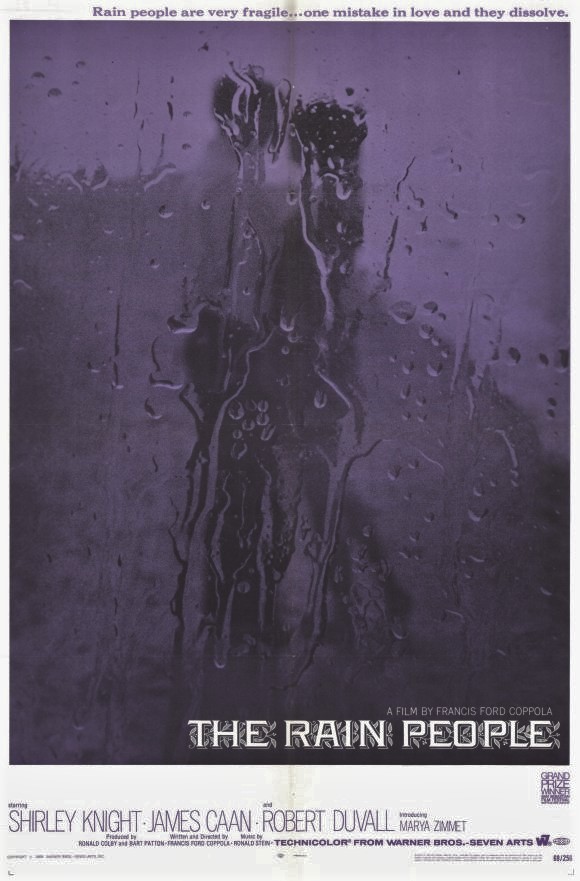
Francis Ford Coppola makes wonderful use of the rain and there are many shots of it particularly in the first half as we see it creating puddles on the road and even streaming down the car windows in close-up. The cloudy, murky weather acted as a nice motif to Natalie’s inner emotional state and the confusion that she was going through. The film’s promotional poster seen above is excellent too and brings out the moodiness of the movie with one perfect shot although seeing the couple kissing in the backdrop is a bit misleading as that’s one thing you definitely don’t see here despite Natalie’s efforts to try and find it. The two people should’ve, in order to be consistent with the theme of the film it was promoting, been seen standing side-by-side instead of hugging.

I also really loved Coppola’s use of flashbacks here, which gets sprinkled in throughout. I liked the scenes showing the couple in happier times during their wedding as it illustrates how relationships that go bad or don’t work out still had their good moments even if they were brief. The flashbacks dealing with Duvall trying to save his family from a burning house are quite revealing too as what he describes verbally through voice-over is quite different from what we see.

Leonard Maltin, in his review of the film, called the script ‘weak’, which I completely disagree with. Yes, not a lot happens, the random situations that Natalie goes through perfectly reflect what could happen to anyone on a trip, which I liked because the plausibility here is never compromised. She ends her journey feeling as lost as she did when she started, but I felt that was the whole point, so in my opinion the script is strong.

George Lucas, who worked as an aide on this production, filmed a 32-minute documentary of this movie as it was being made called Filmmaker, which is accessible on YouTube although the sound quality is poor. This film has several revealing moments including conflicts that director Coppola had with Knight, but what I found most interesting is that when the crew traveled down to Chattanooga they all cut their hair and shaved their beards,which included Coppola himself, as they felt the locales wouldn’t work with them unless they appeared clean-cut. Seeing Coppola with a rare non-beard look alone makes this short film vignette worth catching.

My Rating: 8 out of 10

Released: August 27, 1968

Runtime: 1 Hour 41 Minutes

Rated R

Director: Francis Ford Coppola

Studio: Warner Brothers

Available: DVD-R (Warner Archive), Amazon Video, YouTube

Some Kind of a Nut (1969)

By Richard Winters

My Rating: 1 out of 10

4-Word Review: Grow beard, lose job.

One day while out on a picnic in Central Park with his fiance Pamela (Rosemary Forsyth) Fred (Dick Van Dyke) gets stung on his chin by a bee. The sting takes too long to heal, so in order to avoid having to shave over it he grows a beard, which doesn’t go over well at his job. When his boss (Peter Turgeon) tells him to get rid of it and he refuses it leads to his firing, which mobilizes his co-workers to walk off of their jobs in protest.

Writer/director Garson Kanin has written many funny and award-winning screenplays with Adam’s Rib and Born Yesterday being two of his most famous ones, but this script seems like it was written by a completely different person altogether. The idea of Van Dyke bucking-the-system and discarding conventional mores has definite potential especially since it was filmed in the late 60’s when a lot of that was going on, but the movie goes nowhere with it. Instead of dealing with the ramifications of his rebellion the plot pivots to his ex-wife’s (Angie Dickinson) attempts at reconciliation, which is too contrived and has nothing to do with the main theme.

Van Dyke has one brief moment of non-conformity and then immediately snaps back into being his staid self without showing any real growth or change. Instead of him directly organizing the effort to have his co-workers walk off their jobs on his behalf it’s actually another associate (played by David Doyle) who inspires it while Van Dyke stands back in awe like a main character who has become a passive bystander in his own movie.

There was no need for three female love interests either. Forsyth was the youngest so in some ways it made more sense for her to connect to his rebellious side, but instead it’s Dickinson his ex-wife. However, it’s never made clear what lead to their divorce in the first place, so unless they tackle that direct issue then whatever reconciliation they have will only lead to another break-up down-the-road. Zohra Lampert, who plays this beatnik type lady that Van Dyke befriends and goes out drinking with, is far more lively here than the other two actresses and showed just enough bohemianism traits to fit with the film’s attempted non conformist theme.

There are some interesting camera shots like a close-up of the actual bee sting and a segment, which I thought was real cool when I was in the third grade and first saw this film, showing a map of the nation and then a red miniature car similar to the one Van Dyke and Forsythe are riding in driving around on it to  each city on their trip. However this amounts to just being a shallow way to cover-up how boring and empty the script really is, which meanders too much on scenes that don’t propel the story along. A good example of this is when Forsyth and her two brothers (Elliot Reid, Steve Roland) chase Van Dyke around his apartment complex in an attempt to shave off his beard, which seemed like a futile waste of energy because he could just regrow it in a matter of a few days, so why even bother?

Released: October 1, 1969

Runtime: 1 Hour 30 Minutes

Rated M

Director: Garson Kanin

Studio: United Artists

Available: Amazon Video

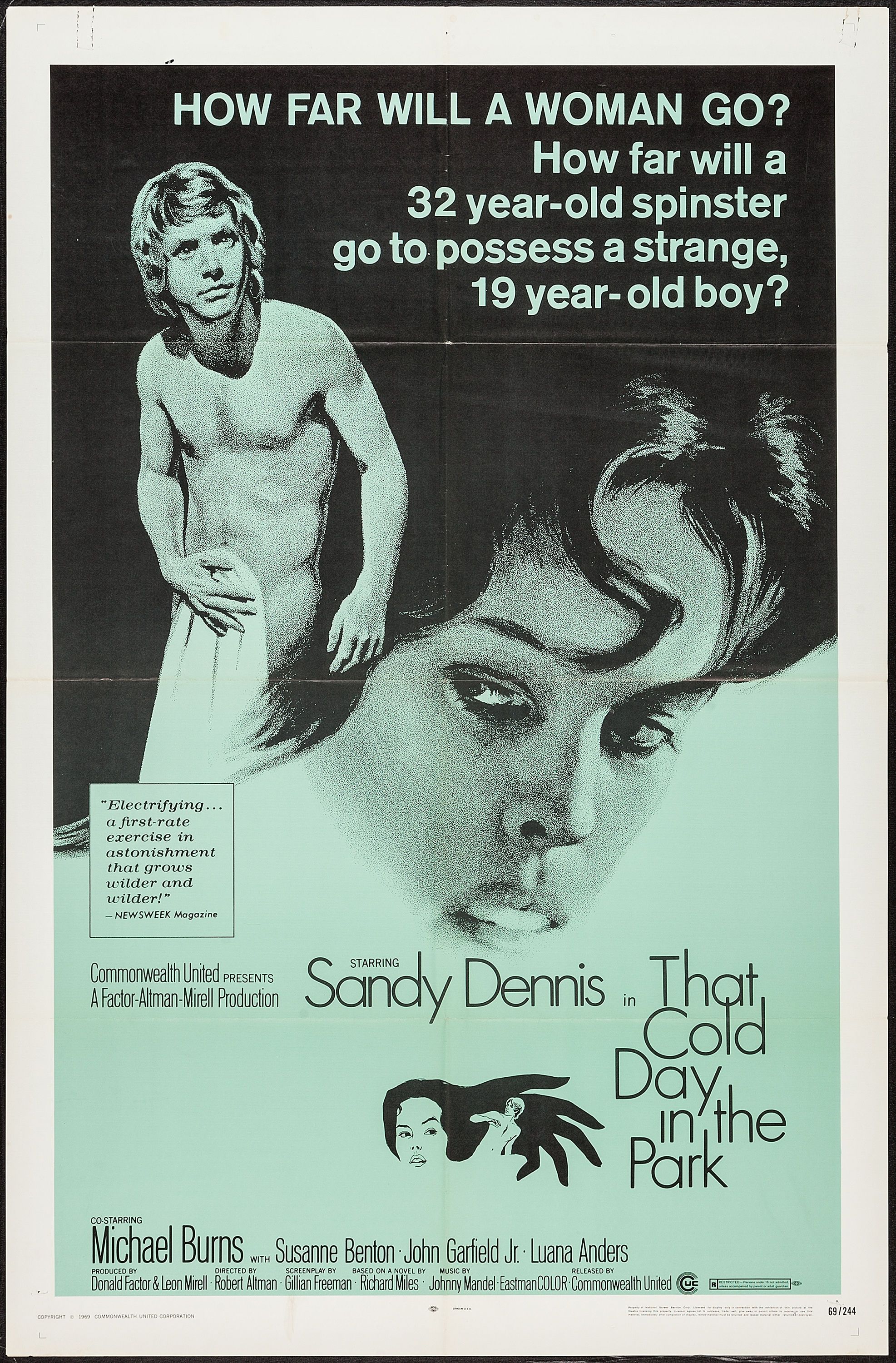
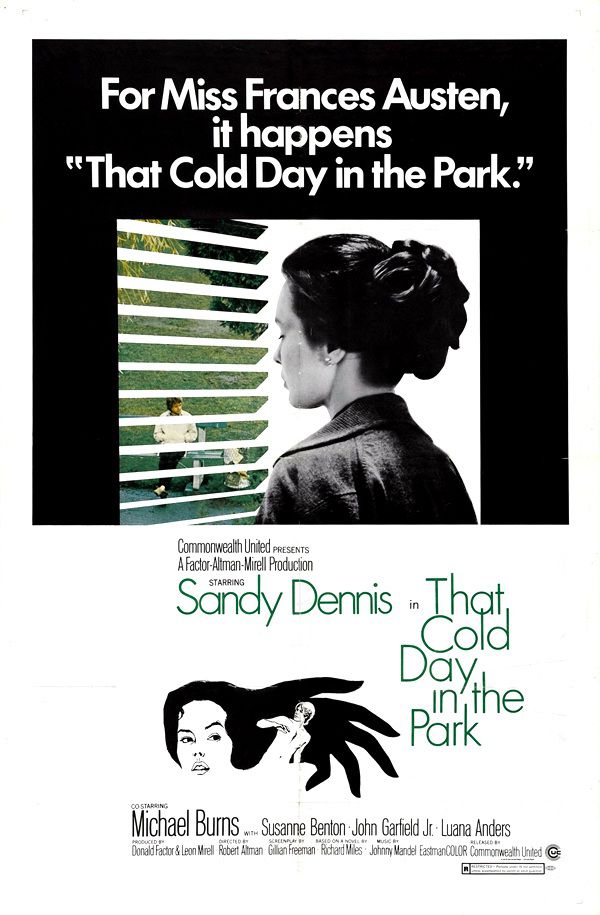
That Cold Day in the Park (1969)

By Richard Winters

My Rating: 4 out of 10

4-Word Review: Spinster takes in boy.

Frances (Sandy Dennis) is a rich, but lonely woman living a reclusive life inside her luxury Vancouver apartment with only her service staff to keep her company. One day she spots a teen boy (Michael Burns) sitting all alone on a park bench while it’s raining. She decides to invite him up to her apartment where she gives him food and a shower and becomes very attached to him despite the fact that he does not speak. Unbeknownst to her he has a whole other life with friends and family, but decides to exploit Frances’ generosity for his own gain only to learn that Frances has her own devious plans in mind.

The film’s only interesting aspect is Robert Altman’s direction, which is far different from the later movies that he did in the ’70’s, which emphasized conversations going on by secondary characters who weren’t always even in the scene, which here occurs only once when Frances goes to a doctor’s office, but is otherwise non-existent. Instead Altman successfully captures Frances’ isolated condition including the quiet apartment atmosphere where the viewer feels as trapped inside the four walls of the place as the character’s and the idea that there was an actual film crew on the set with the actors seems almost hard to believe. I also enjoyed the way the boy’s family life is shown by having the camera remaining outside and peering into the house’s windows to capture the action and dialogue going on inside.

The film fails though to be compelling as there is no reason given for why Frances feels so compelled to bring in this boy, or why this otherwise pretty, able-bodied woman should be so alone in the first place. One scene even has another middle-aged suitor propositioning her with a relationship, which she coldly refuses, but why? Is she more into teen boys and if so this needs to get explained and the reason given for it.

Dennis is an interesting actress, but isn’t up to playing characters with a sinister side and she’s a bit too young for the role. An older woman such as Ingrid Bergman would’ve been far better able to convey the age disparity between the two characters, but she unfortunately refused the part when offered. Burns is only adequate and the fact that he doesn’t initially speak makes the dynamics between the two interesting and the film should’ve delayed the fact that he could talk until the end, instead of revealing this in the middle part, which takes away any potential for mystery and intrigue.

Spoiler Alert!

The ending, which consists of Dennis trapping Burns inside her apartment makes no sense. The fact that she nails the windows shut is ridiculous as he would only need to pry the nails out of the wood, which he successfully does to a few of them anyways, in order to open the windows back up and get out. He is also physically stronger than her and the fact that she uses no weapon means he could overpower her if he wanted. Besides his family already knew where he was as his sister (Susanne Benton) came to visit him and would most likely come looking for him when he didn’t come home, so having it end by portraying him as a helpless hostage with no way of escaping is quite weak and unsatisfying.

My Rating: 4 out of 10

Released: June 8, 1969

Runtime: 1 Hour 46 Minutes

Rated R

Director: Robert Altman

Studio: Commonwealth United Entertainment

Available: DVD, Blu-ray (Region B/2), Amazon Video