Tag Archives: Sidney Lumet

Daniel (1983)

daniel

By Richard Winters

My Rating: 7 out of 10

4-Word Review: Researching his parent’s execution.

Based on the 1971 novel ‘The Book of Daniel’ by E.L. Doctorow, who also wrote the screenplay, which was inspired by the true story of Ethel and Joseph Rosenberg, who were convicted and executed in 1953 for being spies to the Soviet Union. The story here centers on Daniel (Timothy Hutton), the now grown son of Paul (Mandy Patinkin) and Rochelle (Lindsay Crouse), who many decades after his parent’s execution now decides to research their case to see if his parents really were spies, or not.

Despite being well produced the film failed at both the box office and with the critics, which is a shame as I felt director Sidney Lumet does some marvelous work here and creates a few powerful scenes. One is when the the FBI agents raid Daniel’s house, who is played at this stage by Ilan Mitchell-Smith, and the look of horror in his eyes as the home gets torn up from top to bottom and his father violently removed in handcuffs. Another great moment are the execution scenes filmed in the actual death chamber at the Sing Sing Prison. These moments are quite chilling as Lumet’s focuses in on the close-up shots of the two being strapped in and the leather flaps of their hoods pulled down over their frightened eyes and then seeing their bodies shake violently while a group of men sit quietly observing it is effectively disturbing and one of the more impactful execution segments put on film.

There are though some things that could’ve been done better. The jumping back and forth between time periods proves distracting and takes the viewer out of the story instead of wrapping them in. The book of which it’s based had a very fluid structure as well, but here the scenes involving Daniel and his sister as children prove far more impactful while segments involving Hutton all grown-up are weak by comparison. The film would’ve been more effective had it taken a linear structure.

Watching Hutton walk along the sidewalk while voice overs are heard from his sister, played by Amanda Plummer, chastising him for not caring more about what happened his parents, was unnecessary and heavy-handed as we had heard her saying all this earlier to him at the dinner table and could see by the shocked reaction on his face that it really got to him, so we didn’t need the same lines getting repeated again. The music particularly the singing, is way too intrusive and having almost no music and just relying on the action and visuals would’ve been far better.

I was also confused who Linda was, played by Tovah Feldshuh, whom Daniel comes upon at a dental office years later and acts like he knows her from childhood. I didn’t remember seeing a young Linda, though one is listed in the closing credits, and then it dawned on me that there was a quick moment when a snotty girl tells Daniel and his sister, when they’re kids, that they ‘smell’ while they’re riding in a car, but because this character does end up returning and playing a pivotal role to the plot I felt the confrontations between them as kids should’ve been more pronounced and extended instead of so fleeting that you completely forget about it.

Hutton, who turned down the starring role in Risky Business to be in this at the protest of his agent, gets wasted. He gives a strong performance, but is over shadowed by Ilan Mitchell-Smith. His character also had too wide of an arch as he seems to have a complete personality change after the argument with his sister even though I thought he should’ve been shown harboring the same feelings and questions about his parent’s death for a long time and decided to explore the case out of his own curiosity and anger. I also felt that both he and his sister should’ve done the investigation together instead of discarding her off to a mental institution and barely seen. I know the book had her going to a mental hospital as well, but we see them go through the trauma together as children and therefore it seemed only right that they should work as a team as adults to find the answers.

The film offers no conclusions. The parents are portrayed in a highly sympathetic way like they didn’t really do anything and it does play with the idea that there might’ve been another phantom couple ‘who were the real culprits’ though it doesn’t pinpoint to anyone specifically. I felt it would’ve been a stronger movie had it based itself on the real children of the Rosenbergs, Michael and Robert, and detailed things from their true-life experiences. Maybe they didn’t want the limelight, which is okay, but fictionalizing a real historical event with a lot of made-up people and situations doesn’t have the same profound effect.

My Rating: 7 out of 10

Released: August 26, 1983

Runtime: 2 Hours 10 Minutes

Rated R

Director: Sidney Lumet

Studio: Paramount

Available: DVD, Amazon Video, Paramount +

Equus (1977)

equus1

By Richard Winters

My Rating: 6 out of 10

4-Word Review: Teen blinds six horses.

Martin (Richard Burton) is a disillusioned, middle-aged psychiatrist who gets tasked with finding out why a 17-year-old boy named Alan (Peter Firth) blinded six horses one night in a stable with a sickle. At first Alan is uncooperative during their sessions and will not speak to him and instead sings out commercial jingles repeatedly, so Martin must go to Alan’s parents (Colin Blakely, Joan Plowright) in an effort to find some answers. It is here that he learns the mother is highly religious and taught her son that ‘God sees all’ particularly when it comes to sexual transgressions. Alan though has replaced God with his obsession with horses and idolizes them instead where he essentially makes them his ‘deity’. Martin now must try to break the boy away from this fanaticism in an effort to make him ‘normal’, but realizes when he does that the kid will cease to have passion and become like Martin himself who no longer has any emotions for anything including his own wife whom he no longer shares intimate relations.

Director Sidney Lumet has always had a penchant for turning plays into a movies and with some of them he’s had great success like with 12 Angry Men, but some of his other efforts did not fare as well. This project was met initially with a lot of apprehension, but overall Lumet’s directorial flair adds a lot and cinematically it works for the most part. The effort to get away from the staginess of the story by having several scenes done outdoors, like Martin having a discussion with his friend played by Eileen Atkins, about the case while raking leaves I felt really worked. Again, with cinema you have to have the characters doing something during the dialogue even if it’s some sort of chore as there’s nothing more stagnant than talking heads in a movie. The opening sequence done over the credits is well done too as it features Martin dealing with hostile patients hitting home the point of how burnt-out with his career he is without having it told to us and the white color schemes accentuates the tone one is most likely to see in hospitals.

The controversy came with the portrayal of the horses. In the play there were performed by muscular men inside a horse costume, but for the movie Lumet decided they needed to use real animals. This is okay until it comes to the scene where they get blinded. The play version only intimates the violent act, but with the movie you actually see the sickle go right into the horses’ eyes, which is so realistically done I don’t know how they did it without hurting the animal. This was way before computer effects, so just be warned if you’re an animal lover these scenes may be too graphic to bare and could easily take some viewers out of the story to the extent they may not be able to get back into and might just turn it off altogether.

The casting is a bit problematic. Both Burton and Firth played the roles in the stage version, but by this point Firth was no longer looking like a 17-year-old, he was in fact already 23. I admire his bravery to ride a horse in the nude in one of the movie’s more memorable moments, but he still resembles adult features physically taking away the innocence of the character and the shock of how someone so young, i.e. a teen. could commit such a vicious act. Burton too looks too worn out having spent this period of his career battling alcoholism. Some may say that this fit his role, but his presence seems at times almost lifeless and like he’s just walking through his part. The segments where he speaks directly to the camera become long-winded, stagey and aren’t effective.

The story itself may not work for everyone. It was inspired by a true event, which occurred in 1954, that playwright Peter Shaffer heard about, but did not actually investigate. Instead he wanted to come up with his own hypothesis on how someone could do what this character does without learning the real reason that motivated the actual culprit. Some may find the teen’s motivation here to be interpretive and revealing while others will blow-it-off as pseudo psychology and not able to fully buy into. For example certain viewers will find the scene where the father catches the boy kneeling in front of a picture in his bedroom of a horse and ‘worshipping it’ while wearing a make-shift harness to be quite disturbing though with others this same segment may elicit a bad case of the giggles instead.

My Rating: 6 out of 10

Released: October 14, 1977

Runtime: 2 Hour 17 Minutes

Rated R

Director: Sidney Lumet

Studio: United Artists

Available: DVD, Blu-ray

Last of the Mobile Hot Shots (1970)

lastmobile

By Richard Winters

My Rating: 4 out of 10

4-Word Review: A game show wedding.

Myrtle (Lynn Redgrave) and Jeb (James Coburn) meet at a game show being taped in New Orleans and find themselves working together as contestants when brought up onto the stage. They end up winning some money, but are told that they cannot collect it until they’re officially married on live television, which they both agree to. After the nuptials they travel to an old mansion known as the Waverly Plantation that has been in Jeb’s family since 1840. Jeb wishes to use the money earned on the game show to fix up the place, but finds his plans being stymied by Chicken (Robert Hooks) a multi-racial half-brother that has been residing at the place and maintaining it for many years. Chicken insists that he’ll become the next owner of the place once Jeb succumbs to terminal cancer, but Jeb wants Chicken off the premises immediately and have the document stating that Chicken is the next of kin to be destroyed. He orders Myrtle to flirt with Chicken until she can get him into a compromising position so that she can steal the document. Once that is retrieved he then wants her to kill him with a hammer while Jeb waits upstairs. Though initially reluctant Myrtle decides to go through with the plan only for Chicken to turn-the-tables on them with an unexpected twist.

While playwright Tennessee Williams is celebrated for his acclaimed work like A Streetcar Named Desire and Cat on a Hot Tin Roof many people don’t realize that his biggest success came early in his career while towards the end,  especially by the mid-60’s through to his death in 1983, his output was very little and what he was able to get produced was generally not well received by either the critics, or the public. This film is based on his play The Seven Descents of Myrtle, which was originally written as a short story in 1942 and published in 1954. Williams then decided to turn it into a one-act play in 1967, but then expanded it to a full length stage production, which premiered on Broadway on March 27, 1968 with Harry Guardino as Chicken and Estelle Parsons playing Myrtle. This version though only ran for 29 performances and was generally considered a failure.

However, director Sidney Lumet saw the production and decided he wanted to take a stab at turning it into a movie. He made several changes to the story with the biggest one being that in the play the Jeb character, who was called Lot, was a closeted transvestite, which is something that the movie doesn’t bring up at all though would’ve been far more interesting had it done this. The play also doesn’t feature the game show segment, which was very surreal and makes the film seem almost like a misguided parody.

I did enjoy the way famed cinematographer James Wong Howe captured the decaying mansion, which was filmed on-location in St. Francisville, Louisiana, a famous small town known for its abundance of historic old buildings. Everything else though falls flat. The opening bit at the game show is funny, but becomes jarring with the second-half, which is more dramatic making it seem like two completely different movies with highly inconsistent tone rammed into one. The Myrtle character is not fleshed-out enough to make any sense, or even seem remotely believable and ultimately like with the rest of them comes-off as an empty composite that is not relatable in any way to real people.

The acting though by Redgrave is quite strong. Normally British actors have a hard time masking their accent, but here she’s able to speak in an authentic Southern dialect without her European voice being detectable in the slightest and she puts on a provocative striptease to boot. Hooks dominates the proceedings and ultimately outclasses Coburn who later admitted regret at doing the project and considered his appearance here to be a low point in his career. Having Williams write the screenplay might’ve helped and I’m not sure why he wasn’t asked, but Gore Vidal doing the task turns the whole thing into an absurd misfire that should never have been attempted.

My Rating: 4 out of 10

Released: January 14, 1970

Runtime: 1 Hour 40 Minutes

Rated X

Director: Sidney Lumet

Studio: Warner Brothers

Available: DVD-R (Warner Archive)

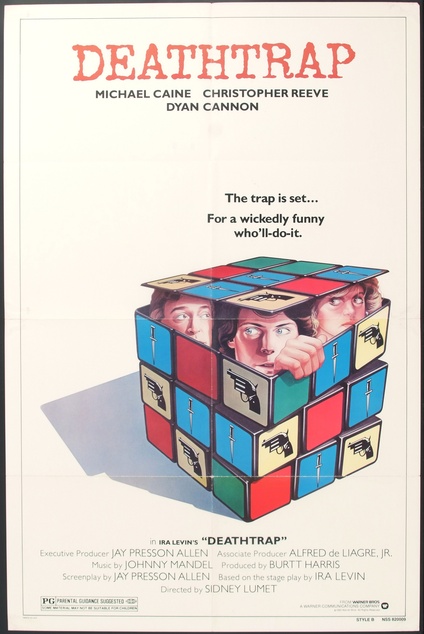
Deathtrap (1982)

By Richard Winters

My Rating: 4 out of 10

4-Word Review: Playwright turns to murder.

Sidney Bruhl (Michael Caine) was at one time a top playwright, but his latest play is a flop. To add to his depression he finds that one of his students who attended his writing seminar, Clifford Anderson (Christopher Reeve), has on his first attempt written a brilliant sure-fire hit. Something that makes Sidney jealous. He decides to invite Clifford over to his secluded cottage and while there, and with the help of his wife Myra (Dyan Cannon), kill Clifford and then steal his script and treat it as if it’s his own. Things though don’t work out quite as expected especially when their neighbor Helga (Irene Worth) arrives who has psychic visions that could ultimately implicate Sidney for doing the dirty deed.

The film is based on the Broadway play of the same name written by Ira Levin that ran for 1,793 performances from February 26, 1978 to June 13, 1982. The play was well received by critics and audiences alike including director Sidney Lumet who put up some of his own money to get it made into a film, but ultimately he relies too heavily on the twisting plot while failing to add any cinematic element to it.

The exterior of Sidney’s home was the picturesque DeRose Windmill Cottage, which sits in East Hampton, New York and helps add a visual flair, but the interior of the home was shot on a soundstage and the film becomes quite claustrophobic as almost the entire story takes place in this one setting. The movie desperately needed more cutaways, even some minor breakaway bits like Helga’s disastrous guest spot on the Merv Griffin Show, which gets talked about, but never shown, in order to make it seem less like a filmed stageplay, which it ultimately ends up being.

The script brings up some potentially interesting insights like how sometimes the characters in a writer’s play can closely parallel the authors themselves. In fact many people that knew him felt that the Sidney character here strongly resembled the real Ira Levin, but the film fails to pursue this in a satisfying way and is devoid of any interesting subtext or nuance. The characters end up being just boring one dimensional caricatures that are wholly unlikable. You could care less which one of them killed who, or whether any of them even survive.

Christopher Reeve is the film’s only real bright-spot and the way he plays a gay man is effective and believable. His onscreen kiss with Caine was considered controversial and daring at the time and even upsetting to fans to the point that purportedly one audience member in a Denver theater screamed out “Superman, don’t do it!” just as the kiss occurred. Irene Worth is fun too and her accent is so believable that I was convinced that she must’ve been born in Eastern Europe and was shocked to learn that instead she was from, of all places, Nebraska.

Caine is good, but his presence will remind many of the movie Sleuth, which he also starred in and is quite similar to this one. In fact a lot of viewers thought this was a sequel to that simply for that reason and because of this somebody else should’ve been hired to play the part.

Cannon on the other hand is annoying as the hyper wife and shares no onscreen chemistry with the other two actors. Marian Seldes had played the role on Broadway in every one of its 1,793 performances, which garnered her a citation in the Guinness Book of World Records as most durable actress and because of that alone she should’ve been given the part here.

Johnny Mandel’s soundtrack gives the proceedings a highbrow flair and I wished it had been played more. The plot twists may entertain and surprise some, but not if you think about them for too long, which ultimately makes this just a second-rate Sleuth.

My Rating: 4 out of 10

Release: March 19, 1982

Runtime: 1 Hour 56 Minutes

Rated PG

Director: Sidney Lumet

Studio: Warner Brothers

Available: DVD, Blu-ray, YouTube

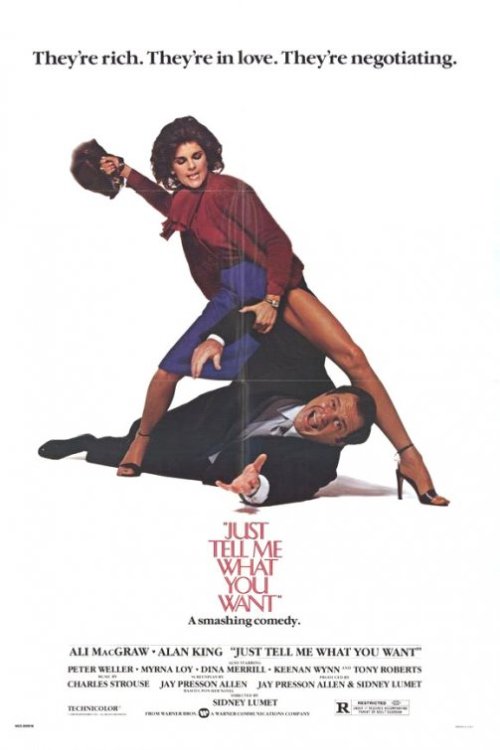
Just Tell Me What You Want (1980)

By Richard Winters

My Rating: 6 out of 10

4-Word Review: Rich tycoon gets dumped.

Max Herschel (Alan King) is a rich and successful businessman who’s used to getting what he wants. He’s rude and crude and doesn’t mind displaying his anger or contempt for others at a moment’s notice. After 14 years Bones (Ali MacGraw), his mistress, has decided she’s had enough. She leaves him for a much younger man (Peter Weller). This enrages Max who does whatever he can to win her back, or at the very least ‘punish’ her for leaving him.

The film, which is based on a novel by Jay Presson Allen has a delicious New York flavor with the majority of the action taking place at the Old Westbury Gardens estate that fronts as Max’s home. The interiors of the stately mansion are at times more interesting than the conversations and the exteriors coincidently were also used in Love Story, which was another MacGraw vehicle. Director Sidney Lumet gives the dark comedy a classy air with a rousing, distinctively jazzy score by Charles Strouse, which I wanted to hear more of and wouldn’t have minded if it had been played all the way through the movie.

The story has sharp dialogue and a deliciously acerbic edge, but becomes preoccupied with Max’s business dealings, which most viewers may find too complex to follow and aren’t that integral to the story. The first hour is spent focused on Max, whose obnoxious ways quickly become off-putting and tiring. The catalyst is his love-hate relationship with Bones and more scenes should’ve been shown with them together while having her break-up with him come much sooner.

King was a comedian known for angry monologues and that emotion gets channeled into his character. I’ll give them props for creating an unlikable lead and not holding anything back as too many times films create abrasive people only to soften them too soon or not go all-the-way with it. Here it gets pushed to the limit, but I was still hoping for Max to have more of an arch and was disappointed that he remains for the most part a callous jerk to the very end.

MacGraw’s restrained approach works well off of King’s flamboyance and the highlight is when she corners him at a luxury department store, which was filmed on-location at the Bergdorf Goodman, and tackles him while destroying everything in sight. However the character’s nickname of ‘Bones’ I did not care for especially with no explanation for why she was given it. Was she called this because she was thin, or was it for some other reason? An attractive female should be given a pleasant name not something that sounds demeaning.

Legendary actress Myrna Loy, who had been around since the silent film era, plays Max’s long suffering secretary and earns her pay here. Loved the scene where King cries right into her bosom while she holds his head and acts like his mother, but also the part where he shouts directly into her face even throws out the C-word and she doesn’t flinch. Keenan Wynn is likable and speaks with an accent in a sympathetic role as a Russian businessman and Dina Merrill’s emotional breakdowns as Max’s mentally fragile wife are impressive and could’ve been extended.

Spoiler Alert!

Overall though it fizzles and it’s not because it’s filled with a lot of extraneous dialogue and scenes that should’ve been cut, but more because it plays itself as this sort-of anti-romance only to sell-out at the end. There is simply no way anyone could truly fall-in-love with Max because there was nothing about him to love. Having him do one nice thing shouldn’t erase all the other bad things he did before. Bones had already spent 14 years with him which should be more than enough time to realize things won’t be any different moving forward. Having them reconcile by working together as business partners maybe, but a marriage is simply a disaster waiting to happen. Just because audiences long for the ‘happy ending’ doesn’t mean that’s what you give especially by having two people magically find love for each when none had ever existed before.

End of Spoiler Alert!

My Rating: 6 out of 10

Released: January 18, 1980

Runtime: 1 Hour 53 Minutes

Rated R

Director: Sidney Lumet

Studio: Warner Brothers

Available: DVD (Warner Archive), Amazon Video, YouTube

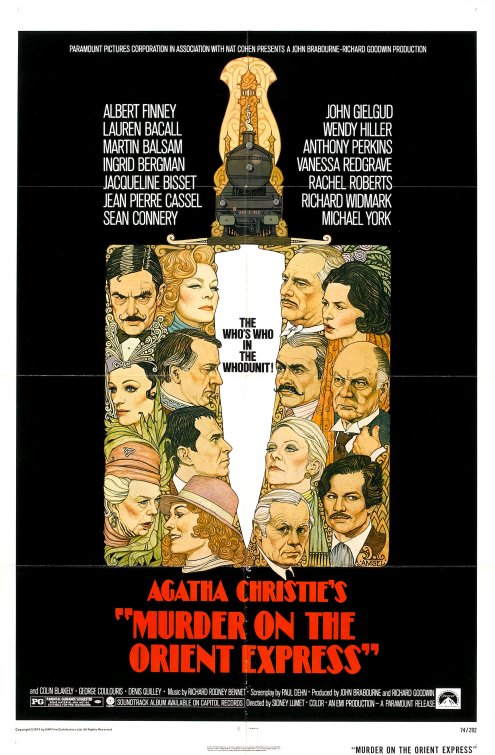
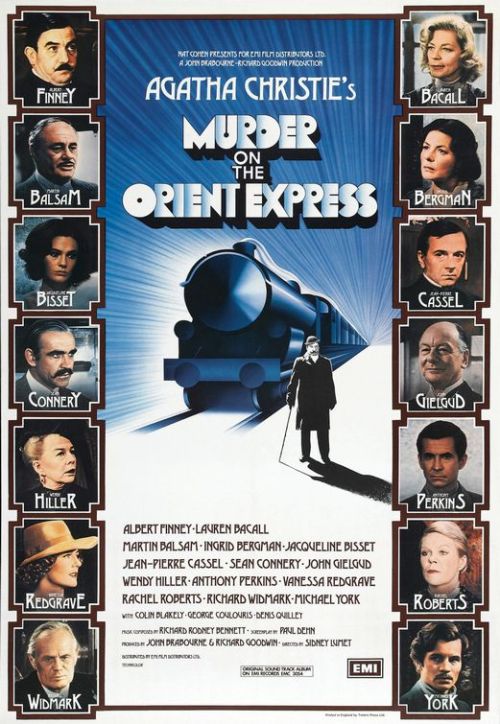
Murder on the Orient Express (1974)

By Richard Winters

My Rating: 8 out of 10

4-Word Review: They all did it.

The time is December, 1935 and world-renown detective Hercule Poirot (Albert Finney) boards the Orient Express as an unexpected guest who’s able to find a spare compartment due to his friendship with the train’s owner (Martin Balsam). During the night one of the other passengers (Richard Widmark) is found dead and it is up to Poirot to solve the crime while the train remains stalled by a large snow bank.

This production is considered by many to be the best film version of any of Agatha Christie’s novel-to-screen attempts and in fact the author herself said as much when she attended a showing of the movie on the night of its premiere. Director Sidney Lumet’s ingenious touch is on-target the whole way as he creates a nice blend of kitsch and camp until the over-the-top costumes, playfully sharp dialogue, and glossy camerawork become more of the fun than the mystery itself.

In fact it’s Lumet’s ability to capitalize on the little things and control every minute detail that makes it so captivating even on repeat viewings. Their ability to turn an abandoned warehouse into a bustling train station is just one example. I also enjoyed the moment when the train leaves the station that gets done to the sound of a waltz composed specifically for the film by Richard Rodney Bennett. Originally they were going to have train sounds edited in and had hired a sound engineer who had spent his whole life recording these noises for specifically this purpose only to get the disappointment of his life when he was told that they had decided to go with the music alone, which crushed him so much that his eyes welled up with tears and he never returned.

Finney’s performance is outstanding. He was not someone you’d have in mind initially for this type of part, but through his brilliant acting and effective make-up he disappears into the role and immerses the viewer in the presence of this highly eccentric character and his unusual habits including the way he puts both his hair and moustache into a hair net before going to bed and reads a newspaper while wearing gloves.

The star studded supporting players are perfectly cast for their parts too. Anthony Perkins nicely plays-up his nervous man routine while Wendy Hiller is enjoyable as the caustic aging Princess who wears a constant frown because her doctor advised her that smiling ‘was not good for her health’. Widmark has an amusing conversation with Poirot particularly with his inability to correctly pronounce the detective’s last name and Ingrid Bergman shines in a small bit as a poor, but devoutly religious woman, which was enough to net her the Oscar for best supporting actress.

Spoiler Alert!

The murder scene in which all the passengers file into Widmark’s cabin and systematically take turns stabbing him is, like with everything else, astutely captured particularly with the way it’s shot by using only a blue tinged light as its sole light source. Lumet craftily uses a two-camera set-up here in which one camera captures the characters and the other focuses on Lauren Bacall’s character’s reactions to it as she stands at the doorway as a lookout. Bacall was never known as an actress to show much vulnerable emotion, but here, at least through her facial expressions, she does quite well. However, this segment also reveals a fatal flaw as Poriot’s cabin was right next to Widmarks’s and earlier in the film he was able to hear the conversations going on in the cabin next him almost perfectly, but then as each participant takes turns stabbing Widmark they say something out loud and yet for whatever reason Poirot never hears this, which makes you wonder why.

End of Spoiler Alert!

The script, by Paul Dehn, gets talky but is saved by its amusing verbal exchanges and Lumet’s use of different lenses to capture it, so I didn’t find it a problem in a movie that deserves its classic status both a mystery and cinematic achievement. The remake directed by Kenneth Branagh is set to be released in November.

My Rating: 8 out of 10

Released: November 24, 1974

Runtime: 2 Hours 8 Minutes

Rated PG

Director: Sidney Lumet

Studio: Paramount

Available: DVD, Blu-ray (Region B/2, A/1)

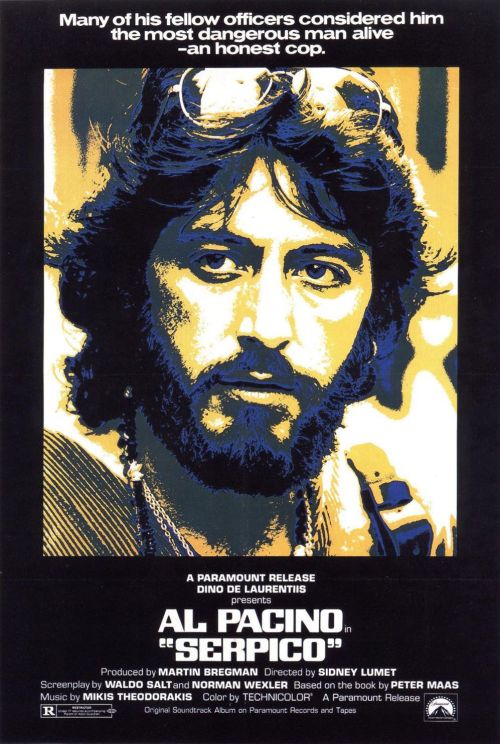
Serpico (1973)

serpico

By Richard Winters

My Rating: 8 out of 10

4-Word Review: A cop fights corruption.

One of the followers of this blog has requested that I review this movie, so today we take a look at Frank Serpico (Al Pacino) a policeman who fought against corruption that plagued New York’s police department during the ‘60s. Even though many of his partners on the force would accept under-the-table payouts from criminal elements in exchange for ‘looking-the-other-way’ he wouldn’t and when he would tell his superiors about it nothing would get done. Instead they would transfer him to other precincts only for him to find the same problems there. It was only when he decided to report the issue to the New York Times that people started to take action, but in the process he also made himself a mark and vulnerable to having his unhappy comrades set him up to be shot while on-duty.

The film is based on the Peter Maas novel, which in turn recounts the life of the actual Frank Serpico and the events he went through while working on the force between the years of 1959 to 1972. Not only does he remain alive today, but according to recent reports is even considering, at the ripe old age of 79, a run at political office. Equally interesting is that he and Pacino roomed together during the summer that this was filmed and became close friends.

It’s been years since I’ve read the novel, but I felt this film sticks closely to what actually happened and the always reliable Sidney Lumet manages to keep things exciting and insightful. The dialogue is sharp and the on-location shooting, which was done in every borough of New York except Staten Island, gives the viewer an authentic feel of the city as well as the police environment.

The film also does a successful job at showing the drawbacks of accepting bribes without ever getting preachy or heavy-handed. One might think, like many of Serpico’s partners do, that taking some kickbacks isn’t that big of a deal, but then the film shows in one brief moment a policeman shoving another man’s head into a toilet when he doesn’t ‘pay up’, which hits home how the police become no better than organized crime who would notoriously demand ‘protection money’ from business owners.

The only thing I didn’t like was the music, which was too loud and jarring. Fortunately it’s put in only sparingly, but its melodic quality takes away from the grittiness and the film works far better by simply relying on the ambient sounds of the locations that the scenes are in. In fact this is one movie that could’ve done fine without any music at all.

Pacino is fantastic and I loved how the character starts out as this clean shaven, boyish looking fellow only to grow into a bearded, long haired guy as the story progresses, which symbolically connects with the way he becomes savvier to the system. The character also sports earrings long before it became vogue for males to wear them.

Tony Roberts does well as one of the few cops that sides with Serpico and tries to help him in his fight and F. Murray Abraham can be spotted near the end as a member of a vice squad who tries setting Serpico up to be killed. This movie also marks the film debuts of character actors Alan Rich and Kenneth McMillan. In my mind this is also the debut of Judd Hirsh. Some sources state that his first onscreen appearance is in Jump, which came out two years earlier, but I watched that film and couldn’t spot him anywhere, but her I was able to spot him right away.

My Rating: 8 out of 10

Released: December 5, 1973

Runtime: 2Hours 10Minutes

Rated R

Director: Sidney Lumet

Studio: Paramount

Available: VHS, DVD, Blu-ray, Amazon Instant Video, YouTube

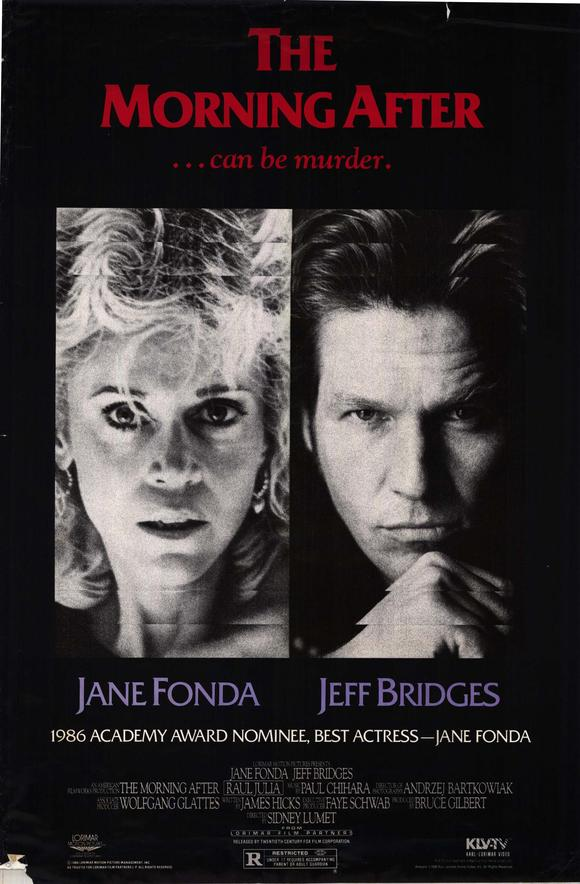
The Morning After (1986)

the morning after

By Richard Winters

My Rating: 5 out of 10

4-Word Review: She can’t remember anything.

Alex (Jane Fonda) is an out of work actress and alcoholic who is prone to black outs. One morning she wakes up to the find that the man lying beside her has been murdered. She isn’t sure if she did it or not as she can’t remember anything. She cleans up the place and then by chance meets Turner (Jeff Bridges) a former cop who tries to help her prove her innocence.

Starting out right away with her waking up to find the dead body doesn’t work. Some background to the character would have been better as without it the viewer doesn’t particularly care about the character’s predicament. It took me a long while before I could get into it and even then it was only at a lukewarm level. The laid-back and melodic jazz soundtrack doesn’t help. For a thriller it is completely out-of-place and as good as a director as Sidney Lumet is he seems to have problem in that area as the musical score selected for Family Business another film that he did was also a terrible choice.

The film has one interesting twist near the middle, but the pacing is so slow that whatever intrigue it gave me quickly subsided, which is the film’s biggest problem. It doesn’t know if it wants to be a thriller, mystery, drama, or love story. Too much time is spent dealing with Alex’s budding relationship with Turner, which isn’t interesting. By the time they do get back to the mystery you really don’t care anymore. There are also not enough suspects and I had figured out who the culprit was long before the revelation comes about.

Fonda is competent particularly in a teary-eyed emotional sequence where she tries to somehow justify her pathetic self-destructive existence. The character though is unappealing and it may take a while for the viewer to warm up to her if at all. I did like her in the blonde, puffy 80’s hairstyle, but at the half way mark she changes back to her more natural brunette look, which I felt made her look older.

Bridges character helps stabilize Fonda’s and in that regards his presence is helpful, but having them meet by complete chance and then having him get so involved in her quandary seemed implausible. It would have been better and made more sense had he been a longtime friend who she turned to in her time of crisis. Although Raul Julia has a less screen time he still adds a lot more energy than Bridges.

Kathy Bates, Bruce Vilanch, and Frances Bergen (Candice’s Mom) can all be seen in brief bits. I also want to mention Richard Foronjy who nails the caricature of a streetwise big city cop perfectly.

Although the film is now 27 years old it really isn’t too dated. Only two issues in this area come to mind. One is when Alex can’t get any money out of the bank because it is closed due to a holiday and there doesn’t seem to be any such thing as ATM machines. Another occurs when a police investigator asks the Raul Julia character if he is gay by using a derogatory term, which wouldn’t go over today. However, Julia’s comeback line “How bad do you want to know?” is a good one.

My Rating: 5 out of 10

Released: December 25, 1986

Runtime: 1Hour 43Minutes

Rated R

Director: Sidney Lumet

Studio: Lorimar Productions

Available: DVD, Amazon Instant Video