Tag Archives: Robert Shaw

The Luck of Ginger Coffey (1964)

the luck of ginger coffey

By Richard Winters

My Rating: 7 out of 10

4-Word Review: He needs a job.

Ginger Coffey (Robert Shaw) is a middle-aged man living in Montreal whose dreams and ambitions far outweigh his grim predicament. He moves from one low paying job to another convinced that his lot in life will improve. His wife Vera (Mary Ure) decides to leave him and Ginger tries to win her back while juggling two jobs and hoping to get a promotion in one that never seems to come.

As a vivid look at the daily lives of the everyday working class this film hits a solid bullseye. The conversations between the co-workers and the monotonous and sometimes demeaning job interview process and Ginger’s on-going arguments with his wife and daughter are all true to form. There is no pretension and director Irvin Kershner keeps everything at a bare-bones minimum giving it almost a documentary style and making the viewer feel immersed in the bleak environment. The outdoor shots of the city are unexciting and cinematically unappealing, but help reflect the grim level. Watching Ginger get kicked out of his apartment and have to carry what is left of his belongings and then place them on the outside sidewalk while he goes in to visit his daughter in her school is quietly powerful.

Robert Shaw is excellent. This is a man who had by all accounts had a very dominating and proud personality in real-life and usually played characters with the same traits, so seeing him play against type and succeed is interesting. What is really effective is that he makes the character very human and likable despite his constant goof-ups, which keeps the viewer compelled to his situation.

Ure, who at the time was married to Shaw in real-life, gives an equally outstanding performance. Her perplexed facial expressions are perfect and the fact that we see her character grow and become more confident is good.

I also must mention Liam Redmond as Ginger’s cantankerous boss, who is nicknamed by his employees as ‘Hitler’. Ginger’s rushed job interview that he has with him is one of the film’s highpoints as is the moment when Ginger dashes away from him when he is caught making a personal phone call.

The only real complaint I have with the film is the ending, which is for the most part non-existent. I have seen vague wide-open endings in my movie viewing lifetime, but this thing is a cop-out and really boring one at that. I think when a viewer has spent nearly two hours empathizing with his difficult  and precarious situation that they deserve some sort of finality, or at least a hint of what became of him and whether he ever did find that ‘luck’ that he was so convinced was out there.

My Rating: 7 out of 10

Released: September 21, 1964

Runtime: 1Hour 40Minutes

Not Rated

Director: Irvin Kershner

Studio: Continental Distributing

Available: YouTube

The Birthday Party (1968)

the birthday party 3

By Richard Winters

My Rating: 8 out of 10

4-Word Review: Tear up the newspaper.

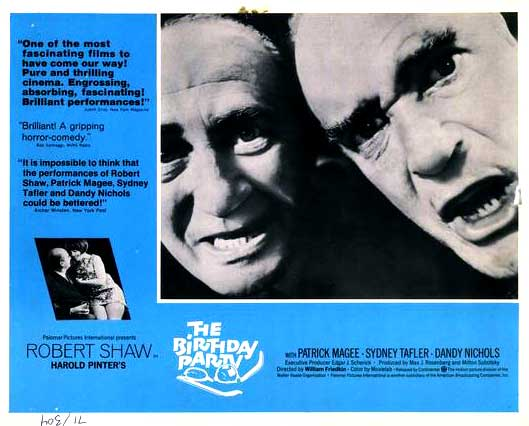
Since tomorrow will be my birthday I wanted to come up with a film that had birthdays as its theme and found this bizarre but fascinating obscurity. It is the story based on the play by Harold Pinter of Stanley Webber (Robert Shaw) a mysterious and private man who takes up lodging in a rundown British seaside house. He rents an upstairs room from Mr. and Mrs. Bowles (Moultrie Kelsall, Dandy Nichols) who are quite odd themselves. One day two men dressed in black suits (Patrick Magee, Sydney Tafler) come to pay Stanley a visit. They know something about Stanley’s past and their presence frightens him to the extent that it causes him to have a nervous breakdown.

On the surface this film shouldn’t work. There is an excessive amount of talking with dialogue that doesn’t say much and at times seems absurd. The set is drab and dirty with the camera seemingly locked down inside of it. There is never any explanation about Stanley’s past or what he is running from nor who the men are or what they know about him. The ending is elusive and the viewer will go away feeling more confused than they did at the start.

However, it is these ingredients that make the film so thoroughly intriguing. The seemingly banal dialogue is simply a façade for underlying thoughts and feelings. What Stanley is trying to run from is unimportant because it is really not about him at all and is instead more about ourselves, human nature and the quandary of our existence. It’s an examination of people’s futile attempts at trying to escape from who they are only to have society and life catch up with them. The set could be a metaphor for the inside of Stanley’s head. The grimy and decayed place symbolizes his decayed soul and the men in black suits are his conscience coming to haunt him.

Once you adjust to the eccentric narrative it then becomes a fantastic film for observing subtitles and nuance. Director William Friedkin shows a keenness for detail not only visually, but with the sound as well. The way the Magee character tears up a newspaper and the sound used for it could actually unnerve some viewers. Stanley’s meltdown scene is very unique and overall the direction is superb for such difficult material.

This movie was years ahead of its time, but for some it may be off-putting. However, it should be enjoyed by those who crave the avant-garde. It is also a rare chance to the see the normally strong-willed Shaw playing a very weak and vulnerable character. Nichols is also a stand-out playing an Edith Bunker type with a perverse streak lying just beneath the surface.

the birthday party 1

My Rating: 8 out of 10

Released: December 9, 1968

Runtime: 2Hours 3Minutes

Rated G

Director: William Friedkin

Studio: Palomar Pictures International

Available: VHS, DVD (Region 2)