Tag Archives: Review

Little Miss Marker (1980)

little1

By Richard Winters

My Rating: 3 out of 10

4-Word Review: Kid used for collateral.

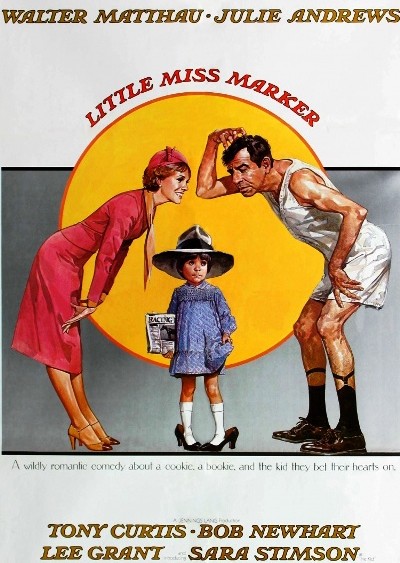
Sorrowful Jones (Walter Matthau) is a no-nonsense bookie running a gambling operation during the 30’s. When one of his clients named Carter (Andrew Rubin) cannot pay back his $10 debt he puts up his 6-year-old daughter (Sara Stimson), who is simply known as ‘the Kid’, as collateral. Sorrowful tells his assistant named Regret (Bob Newhart) to look after her, but Regret does not like kids, so he drops the young girl off at Sorrowful’s doorstep one night and then promptly leaves forcing Sorrowful to begrudgingly become her surrogate father figure. Eventually the two grow fond of each other and become inseparable, as does Amanda (Julie Andrews) who’s the girlfriend to a crime boss named Blackie (Tony Curtis). Blackie does not like that Sorrowful is showing an interest in Amanda, or her in him and  proceeds to try and throw a monkey-wrench into their potential affair while also coercing Sorrowful to partner with him in a fixed horse race.

This film was the fourth remake of the story that originally came out in 1934 and starred Adolphe Menjou as Sorrowful and Shirley Temple as the Kid. In 1949 it got remade with Bob Hope playing Sorrowful and Mary Jane Saunders as the child. Then is 1962 a variation of the story was was done called 40 Pounds of Trouble that was shot on-location in Disneyland and starred Tony Curtis in the Sorrowful role, though the character name was changed to Steve, and Claire Wilcox portraying the child, whose name in the film was Penny. While I have not seen any of those versions I still came away feeling this one had to be the weakest. A lot of the problem is that the script relies too heavily on the cuteness factor of the child, who is certainly adorable, but has no discernable personality. It’s also hard to imagine that a child who has just been abandoned by her father, and had also gone through the trauma of the death of her mother, would be so well-behaved and in reality would probably be showing some serious adjustment issues.

I’m not sure why Matthau, who also produced, thought this project would be a good idea, but appearing in it did not bolster his career. Didn’t he ever hear of the old adage never share the screen with animals or cute kids as they’ll just steal away all the attention? It’s not like Stimson, whose only movie role this was and who now works as a pediatrician in Arizona,  didn’t have to do anything special for that to happen as her big blue eyes are enough to capture the heartstrings of just about any viewer. I also had a hard time understanding his character particularly the fact that he was this brash, tough talking bookie yet doesn’t carry a gun nor have any fighting skills as proven by the fistfight he attempts to have with Curtis where even though Curtis was shorter Matthau he’s is still frightened of him and constantly backing away whenever Curtis got in his face. You’d think a streetwise person would have some ability to defend himself if needed and not just slink away the second someone else, particularly one who was smaller, suddenly got aggressive.

Bob Newhart gets completely wasted in a role that’s so small and insignificant I’m surprised why he even took it. I also didn’t think this was the right movie for Julie Andrews either. Sure, she has an engaging quality, but for a woman dating a crime boss she seemed way too pure and innocent almost like she was completely oblivious to his underhanded nature. In reality the people one hangs out with will inevitably rub off on that person and a more realistic portrayal would’ve had her being a bit corrupt, which would’ve actually been more interesting as it would’ve created a two-dimensional character who was cold and conniving most of the time, but then when the kid comes along a softer side gets exposed.

In contrast both Curtis and Brian Dennehy, who plays his henchmen, are a delight and needed more screen time. It’s interesting too seeing Lee Grant appear near the end playing a judge and almost unrecognizable in a gray wig, but the story as a whole flounders chiefly because, outside of the scenes showing a fixed horserace, there’s no action at all, which makes it absurd to call this a ‘family movie’. If I, as an adult, was bored I can only imagine a kid being even more so. In fact I’d say this movie really wasn’t made for kids at all, but instead little old ladies who enjoy cutesy kids the way they like cutesy puppy dogs and want children only shown as being adorable even though kids, like with everyone else, can have their bad side, which conveniently gets left out here.

My Rating: 3 out of 10

Released: March 21, 1980

Runtime: 1 Hour 43 Minutes

Rated PG

Director: Walter Bernstein

Studio: Universal

Available: DVD, Blu-ray

Next Stop, Greenwich Village (1976)

nextstop

By Richard Winters

My Rating: 7 out of 10

4-Word Review: He dreams of stardom.

In 1953 Larry (Lenny Baker), a young man in his early 20’s, decides to move out of his home in Brooklyn that he still lives in with his parents (Shelley Winters, Mike Kellin) and into an apartment situated in the artsy district of Greenwich Village. Larry dreams of becoming a movie star and feels the way to start his career is by living with fellow artists. He also wants to get away from his meddling mother, but finds no matter where he goes she always comes to visit many times at the most inopportune moments including when he’s holding wild parties, or making-out with his new girlfriend Sarah (Ellen Greene).

The film is loosely based on writer/director Paul Mazursky’s early life as a struggling artist, which is fine, but how much one likes this movie hinges almost completely on how much they can stand the main character. For me he wasn’t so likable. While I admit his mother was annoying she was still well-meaning and the way he constantly lashed-out at her seemed too angry and aggressive. I would’ve thought someone who had been raised in that type of overbearing environment all of his life would’ve figured out a more subtle way to placate his mom that wouldn’t have needed to be so abrasive. When he tells his neighbor lady (Rachel Novikoff) that he’s moving to Greenwich Village to ‘become a big star’ like it was going to be some automatic thing seemed a bit too deluded and you’d think by that age he would’ve been a little bit better grounded.

The friends that he makes, which include some early performances by Christopher Walken, Antonio Fargas, and Dori Brenner, are a bit off-kilter as well. For instance they visit a fellow artist friend named Anita (Lois Smith) at her apartment only to find her sitting inside the bathroom with her wrists slit and talking about how she wants to die. They manage to get her patched-up, but then return to the apartment a couple of weeks later with the same carefree spirit that they had the first time, but you’d think after what they witnessed they’d approach the place cautiously, or maybe never want to go there again, for fear that she’d try it again and this time succeed forcing them to witness a tragic sight and yet this bunch acts like for some reason the whole suicide thing will never reoccur only to be shocked when it does even though I as a viewer was completely expecting it.

The story is rather rudimentary and involves basic elements that seemed to be analyzed in a lot of coming-of-age films during the 70’s including having Larry’s girlfriend get pregnant and require an abortion, which wasn’t exactly a unique twist. I did though enjoy the scenes inside Larry’s acting class and the way his teacher (Michael Egan, who was portraying the legendary acting coach Herbert Berghof) challenged his students after his each performance that they gave in the class and requiring them to analyze why they portrayed a certain character the way they did. Not enough other movies capture the technical side to acting, so I felt these scenes stood out in a good way and were quite introspective to the craft. I also liked the dream sequence where Larry imagines himself as a successful star, but then this quickly turns into a nightmare where he sees himself booed by the audience and even has pies thrown in his face, which I felt brought out the insecurity many artists, especially actors, harbor, even the successful ones, where they secretly fear never being quite good enough.

Spoiler Alert!

My biggest complaint though was with the ending where for some inexplicit reason Larry gets hired to play a part in a movie and whisked off to Hollywood even though I didn’t see what was so great about his audition, or why this scrawny guy stood out to the casting directors from all of the other men that were also vying for the role. I realize that Mazursky was basing this on his own life as he was able to escape to Hollywood after getting the starring role in the Stanley Kubrick drama Fear and Desire, but this only occurs to a small handful of people and the vast majority who move to Greenwich Village never really leave it, or if they do it’s most likely to the suburbs where they’re forced to get ‘real jobs’, or maybe even back home to their parents after they run out of money. If the movie has Greenwich Village in its title then that’s where it should’ve stayed as most people who live there probably ultimately wouldn’t like Hollywood as it’s a completely different vibe and sometimes it’s better being a big fish in a small pond, which I felt is the message that the film should’ve conveyed as the Hollywood twist seemed too dreamy.

End of Spoiler Alert!

Either way the film is helped immensely by Shelley Winters, who plays the overbearing mother to a T and comes complete with realistic crying spells. This should’ve netted her a third Oscar and for all purposes was her last great role as the parts she got offered after this were virtually all of the B-movie variety. Baker on the other-hand, whose only starring vehicle this was as he died, at the young age of 37, less than 6 years after this film came out, is an acquired taste. I don’t know if it was his extreme skinniness that got to me, he was 6’0, 145 pounds, but I just couldn’t really ever warm up to him and felt that Harvey Keitel, who had been considered for the part, would’ve worked better. You do though get to see Bill Murray, in his live-action, feature film debut, as a party guest as well as Jeff Goldblum as a humorously obnoxious struggling actor doing whatever he can to stand out and get noticed.

My Rating: 7 out of 10

Released: February 4, 1976

Runtime: 1 Hour 51 Minutes

Rated R

Director: Paul Mazursky

Studio: 20th Century Fox

Available: DVD, Blu-ray

The Blockhouse (1973)

blockhouse2

By Richard Winters

My Rating: 6 out of 10

4-Word Review: There’s no way out.

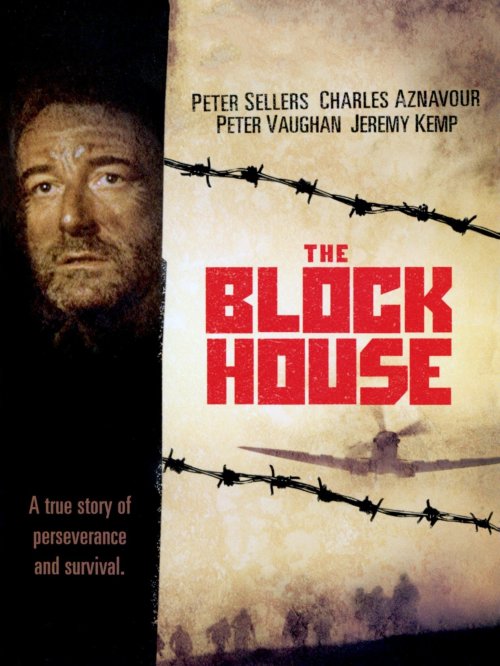
On D-Day a group of war prisoners on an island that’s run by German soldiers seek shelter from an allied air attack by finding refuge in an underground German bunker, but once inside, they realize to their horror that the shelling outside has blocked-off both the entrance and exit, which essentially traps them in permanently. They are fortunate enough to find a supply room full of enough food and wine to keep them fed for a long time, but as the days wear into weeks and then months and even years they grow tired and despondent about their situation. They try to find ways to break through the cement walls, but their attempts prove futile, which leads all of them into a mental and emotional breakdown.

The film is best known as being one of Peter Seller’s rare dramatic turns where he plays a character that is not funny or colorful. Normally his performances are quite flamboyant and over-the-top and he tends to dominate the spotlight, but here he blends in with the rest of the performers with a rare low-key portrayal that is quite impressive when given how he normally acts. This was yet another project he got involved in during the early 70’s when his career was on the down side and he was desperately taking just about any offer that came along, no matter what the quality, in an effort to bring in money. While some of those movies that he starred in during that period were truly awful (i.e. Where Does it Hurt?) this one, despite its grim theme, is unique and worth checking out particularly for those who enjoy experimental cinema.

The film was directed by Clive Rees, whose only other cinematic directorial effort was When the Wales Came, which had a similar theme about an eccentric man living an isolated existence on an island. While Rees is not as well known as Stanley Kubrick, Sellers insisted in interviews, that he was ‘every bit as good’.  While this statement may seem like an exaggeration I was quite taken aback by the gritty realism and the way the viewer feels just as trapped as the victims. The actors give all-around great performances and you see their character’s ultimate mental decline happen right before your eyes, which is both vivid and gut-wrenching. The story also looks at all aspects of their deterioration where they start to do things they had never done before including conveying certain homo-erotic elements. While none of this gets shown I was still impressed that it at least got lightly touched-on as I feared due to the period and heavy UK censorship, where this film was made, that would be one facet that couldn’t get introduced, but ultimately in a soft way it does.

If you’re looking for an entertaining crowd pleaser than this movie won’t be it. As Sellers rightly stated in his interview it’s meant for serious ‘connoisseur’s of cinema’ only. TV Guide complained that the film in their review ‘goes nowhere’ and it doesn’t reveal a ‘metaphysical reason’ for the character’s predicament, but I really didn’t think one was needed. Sometimes shit just happens and people must learn to adapt to their new harsh reality, or fall apart and in that vein I felt the movie does an excellent job and goes much further into this dark, murky psychological realm than most others would dare.

Spoiler Alert!

The story is based on the 1955 novel of the same name by Jean-Paul Clebert, who also coincidentally lived an isolated existence for many years in an abandoned village. The novel is loosely based on the actual incident that occurred on June 25, 1951 when two German soldiers in Poland were rescued from an underground shelter that they had been trapped in for 6 years. The difference is that in the movie we never see the rescue as it ends with the remaining two survivors stuck in total darkness when the last of their candles goes out. I felt it would’ve worked better had the rescue been shown as well as a better build-up where we would’ve gotten to the know the men better in the prison camp before they were forced underground, which would’ve made their mental declines even more interesting.

My Rating: 6 out of 10

Released: June 1, 1973

Runtime: 1 Hour 33 Minutes

Rated R

Director: Clive Rees

Studio: MGM

Available: DVD, Amazon Video, Tubi

The Last American Hero (1973)

lasthero

By Richard Winters

My Rating: 7 out of 10

4-Word Review: He follows his dream.

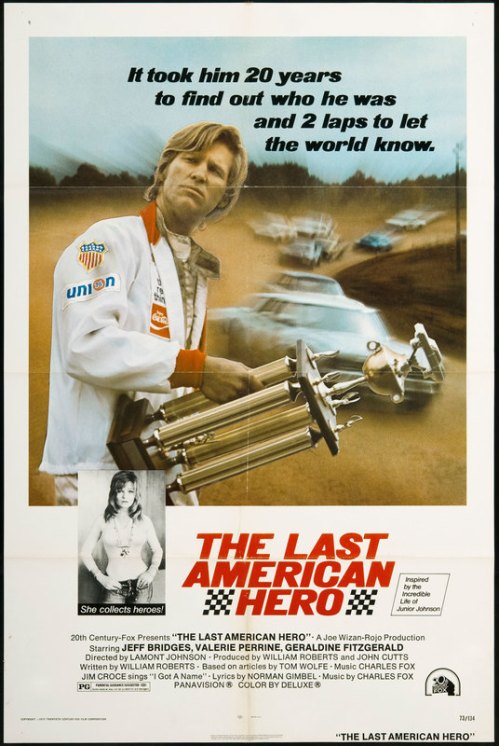
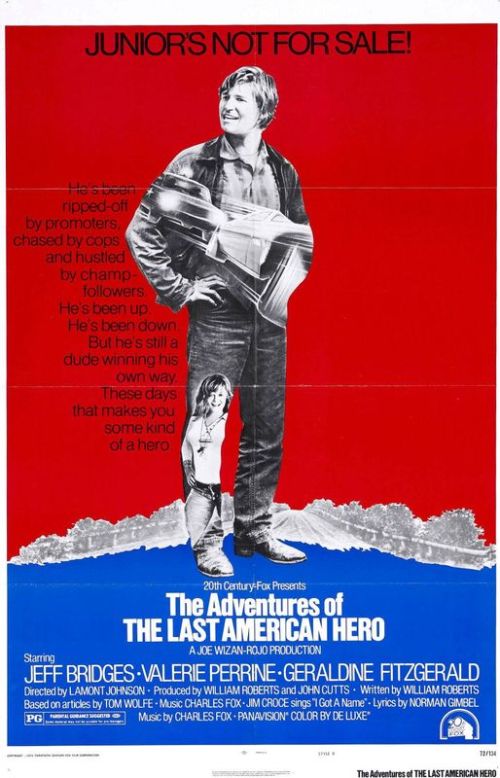
Junior Jackson (Jeff Bridges) works in his family’s moonshine business as a driver who transports the liquor and uses his superior driving skills especially his patented ‘bootlegger-turn’ in which to avoid capture he gets the vehicle to make a 180-degree turn by using the emergency brake, which then allows his car to go speeding off in the opposite direction. However, the authorities are able to catch-up with his father (Art Lund) and they throw him in jail for 11-months. With no moonshine business Junior is forced to find other means for an income, so he decides to try and turn his driving skills into a profit venture by entering into a demolition derby run by Hackel (Ned Beatty). He does well in this and eventually moves up to the higher levels and makes enough money for him to decide on turning it into his career, but his family does not approve as they feel it’s too dangerous. Junior is also forced to buy his own race car and pay for his own pit crew, which causes him to go back into the bootlegging business as a runner all to the disapproval of his father who feels it will just lead Junior into the same prison that he was in.

Overall this is one of the best bio’s out there and impeccably filmed and edited by actor-turned-director Lamont Johnson, who appears briefly as a hotel clerk. Johnson’s directing career was a bit spotty, he also did notorious clunkers like Lipstick and Somebody Killer Her Husbandbut this one is virtually flawless and there’s very little to be critical about on the technical end. The racing footage is both intense and exciting and one of the few racing movies where I was able to follow the race as a whole and not just be bombarded with a lot of jump cuts. I also appreciated how it captures the pit stops and the different conversations that the driver has with his crew during these moments and how sometimes this can be just as intense in its own way. The on-locations shooting done in and around Hickory, North Carolina as well as some of the neighboring race tracks during the fall of 1972 helps bring home both the ambiance and beauty of the region.

For me though what really stood out was Junior’s relationship with his family and how they were not supportive, at least initially, to his dreams as a racer and forcing him to have to pursue it on his own. Many times people who have ambitious goals don’t always have their friends and family on the same page with it and the road to success can definitely have its share of loneliness while also testing one’s own inner fortitude. One of my favorite scenes, that goes along with this theme, is when Junior is inside a K-mart and comes upon a recording booth that allows him to make a voice tape message that can be sent via the mail to one’s family or friends. Junior conveys into the microphone what he wants to say to his family, but ultimately seems to be talking more to himself than them, as a kind of self therapy to release the inner tensions that he’s been feeling, and subsequently never actually sends it out.

The acting is top-notch particularly by Bridges. Normally he’s good at playing mellow, level-headed characters, but here does well as someone who at times is quite volatile and caustic. There’s great support by Beatty as an unscrupulous race track owner, Ed Lauter as a highly competitive owner of a competing racing teams as well as Valerie Perrine as a woman who enjoys bed-hopping between different men, sometimes with those who are friends with each other, and yet completely oblivious with the drama and tensions that this creates. William Smith is good as a competing racer and while his part is small the scene where he walks in on Junior sleeping with his girl (Perrine) and the response that he gives is great. I thought Geraldine Fitzgerald, who plays Junior’s mother, was excellent and her Irish accent somehow effectively made to sound southern, but she should’ve been given more screen time.

The story is based on an Esquire article written by Tom Wolfe that was entitled ‘The Last American Hero was Junior Jackson. Yes!’, which in turn was based on NASCAR racing champion Junior Jackson (1931-2019) who also served as the film’s technical advisor. The movies pretty much stays with the actual account, but does change one pivotal point in that it has the father going to jail when in reality it was Junior who was sentenced to 11-months in 1956. Why this was changed I don’t know, but it usually helps the viewer become more emotionally connected to the protagonist when they see them going through the hardship versus someone else, so having Bridges spend time in the slammer would’ve made more sense. The film is also famous for its theme song ‘I Got a Name’ sung by Jim Croce, but this song has been played so much on oldies radio that one no longer connects it with the film and in fact when it does get played it takes you out of the movie because it reminds you of somewhere else where you’ve first heard it, which most likely wasn’t this movie.

lasthero2

My Rating: 7 out of 10

Released: July 27, 1973

Runtime: 1 Hour 35 Minutes

Rated PG

Director: Lamont Johnson

Studio: 20th Century Fox

Available: DVD, Amazon Video, YouTube

Last Tango in Paris (1972)

lasttango2

By Richard Winters

My Rating: 7 out of 10

4-Word Review: Sex without knowing names.

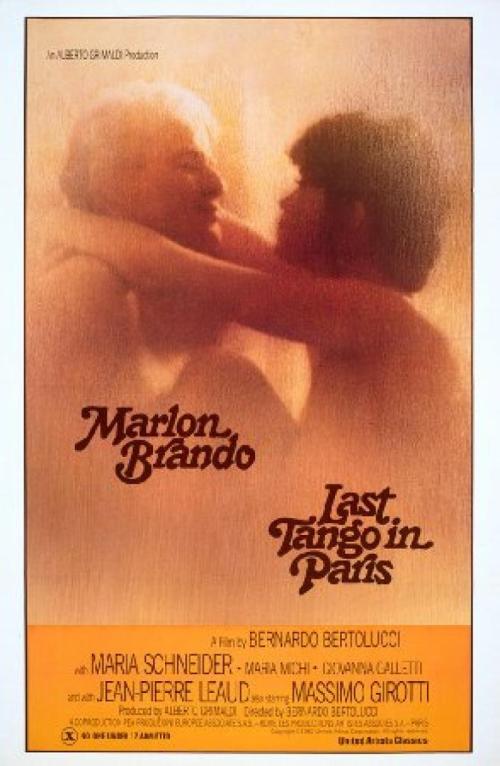
Paul (Marlon Brando) is a middle-aged American man living in Paris who’s despondent over his wife Rosa’s recent suicide. Feeling alone and without direction he meets up with Jeanne (Maria Schneider),a much younger woman, while both are looking to rent the same apartment. Jeanne is dating Thomas (Jean-Pierre Leaud) a filmmaker who wants to film her life and make it into a movie, which Jeanne is not so keen about. Despite not knowing Paul’s name, as he wants their identities to remain a mystery, she gets into a torrid sex affair with him and finds Paul’s evasive manner to be both frustrating and intriguing. However, after he rapes her he disappears and Jeanne considers their relationship over, but Paul meets her on the street a few days later, but this time he tells her all about himself, but hearing the sad details of his lonely life makes him less appealing to her. She tries to get away from him, but Paul continues to pursue her, which ultimately leads to tragedy.

The film is probably better known for the controversy and scandal it caused upon its release than anything else. While some of its sexual aspects will seem somewhat tame by today’s standards back in 1972 it became a hotly contested commodity where the government in Italy openly banned the film and ordered all copies of it seized and destroyed while also revoking director Bernardo Bertolucci’s right to vote for 5 years. Residents of Spain, where the film was also banned, would travel hundreds of miles to the French border just so they could see the film that everyone was talking about. In the US the controversy was no different with conservative pundits labeling it ‘pornography disguised as art’. In Montclair, New Jersey residents tried to physically block movie goers from going in to see the film by forming a human chain in front of the theater and those that were able to break through got labeled as being ‘perverts’.

Today the most controversial aspect are Maria Schneider’s accusations that the infamous ‘butter scene’ where Brando rapes her anally while using butter as a lubricant was not planned nor scripted and the she was taken by complete surprise. In a 2013 interview Bertolucci admits that Maria did not know the details of the scene ahead of time and this was intentional in order to capture the genuine look of shock on her face. While Bertolucci says he does not regret doing the scene he still felt bad for Maria, who maintained up until her death in 2011, that she had been both ‘violated’ and ‘humiliated’ and never spoke to Bernardo afterwards.

As for the film itself it’s interesting on a technical end, I particularly enjoyed its fragmented/dream-like narrative, but it also comes-off as being a bit overrated. It was based on Bertolucci’s own sexual fantasies regarding his desire of picking-up a young, beautiful woman off the streets and having a passionate sexual affair with her without ever knowing her name, or having any responsibilities or obligations attached to it, which is certainly an intriguing idea for a script, but the way the two come together seemed just a bit too rushed and unrealistic. Brando, who never bothered to memorize his lines and ad-libbed most of it, seems to be playing himself as he displays the same moody, self loathing quality that he also conveyed in every interview I’ve seen him in making it less about creating a character and more just him showing his true nature. Schneider is the best thing about the movie, as is the scene where the two disrupt a tango dance contest, but ultimately the film leaves one with a dark, depressed, and dismal feeling after it’s over.

My Rating: 7 out of 10

Released: October 14, 1972

Runtime: 2 Hour 10 Minutes

Rated NC-17

Director: Bernardo Bertolucci

Studio: United Artists

Available: DVD, Blu-ray, Amazon Video, Pluto TV, YouTube

The Last Metro (1980)

lastmetro1

By Richard Winters

My Rating: 7 out of 10

4-Word Review: Hiding from the Nazis.

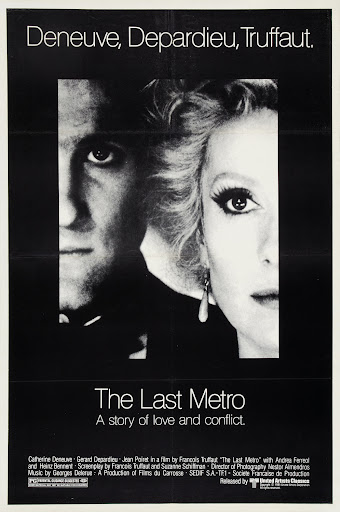
Bernard (Gerard Depardieu) is a young actor, who’s also a member of the French Resistance, living in occupied Paris during World War II. He gets a part as the leading man in a play at a playhouse run by Marion (Catherine Denueve) who has taken over the business since her husband Lucas (Heinz Bennent), who was Jewish, and supposedly fled the country when the Nazis took over, but in reality is hiding-out inside the cellar. Bernard and Marion don’t get along at first, but slowly form a bond when they find a mutual enemy in the form of theater critic Daxiat (Jean-Louis Richard) who is an anti-Semite that writes a nasty review about their play, accusing it of being pro-Jewish, in an effort to close the place down, so that he can take it over.

The film, which was writer/director Francois Truffaut’s most successful movie financially and one of the highest grossing French Films ever, remains sufficiently compelling despite very little that actually happens. One of the elements though that I found intriguing was the behind-the-scenes segments revealing all the work that gets put into a play before its opening night premiere . I especially liked Nadine (Sabine Haudepin) as a young actress who tirelessly goes from one acting gig to another, sometimes multiple ones on the same day, in order to help her career and get established.

Revealing right away, or pretty much by the end of the first act, that the husband has never left the country like everyone presumes, was a mistake that lessened the intrigue. For one thing the place he is hiding in, which is the cellar of the theater, is not too creative and even has a back door leading out to the alley way, which made me feel that anyone could’ve caught on to his whereabouts a lot sooner especially as Marion sometimes leaves her visits with him by going out the back entrance. Any passer-by/snitch could see her doing this and wonder what the door lead to, or called the Nazi authorities to have them investigate. It’s also not clear how, in seemingly a few minutes time, Marion is able to hide Lucas and his bed/personal belongings, from the Gestapo when they eventually insist on checking-out the basement.

Marion’s interactions with her husband is not particularly compelling and yet these scenes take up the majority of the runtime during the second act while Depardieu, who is excellent, barely gets seen at all. Then during the third act Marion and Bernard suddenly get really into each other, but the interactions between the two needed to be shown more for this to be organic to the viewer and in fact should’ve been more the focus of the film than Lucas. Had I been the director I would’ve kept Lucas’ whereabouts a secret until near the end when Bernard finally becomes aware of it and used the mystery of whether Marion knew more about it than she lets on as part of the intrigue.

The ending is a bit of a disappointment. The tone of the film works as a drama, but then suddenly shifts with about 10 minutes to go into a quirky comedy, which doesn’t work. The story threads get wrapped up in too tidy of way leaving the dynamics of Marion’s relationship with Bernard and Lucas’ response to it wide-open. After 2 hours and 10 minutes the character arcs should’ve been better defined and since they aren’t it makes the viewer feel like the movie doesn’t really go anywhere, or lead to anything insightful, which is a shame as it’s a nice looking, period authentic production otherwise.

My Rating: 7 out of 10

Released: September 17, 1980

Runtime: 2 Hours 11 Minutes

Rated PG

Director: Francois Truffaut

Studio: Gaumont

Available: DVD, Amazon Video

The Magic Christian (1969)

magic2

By Richard Winters

My Rating: 8 out of 10

4-Word Review: Everybody has a price.

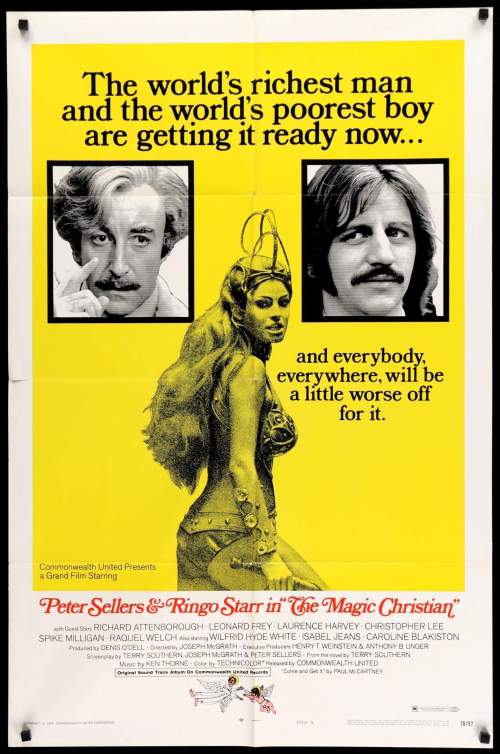
Sir Guy Grand (Peter Sellers) is a billionaire with an eccentric side, who wants to prove the powerful influence money has over other people. He meets Youngman (Ringo Starr),a homeless man in a park, and decides to adopt him as his son. Together they proceed to play elaborate pranks on the public by watching how far they can push their theory and what humiliating lengths people will go to get their hands on some money.

The film is based on the 1959 novel of the same name written by Terry Southern, who also wrote the screenplay, and while the novel was considered a success the movie, at least when it was first released, wasn’t. My critics complained of the film’s heavy-handed satirical nature and unrelenting jabs at capitalism even though all the same pranks done in the movie were also in the book. The film also has the exact same satirical theme as O Lucky Man, which starred Malcom McDowell and came out just a few years later that also took numerous potshots at capitalism and yet many of the same critics adored that one, but came down hard on this one.

Fortunately through the years the film has managed to find a cult following. I supposed if one has more of a socialist bent they may enjoy it more, but it has such a surreal, creative vibe to it that it’s fun to watch no matter if you agree with it’s message, which is kind of muddled anyways, or not. Some of my favorite bits included snotty, rich aristocrats boarding a ship cruise that puts them in increasingly more humorously challenging and bizarre situations. The final segment, which has the classic song ‘Something in the Air’ by Thunderclap Newman playing during it, features a giant outdoor vat filled with urine, blood, and animal feces and then having Grand throw money into it and challenging onlookers to jump into the mess in order to get at the money, which despite the awful stench they readily do.

There’s many cameo appearances by famous stars who agreed to take small roles as a favor to Sellers who at the time was a top star and friends with many of the big headliners of the day. Some of the best bits here include Laurence Harvey who does a striptease while onstage and in front of a packed house of onlookers while reciting ‘Hamlet’. Yul Bryner, looking almost unrecognizable in a female wig, is great as a transvestite who comes-onto a shy Roman Polanski while at a bar. Spike Milligan is hilarious as a traffic cop who agrees to eat his own traffic ticket for the right price as well as Raquel Welch as a slave commander with a whip, Wilfred Hyde-White as a drunken ship captain, and John Cleese as a perplexed auctioneer.

The problems that I had with the film dealt mainly with the relationship between Sellers and Starr. Sellers meets Starr one day in a park by chance and then begins to have a conversation with him, but there’s music playing over this, so we never hear what they’re saying, which is frustrating as the having a rich man suddenly offer a poor man the chance to be his adopted son seemed like dialogue that should be heard. Starr is also not given much to do and it seemed almost pointless for having even in the movie. In the novel there was only the Grand character creating the pranks, but it was decided for the movie to make it a two man show, but Ringo has so little to do that it didn’t seem worth it and this reportedly was due to Sellers’ insecurity of being upstaged and thus insisting that all the best lines had to go to him.

It’s also never clear why the Sellers’ character does what he does. What’s the motivation for why this rich man feels the need to expose other people’s foibles and vanities? Does he feel guilty about being so rich and therefore has decided to ‘take-it-to’ the others in his own social circle? None of this gets explained or analyzed at all, which on the character end makes the film quite superficial and confusing.

My Rating: 8 out of 10

Released: December 12, 1969

Runtime: 1 Hour 32 Minutes

Rated M

Director: Joseph McGrath

Studio: Commonwealth United Entertainment

Available: DVD, Blu-ray, Amazon Video

Last Resort (1986)

lastresort1

By Richard Winters

My Rating: 2 out of 10

4-Word Review: Family takes nightmarish vacation.

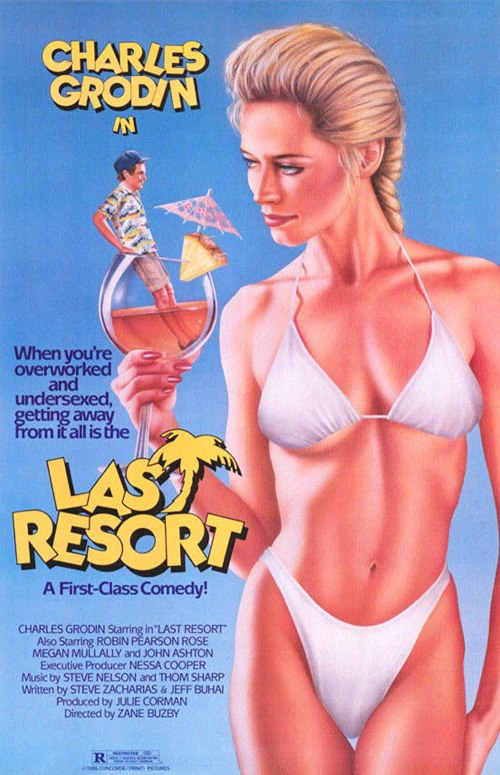
George (Charles Grodin) is a Chicago salesmen who loses a major client when he calls him fat, which in-turn costs him his job. Feeling the need to get away from the cold Chicago winter and reassess things he decides to take his family to a tropical island for some much needed r-and-r, but finds the place run by crazy people who house everybody in tiny little cabins. The island is also surrounded by a barbed wire fence due to a civil war going on, which soon has George stuck in the middle of it.

This film was directed by Zane Buzby, who appears here as a abusive summer camp counselor and who has since left the directing profession and devoted her life to brining aid to last surviving members of the Holocaust in Eastern Europe, which is a far better way to spend her time than making films like these, which isn’t funny and lacks any type of visual style. Much of the blame for this is the low budget, which makes the movie look cheap right from the start with its stock footage of a Chicago blizzard, the generic music score, and every indoor shot looking quite shadowy as if they weren’t able to afford enough spotlights to give it the properly lighted look. The island setting is bad too looking nothing like an actual island, but instead the brown, sun scorched landscape of a studio backlot.

The story is built around a lot of gags the majority of which aren’t funny, or even slightly original. The concept is the reverse of a National Lampoon’s Family Vacation where Chevy Chase plays the inept father who bungles everything while everyone else around him is normal. Here the father is the normal one and all the other people are nuts, but this doesn’t work as well as the folks behave in such an extremely absurd and obnoxious way that they have no bearing at all to real people and for satire to work it still needs to have some semblance to reality and this thing has none. It’s just insanity for the sake of goofiness with no point to it, which gets old fast.

I’m a big fan of Grodin, but his dry humored, deadpan observations are not put to good use and he ends up getting drowned out by all of the foolishness. I did though at least start to understand why Howard Stern always would accuse him of wearing a wig. To me I never thought he did wear one and Grodin, who disliked Stern immensely as he felt the shock-jock’s humor was too vulgar, would hotly dispute these accusations and even had one segment on his own short-lived talk show during the late 90’s where guests were allowed to tug on his hair just to prove it was natural and wouldn’t come off. However, here for whatever reason it really does appear like some rug plopped onto his skull that doesn’t even fit the dimensions of his head right.

Some of the supporting cast, which consists mainly of yet-to-be-famous, up-and-coming-stars does help a bit. This though does not include Megan Mullally, who plays Grodin’s daughter Jessica, who puts-on a high pitched, squeaky voice that I found really irritating. I did though find Jon Lovitz somewhat amusing as a bartender that can supposedly speak English, but can’t understand anything that Grodin says. Phil Hartman, wearing a blond wig, is a riot as a French gay guy named Jean-Michel who comes-onto Grodin, but my favorite was Mario Van Peebles as a flaming gay man who’s also one the tour guides. Some viewers may complain that his portrayal is too over-the-top and stereotypical, but it’s still campy fun especially at the end when he rips off his wig and suddenly turns into a macho guerrilla soldier freedom fighter.

My Rating: 2 out of 10

Released: May 9, 1986

Runtime: 1 Hour 24 Minutes

Rated R

Director: Zane Buzby

Studio: Concorde Pictures

Available: DVD, Amazon Video, Shout Factory TV, Pluto TV, Tubi

Libido (1973)

libido1

By Richard Winters

My Rating: 5 out of 10

4-Word Review: Four stories about sex.

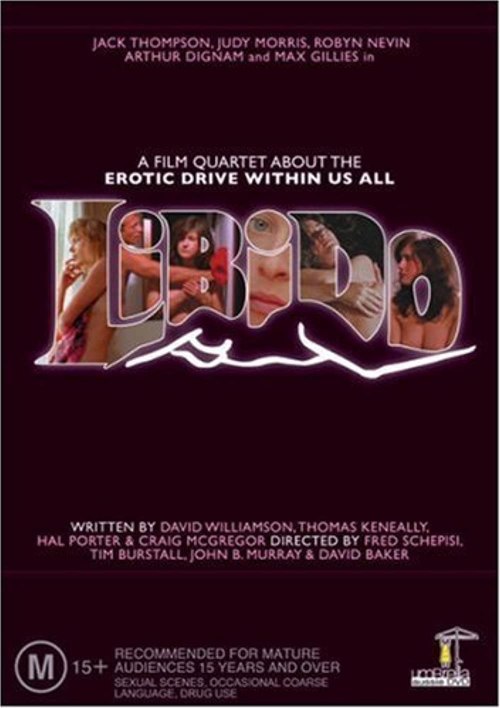
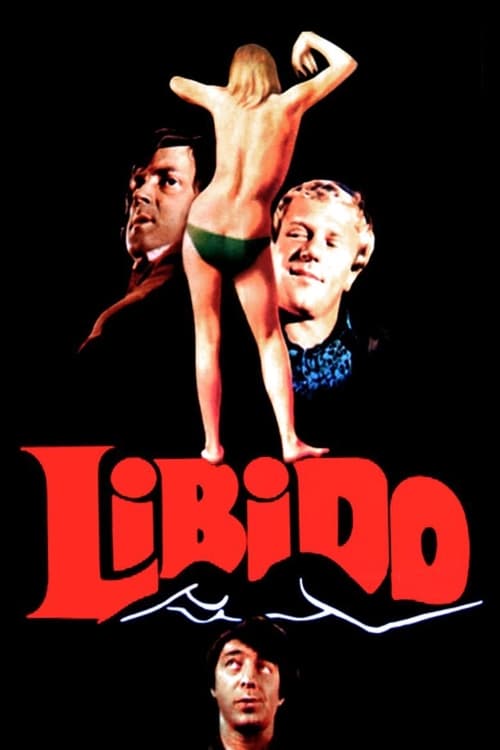
The genesis for this movie came about during a series of workshops held in southern Australia that was sponsored by directors and producers as a way to help writers craft a good story and create believable characters. The challenge was for each writer to come up with a different story built around a same theme, in this case sex, or the sex drive. Four of the best stories picked were then produced by the Australian Council for the Arts and put into the film. A sequel was planned called ‘The Bed’, which would’ve had 4 stories dealing around the idea of a bed in someway, but ultimately the funding was never able to be attained.

The first segment is called ‘The Husband’ and was written by Craig McGregor and directed by John B. Murray and is the weakest. It details the plight of a husband named Jonathan (Bryon Williams) who becomes jealous when his wife Penelope (Elke Neidhardt) starts to openly fool around with Harold (Mark Albiston) who had been the best-man at their wedding. The segment does have a provocative dream-like moment where Penelope has sex with four different men, but outside of that it’s rather flat. The dynamics of the marriage are confusing and both the characters and relationship needed to be fleshed-out better for the situation to make sense and it relies too heavily on explicit moments thrown in to make it seem more interesting than it really is.

‘The Child’ is the title of the second segment and was written by Hal Porter and directed by Tim Burstall. The setting is the early 19th century and deals with a young boy named Martin (John Williams) whose father dies on the Titanic. His mother (Jill Foster) then begins a relationship with a suitor named David (Bruce Barry), which causes Martin to feel alone and neglected. This though changes when a governess named Sybil (Judy Morris) is brought in to take care of him while the mother is away. Martin grows a special fondness for Sybil and even begins to fall-in-love with her despite their age difference, but he then becomes shocked and upset when he finds her having sex with David in the backyard greenhouse, which ultimately leads to tragedy.

This story has a lot of potential and for awhile had me intrigued. It’s also interesting seeing Morris, who is probably best known as the uptight college professor in The Plumberplaying a polar opposite here as someone who is sexually promiscuous. Unfortunately the story leaves open too many loose ends, which I found frustrating.

The third story, which had to be cut from the Spain release as it was feared it would offend too many people, is called ‘The Priest’. The plot involves Father Burn (Arthur Dignam) who falls for Sister Caroline (Robyn Nevin). Father Burn wants them to both leave the church and get married, but she resists, which causes him to have a nervous breakdown and be sent to an insane asylum. This segment, which was written by Thomas Keneally and directed by Fred Shepisi, has a few insightful moments, but gets bogged down with endless dialogue and an ending that doesn’t offer any type of satisfactory conclusion.

The best segment is the last one, which was written by David Williamson and directed by David Baker. It deals with the story of a womanizer named Ken (Jack Thompson) who chases after women for cheap one-night stands even as his own wife lies in the hospital giving birth to his child. His pal Gerry (Max Gillies), who does not have as much luck with women, looks up to Ken and is impressed with his prowess. Ken decides to show Gerry ‘how it’s done’ by taking him out to a bar where they meet up with two women (Debbie Nankervis, Suzanne Brady) that they eventually take home to Ken’s oceanfront home. Things though start to take a dark turn when the women show more fondness to Gerry than Ken, which causes Ken to lash-out in a jealous rage, which forces Gerry to see an ugly side to his friend that he didn’t know existed.

This segment gets unexpectedly tense, but is played-out in a realistic manner. It’s great too seeing Thompson portray the playboy type, which he seems born to play and honed to an even finer level a year later in the movie Petersen. This story also features a surprise ending, which isn’t bad.

libido2

My Rating: 5 out of 10

Released: April 6, 1973

Runtime: 1 Hour 57 Minutes

Not Rated

Studio: British Empire Films Australia

Available: dvdlady.com

The Last Starfighter (1984)

laststar1

By Richard Winters

My Rating: 2 out of 10

4-Word Review: Teen recruited into battle.

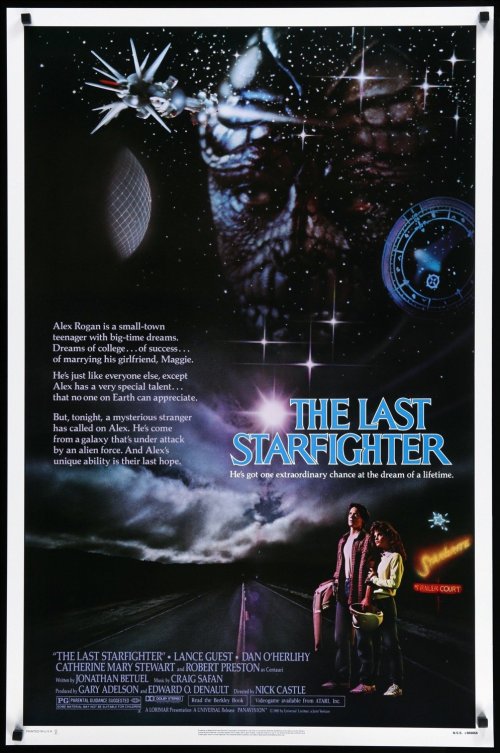
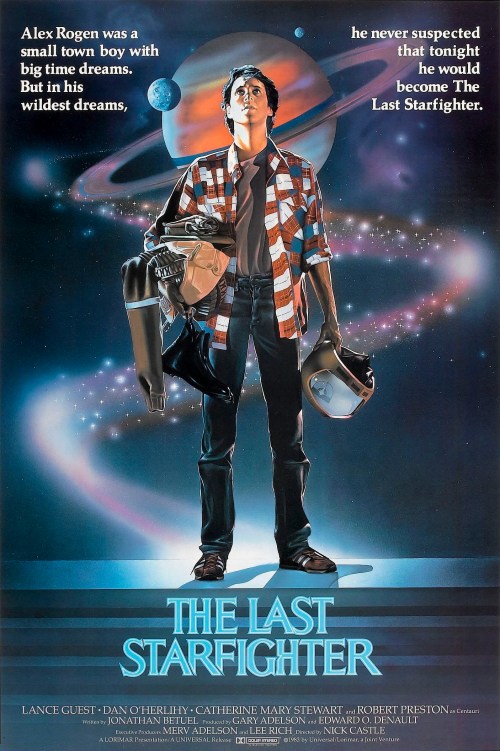
Alex (Lance Guest) spends his time playing an arcade game called ‘Starfighter’ and gets so good at it that he becomes the game’s highest scorer. He’s then approached by the game’s inventor, Centuri (Robert Preston), to take a ride in his  futuristic-looking car as a prize. Alex accepts the invitation only to learn that Centuri really isn’t human, but instead an alien recruiting Alex to help them protect the frontier from Xur (Norman Snow) who has found a way to breach the forcefield that protects Rylos and the surrounding planets from invasion. The ‘Starfighter’ game was meant to be a test to find those that were good at the game and then bring them into the battle since the skills needed to win the game are the same ones needed for the battle.

While the film did quite well at the box office, bringing in $28 million from a $15 million budget, as well as spawning a novel version, a video game, and even an off-Broadway musical, I still found it to be a complete bore to watch. I don’t mind sci-fi, space-age movies, which were all-the-rage in the 80’s, but the special effects in this one are so tacky looking that I couldn’t take it seriously. This was one of the first films to use computer graphics instead of physical models, but the result makes this entire galactic war look like a video game. Maybe that was the intention, but I didn’t care for it.

The story, which was written by Jonathan R. Beutel while he worked as a cab driver, is full of too many plot holes. Having the setting inside a trailer park, which wasn’t even Beutel’s idea anyways, but instead director Nick Castle’s, is the only original thing about it. I didn’t understand though why all the people living in the trailer park would be so excited about Alex getting the high score in the game and come out of their homes to cheer him on. To them it’s just a silly kid’s game and becoming good at it doesn’t really mean much in the real-world, or lead to anything, so outside of an idle teenager with too much time on his hands, why care? It would’ve been more ironic had Alex achieved the high score with no one else around making him feel his efforts were under appreciated, only to later learn that in a far off galaxy it was anything but.

The way Centuri finds him, by literally driving up to him in the middle of the night in his snazzy car while Alex is conveniently walking alone is not interesting and this scenario could’ve been played-up in a more creative way by forcing Centuri to tour through the trailer park and visiting the many residents, which could’ve included some offbeat interactions, before he finally comes upon Alex. Also, why are these aliens forced to recruit a human teenager in their effort to save their own space fortress? Aren’t there other aliens within their own galaxy that could take-up the cause? What’s in it for Alex to get involved and put his life on the line for some distant, separate universe that he has nothing to do with and won’t directly affect his life in any way should these planets get invaded? The idea too that only two individuals, Alex and his alien pal Grig (Dan O’Herlihy), can take on this massive army and win are long odds that would only make sense in a cheesy Hollywood movie.

Guest was not the right choice for the part either as he was too old, playing a teen when he was already 23 at the time of filming and looking it. The part should’ve been played by a 12-year-old especially since the storyline is at a bubblegum level that only a preteen would be able to buy into. Preston is certainly a great actor, but I didn’t understand why his character felt the need to wear a human mask to disguise his alien face when all the other aliens freely showed who they were. It’s disappointing too that Norman Snow, who gives an campy performance as the villain, disappears too soon, but I really did like O’Herlihy, who’s completely unrecognizable underneath all of the make-up, and the only thing that makes watching this dopey thing slightly worth it.

The one aspect of the plot that is amusing is the Beta Alex that’s put in Alex’s place to help disguise that the real Alex is missing. These scenes, where the Beta learns to adapt to the human culture in awkward ways, are the only original bits in the film and where filmed after production had already finished when test audiences reacted favorably to the character forcing Guest to return to shoot the added scenes, but because he had already gotten a haircut by this time, the Beta Alex is then seen wearing a wig. Outside of these moments though I found the film to be pretty flimsy especially on the logical end and one of the weakest entries of the 80’s sci-fi craze.

laststar2

My Rating: 2 out of 10

Released: July 13, 1984

Runtime: 1 Hour 41 Minutes

Rated PG

Director: Nick Castle

Studio: Lorimar Film Entertainment

Available: DVD, Blu-ray, Amazon Video, YouTube