Tag Archives: Review

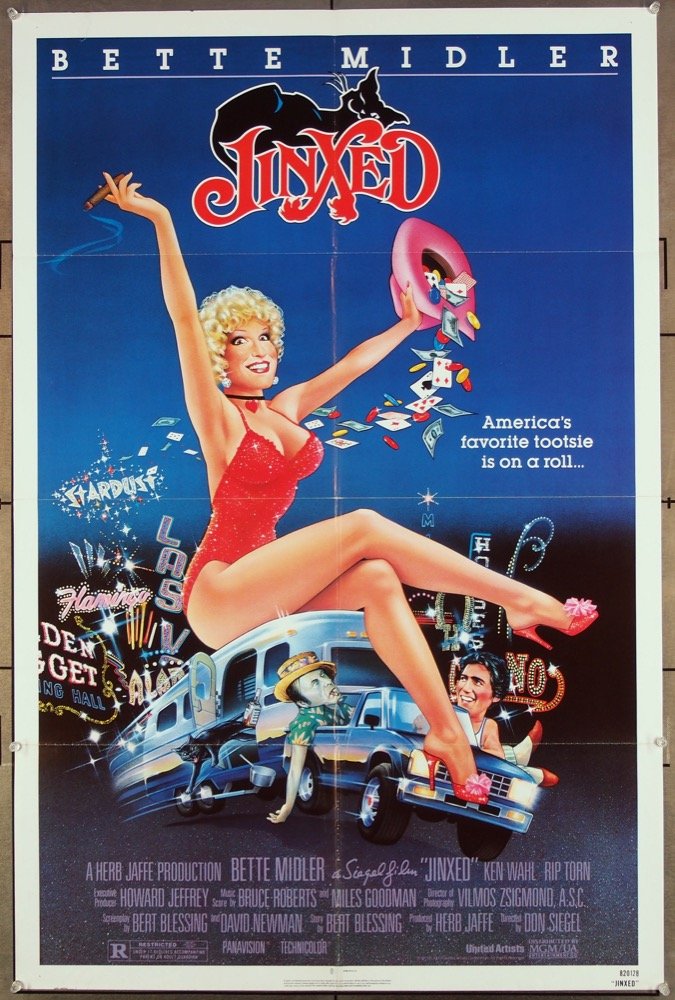
Jinxed! (1982)

Version 1.0.0

Version 1.0.0

By Richard Winters

My Rating: 3 out of 10

4-Word Review: Blackjack dealer is cursed.

Harold (Rip Torn) is a gambler who can never seem to lose whenever he goes up against one Vegas blackjack dealer in particular, Willie (Ken Wahl). In fact Harold’s winning streak versus Willie becomes so extended that it gets him fired and he’s forced to find a similar job in Reno. Harold follows him up there and Willie’s losing ways start all over again. His supervisor (Val Avery) doesn’t think Harold is doing anything unethical and instead becomes convinced that he’s put some sort of jinx on Willie and for Willie to end it he needs to get something of Harold’s. He drives out to Harold’s isolated trailer where he resides and realizes he has a wife named Bonita (Bette Midler) who also happens to be a lounge singer. She’s sick of dealing with Harold’s abusive ways and makes a deal with Willie that they kill him and then spend the proceeds of his life insurance payout afterwards.

The movie is appropriately titled not so much for what occurs onscreen, but more with what happened behind it. The story was based on the Frank D. Gilroy novel ‘The Edge’, which was published in 1980 and then had the screen rights sold for $300,000. While Gilroy wrote the first draft it was then handed over to David Newman who did a second rewrite and from there passed onto Jeremy Blatt who did a third version before director Don Siegal and Bette Midler began doing further revisions until Gilroy finally asked for his name to be taken off the credits as the plot no longer resembled anything from the book.

The real issue though started with Siegel who was at odds with the leading lady and then eventually became stricken with a heart attack where he ceded directing reins to Sam Peckinpah who completed many of the remaining scenes uncredited. Star Wahl also found getting along with Midler to be difficult and the two feuded throughout making no secret of their disdain for each other even after the shooting was long completed.

From my standpoint the biggest problem was the casting. Midler can be a funny lady, but not in this type of role. She’s known for her snarky, brash, and outgoing personality, but here plays someone who’s shy and pensive something that just doesn’t connect with who she is at all. Maybe she wanted to step out of her comfort zone and that’s why she took the role, but she doesn’t play it convincingly and thus it’s hard to get into. Wahl isn’t up to the demands of being a leading man and it’s no wonder he retired from the business in 1996. His delivery is flat and nothing that he says, or does is engaging. He has a few amusing lines here and there, but overall seems to be phoning it in and the romantic moments between him and Midler come-off as clearly awkward and out-of-place.

There were a few elements that I did like. It captures the rustic side of Nevada quite nicely and not just Vegas, but also Reno and the rural portion of the state. You also get to see an actual, in fact there’s two of them, $10,000 bill, which the fed no longer prints making it the coolest moment in the whole movie. Torn also gives a energetic performance and could’ve put on a clinic for the other two if they had paid attention. Though during his character’s death scene he does blink his eyes and make some brief facial gestures when Midler kneels beside him and slaps him making it seem like he really wasn’t dead even though technically he was. There’s also a few too many shots of his hairy butt crack, which I didn’t particularly care for. A funny scene done inside an adult bookstore, where director Siegel gives himself a cameo as the porn shop clerk, which I found to be a highlight.

Spoiler Alert!

Unfortunately the third act veers off in a weird way where Midler goes on a scavenger hunt using cryptic letters that her deceased husband wrote her before he died, which as critic Roger Ebert describes in his review of the film, ‘paralyzes’ the movie. If anything Wahl should’ve gone along with her as they follow the clues, which might’ve strengthened their chemistry and made them seem more like real couple who could work together to solve things instead of these two individuals doing things mostly on their own.

There’s also no explanation for what exactly was causing the whole jinx thing. Supposedly the luck as it were was coming from the cigars that Torn was smoking, and which Midler later does as well, but why would these cigars bring good luck? Normally smoking cigars can’t help one win at blackjack, so what secret cosmic power did they possess, so that it made a difference in this case? There’s no answer either as to who Torn was calling on his pay phone outside of the trailer he lived in after he lost to Wahl and was now broke. It made it seem like he was conspiring, or in connection with someone else, or maybe some sort of behind-the-scenes organization, criminal or otherwise, and the film should’ve made it clear what this was about, but ultimately doesn’t.

My Rating: 3 out of 10

Released: October 22, 1982

Runtime: 1 Hour 43 Minutes

Rated R

Director: Don Siegel

Studio: United Artists

Available: DVD, Blu-ray, Amazon Video

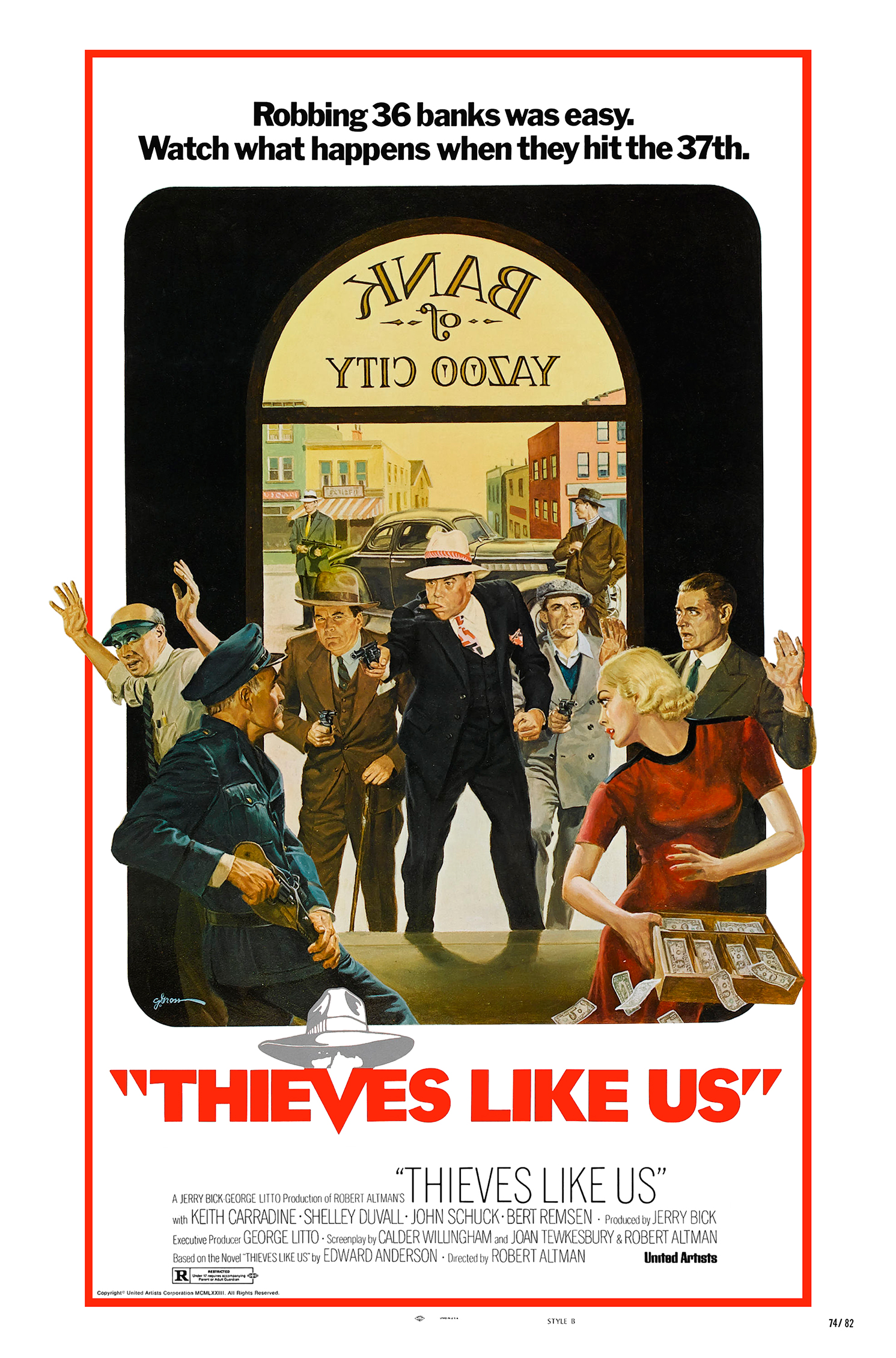
Thieves Like Us (1974)

thieves

By Richard Winters

My Rating: 6 out of 10

4-Word Review: Convicts escape from jail.

Bowie (Keith Carradine) is a young man stuck in jail due to a murder conviction from when he was a teenager. He teams up with Chicamaw (John Schuck) a middle-aged man to escape from prison and meet-up with T-Dub (Bert Remsen) an older man who has them hide-out at a local auto garage where Bowie meets the owner’s daughter Keechie (Shelley Duvall) and the two start-up a relationship. The three men return to their criminal ways by robbing banks, which goes well for awhile until the quick-triggered Chicamaw shoots and kills a bank clerk, which gets him recaptured and returned to prison. Bowie, who has now gotten Keechie pregnant, feels a loyalty to help get Chicamaw out, but Keechie wants him to settle down and get a conventional job while learning to become a family man. Bowie though resists the urge and after leaving Keechie at a motel cabin owned by Mattie (Louise Fletcher) sets out to help Chicamaw break-out for a second time, but this ultimately leads to tragedy.

The film was based on the novel of the same name written by Edward Anderson and published in 1937. The book had been adapted before in 1949 as They Live By Night, which Robert Altman was not aware of before taking on the project. Joan Tewksbury, his longtime screenwriter, adapted the book in a matter of 4-days, but getting it financied proved challenging and it was only after Altman and two of his other producers offered to mortgage their homes to help bring in needed capital that it eventually got green-lit. Unfortunately once it was completed the studio didn’t know how to promote it and ultimately released it without any advertising budget or fanfare. After a brief 3-week stay in the theaters it fell into obscurity before being resurrected by critical acclaim, which made it do well on cable television and has since gained a small cult following.

The atmosphere is probably the best thing as Altman achieves an authentic 1930’s setting. Other films that try to recreate the era always come-off a bit affected and cliched, but because Altman actually grew up during the period he’s able to give it the needed grittiness and I felt right from the start I was being transported to a different time versus feeling like I’m looking back at a bygone era through a modern day lens. The film has two very memorable moments. One of them is when Bowie goes to the prison to help Chicamaw breakout and meets up with the prison warden who’s residing in this country-style house and feasting on a large dinner. The contrast of this home cooked meal prepared by his wife like they were peacefully living out on a rural farm versus stationed right in the middle of a prison with dangerous criminals is something I really loved. The bank robbery game that the three men play with Mattie’s children where they turn their living room into a make believe bank with the children playing bank clerks and then the men proceed to ‘rob it’ is quite cute as well.

The acting is excellent by Carradine who starts to come into his own during his moments with Duvall, who is also good and does her very first fully nude scene. Lousie Fletcher, who’s first movie this was after she took a 10-year hiatus to help raise her kids, is supreme and helps give the proceedings a very definite, no-nonsense attitude and it’s just a shame she wasn’t in it more though the segments she does have she makes the most of. Tom Skeritt turns out to be a delightful surprise here. Normally I’ve found his work to be rather forgettable and under the radar, but here he stands-out as an alcoholic father who’s a pathetic character with darkly amusing lines.

The film though does suffer from Schmuck’s and Remsen’s characters seeming too much alike and I found the rapport between them to be quite unenlightening. Altman also takes a page out of Hitchcock’s directing book where like with what Hitch did in Frenzy he has the camera pull back away from the action going on inside the building and focusing instead on what’s going on outside. He especially does this during the robberies, which is initially kind of interesting, but he does it too much and then when he finally does show a robbery in progress he does solely from a bird’s-eye view with the camera nailed to the ceiling, which causes the viewer to feel too emotionally detached from what’s happening. He also completely skips over the part where T-Dub gets shot and killed and Chicamaw recaptured, the viewer only learns of this by hearing it reported on the radio, but these are pivotal moments to the story and the film is slow enough the way it is, so this is the type of action that should’ve been played-out.

Spoiler Alert!

The climactic sequence where the cabin that Bowie is in gets surrounded by Rangers and shot-up doesn’t work at all. This is mainly because it’s too reminiscent of the same type of shoot-up done in Bonnie and Clyde that was more famous and riveting. Here it comes-off like a second-rate imitation of that one and does nothing but make you want to go back and see that one while completely forgetting about this one in the process.

My Rating: 6 out of 10

Released: February 11, 1974

Runtime: 2 Hours 3 Minutes

Rated R

Director: Robert Altman

Studio: United Artists

Available: DVD, Blu-ray

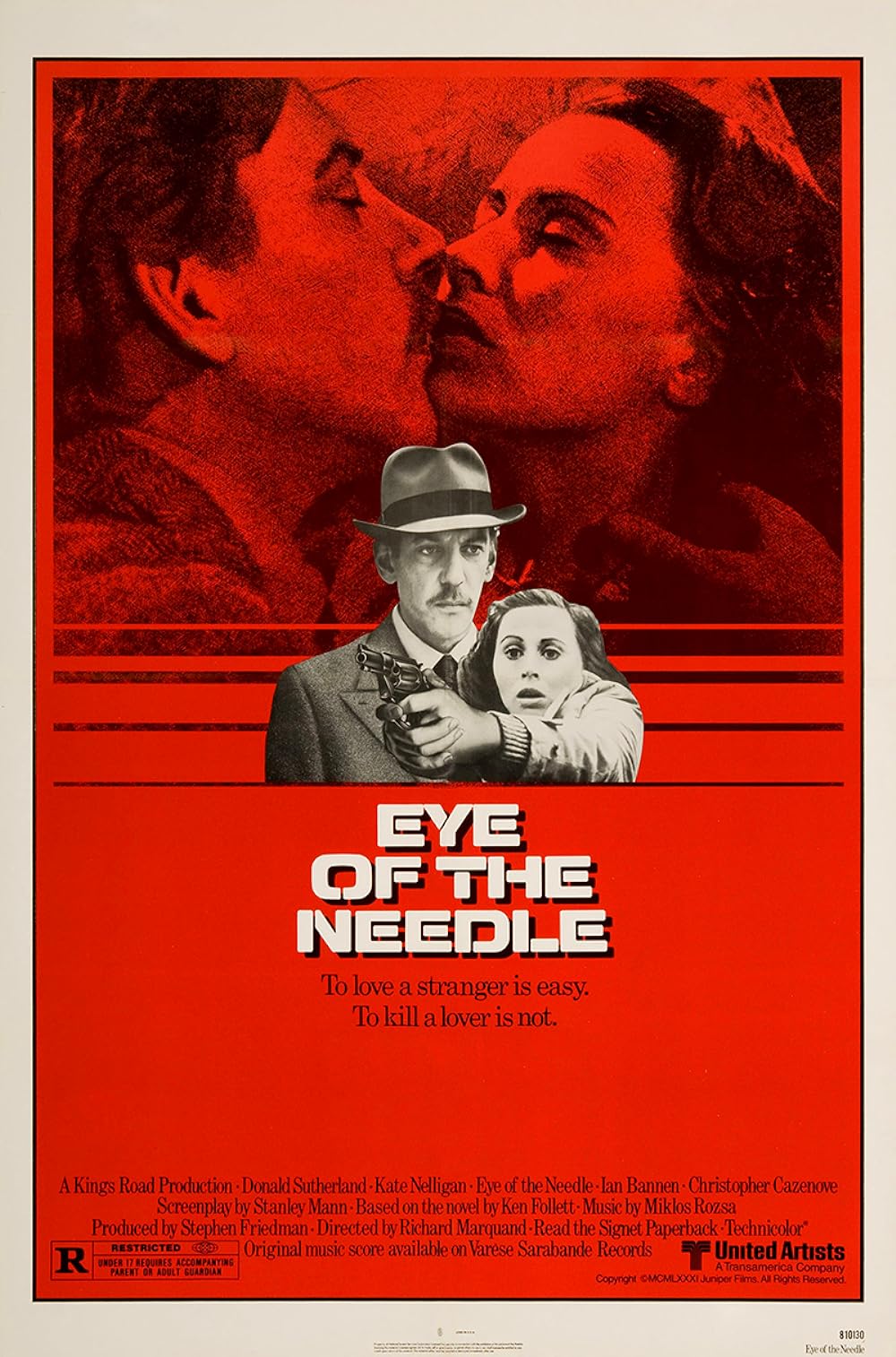
Eye of the Needle (1981)

eye

By Richard Winters

My Rating: 7 out of 10

4-Word Review: Spy infiltrates isolated family.

Henry (Donald Sutherland) is a German spy stationed in England during WWII, who comes upon an airplane site that he thinks is the Allied commandment post for the eventual invasion of Normandy, but upon closer inspection he finds out that the planes are all made of wood and the place is simply a decoy. With this information he tries to charter a U-boat to get back to his homeland, so he can hand his findings directly to Hitler and thus potentially change the course of the war. Instead his boat gets hit by a storm and crashes on the beach of Storm Island. Only four people reside there including Tom (Alex McCrindle), a lighthouse keeper and owner of a 2-way radio, which Henry needs to communicate back to Germany, as well as a young family made up of Lucy (Kate Nelligan), her husband David (Christopher Cazenove) and their 5-year-old son Jo. The family allows Henry to stay in their home while he recovers from his accident.  Lucy is sexually frustrated because on their wedding the couple got into a terrible car accident, which has left David paralyzed and unable to perform in bed. Henry catches onto to Lucy’s despondent situation and soon becomes her lover, but David suspects Henry of being a spy and the two have an ugly confrontation, which sends the situation for all those on the island to go spiraling out-of-control.

The film is based on the 1978 novel ‘Storm Island’ by Ken Follet, with the script staying pretty faithful to its source material. The story though kind of acts like two movies in one. The first half almost fully focuses on Henry’s spy exploits with lots of action and thrills while the second-half settles into being more of a subdued romance. Watching Sutherland playing this cold-blooded killer willing to callously off anyone that even slightly gets in his way without any remorse when for most of his career he played peace-loving hippie types, or at least that’s what he’s best known for, makes for an interesting contrast. It also shows as opposed to James Bond movies how being a spy can be a very lonely and unglamorous endeavor where a person is forced to constantly be on the run and can rely on no one, but themselves.

Spoiler Alert!

The shift during the second act where the tone becomes more of a drama doesn’t work as well. I couldn’t understand why Henry, this spy on-the-run and under extreme stress, would suddenly pick this time to get into a romance with a perfect stranger that he’s known for less than a day. If he wants to try and exploit the situation to feign romance so she will let down her guard and possibly defend him when and if the authorities arrive then fine, or maybe he’s just looking for some cheap sex to unwind him, which I could understand also. However, being in extreme survival mode where the welfare of himself and his top secret film are of the uppermost importance and then suddenly to pick this time to get sidetracked, and put himself in a an evermore and needlessly vulnerable position by trying to start-up and an affair while also simultaneously hiding-out made absolutely no sense.

I couldn’t buy into Lucie openly admitting her painful marriage to a perfect stranger either, which she candidly divulges to Henry less than 24-hours after first meeting him. Most people have pride and ego and thus won’t want to admit the harsh truth about their lives when somebody, in this case Henry, exposes it to them. They instead would want to ‘keep up appearances’ and maybe even become defensive, or resentful of someone they don’t know bursting into their home and openly telling them unflattering things about themselves and yet here Lucie melts completely when Henry confronts her about her flawed union and gushes out all the personal details like he’s her own personal therapist, which happens too quickly to being even remotely believable.

Spoiler Alert!

The affair angle didn’t seem necessary anyways since during the third act when she finds out he’s a spy she goes after him violently without any pause. You’d think if she had been intimate with him she might want to ‘hear his side of things’ or consider escaping with him from her dreary life instead of her immediate response being that he’s the mortal enemy.

With all this said I did like the climactic foot chase where Lucie goes after Henry with a gun alongside this rocky cliff ( in the book she throws a stone at him, but the shooting gun makes it more dramatic). Yet even this and some of the other twists that come about during the third act aren’t as effective as they could’ve been because all of the secrets are given away right from the start and instead having it start out in the cottage, where the relationship between Lucie and Henry could’ve taken more time to be realistic, and where Henry’s true identity wasn’t known upfront would’ve made what happens at the end more riveting, shocking and even profound, which with the way it gets done here doesn’t fully gel.

There’s also some problems on the technical end. The music is way too loud and at times obnoxious to the point it becomes heavy-handed and could’ve easily been left out altogether. The scene showing Henry chasing after Lucie who’s driving away in a car gets badly botched. The faraway shots of him running are okay, but the close-up, showing him from the waist up, looks like he’s jogging on a treadmill. The scene too inside the lighthouse where Lucie unscrews a lightbulb in order to insert a key into the socket and cause the fuse to blow looks phoney because if she were handleling a live bulb bare handed, as she does, she would’ve flinched and even let out a bit of a yelp from the scorching heat, but instead she doesn’t.

My Rating: 7 out of 10

Released: July 24, 1981

Runtime: 1 Hour 52 Minutes

Rated R

Director: Richard Marquand

Studio: United Artists

Available: DVD, Blu-ray, Freevee, Roku, Tubi, Amazon Video

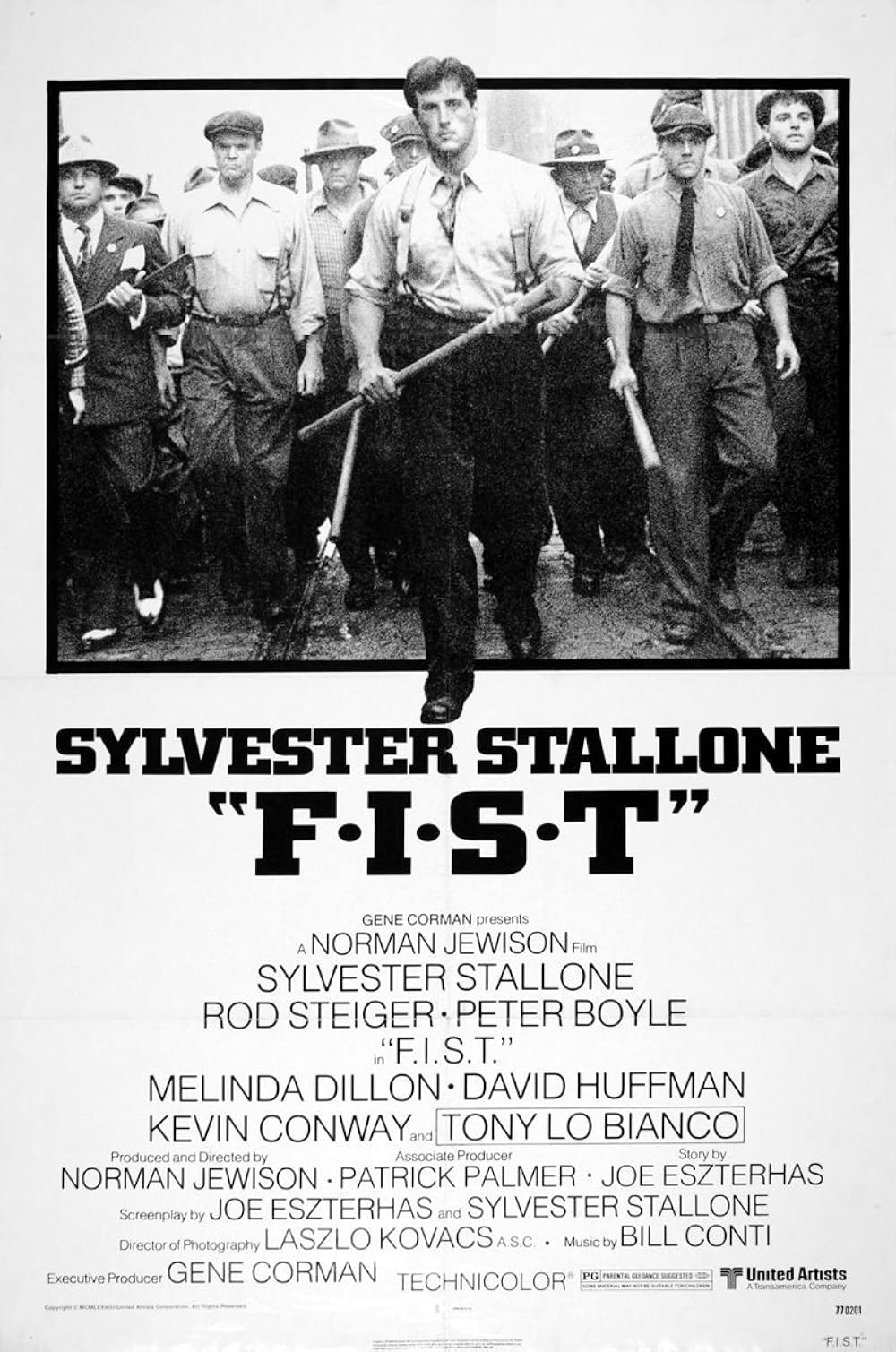
F.I.S.T. (1978)

fist

By Richard Winters

My Rating: 7 out of 10

4-Word Review: Laborer becomes union leader.

Set in the 1930’s in Cleveland the story centers on dock worker Johnny Kovac (Sylvester Stallone) who becomes so upset at the poor treatment of the employees that he leads a revolt that soon gets squashed by a management when Kovac goes to the office of Mr. Andrews (James Karen) who promises to bring his demands to ownership only for the next day to have Kovac and his friend Belkin (David Huffman) fired from their jobs. Impressed though by their tenacity truck driver Mike (Richard Herd) recruits them into his union telling them they would have a job of going out and recruiter others. Kovac initially refuses the offer until he finds out that a free car would come along with it. Kovac eventually rises up the union ladder until he becomes their national leader, but with the power and prestige also comes corruption and enemies.

This was Stallone’s first film after doing Rocky, which was a bit of a gamble by director Norman Jewison. He had wanted to cast Jack Nicholson in the role, Nicholson would later star in a similar film Hoffa, which came out 14 years later, but was so impressed at Stallone’s performance in the boxing film that he offered the role to him before he was even a household name. Jewison felt Sly was a star in the making just from what he saw in the preview of the film not knowing whether that movie was ultimately going to be a runaway success, or not. Had it not it might’ve put him in an awkward position as the studio wasn’t likely to finance a project that didn’t have guaranteed star power. As it was it became a blockbuster making the tables-turned a bit because Stallone could’ve easily backed out of the deal since it had only been a verbal agreement and he had since then been offered higher paying roles, but he kept to his word and took on this project, which surprised Jewison as many big names in Hollywood don’t always stick to their promises, but then later when the film didn’t do as well as expected Jewison’s blamed Stallone’s casting as part of the problem.

From my perspective I thought Stallone was terrific. His delivery does come-off as a bit monotone, but I felt that’s what added to the authenticity as this was a character with a limited education, so he probably wouldn’t sound real smart to begin with. Seeing Sly fight the system correlated with his real-life struggles as an actor trying to make it big in a competitive business, which helped to make it seem all the more genuine like this was a guy who had really lived the same type of life as the man he was playing.

In support I was highly impressed with David Huffman. This was an actor, whose career and life were sadly cut short in 1985 when he got stabbed to death, who I had always found quite bland. He had an attractive looking face, which I figured is what got him his foot-in-the-door, but his acting always came off as blah, but here he puts a lot of emotion into his role and it’s interesting to see the way his character grows and morphs throughout. James Karen and Tony Lo Bianco both have small parts, but there sinister facial expressions and ability to mug to the camera without it seeming obvious is what helps them stand-out. I was surprised though with Rod Steiger who gets second billing, but doesn’t appear until 1 Hour and 33 minutes in. His part, as a powerful senator, does ultimately become integral to the proceedings, but the fact that he underplays instead of his usual over-acting is what got me.

I thought the way Jewison captured the setting was great. It was actually shot in Dubuque, Iowa because by that time Cleveland no longer looked the way it once did, but the flavor and vibes from that period come-out strong and you feel right from the start that you’re being swept away to a bygone time. Stallone’s ascension into the ranks of union head prove riveting, but his corruption and downfall get glossed over and seemed rushed. I did though appreciated the way it examines worker’s unions from all angles both the good and bad making it seem less like a propaganda movie than Norma Rae, which came-out at around the same time, but only focused on the positive aspects of unions.

Spoiler Alert!

The ending, in which Kovac gets shot and killed while in his home came-off like a cop-out. It was intended to reflect at the time the recent disappearance of union head Jimmy Hoffa, but seeing the main character get assassinated without telling who was behind it proves unsatisfying. Sure we could probably surmise who the culprits were, but having to sit through a long movie only to be left with more questions than answers makes the viewer feel like watching it had been a big waste of time.

My Rating: 7 out of 10

Released: April 13, 1978

Runtime: 2 Hours 25 Minutes

Rated PG

Director: Norman Jewison

Studio: United Artists

Available: DVD, Blu-ray

Butterfly (1982)

butterfly

By Richard Winters

My Rating: 0 out of 10

4-Word Review: Family has genetic birthmark.

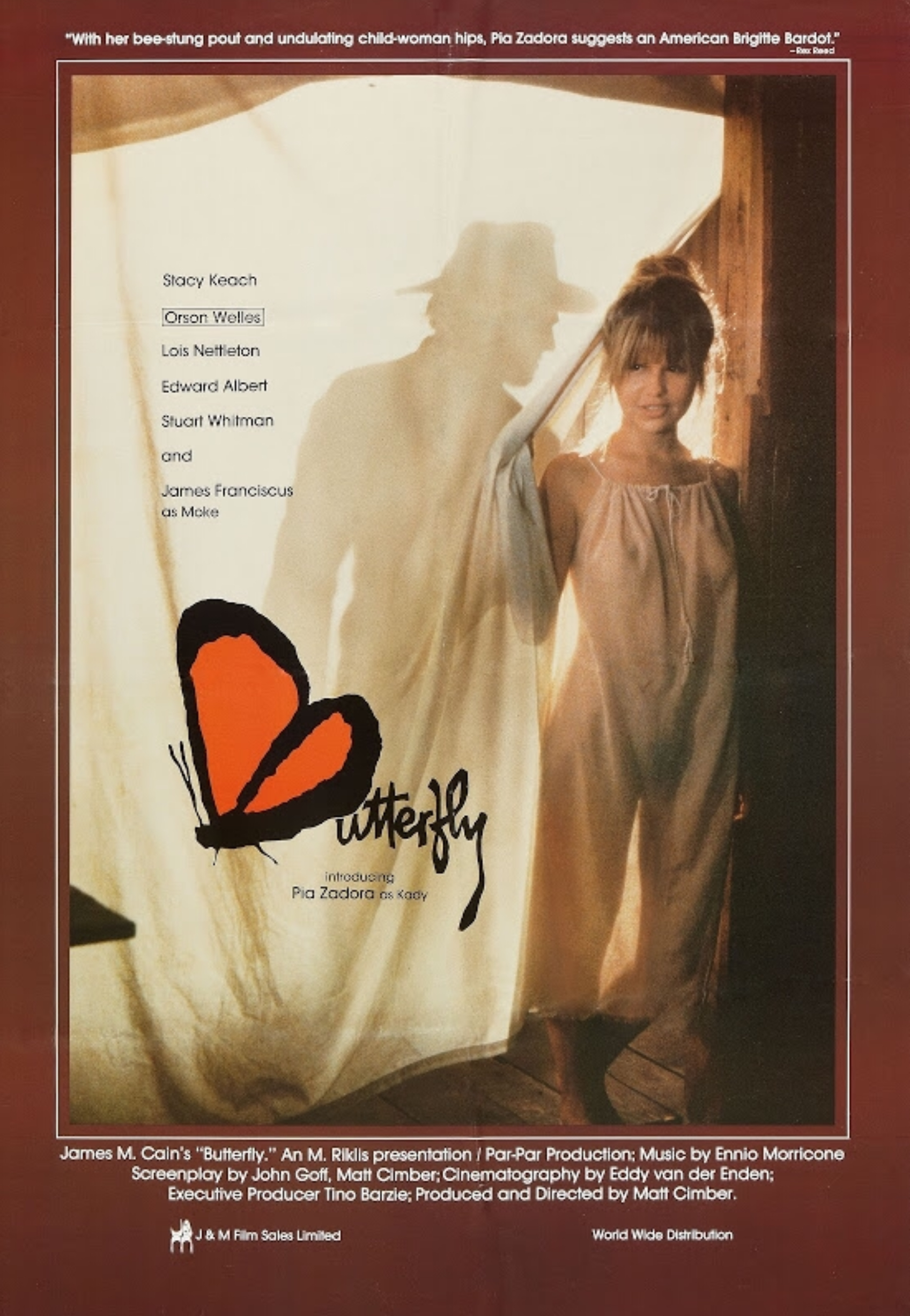
Jess (Stacy Keach) takes care of an unused mine outside of a small Arizona desert town. One day Kady (Pia Zadora) shows up at his doorstep. Jess doesn’t recognize her at first, but then realizes she’s his 17 year-old daughter the product of his marriage to Belle (Lois Nettleton) who abandoned him 10 years earlier for another man named Moke (James Franciscus). She is pregnant by a man who refuses to marry her, so she  wants to steal silver from the mine that Jess protects in order to help her financially with the child who’s on the way. At first Jess disapproves, but Kady uses her provocative body and looks to essentially seduce him and get him to relent. However, a local man named Ed (George Buck Flower) witnesses their stealing from the mine as well as their lovemaking later on, which gets them arrested for incest.

The story is based on the 1947 novel ‘The Butterfly’ by James M. Cain, who at the time was an immensely popular author, who had many of his books made into movies, but due to the controversial nature of this one it had to wait 35 years until it finally went to the big screen. He was inspired to write the story when years earlier, in 1922, he got a flat tire while driving through a mountainous area in California and a farm family that had moved there from West Virginia helped him fix it, but at the time he speculated that the young daughter they had with them was a product of incest.  The movie makes several deviations from the book. In the book Jess was the overseer of a coal mine and the plot took place in West Virginia while the Kady character was 19 instead of 17.

While the plot has some tantalizing elements, and on the production end it’s well financed, the whole thing comes crashing down due to the really bad performance of its lead actress. Zadora at the time had done only one other film before this one, Santa Claus Conquers the Martians, which was universally lambasted. It probably should’ve killed anyone’s career who had been in that, but she continued to struggle on in the business. Then in 1972 while performing in a small role in a traveling musical show, she caught the eye of a rich businessman named Meshulam Riklis, who was 29 years her senior. The two began dating and eventually married in 1977. Her new husband was determined to make her a star even if it meant buying her way in. He put up the entire $3.5 million budget for the film while demanding that she be placed as the star forcing director Matt Cimber to cast all the other parts around her. Riklis even put up big money to help get her promoted to winning the Golden Globes Newcommer of the Year Award, but all of this didn’t get past the critics, or audiences who rightly saw her as undeserving of all the attention and while she did a few other movies after this, which were equally panned, and even a few music videos and singing ventures, she is overall largely forgotten today and hasn’t been in a movie in 30 years.

To some extent her performance isn’t completely her fault as her character is poorly fleshed-out, which is my main gripe. I just couldn’t buy in that this chick on the verge of adulthood would be so extraordinarily naive that she’d come-on to her own father and not see anything wrong with it. First of all why is she sexually into her dad anyways as majority of girls tend to want to go for guys their own age and if not there has to be a reason for it, which this doesn’t give. In either case she should have some understanding that the rest of society doesn’t condone this behavior nor having her aggressively flirt with literally any guy she meets. The fact that she’s so blissfully ignorant to the effects of her behavior made her not only horribly one-dimensional, but downright mentally ill. Sure there’s people walking this planet that harbor some sick, perverse desires, but virtually all of them know they’re taboo and not dumb enough to be so open about, or if they do they learn real fast. Having her unable to understand this, or never able to pick-up on even the slightest of social cues is by far the most annoying/dumbest thing about it.

Keach, who gives a good performance and the only thing that holds this flimsy thing together, has the same issue with his character though not quite as bad. The fact that he doesn’t even recognize his daughter at first is a bit hard to believe. Sure he left the family 10 years earlier, but that would’ve made her 7 at the time and although she has clearly grown I think she’d still have the same face. He gives into his temptations too quickly as at one point he massages her breasts while she’s in the tub. Now if he weren’t religious then you could say he didn’t care about the taboos and had been living so long alone that he’d be happy to jump at any action he could irregardless if they were related, but the fact that he goes to church regularly should make him feel guilty and reluctant to follow through. In the book he’s portrayed as fighting these internal feelings by turning to alcohol, which is the way it should’ve been done here as well.

The eclectic supporting cast does make it more interesting than it should. Orson Welles caught my attention not so much for his role as a judge, but more because of his wacky combover. James Franciscus, who usually played sterile good guys is surprisingly snarly as the heavy and Stuart Whitman has a few good moments as a fiery preacher though even here there’s some logic loopholes that aren’t explained like how did he know Kady was Jess’ daughter, which he mentions while at the pulpit much to the surprise of Jess as he hadn’t introduced her to anybody.

My Rating: 0 out of 10

Released: February 5, 1982

Runtime: 1 Hour 48 Minutes

Rated R

Director: Matt Cimber

Studio: Analysis Film Releasing Corporation

Available: DVD-R

Paradise Alley (1978)

paradise

By Richard Winters

My Rating: 5 out of 10

4-Word Review: Promoting brother as wrestler.

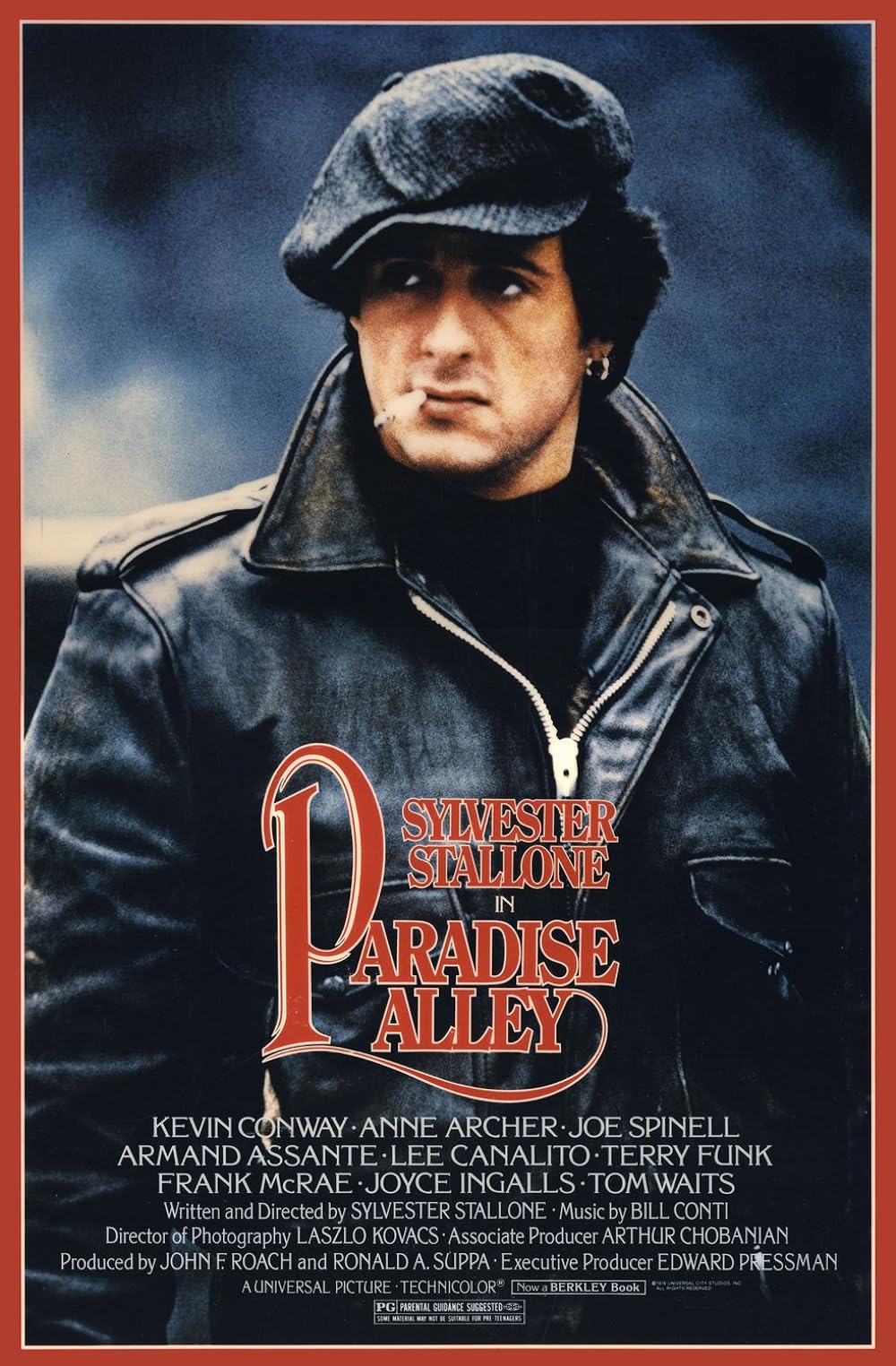
Cosmo (Sylvester Stallone) is a local street hustler in Hell’s Kitchen who will attempt just about anything to make a buck even pretending to be a homeless person begging for money. Eventually he gets the idea of turning his younger brother Victor (Lee Canalito) into a wrestler and then promoting his bouts inside the ring with others. Victor, who’s strong and well built, initially resists, but he eventually grows tired of his job hauling ice blocks and decides to give in. Cosmo’s other brother Lenny (Armand Assante), a war veteran who walks with a limp, is not keen to the idea either, but through prodding comes onboard as Victor’s manager. Things start out well, but the despite winning the contests Victor’s body takes quite a toll and Cosmo ultimately believes it’s time to give up on it, but Lenny, who begins to enjoy the money he’s making as manager, refuses to let up and pushes Victor into more and more dangerous matchups, which Cosmo’s worries may be putting Victor at too much risk.

The script was written by Stallone that was initially started as a novel. He wrote this before Rocky, but couldn’t get anyone interested in financing it though he was at least able to get it optioned. He then had an acting audition with two producers, Irwin Winkler and Robert Chartoff, while he didn’t get the part he did mention, as he was walking out, about this script. The two men were interested in looking it over, but the other producer who Stallone had optioned it to refused to give it up, so Sly instead wrote Rocky, which he then handed over to Chartoff and Winkler, which was green-lit. Then when that became a runaway success the producers agreed to finance this one even allowing Stallone to not only star, but also direct.

Unfortunately the result here is a mish-mash with things being off-kilter right from the start. The absurd race that Stallone has with another man, done over the opening credits, where the two jump from one tall city building to another seemed hard to believe. At some point one or both are going to miss hitting the other side and fall most likely to their death, which does happen eventually, but the guy is lucky enough to conveniently hang onto an outdoor clothes line though with no explanation for how he got down from that and Stallone, supposedly his friend, just laughs at him dangling there and struts away. Stallone also sings the opening song, which is dreadful.

Things really don’t improve much from there. There are a few nice camera angles and provocative close-ups here and there, but the scenes meander to the point there doesn’t seem to be any momentum, or story. The tone shifts precariously from gritty realism to romanticized idealism. The characters aren’t consistent either. Stallone is the one that initially involved in pushing his reluctant brother into the ring while Assante is very cautious and then for some inexplicable reason this gets reversed with Stallone warning of the danger while Assante becomes overly driven. However, for it to make sense there needs to be an explanation for this big change between the two and none is given making their mutual character archs poorly fleshed-out.

Stallone is certainly engaging though his likability gets tested especially with the segment where he ties up a live monkey, even puts a gag in its mouth, and then dangles it from the ceiling. Anne Archer is fun and virtually almost unrecognizable sporting a red hairdo while playing a sassy Italian love interest. Kevin Conway is highly amusing as the heavy who talks tough when surrounded by his henchmen, but proves wimpy when all alone and his climatic pants pulldown is a hoot. Noted real-life wrestler Terry Funk is quite memorable as the muscled bully and the arm wrestling match-up between he and Victor where the mounting sweat glistens off his body as he struggles to keep his arm from hitting the table is one of the movie’s highlights.

The climactic wrestling match done inside a building with a very leaky roof where the action is done in slow-motion with water splashing all over does have its moments though it eventually becomes redundant. While there’s flashes of occasional brilliance it never fully comes together. A tighter script and more consistent tone were sorely needed and Victor, who’s the only likable guy of the bunch, required more of a multi-dimensional context. The fact that he could beat-up anyone and do it in such a humble way while never having to pay the ultimate price either physically or mentally just isn’t believable.

My Rating: 5 out of 10

Released: September 22, 1978

Runtime: 1 Hour 47 Minutes

Rated PG

Director: Sylvester Stallone

Studio: Universal

Available: DVD, Blu-ray, Amazon Video, YouTube

Second Thoughts (1983)

second thoughts

By Richard Winters

My Rating: 1 out of 10

4-Word Review: Lawyer considers an abortion.

Amy (Lucie Arnaz) is in a relationship with Will (Craig Wasson) a former political activist who found out trying to change the world was too difficult, so now he settles for just being a street musician, who at times gets in minor skirmishes with the law and needs Amy’s assistance as she’s also a lawyer. Amy then also gets ‘hired’ by her ex-husband John (Ken Howard) to represent him in his divorce from his second wife that’s really a ploy to try and get back together with her. Will and John know each other when Will applies for a loan from a bank that John manages though neither of them know about either of their relationships with Amy. Then Amy gets pregnant and considers an abortion. John is fine with her decision and even agrees to drive to the hospital while Will sneaks into the facility and kidnaps her in an attempt at preventing it from happening.

This was the second movie directed by famed producer Lawrence Turman whose first foray behind-the-camera was 12 years earlier with Marriage of a Young Stockbrokerwhich was panned by most critics though I found it interesting. This one got savaged as well and for the most part rightly so. The main issue is the disjointed tone that starts out as a drama with a TV-Movie of the week theme and then by the second act slides over into becoming an offbeat comedy. The unimaginative title and misleading movie poster, which makes it seem like two horny adults frolicking around, which it isn’t, was more than enough to confuse potential audiences and keep them away and thus lead it into being a financial disaster at the box office with a very limited release before falling off into complete obscurity.

To its benefit it does have some unique moments. The segment where Will puts a dead fish into the bank’s safety deposit box as revenge for them not giving him a loan and then stinking up the place to the point that they bring in a whole bunch of cats in order to sniff out where the odor was coming from is commendable. I also enjoyed Lucie’s attempt to escape from the isolated cabin that she’s in, where she’s handcuffed to a bed, by trying to drag the entire bed frame down the stairs, which could’ve been played-up more. I also got a kick out of the scene where John’s ex-wife, played by Ann Schedeen, threatens his beloved potted plants, even holding one ‘at gunpoint’ unless he agrees to pay for her cosmetic surgery.

Unfortunately Lucie Arnaz’s performance kills it. She had the option of either doing this one, or Poltergeistand decided on doing this because she felt it lent her greater dramatic work, but in the end she should’ve gone with the other one as that has obtained a cult following while this one is completely forgotten. Her character is too much of a composite of the modern career woman. There’s nothing unique, or interesting about her and thus you never get emotionally invested in her journey and if anything find the times she is on the screen to being the film’s most boring moments.

Wasson has been lambasted on this blog before with the other movies he’s been in and his appearance here proves no exception. He’s supposed to be playing an American Indian, but doesn’t look the part at all and somebody with an actual Native American ancestry should’ve been given the role. The songs that he sings, many of which have a ragtime quality, I found to be just as annoying as his acting and his character isn’t likable. The way he holds this woman against her will until she agrees to have ‘his baby’ I found genuinely creepy. Now of course if one is on the Pro-Life side of the fence maybe they’d consider what he does to be ‘heroic’, but while having a civil debate on the issue and him voicing his concerns on why he feels she shouldn’t terminate the pregnancy is fine, but then confining someone to a small room against their will is where I feel he takes things too far and is no longer just this benign guy with good intentions.

The film’s ultimate message becomes a murky as its tone. Initially I thought with the casual way that the abortion option gets discussed that this was a typical liberal minded film with a pro-choice sentiment, then by the third act this all seems to get reversed especially with the female doctor character played by Peggy McCay. She has performed abortions before, but now is reluctant to do it on Arnaz while using the excuse that she no longer ‘feels comfortable’ with it, which seemed to be the filmmaker’s attempt to insinuate that abortion doctors know what they’re doing is ‘wrong’ and ultimately start to feel guilty about it afterwards.

There’s another doctor played by Arthur Rosenberg, who has no qualms performing abortions, but is also portrayed as being incredible callous and obnoxious. At first I thought this was just done for misguided comedy, but eventually it seemed that this was the filmmaker’s way of trying to show how doctors that do this type of procedure without an regrets are ‘bad and crass’ people inside and his constantly rude demeanor was just a way of ‘exposing’ this.

In either case both sides will get alienated by it. A pro-lifer won’t want to sit around watching a movie that at the beginning seems to be taking a different viewpoint  just to wait until the very end when it then seems to finally come around to their position. Pro- choice people will dislike the movie for the exact opposite reason and therefore you have to wonder what type of viewer this movie was meant to attract as I can’t think of anyone that would like it.

My Rating: 1 out of 10

Released: February 6, 1983

Runtime: 1 Hour 38 Minutes

Rated PG

Director: Lawrence Turman

Studio: Associated Film Distribution

Available: DVD-R (dvdlady.com)

Wild Horse Hank (1979)

wildhorse

By Richard Winters

My Rating: 4 out of 10

4-Word Review: Teen girl saves horses.

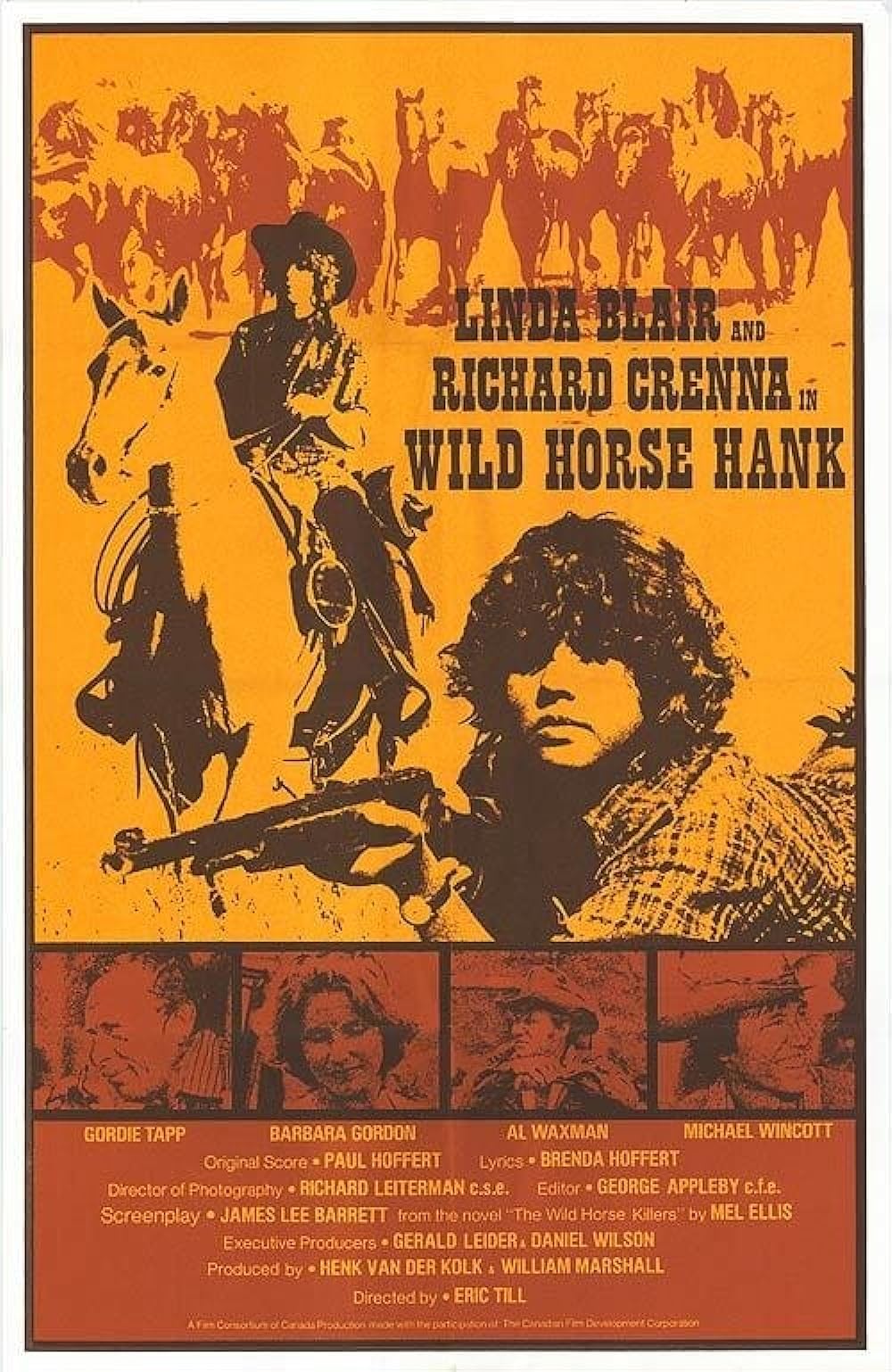
Based on the novel ‘The Wild Horse Killers’ by Mel Ellis the story centers around a teen girl named Hank (Linda Blair) who while tracking down her escaped stallion comes upon a group of men abusing some horses. She later learns that these men plan on destroying them in order to resell their meat for pet food. Hank becomes determined to herd them along treacherous terrain to the safety of a federal park where the horses will be free to roam without danger of being hunted. The problem is that it will be 150-mile trek and her father (Richard Crenna) doesn’t feel she’ll be up to the job, but Hank isn’t use to taking no for an answer and decides, with rifle in hand, to take on the challenge.

What stood out for me was the gorgeous western Canadian setting filmed on-location at both Dinosaur Provincial and Waterton Lakes National Park in the province of Alberta. The vast open view gives one a true sense of the outdoors and the rugged elements. The portrayal of the towns folk particularly the girlfriend of one of the bad guys, played by Barbara Gordon, who refers to her toddler son as her ‘popcorn fart’ and allows him to sip beer while complaining to everyone that he’s ‘a burden’ displays in raw fashion the economic hardship of country living and how fringe some in that region are and what levels they’d be willing to resort to in order to try and get out of it. It also gives a motivation for why the men are as savage as they are and it isn’t so much that they’re just ‘evil’, but more because other opportunities in such isolated areas are sadly few and far between.

The men are portrayed differently than in most other films where bad guys are given menacing looks and threatening presence. Here though they’re more like non-descript jobos you might find at the neighborhood bar, who on their own don’t pose much of a threat and like with the culprits in the classic film Straw Dogs don’t really become scary until they band together showing how otherwise benign people can become dangerous through peer pressure and financial insecurity, which in a way ends up making them even scarier.

Blair can certainly be a great actress if given the right material and knowing how much she loves animals I’m sure she took on this project because the theme was close to her heart, but the character doesn’t offer her much acting range. Normally the protagonist is supposed to grow and change in some way during the course of a movie, but here she’s one-dimensional. She’s super head-strong right from the start and remains that way to the end making her personal journey static. Had she been insecure at the beginning and then learned to overcome those feelings would’ve at least given the character a genuine arch.

I was surprised too that Crenna, who’s only adequate in his role and borders on being miscast, doesn’t go along with his daughter on her trek. He argues with her about how dangerous it is and yet ultimately waves her on her way and stays home. Had he tagged with her there could’ve been more opportunity for conversation and learned more about these people instead of long segments of silence, which makes the viewer more emotionally detached from what the character is going through instead of engaged.

I know I’ve complained about other adventure movies that throw in a hooky romance as a subplot, which I usually find annoying and yet this is a rare case where I wish it had been done. There’s a young good-looking guy named Charlie, played by Michael Wincott, who’s related to the poachers, but teeters the fence on whose side he’s on. He has some interactions with Blair during her trek and seemed like he was a potential love interest, but then he disappears only to come back later. He should’ve stayed all the way through as they made an interesting and cute couple with just enough animosity to keep it spicy.

Spoiler Alert!

There is a scene where Blair’s horse gets injured and she’s forced to shoot it, which I found powerful and the climactic sequence in which her father, who conveniently reappears again, gets all the truckers to create a roadblock, which stops the traffic, so the horses can cross the road. Overall though the film lacks subtext. The formula is too simple and straight forward. It may interest preteens especially those who love horses, but the main characters aren’t multi-dimensional.

My Rating: 4 out of 10

Released: May 15, 1979

Runtime: 1 Hour 35 Minutes

Not Rated

Director: Eric Till

Studio: Canadian Film Development Corporation

Available: DVD-R

Let it Ride (1989)

let

By Richard Winters

My Rating: 5 out of 10

4-Word Review: Betting at horse racing.

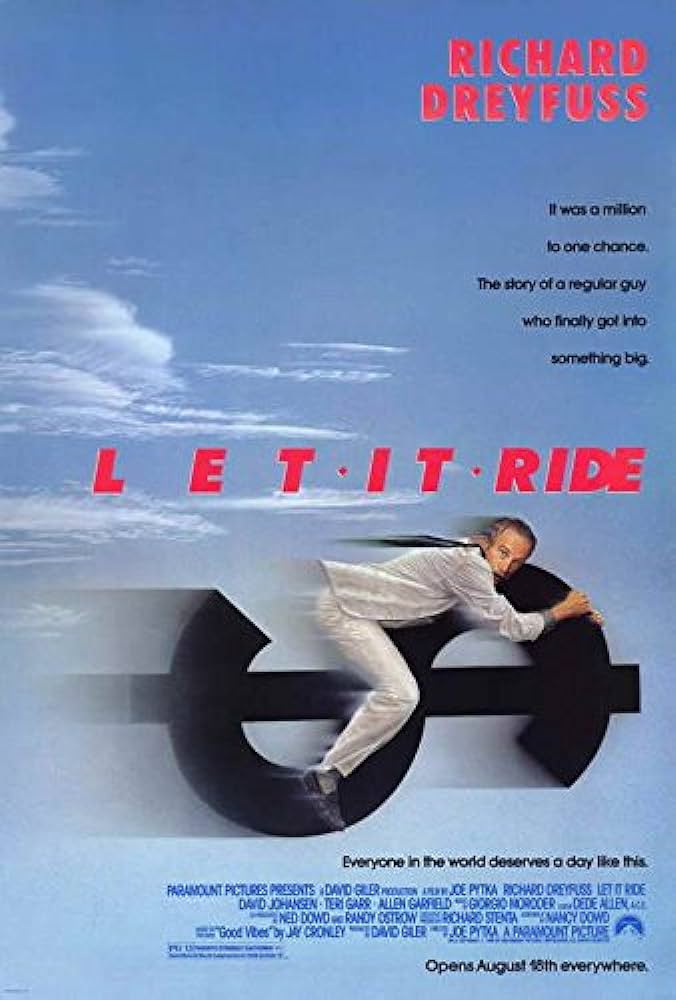
Jay (Richard Dreyfuss) along with his friend Looney (David Johansen) are two struggling Miami cab drivers. One day Looney, who secretly records discussions that his passengers have while in the backseat of his cab, overhears a tip by two men of an upcoming horse race. He passes on the recording to Jay. Jay has not had much success in betting and has even promised his wife Pam (Teri Garr) that he will quit, but he can’t pass up this opportunity and places a wage on the horse that had been discussed. It turns out to being a photo finish in his favor and he spends the rest of the day making more bets by using all of his winnings as his wagering. Soon, he finds himself getting richer and richer even as his wife comes to the track in an effort to get him to stop. Will his luck hold, or run out?

Probably the best thing about the movie is the acting particularly by Dreyfuss, who’s known for playing aggressive, snarky types, but here comes-off as surprisingly sympathetic. You genuinely feel for the guy and his need to win at something and has one comically touching moment where he kneels at the toilet of a grimy bathroom stall and prays/pleads to God for a break. Garr, who reunites with Dreyfuss as the two starred 10 years earlier in Close Encounters of the Third Kind where they also played a husband and wife, is equally engaging though while seen right at the start disappears for quite awhile only to reappear briefly during the second act where it would’ve been better had she remained in it all the way through.

In support Johansen, better known as Buster Poindexter the lead singer of the punk band the New York Dolls, is amusing as Jay’s ever losing friend and Robbie Coltrane has some great reaction moments as the ticket seller. Jennifer Tilly almost steals it as a voluptuous vamp while Allen Garfield gets in a few funny quips as her Sugar Daddy boyfriend. A young Cynthia Nixon, wearing braces, can be seen as a underage girl trying to sneak in a bar with a phoney ID though her part doesn’t have all that much to do with the main plot and Michelle Phillips, singer from the Mama’s and the Papa’s, as a rich women who comes onto Jay at a luncheon.

The story, which is based on the 1979 novel ‘Good Vibes’ by Jay Conley, starts out well. I enjoyed the way it captures the working class life of Miami versus the usual glossy look at the chic neighborhoods of the area. All the actors including the stand-ins and those milling about in the background have a very ordinary, everyday quality, which nicely captures how people, who sometimes have very little money, will still flock to the track in a desperate attempt to ‘make it big’ even though it rarely ever happens. The shooting, done on-location at the famed Hialeah Park Race Track, one of the oldest in Florida, is terrifically done and you feel like you’re right there standing next to the track as the horses go thumping by while kicking up clumps of dirt.

The tone though is inconsistent. Instead of remaining this character study with a slice-of-life quality it instead skewers into becoming a camp comedy. Case in point comes when Jay gets arrested for mistaken identity, but still makes a mad dash to place his bet, which gets filmed in a sped-up fashion including having him crash through a wooden door with a cartoonish flair that’s jarring and out-of-place. It also gets highly exaggerated as in only one day’s time everyone at the track gets to know Jay and cheers him on, which is too quick of a turnaround for such a thing to realistically happen.

Spoiler Alert!

The ending leaves much to be desired as Jay just continues to win and win until his earnings amount to over $600,000 (or $2 million in today’s dollars), but what is causing him to have such a streak of luck? Did God really answer his prayers, or is some other mystic source at play? Everyone knows that you end up losing more than you win at gambling and a winner’s luck will eventually run-out at some point.  Showing a guy who never was good at gambling before without having earned it like learning some special skill, or insight, makes for a flimsy and fanciful movie. Getting lucky on one bet, maybe even a really, really big one that beats long odds, which is how the movie should’ve played it, might happen, but having him just continue to ‘get lucky’ with no explanation is too exaggerated and doesn’t show the harsh downside, which if you’re going to do a story about gambling in any type of realistic way, needs to be shown as well.

My Rating: 5 out of 10

Released: August 18, 1989

Runtime: 1 Hour 27 Minutes

Rated PG-13

Director: Joe Pytka

Studio: Paramount

Available: DVD, Blu-ray, Amazon Video, YouTube

White Line Fever (1975)

white

By Richard Winters

My Rating: 5 out of 10

4-Word Review: Truck driver fights corruption.

Carrol Jo (Jan-Michael Vincent) has returned from a overseas trip in the Air Force and is now set to marry his sweetheart Jerri (Kay Lenz), but to do so he must get a job. Since he grew up in the trucking business where his father was a long haul driver he decides to buy himself a rig by getting a loan at the bank. Once purchased he drives to the Red River company in town to find cargo to haul, so that he can quickly start making money and get out of debt with the bank as soon as possible. However, he realizes that the company has become overrun with corruption and if he wants to work there he must agree to haul contraband, which he refuses. He tries going into business for himself, but the folks at Red River, who secretly have deep connections to some very influential and rich people, are determined not to let his start-up get-off the ground and stymie his efforts at every turn, which causes Carrol Jo to take matters into his own hands and proceeds to instigate an elaborate revenge.

This was Jonathan Kaplan’s 5th film effort and he got hired onto the project when one of the producers mistakenly thought the film he did before this one, Truck Tanner, had been about truck driving, which it wasn’t, but Kaplan decided to just take the offer without bothering to correct the confusion. His directorial instincts helps a lot particularly at the beginning where he uses some interesting montages including showing actual pics of Vincent and Lenz as children and then progressive photos as they age into adulthood. There’s quick edits, which gives it a breezy pace and never allows it to get boring.

However, the story itself is quiet pedestrian as there’s no interesting twists. Small town bigots running a questionable trucking operation is about as cliched as it gets and it’s hard to get emotionally invested in the proceedings when you know exactly how it’s going to work out. No new angles get added in and everything from the one-dimensional characters to the paper thin plot is so painfully predictable it becomes genuinely irritating.

The story has more of a herky-jerky structure than a linear one. I thought the whole first two acts would be Vincent dealing with the repeated harassment until he’s had enough and implements a vigilante style response, but instead it becomes more violent vignettes with the bad guys doing something underhanded and then Vincent immediately responding making it seem episodic and like the plot is moving in a circular fashion instead of forward. Shooting it in Tucson, Arizona is alright though the barren, sandy wintertime desert landscape isn’t exactly eye-catching. Having police cars fitted with Confederate flags and cops behaving like southern hicks is out-of-place as Arizona is a western state far removed from the deep south as most of the people living there have come from the north to escape the cold winters and certainly not from places like Alabama like the movie seemingly wants you to believe.

The supporting cast is certainly engaging especially Slim Pickens who manages to always be fun no matter what B-movie he is in, but Vincent is weak. This was reportedly when he first started using cocaine, which culminated in both the downfall of his career and eventually his life. He mentioned that he never felt comfortable with the fame and I suspect it’s because he knew deep down he maybe didn’t really belong. He’s a good-looking guy who in supporting parts had some potential, but as someone trying to carry a film he’s incredibly blah and doesn’t add anything other than the basic reaction shots. Lenz shows a far more interesting energy and the script should’ve been rewritten to make her the truck driver trying to fight a male dominated industry, which would’ve given the movie the unique spin that it needed.

The villain side gets botched as well. Pickens would’ve been okay, but he amounts to being just a throwaway henchman as does Martin Kove, who years later would get remembered as being the mean coach in The Karate Kid. L.Q. Jones though had strong potential and had he been the so-called brains behind the thing it could’ve been forgiven and there’s even a long, drawn-out foot chase between he and Vincent near the end that isn’t bad, but the ultimate culprits turn-out to being this group of non-descript old guys headed by Don Porter best known for playing Sally Field’s widowed father in the TV-Show ‘Gidget’. Now, R.G. Armstrong, who plays Porter’s shyster lawyer, isn’t bad, but Porter doesn’t have enough sleazy flair to give the part any panache making him come-off more like he’s just another stock character. In films like these there needs to be one really nasty mastermind that needs to be taken down and having it get assimilated to an entire group of otherwise non-descript old guys dilutes it too much.

Spoiler Alert!

Even the action seems a bit lacking. Granted there are a few edge-of-your-seat moments like when Vincent gets on top of a moving rig in order to fire a rifle at the driver of another vehicle that’s chasing them and Pickens death scene, in which he gets runover by a truck is pretty shocking too, but other than that the stunts are run-of-the-mill. The ending was a particular letdown as it has Vincent driving his truck through the gate of Porter’s residence and then into the marquee that sits out front, but I wanted him to go all the way and crash through the walls of the plush mansion. I’m sure that would’ve been deemed too expensive to pull-off, but it would’ve given it a more dramatic conclusion and if done in slow motion could’ve been really cool to see and might’ve made sitting through the rest of it worth it.

My Rating: 5 out of 10

Released: July 16, 1975

Runtime: 1 Hour 30 Minutes

Rated PG

Director: Jonathan Kaplan

Studio: Columbia Pictures

Available: DVD-R, Amazon Video, Tubi