Tag Archives: Raquel Welch

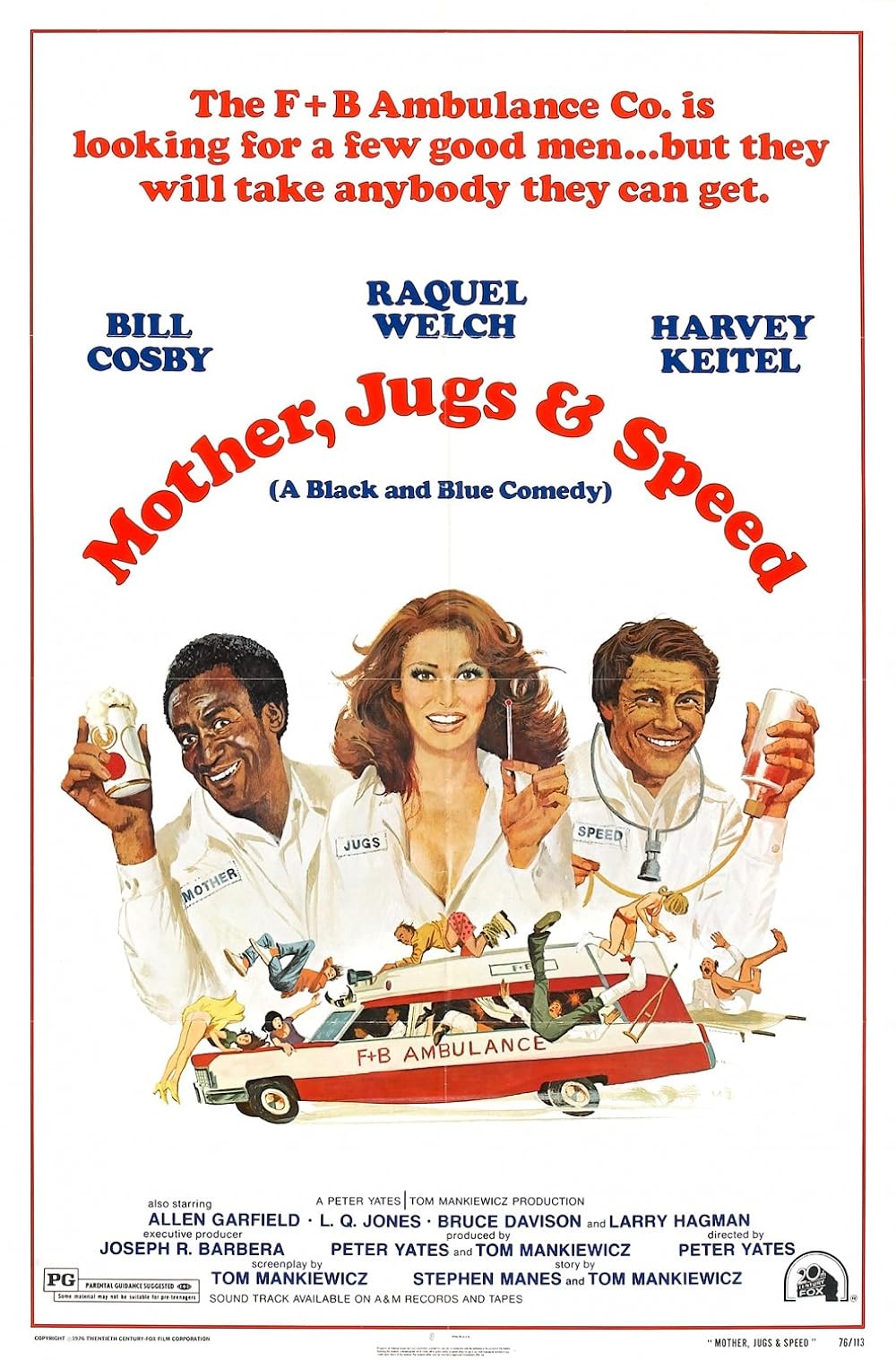
Mother, Jugs & Speed (1976)

By Richard Winters

My Rating: 8 out of 10

4-Word Review: A corrupt ambulance company.

Mother (Bill Cosby) is a part of a team of ambulance drivers working for Harry Fishbine (Allen Garfield) who runs the F & B Ambulance company that is competing with Unity ambulance to get a contract with the city of Los Angeles. Harry is willing to do any underhanded deal that he needs to in order to keep the company competitive, which many times is at the patient’s expense. Tony (Harvey Keitel) is a former cop whose been suspended due to allegations of him dealing cocaine and thus gets hired to partner with Murdoch (Larry Hagman), a man whose compulsion for sex seems to know no bounds. Jennifer (Raquel Welch), nicknamed ‘Jugs’ due to her ample breast size, mans the switchboard, but longs to be a driver and is excited to finally get her certification, only for Harry to refuse to hire her due to sexist reasons.

The disco song ‘Dance’ by Paul Jabara, which gets played over the opening credits, may get some viewers to think it’s a silly 70’s flick, which it definitely isn’t. The concept was inspired by cartoonist Joseph Barbera, who after taking an ambulance ride, became intrigued with the idea of doing a movie about an ambulance company and hired noted screenwriter Tom Mankiewicz to write the first draft. Mankiewicz had plenty of success writing James Bond movies but was at a loss at how to approach this one and only after tagging along on some ambulance rides over a span of three nights was able to come up with the plot. He then bumped into Peter Yates at a party. Yates, best known for having directed Bullit, was interested in a change of pace by doing a comedy, but one that he hoped had ‘some bite’. Mankiewicz then immediately ran out to his car and dug the script out of his trunk and handed it to him and by the next day, after having read it during his flight back, Yates was solidly onboard.

As dark comedies go this one has to be one of the darkest and is compelled to look at every grim aspect of the human experience from drug addiction to poverty and the basic apathy people feel about their jobs and the little things they have to do and tell themselves in order to get through it. What surprised me though was that it was only given a PG-rating. Granted they never say the word ‘fuck’, nor is there any nudity, but it’s still very adult, nonetheless. Because it stars Cosby, who at the time was known for his family-oriented comedy it could’ve given parents the mistaken impression that this would be safe for kids, but it’s definitely not. There’s a lot of caustic humor including Hagman making jokes about having sex with 13-year-old twins and one moment where he attempts to get-it-on with a comatose patient. There’s even a shocking scene where somebody gets shot and killed, so what Jack Valenti and his MPAA board where thinking when they viewed it, I don’t know, but this is certainly not material for young eyes.

Mankiewicz’s acerbic script hits all the right targets, but the acting scores as well. Cosby is terrific as a sort of anti-hero who drinks while he’s driving and harasses nuns but also shows the required proportionate jaded sensibilities to handle the grim challenges. Hagman is outrageously crass but countered nicely by Bruce Davidson and Keitel, who manage to bring some likable qualities into the cast. The funniest person though, despite everything, is Garfield, who’s the perfect caricature of a shyster owner more than willing to do whatever it takes to stay afloat and his motivational rants, particularly the one that starts things out, are hilarious.

The only one that seems miscast is Welch, who despite being easy on the eyes, has never really shown to have much of an acting range. I did like her character’s arch where she’s finally given the chance to go on an ambulance run and learns the hard way that not every life can be saved, as well as a scene where she takes an ambulance on a joyride and gets pulled over by the cops, but sympathetic wise she’s kind of cold. She just doesn’t seem to have the ability to show vulnerability, which is what her character required it’s just a shame the part wasn’t played by Valerie Perrie, who would’ve been perfect, but she declined due to her unwillingness to accept a deferred payment.

Spoiler Alert!

My one caveat is the ending, which has Hagman taking some narcotics that causes him to have a psychotic reaction where he holds the owner’s wife Peaches, played by Valerie Curtin, hostage at the station, but this came off as too jarring. While Hagman’s character certainly had a creepy factor it was still done in a humorous way making him benign and just ‘one of the gang’, so having him go nutso without any type of forewarning didn’t make a lot of sense. Would’ve been better had some addicts looking for drugs robbed the station and held Hagman and Peaches at gunpoint and thus requiring the rest of the employees to work together to find a way to save them.

My Rating: 8 out of 10

Released: May 26, 1976

Runtime: 1 Hour 38 Minutes

Rated PG

Director: Peter Yates

Studio: Twentieth Century Fox

Available: DVD
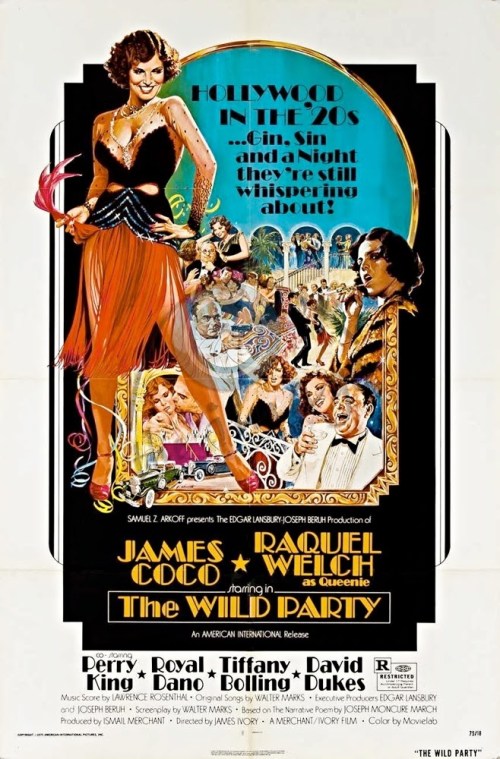
The Wild Party (1975)

By Richard Winters

My Rating: 3 out of 10

4-Word Review: Slumming actor stages comeback.

The year is 1929 and Jolly Grimm (James Coco) the once successful silent film star now finds himself, with the advent of talking pictures, to be in low demand. Although his movies once made a killing his style of humor is now considered cliched and with no studio willing to fund his latest pic he’s forced to use his own money to get it made. He holds a lavish party in his mansion inviting many Hollywood elites who he hopes will show an interest in his movie once he screens it to everyone, but instead his guests are more into each other as the party quickly devolves into a wild sex orgy with even Jolly’s faithful girlfriend Queenie (Raquel Welch) cheating on him with a much younger and better looking actor (Perry King).

The story is loosely based on the 1926 poem of the same name by Joseph Moncure March while the Jolly character was inspired by Fatty Arbuckle a famous silent film comic who was accused and the later acquitted of the rape and manslaughter of actress Virginia Rappe in 1921. The script though by Walter Marks doesn’t seem to know what tone it wants to take as at times it seems like a trenchant drama while at other moments it comes off as a surreal comedy. The original intent was to turn it into a musical, which would’ve been a better idea as the lack of cohesion causes the pacing to be completely off and never allows the film to build any tension or momentum.

The party scenes are not interesting or provocative and in many ways it’s a poorman’s version of Day of the Locust which came out at the same time and had a similar theme, but a far stronger impact. The sex is stagy and mechanical and seeing all the guests sprawled in a symmetric way on the floor the next day throughout the mansion looks too surreal-like to be even remotely believable. The party’s only interesting moment is when Jolly has a meltdown by going on a long angry rant that reveals his ugly side to his guests, but the filmmakers botch this sequence by focusing solely on Coco instead of cutting away to show the shocked reactions of the party-goers.

Coco, in his only starring vehicle, does quite well in a role I didn’t think he was equipped for. Welch gives an equally strong performance, possibly the best of her career, but the relationship of their two characters made no sense. Director James Ivory tries to flesh them out by having the two at different moments go on long soliloquys explaining what attracted them to the other, but in both cases it rings hollow. So what if Coco treated Welch with respect and asked her ‘deep questions’ when they first meet, which is apparently why she fell for him, he’s no longer doing that now, so why stick with him? Coco’s statement, that he couldn’t ‘live without her’ comes off as equally absurd since every time he talks to her he’s abusive.

The relationship angle should’ve been scrapped as it’s Jolly’s mental deterioration that is more interesting.  A far better and more realistic scenario would’ve had Coco coming onto a young starlet such as Queenie at the party but she would reject his advances and then later when he saw her with a younger actor it would set off his already shaky ego, which would then precipitate the violence.

Spoiler Alert!

The shooting that occurs at the end isn’t effective. The film is filled with so many lulls that by the time it finally gets to it you really don’t care who dies and who doesn’t. Having it occur the next morning after the party is already over seems anti-climactic and something that should’ve been witnessed by all the guests. It’s also a bit frustrating to have it end so abruptly without any aftermath or denouncement given.

End of Spoiler Alert!

Tiffany Bolling and Perry King add some zest in support especially with their facial expressions and the sultry dance done by Chris Gilmore (who gets billed here as Annette Ferra) adds a weird sensual vibe. However, having David Dukes’ character break the fourth wall and begin speaking directly to the camera as he describes the party guests is a distraction, which only  further cements this as a misguided misfire that needed better focus.

My Rating: 3 out of 10

Released: March 4, 1975

Runtime: 1 Hour 47 Minutes (Director’s Cut)

Director: James Ivory

Studio: American International Pictures

Available: DVD, Amazon Video

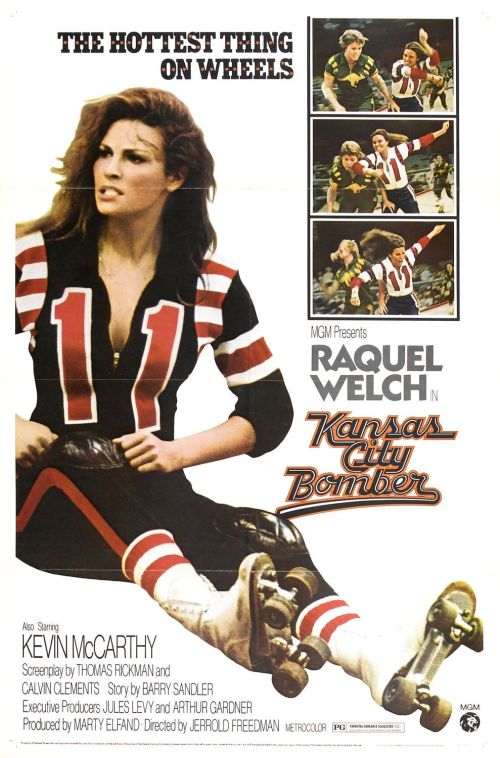
Kansas City Bomber (1972)

kansas city bomber

By Richard Winters

My Rating: 2 out of 10

4-Word Review: Life on roller derby.

Raquel Welch plays K.C. Carr a struggling mother of two who goes all-out as the star in the roller derby circuit. She plays for the Kansas City Bombers, but then gets into a grudge match with Big Bertha (Patti ‘Moo Moo’ Cavin) with the loser agreeing to leave Kansas City and never return. Through some cheating by other teammates K.C. loses, but is soon picked up by the Portland Loggers whose owner (Kevin McCarthy) is quite impressed with her and promises to make her a star. The two eventually get into a relationship, but then she gets into yet another grudge match this time with the aging Jackie (Helena Kallianiotes) and the loser agreeing to leave Portland forever.

During the ‘70s the roller derby sport was all-the-rage and several films during the period were produced on the subject including The Unholy Rollers, which was also released in 1972 and starred Claudia Jennings as well as Derby, which was a documentary on the sport and came out a year before this one. I once went to a roller derby game a few years back in Indianapolis and I found it to be inane and boring, but there were indeed some people there that seemed to really get into it. In fact if there is one thing that this film does well it is the way it captures the spectators. Seeing many of them with missing teeth and looking like they would not fare too well on a college entrance exam, but getting extremely worked-up with the action in front of them solidly hits-the-mark on the mentality that one will find when attending these events.

The action though looks horribly fake and it’s obvious that the performers are pulling their punches during the fight sequences. I initially thought this was intentional and to show how the sport is really just about acting, but the script wants to play it like it’s for real, which makes the phony staged action look all the more ridiculous.

Welch’s presence is another hindrance. She’s a beautiful looking lady, but her acting has always been suspect. She manages to convey a toughness during the game sequences, but the character is just too nice and naïve otherwise. The film makes efforts to show the hard life and dehumanizing conditions that working in the business entails and yet somehow we are expected to believe this is the one person that has managed to ‘rise above it’ when in reality it would’ve dragged her down to its level, or at least made her more world-wise. The scene where she becomes ‘shocked’ at how the players are being ‘used’ and expresses this to the Kevin McCarthy character gets a good comeback from him when he states “We’re all being used…that’s the American way. You outta know that by now!”  And the fact that she strangely doesn’t despite being supposedly a ‘seasoned’ player makes her character come off as poorly fleshed-out and hollow.

Her relationship with McCarthy is a major issue as he was 30 years older than her. The two share no chemistry and have little in common and watching this gray haired man walking hand-in-hand with a hot young chick comes off like an old fogey that’s  porking his granddaughter.

The unintentionally funny climactic finish is pathetic and features the replay of the same hokey shot done from 3 different angles. The ending also leaves open a slew of unanswered questions while wasting the talents of a young Jodie Foster who appears only briefly as Welch’s daughter. I also didn’t get why it was entitled the Kansas City Bomber as the character spends only a brief time there while the bulk of the story takes place in the Pacific Northwest.

My Rating: 2 out of 10

Released: August 2, 1972

Runtime: 1Hour 39Minutes

Rated PG

Director: Jerold Freedman

Studio: MGM

Available: DVD (Warner Archive), Amazon Instant Video, YouTube

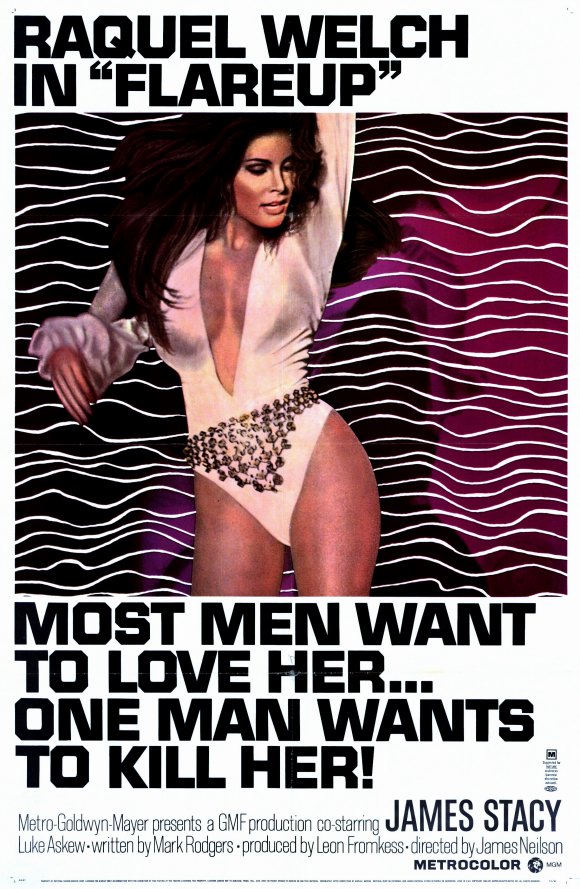
Flareup (1969)

flareup

By Richard Winters

My Rating: 3 out of 10

4-Word Review: Stalker terrorizes go-go dancer.

Michele (Raquel Welch) is a Las Vegas go-go dancer that attracts the unwanted attention of Alan (Luke Askew) who blames her for the breakup of his marriage. After killing his wife he then sets his sights on Michele who moves to Los Angeles in an attempt to lose him, but he figures out what club she is dancing at and continues his reign of terror. When Michele finds a new boyfriend named Joe (James Stacy) the psycho decides to add him to his already growing hit list.

Raquel is the whole movie. Her acting ability is definitely limited and at times even annoying, but in the looks department she gets an A+. In fact I’d say she is at her best looking here out of all the movies she has done. The scene where she gets on stage to gyrate her body during a provocative dance number is pretty much the highlight of the whole film. Although some of the other girls dance topless she does not and she very angrily rejects another female dancer who offers her some ‘woman love’, so there is no lesbian scene either, which could be a disappointment to some oversexed male viewers, but her presence offers enough eye candy to propel the movie on nonetheless.

Askew who wears a tacky bowl haircut looks a bit too clichéd, but he is a good enough actor to keep it tolerable. Stacy is decent as the love interest, but the romantic scenes bog down the pace. This was the last movie he did before he got into a motorcycle accident and lost his left leg and arm, which spiraled both his career and personal life downward and eventually led to a child molestation charge in 1995 that sent him to prison.

James Neilson’s direction is okay. The best part is the on-location shooting, which makes you feel like you are right back on the streets of Las Vegas from forty years ago and its fun seeing the different shops and billboards that were out during that era. The foot chase between Welch and Askew that occurs late at night in a zoo with wild animal noises heard in the background has potential, but should’ve gotten more extended.

The script though is one-note and gets stretched much too thin. The action starts out right away, but the pacing is poor and there is really never any tension. Everything gets done in a formulaic way with nothing that is unique or memorable.

Although I will give some credit to the finale that features a burning man the special effects are overall pretty shoddy. The psycho shoots at and kills people, but we never see any bullet holes or blood on the dead bodies. One scene has a security guard (Gordon Jump in an early role) shooting at Askew’s car and putting two bullet holes in its rear window, but then when the camera cuts away to a long view of the car the bullet holes have somehow miraculously disappeared.

My Rating: 3 out of 10

Released: November 10, 1969

Runtime: 1Hour 40Minutes

Rated M

Director: James Neilson

Studio: MGM

Available: VHS, DVD (Warner Archive)