Tag Archives: Movies

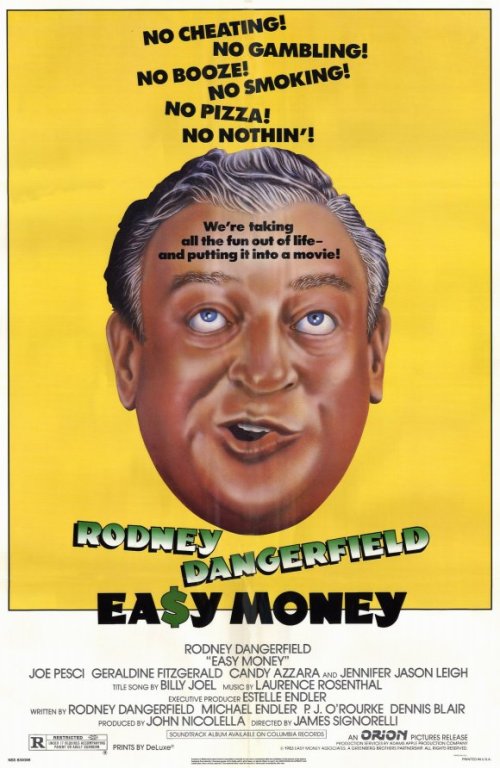
Ea$y Money (1983)

easy money

By Richard Winters

My Rating: 4 out of 10

4-Word Review: Breaking his bad habits.

Monty Capuletti (Rodney Dangerfield) is a married man with two teenage daughters who is trying desperately to make ends meet while working as a child photographer. His oldest daughter Allison (Jennifer Jason Leigh) is set to get married to a man named Julio (Taylor Negron) that Monty does not approve of. Attending the wedding is Monty’s rich, but hateful mother-in-law (Geraldine Fitzgerald) who promptly dies on her way back home. At the reading of her will she stipulates that she will give her entire fortune to Monty, but only if he gives up all of bad habits, which includes his drinking, gambling and drug use. Monty isn’t sure he can do it, but his eager family members try to coach him into trying.

This was Rodney’s first starring vehicle after his breakout success in Caddyshack, but the script doesn’t take advantage of his comic ability. The opening sequence in which the viewer gets an understanding of the character’s personality visually by having the camera pan through his cluttered work area is great and probably the best part of the whole movie, but trying to confine his edgy persona into the sterile role of a suburban dad isn’t effective. His wife, played by Candice Azzara, is much too young and good looking a woman and would typically be way out of his league. His daughters are also too attractive and he was already in his 60’s at the time, which made him much better suited for a grandfatherly role. A much funnier plot would’ve had him stuck with his adult daughters still living at home because they were too ugly to find suitors and his desperate attempts to con someone into marrying them just so he could get rid of them and be able to enjoy  his ‘golden years’ in peace.

The script is limp and doesn’t get going with its main premise until the second half with the first part dealing with the daughter’s on-again, off-again relationship with her new husband that goes nowhere and seems added in solely to pad the running time. The idea of Monty having to give up his bad habits is poorly thought out as well as there is no third party coming in to observe that he sticks with it, or hidden cameras placed somewhere to monitor him. It leaves everything up to his family members to ‘keep him on track’ even though they could’ve lied and covered up for him and his ability to cheat at any time was wide open.

The film also does not take enough advantage of the jokes that it does have. One scene has him, in a bout of frustration, swearing at a fat kid that is not behaving, but the camera never cuts back to the parent’s shocked expression, which would’ve been the best part. Another segment has Julio and his friend trying to sneak into Rodney’s house late at night in an attempt to win back Allison, but in the process they snap off the power lines connected to the home and knock out the electricity yet the film never gets the response of the rest of the household when this occurs and instead quickly cuts away and never comes back to it making it seem almost like it never happened. Last, but not least is a scene where Rodney gets an exercise bike for Christmas and tries it out only for him to go crashing into the Christmas tree and hitting his head against the window and yet no one jumps up to see if he is alright even though I would think that would be the most natural response for someone, especially family members, to do.

There is also a scene involving drunk driving, which I found interesting only because 5 years later the movie License to Drive also had a similar scene, but in that one it was somehow considered more controversial and labeled in bad taste even though the scene here I thought was worse because it was done by the main characters, or in this case Joe Pesci who plays Rodney’s best friend.

The segment where Rodney gets shot in the buttocks and forced to hang in midair at the hospital while his injuries are allowed to heal is quite funny as is the scene involving male runway models showing off Rodney’s latest ‘regular guy’ fashions, but outside of these two segments the film falls flat in a script that never gains any traction and is wildly unfocused. Billy Joel of all people sings the film’s title tune in a song that is catchy, but I’ve never heard played on the radio even though all the rest of his tunes seemingly are.

My Rating: 4 out of 10

Released: August 19, 1983

Runtime: 1Hour 35Minutes

Rated R

Director: James Signorelli

Studio: Orion Pictures

Available: DVD, Blu-ray

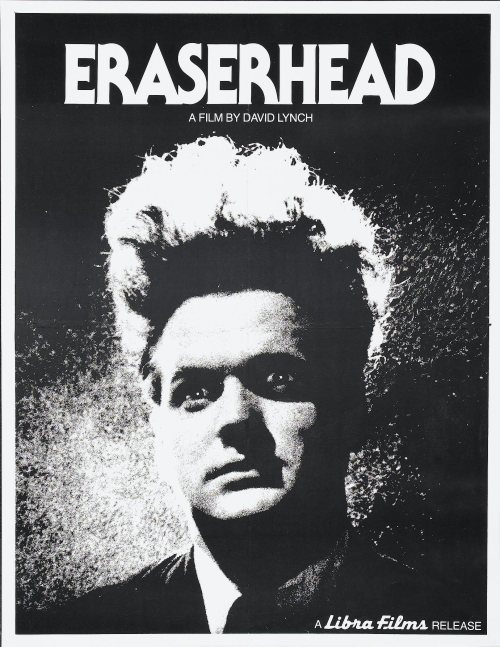
Eraserhead (1977)

Eraserhead

By Richard Winters

My Rating: 6 out of 10

4-Word Review: Couple has deformed baby.

In David Lynch’s first feature length film, a movie that took almost 5 years to make and had a good deal of it financed by Sissy Spacek and her husband, we have a surreal almost cryptic-like tale detailing a lonely man named Henry (Jack Nance) and his ultimate descent into a madness as he is forced to take care of severely deformed child while also harboring the dark urge to kill it.

It is hard to say whether one can like or dislike this as it goes so far out of the conventional form of film narrative that it seemingly defies all genres and puts itself into a category all its own. On a sheer technical level it is quite impressive especially when you factor in its shoestring budget and array of production set-backs. Each scene is meticulously detailed with wild and unsettling imagery that on a purely visual level will be more than enough to leave an impact. Overall the film is cold, ugly and unyielding, but helped tremendously by Nance’s presence as a sort of detached everyman who seems as confused and aloof to his surroundings as the viewer.

To me the most jarring image is the baby, which is incredibly lifelike. Had it came off looking fake, or like some puppet or Claymation attempt the film would’ve been a failure, or deemed laughable, but this thing is freaky looking to the extreme and Lynch spares no expense in getting the camera close up to it, which could force some viewers to turn away. Supposedly it was made from the embalmed fetus of a calf, but no one knows for sure and the crew was forced to blind fold themselves when Lynch set it up, so the secret would never come out. Either way it is effective and it manages to move its eyes and mouth almost like it were real and coming off as far more authentic than any computerized effect.

Spoiler Alert!

Of course the most confounding thing about the film is its story and symbolism’s that can be interpreted in a million different ways depending on the viewer’s own perspective. For what it’s worth I’ll give you my interpretation, which isn’t that complicated. To me the deformed baby symbolizes Henry’s soul, which has been mangled by the soulless world that he lives in, which would explain why he is so extremely passive because he is simply a walking zombie. The scene where his head pops off and the ugly child’s head pops into its place only reinforces this. The lady that he sees in the radiator is an angel from heaven and the beautiful lady that lives across the hall from him is the devil who entices him with sex, but when she realizes he has no soul to take, just an ugly mangled remnant of one, which gets exposed to her when she sees him standing in the doorway, she quickly loses interest and moves onto someone else. When he finally kills the baby he is essentially killing himself, which then explains why he ends up in the final scene in heaven with the lady in the radiator.

The man in the planet that we see at the beginning represents Henry’s own subconscious as he quarrels within his mind at the thoughts of killing the child. The man could also represent the world at large and how it controls everyone with its levers, which when Henry finally kills himself they start to have sparks fly from them and the man struggles in containing them, which shows that Henry has now ‘broken free’ from the man and this world by taking his own life.

End of Spoiler Alert!

Some consider this a horror pic, but I found certain parts of it to be quite funny in a darkly humorous way particularly the segment where Henry goes to visit his girlfriend’s parents. To me the most horrifying thing about is the way it challenges the viewers to question their own morality by forcing them to face the difficult quandary or what they would do if put into the same situation as Henry and forced to care for a hideous looking baby that some would consider would be better off dead.

My Rating: 6 out of 10

Released: September 28, 1977

Runtime: 1Hour 29Minutes

Not Rated

Director: David Lynch

Studio: Libra Films International

Available: DVD (Criterion Collection), Amazon Instant Video

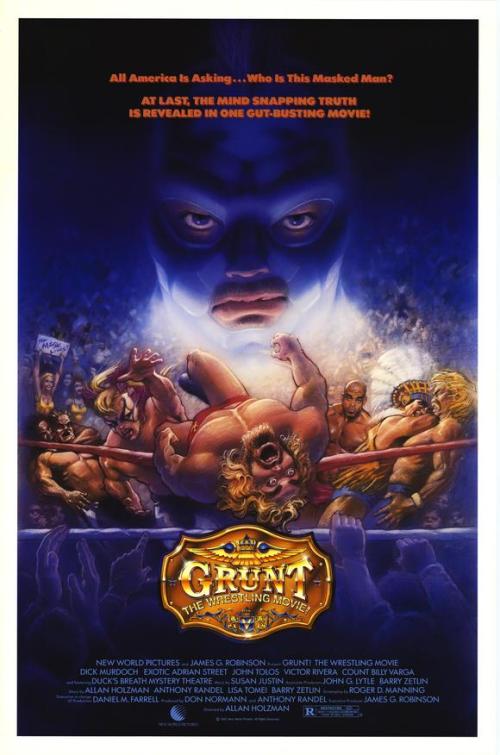
Grunt! The Wrestling Movie (1985)

grunt

By Richard Winters

My Rating: 4 out of 10

4-Word Review: Who is masked wrestler?

On October 13, 1979 Mad Dog Joe De Curso (Greg ‘Magic’ Schwarz) has a violent wrestling match with defending champion Skull Crusher Johnson (Greg Rivera). During the melee Johnson accidently gets his head stuck in the ringside ropes where Mad Dog decapitates him with one swift kick. The wrestling world then goes into an uproar with the biting question on everyone’s mind ‘Does a defending champion lose his title when he loses his head?’ that nobody, not even the commissioner seems willing to answer. After spending 90 days in jail Mad Dog gets released, but suffers from severe depression and eventually jumps to his death off of a bridge. Yet documentary filmmaker Leslie Uggams (Jeff Dial) thinks that Mad Dog is still alive and working under the disguise of a masked wrestler whose identity is unknown. Uggams begins a crusade of trying to unravel the mystery by interviewing those who knew Mad Dog best while also following the masked wrestler around to his events and trying to get to know both him and his French lady manager Angel Face (Lydie Denier).

The first 10 minutes of this thing is brilliantly bizarre that has just the right mix of offbeat humor, wrestling action and cinematic quality to make it interesting, original and hilarious. I am no wrestling fan myself, but director Allan Holzman manages, at least in the opening segment, to draw the uninitiated into the wrestling world by unfolding all the side dramas, storylines and over-the-top characters that fans of the spectacle find so enjoyable. The bit is also filmed in black-and-white with a sort-of foggy back drop that helps give it a surreal effect while also playfully making fun of the event and those who watch it.

Unfortunately the remainder of the movie is unable to sustain that same momentum becoming instead an overplayed one-joke that goes nowhere. It also spends too much time in the ring where the viewer is forced to watch one wrestling bout after another until it becomes more like a pay-per-view event than a movie.

One of the few non wrestling segments that I did enjoy is when the masked man and Angel Face go onto Wally George’s ‘Hot Seat’ TV-Program. George was a notoriously combative conservative talk show host during the ‘80s and the precursor to Rush Limbaugh and Bill O’Reilly. He was also the father to actress Rebecca De Mornay who has spent her entire career trying desperately to downplay that fact. Liberal guests would come onto his show and almost immediately be berated before being thrown off, which is what happens to the masked man and Angel Face, but not before George gets into the masked man’s face and demands he take it off, which is pretty funny.

Adrian Street, a wrestler who dresses in drag, is a scene stealer and the segment with the masked man being interviewed on his show is equally good. I also enjoyed Denier as the rambunctious manager who flashes an opposing player during one of the mask man’s wrestling matches and carries around a pet poodle who wears a mask similar to her clients.

The scene involving a bout between two lady wrestlers with the song ‘She Was a Mighty Big Girl for Her Age’ is good and the match where the masked man takes on four dwarf wrestlers is an absolute howl, but the film is geared too much to the hardcore fan and those with very little interest in the ‘sport’ will find it off-putting and overtly silly.

My Rating: 4 out of 10

Released: November 24, 1985

Runtime: 1Hour 29Minutes

Rated R

Director: Allan Holzman

Studio: New World Pictures

Available: VHS, DVD-R, Amazon Instant Video

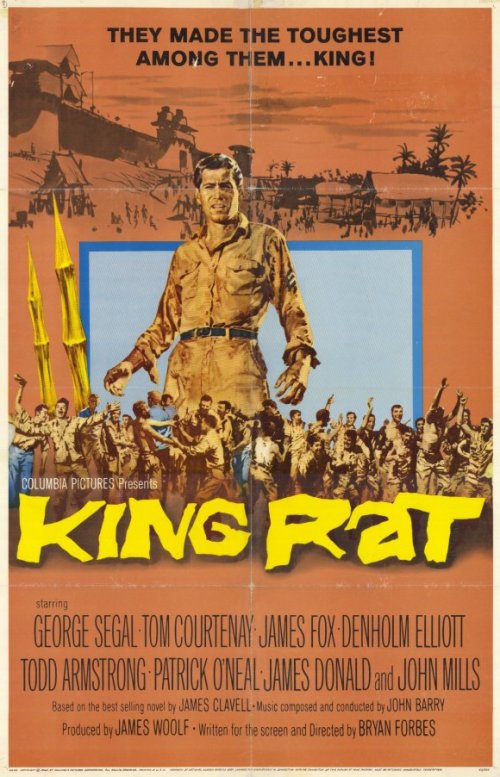
King Rat (1965)

king rat 1

By Richard Winters

My Rating: 6 out of 10

4-Word Review: An island prison camp.

British and American POWs are held on an Island prison camp run by the Japanese during WW II. This camp is unlike the others as it does not have any walls, barbed wire fences, or prison guards. The men are allowed to roam freely while trapped on a tiny island with nowhere to go. Corporal King (George Segal) manages to wheel-and-deal his way to the top of the food chain by getting involved with the underground black market, which allows him to live the relative good-life while the other prisoners remain near starvation. He befriends Marlowe (James Fox) who can speak the Malaysian language, which he feels can come in handy as he gets involved with a diamond smuggling operation as well as selling deer meat, which unbeknownst to his customers is actually meat from rats who’ve feed off of the bodies of the other dead prisoners.

To some extent one can find some similarities to this and The Great Escape or Stalag 17 in that the prisoners have managed to create their own underground network without their captors being aware, but that is pretty much where the comparisons end. This film is darker and examines more the psychological deterioration that the men go through while realizing its themselves and each other that is more the enemy than the actual Japanese guards who are shown very little and have no presence at the camp or in the movie.

Segal gives a star making performance as a anti-hero who could easily be quite unlikable, but Segal’s engaging on-screen persona gives the character an added spark making him and his constant conniving more amusing than anything particularly with the way he barters with the Malaysian guards during their discussions on the price of the transfer of diamonds.

The supporting cast is outstanding as well especially Fox as the only sympathetic character and Tom Courtenay as the overzealous Grey and his never-ending crusade to take King and his cronies down. James Donald is also good as the no-nonsense Dr. with a very matter-of-fact bedside manner and a young Richard Dawson who gets the shock of his life when he comes in after the Japanese surrender to free the men of their enslavement only to find that they’re strangely reluctant to leave.

The film works in episodic fashion and while it maintains a gritty level it also has some lulls and few too many shifts in tone. There are though many unique and memorable moments including the ending where the men find themselves free to return home, but respond much differently than you’d expect. There is also a scene where the men kill a dog after it attacks some chickens and then later eat it as if it were a delicacy.

My Rating: 6 out of 10

Released: October 27, 1965

Runtime: 2Hours 14Minutes

Not Rated

Director: Bryan Forbes

Studio: Columbia Pictures

Available: DVD, Amazon Instant Video

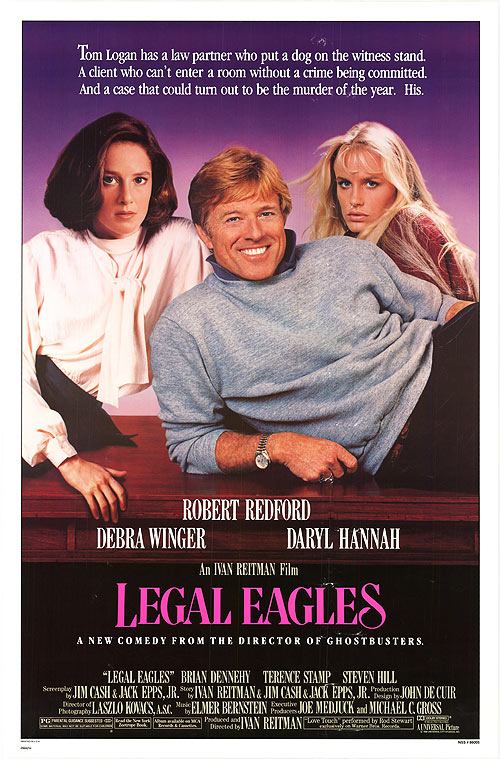
Legal Eagles (1986)

legal eagles

By Richard Winters

My Rating: 5 out of 10

4-Word Review: Searching for stolen paintings.

Successful district attorney Tom Logan (Robert Redford) suddenly finds himself in a big mess when defense lawyer Laura Kelly (Debra Winger) approaches him in regards to her quirky client Chelsea Deardon (Daryl Hannah). She feels that Chelsea is innocent of the charges against her and hopes to have them dropped before it goes to court. When Tom looks into the case he finds that there’s much more to it than initially assumed, which leads the three into danger, stolen paintings, murder and even a weird love triangle.

If you are expecting anything having to do with a legal drama then you’ll be highly disappointed as there is very little time spent in the actual courtroom. Instead you get what amounts to an ‘80s action flick with explosions, car chases and even shootouts as these two lawyers go through things that no other lawyer in the history of the universe has ever went through either before or after.

The main selling point, and the only thing that actually works, is the casting. Redford with his laid back style is terrific in this type of comedy and I enjoyed the way he tries to remain cool-under-pressure despite being exasperated with two very kooky females, who both have an interest in him, coming at him from both sides. Winger is fun too as a well-meaning young attorney who tries hard, but still seems a bit ‘rough-around-the-edges’. Hannah is also perfectly cast in a role that works well with her slightly flaky, free-spirited persona and she even has a scene where she performs a fire-laden performance art piece that she wrote herself.

The first hour has a nice balance between the interpersonal relationships of the three as well as an intriguing mystery, but the second half leans too much into the action and gets overblown. The supposedly ‘exciting’ finale only helped to get me bored and annoyed. It’s the chemistry of the three stars and the romantic entanglements that ensued between them that had me interested and are what made the plot unique. The film should’ve emphasized this area more and even played it up. Having things end up working out so conveniently between the three despite the fact that both women were for a time seemingly competing for Redford’s affections misses out on a lot of potential fireworks and amusingly comical scenarios.

Familiar faces pop up in minor roles including a young Christine Baranski as a fledgling member of Tom’s legal team as well as Terence Stamp in a role that ends up being so small and insignificant I was surprised he agreed to take it. The film also features Rod Stewart’s hit song ‘Love Touch’ that climbed to number 6 on the pop charts, but isn’t heard until the very end when it gets played over the closing credits.

My Rating: 5 out of 10

Released: June 20, 1986

Runtime: 1Hour 56Minutes

Rated PG

Director: Ivan Reitman

Studio: Universal

Available: VHS, DVD, Amazon Instant Video

The Dove (1974)

dove

By Richard Winters

My Rating: 5 out of 10

4-Word Review: Sailing around the world.

Based on a true story and produced by Gregory Peck this film examines the journey of Robin Lee Graham (Joseph Bottoms in his film debut) as he sails in his boat called The Dove around the world. When he starts out he is only 16, but through the course of his journey he goes through many adventures, meets a beautiful woman named Pattie (Deborah Raffin) who he eventually marries and returns home a full grown man.

The variety of exotic locales and stunning cinematography by Sven Nykvist are a chief asset, but the film starts off with absolutely no backstory. The viewer is hoisted onto the boat with the main character without having any idea who he is, his background, preparation, reason for doing this, or his relationship with his family. Bits and pieces of this come out later, but it would’ve been nice to have had some of this info from the start and would’ve allowed for more of an emotional connection to the character.

The first hour is spent more on land than at sea, which is another problem because it doesn’t get riveting until he is actually on the boat and fighting the many elements. The melodic mood music gets excessive and should’ve been toned down as well and the two songs sung by Lyn Martin, which could’ve been scrapped completely as the natural ambience of the sea is far more soothing.

Bottoms, who retired from acting in 1999 and now runs an art gallery, does quite well. His boyish face and variety of emotions that he goes through during his adventure ring quite true for someone of that age and help to make the character quite real. I also enjoyed how the character is astute in certain areas, but very awkward in others particularly with the way he tries to court Patti, which also leads to the film’s best line “I’m feelin’ romantic…in a horny kind of way.”

Raffin is stunningly beautiful and her acting is outstanding and I liked how the female character was portrayed as being older, wiser and more practical. The two share a great chemistry, but Robin’s relationship with his ornery pet cat Arvana is equally interesting even though its demise is unpleasant.

Familiar character actors pop up briefly playing pesky photographers from National Geographic magazine that carried the story through his trip. John Anderson has a funny bit here, but the best is Dabney Coleman who speaks with an Australian accent!

The actual journey began in September, 1965 and wasn’t completed until April of 1970 with many stops and starts in between, which the film does a good job of showing as at several points Robin abandons the mission only to finally start it back up several weeks or months later. Although the film gives the impression that he completed the full journey in reality he didn’t as he started it in Hawaii, but finished it in Long Beach, California also the boat that he used for his trip ending up getting destroyed in 1989 during Hurricane Hugo.

My Rating: 5 out of 10

Released: October 16, 1974

Runtime: 1Hour 45Minutes

Rated PG

Director: Charles Jarrott

Studio: Paramount

Available: VHS, Amazon Instant Video

The Crazy World of Julius Vrooder (1974)

crazy world 2

By Richard Winters

My Rating: 4 out of 10

4-Word Review: Pretending to be crazy.

Vrooder (Timothy Bottoms) is a Vietnam Veteran who has returned from the war and is unable to cope with the stresses of everyday life, which eventually gets him checked into the psychiatric ward of a local VA Hospital. There he falls in love with Zanni (Barbara Hershey, but billed as Barbara Seagull) who works as a nurse there, but he is unhappy to find that she is already engaged to Dr. Passki (Lawrence Pressman). To escape his frustrations he hides out in an underground bunker that he has created near a local highway. The place comes complete with electricity and telephone service as well as an array of booby traps to tip him off if anyone comes near, but the heads of the local power and telephone companies’ start trying to track him down in an effort to stop his pilfering of their services, which could ultimately lead to an end to his days of freedom.

The film is cute, but a little too cute and was produced, believe it or not, by Hugh Hefner. It likens itself to being an offbeat comedy, but there really isn’t that much that is original about it and it comes off more like a tired anti-establishment flick with the proverbial authority figures portrayed in stale, one-dimensional ways. One could actually consider this as a weak cousin to One Flew Over the Cuckoo’s Nest with Vrooder being McMurphy, Passki being a toned-down male version of Nurse Ratched and the suicidal Alessini (Michael Cristofer) being like Billy Bibbit.

The only slightly diverting thing about this film, that otherwise suffers from having a limited budget and looks like it was shot initially on video and then later transferred onto film, are the scenes involving the heads of the power and telephone companies (Jack Murdock, Lou Frizzell) working together to track down the culprit who’s stealing their service. The climactic scene in which Jack Colvin plays an over-the-top Dirty Harry type cop obsessed with getting Vrooder and sending an entire armed police force into the forest to find him is amusing as is the mugshots shown of past felons who had stolen electrical and phone service, which were all made up of headshots from the film’s behind-the-scenes crew.

Bottoms is rather transparent, but Hershey, with her effervescent smile and naturally carefree persona, is far better as her simple presence naturally exudes the film’s hippie-like theme. This was the second of four films in which she was billed with the last name of Seagull and this was done as a personal tribute to seagull that she had accidentally killed while filming a scene in the movie Last Summer.

Albert Salmi, in a rare appearance without his mustache, is excellent in support as Vrooder’s good-natured, fun-loving friend Splint and I found it hard-to-believe that this same man who could play such a peaceful character so well would years later in real-life murder his wife before turning the gun onto himself. Elderly film director George Marshall also does well as the aging Corky and his performance should’ve merited supporting Oscar consideration.

This obscure movie also marks the film debuts of several performers, which includes not only Murdock’s and Cristofer’s, but Ron Glass’ as well who plays an hospital orderly and Dena Dietrich playing Vrooder’s mother who later became best known as Mother Nature in a series of commercials that ran during the ‘70s.

crazy world 1

My Rating: 4 out of 10

Released: October 18, 1974

Runtime: 1Hour 38Minutes

Rated PG

Director: Arthur Hiller

Studio: 20th Century Fox

Mickey One (1965)

mickey one 1

By Richard Winters

My Rating: 6 out of 10

4-Word Review: Comic hides his identity.

Warren Beatty plays a successful night club comic who’s living the good life until he falls into disfavor with the mob. He decides to go on the run by burning his social security card and getting a new one with a Russian name on it that is so hard to pronounce that everyone just calls him Mickey One. After spending time on the streets of Chicago he finally gets himself another gig at a club run by Ed Castle (Hurd Hatfield), but the better things get for Mickey the more paranoid he becomes convinced that he is being watched and followed at every turn and unable to relax for even a second.

This film marks the first pairing of Beatty and director Arthur Penn and their next project, Bonnie and Clyde, was a great success, but the results here are only so-so. The idea of trying to replicate the artsy French New Wave films of the late ‘50s and early 60s is intriguing, but poor pacing and a lack of consistent style hurts it. An early scene taking place inside an automobile junkyard has just the right combination of crisp editing and camerawork to give it an enticing visual quality, but then the film veers off into too many talky segments. It manages to recover at the end by giving the viewer a strong sense of the paranoia that the main character is feeling, but wide shifts in the film’s dramatic tone hurts it overall making this more of an interesting curio than a classic.

Beatty is okay, but he tends to be a bit too detached and his attempts at stand-up comedy are unfunny despite the many shots of audience members laughing. Hatfield is terrific in support and his presence significantly helps. Franchot Tone is also quite good in a part that features no lines of dialogue.

The film does have some unique and memorable moments. Tone’s strange art exhibit that he names the Yes Machine that he constructs on the ice rink of the Marina Towers is engaging particularly when he sets it on fire only to have it put out and ruined by the Chicago fire department. The best moment though is when Beatty tries to do a stand-up routine in an empty and darkened room with only a bright spotlight shining on him and a mysterious, unseen man sitting behind it, which has the perfect blend of mood and style and a scene I wished had been extended.

My Rating: 6 out of 10

Released: September 27, 1965

Runtime: 1Hour 32Minutes

Not Rated

Director: Arthur Penn

Studio: Columbia Pictures

Available: DVD-R, Amazon Instant Video

Tin Men (1987)

tin men

By Richard Winters

My Rating: 6 out of 10

4-Word Review: Feuding between two salesmen.

Bill (Richard Dreyfuss) and Ernest (Danny DeVito) are two aluminum siding salesmen living in 1963 Baltimore who one day find themselves involved in a minor car accident. Their feuding though escalates as each blames the other for the fender bender, which leads them to vandalizing each other’s cars when the other isn’t around and even having Bill begin an affair with Ernest’s wife Nora (Barbara Hershey). Yet as a federal commission begins honing in on their unscrupulous sales practices the two find that they may need to learn to work together in order to survive.

This is one film that is hard to gauge. For the most part I liked it. The cinematography and period detail are bright and vivid and I loved the row of track houses that the DeVito character lives in. The dialogue is sharp and Dreyfuss is good at playing the type of character DeVito usually does while DeVito is surprisingly more sympathetic. In fact I felt this may be the best performances of both of their careers.

The humor though fluctuates between being subtle to farcical and the over-the-top feud between the two becomes quite strained. For one thing I didn’t think the DeVito character had enough time to be sneaking around trying to destroy Dreyfuss’s car since he was barely able to make ends meet with his job. The fact that both he and Dreyfuss destroy the other’s car, but then don’t sue or even call the police when it continues made little sense. These two watch every little penny that they have, so having Dreyfuss’s car mysteriously get repaired after it was vandalized was questionable as most insurance policies won’t cover that type of repair and it’s highly unlikely he would’ve paid for it out of his own pocket when he clearly knew who had done it.

I also had issues with the Hershey character. Her acting is outstanding, but the fact that she decides to have an affair with Dreyfuss after only a brief meeting with him while inside a grocery store seemed unlikely. For one thing this was 1963 and before the sexual revolution, so even considering an affair was filled with shame and stigma and having her openly discuss it with her friend at work seemed quite dubious. She also ends up moving-in with Dreyfuss even before was she was divorced, which was another big no-no and makes her behavior far too liberated and completely out-of-place for the time period.

The film improves as it goes along, but the incessant fighting gets overdone and quickly loses its edge. Having them learn to get along at some point was needed. It eventually does occur to some extent at the very end, but it takes way too long to get there and it should’ve happened sooner and given the story and characters an extra dimension. There is also a scene where the two get together to play a game of pool where the winner gets to have Nora, but the film then cuts away without ever showing the game getting played, which was a bit of disappointment since the scene had potential for some interesting nuances.

My Rating: 6 out of 10

Released: March 13, 1987

Runtime: 1Hour 52Minutes

Rated R

Director: Barry Levinson

Studio: Buena Vista Pictures

Available: VHS, DVD, Amazon Instant Video

The Happiness Cage (1972)

mind snatchers

By Richard Winters

My Rating: 5 out of 10

4-Word Review: They control his mind.

Christopher Walken plays James Reese a veteran of the Vietnam War who has issues with aggression. After numerous arrests he gets shipped off to a hospital in Europe run by Dr. Frederick (Joss Ackland) and overseen by a U.S. General (Ralph Meeker). There they do tests on the patients by implanting special devices into their brains that connects to their pleasure centers and can quell their aggressive behavior by having them feel a pleasurable sensation every time a button is pressed from a remote.

Walken’s performance is outstanding and Ronny Cox as his fellow patient is also quite good especially the part where he has the device implanted into his own brain, which turns him into a sad, pathetic, child-like state. Bette Henritze gives an interesting performance as well as a naïve, middle-aged nurse hired to make the patient’s stay more ‘happy’ by supplying them with books and board games only to be attacked and raped by Cox and then forced to play a game of checkers with him afterwards.

The story, which was based on a play by Dennis Reardon, certainly has its moments. In fact I was surprised how caught up into I got since the production values are close to appalling. The film was shot in Denmark in a building that looks like it was formerly a rundown mansion converted into a makeshift hospital for the sake of the movie. It all looks embarrassingly cheap and the idea of having a big hospital with a full-time staff and even a barbed wire fence and guard dogs, but only three patients is quite hard to believe.

Had the budget been bigger it might’ve been able to reach a broader audience. Bernard Girard’s direction is okay for the limitations that he was given, but the film’s faded, grainy stock and overall amateurish look becomes a turn off from the beginning and something that it cannot overcome. The plot itself is interesting, but the concept has been filmed before and with better results.

Alternate Title: The Mind Snatchers

My Rating: 5 out of 10

Released: June 28, 1972

Runtime: 1Hour 32Minutes

Rated PG

Director: Bernard Girard

Studio: Cinerama Releasing Corporation

Available: DVD, Amazon Instant Video