Tag Archives: Movies Based on Novels

Funny Farm (1988)

funny1

By Richard Winters

My Rating: 3 out of 10

4-Word Review: Novelist moves to country.

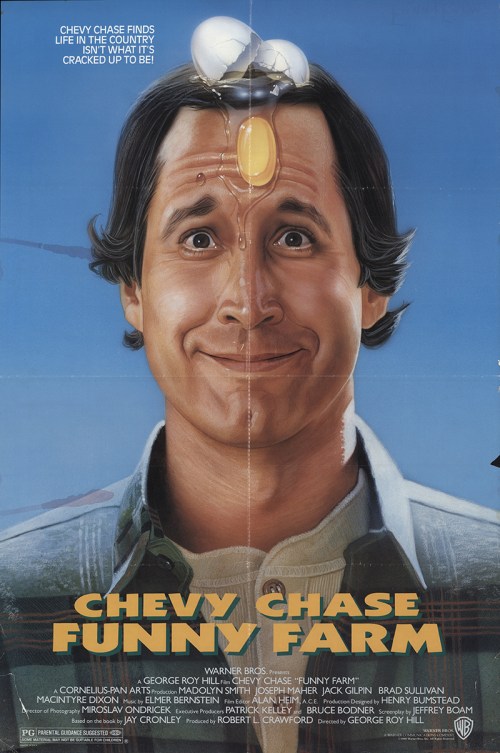
Uninspired comedy about a man named Andy Farmer (Chevy Chase) who receives an advance from a publishing company, which he uses to quit his job and buy a cabin out in the country with his wife Elizabeth (Madolyn Smith) in order to write his novel. Unfortunately the local citizens are eccentric in very clichéd ways and their time there is spent dealing with one crazy misadventure after another.

Right from the start this film proves to have no footing in reality. Publishing companies only pay advances to authors who are already published and proven. They do not shell out $10,000 to some average unpublished Joe with only a vague idea for a story. Many publishers won’t even look at a finished manuscript from someone unless they are already represented by an agent and have some sort of track record, which renders this entire premise as ridiculous.

The movie starts off too quickly with them moving to the country without any set-up. The characters themselves are extremely bland and the script does not take advantage at all of Chase’s cynical, sardonic humor, or impeccable comic timing. Smith is certainly pleasant on the eyes, but things could have been more interesting had they been played-up as spoiled city slickers like the Lisa Douglas character from the TV-series Green Acres and then forced to adjust.

The humor is sloppy and uninspired and shows no level of sophistication. It is thrown in haphazardly without any consideration for story progression, or character development.  Much of it is not funny and the whole thing seems like a stretched out episode from the old Newhart TV-series and in fact the film was shot in Vermont were that series took place. The only mildly amusing moment comes when Andy goes fishing with some of the men from town and ends up accidently throwing them all overboard and even that is worth only a small chuckle. The final segment were Andy and Elizabeth convince everyone in the town to act like people from a Norman Rockwell painting and have them study covers from old issues of the Saturday Evening Post, as  they think this will make things seem more appealing to prospective buyers, is utterly preposterous.

The only time this film has any possibilities is when Elizabeth ends up not liking the story that Andy has written. Being a writer myself and having dealt with other writers I can attest that this can happen more than you think. In fact famous horror novelist Richard Laymon stated that his number one rule of things not to do was giving your manuscripts to friends and family members to read because it can create needless acrimony. Things get dicey when Elizabeth writes a story that sells, but the sterile script by Jeffrey Boam fails to take full advantage of this scenario and the results become as disappointing as everything else.

I did like that it was shot on location. The cottage is nestled away in a scenic area and the viewer gets the feeling that they are ‘getting away from it all’ along with the characters.  Capturing it during all four seasons is another plus. I also thought that the realistic looking stuffed squirrel was cool and I wish I could find one of those for myself.

Sadly, this was director George Roy Hill’s last film. He had much more success with Butch Cassidy and the Sundance Kid, Slapshot, and The Sting to name just a few. None of his genius shows up here as it is quite mechanical and formulaic.

My Rating: 3 out of 10

Released: June 3, 1988

Runtime: 1Hour 41Minutes

Rated PG

Director: George Roy Hill

Studio: Warner Brothers

Available: VHS, DVD, Blu-ray, Amazon Instant Video

The Choirboys (1977)

By Richard Winters

My Rating: 3 out of 10

4-Word Review: These guys are crude.

I’ve been a fan of author Joseph Wambaugh ever since I was fourteen and read ‘The Onion Field’, which I found to be incredibly gripping.  Wambaugh, a former policeman turned author, usually writes stories about cops that are laced with drama as well as humor.  ‘The Choirboys’ novel had all of these ingredients and rose to the top ‘New York Times’ bestsellers list. Unfortunately the film version did not do quite so well.  Wambaugh hated it and continues to lambast it even in interviews today.

Most others disliked the film as well although there are a few who liked its outrageous humor.  As any good reviewer I wanted to be open-minded.  The film has languished in obscurity for decades.  It was released to theaters just two days before Christmas in 1977 and then faded out quickly.  It has never been shown on broadcast television. It was released to VHS on 1993, but copies of it are rare.  It has never been released on DVD, but just recently it has become available on the Netflix streaming option as well as Starz Play. So if you still want to see this film after reading this review, then that is where you can find it.

The film, like the novel, starts out with a scene from the Vietnam war where we see a soldier trapped in a cave and panicking as the enemy moves in.  It then cuts to the present day where a group of policemen who, after a grueling day of work, routinely let loose by having what they call ‘choir practice’ in the evenings.  This is simply a code word used as an excuse for hard partying and practical jokes, which takes up the whole first half of the film.  The second hour turns dramatic as that same soldier that was trapped in the cave, and is now one of the policemen, has a frightening flashback which leads to tragedy.  His police buddies try to cover it up and the rest of the movie deals with the subsequent investigation.

One of the biggest drawbacks to the film is the incessant amount of pranks and juvenile behavior that is shown, which quickly becomes  redundant.  I did like the part where one of the jokes goes too far and one of the men yells out “let’s get out of here before somebody calls the cops”.  I also like the statement George DiCenzo’s character says to a prostitute as he is having sex with her.  It is very anti-PC, but a laugh-out-loud moment nonetheless.  The rest of the pranks are dull and unimaginative. Director Robert Aldrich could have cut ninety percent of it and still made his point. It all ends up making cops look like inane buffoons without balancing it with their humanity like the novel did.

The second hour deals more with the drama, but really isn’t much better.  The lighting is dark and shadowy.  The shot composition has no visual flair and ends up looking more like a cheap TV show than a movie.  The editing is very choppy and the film fails to find a good pace or momentum.

There are a few bright spots.  I really liked the Burt Young character. Many people remember him best from the Rocky movies.  Here he plays an incredibly grungy, crass police sergeant who exposes a tender side at a completely unexpected moment.  I also liked Don Stroud’s performance as the unhinged policeman.  In many ways I felt he carried the majority of the movie.  Perry King is also good as a cop hiding a dark side.  He does real well in these types of parts and reminded me of his performance in The Procession of Joel Delaney. The movie also stars the very durable Charles Durning, which is also a good thing.  As of this writing he is now eighty-seven years old and has four, yes four, projects on his slate for this year alone.

The film though does not live up to the novel and reading the book in this case would be the much better choice.  Normally I dislike Hollywood’s recent penchant for remaking old films, but in this instance I would applaud it.

My Rating: 3 out of 10

Released: December 23, 1977

Runtime: 1Hour 59Minutes

Rated R

Director: Robert Aldrich

Studio: Universal

Available: VHS

Stay Hungry (1976)


stay hungry 2

By Richard Winters

My Rating: 3 out of 10

4-Word Review: Read the book instead.

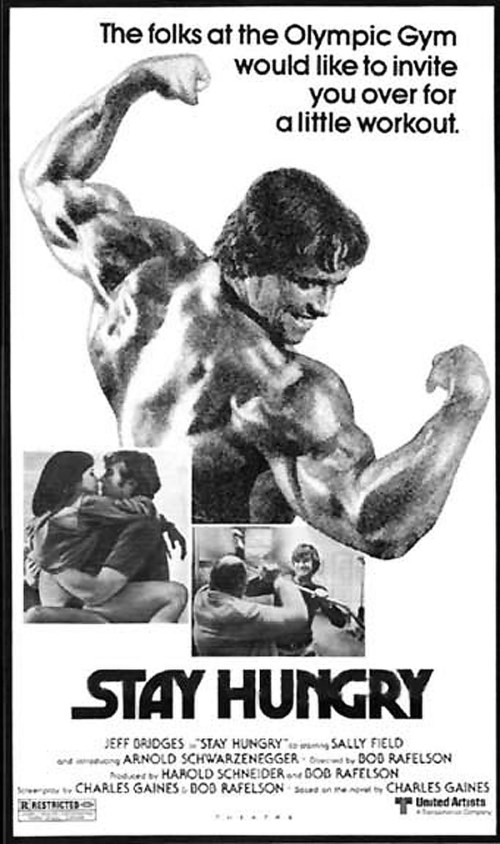
Craig Blake (Jeff Bridges) is a young southern man left alone with his butler in a big mansion when both his parents die in a car crash.  He works at a shady investment firm run by the con-man Jabo (Joe Spinnell).  They have managed to purchase all the other buildings on a block except for a workout gym. Craig is told to meet with the owner of the gym named Thor (R.G. Armstrong) and transact a purchase, so the firm can use the space to build a high-rise office complex.  However, once Craig meets with some of the people working there, including Joe Santo (Arnold Schwarzenegger) who is a body builder and uses the gym to prepare for the Mr. Universe title, as well as the pretty receptionist Mary Tate (Sally Field) he starts to have second thoughts about going through with the deal.

The film is based on the 1972 best-selling novel of the same name by Charles Gaines. There are quite a few differences between the book and the film, with the novel being much better. In the book there is no real estate firm, or potential acquisition of the building. Craig is simply bored with life and goes to a gym on a whim and uses the idea of bodybuilding as a way to find an identity. The book also features a camping trip that the group goes on and a fascinating psychedelic experience that Craig has when he takes an illicit drug that was completely cut out of the movie. The book has much richer characterizations and a profound philosophy that is devoid in the movie.

The film is poorly paced. Nothing really seems to happen and it only comes together at the end and by then it is too late.  Director Bob Rafelson tries to make the movie take on too many things. It shifts awkwardly between drama and sardonic comedy, but fails to achieve any type of cohesion, or momentum.  The flow is more like a European style of filmmaking where the story is told in a more relaxed pace and features long takes and side conversations. However, the dialogue isn’t interesting enough to carry it and the film focuses too much on the relationship between Craig and Mary, which happens too fast and doesn’t seem to have enough chemistry.

I also didn’t like how the character of Craig is portrayed. Bridges gives his usual dependable performance, but he has no southern accent even though he is from the area and everyone else speaks in a very thick one. He talks and acts much more like he is from the west coast and, like the viewer, acts as if he is some detached stranger that is just passing through with no real roots in the area, people, or customs. I think the Hollywood producers intentionally did this because they figured mainstream audiences could not relate to a southerner, who are still straddled with the unfair stigma of being hick, redneck, and racist. So the character was modified to bring broader appeal, but in the process becomes unrealistic and a bit annoying.

On the technical end it is okay although the budget looks limited. Filming on-location in Birmingham, Alabama helps, but I would have liked to have seen more of the area. There are a few unique scenes that make it somewhat enjoyable. One includes Craig stealing a painting off the wall of an office and another involves a throng of half-naked body builders spilling out onto the streets of the city and holding up traffic. There is also a very violent altercation at the end between Craig and Thor that features them battling with each other while using equipment from the gym. The action here is choreographed and edited nicely and looks genuinely real. There is also a brief moment where Field and Bridges go water skiing that was done by the actors themselves and not stunt doubles.

Schwarzenegger is appealing in what is considered his first official acting debut since in his previous two films his voice was dubbed and he had no speaking lines in the other. I liked the way the character is humanized here and shown with a different side to him including having him play the fiddle in a country band. Field is good playing a very feisty and rambunctious character. It also features her in a nude scene although it is from the back only. Woodrow Parfrey also deserves mention as Uncle Albert simply because his eccentric acting style always grabs your attention even in the smallest of roles. He also is the film’s narrator and speaks with the most authentic, best sounding Southern accent out of everyone.

R.G. Armstrong is by far and away the most memorable part of the film. He wears a hilariously awful wig throughout and is slimy in a real goofy way in every scene he is in. His best part comes when he has sex with a couple of prostitutes while on some of the workout machines. He also did, at age 60, his own nude scenes, so you have to give him credit there.

stay hungry 1

My Rating: 3 out of 10

Released: April 23, 1976

Runtime: 1Hour 42Minutes

Rated R

Director: Bob Rafelson

Studio: United Artists

Available: VHS, DVD

What Ever Happened to Baby Jane? (1962)

By Richard Winters

My Rating: 7 out of 10

4-Word Review: Living in the past.

This is a classic horror film that managed to resurrect the sagging careers of acting legends Bette Davis and Joan Crawford. It also spawned a whole new ‘psychobiddy’ genre of films. The movie is based on the 1960 bestselling novel by Henry Farrell.

The story takes place almost exclusively in an old, rundown Hollywood mansion where two aging, feuding sisters live. Baby Jane Hudson (Davis) was at one time a big child star, but never managed to cross-over to adult roles. She lives in a fantasy world, refusing to move on with her life, and takes out her frustrations on her crippled sister Blanche (Crawford), who at one time was a big movie star until a horrible car accident left her bound to a wheelchair.

The real-life feud and animosity that the two stars had for each other is now legendary. Some of the things the two said about the other is hilariously over-the-top and too many to quote here, but well worth checking out. When you hear of all the incredible things that the two did to each other behind the scenes you almost become amazed that the film was ever able to get made. I wished that a documentary had been filmed examining the movie’s production as that could have been almost more entertaining than the film itself.

All things considered, Davis is nothing short of fabulous here. She should have won the Oscar hands down and she pretty much steals the film. She also wore gaudy make-up that gives her an almost ghost like appearance. Crawford is very good as well, but her role is not as flashy. Sadly for her this was her last hurrah as her alcoholism took its toll and her roles after this were in B-movies while Davis went on strong for the next twenty years.

Of course some may argue that the real star was director Robert Aldrich. I liked the bird’s-eye shot of Blanche spinning around in her wheel chair in frustration and terror. It is brief, but gives the viewer a very unnerving feeling. The scene where Baby Jane does an old rendition of one of her routines that she did as a child in front of a mirror that she has set-up in her living room that is also surrounded by stage lights is a nice directorial touch. The campy opening that takes place in 1917 that shows Baby Jane at her peak is memorable as is the very offbeat climatic sequence on a crowded beach. I also got a real kick out of all the Baby Jane toy dolls.

Victor Buono deserves mention as he was nominated for the supporting Oscar for his role as Edwin Flagg, the fledgling composer who Baby Jane hires to help resurrect her stage show. Although best remembered for his comedic skills he was also quite good in his serious parts and his immense girth always made his presence known. I enjoyed how they form this weird quasi-relationship that is based solely on each other’s lies and delusions.

I did have a few complaints to what seemed to me to be some serious logistical flaws. One is the fact that Blanche is stuck in her upstairs bedroom with no way to get downstairs. You would think that with all the money that they once made that they would’ve been able to afford building either an elevator, or a chair lift. It also seemed implausible to believe that Blanche had been stuck in her bedroom since 1935 when she had her accident, until present day 1962, which is what the film seems to imply. As much as I liked the African-American housekeeper Elvira Stitt (Maidie Norman), who is well aware of Baby Jane’s psychosis and has no trouble standing up to her, I thought it was awfully dumb the way she set down a hammer that she was holding right in front of Baby Jane and then turned her back to her, which allowed her to be attacked that anyone else could have predicted would happen. I also felt there was a little too much background music that at times got a bit melodramatic.

Still, this is a great film that his highly entertaining from beginning to end. With the exception of some of Baby Jane’s ‘dinner surprises’ the film is devoid of any real scares and there is no gore, which may disappoint today’s younger, more jaded viewers. However, the film has a very strong, dark psychological undercurrent, which proves to be immensely fascinating and will be appreciated by those who are more sophisticated. The film’s theme, which is that of Hollywood’s fickle, vicious cycle of fame, is universal and as strong today as it was back then.

It is interesting to note that the director’s 18 year old son William, who appears at the end as a lunch attendant at the beach, produced  29 years later the made –for-TV remake of this film that starred the Redgrave sisters, but was not as good. Also director Aldrich later made two variations of this same story. One was Whatever Happened to Aunt Alice which he produced and starred Geraldine Page and Ruth Gordon and also the British classic The Killing of Sister George which he also directed.

My Rating: 7 out of 10

Released: October 31, 1962

Runtime: 2Hours 14Minutes

Rated NR (Not Rated)

Director: Robert Aldrich

Studio: Warner Brothers

Available: VHS, DVD, Blu-ray, Amazon Instant Video

Open Season (1974)

By Richard Winters

My Rating: 3 out of 10

4-Word Review: Humans are their prey.

This is the type of film that has a really great concept, but ends up being ruined with its poor execution. It is based on the novel ‘The All-Americans’ by David D. Osborn, who also co-wrote the screenplay. The story involves three ‘All-American’ suburban family men (Peter Fonda, Richard Lynch, and John Phillip Law) who once year go on a ‘hunting trip’ except here they hunt people. They typically pick their victims up at random and then drive them to their isolated hunting lodge in the woods. They feed and entertain them for a week and then give them a few supplies as well as a compass and tell them that the highway is twenty-five miles north.  If they are able to make it to the highway they are free and if not the three men will hunt them down like animals. The victims are always given a thirty minute head start, but none of them ever make it. The movie focuses on a man and woman (Alberto de Mendoza, Cornelia Sharpe) that are having an affair and are kidnapped by the three outside of a truck stop.

The beginning is well-done and quite easily the best part of the whole film. It goes back in time to when the three men where in college and accused of gang raping a young lady.  To the shock of the girl’s mother the prosecuting attorney tells them they have no case because these boys are great athletes with stellar reputations and nobody would believe they would do something like that. I liked this part for two reasons. One is the fact that at least we are given some sort of history to these culprits. A lot of movies never do this and you always wonder how these psychos where able to get away with it for so long. At least here we are given a backstory and somewhat plausible one at that.  Many sociopaths have been able to fool people for years simply because they smart enough to play the respectable role in society and bring out their deviance only when it is completely safe to do so. Also, athletes, especially in the past, where given much more leeway and many of their transgressions would get over-looked. So to me this made a lot sense and helped get me into the movie right away. I also liked the imagery used over the opening credits as well as the very haunting music score.

I also liked how the film then cuts to the present day showing the men at a neighborhood block party and interacting with their wives and kids. The three actors are perfect for their parts.  They were all B-actors who’ve made a career playing sleazy characters and fall into the roles easily. Richard Lynch is especially good. In real life he once set himself on fire in 1967 while taking LSD and his scarred, pale, and rough looking face always makes a creepy impression. Director Peter Collinson does some good camera work with detailed bird’s-eye view shots that show how sprawling the forest is and indeed gives the viewer a very remote feeling.

Unfortunately the rest of the film goes downhill. Part of the problem is that there is just too much talking.  In fact the whole middle section is spent with a lot of drawn out conversations that aren’t interesting, or well-written. It saps the tension out of the film until there isn’t any left.  It isn’t until the very end that they finally get around to letting the victims go out into the woods and then tracking them down. However, this too is poorly handled. The action is limited and not well choreographed. The whole sequence goes by too quickly and comes off like it was nothing more than an after-thought that fails to take advantage of its immense forest setting.  In fact for a film with such a sadistic and exploitive theme there is actually very little violence to speak of and no gore at all. The three bad guys also end up becoming quite banal and one-dimensional. They show no distinctive personalities whatsoever as they agree with each other on everything and seem to do nothing more than laugh and guffaw and each other’s juvenile jokes and antics.

If you are interested in watching this film then please don’t read any further as it may be considered a spoiler:

The film’s twist ending is weak as well. It features actor William Holden (a very accomplished actor and why he took this role, which amounts to nothing more than a cameo, I will never know) playing the father of the girl that the three men raped in college. He secretly followed the men on their hunting trip and decides to have his revenge by gunning them down just like they had done to all their victims. Again, the action here is handled in an unexciting and unimaginative way. I couldn’t buy into the fact that these men, who supposedly fought in Vietnam, would panic so quickly and act like a bunch of scared children the minute they found out that they were being shot at. They show no savvy or survival skills and allow themselves to be easily picked-off in an uninspired fashion.

I have always enjoyed Deliverance and I liked how this film used a variation of that theme where instead of the civilized man going out and coming to terms with the savage of the wilderness they instead go into the wilderness to come to terms with their own, inner savage. More action, better tweaking of the characters, and a faster pace and this film could’ve been a cult classic as the ingredients are all there. As it is now though I think it is much too bland to interest or intrigue anybody.

My Rating: 3 out of 10

Released: November 1, 1974

Runtime: 1Hour 44Minutes

Rated R

Director: Peter Collinson

Studio: Columbia Pictures

Available: VHS

Charley Varrick (1973)

charley

By Richard Winters

My Rating: 7 out of 10

4-Word Review: Charley outsmarts them all.

Charley Varrick (Walter Matthau) is a crop duster and former stunt pilot who in order to make ends meet robs small banks in and around the state of Nevada. He does this with the help of his girlfriend Nadine (Jacqueline Scott) as well as a young, quick tempered man named Harmen Sullivan (Andrew Robinson). Unfortunately the latest bank that they rob was a front for the mob and the money they take was already stolen cash and the mob is soon hot on their trail as are the police. Worse is the fact that Charley and Harman don’t seem to see eye to eye on anything, which leads to a lot of intense confrontations and intrigue at every turn.

Initially I felt Matthau may have been miscast. We are so used to seeing him in comedies that watching him in a movie that features gritty violence seems almost unsettling. However, as the movie wears on and the story gets more intricate I started to really enjoy Matthau’s character and felt he was a perfect fit. I loved how he is so laid back and unassuming and yet in his own subtle way still manages to outwit everyone, even the dangerous mob. The film definitely feeds off of the confrontations between Charley and Harman who are diametrically different in every aspect. The fact that Charley manages to get the upper hand on the otherwise violent prone, out-of-control young man makes it all the more pleasing.

Robinson again gives another outstanding performance. The guy is an amazingly intense actor, who has never been given his just recognition. The guy stole the film in his most famous part as the killer Scorpio in Dirty Harry and he practically does it here as well.

Woodrow Parfrey another unfairly over-looked character actor gives a delightful performance as the timid bank manager stuck between the mob and the police. The conversation that he has with the mob boss Maynard Boyle (John Vernon) out near a cow pasture where they ascertain that the cows may have it better in life than the humans is memorable.

The only actor that didn’t quite hit the mark with me was Joe Don Baker as the mob hit man named Molly. I liked the character who was this extremely cold, calculating killer smoldering underneath his calm façade with a nasty penchant for violence and sadism as well as an odd moral code. Baker seems to be having a lot of fun with the part, but I would have liked the character to have been bigger physically and a few more scenes showing just how mean and threatening he really was. Although politically incorrect to the extreme the scene where he ‘convinces’ the Sheree North character to go to bed with him is amusing.

The cinematography seems to be lacking. Nevada can be a scenic desert state if captured right, but that wasn’t done here. The majority of the action takes place in a dusty trailer park, which is expectedly bland visually. The bank that was chosen for the opening sequence was very ordinary as was the locale. I think they should have scouted around for something a little more exotic as the opening shot should always be something that should grab the viewer in and that certainly didn’t happen. Despite being directed by the legendary Don Siegel this whole thing had a little too much of a TV-movie look.

Another beef I had with the film is the segment where Charley goes to bed with a woman named Sybil Fort (Felicia Farr) who is the secretary of the mob boss that Charley wants to get into contact with. Charley barges into her apartment after disguising himself as a flower delivery man and then threatens to harm her if she screams. Then, just a little while later they go to bed together and she behaves like she has suddenly gotten really ‘in’ to him. I know in the post-sexual revolution 70’s and in Hollywood’s effort to always seem ‘sophisticated’ and ‘relevant’ it was common for characters of the opposite sex to go to bed together even if they had just met. Sometimes though this ritual seemed to border on the absurd and this scene here was a perfect example. This woman had no idea who this man was and who had threatened her just a short while before. Also, Matthau does not have the face or physique that most women are going to get the ‘hots’ for. My only guess is that this was meant to be an inside joke since Farr in real-life was the wife of Jack Lemmon and therefore they thought it would be fun to have Matthau go to bed with his best friend’s wife and also possibly live out a private fantasy. Either way it came off as dumb and forced.

Despite all of this it is an entertaining and fun movie especially for those who enjoy a story that emphasizes a clever battle of wits. A remake wouldn’t be a bad idea if it could give it a little more visual flair and a slightly better choreographed action.

My Rating: 7 out of 10

Released: October 19, 1973

Runtime: 1Hour 51Minutes

Rated R

Director: Don Siegel

Studio: Universal

Available: VHS, DVD, Amazon Instant Video

Bank Shot 1974

bank1

By Richard Winters

My Rating: 8 out of 10

4-Word Review: A bank on wheels.

Donald E. Westlake was a prolific author that excelled in writing elaborate and ingenious crime capers that were later turned into movies including:  The Split, The Hot Rock, and Cops and Robbers. However, this one may not only be his most ingenious and funniest, but it may actually be the most ingenious and hilarious bank robbery movie made of all time. The concept is outrageously offbeat and consists of a bunch of drop-outs who decided to rob a mobile home that has been turned into a bank, but instead of stealing money out of the bank they decided to steal the entire building.

One of the great things about this movie and one that makes it so delightful to watch over and over is the fact that it doesn’t just sit on its one-joke premise and squeeze it until there is nothing left, but instead uses it as a springboard for all sorts of wild and offbeat tangents. This film is simply one wild comedic gag and set-up after another and all at a zany fast-pace. The scenes are original and work in perfect balance to the characters and rest of the story.

Some of the best ones are when the main character of Walter Upjohn Ballentine (George C. Scott) tries to break out of his prison grounds by using a bulldozer that he has stolen while the prison warden tries to somehow chase him down while driving a little bitty golf cart. There is also the scene where the motley crew crawl underneath the bank building and quietly install wheels on it and then cart the place away with the bank guards still inside.  The scene where they hide out in a crowded trailer park and the police and F.B.I. surround the wrong home is also hilarious and is their many futile attempts to break open the bank’s safe, which is supposedly burglar proof. Another gem is when the bank goes careening down a steep hill and they go chasing after it.

All the characters are wonderfully kooky. Ballentine and his group are truly social outcasts and losers. Too many films portray the supposed outsider as still being cool and hip when in reality they are anything but. Here they are dopey looking and inept. None of them could fit in if they wanted too and yet they all show a nice camaraderie to one another as well as an amazing resiliency and a ‘never say die’ philosophy even as they come upon one unexpected obstacle after another. The film nicely brings out the vivid anti-establishment, anti-authority feeling during that era that in today’s films seems diluted. The idiosyncrasies of the characters is also fun including Frank McRae as Herman X a black man who wants to use his share of the stolen proceeds to run for mayor of Anaheim where he hopes to then instill ‘some law and order’.  Joanna Barnes as a carefree hippie is engaging as is her infectious laugh.

Clifton James as ‘Bulldog’ Strieger the police warden who makes it his mission to track down Ballentine and is gang is perfect. For one thing he really does look like a bulldog and his hamminess is fun without going overboard. He has become famous for his redneck sheriff character and it has been used in many other, more famous films including two James Bond movies: Live and Let Die and The Man with the Golden Gun.  As well as Superman II and Silver Streak, but here I think he is at his funniest.

About the only thing that I did have a problem with was with George C. Scott himself. Normally he is a fine actor who usually gives brilliant, flawless performances, but here he added traits to his character that make him annoying. For one thing he speaks with a lisp. I have no idea why he decided to do this, but it doesn’t work. He also wears big bushy eyebrows, which look dumb and distracting.

The film is also too short. It runs at only 80 minutes, but I would have loved to see it keep going. The ending is also a bit of a dud. It seems like the writers wrote themselves into a hole that they had no idea how to get themselves out of, so they just abruptly ended it.

Otherwise this is a creative, highly original comedy that improves with each viewing. It’s great non-think entertainment for a slow evening that can also be enjoyed by the whole family.

My Rating: 8 out of 10

Released: July 31, 1974

Runtime: 1Hour 23Minutes

Rated PG

Director: Gower Champion

Studio: United Artists

Available: VHS, DVD, Netflix Streaming

11 Harrowhouse (1974)

11

By Richard Winters

My Rating: 6 out of 10

4-Word Review: Cockroaches come in handy.

Heist films are usually a dime a dozen and it seems to becoming increasingly difficult to find a new spin on the genre. However, this film, based on the novel of the same name by Gerald A. Browne, is rather ingenious and deserves more attention. The plot revolves around Howard R. Chesser (Charles Grodin, who also co-wrote the screenplay) as a small-time diamond merchant who gets the chance to supervise the purchase and cutting of a large diamond that will be named after its wealthy owner Clyde Massey (Trevor Howard). The diamond ends up being stolen and stored inside the vaults of a large diamond conglomerate called ‘The system’ that is located at 11 Harrowhouse.  With the help of an inside man named Charles (James Mason) who works at the vault and has become unhappy with the company, Howard and his daredevil girlfriend Maren (Candice Bergen) pull off a daring heist.

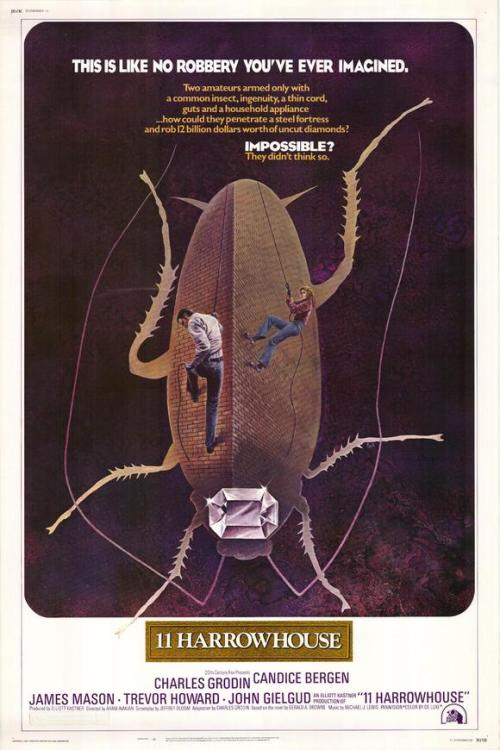
The robbery itself is quite unique and a highpoint. Howard and his girlfriend manage to break into the electrical system of the building and put cockroaches with different colored stripping along their backs down through the piping that houses the building’s electrical wiring. They do this to find out which ones lead to the underground vault. Once Charles reports to them which cockroach came through the vaults electrical outlet, Howard pulls out the wiring and replaces it with a long thin hose. The hose is connected to a powerful vacuum, which sucks up the diamonds and places them into a large truck sitting outside the building and driven by Maren.

When the crime has been completed Howard learns that they’ve been doubled-crossed and a wild car chase inside the sprawling estate of an English mansion ensues. The chase sequence features some funny voice-over commentary by the Howard character as well as some excellent stunt driving.

Howard’s relationship with his girlfriend has a twist to it as well, which I enjoyed. Instead of Howard being the macho one it is actually Maren. She likes to drive her flashy sports car at high speeds, which scares Howard. During the robbery she is the one who does all of the dangerous stunts while Howard looks on with awe. She is also loaded with money and helps support Howard during the lean times. I thought this role-reversal was refreshing and nicely reflective of the 70’s era.

The supporting cast is filled esteemed British actors that inject the film with energy and class. I have always felt that Trevor Howard was an incredible talent. Here his screen-time is unfortunately limited, but he still makes the most of it. Sir John Gielgud as the director of ‘The system’ is splendid as well. His character is snippy and acerbic and this comes to a hilt when he finds out they’ve been robbed, which is highly amusing. James Mason is equally brilliant as Charles. I have always found him to be a superior actor, but was impressed with how he managed to steal every scene he is in despite playing someone who is rather meek and passive.

If anyone comes off poorly it is actually Grodin.  I find the man to be a very talented actor-writer, but he goes a bit overboard in his portrayal of someone who is detached and malcontent. Most of the time Grodin seems to be almost sleepwalking through the part as he shows no energy and becomes almost transparent. His running narrative though is quite funny and one of the best elements of the film. There are two versions of this movie, one with the narrative and one without. I would recommend the one with the narrative as it gives the story a slightly added dimension.

The film did not do well upon its initial release and Grodin has said in later interviews that the reason for this was because the audiences at the time ‘didn’t get it’. His intention was not to make a crime-caper at all, but instead use the story to take potshots at big business and the establishment. The satirical elements are there, but it is much too soft. For satire it needed a lot more of a punch and payoff. For light entertainment it is kind of clever and works pretty well on a slow afternoon although I did find the first half to be a bit slow-going and did not become engaged with it until the actual execution of the robbery.

My Rating: 6 out of 10

Released: September 26, 1974

Runtime: 1Hour 34Minutes

Rated PG

Director: Aram Avakian

Studio: 20th Century Fox

Available: Amazon Instant Video