Tag Archives: Mills Watson

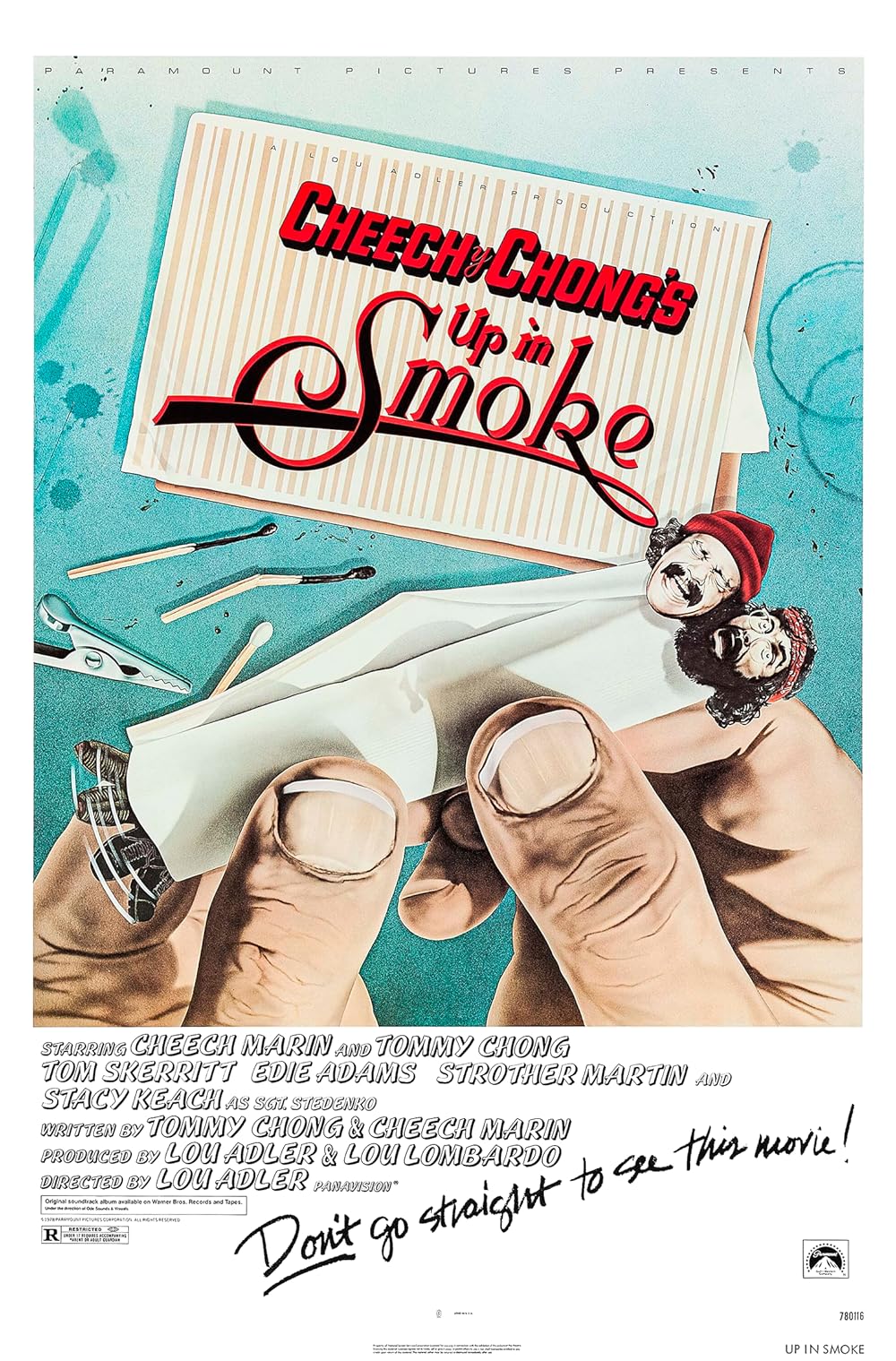
Up In Smoke (1978)

By Richard Winters

My Rating: 5 out of 10

4-Word Review: Two stoners become friends.

Anthony (Thomas Chong) is told by his father (Strother Martin) that he must find a job, or he’ll be kicked out of the house. Anthony then hitches a ride with Pedro (Cheech Marin) and the two quickly become friends based on their mutual interest of getting high on drugs. Soon they’re involved in many adventures including being shipped off to Tijuanna. In order to get back into the country they agree to drive a van that unbeknownst to them, is made completely of hardened marijuana, which gets them quickly put on the radar of Seargent Stelko (Stacy Keach) who along with his crack team of incompetents chases the two relentlessly in order to haul them into jail and make the country’s streets safe again. 

Cheech Marin was trying to avoid the draft when he went to Canada in 1969, which is where he met Thomas Chong, already a Canadian citizen who was starting up his own improv called ‘City Works’ after seeing Second City improv in Chicago while touring as a musician. The two became a comedy team who would come out to warm up audiences before concerts, but in many cases were more popular than the bands they were introducing. This then caught the attention of producer Lou Adler, who signed them to a contract to create record albums, which were so profitable that they graduated into making a movie, which Adler directed, that recreated many of the same skits they had used during their stage routines.

The movie upon its initial release with its open drug use was considered quite controversial and lead to many critics at the time to condemn it but nonetheless proved to be a big money-maker grossing $104 million on a $2 million budget.  Today the film is seen in a much softer light and in 2024 was elected for preservation by the National Film Registry by the Library of Congress.

I remember watching this when it came out and laughing at much of it particularly the car scene where the two smoke a giant marijuana cigarette and then get pulled over by the police. The film also does a terrific job of showing the East L.A. vibe possibly better than any other movie out there. You feel immersed in the culture and get a vivid feel of the era and setting especially at the end when the two go onstage and take part in the Battle of the Bands at the Roxy Theater. The film also has a leisurely pace, much like a French film, where it doesn’t feel the need to have a highly structured plot like in most American films and putting the emphasis more on atmosphere, which is a refreshing change of pace. Some of the supporting players, including Strother Martin who refers to his son as the ‘anti-Christ’ and Stacy Keach as the hardnosed police detective as well as his loyal, but bumbling deputy, played by Mills Watson, but without his patented mustache, who later went on to play the same type of role in the TV-show ‘The Misadventures of Sheriff Lobo’, are all perfect and help add to the fun.

On the negative end the two leads and their interactions, are poor. Cheech never even bothers to learn his buddies name and just continues to refer to him as ‘man’ for the duration of the pic, which might be the intended comedy, but offers no character development. They never grow or change and instead are paralyzed in a permanent caricature. Marin is funny, and in fact the only source of the humor, but Chong is underdeveloped. He spends most of the time strung out on drugs, or going through a bad trip, to the point that he seems catatonic and allowing all the energy to go to Marin, which is fine as he makes the most of it, but it barely seems like a buddy pic when it’s only one guy getting all the laughs. 

Without sounding like somebody’s old-fashioned parent I must agree with the initial sentiment that found this movie to be glorifying drug use and thus toxic to the day’s youth. The film acts like using drugs is just harmless fun. The scene involving actress June Fairchild, who later became homeless due to her own real-life addictions, where she sniffs some Ajax by mistake thinking it’s cocaine, but has no bad reaction to it and instead gets just as an enjoyable high is a problem. Granted I realize it’s supposed to be ‘funny’, but I could see a parent being concerned that it’s sending the wrong message to impressionable teens. 

My Rating: 5 out of 10

Released: September 15, 1978

Runtime: 1 Hour 26 Minutes

Rated R

Director: Lou Adler

Studio: Paramount Pictures

Available: DVD, Blu-ray, Amazon Video, YouTube

…tick…tick…tick (1970)

By Richard Winters

My Rating: 4 out of 10

4-Word Review: New sheriff faces racism.

Citizens of a small southern town get on edge when the current sheriff (George Kennedy) gets voted out and replaced by a black man (Jim Brown).  As the new sheriff Jim faces stiff resistance even from fellow members of the black community, but he forges on. When the son of a rich white man from a neighboring town runs over and kills a young white girl while he was driving drunk, Jim has him put into jail, but the young man’s father demands that he be released and when Jim refuses it creates the beginning of a potential race riot that forces the white citizens of the town to make a hard choice; do they continue with their racist behavior, or join the black sheriff in defending their town from corrupt outsiders?

The film starts out on the cheesy side by showing up close an egg frying on a sidewalk. The problem is that I tried this last year in Austin, Texas when the temp was 110 (actual temp and not a heat index figure), but I couldn’t get it to work even though I did it on asphalt and in direct sunlight. Some say that the egg has to be put in a frying pan and then have the pan put on the cement and maybe so, but that’s not how the film shows it and what’s worse is that it looks like the egg is already in a fried state even before it hits the pavement.

It’s also annoying that despite having the Deep South as the setting it was actually filmed in Colusa, California where the topography looks much different. I also had to wonder why everyone is constantly glazed over in sweat even when they were in bed at night and only small, little fans to cool them. The story’s time period is the present day (1970) and air conditioners were invented in 1902, so why the hell doesn’t anyone in this hot southern town own and use one?

The soundtrack features loud, poorly sung songs that not only get played over the opening and closing credits, but during a lot of the film as well, which gives the entire production a very B-level movie feel. I also got tired of hearing the sound of a clock ticking in the background that permeates just about every scene during the first 30 minutes and becomes heavy-handed and annoying.

The only thing that saves it is Jim Brown who’s really good here and looks better and younger without his trademark mustache. Kennedy on the other hand doesn’t seem up to the challenge with many of his scenes, particularly the one were he accosts a young man who was harassing him, coming off as unintentionally funny.

It’s sort-of fun seeing Frederic March playing a goofy mayor as well as Mills Watson, in his film debut, playing a racist deputy a decade before playing his most famous role as the bungling deputy Perkins in the ‘Misadventures of Sheriff Lobo’ TV-show.  I also liked how Clifton James and Anthony James (no relation) who had both played racist southern types in other films get roles here where they’re more level headed and help suppress the racist behavior of others instead of stoking it.

The film gets marginally better as it goes along and the ending is okay even a bit unique for this type of genre, but overall it’s just a cheap imitation of In the Heat of Night, which was much better. The only really surprising thing about the movie is that it received a G-rating despite having the N-word spoken throughout by several of the characters.

My Rating: 4 out of 10

Released: January 9, 1970

Runtime: 1 Hour 40 Minutes

Rated G

Director: Ralph Nelson

Studio: MGM

Available: DVD-R (Warner Archive), Amazon Video 

Lucky Lady (1975)

lucky lady

By Richard Winters

My Rating: 6 out of 10

4-Word Review: Three’s not a crowd.

Walker (Burt Reynolds) and Claire (Liza Minnelli) make money by helping people illegally cross the Mexican border into the states, but when their third partner in the business dies and they almost get arrested they decide to get into an easier line of work. With the help of Kibby (Gene Hackman) they become rum-runners who transport liquor by boat under the cover of night during the prohibition era. As the three start to have some success and get to know each other they also form a love triangle and spend their evenings involved in a ménage-a-trois.

If you’re in the mood for non-think, grandiose style entertainment made in the same vein of classic movies from Hollywood’s golden era then you should find this more than satisfying. The plot moves along at a nice breezy pace with characters that are distinct and fun and full of snappy dialogue. The majority of the story takes place on water, but manages to remain quite exciting and ironically only becomes waterlogged when it goes on land. The lavish sets are splendid and the film could be enjoyed by simply taking in those alone.

The three leads are in top form and play against type. Minnelli, who actually looks sexy here in a flapper styled hairdo, is quite amusing with her acerbic one-liners. Reynolds is great as the klutzy member of the trio and Hackman is solid as always playing someone who seems meek at first, but eventually takes over things with his patented strong personality. Unfortunately John Hillerman, best known for playing Higgins in the ‘Magnum P.I.’ TV-series, is the only weak link of the cast playing a bad guy that never conveys enough menace to be truly threatening.

A young Robby Benson who was 18 at the time, but looks more like 14 is quite good in support. I was never all that impressed with the former teen heart throb, but here he is effective playing a shy kid who says little, but when he does say something it’s a gem. Geoffrey Lewis is also quite funny as an inept Captain of the Coast Guard. Mills Watson, who is best known for playing Deputy Perkins on the ‘The Misadventures of Sheriff Lobo’ TV-series can be spotted in a couple of scenes. IMDb does not have him listed here, but I recognized him and his name does come up on the closing credits as a character named Giff.

For lightweight entertainment the film does have quite a few action sequences that are surprisingly well choreographed and even quite bloody, but the climatic sequence becomes too cartoonish. I was also disappointed that the one unique element of the story, which is the three getting into a relationship, is only mildly touched upon and basically forgotten after the first hour. The film could’ve gone a lot farther with that and even made it the centerpiece of the plot, which would’ve helped make it more character driven and groundbreaking.

My Rating: 6 out of 10

Released: December 25, 1975

Runtime: 1Hour 58Minutes

Rated PG

Director: Stanley Donen

Studio: 20th Century Fox

Available: DVD