Tag Archives: Michael Caine

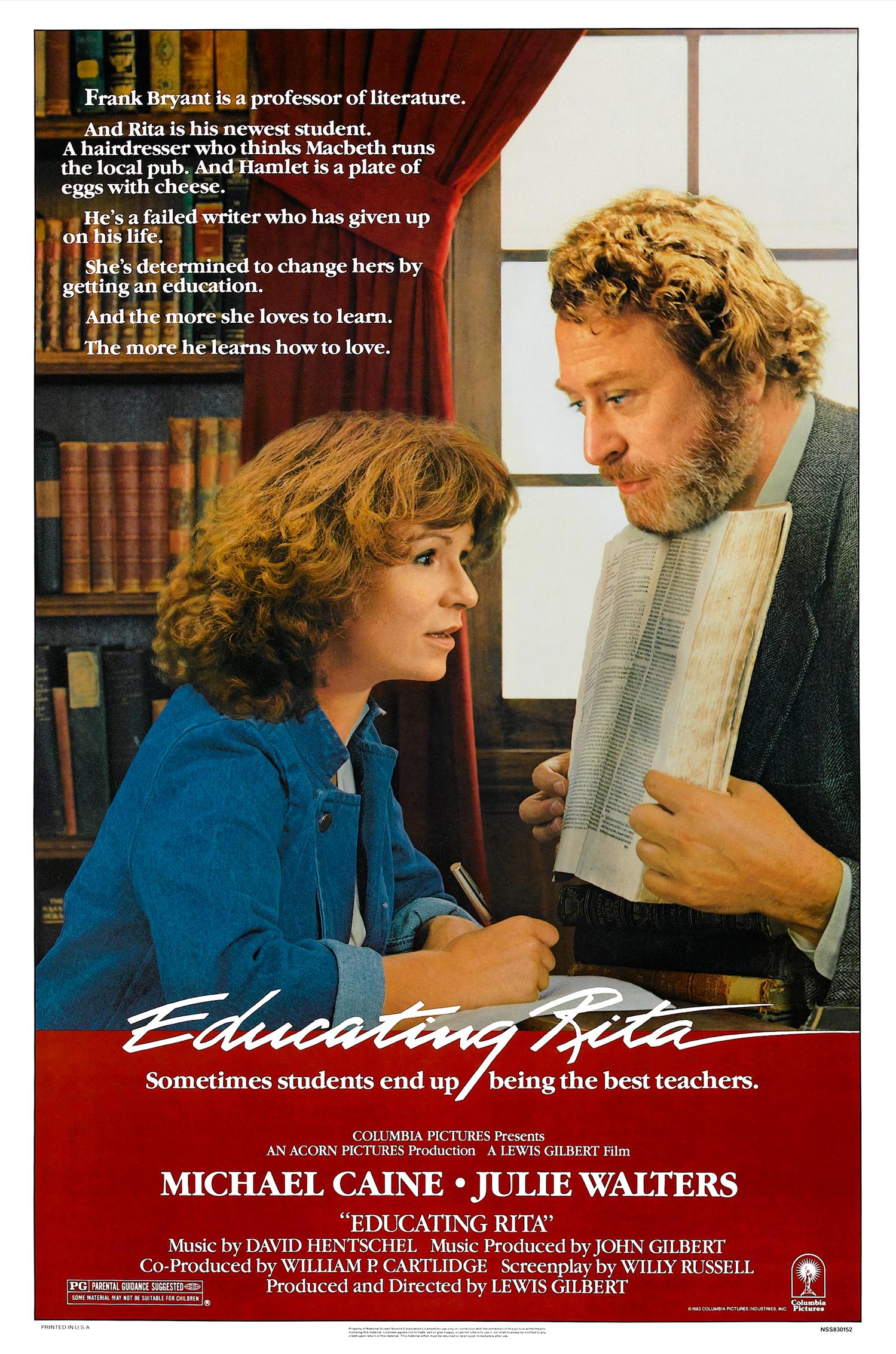
Educating Rita (1983)

By Richard Winters

My Rating: 5 out of 10

4-Word Review: Trying to better herself.

Rita (Julie Walters) is a young working-class woman who finds her job as a hairstylist and marriage to Denny (Malcolm Douglas) to be unrewarding. Denny wants her to have a child, but she fears that will just tie her down more. In an attempt to ‘better herself’ she decides to enroll in Britian’s open university where she takes a course in English literature.  Frank (Michael Caine) is a disillusioned college professor who lost the zeal for his job years earlier and has now taken to the bottle. Rita wants him to be her tutor, but Frank initially resists only to eventually agree. Despite their contrasting personalities the two ultimately form a bond and Frank uses Rita’s passion for learning to reignite his own dormant desires that allows him to breakout of his loveless relationship.  However, Rita too begins to see things differently when her roommate/friend tries to commit suicide and she realizes that things aren’t always greener on the other side of the fence.

The film is based on the play of the same name by Willy Russell that premiered in London in 1980 and also starred Walters in the title role. Unlike the movie the play had only two characters and everything took place inside the tutor’s office.

The story’s theme does have an inspiring quality, which is what galvanized the critics to it, but the main character and her transition is a bit hard to believe. On the surface she’s quite likable and well played by the star, but her ambition seems awfully extreme. It would’ve helped had we seen the moment when she first got the idea to go back to school versus having it just briefly be discussed. Wanting to learn a trade in order to make more money and move out of one’s humble surroundings is both commendable and understandable but becoming well versed on the plays of Henrik Ibsen isn’t really going to do that. To pay the bills she’s still going to be stuck working as a hairdresser, which was supposedly the boring routine she wanted to get out of. Expanding one’s literary knowledge may allow her to have lofty conversations among elites at posh parties, but as a whole she’d still be in her same predicament financially.

The Pygmalion-inspired theme was unnecessary. Without sounding snotty I couldn’t buy into the idea that this working-class woman with a limited education could learn to fully appreciate the great literary works or would even want to. The story acts like all that is needed is a great deal of enthusiasm and you can do accomplish anything, but history is full of people who jump into lofty goals with the best of intentions and still fail. Realistically I think this type of person would’ve eventually gotten overwhelmed and realized she was in over-her-head. To solve this the character should’ve been modified to being someone who was middleclass with a literally background, but who had to drop out because her parents died forcing her to go to work at the factory in order to make ends meet, but still longed to get back into what she really enjoyed and thus hired a tutor to help her, which would’ve been for the discerning viewer easier to swallow.

Rita’s ultimate transition is more off-putting than inspiring. I didn’t like her change in hair color where she goes from blonde to brunette, which makes her seem like a different person instead of someone who’s evolved. There needed to be more challenges and roadblocks. A brief spat with her husband, in which he throws her books into a fire, blows over too quickly and she’s able to grasp the complex material, even able to write in depth term papers with a relative ease that didn’t come off as wholly believable. Having her get a bad grade in a course and using this to reassess her goals would’ve allowed in a broader angle and not have been so fanciful, which the film starts to become.

Caine plays his part wonderfully and he certainly is much more into this role than he was in Blame it on Riowhich he did the same year. However, his character’s motives were difficult to understand. I thought this would’ve been the classic case, which can occur with a lot of academics in higher education, where the students aren’t into learning and are apathetic, which frustrates the professors, and this then turns them to alcohol. Here though that didn’t seem to be the case making him come off more like he was just tuning out on his own accord and thus making him less relatable. I also felt he should’ve been fired much sooner as the young adults attending his classes knew that he was drunk, even verbally said as much, so he likely would’ve been reported, and for him to then on top of this get a second chance when he fell over inebriated during a speech, seemed rather implausible.

I did enjoy the scenes involving Frank’s girlfriend Julia (Jeananne Crowley) and her relationship with a married man named Brian (Michael Williams) and how every time Frank comes into the room, and they are there Brian pretends, as a ‘cover’, that he is speaking to someone on the phone. These scenes, which becomes a running-joke, were amusing, but near the end Frank informs Brian that the phone was disconnected and thus revealing that he was in on their charade. This though doesn’t jive because with the old fashioned rotary phone, such as the ones shown here, there would always be a dial tone when one put the receiver to their ear, except of course if the service had been cut and thus Brian would’ve already known that it had been disconnected when he didn’t hear the tone and no need then for Frank to explain it.

My Rating: 5 out of 10

Released: May 3, 1983

Runtime: 1 Hour 46 Minutes

Rated PG

Director: Lewis Gilbert

Studio: Columbia Pictures

Available: DVD, Blu-ray
The Island (1980)

island

By Richard Winters

My Rating: 0 out of 10

4-Word Review: Journalist investigates pirate hideout.

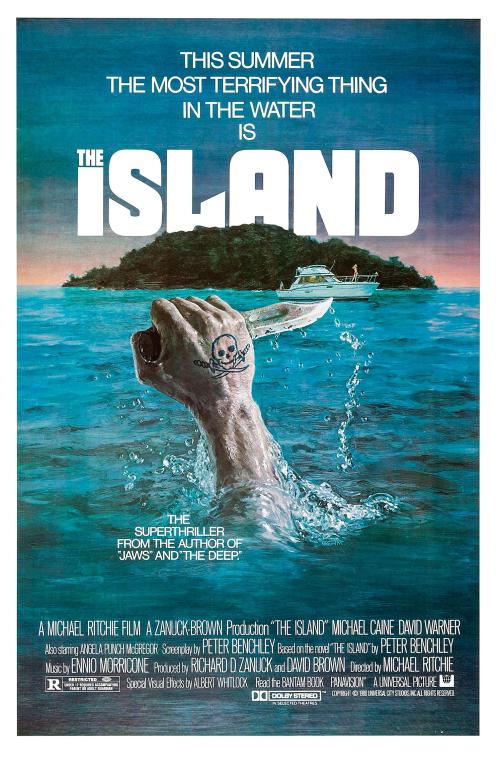
Blair (Michael Caine) is a newspaper reporter who becomes intrigued about the reports of missing boats in the Caribbean. He gets the permission from his editor to travel down there to investigate and he takes along his 12-year-old son Justin (Jeffrey Frank). The trip proves dangerous right from the beginning when the plane they’re traveling in crashes on one of the islands when the wheels of the craft fail to operate as its trying to land. They then go on a fishing trip only to be attacked by some pirates living on an uncharted island. Justin is brainwashed by the head of the group, Nau (David Warner), to become heir while Blair is put to the task of being the resident scribe and in the process becomes the source of romantic affection to Beth (Angela Punch McGregor) whose husband he killed earlier during the attack on their fishing boat. While Blair desperately searches for an escape he becomes even more worried about his son who no longer shows any loyalty to his father and instead considers himself a descendant of the pirates.

This was another one of Caine’s ‘paycheck projects’ where he’d do the film simply on the basis of the monetary offer regardless of the script quality. He has since regretted this decision and refuses to talk about it in any of his interviews while privately labeling it the worst film of his career. The script was written by Peter Benchley and based off of his novel of the same name. Since Benchley also wrote Jaws he was for awhile deemed a hot commodity in Hollywood, but after this movie tanked his status diminished completely and he was never offered another script deal again though his 1991 novel ‘Beast’ did get adapted into a TV-movie.

The main problem is the disjointed tone that comes off at times as a thriller and at other moments a comedy. The scenes of violence, which start out right away, are completely botched. The first one has what’s clearly a mannequin put in place as the victim and thus makes the stabbing sequence unintentionally laughable. The second violent episode where the pirates raid another boat has the victims not making a single sound as they’re being hacked and thus allowing their daughter to sleep through it, but I feel men and women will definitely yell out in terror as their fighting for their lives. The third raid features one of the victims trying to take on the pirates, one-by-one, karate style, but this turns the thing into a farce and makes the pirates engaging in a weird sort of way, which saps away all the suspense.

The concept that this pirate community would be inhabiting an uncharted island for centuries and not found out is unbelievable to the extreme. They come-off like people lost in a time warp who are confused and baffled by modern technology, but they’re clearly able to get off the island whenever they want, so why wouldn’t they travel to other islands, or even the mainland where they would come into contact with the modern day civilization? Even if the whole group didn’t go there would most likely be a few who’d be curious enough to want to explore what else was out there. Having the pirates get into a time machine from the 1600’s to the modern day, or be the ghosts of pirates from long ago, as wacky as those concepts may be, would still be better than doing it the way it gets done here.

The Caine character is boring and the way he gets put on this assignment is ridiculous as his boss just tells him ‘to go’, without putting up any provisions like how long he’ll be staying, where exactly will he be traveling to, how many articles would he be writing and when would they be due, or even whether the newspaper would even be compensating him for the cost. With terms this loose a person could frolic away on some tropical vacation and his employers wouldn’t have known the difference. He’s also never shown writing anything on a notepad, or typewriter, or dictating into a tape recorder, so it barely seems like he’s a journalist at all. The idea that Caine would be the only person on the planet intrigued by these disappearances is absurd too as relatives of the victims would be demanding answers and there would be other news reporters wanting to travel there in an effort to be the first to get the ‘big scoop’.

It’s also odd that a father would choose to take his son on such a dangerous mission knowing full well that others who have traveled to this area have disappeared without a trace making it seem like he’s an  irresponsible parent. The kid also gets ‘brainwashed’ too quickly, literally overnight, making it seem like he might have some sort of mental disorder if he’s able to change personalities and allegiance that fast. The idea of putting match sticks in his eye sockets and thus not allowing him to sleep would most likely dry his eyes out and blind him instead of getting him to come onto their side and like them. The pirates are also able to do the same ‘brainwashing’ with another young girl they kidnap, but how is this primitive group so adept at child psychology in ways that modern man isn’t?

Spoiler Alert!

The ending, which features Caine annihilating the entire group via a M2 machine gun is cool though it should’ve been done in slow motion to fully accentuate the violent depravity. The subsequent chase through the dark bowels of the ship between Caine and his son and Nau where you hear the creepy splashing of the sea water hitting against the ship’s bottom isn’t bad either. Unfortunately everything that comes before is a wretched mess making it by all accounts one of the worst and most inane films I’ve ever seen.

My Rating: 0 out of 10

Released: June 13, 1980

Runtime: 1 Hour 54 Minutes

Rated R

Director: Michael Ritchie

Studio: Universal

Available: DVD-R, Amazon Video, YouTube

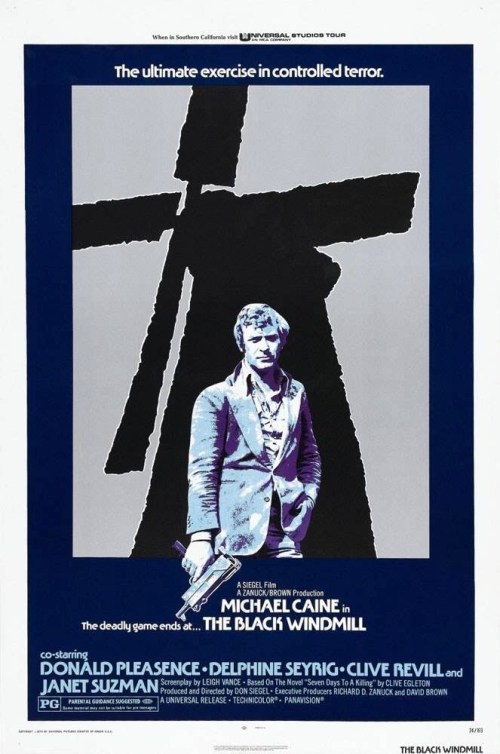
The Black Windmill (1974)

black

By Richard Winters

My Rating: 5 out of 10

4-Word Review: Agent’s son is kidnapped.

Michael Caine plays Major John Tarrant, a British Intelligence Officer, whose young son David (Paul Moss) gets kidnapped by an underground criminal organization headed by McKee (John Vernon). McKee is aware of John’s profession and insists that to get his son back he must fork-over some uncut diamonds, which had already been purchased to fund another operation. John informs his supervisor, Harper (Donald Pleasance), about their demands, but Harper begins to suspect that John may have orchestrated the kidnapping himself and thus refuses to go along with the turnover of the diamonds. Frustrated John decides to deliver them himself, but finds that he’s put himself into a perilous situation that he might not be able to get out of.

The film is based on the novel ‘Seven Days to a Killing’ by Clive Egleton and directed by Don Siegal who’s most notable for having done Dirty Harry. On the technical end it’s masterful. The lighting and editing are pristine and shot on-location in England in many scenic spots including the historic, but now closed Aldwych underground train station and the Shepherd’s Bush station as well as the climactic sequence, which takes place at the Clayton Windmills, known as Jack and Jill with Jill being built in 1821 and Jack in 1866. There’s also a terrific supporting performance by Pleasance who plays this uppity agent who won’t allow smoking in his office, nervously fiddles with his mustache, and is shocked by the forwardness of one of the other elderly agent’s younger wife, played by Catherine Schell. In fact his eye brow raising expression during his visit with her is one of the more amusing moments in the film.

The story seems a bit pedestrian with elements stolen from other better spy films including a Q-like moment where a  researcher shows Harper and John how they’ve come-up with a new invention, which is a briefcase that can shoot bullets just like a gun. Another segment has John being followed by a bad guy while hopping onto the subway, which looks like it was taken straight out of The French Connection, though much better done there.

There’s also the part where John, upset with Harper’s refusal to deliver the diamonds, breaks into Harper’s office and steals the key to the bank safe that has the diamonds in it, but this seems much too easy. You’d think an operation that has lights on top of the office doors, with green to be allowed in and red to be locked, would have a better contraption to stop someone from breaking in like burglar alarms to sound when somebody trespasses, or laser beams that would trip off and sound alarm on a mobile device carried by a security guard. Yet John is able to break-in with hardly any effort and the way he tries to disguise his voice to sound like Harper is pathetic and should’ve been enough to alert the bank manager that something fishy was going on. Also, you’d think Harper would have his eye on John, or had someone else keep tabs on him since he’d most likely be angry over the news that the agency wasn’t going to help him and thus already be predicting that he’d make an effort to steal the key before it actually happened.

The biggest issue though is that John is not emotional. His stoic nature makes him seem almost inhuman and like he may not actually care about his son’s safety at all. Supposedly this is because he’d been trained as an agent to hide his feelings, but the viewer still needs to see his softer side at some point, so we know he’s suffering inner turmoil about what’s going on and the fact that this is never shown makes it hard for us to side with him. It also gives Caine one of the flattest performances I’ve ever seen and is so stone cold it could’ve been done by a robot and you’d never know the difference.

The kid is far more engaging and if the movie had shown him more it might’ve worked better, or at least shown John and the boy together, we only see a fleeting few seconds of a photo of them, but we should’ve viewed them in a fun activity before the kidnapping, so we could feel the bond that is otherwise quite hollow. John’s relationship with his wife, played by Janet Suzman, doesn’t gel either. They’re already separated apparently because John put his career ahead of the family, but there needed to be more of an arc to make it interesting like having them bitterly at odds at the beginning only to realize they must put their animosities behind them in order to work together to find their son, but here there isn’t enough dramatic friction between the two, so seeing them rekindle things near the end packs no punch at all and like with everything else here emotionally vanquished for the audience.

My Rating: 5 out of 10

Released: May 17, 1974

Runtime: 1 Hour 46 Minutes

Rated PG

Director: Don Siegel

Studio: Universal Pictures

Available: DVD, Blu-ray
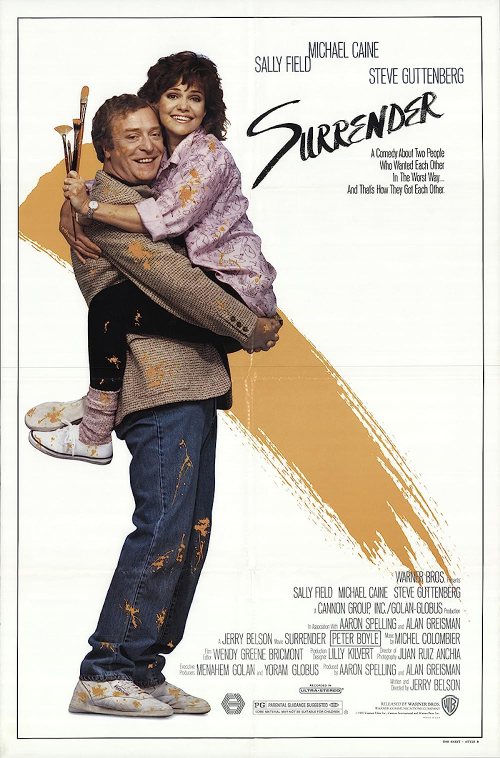
Surrender (1987)

surrender

By Richard Winters

My Rating: 1 out of 10

4-Word Review: Pretending to be poor.

Sean Stein (Michael Caine) is a successful novelist, who after suffering through two contentious divorces, has decided that women are only after him for his money and considers them off-limits. Daisy (Sally Field) is a struggling artist, who is in a relationship with Marty (Steve Guttenberg), a successful attorney with no interest in making a long term commitment. While attending a charity ball that gets overrun by gunmen who rob the place, Sean and Daisy, find themselves tied-up together and despite the stressfulness of the situation slowly get to know each other. The next day, after they ultimately get freed, Sean asks Daisy for a date, but decides to pretend that he’s poor to make sure she loves him for who he is rather than because of his money.

While Jerry Belson wrote several successful comedies during the 70’s and based this story loosely on his own life experiences where he proudly stated that everything that happened to Sean in this movie happened to him in real-life, the pacing and basic comedy scenarios really don’t work. It starts out alright  as they’re several flashbacks showing Sean with his attorney, played by Peter Boyle, battling his ex-wives in court. The different hairstyles that they have as they go through the years is funny and the most creative thing in the movie. I was though disappointed that the two women who play the ex-wives, Louise Lasser and Iman, are never give a single word of dialogue, which wastes the talents of these well-known actresses.

After the first ten minutes though things quickly fall apart. Having armed thieves crash the party that the two are at is particularly troubling as there is no forewarning for why this is happening. People who attending posh parties usually don’t find themselves at gunpoint, so why are they here? Had there been even a fleeting mention of a group of criminals crashing area get togethers then maybe, but here we get no explanation either before, or after giving the plot a haphazard quality like the filmmakers are happy to throw in any crap they want whether it makes sense, or not. The characters respond to what most would consider to be a traumatic experience like it’s just a ‘run-of-the-mill thing’ and by the next day barely remember it, even though many people would have genuine PTSD after it was over.

Caine’s attempts to woo Sally would in most cases have the woman thinking he was a potential stalker. First he comes to her house six hours before their date saying that he couldn’t wait that long to see her and wanted to spend every waking minute with her that he could, which for any sane woman would be a serious red flag. He then kisses her without her consent and begs for immediate sex, or he might not be able to control himself and instead of calling 9-1-1 she gives him a pity fuck. Not only is this unfunny and stupid, but an insult to the viewer’s intelligence that they would find any of this to be a normal, well-adjusted way to start a healthy relationship.

I also thought Caine, who was a raving misogynist who even had signs on the front gate of his home banning women from entering, came around to liking Sally too quickly. Sure she was kind to him when they were tied-up, but an avowed women-hater doesn’t just change his ways overnight, but in this movie that’s exactly what happens, which isn’t realistic. If anything it should’ve been Sally chasing after Caine, who might’ve liked her a little at first, but so set in his ways would still decide to avoid her and only after an extended period of time, and continual prodding by Sally, would he eventually relent.

The pretending to be poor thing isn’t handled well either. I was expecting there to be a lot of comic moments dealing with Caine trying to desperately hide his wealth and background, but that never gets played out. He isn’t even forced to rent himself a seedy, little apartment in order to hide the fact that he lives in a mansion as Sally was apparently never curious about seeing his place, but how many serious relationships are there where they always go to one partner’s home and never the other?

The third act gets even more ridiculous as it has Caine insisting that Field needs to sign a prenup agreement. She’s resistant at first, and even insulted, but then eventually signs it without ever bothering to read it, which is idiotic. She also goes to Vegas and wins 2 million dollars at the slot machine her very first time playing it, which is beating insurmountable odds.

I did like the scene where Caine hands Sally a manuscript he has written, which was published into a book though he doesn’t tell her this and then becomes insecure when she doesn’t immediately like it, which being a budding screenwriter myself, I found funny and despite all the other absurdity in the film, a bit true to life. I was hoping the movie would explore this situation more, but it doesn’t making the rest of it a sore disappointment.

I was surprised why either of these big name stars agreed to do it. I know Caine was willing to be in almost anything for the money, but I’m not sure what Sally’s excuse was and if you ask me I’d find the old reruns of her TV-show ‘The Flying Nun’ to be more entertaining. It’s easy to see why this dumb thing, despite the star quality, has never gotten a DVD or Blu-ray release and nobody’s been clamoring for it either. It bombed badly at the box office too managing to recoup only $5 million of it’s $15 million budget.

My Rating: 1 out of 10

Released: October 9, 1987

Runtime: 1 Hour 34 Minutes

Rated PG

Director: Jerry Belson

Studio: Warner Brothers

Available: VHS, Tubi

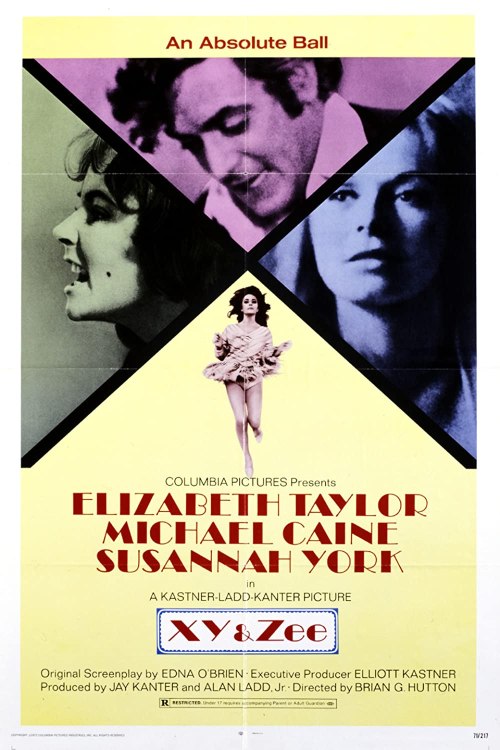
X Y & Zee (1972)

x

By Richard Winters

My Rating: 4 out of 10

4-Word Review: Wife sabotages husband’s affair.

Zee (Elizabeth Taylor) is the middle-aged wife of Robert (Michael Caine) and the two have been in a tumultuous marriage for many years. Then at a party Robert spots Stella (Susannah York) who is a single mother with two boys. Robert enjoys her much calmer less confrontational demeanor, which is the exact opposite of Zee’s and the two quickly fall into an affair. Zee though becomes aware of what’s going on and becomes determined to put a stop to it one way or the other. At first she is meddlesome by constantly calling-up Stella and warning her about Robert and even going to her place of business to harass her. When that doesn’t work she tries playing into Robert’s sympathy and at one point even attempting suicide, but when all that fails and the affair continues she uses her gay friend Gordon (John Standing) to dig-up some dirt on her and when she finds out the secret that Stella has she uses it to exact her revenge.

Taylor and her over-the-top shrewish performance is the whole reason the movie works and if you watch it for that purpose you won’t be disappointed. Sure she’s played this role a bit too often to the point that it was becoming more of a caricature for her and ultimately what I feel killed her career as by the 80’s she was no longer making films for the big screen, but still when she’s as entertaining doing it as she is here it’s still a joy to watch. Unfortunately she dominates every scene that she’s in that it leaves very little room for her co-stars particularly York who’s completely dull by comparison. York certainly was an accomplished actress, but in this movie she’s unable to go toe-to-toe with her superior co-star and the film suffers for it. A strong actress with a definite presence was needed instead York just quietly sits there looking overwhelmed as Taylor’s character continuously berates her. If anything Mary Larkin, who plays Caine’s nerdy secretary, should’ve been the love interest, Caine ultimately sleeps with her anyways, as she’s so meek that you would feel sorry for her when Taylor got snarky with her, but with York you feel nothing and it’s almost like she’s transparent.

Caine on the other-hand is able to hold his own, but his frothy retorts at Taylor’s abuse is never quite as clever, or entertaining as hers. My biggest issue with his character is why doesn’t he just divorce her as he’s quite wealthy and could easily do it and yet avoids it. He mentions at one point wanting to kill her, but never just divorcing her. Since the couple never had any kids it would be less messy, so why not just take that route and then he could see York, or any other woman for that matter without worrying about Taylor getting in the way. I realize some marriages are held together for weird reasons, even those when it becomes achingly clear that it should end, but for whatever reason it doesn’t. However, after 2-hours of watching this those reasons should eventually become clear, but they never do.

Spoiler Alert!

I sat through almost the entire movie just waiting to find out what the ‘dark secret’ was that York’s character held, as described by Leonard Maltin in his review, only to finally realize it was nothing more than her being a closet lesbian. What’s worse is that nothing much happens once the secret is exposed. Maltin also describes Taylor/York’s lovemaking scene as ‘ranking high in the annals of poor taste’ though this sentence has been removed from his review in the later editions of his book presumably to avoid making him look homophobic, but whatever lovemaking he may of seen I didn’t and I watched the full 1 Hour 49 Minute newly remastered version from Columbia Pictures (same version streaming on Amazon Video), so either a minute of it got snipped on this cut, or Maltin was offended at seeing the two women hug, which is all there is.

Admittedly I was disappointed as I was hoping to see them kiss, or in bed together, which would’ve livened it up a bit and made it worth sitting through, which otherwise is a strain. The lesbian angle should’ve been introduced much earlier and showing Taylor and York not only getting-it-on and enjoying it, but inviting the reluctant Caine in as a threesome. That would’ve made the movie truly sophisticated and ahead-of-its-time, but having it end the way it does with York seeming very ashamed and defeated about her homosexuality makes it dated and out-of-touch with modern-day sentiments. A misguided relic of its period that really doesn’t have much to say and nowhere near as ‘daring’ as the filmmakers thought it was.

My Rating: 4 out of 10

Released: January 21, 1972

Runtime: 1 Hour 49 Minutes

Rated R

Director: Brian G. Hutton

Studio: Columbia Pictures

Available: DVD-R, Amazon Video, Tubi

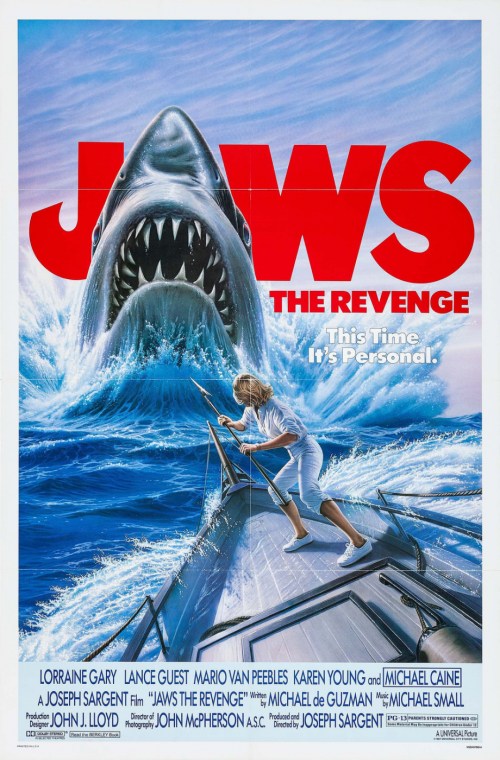
Jaws: The Revenge (1987)


By Richard Winters

My Rating: 3 out of 10

4-Word Review: Shark holds a grudge.

It’s been 9 years since the last shark attack in Amity. Since that time Chief Martin Brody (Roy Scheider) has died from a heart-attack, but the rest of his family continue to live in the area and carry on his legacy. His son Sean (Mitchell Anderson) like his father, works in the police department and one chilly night gets assigned to repair a disabled buoy out in the harbor. It’s there that he’s attacked and killed by a great white shark, making his mother Ellen (Lorraine Gary) believe that the shark is intentionally hunting down the members of her family, she even has nightmares about it. She warns her other son Mike (Lance Guest) to stay out of the water, but since he’s an underwater research scientist this is not possible, which starts to create friction between the two.

Just when the public thought it was safe to go back to the theaters again another formuliac shark movie got propped-up. This one was the brainchild of Universal CEO Sidney Sheinberg, (who was also the husband of the film’s star Lorraine Gary) who wanted to promote the new Jaws ride at Universal Studios theme park. In order to keep the story ‘fresh’ they decided to add-in a mystical element to it, but it’s not thought out enough to make any sense. I would think a shark would view people the same way people view sharks in that they would all look alike. How would a shark know when a Brody family member was in the water? Better yet how would the shark know when the Brodys move from New York all the way down to the Caribbean?

In the early versions of the screenplay, as well as the novel version of the film, the mystical factor gets explained as having been caused by a witch doctor named Papa Jacques who has an ongoing feud with the Brody’s and uses voodoo to compel the shark to kill them, but this idea got nixed in the final draft as it veered too much away from the actual shark. In some ways this was probably a good thing because in the novel there are several chapters done from the shark’s point-of-view where he becomes confused about why he’s killing the Brodys, which would’ve been too ludicrous had that been put into the movie.

The film sorely misses Roy Scheider, who’s only seen in brief flashbacks, and Richard Dreyfuss, who both refused to do the sequel. Had they been the elements of the shark’s revenge and having the nightmares only to decide to go out together on a boat ride to conquer those fears, this might’ve been worth catching.

Lorraie Gary’s presence is not interesting as she had been only a minor supporting player in the first two. She’s not the only one to reprise her role as Lee Fiero, who played Mrs. Kinter the mother of the young boy who gets killed by the shark in the first film, can be seen very briefly. Fritzi Jane Courtney, who played Mrs. Taft in the first two movies, is also on hand reprising the same character, but by this time her hair had turned all white and I didn’t immediately recognize her.

The presence of Michael Caine has to be the biggest head-scratchier. Granted he was notorious for doing what became known as ‘paycheck movies’ where no matter what the quality of the script he’d take the offer if the money was good, but his part here is quite minor and there’s long stretches where he isn’t seen at all. He later admitted that he has never seen the film and is well aware that it’s a flop, but the house it helped build with the money he made is ‘really nice’.

In fact the only performance that I was really impressed with was that of Judith Barsi, who plays the daughter of the Mike character. She’s perky and precocious when it’s required, but also believably frightened when it’s necessary making her untimely death, at the hands of her own father just a year after this film was released, all the more tragic.

Spoiler Alert!

The film’s most controversial moment has to do with the ending in which too variations were filmed. One has Gary ramming the shark with her boat and killing it while the other one has the beast exploding. Both versions show the cast jumping into the water as the boat they’re on breaks apart, but no explanation for how they ended up finding their way back to land, which is a big cop-out.

End of Spoiler Alert!

Probably the most amusing thing about this mess is the interview director Joseph Sargent gives on American Archives in which he mockingly laughs at his own film. He goes on to muse about Caine taking the part and shocked that he would think it was a ‘good script’. He then ponders about how ‘grown, intelligent men’ could ever work on a project that is so  stupid and admits that it was the money and power, as he acted as the film’s producer, that lead him to make the fatal mistake of doing it, which he knew was a really bad idea from the very beginning.

My Rating: 3 out of 10

Released: July 17, 1987

Runtime: 1 Hour 30 Minutes

Rated PG-13

Director: Joseph Sargent

Studio: Universal

Available: DVD, Blu-ray, Amazon Video, YouTube

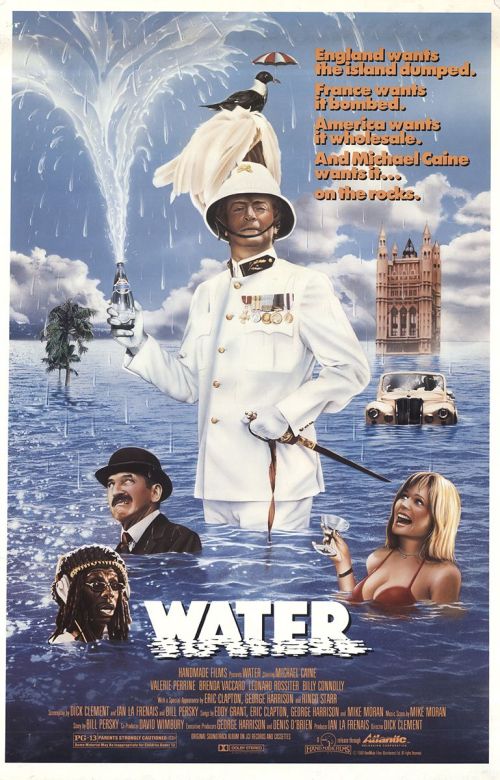
Water (1985)

By Richard Winters

My Rating: 4 out of 10

4-Word Review: Island nation fights back.

Governor Baxter Thwaites (Michael Caine) runs the British Colony island of Cascara a largely peaceful place that is mostly ignored by everyone else. Then one day one of the oil rigs on the island taps into a underground reservoir of water that has all of its impurities already removed. The delicious tasting drink, that can also be used as a laxative, becomes much sought after from bottling companies across the globe. Now suddenly the British government wants everyone on the island to move out and find some other island to live on while taking over and turning this one into a profit making venture.

The film is patterned after many British satires of the 50’s through the 70’s like The Bed Sitting Room and O Lucky Man that mixes in wacky characters with absurd comic scenarios and also trying to make sharp political observations in-between. Unfortunately this film, which is based on a story by Bill Persky who appears briefly as a TV director, goes soft and is too similar in its vapid tone to Persky’s other social satire flop, Serial, which came out 5 years earlier. The message is too ambiguous and the plot too cluttered with insignificant characters that it becomes almost nonsensical.

The characters are so eccentric that the viewer cannot identify with, or care about any of them. The film in a way comes off as almost racist since the island is populated with black people, but the main characters are all white while the blacks folks get completely pushed into the background. If anything the viewer could’ve sided with the islanders and their quest to protect their homeland, but since all focus is put on the British people who control them, that never happens.

The eclectic cast is the only thing that somewhat holds it together. Brenda Vaccaro, who normally plays in dramatic roles, is very funny as Caine’s feisty wife although I could’ve down without her misguided accent. Valerie Perrine, with her clear blue eyes is fun too as an idealistic social activist although she was already in her 40’s at the time in a role which would’ve been better served by someone in their late teens or early 20’s.

Caine on-the-other-hand isn’t all that entertaining with the exception of the scenes showing him wearing a cocked hat, which are amusing.  He at least seems more comfortable here than in Blame it on Rio, which he did the same year as this one, but due to the subject matter in that one he clearly looked quite awkward and stiff while here he’s having a fun time even if the audience really isn’t.

This also marks the last feature film appearance of Leonard Rossiter, who died in his dressing while waiting to go on stage in a play he was in just a few months after completing his filming here. Normally he’s enjoyable to watch even when he’s playing a stuffy character, which is what he usually did anyways, but here he’s too much of a jerk and I did not find him to be humorous or interesting in any way.

If there is one person that ultimately does comes-off best it would be Billy Connelly who’s hilarious as this rebel leader who refuses to speak and instead communicates everything through singing. Dick Shawn is also quite good as this arrogant actor whose career has declined and now forced, much to his dismay, to being a spokesperson for informercials. You can also spot Joyce Van Patten very briefly in an uncredited role as a TV news reporter.

George Harrison, who also produced the film, appears near the end playing the bass guitar in front of political leaders at the UN while Ringo Starr handles the drums and Eric Clapton does the vocals, but the movie would’ve been more entertaining had all three of them been given roles to play, or at  least it couldn’t have hurt. The film’s title is a bit misleading too as the water ultimately has nothing to do with what saves the island from takeover, or allows them to keep their independence.

My Rating: 4 out of 10

Released: January 11, 1985

Runtime: 1 Hour 55 Minutes

Rated PG-13

Director: Dick Clement

Studio: Atlantic Releasing Corporation

Available: DVD

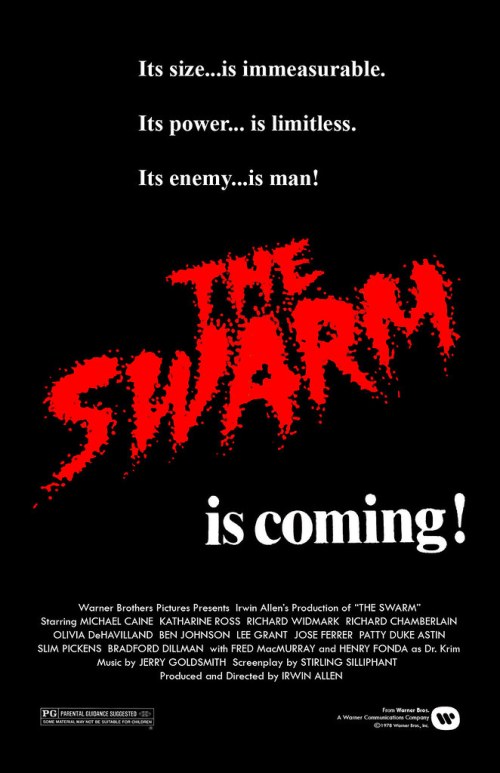
The Swarm (1978)

By Richard Winters

My Rating: 1 out of 10

4-Word Review: Killer bees invade Texas.

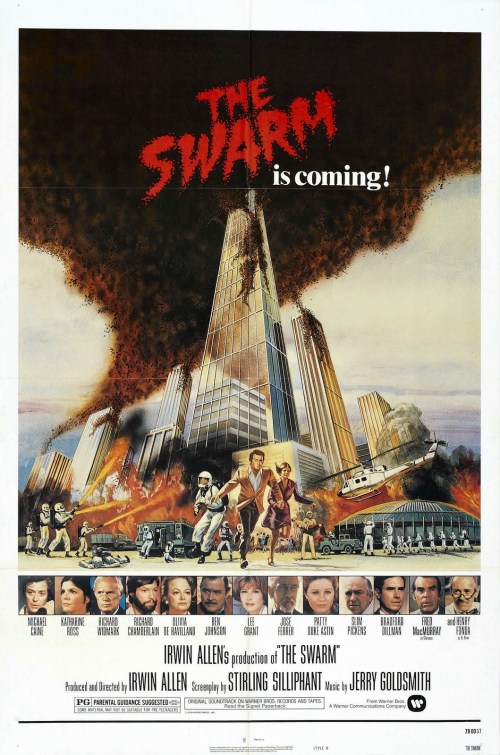
When his parents (Robert Varney, Doria Cook) are attacked by African Killer Bees while out on a picnic their young son Paul (Christian Juttner) manages to escape by jumping into their car and driving off. He then drives into the small town of Marysville, Texas where he tells the people about what happened. Scientist Bradford Crane (Michael Caine) and Army General Slater (Richard Widmark) are put in charge, but neither can agree on what strategy to use. Meanwhile Paul gets some of his friends to go back out to the park where the attack occurred to set fire to the hive, but instead of killing the bees it gets them to swarm onto the nearby town and the unsuspecting citizens.

Director/producer Irwin Allen was by the late 70’s known as the disaster master after having by that time either produced or directed 4 ( he ultimately ended up making 7) disaster flicks for both TV and the big screen many of which like The Poseidon Adventure and The Towering Inferno made a ton of money, so he was riding high coming into this one only to have it bomb monumentally at both the box office and with the critics. He took the failure of this film so personally that he refused to ever mention it and even walked out of an interview when he was asked about it.

In retrospect it’s easy to see why it failed as the special effects just aren’t interesting enough. Watching repetitive shots of swarming bees can only go so far and the victims just lay there without having their skin show any signs of swelling from the multiple stings, which you’d expect them to have. The shots from the point-of-view of the victims, which shows the bees in a giant form, is the only cool thing though, like everything else in the film, this ends up getting overdone and corny.

The script is ripe with unintentionally funny moments including having the authorities attempt to kill the bees by spraying at them with a flame thrower, which doesn’t seem to affect the bees at all and instead only sets buildings on fire as well as some of the people. The idea that the bees were set off by an alarm siren at a military base, which somehow sounded exactly like their mating call is too preposterous to believe and only makes the ‘science’ behind the film completely silly.

The film also makes the mistake of having the setting be in Texas, but not actually filming it there. Sure there’s a few shots of some famous Houston landmarks that get briefly shown, but the majority of it was clearly shot on a studio backlot in California and any true Texan will easily spot this as the topography and landscape between those two states are quite different. Had the film been made on-location it would’ve helped give it a little more character, which it is otherwise lacking.

The cast is made up of a lot of famous names, but they all get wasted. Lee Grant appears only briefly as an aggressive TV reporter that for the most part has little to do with the progression of the plot. Fred MacMurray, in his last film appearance, plays a rival to Ben Johnson who both compete for the affections of Olivia de Havilland, but all three get killed off in the second act, so what’s the use of introducing this potential story arc if it ends up not really going anywhere?

Caine makes for one of the most boring screen heroes in film history and gets seriously upstaged by Henry Fonda, who plays one of the scientists trying to create a serum to combat the deadly bee stings, even though Fonda is confined to a wheelchair the whole time. This was the first of many ‘paycheck movies’ that Caine did and in fact he admittedly never even bothered to read the script before agreeing to sign on, but still felt it was worth it as he was able to use the funds to purchase a nice mansion in Malibu unfortunately for the viewer there’s no such mansion just boredom instead.

My Rating: 1 out of 10

Released: July 14, 1978

Runtime: 2 Hours 35 Minutes

Rated PG

Director: Irwin Allen

Studio: Warner Brothers

Available: DVD, Blu-ray (Warner Archive), Amazon Video, YouTube

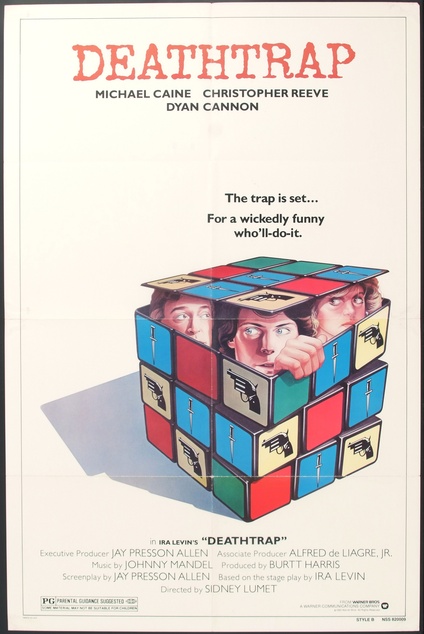
Deathtrap (1982)

By Richard Winters

My Rating: 4 out of 10

4-Word Review: Playwright turns to murder.

Sidney Bruhl (Michael Caine) was at one time a top playwright, but his latest play is a flop. To add to his depression he finds that one of his students who attended his writing seminar, Clifford Anderson (Christopher Reeve), has on his first attempt written a brilliant sure-fire hit. Something that makes Sidney jealous. He decides to invite Clifford over to his secluded cottage and while there, and with the help of his wife Myra (Dyan Cannon), kill Clifford and then steal his script and treat it as if it’s his own. Things though don’t work out quite as expected especially when their neighbor Helga (Irene Worth) arrives who has psychic visions that could ultimately implicate Sidney for doing the dirty deed.

The film is based on the Broadway play of the same name written by Ira Levin that ran for 1,793 performances from February 26, 1978 to June 13, 1982. The play was well received by critics and audiences alike including director Sidney Lumet who put up some of his own money to get it made into a film, but ultimately he relies too heavily on the twisting plot while failing to add any cinematic element to it.

The exterior of Sidney’s home was the picturesque DeRose Windmill Cottage, which sits in East Hampton, New York and helps add a visual flair, but the interior of the home was shot on a soundstage and the film becomes quite claustrophobic as almost the entire story takes place in this one setting. The movie desperately needed more cutaways, even some minor breakaway bits like Helga’s disastrous guest spot on the Merv Griffin Show, which gets talked about, but never shown, in order to make it seem less like a filmed stageplay, which it ultimately ends up being.

The script brings up some potentially interesting insights like how sometimes the characters in a writer’s play can closely parallel the authors themselves. In fact many people that knew him felt that the Sidney character here strongly resembled the real Ira Levin, but the film fails to pursue this in a satisfying way and is devoid of any interesting subtext or nuance. The characters end up being just boring one dimensional caricatures that are wholly unlikable. You could care less which one of them killed who, or whether any of them even survive.

Christopher Reeve is the film’s only real bright-spot and the way he plays a gay man is effective and believable. His onscreen kiss with Caine was considered controversial and daring at the time and even upsetting to fans to the point that purportedly one audience member in a Denver theater screamed out “Superman, don’t do it!” just as the kiss occurred. Irene Worth is fun too and her accent is so believable that I was convinced that she must’ve been born in Eastern Europe and was shocked to learn that instead she was from, of all places, Nebraska.

Caine is good, but his presence will remind many of the movie Sleuth, which he also starred in and is quite similar to this one. In fact a lot of viewers thought this was a sequel to that simply for that reason and because of this somebody else should’ve been hired to play the part.

Cannon on the other hand is annoying as the hyper wife and shares no onscreen chemistry with the other two actors. Marian Seldes had played the role on Broadway in every one of its 1,793 performances, which garnered her a citation in the Guinness Book of World Records as most durable actress and because of that alone she should’ve been given the part here.

Johnny Mandel’s soundtrack gives the proceedings a highbrow flair and I wished it had been played more. The plot twists may entertain and surprise some, but not if you think about them for too long, which ultimately makes this just a second-rate Sleuth.

My Rating: 4 out of 10

Release: March 19, 1982

Runtime: 1 Hour 56 Minutes

Rated PG

Director: Sidney Lumet

Studio: Warner Brothers

Available: DVD, Blu-ray, YouTube

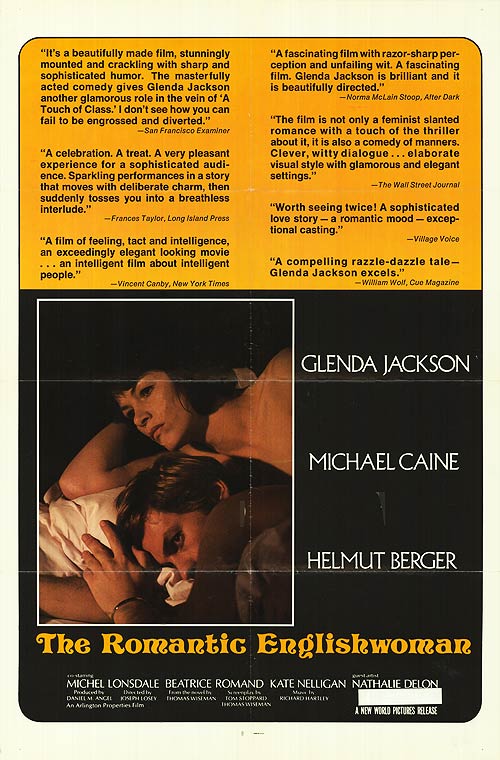
The Romantic Englishwoman (1975)

By Richard Winters

My Rating: 6 out of 10

4-Word Review: Writer suspects wife’s infidelity.

Unhappy in her marriage Elizabeth (Glenda Jackson) goes off to Baden-Baden, Germany for a little respite and there meets up with the dashing Thomas (Helmut Berger). Although quite charming Thomas is also caught up in the criminal underworld and being chased by gangsters. After the two share a brief tryst she returns home to her husband Lewis (Michael Caine). Lewis suspects that Elizabeth was unfaithful during her trip, but can’t prove it. He invites Thomas to stay at their place in order to help him finish a screenplay that he is working on and in the process the affair between Thomas and Elizabeth starts up again, but this time Lewis is determined to stop it.

The concept is intriguing, but the film gets ruined by playing its cards too early. A far more interesting scenario would’ve been to have Lewis not suspect Thomas at all or even his wife’s longing for him and instead simply invited Thomas over as a genuine writing partner and only slowly becoming aware of the tensions boiling beneath the surface. Unfortunately having Lewis almost immediately figure things out even before Thomas arrives makes for a very boring first hour with the couple arguing over the same staid, redundant infidelity talking points that have been done a million times before.

The story’s only interesting wrinkle has Thomas starting up a relationship with the nanny (Beatrice Romand), which made more sense as Elizabeth was way older than him and I failed to see why he would’ve been attracted to her to begin with. The nanny was young and cute and it was fun seeing Elizabeth seethe with the same type of jealousy as Lewis, but the film quickly kills this storyline by having the nanny forced to move out and everything goes back to the same formulaic love triangle.

Having Lewis recreating scenes in his screenplay that replicates what he is going through in real-life had potential as it nicely illustrates the thin line between fact and fiction that writers routinely do. Unfortunately the film treats these scenes in a campy/hooky manner and then drops it just as quickly as the romance scenario mentioned above.

The direction is static with a camera nailed to the ground and everything captured in a dingy, shadowy way. The opening bit detailing how Elizabeth first meets Thomas had a naturalistic quality, but the shot were she spots Thomas from across the room and her eyes remained locked on his and she never turns away is not believable. If two people are strangers and one catches the other one staring at them it’s sheer human reflex that the other one will divert their gaze as it’s rude, awkward and off-putting otherwise. Also, to have the word romantic in the title is absurd especially after the two proceed to have sex inside an elevator during their first meeting, which is pure animalistic lust and a more accurate title would’ve been ‘The Horny Englishwoman’.

Spoiler Alert!

The third act helps fill in the gaps in regards to Thomas’ secret past, but having Elizabeth run off with him makes her character seem exceedingly shallow as she essentially abandons her young child in the process. Earlier in the film she got very upset when she saw her child sitting out on a ledge and she fired her nanny for being irresponsible and not watching him more carefully only to then by running off with Thomas behave just as irresponsibly.

The film’s final shot features strange people inhabiting Lewis and Elizabeth’s home like they’re having a party without the owners there. Lewis then after having taken Elizabeth away from Thomas and back with him drives the car the two are in up to their house. Elizabeth looks shocked at seeing all the people inside, but Lewis has a jaded expression and seems to being enjoying watching Elizabeth’s discomfort, but then the film cuts to the credits and never explains what’s occurring and nothing is more frustrating than a film which ends just as it’s finally beginning to get interesting.

My Rating: 6 out of 10

Released: November 26, 1975

Runtime: 1Hour 56Minutes

Rated R

Director: Joseph Losey

Studio: New World Pictures

Available: DVD, Blu-ray, Amazon Video