
By Richard Winters
My Rating: 7 out of 10
4-Word Review: Spy infiltrates isolated family.
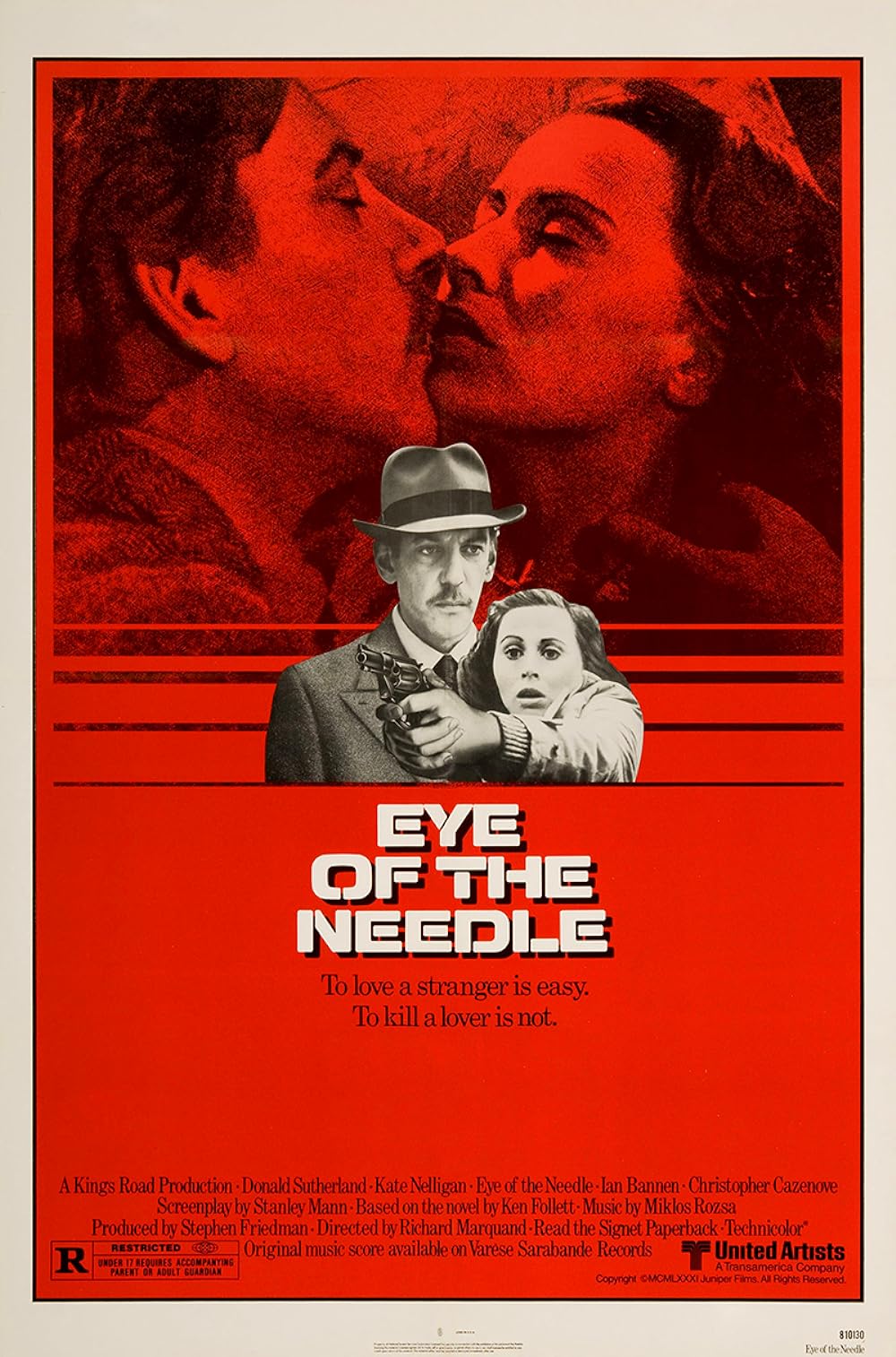
Henry (Donald Sutherland) is a German spy stationed in England during WWII, who comes upon an airplane site that he thinks is the Allied commandment post for the eventual invasion of Normandy, but upon closer inspection he finds out that the planes are all made of wood and the place is simply a decoy. With this information he tries to charter a U-boat to get back to his homeland, so he can hand his findings directly to Hitler and thus potentially change the course of the war. Instead his boat gets hit by a storm and crashes on the beach of Storm Island. Only four people reside there including Tom (Alex McCrindle), a lighthouse keeper and owner of a 2-way radio, which Henry needs to communicate back to Germany, as well as a young family made up of Lucy (Kate Nelligan), her husband David (Christopher Cazenove) and their 5-year-old son Jo. The family allows Henry to stay in their home while he recovers from his accident. Lucy is sexually frustrated because on their wedding the couple got into a terrible car accident, which has left David paralyzed and unable to perform in bed. Henry catches onto to Lucy’s despondent situation and soon becomes her lover, but David suspects Henry of being a spy and the two have an ugly confrontation, which sends the situation for all those on the island to go spiraling out-of-control.
The film is based on the 1978 novel ‘Storm Island’ by Ken Follet, with the script staying pretty faithful to its source material. The story though kind of acts like two movies in one. The first half almost fully focuses on Henry’s spy exploits with lots of action and thrills while the second-half settles into being more of a subdued romance. Watching Sutherland playing this cold-blooded killer willing to callously off anyone that even slightly gets in his way without any remorse when for most of his career he played peace-loving hippie types, or at least that’s what he’s best known for, makes for an interesting contrast. It also shows as opposed to James Bond movies how being a spy can be a very lonely and unglamorous endeavor where a person is forced to constantly be on the run and can rely on no one, but themselves.
Spoiler Alert!
The shift during the second act where the tone becomes more of a drama doesn’t work as well. I couldn’t understand why Henry, this spy on-the-run and under extreme stress, would suddenly pick this time to get into a romance with a perfect stranger that he’s known for less than a day. If he wants to try and exploit the situation to feign romance so she will let down her guard and possibly defend him when and if the authorities arrive then fine, or maybe he’s just looking for some cheap sex to unwind him, which I could understand also. However, being in extreme survival mode where the welfare of himself and his top secret film are of the uppermost importance and then suddenly to pick this time to get sidetracked, and put himself in a an evermore and needlessly vulnerable position by trying to start-up and an affair while also simultaneously hiding-out made absolutely no sense.
I couldn’t buy into Lucie openly admitting her painful marriage to a perfect stranger either, which she candidly divulges to Henry less than 24-hours after first meeting him. Most people have pride and ego and thus won’t want to admit the harsh truth about their lives when somebody, in this case Henry, exposes it to them. They instead would want to ‘keep up appearances’ and maybe even become defensive, or resentful of someone they don’t know bursting into their home and openly telling them unflattering things about themselves and yet here Lucie melts completely when Henry confronts her about her flawed union and gushes out all the personal details like he’s her own personal therapist, which happens too quickly to being even remotely believable.
Spoiler Alert!
The affair angle didn’t seem necessary anyways since during the third act when she finds out he’s a spy she goes after him violently without any pause. You’d think if she had been intimate with him she might want to ‘hear his side of things’ or consider escaping with him from her dreary life instead of her immediate response being that he’s the mortal enemy.
With all this said I did like the climactic foot chase where Lucie goes after Henry with a gun alongside this rocky cliff ( in the book she throws a stone at him, but the shooting gun makes it more dramatic). Yet even this and some of the other twists that come about during the third act aren’t as effective as they could’ve been because all of the secrets are given away right from the start and instead having it start out in the cottage, where the relationship between Lucie and Henry could’ve taken more time to be realistic, and where Henry’s true identity wasn’t known upfront would’ve made what happens at the end more riveting, shocking and even profound, which with the way it gets done here doesn’t fully gel.
There’s also some problems on the technical end. The music is way too loud and at times obnoxious to the point it becomes heavy-handed and could’ve easily been left out altogether. The scene showing Henry chasing after Lucie who’s driving away in a car gets badly botched. The faraway shots of him running are okay, but the close-up, showing him from the waist up, looks like he’s jogging on a treadmill. The scene too inside the lighthouse where Lucie unscrews a lightbulb in order to insert a key into the socket and cause the fuse to blow looks phoney because if she were handleling a live bulb bare handed, as she does, she would’ve flinched and even let out a bit of a yelp from the scorching heat, but instead she doesn’t.
My Rating: 7 out of 10
Released: July 24, 1981
Runtime: 1 Hour 52 Minutes
Rated R
Director: Richard Marquand
Studio: United Artists
Available: DVD, Blu-ray, Freevee, Roku, Tubi, Amazon Video

 Scopophilia