Tag Archives: Judd Hirsch

Without a Trace (1983)

without

By Richard Winters

My Rating: 7 out of 10

4-Word Review: Her child goes missing.

Susan (Kate Nelligan) works as a college professor while also raising her 6-year-old son Alex (Danny Corkill) as a single parent. Alex normally walks 2-blocks to his school every morning in their Brooklyn neighborhood, so Susan thinks nothing of it when she waves goodbye to him as he turns the corner towards his school while she goes the other way to her job. However, when she returns home and finds that he’s not there she begins to worry. She calls her friend Jocelyn (Stockard Channing), who has a daughter the same age as Alex, only to learn that Alex never showed up to school that day. She then immediately calls the police and Detective Al Manetti (Judd Hirsh) becomes the lead investigator in the case to find the child.

The story is loosely based on the real-life case of Etan Patz who disappeared one day while walking to school on May 25, 1979. Not only did he become the first child to appear on a milk cartoon for missing children, but it also inspired Beth Gutcheon to write a novel, which was a fictionalized account of the his case that was later purchased by producer Stanley R. Jaffe in the amount of $350,000 to turn it into a film, of which Gutcheon was hired to write the screenplay.

While the film has a riveting quality that keeps you watching it does also have a certain ‘genteel atmosphere’ that critic Leonard Maltin complained about in his review, that keeps it a bit sterile for its own good. The film acts like child abduction is almost a novelty that’s rare to happen and shocking when it does though kids can go missing each and every day in this country. The detective states that children can be sexually molested by adults though if children came forward about it they’d ‘never be believed’ or ‘taken seriously’, which is something that I think has certainly flipped the other way in this day and age. He also brings up the subject of child porn, which gets called ‘chicken porn’ here, and parents respond in a naive way to this concept, which again is something I think most adults in this era would’ve been familiar with its existence and not act like they’re being told about something completely new they had never heard about.  The police also ‘set-up-shop’ in the women’s apartment turning it into a virtual police station and remain there day-and-night for 6-weeks, which I couldn’t see happening now.

The sequence with a psychic, played by Kathleen Widdeos, I found unintentionally laughable. Her ‘visions’ are quite vague and when she gets pressed to give something specific, like the license plate number of the car, or identity of the kidnapper, she can’t. Yet the mother acts relieved when the psychic says the child is still alive, but since her ‘information’ is so nebulous she could be a con artist making it all up and no one would know the difference.

David Dukes, who plays the ex-husband and father of the child, who at this time was best known for playing the man who tried to rape Edith Bunker, in a memorable episode of the classic TV-show ‘All in the Family’ of which he received several death threats, plays the only character that shows any emotion and thus the only one who stands-out. The movie also examines the detective’s home-life, which I didn’t feel was needed. Normally I say it’s good when we learn more about a cop’s private side, but since he wasn’t the film’s protagonist I didn’t find it necessary and only helps to lengthen the film’s runtime, which was too long anyways and could’ve neatly been told in only a 90-minute time frame instead of 110 minutes.

I did come away liking Nelligan’s performance, some critics at the time labeled her as coming-off as ‘cold’, but I felt she did alright, but was kind of disappointed that Stockard Channing didn’t get the lead instead. At the time Nelligan was considered the up-and-coming star while Channing had been mostly relegated to comedy including two failed sitcoms, but in retrospect Channing has become the better known actress and proven to be highly versatile, so seeing her in the part of mother would’ve been quite interesting and she might’ve even been able to do it better.

Spoiler Alert!

My biggest beef though is with the ending, which is much different than in the actual incident. In the Patz case his body was never found and it turned into a cold case for many years before a man named Pedro Hernandez came forward in 2012 and confessed to the crime. Here though the boy gets found alive having been kidnapped to help take care of a man’s disabled adult sister, but it’s very hard to fathom how much help a 6-year-old could be expected to give an adult woman nor has there ever been in the annals of crime where a kidnapping has been done for this reason. Having the kid immediately answer the door of the home he is supposedly being ‘confined in’ hurts the tension and would’ve been more suspenseful had the police had to search the place before finally finding him hidden somewhere. Also, if the kid is able to open the front door then what’s stopping him from running out at some point and finding help?

The fact that a neighbor woman named Malvina Robbins (Louise Stubbs), who lives next door to the kidnappers and keeps calling the police about it, but they ignore her, really hurts the credibility of the Manetti character who we’re supposed to like and he’s portrayed as being ‘super dedicated’. If that’s the case then he should’ve followed-up on every single lead he could’ve even if he thought some of them might be ‘cranks’ it shouldn’t matter because you just never know. The fact that he doesn’t do this even after she calls the police hundreds of times makes it seem like a dereliction of duty who should be investigated for not  following up and certainly not some ‘hero’.

I realize most audiences want some sort of resolution and making a movie like this that doesn’t have one might prove frustrating, but in real-life a lot of cases like these don’t get resolved, or if they do the findings are a grim one. To have a movie stay realistic the whole way only to tack-on a feel-good ending does a disservice to the many parents whose missing children never come home and thus hurts it from being as insightful and compelling as it could’ve been.

My Rating: 7 out of 10

Released: February 4, 1983

Runtime: 1 Hour 50 Minutes

Rated PG

Director: Stanley R. Jaffe

Studio: 20th Century Fox

Available: DVD-R, VHS
Teachers (1984)

By Richard Winters

My Rating: 5 out of 10

4-Word Review: Teaching can be difficult.

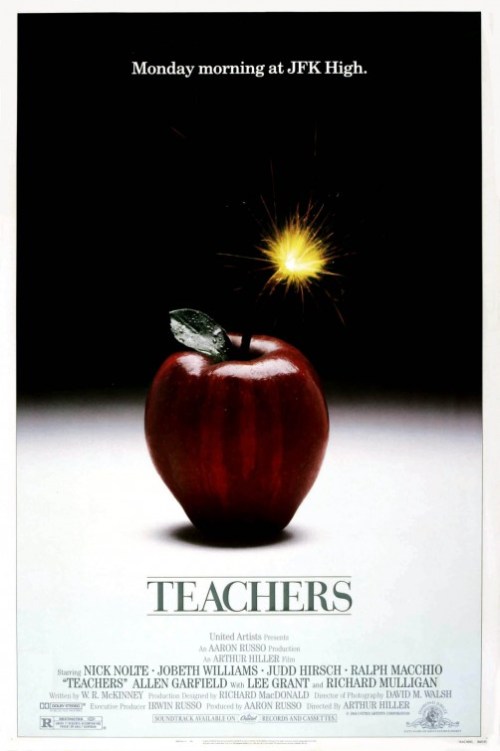
Alex (Nick Nolte) is a burned-out teacher who feels that the system is working against him as he tries to do his job in an inner-city school despite having no support from administrators. Things come to an ugly light when Lisa (JoBeth Williams) a former student of his who’s now an attorney takes part in a lawsuit suing the school for graduating a student who could not read.

Producer Irwin Russo drew on his 10-years as a teacher at an inner-city New York high school as the basis for the story and the film has some good trenchant points, but trying to put a satirical spin to it was a mistake. To make a good satire you gotta go all-in and this film timidly goes half-way with humor that at times, especially at the beginning, is off-putting. It’s not until the second-half when it gets more serious does it ever start catching its stride and the production would’ve been better had it remained a drama from the very beginning.

Nolte comes off like he’s suffering from one long hang-over, which may have been the intention, but the way he basically sleepwalks through the role gives the film no energy and makes the viewer feel as drowsy as he is. His relationship with Lisa, his former student, is forced and uninteresting and even a bit unbelievable since they look to be basically the same age. Judd Hirsh who plays the vice principal should’ve been the lead adult character as he does a great job of balancing the comedy with the drama by playing it straight and simply responding in sometimes glib and humorous ways to the insanity around him.

Ultimately it would’ve worked better had Ralph Macchio been made the star as he’s excellent despite the irony that he was already 23 at the time, but looking more like he was still in the eight grade. Crispin Glover as his goofball friend doesn’t work as well. Sometimes his pseudo-psycho characters are interesting, but here it is poorly defined and distracting. Laura Dern’s character is annoying as she plays another one of those perennial teen girls who gets pregnant and then wants an abortion, which has been so overused in so many other high school films that by now it seems like a cliche.

I did like the on-location shooting done at the former Central High School in Columbus, Ohio and the student body looks to be made up of actual teens and not just young adults trying to play one, but they did seem at times to be a bit unrealistically too well behaved. The scene where a teacher Mr. Stiles (Royal Dano) would fall asleep behind his desk and the students would still quietly do their homework made no sense as I would think they’d take advantage of the situation and goof-off instead.  Richard Mulligan’s role as an escaped mental patient pretending to be a substitute teacher is equally implausible as I thought the authorities would’ve caught up to him much sooner than they do although it is fun seeing him wearing a General Custer outfit as it looks quite similar to the one he wore in Little Big Man when he played the actual Custer.

There are a few good moments here and there, but it’s badly undermined by the misguided humor and corny ending. The eclectic supporting cast though is a treat to watch. I enjoyed William Schallert as a principal who seemingly wants to avoid confrontation at all costs as well as Lee Grant as a lawyer, which is the type of profession her acting style seems born to play. Originally the part was written for a man, but she plays it better than any guy ever could and I also enjoyed seeing her with a brunette hairdo instead of her usual red one, which makes her appear younger than she did in the 70’s.

My Rating: 5 out of 10

Released: October 5, 1984

Runtime: 1 Hour 47 Minutes

Rated R

Director: Arthur Hiller

Studio: MGM/UA

Available: DVD

Serpico (1973)

serpico

By Richard Winters

My Rating: 8 out of 10

4-Word Review: A cop fights corruption.

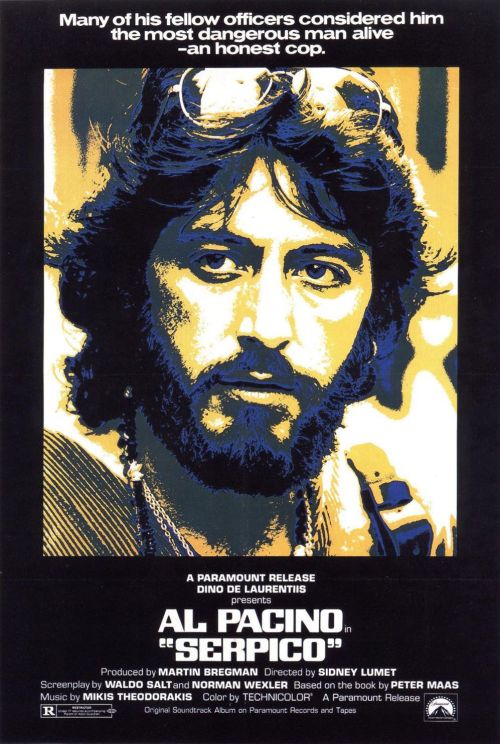
One of the followers of this blog has requested that I review this movie, so today we take a look at Frank Serpico (Al Pacino) a policeman who fought against corruption that plagued New York’s police department during the ‘60s. Even though many of his partners on the force would accept under-the-table payouts from criminal elements in exchange for ‘looking-the-other-way’ he wouldn’t and when he would tell his superiors about it nothing would get done. Instead they would transfer him to other precincts only for him to find the same problems there. It was only when he decided to report the issue to the New York Times that people started to take action, but in the process he also made himself a mark and vulnerable to having his unhappy comrades set him up to be shot while on-duty.

The film is based on the Peter Maas novel, which in turn recounts the life of the actual Frank Serpico and the events he went through while working on the force between the years of 1959 to 1972. Not only does he remain alive today, but according to recent reports is even considering, at the ripe old age of 79, a run at political office. Equally interesting is that he and Pacino roomed together during the summer that this was filmed and became close friends.

It’s been years since I’ve read the novel, but I felt this film sticks closely to what actually happened and the always reliable Sidney Lumet manages to keep things exciting and insightful. The dialogue is sharp and the on-location shooting, which was done in every borough of New York except Staten Island, gives the viewer an authentic feel of the city as well as the police environment.

The film also does a successful job at showing the drawbacks of accepting bribes without ever getting preachy or heavy-handed. One might think, like many of Serpico’s partners do, that taking some kickbacks isn’t that big of a deal, but then the film shows in one brief moment a policeman shoving another man’s head into a toilet when he doesn’t ‘pay up’, which hits home how the police become no better than organized crime who would notoriously demand ‘protection money’ from business owners.

The only thing I didn’t like was the music, which was too loud and jarring. Fortunately it’s put in only sparingly, but its melodic quality takes away from the grittiness and the film works far better by simply relying on the ambient sounds of the locations that the scenes are in. In fact this is one movie that could’ve done fine without any music at all.

Pacino is fantastic and I loved how the character starts out as this clean shaven, boyish looking fellow only to grow into a bearded, long haired guy as the story progresses, which symbolically connects with the way he becomes savvier to the system. The character also sports earrings long before it became vogue for males to wear them.

Tony Roberts does well as one of the few cops that sides with Serpico and tries to help him in his fight and F. Murray Abraham can be spotted near the end as a member of a vice squad who tries setting Serpico up to be killed. This movie also marks the film debuts of character actors Alan Rich and Kenneth McMillan. In my mind this is also the debut of Judd Hirsh. Some sources state that his first onscreen appearance is in Jump, which came out two years earlier, but I watched that film and couldn’t spot him anywhere, but her I was able to spot him right away.

My Rating: 8 out of 10

Released: December 5, 1973

Runtime: 2Hours 10Minutes

Rated R

Director: Sidney Lumet

Studio: Paramount

Available: VHS, DVD, Blu-ray, Amazon Instant Video, YouTube

King of the Gypsies (1978)

king of the gypsies

By Richard Winters

My Rating: 5 out of 10

4-Word Review: Daddy is a psycho

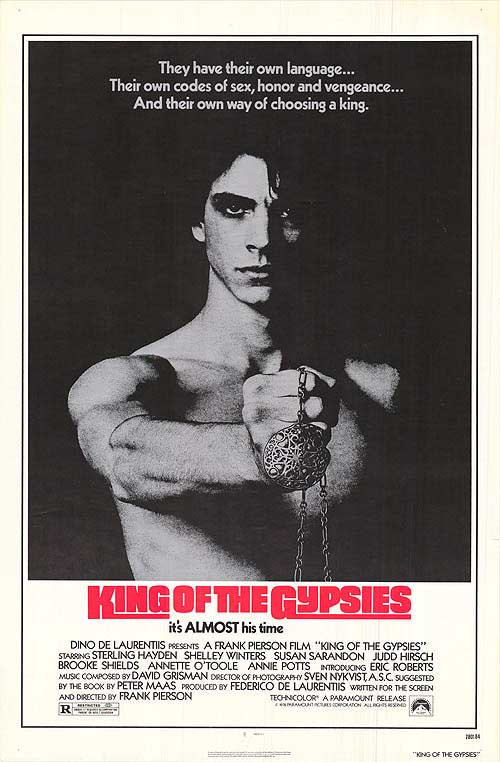
Dave (Eric Roberts) is the rebellious son of Groffo (Jud Hirsch) who no longer wants to be a part of the gypsy clan that he was raised in and instead a part of the American dream. However, when Dave’s grandfather Zharko (Sterling Hayden) lies dying in his hospital bed he gives the coveted medallion to Dave making him the new king of the gypsies. This sends Groffo into a jealous rage and orders two men to go out and kill Dave who now must elude them while trying to get his life together and help get his younger sister Tita (Brooke Shields) out of the clan as well.

Although far from being a complete success the film does manage to have a few unique and even memorable moments. The best is when a young Dave is used as a decoy in an attempt to rob a jewelry store. His mother Rose (Susan Sarandon) pretends to be a customer looking over some diamonds. When Dave creates a ruckus she tries to calm him down by having him drink a glass of water while also having him swallow a diamond that she has discreetly lifted from the display table. They are then able to walk out of the store when the merchants are unable to prove that they stole it only to have Rose later retrieve the jewel when Dave poops it out. Having Groffo put a 10-year-old Dave behind a wheel of a car and drive it down a busy Brooklyn Street is about as nerve-wracking as any car chase I’ve seen. The scene where Groffo tries to physically force Dave to have sex with his own mother is also incredibly startling.

However, despite these few interesting moments the film overall never really gels. The first half showing how the gypsy people live seems a bit clichéd and the way they openly cheat other people in order to make a living makes them unlikable and uninteresting. The only time it ever gets half way compelling is when it shows Dave struggling to survive on the mean streets of New York after he runs away from his psychotic father. Unfortunately this gets ruined when it constantly brings his family and past coming back to haunt him. The cat and mouse game that he plays with his father is not original and Hirsch makes for a very boring villain. He is unable to convey a menacing quality and thus there is never any real tension. The violin soundtrack compliments the gypsy tradition, but eventually becomes annoying.

Roberts is solid in his film debut. His voice-over narration coupled with his raw delivery is effective. Had the film focused solely on him and left out the silly gypsy sub-plot it would have worked much better.

Sarandon gives it some energy and she has the most effective accent. Shields is pretty much wasted and appears in only a handful of scenes. The biggest irony here is that the two played a mother and daughter before in Pretty Baby, which came out just 7 months before this one.

Hayden really seems to be having fun as the bombastic self-proclaimed King Gypsy. Watching him feud at the beginning with Michael V. Gazzo who plays the head of another gypsy clan is somewhat diverting. It is also interesting to see Shelly Winters in a part that has less than three speaking lines. This woman never seemed to ever want to shut up both on-screen and in interviews, so seeing her in a part that allows for so little dialogue is quite a novelty, but she still succeeds with it particularly in the part where she grieves over her dead family members.

It is fun to see a young Danielle Brisebois as well as Matthew Labyoreaux who later went on to play Albert in ‘Little House on the Prairie’. Annie Potts is good in a brief part and Patti LuPone makes her film debut in an uncredited bit.

My Rating: 5 out of 10

Released: December 20, 1978

Runtime: 1Hour 52Minutes

Rated R

Director: Frank Pierson

Studio: Paramount

Available: VHS, DVD, Amazon Instant Video