Tag Archives: John Heard

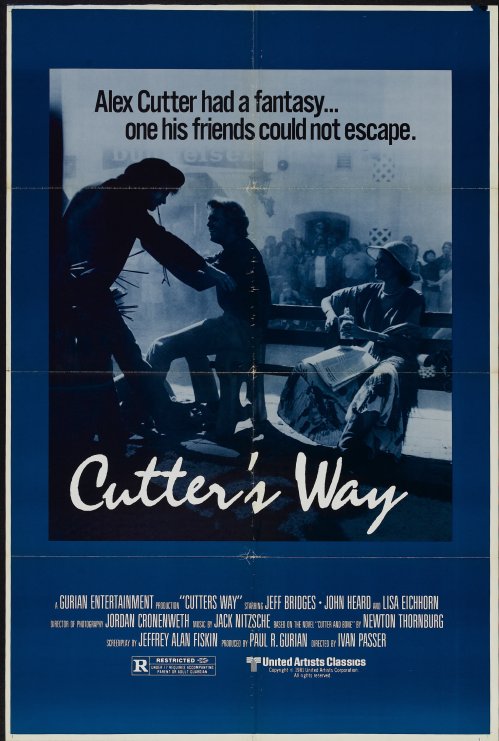
Cutter’s Way (1981)

cutter1

By Richard Winters

My Rating: 6 out of 10

4-Word Review: Friends help catch murderer.

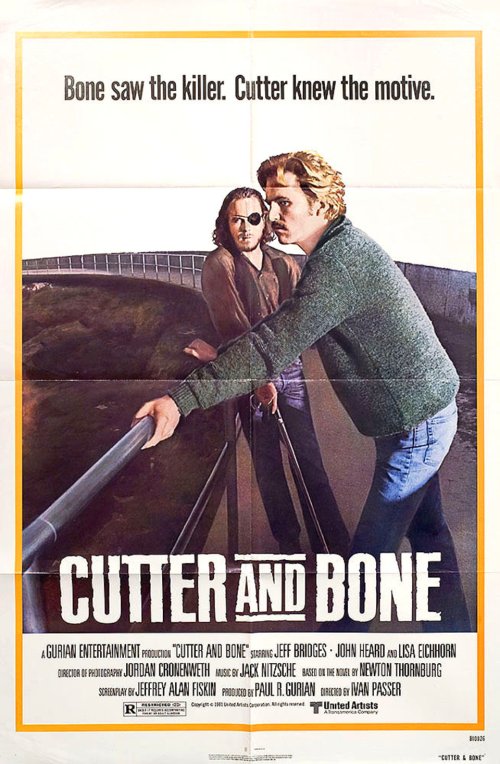
Richard Bone (Jeff Bridges) driving his old beat-up car, a 1966 Austin-Healey, which breaks down in a dark alley during a late night rain storm. From behind comes another vehicle where the driver dumps something into a nearby garbage can that turns out to being the dead body of a young girl. Since Bone’s car is still at the crime scene the next day when the authorities arrive he quickly becomes suspect number one. Bone’s friend, Alex Cutter (John Heard), a Vietnam vet struggling with alcoholism and PTSD, takes on the process of investigating the case to help get his friend out of trouble. The two soon hone in on a rich local businessman named J.J. Cord (Stephen Elliot) whom Bone swears was the man he saw driving the car that dumped the body.

The film is based on the 1976 novel ‘Cutter and Bone’ by Newton Thornburg. Producer Paul Gurian bought the rights to the book and asked struggling screenwriter Jeffrey Alan Fiskin if he’d be interested in adapting it to a screenplay. Since Fiskin was broke at the time, he last sold a screenplay, Angel Unchained, 10 years earlier, he was forced to shoplift the book in order to read and adapt it. David Field from United Artists was open to backing it for $3 million, but only if they could find a big-name star. Gurian then went to the home of Jeff Bridges, where he got attacked by one of Bridges’ dogs thus motivating Bridges to accept the part unseen in order to avoid a possible lawsuit. The film was released in the Spring of ’81 where it fared poorly with the critics and the studio was ready to scrap it only for it to pick-up good reviews a few weeks later. The studio then decided to place the film in their ‘classics’ division where it got retooled from it’s former title of ‘Cutter and Bone’, which they felt made it seem like a comedy about surgeons, to it’s current one and then rereleased it in the fall of that year were through good word-of-mouth it managed to recoup a modest profit.

Director Ivan Passer has stated that his motivation for directing the film was to go against what he felt was the ‘cripple mania’ at the time where film characters would get maimed usually through being in the war and then come back better, stronger people. Here he wanted to show that it didn’t make them better, but instead more dangerous.

While Heard certainly gives a good performance, it was originally intended for Richard Dreyfus, I felt he was too much of a caricature of an angry, wounded war vet and I didn’t find him interesting at all. Bridges was his usual transparent self and thus the interactions between two not all that captivating. Elliott is rather blah as well as the bad guy since for most of the runtime he’s only seen from a distance and never has any lines of dialogue until the final 9-minutes, though this does at least give him a certain creepy/mysterious vibe. Out of everyone I was most intrigued with Lisa Eichorn who plays a woman who bounces between the two friends and seems to want to play-off them both.

The emphasis is on the character study with long takes of Heard snarly at everybody he meets including the next door neighbor’s whose car he crashed into and the the subsequent police report, which goes on too long and doesn’t help the film or story move forward. The mystery isn’t as intriguing as it could’ve been because elements of it fall into place a little too conveniently. Bridges witnesses the killer driving away and then right away the next day spots the guy in a parade. Then a couple of days later the friends are talking about the case at a restaurant where the guys’ wife (Patricia Donohue) is sitting right next to them and overhears everything, which again is letting things fall too neatly into place without much effort.

There’s also questions about why the killer didn’t just run Bridges over with his car when he had the chance in order to avoid any witnesses. Also, Bridges is able to recognize the killer/driver, but when I saw the scene it was impossible to see the face of the driver. The viewer’s perspective should be the same as the protagonist, so if he’s able to get a good look at the culprit then we should’ve too.

Spoiler Alert!

Since everything is tied into circumstantial evidence I was hoping for some unexpected twist at the end. For instance having Bridges’ house get burnt down not because of Cale like they initially thought, but instead from the neighbors still angry over their car. The final confrontation in which Bone apparently shoots Cale (the screen fades to black and we only hear the noise of the gun going off) leaves more questions than answers. Does Bone and to an extent Cutter, who was there in the room with him, now go to jail for this? Seems like that should’ve been confirmed one way or the other and leaving it vague is like showing the viewer only half of the story.
cutter2

My Rating: 6 out of 10

Released: March 20, 1981

Runtime: 1 Hour 49 Minutes

Rated R

Director: Ivan Passer

Studio: United Artists

Available: DVD, Blu-ray, Amazon Video, Pluto, Freevee, Roku Channel, YouTube
The Milagro Beanfield War (1988)

By Richard Winters

My Rating: 8 out of 10

4-Word Review: Small town fights developer.

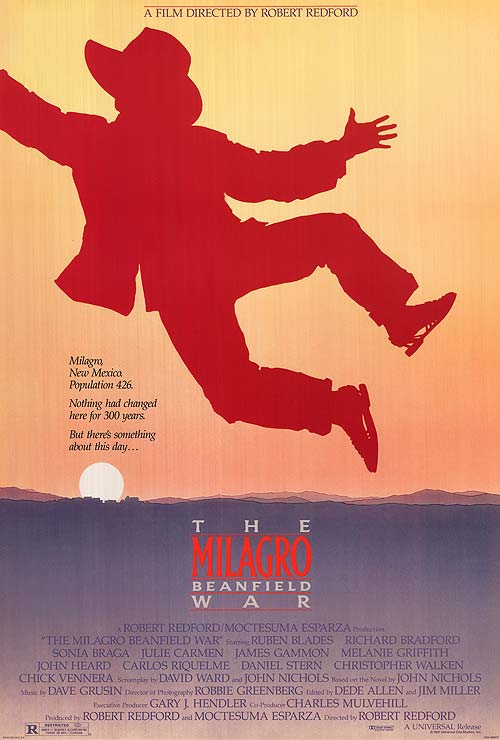
Milagro, New Mexico becomes the centerpiece to controversy when a rich developer (Richard Bradford) decides to build a resort, which cuts off the water supply to the rest of the struggling inhabitants of the nearby town. Joe Mandragon (Chick Vennera) is one of those farmers who is frustrated with the current situation and in a fit of rage kicks a water valve, which allows water to flow into his field where he soon begins to grow beans. Kyril Montana (Christopher Walken) is then sent in by the rich tycoons to ‘settle-the-score’, which only helps to make the town’s resistance to the development even stronger.

The film is based on the 1974 novel by John Nichols and was directed by Robert Redford eight years after he helmed his first feature the very successful Ordinary People. From a completely technical standpoint the film shines in all areas as it delightfully mixes whimsical comedy with harsh real-world issues and manages to keep the tone consistent throughout. My favorite element was the difficulty the activists had in getting the townspeople  ‘on-the-same-page’ and organized to fight their mutual enemy, which illustrated one of the biggest challenges to fighting for social change where just trying to convince and mobilize others is sometimes the toughest part.

John Heard has the film’s best character arch playing a former political activist who dropped out of trying to change-the-world years ago, but after sufficient prodding finally gets back to his old form in one very fiery and memorable moment. Walken is quite good in reverse playing a man sent to initially squash the rebellion only to eventually soften a bit (just a bit) on his stance. Carlos Riquelme is delightful as the elderly Amarante who despite being weak with age fights-the-good-fight including a hilarious scene where he precariously tries to drive a bulldozer.

I wasn’t quite as crazy about Daniel Stern’s inclusion. He plays his part well and the character is likable, but I didn’t understand the need for him in the story. It almost seemed like the filmmakers didn’t trust that the Hispanic cast alone could carry it and a white guy needed to be added in in order to usher in a more mainstream demographic. Vennera is weak only because he constantly reminded me of Bruno Kirby Jr. and could’ve easily passed off as his twin in both his looks and voice.

The only argument I would have against the film, which is otherwise a charmer and does not in any way deserve the outrageous R-rating that it was given, is the addition of Robert Carricart as the Coyote Angel that only Riquelme’s character can see. To an extent this cheapens the struggles that the townspeople go through because it gives what is otherwise a serious problem too much of the fable-like treatment. I would’ve preferred a grittier approach focusing solely on the efforts of the people to create the change, which would’ve left a stronger emotional impact and avoided telegraphing the idea that it was all going to work-out due to this extra magical force.

My Rating: 8 out of 10

Released: March 18, 1988

Runtime: 1 Hour 57 Minutes

Rated R

Director: Robert Redford

Studio: Universal

Available: DVD, Amazon Video

The Trip to Bountiful (1985)

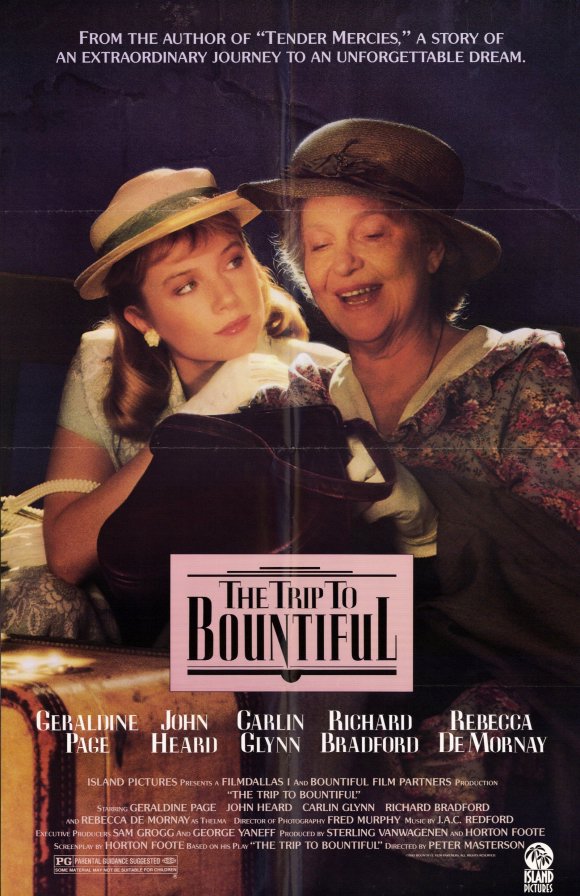
the trip to bountiful 1

By Richard Winters

My Rating: 7 out of 10

4-Word Review: Old lady goes home.

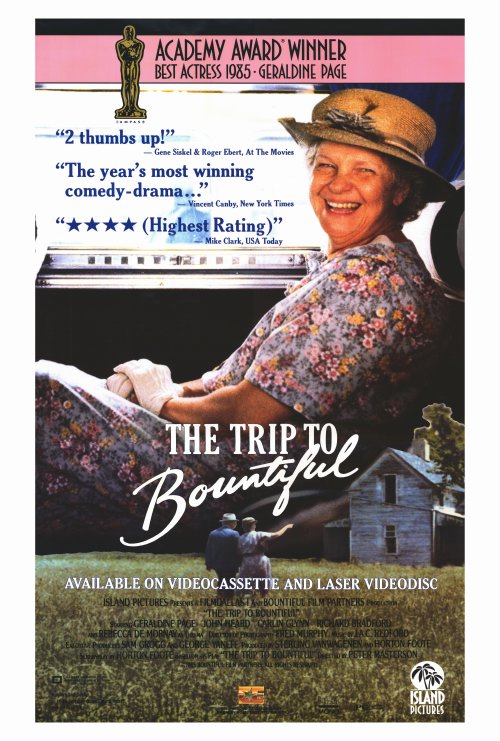
Carrie Watts (Geraldine Page) is an elderly woman living inside a cramped apartment with her grown son Ludie (John Heard) and his wife Jessie Mae (Carline Glynn) in Houston, Texas during the 1940’s. Carrie dreams of one day returning to her childhood home in the small town of Bountiful and ‘escaping’ from Jessie Mae who is overbearing and treats her like a child, but she lacks the transportation or funds. She secretly hides her government checks with the hopes of saving enough to take a train. When she finally makes it to the train station she finds there is no longer any stops to her old town, which is now essentially abandoned, but with the help of the local sheriff (Richard Bradford) he takes her there while Ludie and Jessie follow close behind determined to drag her back with them.

Peter Masterson’s directorial debut shows a great appreciation for Horton Foote’s script as it manages to stay true to the period and tone. I especially liked the part where Carrie describes the quietness of her childhood home while the camera slowly pans the yard and allows the viewer to essentially experience what she is talking about. The recreation of the ‘40s is on-target making you feel like you are living there yourself. Having some tunes of the era playing on a phonograph in the background is a great touch and it’s nice to hear a soundtrack that isn’t from the preverbal classic rock period.

Page shines in her Academy Award winning performance. She has played evil characters with such a relish for most of her career that it is nice seeing her portray a sweet old lady for once and do it so well. Her presence adds to every scene she is in and helps make them more interesting particularly with her conversation on the train with Thelma (Rebecca De Mornay) and the way she holds up everyone in line at the train station specifically two men standing behind her who in real life where her twin sons. She also manages to cry effectively with tears actually coming out of her eyes as opposed to De Mornay whose tearless attempts at it where so pathetic it seemed almost embarrassing.

Carlin is quite good in the snippy adversarial role and I was surprised she didn’t at least get a nomination for her efforts. Heard is solid as a sort of mediator and De Mornay is perfect for the part simply because her fresh youthful face makes a great contrast to Page’s worn one.

The on-location shooting adds a lot of flavor and helps to make this superior over its original stage version. The story itself is slow moving, but a wonderful character study on aging that at times manages to be dryly humorous, honest and sad, but never maudlin.

the trip to bountiful 2

My Rating: 7 out of 10

Released: December 20, 1985

Runtime: 1Hour 48Minutes

Rated PG

Director: Peter Masterson

Studio: Island Pictures

Available: VHS, DVD

The Telephone (1988)

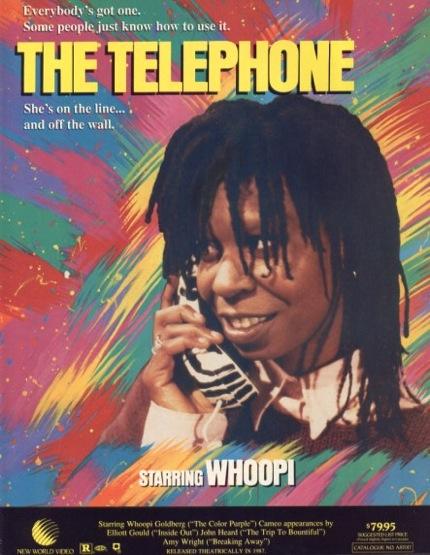
the telephone 2

By Richard Winters

My Rating: 1 out of 10

4-Word Review: I liked the owl.

Vashti Blue (Whoopi Goldberg) is an out-of-work actress sitting inside her dreary small apartment and having conversations with people over the phone. She also argues through a locked door that she shares with the women next door while waiting for a call from an agent for a job opportunity that never comes.

I am all for experimental cinema, which is the best way to describe this misguided project, but to work it still needs an artistic design and focus and this has none. It pretty much comes off as somebody’s cheap home video where a camera is turned on and then someone is allowed to rant and rave without pause for eighty minutes. Some could blame Rip Torn who is an actor turned first-time director here, but in subsequent interviews he has complained that Whoopi wouldn’t listen to any advice or direction that he gave and pretty much made his presence insignificant.  You could also blame the screenplay, which was written by the very odd pairing of Terry Southern and Harry Nilsson. Southern is best known for penning the screenplay for Dr. Strangelove while Nilsson is a famous singer/songwriter whose best work was doing the song ‘Everybody’s Talking’ that was the theme for the classic film Midnight Cowboy. However, Whoopi took great liberties with the material and ad-libbed a lot, so what was originally put down on paper and what is left on the screen could be minimal.

The conversations that Whoopi has over the phone ranges from lame to ridiculous. One includes calling the police and trying to get them to arrest a video store owner because he rented her a tape of Christmas in July with a scene excised is too absurd to be even remotely amusing. The Whoopi character also incorrectly stated that Frank Capra was the director of the film when it reality it was Preston Sturges.  Goldberg puts on a variety of accents including British, Japanese, Indian, and Southern as well as a few others, but her Irish one is suspect and her impression of John Wayne is terrible.

The apartment set is dull and bleak. The viewer feels trapped and with such little visual design their eyes and thoughts are apt to wander. Cutaways are sorely needed, but there are none. An infuriating moment is when there is a sound of a loud car pile-up outside, but despite this being a visual medium the camera never cuts away to show any of it. This was probably due to budget constraints, but what is even more perplexing is that there are sounds of people screaming, police sirens and even rioting and then a half minute later it all suddenly stops for no explained reason.

The supporting cast is eclectic but wasted. Noted character actor Severn Darden, in his last film role, appears in a brief bland bit as Whoopi’s neighbor. Elliot Gould gets a few minutes as Whoopi’s former agent and seems to be seriously slumming as he was a headline star during the seventies and now sadly stuck in this. John Heard is the only one who comes off best as a caustic, brash telephone repairman.

Whoopi’s two pets upstage the human cast by a mile. Her pet owl is very cute and I dug the goldfish particularly when he gets sucked down the drain of her bathtub and she must use a plunger to save him, which is the only time there is any action in the entire movie.

My Rating: 1 out of 10

Released: January 22, 1988

Runtime: 1Hour 20Minutes (The DVD cover states it’s 1Hour 36Minutes, but it is wrong.)

Rated R

Director: Rip Torn

Studio: New World Pictures

Available: VHS, DVD

Between the Lines (1977)

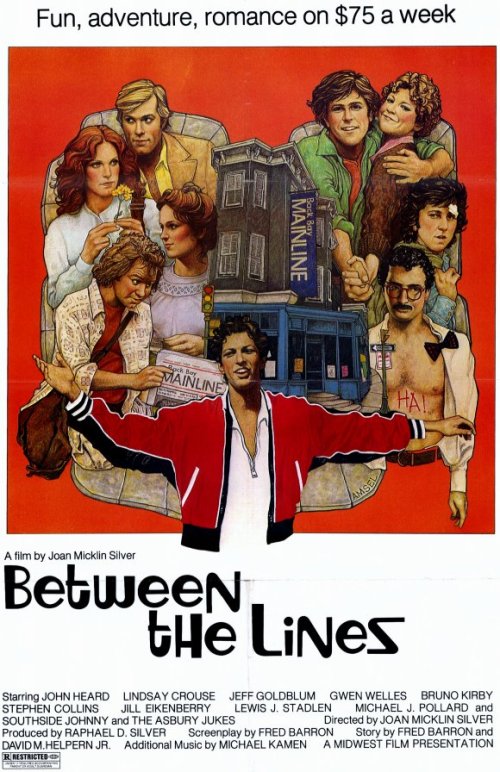
between the lines

By Richard Winters

My Rating: 6 out of 10

4-Word Review: Newspaper get corporate takeover.

This is a look at an underground/counter-culture newspaper staff and the conflicts and concerns that they have at being taken over by a no-nonsense corporate owner (Lane Smith).

The film almost immediately takes you back to the bygone era of the late 70’s. The attitudes and conversations are realistic for that period and anyone who lived through it will most assuredly feel nostalgic .John Heard, Jeff Goldblum, and Bruno Kirby are engaging in their respective parts as is most of the cast. Stephen Collins is good also, but in an unusual role for him as he usually plays nice sensitive types, but here is a more driven, intense, and confrontational. This also works as a good unofficial statement to the death of the counter-culture movement and the eventual rise of materialism.

The story starts out well as it looks at the inside workings of an underground newspaper, but then spends too much of the middle part focusing on the relationships of some of the characters. Only at the end when the new owner takes over does it get back to the newspaper angle. Unfortunately it concludes just as things are getting interesting and we never get to see how the characters survive and adjust to the takeover. The film would have been much stronger and original had it stuck to scenarios involving the newspaper business and scrapped the relationship stuff, which tended to be derivative. Jon Korkes and Michael J. Pollard’s characters are seen too little and needed more screen time.

Also, when the film deals with the relationships there seems to be too much of a feminist bias as the men are always shown to be the ones at fault due to their ‘insensitive and selfish natures’ while the women come off the ones who are ‘reasonable and unfairly neglected’. This could be a product of the fact that it was directed by a woman as well as the era where men were somehow supposed to feel guilty simply because they were men.

This is fun as a time capsule as well as a great chance to see young stars in the making. However, the story does not take advantage enough of its original concept and ends up dealing with a lot of the same old scenarios and story lines that we’ve all seen before. Director Joan Micklin Silver and John Heard teamed up again two years later for Chilly Scenes of Winter, which I felt was better.

My Rating: 6 out of 10

Released:  April 27, 1977

Runtime: 1Hour 41Minutes

Rated R

Director: Joan Micklin Silver

Studio: Midwest Films

Available: DVD (MGM Vault)