Tag Archives: Jason Robards

Hurricane (1979)

hurricane

By Richard Winters

My Rating: 3 out of 10

4-Word Review: Tropical cyclone strikes island.

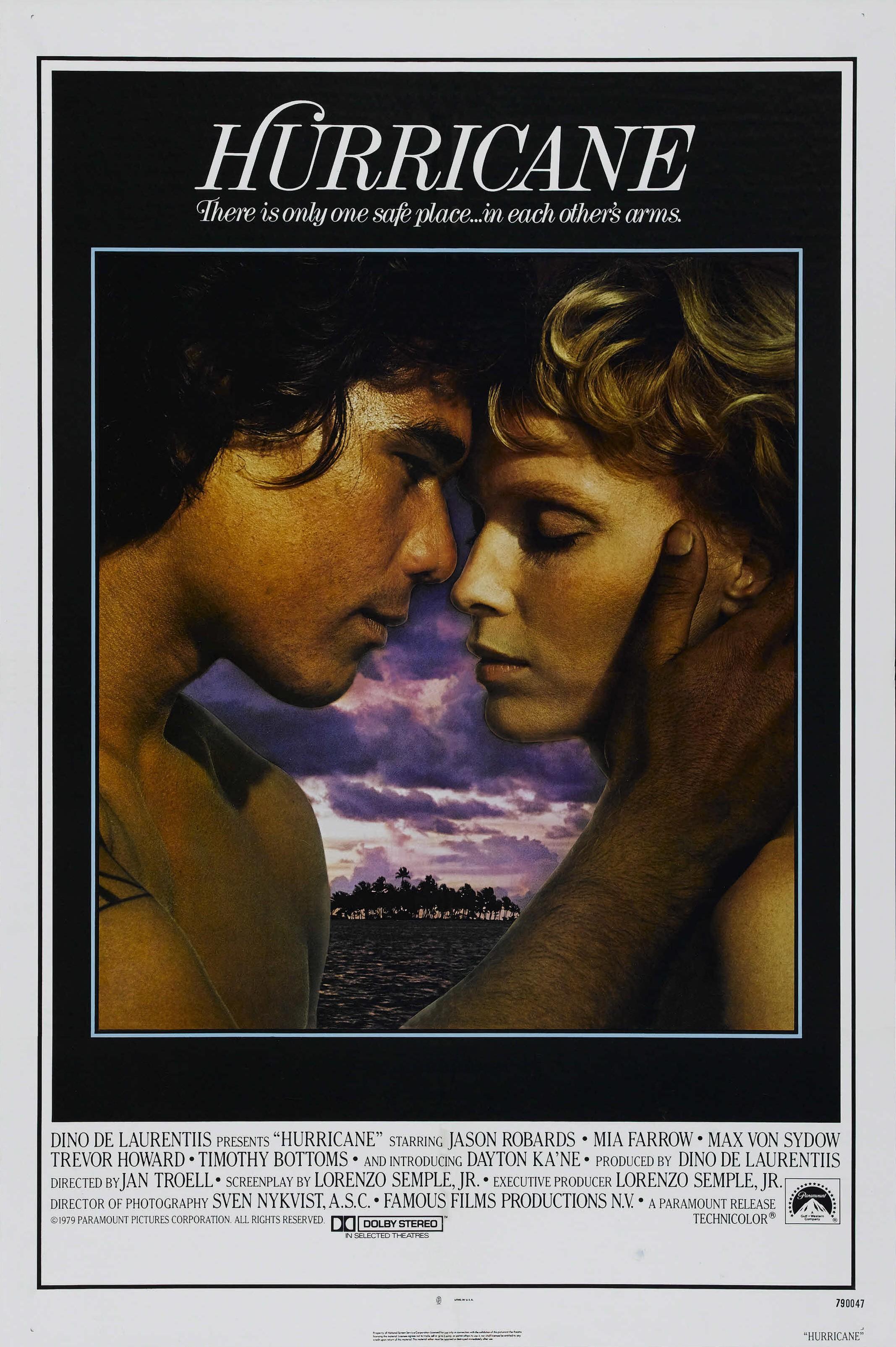
Charlotte (Mia Farrow) is the daughter of Navy Captain Charles (Jason Robards) who was appointed governor of a small island of Alava, which is under U.S. control. She comes to the island for a visit as she hasn’t seen her father in quite a while and immediately becomes attracted to Matangi (Dayton Ka’ne) who works as a houseboy at her father’s estate. A romance blossoms between the two and when her father finds out he puts Matangi in jail on trumped-up charges, but Charlotte is able to find a way for him to escape, but as they go on the run her father sets out to find them and put Matangi back behind bars just as a massive hurricane descends.

The film is a remake of the 1937 movie that was directed by John Ford and in itself an adaptation of the novel of the same name by James Norman Hall and Charles Nordhoff. After completing the runaway hit King Kong, another remake of a 1930’s movie, producer Dino De Laurentiis became inspired to tackle a second classic from the same era. He was most enthused with this one due to the hurricane effects as he was convinced that with modern technology it could be more vivid than the original and even hired the same man, Glen Robinson, who did the special effects for that one to recreate it here, but with modern film capabilities that had been unavailable when the story was first produced. So much focus was admittedly put into the ending that things like character development, which director Jan Troell had come onboard to work-on, were largely ignored causing Troell to consider it an unpleasant experience and he spent the remainder of his career making films in his homeland of Sweden as he felt after this that working on a Hollywood project wasn’t to his liking.

The casting of Farrow is part of the problem as the role called for a woman in her 20’s even though she was already well into her 30’s, but since she had what Dino described as an ‘eternal face of an 18-year-old’ he decided to hand her the part anyways. Her character though is so one dimensional that her time on the screen isn’t captivating. Ka’ne, who was an Hawaiin surfer with no acting experience, does better than expected though he only did one other movie after this before retiring from the business and working the rest of years as a compost truck driver and hotel doorman. Max Von Sydow is good in support playing a doctor who utters the film’s best line, most likely ad-libbed from his well-known atheist roots where he asks why a painting of Adam would require him to have a belly button since if he was created from dust then he’d have no need for an umbilical cord.

The biggest issue is the romantic angle as it occurs too quickly. An interesting relationship is one that has a challenge and this one should’ve had several as Mia’s father was clearly not going to be happy about her seeing Ka’ne and therefore she should’ve been apprehensive about getting involved, or even suspicious as how did she know he wasn’t just using her for leverage to get the old man to soften his stance on policies Ka’ne wanted changed? Instead, they fall into each other’s arms in a seamless few minutes and the whole first hour is spent with them dreamily swimming around in the ocean in a lovesick fashion, which is dull. Having the character of Moana appear, played by Ariirau Tekararere, who was the woman Ka’ne was arranged to marry, offers some potential, but since she barely speaks and when she does it’s in her native tongue without the benefit of subtitles, her presence doesn’t offer much.

Spoiler Alert!

The finale, which is all about the hurricane, is somewhat exciting, but it’s not perfect. The destruction of the homes appear like they’re miniature models and seeing constant shots of blowing rain becomes tiring, but watching the people leave the church while Priest Trevor Howard continues to pray at the pulpit is kind of funny and having the ship burst through the wall was cool too.

However, I wasn’t exactly sure that the couple really got ‘saved’ at the end like the viewer is supposed to believe. Yes, they survived the storm but were now stuck on a tiny sandbar in the middle of the ocean with no source of food, or transportation. Unless some help came along, which wasn’t guaranteed, they weren’t going to survive long. Thus, it’s not a real ‘happy’ ending because although they weren’t killed right away like the others doesn’t mean they won’t die an even more painful death of starvation.

My Rating: 3 out of 10

Released: April 12, 1979

Runtime: 2 Hours

Rated PG

Director: Jan Troell

Studio: Paramount

Available: DVD, Blu-ray (Import Reg. A/B/C)
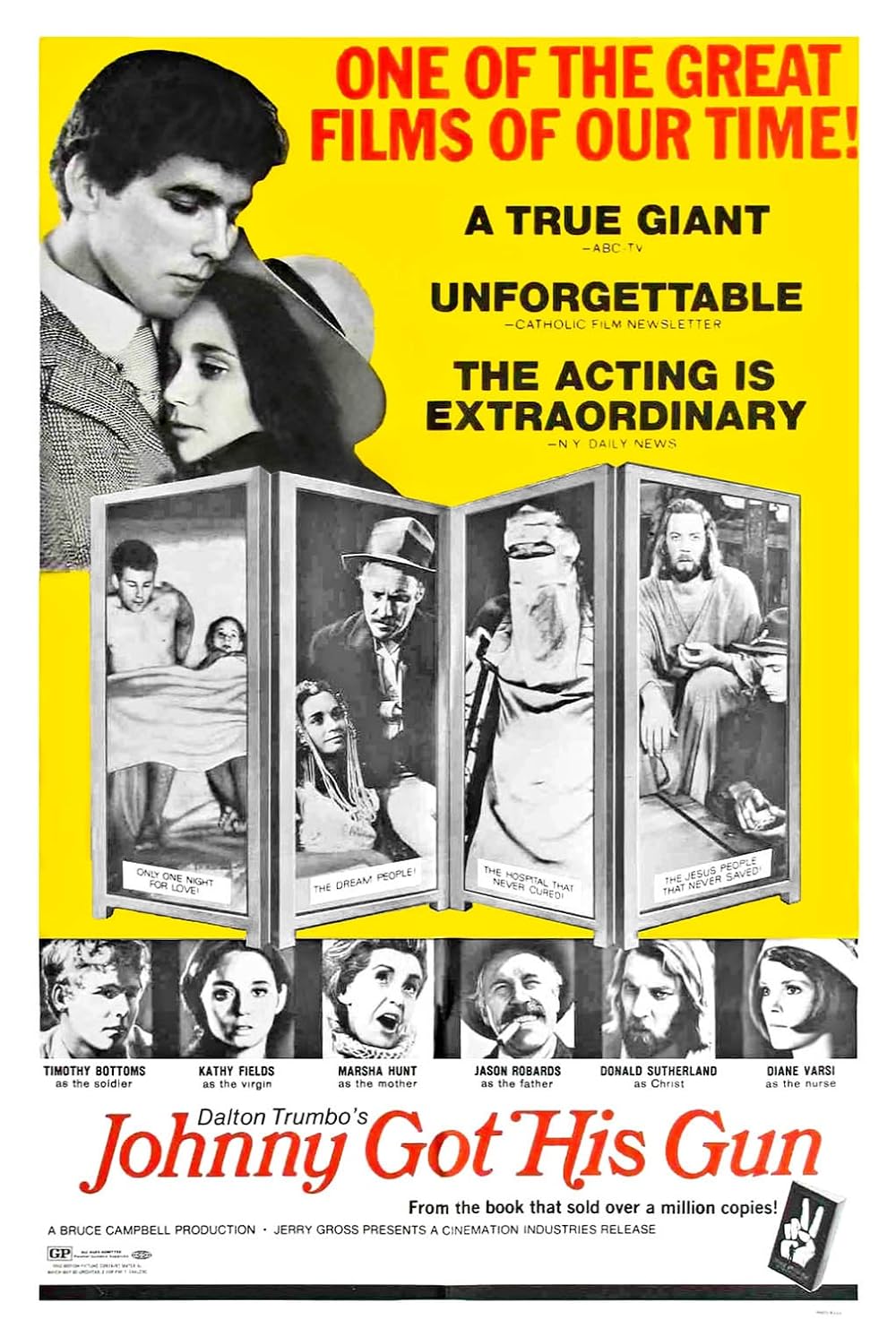
Johnny Got His Gun (1971)

johnny1

By Richard Winters

My Rating: 4 out of 10

4-Word Review: Left with no face.

Joe (Timothy Bottoms) finds himself stuck on a hospital bed, covered with a white sheet and unable to communicate with any of the doctors or nurses. As a soldier fighting in WWI, the last thing he remembers is being hit with an artillery shell and he presumes he’s injured and the medical staff is just trying to make him well again, but ultimately, he comes to the conclusion that he’s lost all of his limbs and even his face. The only thing left is his brain, which allows him to relive the memories of the past, but with no ability to express himself, or see or hear anything, like a prisoner in his own body. Locked away in a utility room, so his disturbing condition won’t be seen by others, he tries to suffocate himself but finds even that to be impossible. Eventually he’s able to use morse code by banging his head against his pillow to alert the staff that he’s still conscious and not a vegetable, but his demands to be toured around in a glass coffin in order to show the public the horrors of war go unheeded.

The film is based on the 1939 novel of the same name by Dalton Trumbo, which was inspired by the real-life case of Curly Christian, a Canadian WWI soldier who lost all four of his limbs during battle. The book was met with many accolades from the critics and was even considered for a movie as early as the 1940’s when it was to star a young William Holden, but funding for the project fell through. By the 1960’s when anti-war sentiment grew during the Vietnam years renewed interest in bringing the novel to the big screen mounted and plans were put in place to have Luis Bunuel direct, but yet again funding became an issue and the pre-production was paused for several years until Trumbo himself decided to take it on by working with private investors to get the required capital. The modestly budgeted film was then given a limited release in the summer of ’71 but was never a hit and largely forgotten until revived in 1989 when the heavy metal group Mettalica used footage from the film in their music video ‘One’.

The film has some interesting aspects including having the present-day scenes shot in black-and-white while Joe’s memories and dreams are done in color. Timothy Bottoms, in his film debut, is excellent. For most of the movie we only hear his voice-over of his thoughts, but within that limitation he plays it well and uses his tone eloquently to convey his emotions and inner angst. The supporting cast such as Jason Robards as Joe’s caustic father help give the movie a bit of an edge and Diane Varsi as the sympathetic nurse who shows compassion with Joe’s dismal predicament and quarrels internally about what to do including considering shirking her professional responsibility in order to put him out of his misery, is quite good too.

The structure though doesn’t fully work. The memories of past events, including his home life and upbringing, are too general, stuff that could’ve happened to anybody and thus nothing stands-out. The dream sequences don’t have enough visual flair and are much too talky. Trumbo may be the master of the written word, but his cinematic sense is lacking, and the film drones along putting the viewer to sleep instead of reeling them in emotionally. The anti-war message may have been ground-breaking for the ’30’s, but by the time of the movie’s release there were too many other art mediums saying the same thing, so what gets said here is nothing new and comes-off as redundant and even preachy.

My biggest complaint though is that we never see Joe’s actual physical state. During the whole movie he remains conspicuously covered by a white sheet, which I found to be a cop-out. I wasn’t opposed to keeping what he looked like a mystery for most of the way as revealing it right away would’ve taken away the shock effect, but at some point, it needed to be exposed to the viewers horrified eyes. Just constantly describing something doesn’t work in movies, maybe in books, but in film one should always go for the visual. Not sure why it wasn’t done here. Maybe they thought it would be too costly to create the special effects, or the gruesomeness would sicken the audience, but wasn’t that supposed to be the whole point? By keeping it at a ‘tasteful’ level it misses-the-mark and one of the main reasons why the movie doesn’t have as strong of an impact as it could’ve.

My Rating: 4 out of 10

Released: August 4, 1971

Runtime: 1 Hour 52 Minutes

Rated PG

Director: Dalton Trumbo

Studio: Cinemation Industries

Available: DVD, Blu-ray, Amazon Video

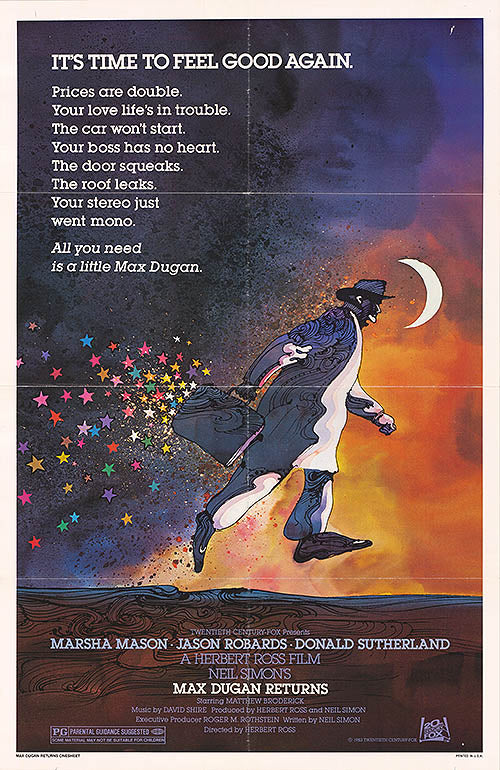
Max Dugan Returns (1983)

max1

By Richard Winters

My Rating: 4 out of 10

4-Word Review: Estranged father comes back.

Nora (Marsha Mason) is a single mother living with her 15-year-old son Michael (Matthew Broderick) who’s struggling to make ends meet as a High School English Teacher. Things become particularly desperate when her beat-up 1964 Volvo car gets stolen and she no longer has any transportation to get to work nor the money to afford buying a new car, or even a used one. Fortunately, the officer working on the case, Brian (Donald Sutherland) takes a liking to her and offers her to use his motorbike even though she needs training on how to drive it. Once she goes through the crash course and begins using it she still has other financial concerns to worry about until one night she receives a mysterious visitor, which turns-out to be her estranged father Max Dugan (Jason Robards) who ran-out on his family 29 years earlier. Now he has returned with a briefcase full of $687,000, which he skimmed from a crooked casino that he used to work at. He tells her he has only 6-months to live and advises her to take the money, so that she and her son can live stress-free, but Nora isn’t so sure she wants to accept it, so Max goes about buying her stuff anyways including a fancy new car.

This has to be one of Neil Simon’s least imaginative efforts and the concept seems so contrived it’s like he thought it up for the 10-minutes that he was sitting on the john. I’ll admit when I was a teen and watched it when it first came out, I enjoyed it. I especially remembered the scenes dealing with Charley Lau, who regrettably died less than a year after the film’s release, where he plays himself the hitting coach for the Chicago White Sox baseball team, who Max hires to help Michael become a better hitter and these teaching scenes I found to be engaging. Unfortunately, the foundational premise has a lot of holes.

The idea that a father would suddenly want to see his daughter after 29 years of being away didn’t seem authentic. If he longed to reconnect then why not reach out earlier? Granted he was in jail for 6 of those years, but what about the other 23? If family was so important to him then why run out on them in the first place? Why doesn’t he at least make some attempts in-between those years to communicate like sending letters of phone calls before just showing up and expecting to be welcomed with open arms? The idea of throwing her and his grandson a lot of money comes-off in bad taste like he’s simply trying to buy their love and if anything seems quite shallow. During those 29 years away you’d think he would’ve met other people he’d become friends with, or other women he dated that he might’ve wanted to give the money to instead, or are we to presume that for 3-decades he lived in a cave and made no contact with anyone else?

I didn’t get why Nora didn’t recognize her father when he called. Yes, it had been awhile since she had last heard or seen him, it’s stated that she was 9 when he left, but he has a distinctive voice, so I’d think it would set something off in the back of her brain that she knows who this is, but can’t quite place it, versus having her immediately call the police in panic after getting a call from some ‘strange man’. He also tells her at one point that he may not actually be Max Dugan, but again she wasn’t a month-old infant when she last saw him, but instead someone entering the fourth grade, which should’ve given her a solid enough memory of what he looked like and thus know if this was her real father, or not.

To help solve all of this Nora should’ve been made a divorcee instead of a widow. The husband/father could’ve been the one who went to jail and then returned a 6 years later with stolen money hoping to use it to win back his wife’s and son’s favor. It would’ve made more sense because less time would’ve passed, and he’d have a more vested emotional interest in bonding with his son since he was directly his versus an elusive grandfather who didn’t even know the kid existed until being ‘tipped off’ that Nora had one by some secondary source.

Matthew Broderick’s character is problematic too. He seems just too obedient and goody-goody to be a believable teen as he promptly makes his bed every morning, even his mother’s, asks to be excused from the dinner table, and even lets his mother kiss him while in full view of his friends. Yes, there’s one brief moment where he tries to sneak a smoke, but otherwise I didn’t detect the typical rebellion to authority that most teens that age have, and it would’ve been improved had the kid been 9 or 10 where still being compliant with their parents’ wishes is a little more understandable.

Sutherland’s character was off as well as he seems way too aggressive about asking out a woman that he had just met while on-duty and actively investigating her case making it ethically questionable whether he should even be doing it. If a guy does come-on to a woman so quickly, simply because she’s attractive and single, as he knew nothing else about her, you’d presume he’s done this to other available women as well and thus should have a throng of casual girlfriends and Nora would just be one of many. The film should’ve just had him already her boyfriend from the start and thus avoided this otherwise awkward and rushed relationship. I also thought it was dumb that Kiefer Sutherland, who appears early on in a brief non-speaking role as one of Broderick’s friends, wasn’t cast as Donald’s son in the climactic baseball sequence at the end and instead the part was given to another young actor.

Spoiler Alert!

The money issue becomes yet another problem as Max spends it on so many lavish gifts that I started to wonder if there would be any left to put into savings. The idea that he could’ve had workers refurbish the house in just one day while Nora and son where in school is ridiculous as something that massive would take weeks if not months. He even ends up driving away with the car he had bought her leaving her again without a vehicle. Yes, he does open-up a bank account in her name and puts in $400,000, but her cop boyfriend was already aware of this and made clear he put his duty to uphold the law over his personal relationships making it very probable that she’d be forced to give it all back. Worse she might be considered an accomplice forcing her to hire an attorney, which would’ve sent her into even more debt making it seem like she’d be better off had the whole thing not even happened to begin with.

My Rating: 4 out of 10

Released: March 25, 1983

Runtime: 1 Hour 38 Minutes

Rated PG

Director: Herbert Ross

Studio: 20th Century Fox

Available: DVD, Amazon Video, YouTube

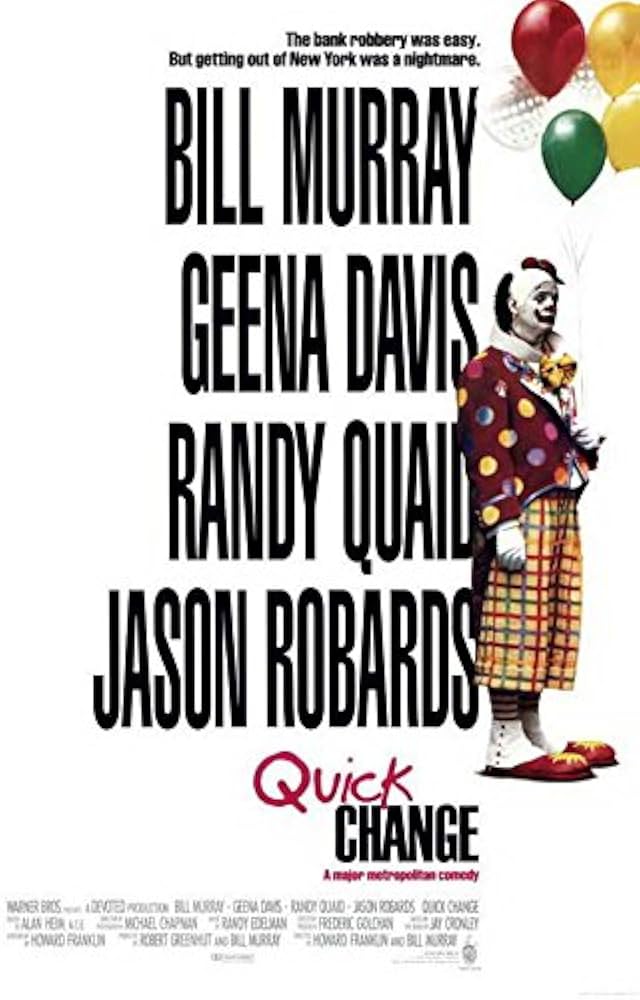
Quick Change (1990)

quick1

By Richard Winters

My Rating: 7 out of 10

4-Word Review: Clown robs a bank.

Grimm (Bill Murray) has had it with New York City. He wants to get out of there and move somewhere tropical as soon as possible and conspires to rob a bank in order to get the money to do it. He dresses as a clown and then has his girlfriend Phyllis (Geena Davis) and friend Loomis (Randy Quaid) pretend to be customers at the bank, so that when he releases the ‘hostages’ they can be two of them. The robbery goes smoothly as they’re able to get $1 million out of the bank, but trying to get out of the city itself proves trying as they get lost on their way to the airport and then their getaway car gets demolished. Police Chief Walt Rotzinger (Jason Robards) is hot-on-their-tale and relentless in his quest to haul them in as he proves to be just one slight step behind them where ever they go and moving in closer with every waking second.

This is the second version of the story that was adapted from a 1981 novel of the same name written by Jay Cronley, a humorist who resided in Tulsa, Oklahoma, who two other novels, Funny Farm and Let It Ride that were also made into movies as well as Hold-Up that was a French film shot in Canada that was the first rendition of this plot. This adaptation proves to be the better one as it takes place, like in the novel, in New York City and takes full advantage of the city’s ambience making it feel almost like it’s a third character.

This is the perfect role for Murray and some critics felt this was his best acting performance of his career he also doubles not only as the producer, but also the co-director as he took over the reins in order to save the project when the originally directing choice Jonathan Demme decided to bow-out at the last minute. The snarky, glib personality of the character is played to the hilt by Bill who has the magical ability to be the world’s biggest smart ass and still have a unique charm about it. Great supporting work by Davis, though the two apparently didn’t get along behind-the-scenes and years later she accused him of sexually harassing her during the production. Good work too by Robards who doesn’t fall into the cliche of a stupid egotistical cop and instead proves to be pretty savvy, which helps accentuate the tension as he’s constantly on their heels and only a beat behind them no matter where they go.

The three acts are better tied together by placing the main nemesis as the city itself and creating a surreal After Hours vibe. Some of the potshots are subtle like watching all the hot dog vendors race over to where the robbery is taking place so that they can take advantage of the situation by selling food to all the onlookers. It also illuminates the ethnic, cultural mix of the Big Apple by featuring a jousting match between two Latinos on bicycles as well as the headaches of trying to find your way around the city and the confusing road signs and constant construction though some of this humor may not resonate with today’s viewers since with the advent of GPS many of these ‘asking for directions’ situations have now become a thing of the past.  The music score by Randy Edelman with its pounding, hard edge quality perfectly matches the city’s gritty, urban attitude.

While the robbery is slick I did find a few loopholes. The first is where does Murray get his other clothes when he changes out of his clown costume and disguises himself as one of the hostages to get away? He is not seen carrying a bag of any kind nor is Davis or Quaid, so not sure where the other suit came from. Some may argue that he was wearing it underneath his clown costume, but this doesn’t work since it was a shirt that came up to his neck that he’s seen coming out of the bank with and when he’s the clown he’s shown with a V-neck T-shirt that exposes the top of his chest. It also doesn’t explain where he gets the glasses, other wig, and shoes that he also has on when he walks out as the fake hostage.

The characterizations are a bit off too as both Davis and Quaid become easily rattled during the second half when they’re trying to get to the airport and become increasingly shaken that they’re going to be caught, but if they have a propensity to being that worried you wonder what gave them the nerve to go through with the robbery in the first place? During that segment they’re very cool and calm and even a bit ballsy, so why the sudden shift to overly panic the moment they get out? A way to have solved this would’ve had the Davis character with a penchant for risks, or enjoy living on the edge and taking chances, so every time they would get into a jam during their escape she’d see it as a certain thrill and not allow it to overtly alarm her.

Spoiler Alert!

The biggest beef though is with the ending in which Robards suddenly realizes, as he’s standing on the ground watching the jet fly overhead that has the three robbers onboard. The film acts like it’s now ‘too late’ and there’s nothing he can do about it, but there really is. All he has to do is go back to the airport and ask where the destination is of the plane that just took off, as I remember it was Paris, France. Since both the U.S. and France are members of Interpol he could easily contact the authorities there asking them to detain the three once the plane had landed. They could then be brought in for interrogation where a simply body search would expose all the money that they had taped to their bodies underneath their clothes, and in Quaid’s case in his duffel bag. This would be more than enough evidence to prove that they were the robbers and thus extradited back to the U.S. for prosecution.

My Rating: 7 out of 10

Released: July 13, 1990

Runtime: 1 Hour 29 Minutes

Rated R

Director: Howard Franklin, Bill Murray

Studio: Warner Brothers

Available: DVD, Blu-ray, Amazon Video, Tubi

Square DANCE (1987)

square

By Richard Winters

My Rating: 3 out of 10

4-Word Review: Moving to the city.

Gemma (Winona Ryder) is a country girl whose never known life beyond the small Texas farm that she lives on with her grandfather (Jason Robards). She at times though does think about her mother (Jane Alexander) who lives in Dallas and what city living would be like. One day her mother takes a rare trip to the farm and invites Gemma to come live with her. Gemma is turning 13 and intrigued to spreading-her-wings. While she loves her grandfather she’d be interested in trying something new, so she agrees to go with her while promising to write home to her grandfather regularly. Once there she finds the jaded lifestyle of her mother and the people around her not to be to her liking as Gemma is quite religious and reads her Bible often. She does though meet-up with Rory (Rob Lowe) a young man who is mentally handicapped, but professes to love her and the two plan to one day get married despite the opposition by her mother and those around her.

This was a film produced by Michael Nesmith better known for being a part of the Monkees rock band in the 60’s. Some of the other films he produced were of a comical/surreal nature, but this is one of the few dramas that he did (the film was also co-produced by co-star Jane Alexander and actor Charles Haid) and while some of his comedies weren’t so great this thing could’ve used some laughs to help liven it up. While the intentions may have been laudable the result is mostly tedium as its attempts to reflect the slow lifestyle of country living backfires creating a movie that’s too methodically paced to ever become interesting and the fact that it managed to only recoup $225,000 at the box office out of its initial $4 million budget is no surprise.

If you watch this movie for any reason do it for the acting, which is exemplary. Ryder, in only her second film appearance, crafts a shy, awkward and sheltered teen quite well and her performance helps guide the viewer through the lulls. Robards and Alexander are equally fine, which is to be expected, but Lowe is probably the most impressive playing against type. Usually he played cocky, worldly-wise types, but here shines as a kind, but dim-witted soul though his delivery, in retrospect, comes-off too much like Tom Hanks in Forrest Gump. Granted this one came out 6 years before that one, but since that film is more famous than this one you can’t help but compare the two and come away feeling, despite Lowe’s best efforts, that his acting here is a bit affected.

The story is too minimalistic as not enough happens to justify sitting through 90-minutes of it. I had a hard time buying into Gemma believing she could marry a mentally handicapped man and having it work out. Granted she’s not worldly-wise and lacks sophistication, but I felt this type of thinking was too naïve even for someone with her background. Wanting to help the man and take care of him possibly as a guardian of some kind would be fine, but the love aspect gets overblown and makes the film come-off as overly idealized and not realistic.

None of the characters, with the exception of maybe Lowe’s, goes through much of a transition. I was expecting Gemma to become corrupted by the jaded ways of the people she meets and possibly even becoming less religious, or even beginning to question her faith, but none of that happens. Gemma basically remains the same, even after a few tussles, and returns back to the farm like nothing happened, which made me wonder what was the point. There’s way too many loose ends that are left open like the grandfather’s lingering racism and his inability to get along with a black friend he used to play with when he was a kid. Gemma invites the black man over for dinner, but the film fails to show us whether the two men begin talking, or remain silent. A good drama should give us some conclusion to things and see the characters grow, which in this case it doesn’t do making the whole thing seem half-baked and not worth the effort or time.

My Rating: 3 out of 10

Released: January 16, 1987

Runtime: 1 Hour 52 Minutes

Rated PG-13

Director: Daniel Petrie

Studio: Island Pictures

Available: DVD-R

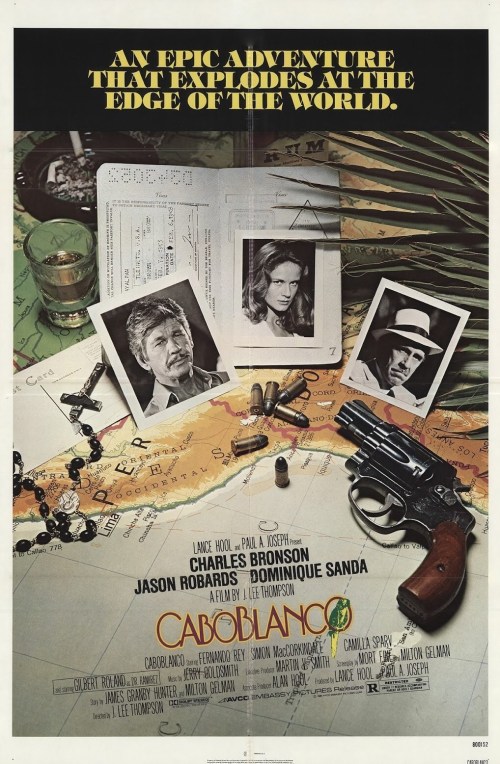
Cabo Blanco (1980)

By Richard Winters

My Rating: 4 out of 10

4-Word Review: Search for sunken treasure.

Giff (Charles Bronson) is an American living in the small fishing village of Cabo Blanco, Peru where he runs a cafe/bar just after the end of WW II. It is here that he becomes inadvertently embroiled for the search of sunken treasure somewhere off the coast where one searcher dies mysteriously while looking for it. Captain Terredo (Fernando Rey) the local police chief insists that the death was an accident, but Giff disagrees and becomes even more suspicious with the arrival of Marie (Dominique Sanda). Terredo almost immediately begins insisting she must leave the village at once convincing Giff that she must hold the secret.

For a film starring Charles Bronson this thing is incredibly tame and non-violent. His name became so synonymous with action movies during the 70’s that you’re expecting that there be at least some of it here, but outside of a half-minute where Chuck clobbers a would-be assassin there is very little of it. I was also presuming that since the storyline did have something to do with sunken treasure that the cast would be on or in the water for most of the runtime, but after the first 5 minutes it becomes completely land-locked.

Initially I thought putting Bronson inside an ensemble cast with performers like Jason Robards, who had a completely different acting style, would prove interesting, but the two don’t share a lot of screen time together and when they do are mostly adversarial. Chuck otherwise is his same old self, playing the one-dimensional character that he did all through the 70’s only here he stands out like a sore thumb as the supporting players give a more nuanced performance that he’s unable to do. He was also nearing 60 and having Sanda play the object of his desires looks like a grandfather coming onto his granddaughter. The youthful Simon MacCorkindale shows more energy and more up to physical demands, which should’ve made him the star.

Sanda’s presence helps especially with her beauty and a face that makes her appear like she was just 18 and for whatever reason looking younger here than she did in The Conformistwhich had been filmed 10 years earlier. I also enjoyed Denny Miller, best known for playing Tarzan as well as Tongo, the ape man on an episode of ‘Gilligan’s Island’. Here he’s one of Robard’s henchman complete with German accent and neo-nazi bowl haircut.

The film doesn’t start to get interesting until the very end when Bronson is forced to speak to a parrot in order to get a secret password that the bird was apparently trained to say. I also like the bit involving a jukebox that goes on the fritz, but otherwise there’s nothing inspiring or original and looks like it was written simply to cash-in on the big name stars. It’s almost worth checking out though simply for the location. While it wasn’t filmed in the real Cabo Blanco, but instead in Barra de Navidad, Mexico, it still has a very sunny, exotic look that gives off a soothing, relaxing feel, so forget the story and just take in the sights.

My Rating: 4 out of 10

Released: January 23, 1980

Runtime: 1 Hour 27 Minutes

Rated R

Director: J. Lee Thompson

Studio: AVCO Embassy Pictures

Available: DVD, Blu-ray

Fools (1970)

By Richard Winters

My Rating: 2 out of 10

4-Word Review: Lost souls find love.

Matthew (Jason Robards) is sitting in a park one day trying to read a book when two children begin taunting a dog, which causes it to bark and impedes Matthew’s peace and quiet. He then warns the children that if they don’t behave the dog will rip their arms out, which angers the dog’s owner (Marc Hannibal) who then proceeds to punch Matthew in the face. Anais (Katharine Ross), who was also in the park, comes to Matthew’s aid and the two quickly begin a romance, but she neglects to tell him that she’s being followed by a private detective (Robert C. Ferro Jr.) whose been hired by her jealous husband (Scott Hylands) who’ll stop at nothing to win her back.

The film is a very odd mix of drama and late 60’s quirkiness that never gels and most of the time comes-off as disjointed and amateurish. The relationship happens too fast and lacks any type of distinction from the thousands of other cookie-cutter romances already out there. The folk-tinged songs sung by Kenny Rogers and The First Edition are too sappy and bog the pace down, which is too slow and ambling to being with.

The biggest issue though is the way scriptwriter Robert Rudelson throws in all sorts of characters and bits that have nothing to do with the main plot. This includes two FBI agents appearing out-of-nowhere who raid the couple’s home and then just as quickly disappear and are forgotten. There’s also a weird bit where the couple confronts a trio of hippies, one of whom is played by Jack Nance in his film debut, who are strung-out on acid and it gets quite violent and ugly. Another segment deals with a psychiatrist (Mako) fighting off an oversexed patient (Laura Ash) and these two do not interact with the two main characters at all, so why this even gets put into the film is confusing.

85 minutes into its runtime the film also suddenly adds in flashbacks and surreal moments including Ross seeing herself jump off a tall building. Surrealism in film can be great, but it needs to get introduced earlier and trickle all the way through instead of popping up near the end, which throws off the tone completely.

Spoiler Alert!

The ending in which Ross gets violently gunned down inside a Church during a babies baptism is jarring, misplaced and like everything else comes completely out-of-nowhere. To some degree you can credit the film for being ahead-of-its-time as it deals with a stalking/jealous husband, which was a topic that had not yet come into the mainstream conversation, but the bird’s-eye view of Ross’ bloody corpse lying on the sidewalk is much too disturbing for a film that had otherwise been quite playful and lighthearted. The reactions by the other people inside the church, one of whom is played by a young Suzanne Somers, is off-putting too as they just stand there in a calm silence instead of screaming and panicking like you’d expect them to.

End of Spoiler Alert!

Robards, who is typically a very good actor, channels too much of the non-conformist quality similar to the character that he played in A Thousand Clowns, which in that film was charming, but here it’s annoying mainly because it doesn’t make sense. In that film he was poor and bordering on being homeless, so his contempt for society made sense, but here he’s a famous horror movie star renting a swanky apartment that overlooks the San Francisco skyline making his anger seem out-of-place. There’s also a brief bit where he attempts to climb over a barbed wire fence, the film cuts away so we don’t get to seem him fully do it, but it looked like a painful if not impossible thing to do and something that shouldn’t be done by someone who wasn’t insane.

Ross on the other-hand is appealing and quite beautiful in literally every shot she’s in, which is the only reason I’m giving this dopey production even two points, but she unfortunately is straddled with a script that appears to have no point to it and if it does it doesn’t convey it in any type of discernible way.

My Rating: 2 out of 10

Released: December 23, 1970

Runtime: 1 Hour 33 Minutes

Rated GP

Director: Tom Gries

Studio: Cinerama Releasing Corporation

Available: None at this time.

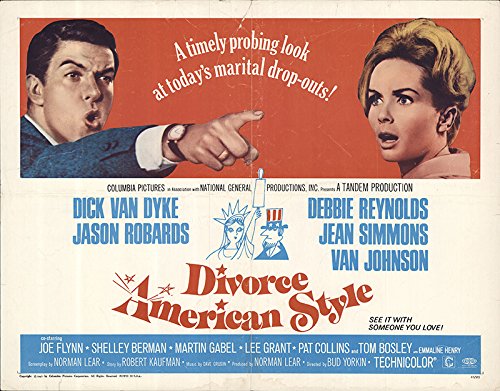
Divorce American Style (1967)

By Richard Winters

My Rating: 2 out of 10

4-Word Review: Couple can’t get along.

Richard and Barbara Harmon (Dick Van Dyke, Debbie Reynolds) appear to have the perfect life living in a sprawling suburban home with two kids, a good job and paid housekeepers, but underneath the facade their unhappy. Neither of them can communicate with the other, so they decide to see a marriage counselor (Martin Gabel), but this just makes things worse. Eventually they get a divorce, but the alimony and child support are so high that Richard is forced to move into a small 1-bedroom apartment and drive around in an old beat-up car. Barbara begins dating an affluent car salesman (Van Johnson) but both find that, despite all their squabbles, the more they’re apart the more they miss each other.

The script was written by Norman Lear who went on to produce the ground-breaking TV-series ‘All in the Family’, but the edge from that one is completely lacking here. I’m not sure if it was the time period this film was made in and what the studios perceived the public was willing to accept, but the satire is mild to non-existent and becomes boring quite quickly. The subject of divorce is handled in such a sanitized way that it barely even touches the surface and in many ways this thing comes off more like a romantic comedy with divorce being only a side-story.

The two leads are incredibly bland. Van Dyke again just seems to be channeling his Rob Petrie character and seemingly unable to play any variation from that. While his squeaky clean image may have made him likable on TV it makes him quite dull and one-dimensional on film. Reynolds fares better, but as a couple there’s nothing unique or interesting about them and the issues that they fight about, which is mainly the fact that they can’t ‘communicate’, comes off as generic and pointless.

The supporting cast are far more engaging. Joe Flynn, who has no problems paying or sex with prostitutes and does not feel it’s cheating because it’s ‘not romantic’ and his wife, played by Emmaline Henry, who wouldn’t go back home to an unfaithful husband even if he ‘hanged himself’ have the type of edge that could’ve made this film far funnier and more memorable had they been made the stars. Even Jason Robards and Jean Simmons have potential playing a divorced couple where the wife still lives in affluence while the husband due to his high alimony and child support lives in the dumps, but dates a pregnant woman (played by Eileen Brennan in her film debut) anyways.

The comedic tone is inconsistent. At times it conveys a surreal flair like having an orchestra conductor come out at the beginning and pretend to direct the voices of all the arguing couples in the neighborhood like there’s a musical quality to it. Having the kids keep a scorecard to their parents fighting is funny too, but these segments get interspersed with long talky moments that drags the whole movie down and things would’ve worked better had it started out right away with the couple already divorced instead of spending the first hour dealing with their protracted arguing.

The anemic insights that it does make about divorce come off as dated and wholly out-of-touch with today’s realities. A modern day divorced couple will most likely find nothing relatable with the story. Tacking on a pseudo happy ending just adds further insult to the topic by making it seem like all marital disagreements can somehow be ‘worked out’ coming off like it was written and produced by those who really hadn’t dealt with divorce issues in their real lives and did very little research on it.

My Rating: 2 out of 10

Released: June 21, 1967

Runtime: 1 Hour 49 Minutes

Not Rated

Director: Bud Yorkin

Studio: Columbia Pictures

Available: DVD, Amazon Video, YouTube

The Ballad of Cable Hogue (1970)

ballad of cable hogue

By Richard Winters

My Rating: 6 out of 10

4-Word Review: Desperate man finds water.

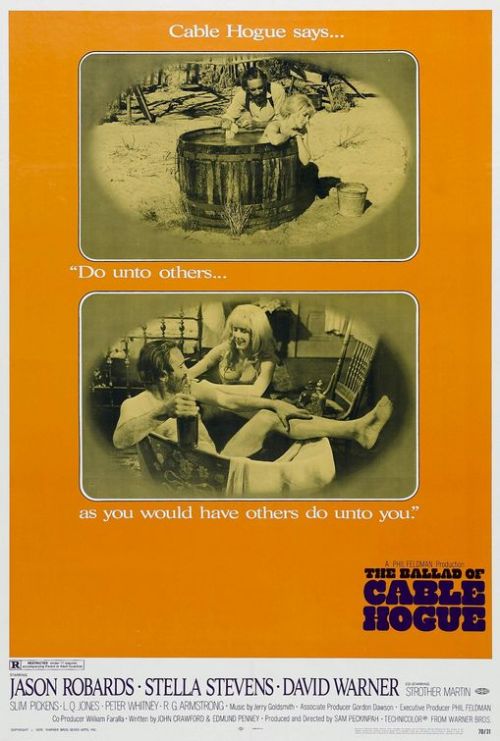
After he is betrayed by his two friends (L.Q. Jones, Strother Martin) and forced to survive in the middle of the desert without the benefit of food, water, a gun or even a horse Cable Hogue (Jason Robards) goes on a mad search for an oasis. After four days in the heat he collapses and just as he is ready to die he suddenly finds water in the most unlikely place. He uses this untapped spring to create a way station for the stagecoaches that travel through the area and becomes quite rich, but deep down he harbors the dark desire to get revenge on the two who wronged him and one day he finally gets his chance.

Theoretically a person can survive up to 4 ½ days, or 100 hours, without water if they are in a climate with a temperature of 72, but in much hotter conditions such as the one shown here it would be far less, so having the character survive like he does seems to be a an extreme stretch, but if you can get past that then the film is quite enjoyable at least at the beginning. The script was written by John Crawford and Edmund Penney who spent the majority of their careers working as character actors in B-movies and this was their one and only foray as writers. The story’s biggest asset is the main character that is expertly portrayed by the gifted Robards. His determination to beat long odds and find success even as he starts from rock bottom should resonate with most viewers and the character’s grit meshes well with director Sam Peckinpah’s perennial theme of rugged individualism.

The addition of David Warner as a dubious minister who helps Cable build his station is excellent and the film could’ve been an engaging buddy movie had it remained at this level. Unfortunately it felt the need to add in a love interest in the form of Stella Stevens, sans make-up, who portrays a whore that takes a liking to Cable. Stevens is not as strong of an actor as Warner and doesn’t know how to carry a scene like he does, so her time in front of the camera is boring and does nothing but bog down the pace while pushing Warner’s character out, which severely hurts the film’s rugged but whimsical chemistry.

Spoiler Alert!

Strother Martin’s character becomes yet another issue. He again gets straddled with the creepy, cowardly bad guy role of which is plays to perfection, but eventually made it seem almost like typecasting. To some extent I was happy to see him become humanized as it went along, but I didn’t like how Cable decides to leave his way station to him instead of the Warner character as he was the one who helped build it. Maybe Cable realized that with the invention of the automobile his station would no longer be prosperous and he would then be sticking Martin with a stinker instead of the goldmine that he thought, which is okay, but then he saves Martin’s life just a few minutes after he was ready to kill him, which became too much of a contradiction.

End of Spoiler Alert!

The film has some funny moments, but I didn’t like the fast motion running as it made it seem too cartoon-like. The numerous potshots at religion and those that expound on it are hilarious and I enjoyed how Peckinpah looks at capitalism from both sides where it is shown to greatly benefit an individual who is able to take advantage of a market demand, but also how it can coldly abandoned that same person the second that demand goes away.  The first 40 minutes are great, but then the story loses steam with comical moments that become too drawn out and have little to do with the main story as well as a protracted ending that really fizzles.

My Rating: 6 out of 10

Released: March 8, 1970

Runtime: 2Hours 1Minute

Rated R

Director: Sam Peckinpah

Studio: Warner Brothers

Available: DVD, Amazon Instant Video, YouTube

The War Between Men and Women (1972)

war between men and women 2

By Richard Winters

My Rating: 2 out of 10

4-Word Review: Misogynist cartoonist goes blind.

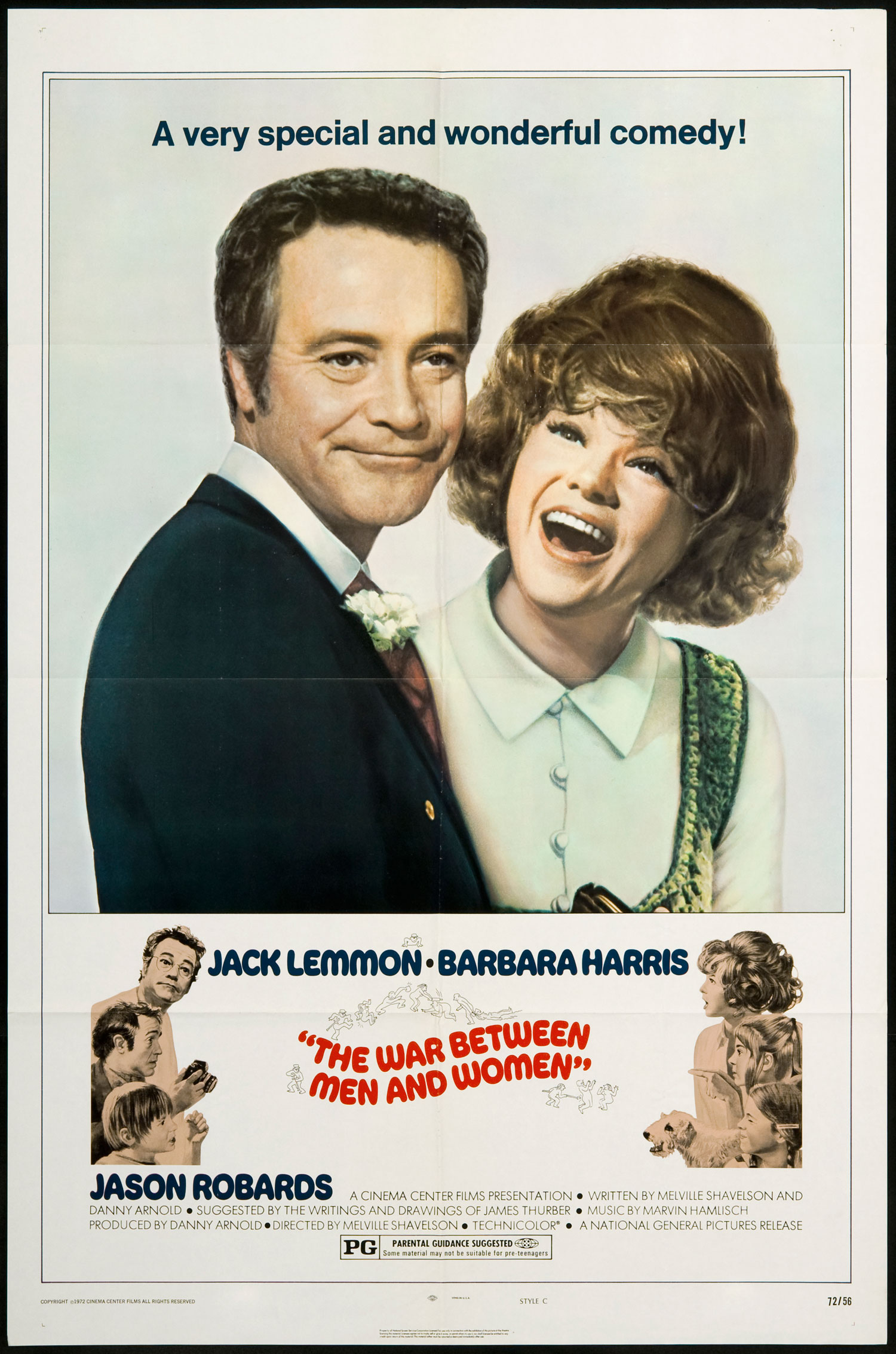
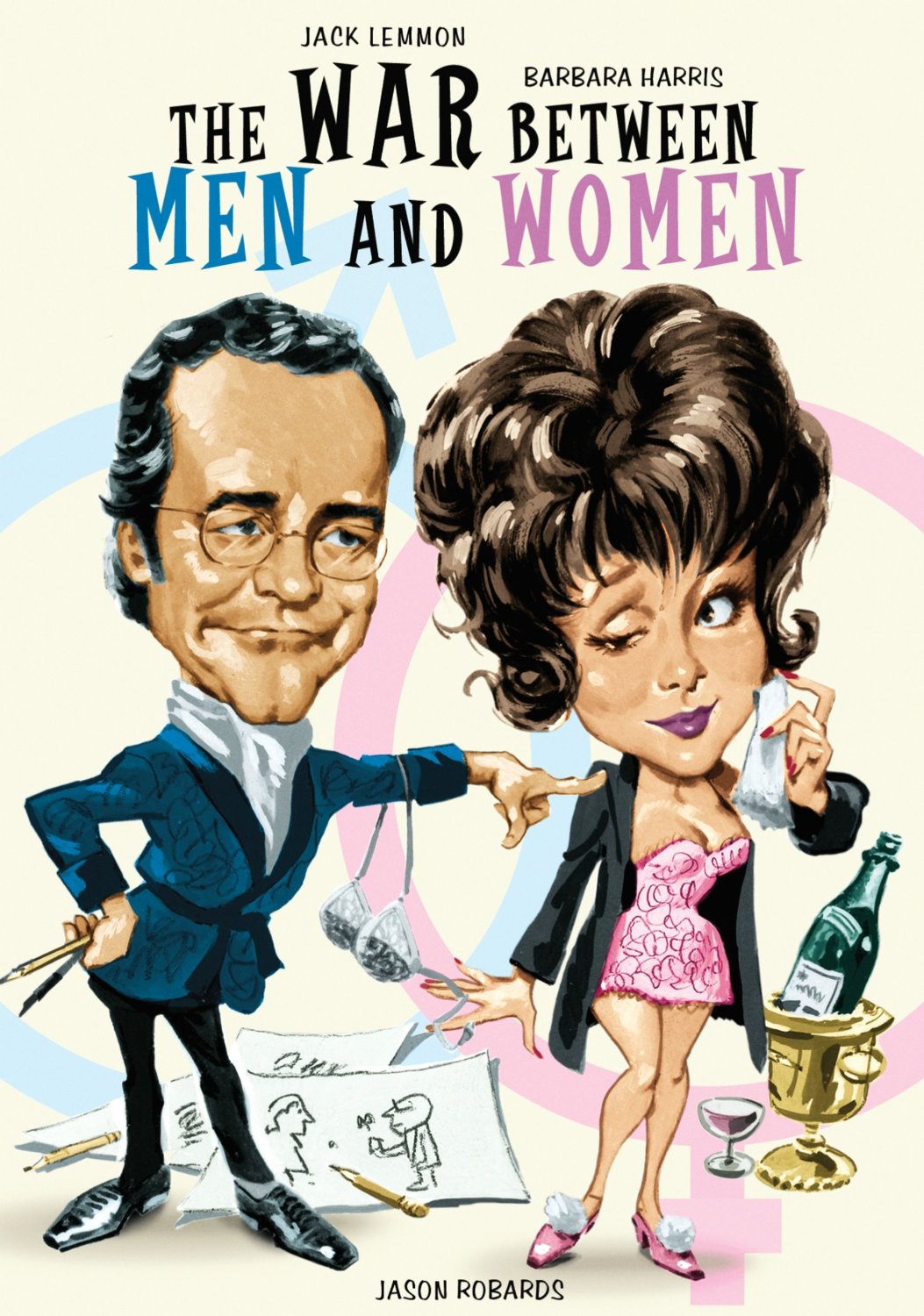
Peter Wilson (Jack Lemmon) is a popular cartoonist whose drawings depict women in disparaging ways. He enjoys his job and single lifestyle where he can live on his terms and keeps his apartment as messy as possible, which he usually does. However, his already poor eyesight gets worse and upon a recent visit to his optometrist (Severn Darden) he finds that he must get an operation to help save it and even then there is a fifty percent chance that he could still go blind. Despondent and depressed he meets Theresa (Barbara Harris) a single mother with issues of her own. The two enter into a whirlwind romance that quickly leads to marriage only to have Theresa’s ex-husband Stephen (Jason Robards) show up at the wedding and wanting to rekindle their relationship.

Peter’s character is loosely based on James Thurber and the film itself is a distant cousin to the TV-series ‘My World and Welcome to it’ that aired for one year on NBC during the 1969-70 season. The film though doesn’t have enough of Thurber’s whimsical humor to make it worth watching. It starts off with some potential as it opens with a weird animated segment and drawings that closely resembled Thurber’s, but then quickly devolves into a contrived comedy/romance with maudlin drama thrown in that makes it seem like two movies in one. Had it stuck with the animation it would’ve done better, but even that gets kind of stupid including one segment where Peter’s drawings start to attack him, which forces the humans to stage an all-out war between them and the cartoon characters.

Peter’s acerbic, woman hating personality is initially diverting, but then for no reason he does a 180-degree turn by falling in-love with Theresa almost immediately and becoming a conventional husband and father while turning the film into a silly version of ‘The Brady Bunch’. I also couldn’t understand why Theresa would fall so head-over-heels for Peter as the two are trading barbs one second and then in bed together the next making their character’s motivations quite confusing.

Robards, who has his hair dyed dark brown and is almost unrecognizable, gets stuck with a thankless supporting role and is seen only briefly. Initially his presence had some potential as he starts to become buddies with Peter and plot against Theresa, but then his character dies unexpectedly making it confusing why he had been written-in in the first place. Lisa Gerritsen, who is best known for playing Cloris Leachman’s daughter in the ‘Mary Tyler Moore Show’ TV-show and the subsequent spin-off ‘Phyllis’ has some appealing moments, but her constant stammering becomes annoying.

Thurber’s wit was unique and legendary, but this film is too timid to dive completely into it. I suppose the idea of having an openly misogynistic protagonist was considered ‘too edgy’ for early 70’s cinema, so attempts were made to make the character more mainstream, but in the process creates a film that is disjointed and bland.

war between men and women 3

My Rating: 2 out of 10

Released: June 1, 1972

Runtime: 1Hour 38Minutes

Rated PG

Director: Melville Shavelson

Studio: National General Pictures

Available: VHS