Tag Archives: Herbert Lom

Revenge of the Pink Panther (1978)

By Richard Winters

My Rating: 6 out of 10

4-Word Review: Out to get Clouseau.

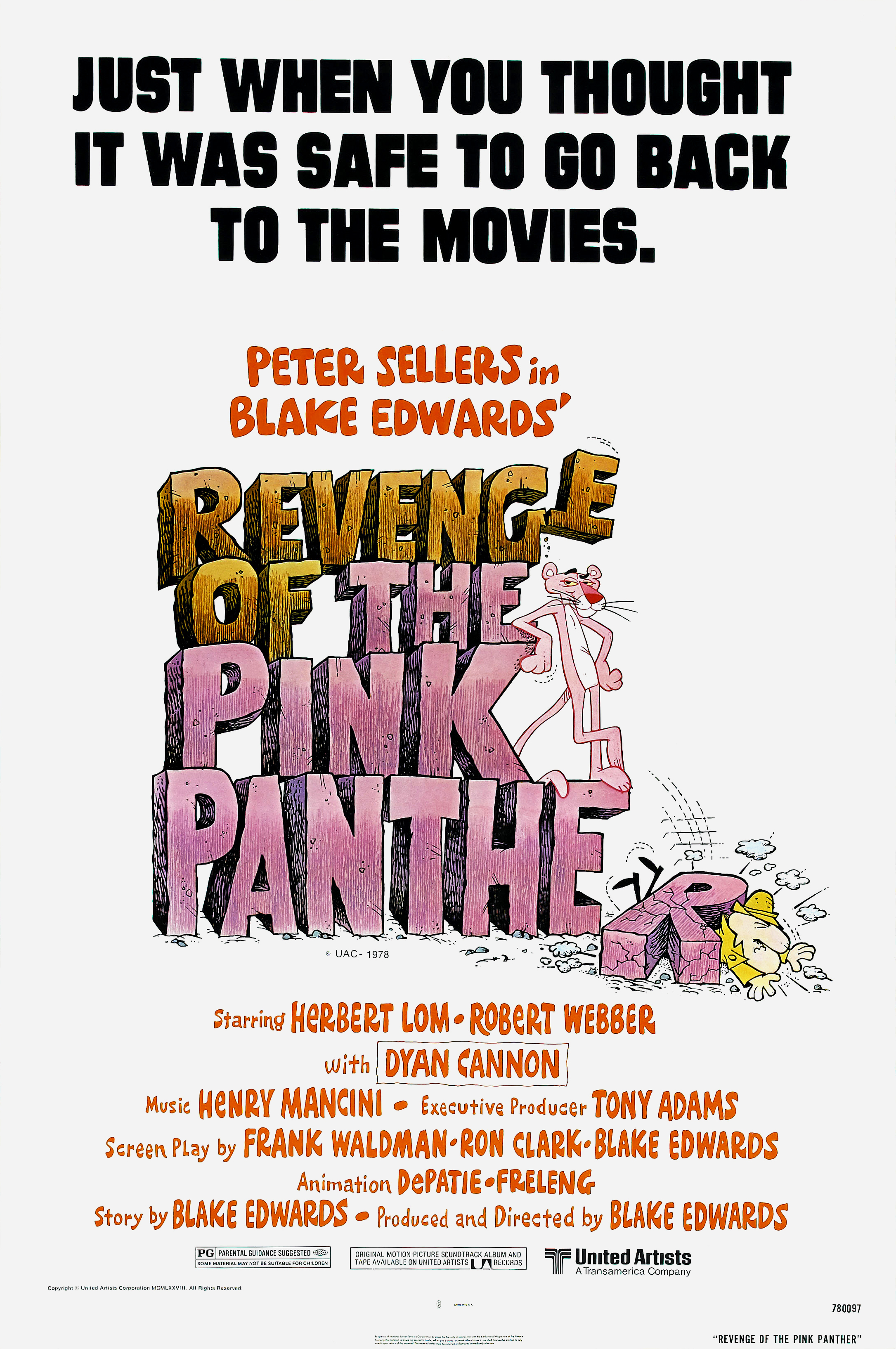
Philippe (Robert Webber) is a successful businessman who’s secretly the head of the French criminal underground. Some though are questioning his leadership considering him to be too weak to remain in that position. In order to squash the impending threat, he decides to make a bold move by having Inspector Clouseau (Peter Sellers) killed. Clouseau was considered a master detective by the outside world and only known to be an incompetent by those who worked with him, so by having him out of the way the drug dealers would feel relieved and thus Philippe would remain in power. However, things don’t get as planned as Clouseau manages to miraculously evade all attempts on his life. The media though mistakenly announces that he has died, which allows Clouseau to go undercover along with his manservant Cato (Burt Kwouk) to find out who’s after him.

This marked the fifth entry in the series and is probably the funniest. Initially director Blake Edwards had wanted to reuse footage that had been cut from the previous entry and then film new scenes around those, but star Sellers insisted he wanted an all-new story and that was probably for the best. Sellers by far gets the most laughs whereas in the one that came before this, The Pink Panther Strikes Againit was Herbert Lom as the unhinged Dreyfus, that was the most memorable, but here his part becomes much more benign, though he still gets one good scene where he tries not to breakout laughing while giving a eulogy at Clouseau’s funeral. Sellers though comes out on top here especially in his disguises like when he pretends to be a sea captain with an inflatable parrot on his shoulder, or in a hilarious send-up as a Mafia Don.

It’s great to see Kwouk, who was usually relegated to the ‘fight’ scene between him and his boss Clouseau, become more involved in the story, as the two go to Hong Kong in disguise to track down the bad guys. Dyan Cannon is a refreshing change of pace. Usually, the women in these films were young models whose sole purpose was to allude sex appeal, but here she’s middle-aged, but still attractive, and shows much more of a feisty personality. She helps build a strong secondary character and is better interwoven into the plot versus simply appearing as a potential romantic interest.

Webber though as the main villain is a detriment. I have no doubt that the notoriously insecure Sellers didn’t like the way Lom stole the film as the nemesis in their last outing and wanted to make sure that didn’t happen again. Not only is the Dreyfuss character far more neutered, but so is Webber making him seem like he’s almost sleepwalking through his role. It would’ve been more interesting had his character has some personal vendetta against Clouseau, possibly because it was Clouseau who had sent him, or one of his men to jail, and now he wanted revenge. Just having him out to get Clousau because it might bolster his own image didn’t seem to be enough of an incentive and the two, outside of one comic moment where Clouseau’s is in one of disguises, never have any ultimate confrontation. Watching him get chased around his desk and cower from Dyan Cannon may have been intended as funny, but it just further erodes his villainy making him seem even more impotent than he already is. Even a comedy still needs a bad guy that can elicit some tension and this one doesn’t.

The implementation of Mr. Chong, played by martial arts instructor Ed Parker, has potential. Supposedly he’s an ‘invincible’ fighter that can beat-up anyone and not be stopped as proven when he takes down several other men while in Webber’s office but then he gets comically defeated once he comes into contact with Clouseau. While watching him go through the floor/ceiling of several apartments below as he crash lands is visually funny it would’ve been more engaging if he had come back at some point and continued his relentless attack on Clouseau albeit with injuries in order to reclaim his reputation that he couldn’t be defeated, but in the process just became more hurt and ineffective.

Spoiler Alert!

The climactic sequence that occurs in Hong Kong is a cop-out and comes-off like they’d run out of ideas, so they tried to save it with a calamity filled chase that plays more like a cartoon, or something better suited for a live action Disney movie. Introducing yet another Mafia boss, this one played by Paul Stewart, makes things too cluttered and there should’ve been just one main bad guy that was the boss of everyone. The finale inside a firecracker factory should’ve proven dangerous and in fact we do see the entire place explode from a distance and yet everyone comes out of it unscathed, which doesn’t exactly make a lot of sense.

My Rating: 6 out of 10

Released: July 20, 1978

Runtime: 1 Hour 39 Minutes

Rated PG

Director: Blake Edwards

Studio: United Artists

Available: DVD, Amazon Video, YouTube
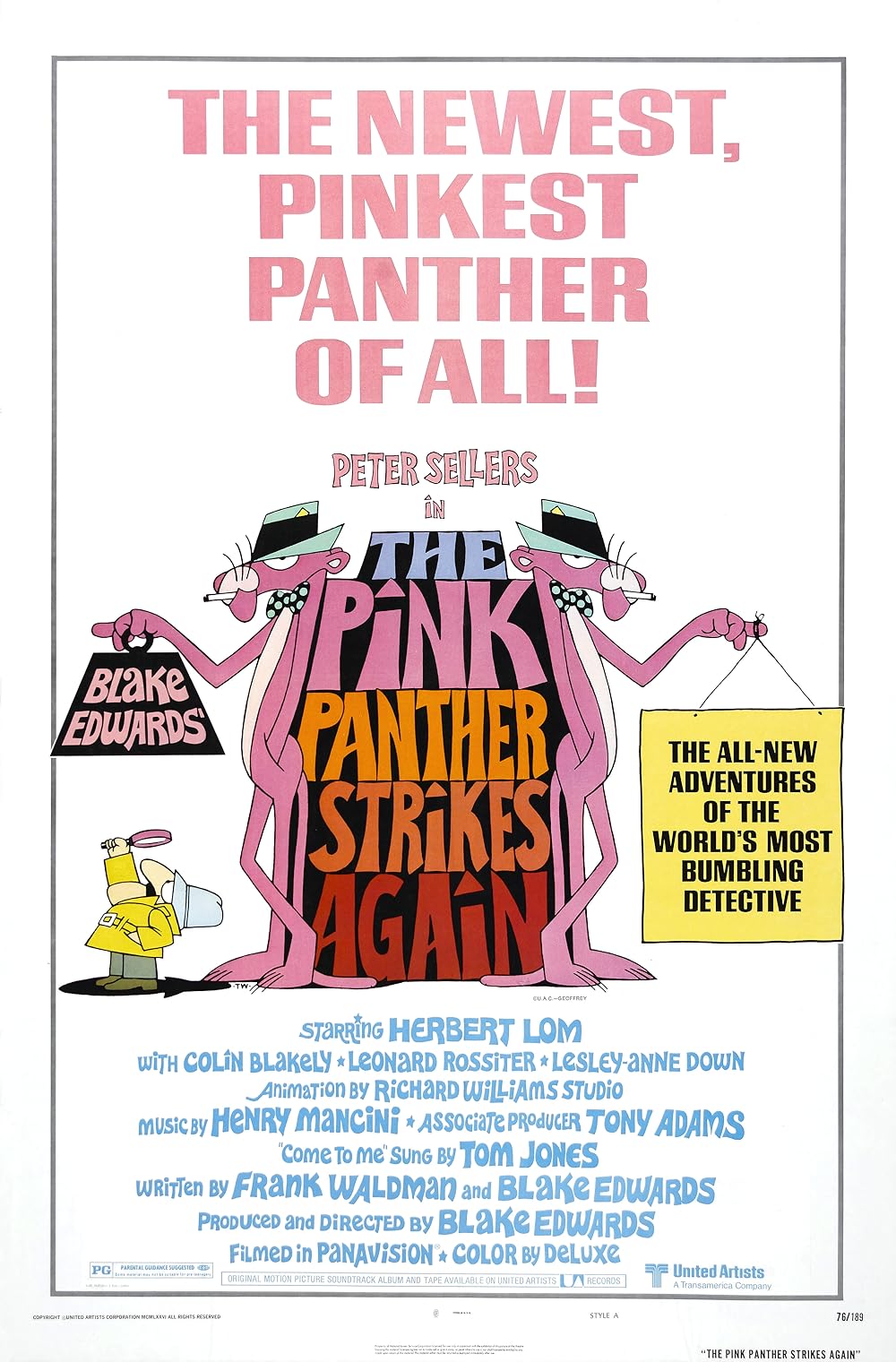
The Pink Panther Strikes Again (1976)

By Richard Winters

My Rating: 7 out of 10

4-Word Review: Clouseau battles doomsday weapon.

Dreyfuss (Herbert Lom) has been informed by his psychiatrist (Geoffrey Bayldon) that he has been cured of his obsession with Clouseau (Peter Sellers) and now deemed sane. He’ll be recommending his release from the mental institution he’s been in later that day at the sanity board of which Dreyfuss is elated. However, Clouseau shows up unannounced planning on speaking to the sanity board on behalf of Dreyfuss, but when he gets there the two meet and after several mishaps, all inadvertently caused by Clouseau, occur it sends Dreyfuss spiraling back into insanity. He then though is able to escape and goes on a mission to kill Clouseau, first on his own and then with the help of several worldwide assassins. When this doesn’t go as planned, he kidnaps a nuclear physicist (Richard Vernon) and blackmails him to create a doomsday weapon that can take out entire buildings with its laser beam and which Dreyfuss has no problem using against the world unless he’s given Clouseau in return.

After the unexpected success of The Return of the Pink Panther, director Blake Edwards was given an immediate green light to write and direct a follow-up. Since he had originally intended for this to be a TV-series he used one of the scripts he had written for that one and expanded it for feature film length. The original cut came out to 126 minutes, but the studio insisted it be trimmed to 95-minute runtime with the excised scenes being used as material for the Curse of the Pink Panther, which released 6 years later after the passing of star Sellers.

Despite constant behind-the-scenes struggles between Edwards and Sellers this film is widely considered their best output second only to The Party, which they collaborated on 8 years earlier. A lot of the reason why it works is the excellent pacing with an almost rapid-fire collage of jokes and mishaps, the scenic European locations and the pleasing yet still bouncy Henry Mancini score.

The humor hits the target in almost all cases, unlike most comedies where there’s usually a few misses, with some of the best moments coming from the supporting players like stuntman Dick Crokett who plays a perfect parody of then President Gerald Ford and Lesley Ann-Down, who replaced Maude Adams who was originally cast, but then fired after she refused to appear nude, as a Russian spy whose attempts to get Clouseau in bed with her proves quite funny. The ongoing confrontations between Lom and Sellers though are still the highlights and the two really work well together with Lom’s angry abrasiveness a nice contrast to Seller’s benign ineptness and in fact this is a rare instance where Sellers gets upstaged as it’s Lom’s performance with his over-the-top villainy that you come away remembering the most after it’s over.

Yet with all of its successes the script is still full of logical loopholes and missing key moments. For instance, Dreyfuss escapes from the mental hospital, but it’s never shown, which I felt since it’s so integral to the storyline needed to be seen and explaining how he was able to do it. What he did to gain access to the apartment downstairs from Clouseau’s should’ve been inserted as well and some sort of answers for how he was able to avoid injury from the bomb going off as it destroyed Clouseau’s apartment and the fallout from it would’ve most assuredly affected the apartment beneath it as well. Clouseau’s ongoing physical confrontations with his house servant Kato (Burt Kwouk) becomes problematic too as they’re constantly damaging the furniture during their fights and if this happens every time he comes home then the furniture should already be in disarray from their last battle as there wouldn’t have been time to have cleaned it up and replaced it with new stuff.

Spoiler Alert!

While the film does at least have Dreyfuss masterminding a major bank heist, which helps to explain how he got funding to build the giant laser and purchase the castle that he and his crew move into, it still makes it seem that they’re able to build the elaborate weapon and all the computers that go along with it, almost overnight, which of course isn’t believable. It also at one point has the laser beam striking Lom making his legs disappear, but he’s still able to somehow walk around anyways as well as maintain his same height, making it seem that his legs are still there and simply invisible.

There’s also the issue of Dreyfuss disappearing at the end, due to the effects of the laser, but in the following installment, Revenge of the Pink Panther, he’s fully intact and no mention of his previous madness to destroy the world. Fans of the series say this is because this whole film was meant to be a dream that Dreyfuss had, which would’ve made a lot of sense. He was already obsessed with Clouseau, so having nightmares about things one is constantly focused on would be logical and the film should’ve had at the very end Dryefuss waking up and still in a strait-jacket, but it doesn’t making it an oversight and not properly thought through.

My Rating: 7 out of 10

Released: December 15, 1976

Runtime: 1 Hour 43 Minutes

Rated PG

Director: Blake Edwards

Studio: United Artists

Available: DVD, Amazon Video, YouTube
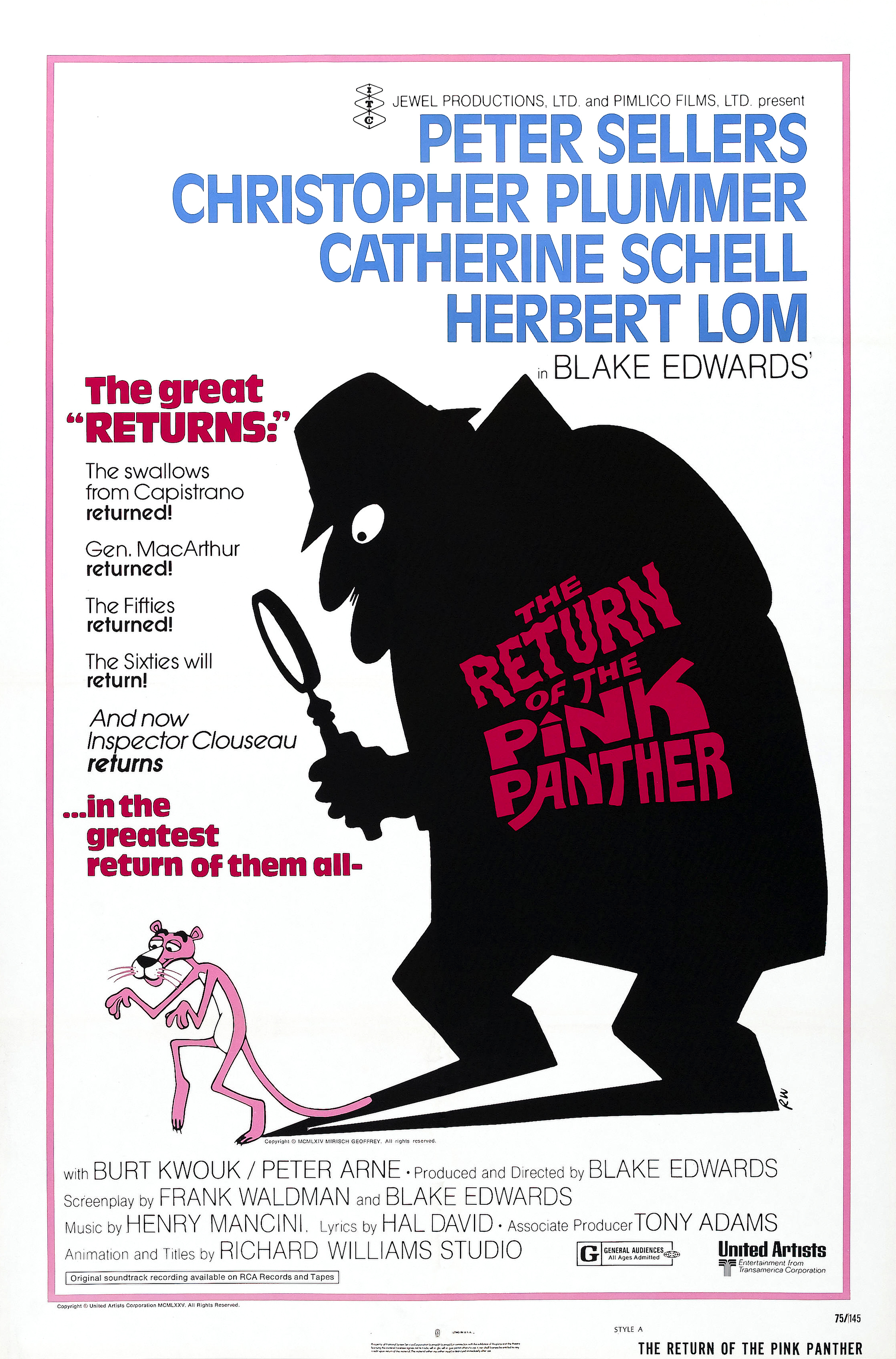
The Return of the Pink Panther (1975)

By Richard Winters

My Rating: 7 out of 10

4-Word Review: Tracking down stolen diamond.

Inspector Clouseau (Peter Sellers) has been demoted to street cop by Chief Inspector Dreyfuss (Herbert Lom) due to Clouseau’s continual incompetence, which is starting to drive Dreyfuss completely mad. However, inside the country of Lugash a prized diamond known as the Pink Panther is stolen and since Clouseau had success retrieving it the first time it went missing during a heist he is put on the case to find it again much to Dreyfuss annoyance. Clouseau suspects that the culprit is Charles Litton (Christopher Plummer), who is a notorious thief. Clouseau attempts to use several different disguises in order to infiltrate Litton’s home that he shares with his wife Claudine (Catherin Schell) in order to find incriminating evidence against Litton so that he can turn him in, but his attempts to try and a take Litton down prove to be comically inept. 

This marked the fourth installment of the Pink Panther series and the first in 10-years that reunited writer/director Blake Edwards with Sellers. Both had said after doing the second film A Shot in the Dark, that they never wanted to work with the other again due to much infighting during the production, but both had since then fallen on hard times. Edwards was by the early 70’s considered box office poison after the colossal failure of Darling Lilli which managed to recoup a measly $3 million from a $25 million budget and his other films from that era Wild Rovers and The Carey Treatment hadn’t done much better. Since Pink Panther had been his last success, he was interested in reviving it and even wrote up a 14-page treatment but found no takers amongst the major studios. Then producer Lew Grade agreed to finance it in exchange for Edward’s wife Julie Andrews agreeing to star in a British TV-special that he wanted to produce. Since Sellers career had also bottomed out, he came onboard to most everyone’s surprise without much hassle.

The film was shot in many scenic locations including Morrocco giving the optics an exotic flair and the proceedings a sophisticated European vibe making it seem like a step-up from just a silly comedy. In the first two installments all the characters were written to be funny and goofy particularly the second film, which had been based on a stage play. Here though the comedy is wisely given over to Sellers while the couple he’s after remain savvy, which makes it more intriguing as you want to see how this inept idiot takes them down, or is able to trip them up at their own game. I also liked how funny bits are interspliced with some legitimate action, especially the opening scene that features the heist, which could’ve easily fit into a realistic film dealing with a robbery. These moments help add a bit of relief from all the laughs, a sort of chance to catch your breath, while making the plot seem like it’s not just all about being a farce.

Lom adds terrific support as Clouseau’s exasperated supervisor, and his assertive acting style works nicely off of Sellers clownish one making the interplay between the two a highlight. It’s good too that Plummer replaced David Niven, who played the character in the first one, but wasn’t able to do it here due to scheduling conflicts, as Niven would’ve been too old and not plausible to have outrun the bad guys like Plummer does. 

My only issue is that Claudine is shown attempting to hold in her laughter at Clouseau right from the start like she knows he’s an idiot before she even met him, but this goes against the premise. Clouseau is considered an accomplished detective by the outside world hence why he was selected to head the case and it’s only the people that work with him and know him who are aware of his ineptness. This is the whole reason why Dreyfuss gets driven mad by him because the rest of the world celebrates the man that he knows is really a fool, so Claudine should’ve initially thought of him as being sharp and only came to the conclusion he was incompetent by the end after having dealt with him. It actually would’ve been funnier had she and Charles feared Clouseau upfront having believed his celebrated reputation and misreading his bumbling as being ‘genius’ ploys and remained that way throughout. In either case seeing her covering her mouth and shielding her giggles makes almost seem like she’s falling out of character and a blooper, similar to how Harvey Korman would unintentionally crack-up during Tim Conway’s antics on the ‘The Carol Burnett Show’ and for that reason it should’ve been avoided. 

My Rating: 7 out of 10

Released: May 21, 1975

Runtime: 1 Hour 54 Minutes

Rated PG

Director: Blake Edwards

Studio: United Artists

Available: DVD, Blu-ray, Amazon Video, YouTube

Ten Little Indians (1989)

tenlittle

By Richard Winters

My Rating: 3 out of 10

4-Word Review: Everybody is getting killed.

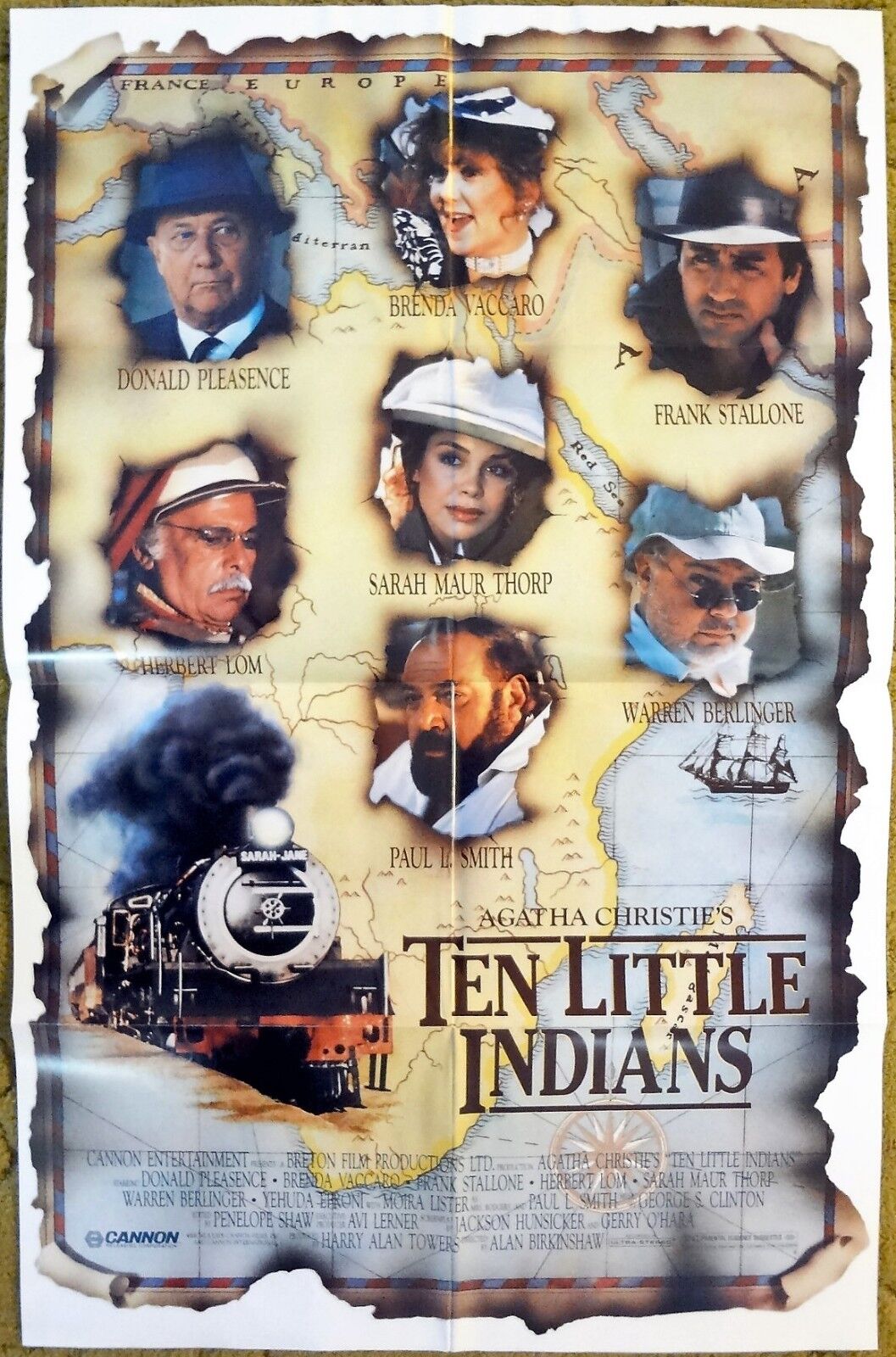
Ten strangers get together on an African safari. The group includes: A doctor (Yehuda Efroni), a judge (Donald Pleasance), a captain (Frank Stallone), an actress (Brenda Vaccaro), a General (Herbert Lom), a nanny (Sarah Maur Thorpe), a detective (Warren Berlinger), along with a man named Marston (Neil McCarthy), and a couple with the surname Rodgers (Paul L. Smith, Moira Lister). They’ve been invited by a man named Mr. Owen, but upon their arrival he’s nowhere to be found. Instead they hear his voice that’s been recorded onto a phonograph where he tells them that they’ve been invited because they’ve been accused of committing a crime years ago and gotten away with it, but he intends to put a stop to that by killing them off one-by-one. As each guest gets murdered one of the heads from the ten little Indians statues that sits in the middle of the dining room table goes missing.

The film has the distinction of being the third movie version of the story done by producer Harry Alan Towers as the first one was produced in the 60’s and the second, which also starred Lom, in the 70’s. The story itself is based on the Agatha Christie novel ‘And Then There Were None’ though the ending was changed to replicate the stage play, which was considered more upbeat. While in the novel and play the setting was an island here it’s the desert of South Africa, which I liked as it gives the proceedings a distinct atmosphere. However, there’s an unusual moment at the beginning where the natives help carry the guests’ luggage to the camp site, but then halfway there for no explicit reason they turn on them by clicking their tongues in unison and ultimately abandoning them, which is creepy, but there’s never an explanation for why they do this.

The landscape looks hot and dry though there’s no sweat glistening off the actor’s faces leading me to believe it was shot in the winter time and thus the complaints about the heat, which are casually mentioned are invalid. I did get a kick out of one of the tents, the main one, having an upright piano. Don’t know who in the world would want to painstakingly haul a piano into the desert sands, or essentially the middle of nowhere, but the appearance of it gave me a chuckle. I was also amused by the elevated lift, held together by a frayed rope, that each guest is forced to sit-in as it takes them many feet in the air of a wide gorge, in order for them to get to the campsite. The contraption looks flimsy and it’s rather unnerving seeing them get into it and ride it all the way down.

The acting is entertaining and made-up of many B-stars whose faces you’ll recognize though not necessarily their names. Vaccaro fares best as a bitchy, spoiled, Hollywood star whose career has gone on the decline. Lom is good as an aging man whose memories plays tricks on him, but Stallone, who’s the younger brother of Sylvester and could almost pass of as his twin, has little to add. Berlinger had gained a lot of weight to the point that he’s rounder than a beach ball, is adequate, but the normally reliable Pleasance appears elderly and lacking energy making his presence almost sad. Smith continues in the mold of the jail guard in Midnight Express, a part that made him famous, but his heavy breathing and lurking ways are not interesting and his acting one-note.

The mystery angle doesn’t get played-up too well as the guests get killed-off with a boring regularity making it at times seem almost like a low-grade slasher. The characters don’t respond to their stressful conundrum realistically. For instance one of the guests dies by drinking alcohol that was linked with cyanide, but the rest of them in the ensuing days go on eating and drinking even though you’d think they’d be nervous about ingesting anything for fear that whatever they put in their mouths could also poisoned. They also go back to their tents each night and peacefully sleep despite seeing the other guests get offed by a unseen killer, which would’ve made me, and most others too fearful to get any shut-eye and instead stay wide awake for fear that the killer would attack the minute anyone closed their eyes.

Spoiler Alert!

The tension is nil and there’s really no interest in finding out who the culprit is. In the book everyone dies and the authorities are only able to figure out what happened from a message that they find written by the judge. Here both Stallone and Thorp make it out alive though Thorp lets go of the rope that had been around her neck just as Stallone comes to her rescue making me believe that she would’ve hung herself before he would’ve been able to get her out of the noose. The rescue plane flies over them instead of landing making it unintentionally seem like they had been left stranded and not saved after all. Having everyone die except for Stallone, which is what I thought was going to happen, and then having him arrested for the murders he really didn’t commit would’ve been a much more ironic twist.

My Rating: 3 out of 10

Released: May 17, 1989

Runtime: 1 Hour 38 Minutes

Rated PG

Director: Alan Birkinshaw

Studio: Cannon Films

Available: Blu-ray, Tubi

Gambit (1966)

gambit 2

By Richard Winters

My Rating: 6 out of 10

4-Word Review: Foolproof plan has holes.

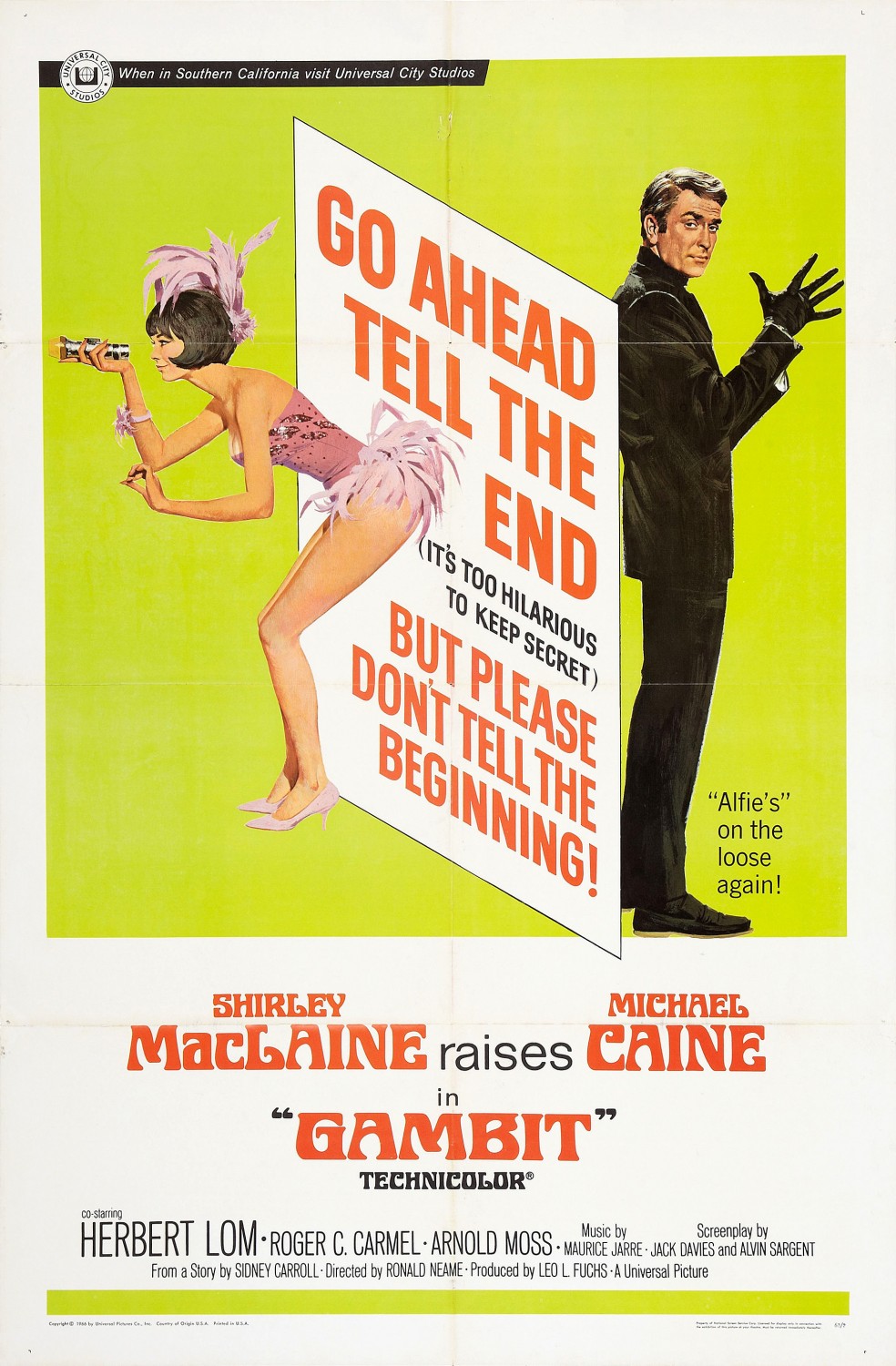
Harry (Michael Caine) is an international cat burglar looking to make his biggest steal yet. He recruits dance girl Nicole (Shirley Maclaine) to pose as his wife and with the help of some makeup and a different hairstyle made to resemble the late wife of reclusive millionaire Shabandar (Herbert Lom). The idea is to use this uncanny resemblance to get Shabandar’s attention who will then invite them up to his reclusive mansion. While Shabandar remains entranced with this woman Harry will use the time to steal an expensive statue that is in Shabandar’s home. Unfortunately Harry fails to factor in the human element, which sends his ‘foolproof’ plan into disarray.

This movie is fun most of the way and great escapism for a slow evening. The novel twist of showing how the plan should work, which takes up the first part and then showing what really happens is quite amusing. The movie works almost as a parody to all those slick heist movies and spy films that always have elaborate schemes, but usually overlook the human element in the process and if anything I wished they had played this up even more.

Maclaine is a delight and for the first 30 minutes doesn’t utter a single word. She has always been good as vulnerable characters and here is almost child-like. The contrasting personalities and verbal exchanges between her and Caine are amusing and something that I wished had also been played up a bit more.

The real problem is the blossoming romance between the two that doesn’t make any sense. The two know each other for only a couple of days and yet somehow ‘fall madly in love’ despite the fact that Harry is very rude and detached towards Nicole the whole time.  Harry also finds Nicole to be quite irritating and even explicitly tells her as much, so why he would suddenly fall for her is just as ridiculous. The idea, which is quite prevalent in 60’ movies, that two single people of the opposite sex must become a couple by the end of the movie is quite contrived and mechanical and in some ways diminishes the story by always forcing a happy ending even when it is not natural or needed.

There are a few other loopholes that hurts the story as well. One of them is while Harry is inside Shandabar’s home he opens up a statue and reaches in to take out the equipment needed to for the crime, but how was he able to do this? Did he sneak into Shandar’s home at some earlier point and put the statue there and if so how was it not detected by Shandabar? This is not explained, which seriously affects the credibility. There is another moment later on where Nicole sneaks back into Shandabar’s home while Harry is committing the robbery, but it is never explained how she was able to do that since there were guards everywhere, which required Harry earlier to go to elaborate means to do it himself.

Spoiler Warning!!!

The twist ending, which has Harry returning the original statue to Shandabar, but keeping the copy of it and using it to resell to the gullible public who thinks it’s the original is kind of cool. However, when Harry smashes the statue replica to pieces in an effort to show Nicole that he has ‘reformed’ from his criminal ways and retain her affections I knew immediately that there must have be even more statue copies hidden somewhere else, which there is, because there was no way his friend Emile would have taken something like that as lightly as he does otherwise.

End of Spoiler Warning!

gambit 1

My Rating: 6 out of 10

Released: December 21, 1966

Runtime: 1Hour 49Minutes

Not Rated

Director: Ronald Neame

Studio: Universal

Available: VHS, DVD (Region 1 & 2), Blu-ray (Region B), Amazon Instant Video