Tag Archives: Entertainment

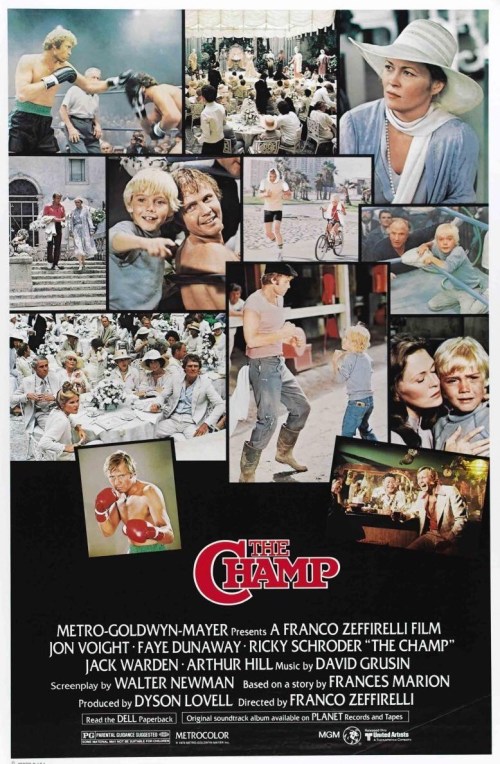
The Champ (1978)

champ1

By Richard Winters

My Rating: 7 out of 10

4-Word Review: Idolized by his son.

Billy (Jon Voight) is a former boxer whose been out of the ring for 7 years. Now at age 37 he works as a horse trainer. His 8-year-old son T.J. (Ricky Schroder) idolizes him and refers to his as ‘The Champ’ instead of dad. Billy though suffers from many inner demons including his perpetual drinking and gambling as well as not making enough money to sufficiently support either himself, or his son. Nonetheless he continues to go out gambling whenever given the chance and he manages to win enough money to buy his son a horse, which they name She’s a Lady. They enter Lady into a race where T.J. meets Annie (Faye Dunaway). Unbeknownst to T.J. Annie is his mother whom she gave up at birth, but now that she’s married to a wealthy man (Arthur Hill) she wants to have custody. Billy refuses to allow it, but when he loses the horse because of a gambling debt and Annie gives him the money to pay it off he eventually relents and has T.J. go live with her while he’s in jail for assault. Once he’s released the father and son reunite, but Billy realizes he must make more money in order to keep him and thus decides to go back into the ring one last time despite warnings from Jackie (Jack Warden), his former manager, that to do so could be life threatening.

The film is remake of the 1931 classic with Wallace Beery playing the part of the father and Jackie Cooper as the son. Director Franco Zeffirelli remembered watching it as a child and it having a profound effect on him. Then years later while he was in his hotel room while on-location filming another feature he saw it come on television and the film again moved him in such a way that he decided he wanted to do a remake. This though wasn’t the first remake as it had already been done in 1953 as The Clown starring Red Skelton though the story had been revised without the boxing theme and the climactic event at the end doesn’t take place at a sporting event, but instead a dangerous stunt that the lead character must do during a live broadcast of a TV special.

While this one stays more faithful to the original concept it was still panned by many critics as being overly sentimental and soap opera-like. Many who were fans of the original felt this one fell far short and complained about the long running time, this one runs of full 2-hours while the older one was only 83 minutes, with the feeling that it stretched the plot out too much and at spots was too slow. Though I’ve never seen the 30’s version I found myself genuinely wrapped up in the drama and the characters.

Many at the time complained that Voight was going back to the same type of Joe Buck character that he played in Midnight Cowboy, but I disagreed. That character was genuinely stupid, but Billy isn’t he’s just down-on-his-luck and suffering from basic human frailties, which made his situation far more compelling.

Schroder is an absolute jewel. He got the part after beating out over 2,000 others and it’s easy to see why. His ability to cry on demand with real tears streaming down his face is amazing and not something other actors are able to do. He’s cute and engaging without it ever getting forced, or overdone. His presence gives the film its energy and virtually the sole reason for why it works as well as it does.

The main complaint that I did have was with Annie. She’s marvelously played by Dunaway, who’s always been one of my favorite actresses and it’s a good role for her acting style as she’s excellent at playing characters that have a bit of a cold and aloof manner while not easily able to show their soft side, but with that said I still couldn’t understand what made the character tick, or her motivations. For one thing she seemed to have nothing in common with Billy, so what brought them together in the first place was a mystery and then having her abandon the kid while she went off living her life seemed pretty extreme. In most cases it’s the father that shirks the responsibility of raising the child, but here it’s reverse, but with no clear explanation as to why. There’s a vague excuse later on that it was so she could ‘pursue her career’, but then this doesn’t explain why she now wants to get close to her son. If she was selfish back then what made her change to suddenly want to be loving and caring? She went 7 years without ever seeing the kid, and did pretty well without him, so why now must she have him? I felt there needed to be some extra context added like she had been addicted to drugs when she had TJ, which then made her deemed unfit to raise him, but now that she had kicked the habit she wanted him back, or maybe she had suffered a miscarriage with her second husband and this made her feel guilty about the child she had let get away and this motivated her to want to seek out TJ, but without any of this added information the character comes-off as transparent, unrealistic, and unrelatable.

I will agree with Leonard Maltin in his review where he states that it looks like Faye wants to go to bed with her own kid. This occurs during the scene where Ricky is on her yacht and looking off in the distance while Faye comes up behind him and begins sniffing his hair like she’s getting turned-on by him. To call this a cringey, awkward moment is an understatement and it’s unintentionally laughable. Why it was left in, or why Zeffirelli thought it would be a good idea to put in I don’t know. The movie manages to recover, but it’s a segment that is indeed ridiculous.

The boxing element is another problem as it gets introduced way too late. It gets briefly mentioned throughout the first 2 acts and there’s even a quick scene where Billy shows up at a gym, but overall it gets played-out as a side-story only to suddenly, 90-minutes in, becomes the main focus, which gives the film a very disjointed feel. Jack Warden’s character doesn’t appear at all until near the end almost like it’s a tacked-on bit that doesn’t really flow with everything else that came before. The boxing scenes are impressive and helps to effectively expose the brutality of the sport, but I felt Billy’s training and decision to enter the ring should’ve been made sooner and the boxing scenes mixed-in throughout, but either way it’s still an competent tearjerker that shouldn’t leave a dry eye in the house.
champ2

My Rating: 7 out of 10

Release: March 20, 1979

Runtime: 2 Hours 3 Minutes

Rated PG

Director: Franco Zeffirelli

Studio: MGM

Available: DVD, Amazon Video, YouTube
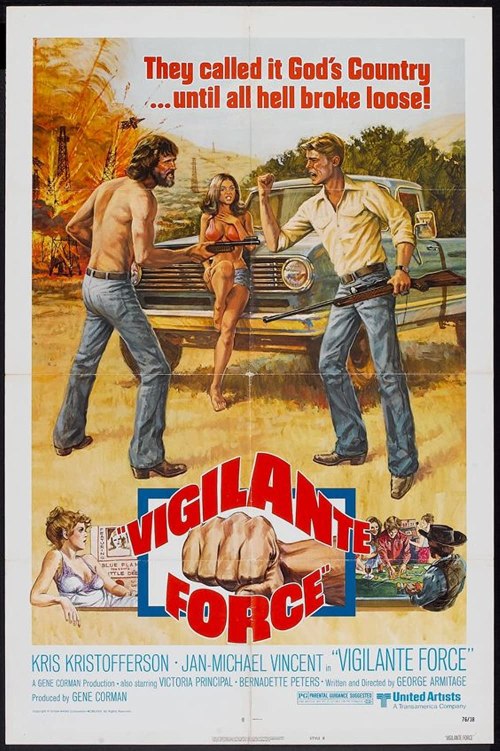
Vigilante Force (1976)

vigilante1

By Richard Winters

My Rating: 4 out of 10

4-Word Review: Veteran takes over town.

After oil is found near a small California desert town many people, including oil workers, move in looking for work. All the new people coming in causes a great deal of  crime in the community and the local police force is too small to handle the influx. Ben (Jan-Michael Vincent), a longtime resident, decides to hire his brother Aaron (Kris Kristofferson), a veteran of the Vietnam War, to help act as a peacekeeper. Aaron then brings along some mercenaries to assist him, but he and his new associates begin acting more like the bullies forcing everyone to submit to their ways of doing things, or face the consequences. This causes Ben to come to the painful realization that his brother is more of a problem than the solution and forcing him to take matters into his own hands in order to rid the town of him.

This was the third film directed by George Armitage, who did Private Duty Nurses and Hit Man before this one and all three being produced within the Roger Corman family, this one by Roger’s older brother Gene, who approached George about the project having only the title in mind and no actual story. Armitage, who had only 30-days to film, decided to make it an allegory of the Vietnam War where a group of strangers would come into a town, much like the American soldiers did when they came upon a small village in Vietnam, and take it over while focusing on the helpless nature of the residents who could do seemingly little about it.

While the concept had lots of potential the execution is rushed making the story come-off as cluttered and unfocused. It’s one of the few films made where there’s violence and action immediately before there’s barely any onscreen credits, but the motivations of why it’s happening is not clear, so it’s more confusing than exciting.  The plot doesn’t make much sense. Why are these new people all resorting to criminal behavior including robbing a bank? Other towns that boast job opportunities don’t necessarily have a  dramatic spike in crime especially if the new people coming in are actually getting employed, which the film intimates they are, so then why the anger and chaos? It seemed to me that there needed to be some sort of crime boss behind it, but there really isn’t. There’s a certain figurehead shown briefly later on, but he seems to be more of a symptom of the crime that’s already had been occurring versus the main orchestrator.

The setting also has a strong country feel with men folk walking around and behaving like blue collar cowboys making Texas a better location for the town than California. Even if for budget reasons is still had to be done in Cali I would’ve at least made it seem like it was the Lone Star state, which is considered a ‘rebel’, redneck state to begin with and thus making the behavior of the townspeople seem a little more organic.

I loved Kristofferson whose laid-back demeanor comes-off as creepy and menacing, but I would’ve liked his dark side to have been played down more at the beginning. The viewer should’ve been roped-in into believing he was a good guy, or hero, and then had the big reveal in the third act that he really wasn’t versus it being obvious right from the start that there was something not right about him.

Bernadette Peters, who plays his on-again, off-again girlfriend, is a delight, but Vincent is not as good. He’s unable to equal Kristofferson’s screen presence and way too naïve. It’s obvious to everyone his brother is trouble, but he remains oblivious for too long making him seem dumb and then when he finally does catch-on he comments that he was aware of his brother’s ‘problematic side’ ever since they were kids, but if that were the case then why did he hire him in the first place?

If you like basic 70’s action, including car chases, fist fights, and explosions, then this may suffice even with the wobbly story. Anyone though expecting anything more will most assuredly walk away disappointed as the script lacks nuance and surprise.

My Rating: 4 out of 10

Released: September 9, 1976

Runtime: 1 Hour 29 Minutes

Rated PG

Director: George Armitage

Studio: United Artists

Available: DVD-R (MGM Limited Edition Collection), Blu-ray

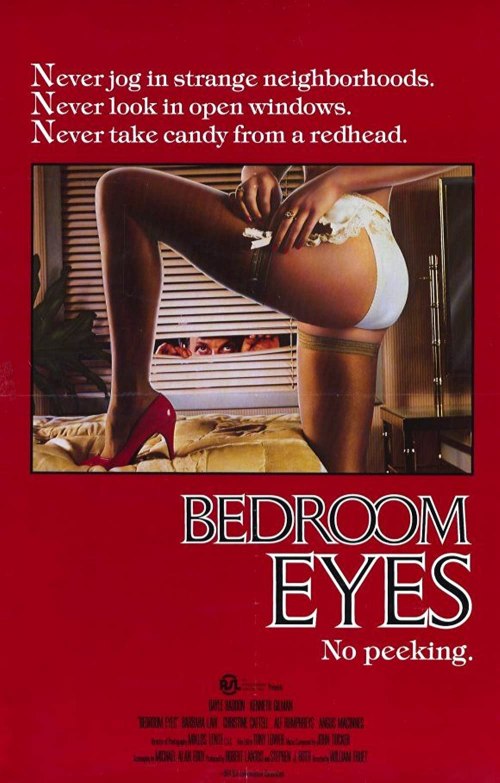
Bedroom Eyes (1984)

bedroom1

By Richard Winters

My Rating: 1 out of 10

4-Word Review: Voyeur witnesses a murder.

Harry Ross (Kenneth Gilman) is a businessman who enjoys taking a late night jog in the Toronto neighborhood in which he lives. One night he steps in dog poo and as he’s trying to scrape it off he notices a light coming from a nearby window. Out of curiosity he peers in and sees a half-naked woman (Jayne Catling) dancing provocatively. It turns him on and he decides to make it a point to peer into the window each night when he goes for a run. He though begins to feel guilty about what he’s doing and thinks he may be a ‘pervert’ and thus schedules an appoint with Alex (Dayle Haddon), who is a psychiatrist, so that they can talk it through. During their sessions he also becomes attracted to her and things slowly work into a relationship. While this is going on he continues to look into the window each night, but eventually witnesses the woman getting murdered and now must go into hiding inside Alex’s apartment as not only the police, who mistakenly think he did it as they get his prints off of the window, are after him, but so is the killer.

This film was directed by William Fruet, a prolific writer/director from Canada, who shot to fame with the excellent Wedding in White and then followed that up with a lot lame thrillers and horror films. While some of those were diverting this one isn’t and the tacky set-up is the biggest problem. The fact that Harry isn’t portrayed as being a life long voyeur, but instead quite literally just ‘stumbles’ upon it is farfetched and the character would’ve had more depth if this had been a constant trait that he had to deal with. Having him ‘panic’ that he was afraid this made him a ‘pervert’ was ridiculous too as I’d think just about any heterosexual guy would get aroused seeing a hot lady cavorting around erotically. The way he peers in, the camera captures it from the inside looking out, is quite obvious as his face is fully light, from the indoor lamps, and thus all the people needed to do was glance up briefly to see him, which I would think would’ve occurred at some point especially since he continues to do it over multiple nights. The fact that they always leave the window shade half open seems like they’re inviting someone to look in though the movie acts like this is unintentional and just a ‘coincidence’. The place is lit in a way that makes it seem like it’s a set for soft core porn flick and the woman behaves like an adult actress, which completely ruins any sliver of plausibility.

Initially I liked seeing Haddon, who was at one time a super model before she got into acting, cast as the therapist as this was traditionally at that time still more of a man’s profession, so she was playing against type, but having Harry immediately asks her out on a date was dumb. Due to this being a professional doctor and patient relationship he should’ve at least waited until after several sessions before he got up the nerve to do it and even then it’s putting her in an unethical spot and he should’ve known that. Fortunately she tells him ‘no’ the first couple of times, which is what she should’ve done, but I knew, going by how stupid this script had already been, that she’d eventually cave and of course she does, which makes the whole premise become even more ludicrous. Having her spot him at a fancy restaurant was too coincidental in such a big city and having his girlfriend perform a sexual act while inside the place with all sorts of people around was over-the-top. If anything Haddon should’ve just been cast as his girlfriend, who just happens to work as therapist, and he could’ve still spoken to her about his voyeurism in private when they were together and this would’ve helped made it more believable.

It does get a bit intriguing for a few minutes when the police begin to close-in on Harry and I enjoyed the inner-rivalry of the police department where the two lead detectives became irritated at how a young ‘wet-behind-the-ears’ kid (Alf Humphreys) was always coming up with new leads and clues before they did, but other than that there’s very little to recommend. The climactic sequence in which the killer ties Harry up while he’s inside Haddon’s apartment, is quite boring and the female actor who plays the culprit shows no panache and thus making her scenes quite dull. In 1989, at the request of no one, this was made into a sequel, but with a completely different writer, director and actors with the only thing connecting the two being the Harry Ross character.

My Rating: 2 out of 10

Released: November 30, 1984

Runtime: 1 Hour 30 Minutes

Rated R

Director: William Fruet

Studio: Pan-Canadian Film Distributors

Available: DVD-R

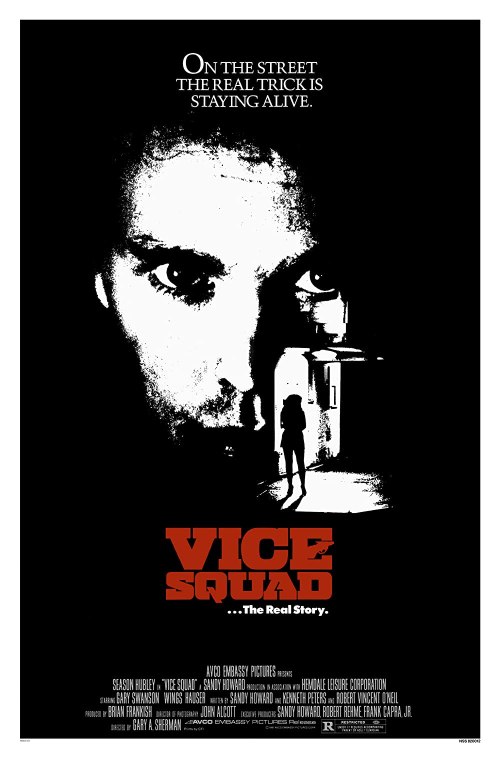
Vice Squad (1982)

vice1

By Richard Winters

My Rating: 2 out of 10

4-Word Review: Violent pimp kills prostitutes.

Princess (Season Hubley) is a business woman who is having some financial trouble and thus decides to go back to being a prostitute in Hollywood in an effort to support her young daughter. She becomes aware that her friend Ginger (Nina Blackwood), who is also a prostitute, has been killed after getting beaten-up by a violent pimp named Ramrod (Wings Hauser). Tom (Gary Swanson), a police detective, gets her to agree to be wired, so that she can get Ramrod to incriminate himself when she goes back to his place for a rendezvous.  The sting works and Ramrod is arrested and put into police custody, but he’s able to escape and spends the rest of the night chasing after Princess and determined to exact a revenge on her while the cops remain always one-step behind and unable to apprehend him.

This was Gary Sherman’s fourth theatrical feature and third horror one. He had started out with British cult hit Raw Meat in 1972 about a group of underground cannibals living in a London subway tunnel was met with rave reviews and fans, but his subsequent horror foray Dead and Buried and Phobia, which he co-wrote only, didn’t do as well. This one is more of a sleazy thriller meant to ‘inform’ the viewer about the brutalities of street life, but is really just an excuse to be exploitive and get cheap points for nudity and violence with characters that are cliched and situations highly derivative.

My main issue was with the prostitutes themselves for instance Ginger who runs away from Ramrod and hides out in a seedy hotel only to let him into her room the minute he comes knocking at her door. Once inside he immediately kills her while asking ‘I can’t believe you were that stupid’ and I felt like saying the same thing. It’s hard to sympathize with characters when they do incredibly dumb things and the scene would’ve worked better if Ramrod was only able to get in by crashing through the window, or breaking down the door, but having her allow him in shows no common sense especially from someone that is supposedly ‘street smart’.

This then brings up the second problem that I had, which is the fact that these women have absolutely nothing to defend themselves with in case things get ugly. They should all have guns, knives, or the very least some pepper spray especially if they’re supposedly ‘street smart’, but instead if things get bad they’re virtually helpless as is the case of when one of the male customers decides to rob Princess of her money and all she can do is give him some veiled threat that her pimp would come after him, which seemed almost laughable. Another scene has her being attacked by Ramrod where she manages to get her hands on a metal pipe and she uses it to hit him twice with it and then drops it to go hide somewhere, but why not continue to hit him until he’s either dead, or comatose? She hated his guts for killing her friend, so why back-off from giving it to him when she had the chance? At the very least, if she is going to run-off, at least continue to carry pipe, so she could use it for protection when he gets back up.

The motivations of the Princess character made no sense. She’s supposedly this L.A. businesswoman living in a nice suburban house, who’s now in financial trouble for whatever reason, but why turn to prostitution? There seemed to be hundreds of other income avenues she could’ve considered before leaping into streetwalking. If it was a high end escort gig where the male clientele could be filtered and scrutinized so it would not just be any scumbag and the prices would be high enough and in a safe neutral area, so she would just have to service one a night instead of ten, then maybe. However, here she’s forced to do one after another submitting that whatever crazy kink they wanted in whatever scuzzy locale they took her to. If she was on drugs, or teen runaway with no money, it might be a little more understandable, but the film portrays her as being smart and educated and she somehow ‘chooses’ to do this, which for me made her seem completely insane and therefore not any one that I could relate to.

The film does have some great acting by Hauser, who also sings the closing song, and Gary Sherman is good as the detective as he doesn’t have the chiseled features of a Hollywood good guy, but instead is more non-descript like how most policemen look, which I liked. Sunset Boulevard, where most of it was filmed, gets captured in a cool way giving it a surreal presence where all the action takes place exclusively at night and once the sun rises all the dark characters go symbolically back into their caves. There’s even a nifty car chase, but overall it’s flat, and predictable, and only for those who enjoy sleazy B-movies.

My Rating: 2 out of 10

Released: January 22, 1982

Runtime: 1 Hour 37 Minutes

Rated R

Director: Gary Sherman

Studio: AVCO Embassy Pictures

Available: DVD, Blu-ray, Amazon Video, YouTube, Tubi

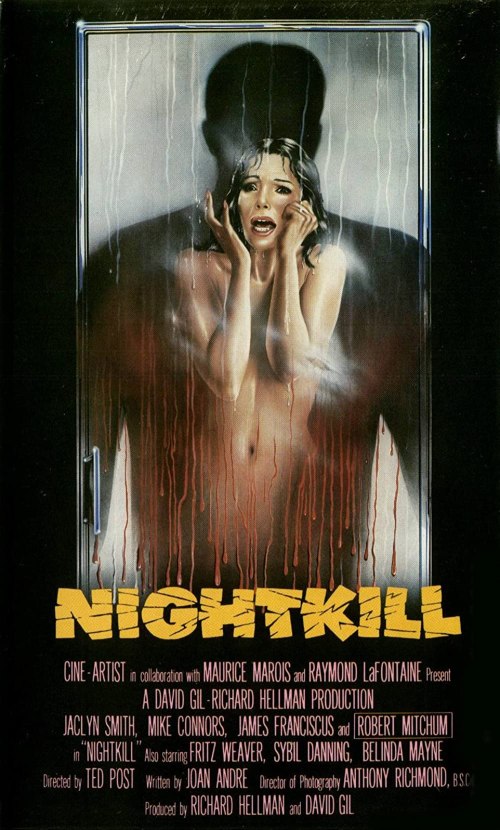
Nightkill (1980)

nightkill1

By Richard Winters

My Rating: 5 out of 10

4-Word Review: Somebody is listening in.

Kathy (Jaclyn Smith) is married to Wendell (Mike Connors) a wealthy, but unethical businessman living in Arizona. She’s unhappy in the marriage and wants a divorce, but Wendell promises to make things hard for her if she does, so she reluctantly stays in it, but on the side has an affair with Steve (James Franciscus) his close business associate. Steve poisons Wendell and sticks his body inside the freezer of Wendell’s home and then impersonates him on a flight to Washington to make it appear that he’s still alive. Kathy remains at home only to become harassed by a aggressive detective Donner (Robert Mitchum) who’s suspicious that Wendell has become a victim of foul play. Kathy decides she must get rid of the body, but when she opens up the freezer she discovers it’s no longer Wendell’s corpse that’s inside, but instead Steve’s.

Odd thriller that was produced by a German film company, but filmed in the US. The film succeeds with having a distinct score and great location shooting of Arizona in which it’s dry, desolate landscape helps reflect the empty, inner nature of the characters. It was directed by Ted Post, who’s best known for the cult hit The Baby, which is famous for its twist ending, and there’s a lot of story twists here too, but for whatever reason fails to be captivating and this is mostly due to the dull characters.

Kathy was the one that got on my nerves the most. One minute she’s telling him that she can’t stand him and then the next minute she’s upset and sobbing over his unexpected death, so which is it? It seems like she should’ve been elated when he keeled-over and having her played-up as being this innocent is unrealistic. When you spend your life associating with bad people it tends to rub-off and it’s hard to imagine she wouldn’t have been tainted by the corruption of not only her spouse, but lover and Smith’s poor attempt at crying just makes it all the more worse. I rather have openly bad people going after each other and seeing which one is left standing then some idealized angel who’s completely out-of-place in the setting and would have to be extraordinarily naïve not to have caught-on to the shenanigans that were going on long before she does. If anything Sybil Danning, who is seen in a much smaller role, should’ve been given the lead as her conniving, sauciness was exactly what the character needed to have made it interesting.

Franciscus isn’t in it long enough to make much of an impression and Mitchum sleep walks through his part and thus making his onscreen presence quite bland and his big name, star status adds nothing. The only one that is fun is Connors, best known for his starring role in the cop TV-show ‘Mannix’. Here he plays against type by being an obnoxious jerk that delights in upsetting some caged monkeys that they have in his home. The rotten personality of his character is over-the-top enough to be fun and it’s just a shame he had to die-off so quickly.

Spoiler Alert!

An mentioned there are some nifty twists, but it ultimately adds up to little. The biggest problem is that Mitchum, who’s just as shady as Connors and Franciscus, ends up getting away with it, by stealing the stolen money that Connors has in his airport locker and flying out of the country, which isn’t exactly an audience pleaser. Smith doesn’t completely die either as we see her injured body on the bathroom floor calling the police making it seem that with her information there was still a chance he could get caught and the film should’ve played this out to completion and not left it open to guessing.

Lots of logistical issues too. For instance Mitchum kills Francsicus supposedly at the airport, but for some reason, we never see it but can only presume, drags the dead body back to Smith’s home just so he can put it into the freezer, but why bother? Also, where does he put Connor’s body when he replaces it with Franciscus’? Where does he get the mask of Mike Connors’ face that he uses to disguise himself that he is him? Does he know a manufacturer that makes specially made masks  to resemble someone they know and if so what company is this because I’ve never heard of it? Also, how does he know there’s a cop inside the police department named Donner as he pretends to be this man when he investigates the case even though he’s really a private eye named Rodriguez? These along with several other questions never get answered, which significantly hurts the plausibility.

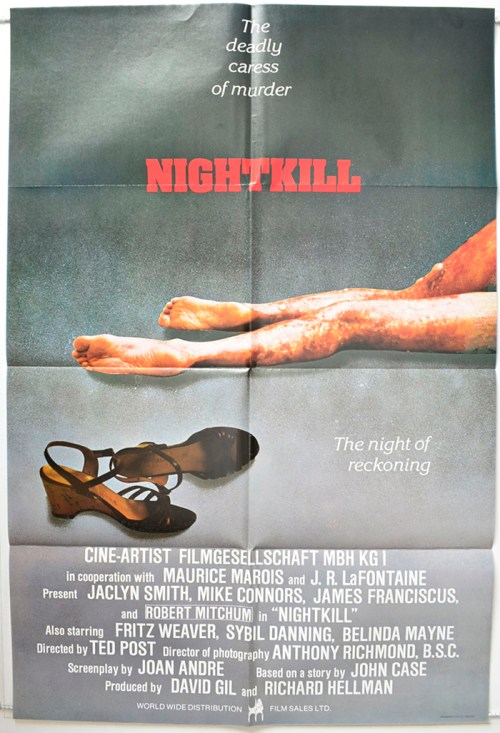
Original Cinema Quad Poster - Movie Film Posters

Original Cinema Quad Poster – Movie Film Posters

My Rating: 5 out of 10

Released: December 18, 1980

Runtime: 1 Hour 35 Minutes

Rated R

Director: Ted Post

Available: DVD-R, Blu-ray

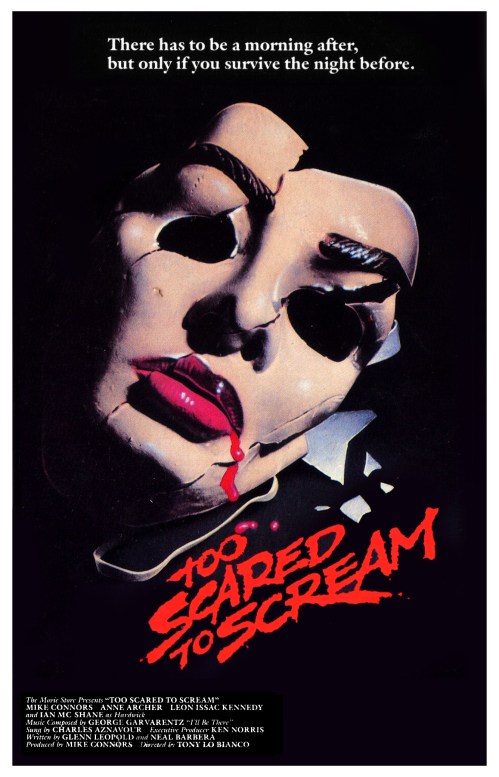
Too Scared to Scream (1984)

tooscared3

By Richard Winters

My Rating: 3 out of 10

4-Word Review: Who’s killing the tenants?

Female tenants living in a New York City high-rise building are turning-up dead in brutal fashion. Lieutenant Alex Dinardo (Mike Connors) and his younger, female partner Kate (Anne Archer) are convinced that the culprit is Vincent (Ian McShane) who works as the overnight watchmen at the apartment building and since all the crimes happen during his shift he quickly becomes suspect number one. Though getting enough evidence in order to arrest him becomes a delicate matter. Alex then decides to asks Kate to move-in to the building as a new tenant and thus keep tabs on what Vincent is doing and hopefully lure him into a situation where he’ll incriminate himself, but Kate soon finds herself in over-her-head as the killer is on-top of what’s going on and he soon bates her into a dangerous game of cat-and-mouse where Alex and the other policemen are not able to help her.

The film was an attempt at creating an American version of an Italian giallo complete with gory murders and an intricate mystery where you don’t know who the real killer is until the final twist ending. It’s also the only film to date to be directed by actor Tony Lo Bianco. Severely straddled during production as it was shot in 1982, but due to the production studio that financed the project going bankrupt it was never released until 3 years later where it was given little fanfare and came and went with few people seeing it.

The biggest problem with it is that it plays-up McShane’s role too much. Granted he’s a gifted actor who’s best known today for his work in the TV-series ‘Deadwood’, but by overemphasizing his character it makes it seem right from the start that he’s the culprit and thus making the investigation uninteresting because you feel it’s just a matter of time before he’s found out and thus little mystery, or intrigue. Granted there are a couple of other suspects, but they seem thrown-in simply as red herrings and aren’t seen much. The story would’ve had better tension had the suspects shared equal screen time and a more balance of clues making it seem like any one of them could’ve done it and thus some genuine interest at getting at what the truth is versus having it seem like it’s all spelled-out from the start. If anything Maureen O’Sullivan, who plays McShane’s near comatose mother whom he takes care of, is far more captivating, despite the fact that she doesn’t speak any line of dialogue and trapped in a wheelchair, then anything McShane himself does.

The unusual pairing of a 60-something male cop alongside a female one that appears to be only around 30 should’ve been what the film focused on as I found their contrasting personalities and different ways they approached their police work to be something that could’ve been played-off of more. Unfortunately the film taps into this just slightly and then quickly moves on and thus misses the opportunity for what could’ve lead to captivating confrontations and debates. Connor does seem a bit too old for this kind of thing and seeing him trying to chase down a young athletic man who was only 20 came-off as almost laughable and I was surprised he didn’t just fall over from a heart attack, or exhaustion before he ever managed to get near the guy. Having him lose a fight to the younger guy and have to depend on his partner to bail him out of it was realistic, so it gets props there, but the way he goes about his police work, which includes physically beating-up on suspects, is highly unethical and should’ve gotten him demoted, or fired.

Spoiler Alert!

I had issues with Archer’s character as well. This comes when she agrees to move into the apartment and work undercover, but seems woefully unprepared for it. She manages to carry a gun with her when she goes down to the basement of the building to do laundry, but then when she gets back to her place she does a goofy aerobics workout where she gets caught off-guard, but wouldn’t a seasoned cop know to carry a weapon on her at all times especially when she’s intentionally making herself a target to the killer? Also, what kind of person walks into their apartment and then doesn’t turn around and immediately lock the door once they’re inside? If you want to argue that this was intentional (I don’t think it was) because she wanted to lure the killer inside, so as to apprehend him, then fine, but she should then make damn sure she was a gun in-hand, pointed at him, when he does, which in this case she didn’t.

You must likely won’t be able to guess who the true killer is, but it’s not worth sitting through. The script doesn’t offer any clues, or hints either, so even an alert viewer won’t figure it out, but that doesn’t mean it’s a good mystery because it really isn’t. The story is sloppily put together without much imagination, or character development. Unlike a true giallo the murders are quick and without much blood, so if you’re a gorehound this thing won’t suffice. The concept had potential, but the execution is half-hearted.

My Rating: 3 out of 10

Released: September 28, 1984

Runtime: 1 Hour 40 Minutes

Rated R

Director: Tony Lo Bianco

Studio: International Film Marketing

Available: Blu-ray (Import), DVD-R

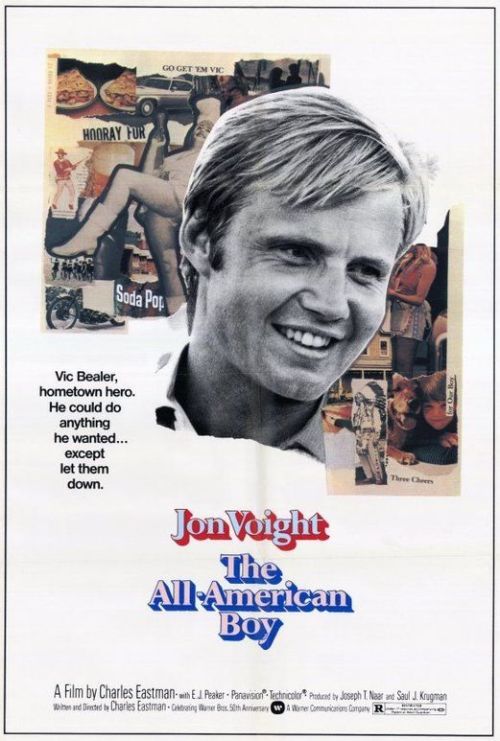
The All-American Boy (1973)

american

By Richard Winters

My Rating: 4 out of 10

4-Word Review: Amateur boxer seeks fame.

While Jon Voight is best known in the world of boxing movies for having done The Champ in 1979, which some consider infamous, his first go-around was actually this one though it remained stuck on the studio shelf long after it was filmed only to be released after his success in Midnight Cowboy. He plays the character of Vic (Jon Voight) a talented, good-looking man whose shown ability in the amateur ring and now is ambitious about making the Olympic team. Arty (Ned Glass) takes him under-his-wing, even lets him stay at his place, while he trains him, but then all of sudden Vic decides he doesn’t want to be a boxer anymore, to the shock of everyone, and never bothers to give anyone any explanation as to why.

The script was written by Charles Eastman, who also directed, and who was the brother of Carole Eastman, who wrote the script for Five Easy Pieces under the pseudonym of Adrien Joyce. Like with his sister’s script it works as a character study and the story is broken up in sections, in this case ‘The Manly Art in Six Rounds’. At various times, usually every 10-minutes, a title will appear on screen such as ‘Round 1’, or ‘Round 2’, but honestly I didn’t see the point  and it doesn’t really make it more interesting and could’ve easily be discarded and probably should’ve been.

On the writing end, particularly the dialogue, it works. Eastman creates a conversational quality where what the characters say is never ‘too on the nose’ (screenwriter’s lingo for being too specific) and the viewer must read into it in order to understand what they mean. In that area the film works, but it’s also highly talky and begins to have a stagnant feel. There’s also very little about the actual sport of boxing. If you’re expecting something like Rocky where there were long segments dealing with the his preparation you’ll be out of luck here. I got particularly frustrated with the scene dealing with Vic getting ready for a contest where he’s seen standing around while other participants and fans enter into the arena, which gets drawn-out, and then just as the fight is supposed to begin it cuts away showing Vic on the phone describing what happened, but to have to sit through a long build-up just to see no action is a letdown.

There finally is some boxing about 50-minutes in and the choreography in the ring, with each participant getting some hits on the other, appears realistic though there’s no blood, or bruising. What makes this segment unusual is more what occurs amongst the audience where one of the spectators, played by Noble ‘Kid’ Chissell, a former professional boxer from 1924 to 1934, begins to masturbate underneath his raincoat, which he has over his lap, which becomes painfully obvious to the other people around him.  Why this was put-in I don’t know. It’s not clear either whether he’s getting-off on the two boxes, or his attraction is to one of the pretty ladies in the audience (I’d presume it was the boxers), but such a bizarre character doing such a strange thing in public needed better fleshing-out and quite frankly more screentime as cringe or not I found his appearance to be one of the few diversions and far more intriguing than the main star.

Seeing a young Anne Archer, who looks almost like an adolescent here, this counts as her film debut since it was filmed before either The Honkers or Cancel My Reservationwhich were both released earlier, is a pleasure though her character doesn’t have a lot to do. E.J. Peaker is quite good as Vic’s on-again, off-again girlfriend, who has a memorable bit inside a recording studio as she attempts to boost her singing career. Jeanne Cooper, better known for her work on ‘The Young and Restless’, which lasted for 5-decades, is quite striking. The best acting though goes to Ned Glass, who is engaging as the foul-mouth manager who spews the F-word seemingly non-stop.

The ending in which Vic gets on a helicopter and is cheered on by his fans and supporters who gather to see him off is the film’s best moment. It’s not like anything super exciting happens, but the location, filmed in the hills just outside of Vacaville, California, where the grass is dark brown, but the trees that dot the landscape remain green gives-off a surreal effect. It goes on for a full 20-minutes all in this vast brown countryside with characters running around in it and at certain points even sliding down the hillsides. The unusual topography leaves a lasting impression and I’ll give props to the filmmakers for taking full-advantaged of it and the one element that allows this otherwise sterile production to stand-out.

My Rating: 4 out of 10

Released: October 24, 1973 (Filmed in 1970)

Runtime: 1 Hour 58 Minutes

Rated R

Director: Charles Eastman

Studio: Warner Brothers

Available: DVD-R (Warner Archive), Amazon Video

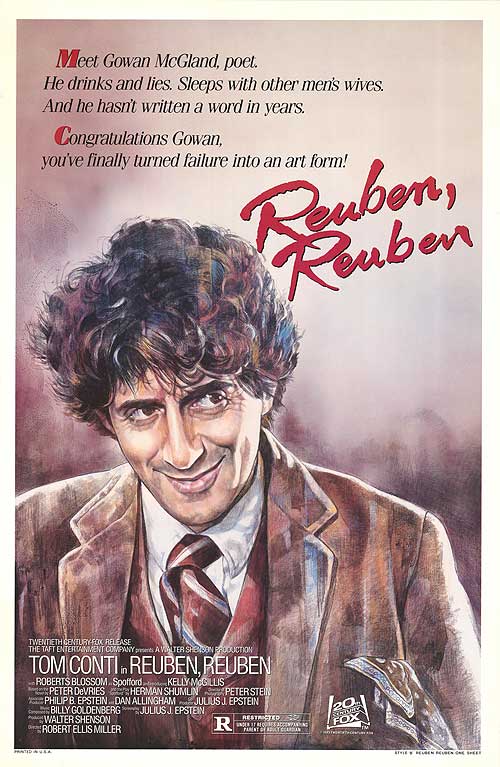
Reuben, Reuben (1983)

reuben1

By Richard Winters

My Rating: 6 out of 10

4-Word Review: Housewives lust for poet.

Gowan (Tom Conti) is a middle-aged poet going through writer’s block who hasn’t written anything in 5 years and manages to remain solvent by touring around a college town and reciting his older writings to women’s clubs. The stress though of not being able to produce anything new causes him to turn to alcohol and further rescinds his writing ability. Geneva (Kelly McGillis) is a college student several years his junior who spots him on a train one day and agrees to pay his fare when he’s found not to have any money. This generosity manages to have a profound affect on him and he makes a commitment to mend his ways while also going out with Geneva on casual dates. The awkward love affair doesn’t go far as Gowan continues to drink and embarrass her every time they go out. When Geneva finds out she’s pregnant the two then must decide how they will proceed.

Unusual romantic flick that has all the ingredients of failing, but manages somehow to have a certain light appeal. Much of this is thanks to McGillis, who in her film debut really shines and while this film is not one of her better known ones I still consider it her best work. Normally film’s dealing with May-December romances don’t work because the younger partner is always portrayed as being wide-eyed and naïve, but here it’s Geneva that’s the sensible one who calls all the shots and remains in control. This change of pace gives the old theme a refreshing new spin and made it palatable enough to hold my interest and in certain moments even becomes touching.

Conti gives a good performance, but he seems more like a caricature. He wears the same dowdy outfit all the way through making me wonder if that was the only suit he owned and if so whether he reeked of odor. I found it hard to believe that this guy, who looks like he was living on the streets, would attract all these frustrated housewives who’d be rushing to go to bed with him. With all the alcohol he consumed I’d have serious questions whether he’d be able to perform, or how sex with him could possibly be much better than with their husbands as I would think it might actually be worse.

Supposedly this was all meant as ‘satire’ and based loosely on the life of Dylan Thomas. Possibly in book form, as this was based on the novel of the same name by Peter De Vries and then later turned into a stage play, it might’ve worked, but as a film set in the modern day it’s confounding. Thomas hit his fame in the 30’s and 40’s when movies and television where just getting started and therefore writers held more clout, but by the 80’s there were so many other types of celebrities that some frumpy looking drunk guy who used big words to create long poems wouldn’t be someone a suburban housewife would get all that excited over. The opening sequence shows the reactions on their faces as they listen to him recite some of his writings and while one of them has a confused look on her face I felt they all should’ve and for my money that would’ve been really funny.

Spoiler Alert!

The finale, which Leonard Maltin in his review calls ‘curious’, but I’d describe more as ill-advised is the one thing that really hurts it. I’m not sure what the thinking was other than Dylan Thomas died young so possibly they felt Gowan needed to die too, but it was the wrong decision. Normally I get annoyed with movies that tack-on a happy ending and have everything work-out even when it’s not earned, but this film works in reverse by throwing in a very sad one that comes out of nowhere and doesn’t fit the tone of the rest of the movie, which for the most part had been quite whimsical.

The way it gets done is pretty dumb too as he elects to hang himself inside his apartment after he finds out all of his top teeth, many of which have been rotting for years due to neglect, would have to be removed. While losing teeth is no one’s idea of fun it does happen to a lot of folks of all ages and dentures (this was made before the advent of implants) if fitted properly aren’t always that noticeable, so to kill yourself over something like that seemed awfully rash.

Just as he’s about to hang himself he gets inspired again to write and even excited about finding new women to sleep with, but then a lovable sheep dog named Reuben runs into the room (you’d think someone planning to kill himself would have the sense to shut his door and lock it) and being overly affectionate jumps-up and knocks down the chair that he’s standing on, which comes-off as being more farcical than anything. I was fully expecting the wooden beam that the rope was tied around to break from the stress of all the weight, which in reality I think it would, but instead it doesn’t and he’s left hanging leaving me genuinely baffled. For such an otherwise light and quirky movie to end this way was very jarring.

My Rating: 6 out of 10

Released: December 19, 1983

Runtime: 1 Hour 41 Minutes

Rated R

Director: Robert Ellis Miller

Studio: 20th Century Fox

Available: DVD, Blu-ray

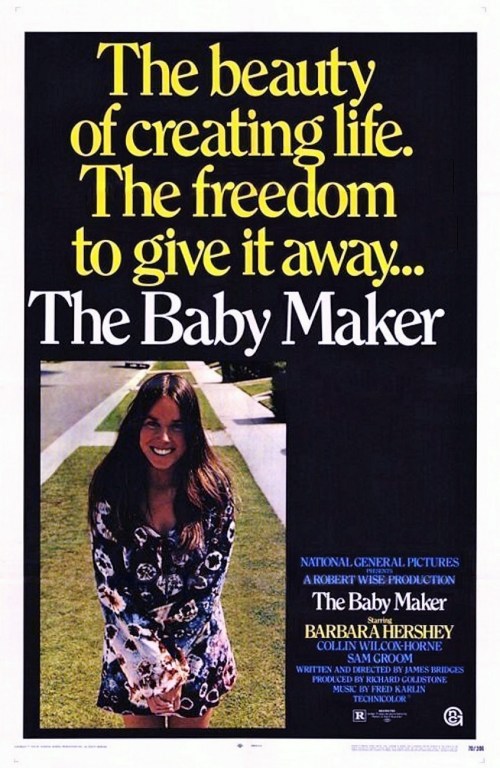
The Baby Maker (1970)

babymaker1

By Richard Winters

My Rating: 4 out of 10

4-Word Review: Paid to give birth.

Tish (Barbara Hershey) is a young, free-spirited women who’s a part of the hippie movement and looking for alternative ways to make money without having to do the usual 9-to-5 job. She becomes aware of the idea of being a surrogate mother hired to give birth to a baby from a couple who cannot have one themselves. The couple in this case are Jay (Sam Groom) and Suzanne (Collin Wilcox Paxton) who are middle-aged and due to a medical complication the wife is unable to have children. They agree to pay Tish an upfront allotment of money as well as covering the rent for the apartment that Tish shares with her boyfriend Tad (Scott Glenn). Things start smoothly enough, but ultimately underlying tensions soon surface like Suzanne’s concern that Tish is getting involved in too much physical activity and with her husband’s seemingly infatuation with the young woman. Tish’s boyfriend also begins to have problems with the agreement especially since Tish has stated she’ll not have sex with him during the course of the 9-month pregnancy.

This was the first film directed by James Bridges, who got his start writing teleplays for the ‘Alfred Hitchcock Presents’ TV-show before blossoming into a career helming such critically acclaimed efforts as The Paper Chase and Urban CowboyWhile the film is not perfect I did feel on the technical end it was well done with vivid cinematography that makes the viewer feel quite intimate to both the characters and their setting as well as a good time capsule to how things looked back in that era. The subject matter was quite unique for the period that even had some film critics labeling it as a ‘travesty’ while another called it ‘insufferable’. While I didn’t find it to be either it does show how provocative the issue was and thus overall making it a groundbreaking movie.

More than anything I really enjoyed the performance by Hershey who seems born to play this role and like she’s hardly even acting and instead just being herself. The carefreeness of her character really comes through especially when she decides to impulsively take-off her clothes while in front of the couple whom she’s just met, and jump into their backyard pool. You feel like she’s a perfect composite of most of the flower children back then and highly revealing to what made them tick. What I didn’t like though was how we never learn what gave her the idea to be a surrogate mother and I felt the film should’ve started from this point instead of having her already done it one time before without any backstory to what first gave her the motivation to even consider what at the time was not a typical thing that most people even the young hippies were doing.

I found the supporting characters to less interesting. Glenn, in his film debut, was the most baffling as he plays this overly selfless boyfriend who goes along too graciously with Tish’s idea of having someone else’s baby. Most guys would not be cool with this, or need more time to warm-up to it especially since it would require her sleeping with a married man. Having her then refuse to have sex with him while the pregnancy went on would be way too much for most men to handle, so the fact that he stays with her even after being told this made him seem unrealistic. Had he gotten into the relationship knowing upfront this is what she did for a living then maybe, but she just springs it on him after she’s agreed to the contract, which would’ve made anyone in that same situation quite upset, and justifiably so. I felt too that him ending up sleeping with one of her friends (Helena Kallianiotes) should’ve been understandable given the circumstances and Tish, being the supposedly open-minded, unconventional person that she is, should’ve allowed for it and possibly even invited it instead of growing jealous and throwing blue paint on them like she does.

I had the same issues with the couple. Collin Wilcox Paxton is excellent and light years away from her most famous role of Mayella Violet Ewell, the backwoods southern white woman who falsely accuses a black man of rape in To Kill a Mockingbird, but there’s just not enough tension between her and Tish, or in the scenes with her husband, which is the film’s biggest failing. It seems more concerned with tackling a novel concept in as genteel a way as possible, but in the process forgets that this is a drama and there needs to be conflict going on in order to keep it riveting. Certain potentially explosive problems are brought-up, but then quickly downplayed. There’s no surprise twist or altercation. It leisurely limps itself along to a hum-drum finish that has no impact at all and unfortunately ruins an intriguing concept that could’ve gone in many different, interesting directions, but ultimately doesn’t.

My Rating: 4 out of 10

Released: October 1, 1970

Runtime: 1 Hour 49 Minutes

Rated R

Director: James Bridges

Studio: National General Pictures

Available: DVD-R (Warner Archive), Amazon Video

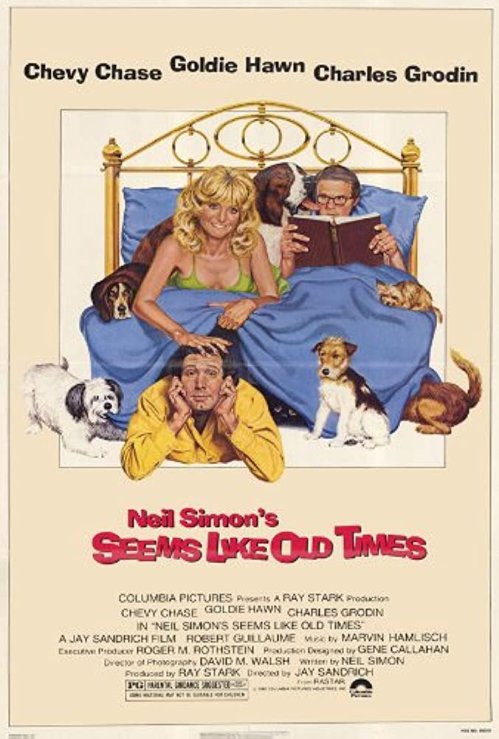
Seems Like Old Times (1980)

seems

By Richard Winters

My Rating: 7 out of 10

4-Word Review: Ex on-the-run.

Nick (Chevy Chase) is a lonely writer working on his novel at a remote seaside cabin, which he hopes will give him the isolation that he needs to allow his creative juices to flow. Unfortunately for him two bank robbers (Judd Omen, Marc Alaimo) stake-out the place and kidnap him and then force him at gunpoint to rob a nearby bank. Nick gets seen on the security camera and a warrant for his arrest is issued. He seeks help from his ex-wife Glenda (Goldie Hawn) a public defender who has remarried to Ira (Charles Grodin) who’s running for attorney general and fears that the notoriety of having his wife’s ex-husband on-the-run from the law could hurt his chances of getting elected. Glenda decides to help Nick by letting him stay in an unused bedroom above their garage while trying to keep him hidden, so Ira won’t find out. This scheme leads to many close calls and misunderstandings while also reigniting Glenda’s feelings for Nick, which she thought she had gotten over a long time ago.

While it may seem hard to believe now screenwriter Neil Simon was at the time, having just come-off his success with the hit The Goodbye Girl , considered chic with young adults particularly on the romance end and this film was the peak of that period as after this his material became increasingly more nostalgic. This works mostly because it remains focused on Simon’s patented one-liners and funny conversational quality, which is quite amusing though it would’ve been nice had it attempted to branch out into other forms of comedy like when Chase and Grodin have a physical fight that is never shown and instead we just hear the noise of it from inside the kitchen while the camera stays stationary in the other room. The visual gags and pratfalls from a funny fight could’ve helped add another dimension to the humor and thus I found this moment to be a missed opportunity.

The acting is uniformly wonderful particularly Chase in a role that takes full advantage of his glib, sardonic delivery probably better than any other film role he’s been in and this most likely was a result of Simon doing a 2-week rehearsal period where he observed the stars interacting with each other and made changes to the script based on the personalities of the performers. It’s good to see Hawn in a more mature role. Before this she played spacey-blondes who were young and on the fringe of society, but here she falls comfortably into a middle-aged setting of a career woman maintaining both a job, home, and marriage and showing the juggling act that this type of lifestyle requires. She’s also not the sole source of humor, but instead reacts to the zaniness around her with funny facial reactions. The supporting cast such as Yvonne Wilder as the heavy-accented Latina maid and T.K. Carter as the wise-cracking chauffeur who hasn’t fully gotten rid of his old ex-con ways are quite amusing too as are the pack of dogs that Hawn owns and proceed to run all over the house at all times.

Grodin was the only character that doesn’t really fit. I found it strange why someone who doesn’t like dogs and can’t stand the way they sleep on the bed that he shares with Hawn would want to marry a woman who was so into them. Outside of the fact that they were both lawyers I didn’t see what else connected them and it seemed like a mismatched marriage. On the other-hand I found it interesting he wasn’t portrayed as a jerk. In most romances were the old partner comes back into the picture the new guy is played-up in a way that makes the viewer dislike them and where you want to see the woman going back to her old flame instead of staying with the cad, but here that’s not the case, which works to some degree, but also hurts it.

Spoiler Alert!

The issue with the second husband really comes into play at the very end when it becomes painfully obvious that Simon couldn’t think up a way to resolve the dilemma and comes-up with one of the dumbest finales imaginable where Hawn and Grodin go driving into the wilderness during a rain storm, have a car accident in which Grodin gets injured and she treks off into the woods only to find an isolated cabin with Chase inside. The movie stops with a freeze-frame of Hawn’s face revealing a broad smile once she sees Chase opening the door making it seem like the two spent a cozy, romantic night in the cabin while Grodin remained suffering inside his stranded car, which wasn’t exactly humane.

Personally if I had written the script I would’ve done it differently, which I realize might’ve been considered ‘too edgy’ for 1980. However, since Chase’s character had been in a Mexican prison for awhile I would’ve had the experience bring out the dormant gay side of him. This could’ve helped explained why the two criminals came to his place to force him into a bank robbery was because they were guys he knew, or former lovers, from jail and they figured out where he lived and hence tracked him down to be a part of their scheme. This would help explain the opening as having them stake out such an extremely isolated place, which didn’t seem to even have any roads leading into it, just to find a willing victim never really made much sense otherwise. The Grodin character could also have some dormant gay desires, which would explain why his sex life with Hawn wasn’t so great. Chase could then take-up permanent residence in the room above the garage where he could, at different times, ‘service’ both Hawn and Grodin and the three could share a happy alternative lifestyle, which being that the story takes place in coastal California wouldn’t have been all that outrageous or unusual.

Another possibility would be to have Grodin played-up as being more into his political career than his marriage and thus pushing Hawn away, or he could just become sick and tired of all the dogs in the bed at night and decide to leave her, which would be understandable as I wouldn’t like sleeping with dogs either. In either case Hawn would be free to run back to Chase and the audience wouldn’t have had any problem with it.

The worse scenario though is how it ends here with Hawn selfishly getting it on with Chase, or at least implying this, while the man she’s married to remains stuck in pain inside a cold, damp car for who knows how long. At some point she’s going to have to decide which guy she wants more, or if she’ll just remain hopping between the two, but some finality needed to be given instead what amounts to a pathetic cop-out by a writer who clearly didn’t want the challenge of having to figure it out.

If anything I would’ve had her with a different facial expression. During the movie she was constantly hyperventilating with this shocked look every time she’d see Chase drop-in and that’s what we should’ve seen as the film’s final image.

My Rating: 7 out of 10

Released: December 19, 1980

Runtime: 1 Hour 40 Minutes

Rated PG

Director: Jay Sandrich

Studio: Columbia Pictures

Available: DVD, Amazon Video