Tag Archives: Drama

The Hand That Rocks the Cradle (1992)

By Richard Winters

My Rating: 8 out of 10

4-Word Review: Not a good nanny.

Claire (Annabella Sciorra) is a young mother who feels that her doctor (John de Lancie) molested her during her exam. She goes to the authorities, which brings out more complaints from other patients. This leads the doctor into killing himself and causing his widowed wife (Rebecca De Mornay) to miscarry. In revenge the widow decides to destroy the life of the woman who brought up the charges and does so by posing as the family’s nanny named Peyton Flanders.

Just when you think that the old psycho formula has gone stale this film comes along that injects a whole new life into it. That is not to say that there is anything new here because there isn’t yet it is a pure thriller that captures the formula well and hits it on all cylinders. It builds the suspense slowly but consistently without throwing in any cheap teasers. You really ARE on the edge of your seat as the tension grows. The climatic sequence is well mounted, but the best part is that it creates a villain that is not only a threat, but also someone you hate, really hate! You look forward to the inevitable showdown and become emotionally involved in its outcome.

De Mornay makes a terrific bad lady. Usually villainess females work of their sensuality, but not here. Yes it is intimated, but it is incased in a very cold and calculating exterior. The character is deliberate and spins an elaborate web while coming up with some clever deaths for her victims with the best one being the death by greenhouse. Her icy stares reminded me of the legendary Bette Davis.

The good guys aren’t quite as interesting and in many ways are a bit boring. The husband/father (Matt McCoy) is especially bland and almost transparent. Sciorra’s beautiful and very angelic face helps, but she seems to get rattled too easily. Julianne Moore, as Marlene a family friend, is the only one who offers anything in the way of tenacity to her personality.

The Ernie Hudson character, who is mentally handicapped, is a nice addition. It shows sensitivity to those with disabilities and doesn’t exploit it simply for entertainment. His final showdown with De Mornay is another one you just can’t wait to see. The kids are adorable and it’s nice to see that they too can be resourceful when they need to be and can’t be so easily brainwashed either.

In all fairness there are some logic loopholes that should be mentioned. One is the obvious fact that this woman makes up her past in order to get the job as the nanny. When she applies for the position you would think that a careful and responsible family such as this one would check her references carefully and find her discrepancies. Also there is the fact that the De Mornay character was at one time a prominent doctor’s wife. This would give me the impression that she would have had a large circle of friends and they would have all wondered what happened to her or at the very least spotted her in her new identity since she apparently only moved to the other side of town.

Still, this is a solid thriller that is perfectly made for fans of the genre and deserves to be on the list with the best.

My Rating: 8 out of 10

Released: January 10, 1992

Runtime: 1Hour 50Minutes

Rated R

Director: Curtis Hanson

Studio: Buena Vista Pictures

Available: VHS, DVD, Blu-ray
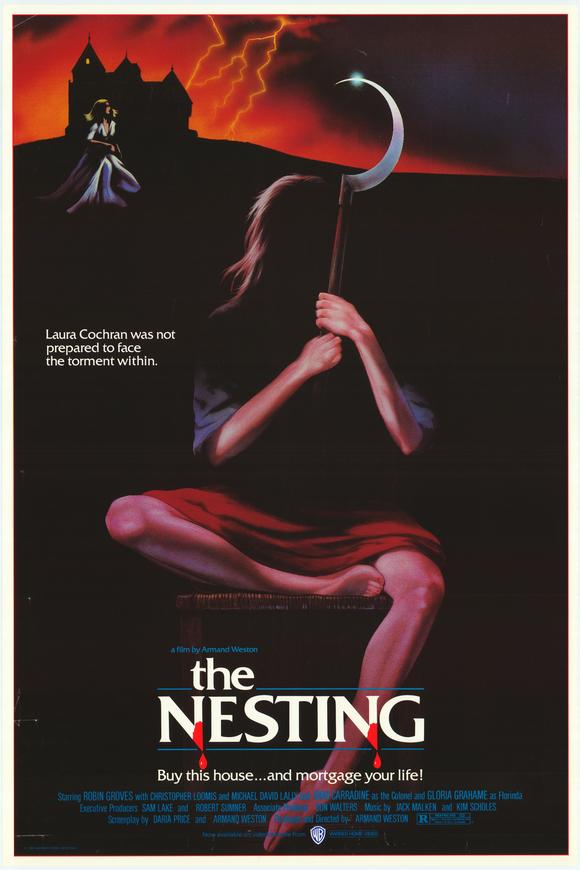
The Nesting (1981)

By Richard Winters

My Rating: 3 out of 10

4-Word Review: House haunted by hookers.

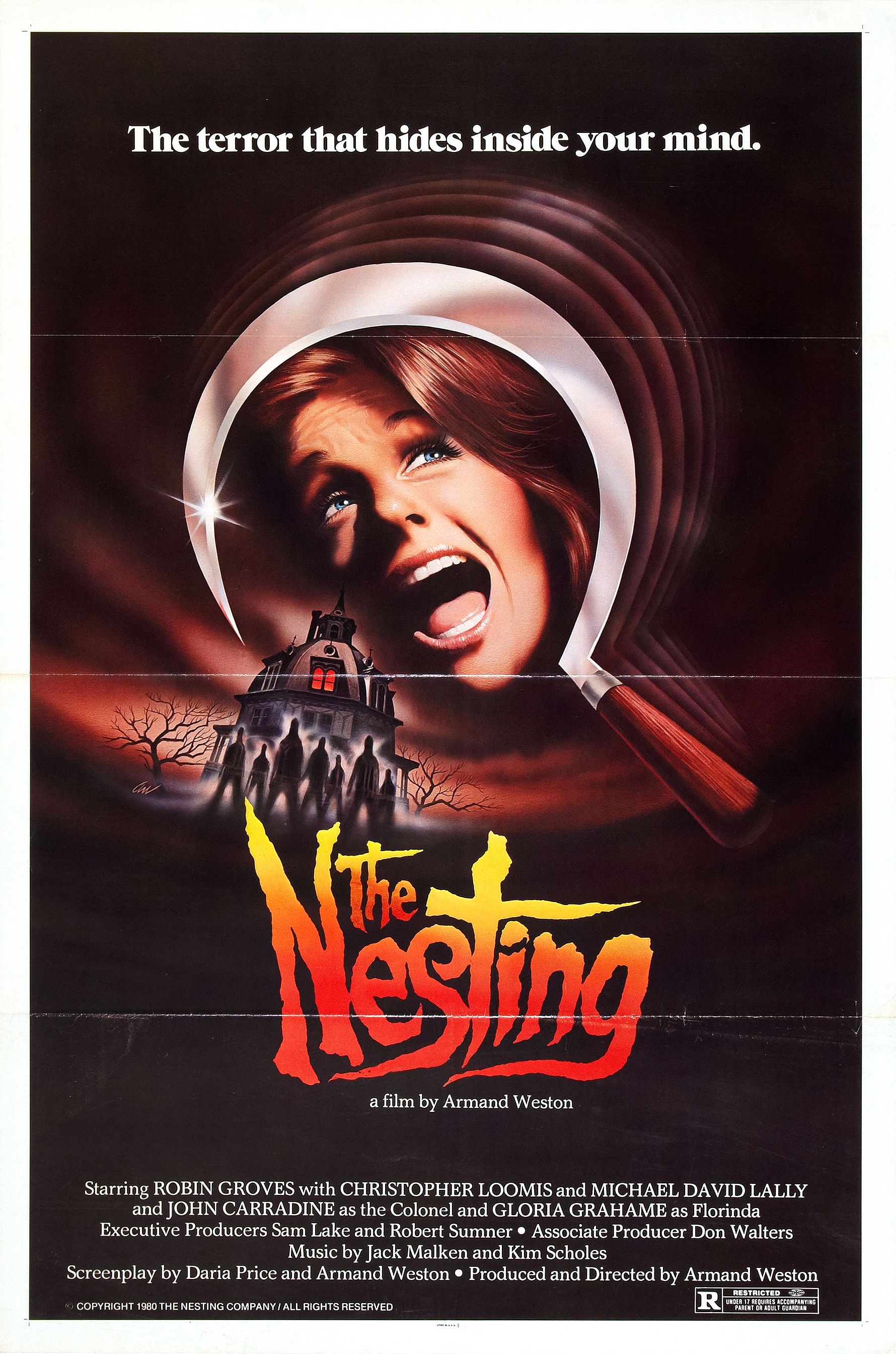
This review will start off a month long theme where in celebration of Halloween every 70’s, 80’s, and 90’s movie reviewed will be a horror one. This film sat in pretty much obscurity until being released by Blue Underground onto DVD and Blu-ray on June 28th. The story deals with Lauren (Robin Groves) a writer who rents an old house that looks strangely similar to the one depicted on the cover of her last novel. Eerie events start to happen and she learns that the building used to be a house of ill-repute and the prostitutes who were murdered there in cold blood are now coming back in ghostly form to seek revenge.

The film was directed by Armand Weston best known for directing porn movies during the 70’s including a couple of edgy, envelope pushing rape and revenge sagas The Taking of Christina and The Defiance of Good.  The directing here is competent enough that it is watchable, but the scares and horror is at a minimum. There are a few moments of creepiness and atmosphere, but it is not sustained and the film is unable to build any momentum, or suspense. The result is rather disjointed and unfocused. The premise borders on being campy and a 104 minute run time is way too long for a plot that offers a meager payoff.

Groves is an unusual choice for the lead. Usually films in this genre cast young college age girls in these roles with high sex appeal and skimpy outfits so that way they will be able to hold the viewer’s (males) attention during the slow parts of which there are many. Groves on the other hand is middle-aged, has an oversized mouth, and a hyper personality that seems better suited for comedy. She does end up having a nude scene, which isn’t bad, but I still felt she wasn’t the right fit.

I did like the idea that the character is given some unusual traits including suffering from agoraphobia (the extreme fear of the outside world) and a kooky creative personality that initially embraces the scares that she receives in the home because she feels it will help stimulate her artistic process. However, the film does not pursue these ideas enough and by the end seemed to have completely forgotten about them.

I was disappointed that Gloria Grahame an Academy Award winning actress was given such little screen time and actually doesn’t even utter a line of dialogue until the final 15 minutes of the movie. This woman was a leading lady during the 40’s and 50’s, but had the misfortune of marrying director Nicholas Ray and then having an affair with Ray’s 17 year old son from a different marriage. She eventually married the son and even had two kids with him, but the resulting scandal ruined her career and demoted her to B-movies afterwards. Still I thought she looked terrific and was better looking than Groves even though she was in real-life twenty-five years older than her. Her best moment is when she crosses a street and then gets hit in rather graphic fashion and run over by a speeding car that gets repeated several times.

Veteran actor John Carradine also appears, but I wished they hadn’t even bothered with him. He appears frail and elderly and speaks his lines in a mumbling fashion.

I did like that the movie was filmed on-location at the Armour-Stiner house in Irvington, New York. This is a unique domed octagonal residence built in 1860 and one of the few left standing. There is even an outdoor scene filmed on the home’s roof where Lauren’s analyst (Patrick Farrelly) falls from a ledge and gets impaled by a weather vane, which proves to be the film’s best gory moment.

The wrap-up and explanation for why Lauren was so strangely attracted to the home is actually kind of neat. I also liked the scene recreating the murderous events where everybody ends up getting shot one-by-one in slow motion. However, the script was in bad need of trimming and revision. There also should have been more special effects sprinkled throughout the production instead of just cramming them all in during the film’s fiery finale.

nesting

My Rating: 3 out of 10

Released: May 3, 1981

Runtime: 1Hour 44Minutes

Rated R

Director: Armand Weston

Studio: William Mishkin Motion Pictures

Available: VHS, DVD, Blu-ray, Amazon Instant Video

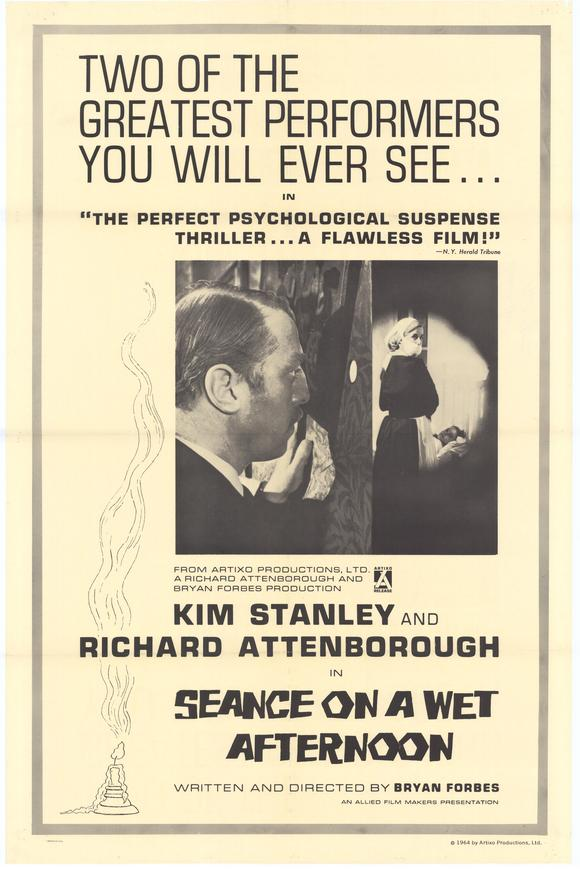
Seance on a Wet Afternoon (1964)

seance on a wet afternoon

By Richard Winters

My Rating: 6 out of 10

4-Word Review: Psychic is a phoney.

Myra Savage (Kim Stanley) is an emotionally unbalanced woman and failed psychic who comes up with an idea that she hopes will revive her career. The plan is for her husband Billy (Richard Attenborough) to kidnap Amanda Clayton (Judith Donner) who is the young daughter of a rich businessman. They will then place her at a strategic location and hold a public séance at which time Myra will ‘miraculously’ predict her whereabouts. This will then, they hope, make her famous and world renowned, but of course things don’t work out as expected.

This is indeed a unique and unusual film that taps into some rare qualities. First and foremost is the black and white cinematography. Every camera shot and angle has a certain evocative flair that is well captured and vivid. The on-location shots pick up just the right amount of ambiance and lighting with each setting. The music score is great and helps create excellent tension. You also will love the little girl that they kidnap. She is adorable without it being forced. Her matter-of-fact sensibilities are a great contrast to Attenborough and Stanley whose characters are child-like and pathetic.

Yet the film doesn’t completely work. The story is handled in a plodding and methodical way without any twists or surprises. There is very little action, some definite slow spots and the conclusion is limp.

If you watch it for the performances then you will be more intrigued. Stage actress Stanley gives a rare film appearance here. It is easy to see why she took the role even though she was known to dislike doing films. The takes are long and give almost unlimited possibilities in creating a character, which is what all stage actors enjoy. She does well and at times may remind one of another legendary actress Geraldine Page who would have also been perfect for the part. Attenborough proves almost her equal. His expressions of shock and worry are memorable. The interplay between the two is fun especially towards the end when this otherwise passive man stands up to the domineering woman.

Overall there are some unique moments, but it is just not suspenseful enough and results in being only slightly above average.

My Rating: 6 out of 10

Released: November 5, 1964

Runtime: 1Hour 55Minutes

Rating: NR (Not Rated)

Director: Bryan Forbes

Studio: Artixo Productions

Available: VHS, DVD (Region 1 & 2)

The Detective (1968)

detective

By Richard Winters

My Rating: 8 out of 10

4-Word Review: Up against the system.

Many people may not realize that Frank Sinatra was the original choice of Harry Callahan for Dirty Harry.  Due to various reasons he turned down the part despite the fact that he was interested.  You can’t help but wonder what that film might have been like had he accepted.  A good indication may be the character of detective Joe Leland that he plays hereIt has a similar theme of a tough cop tired of ‘the system’ and breaking off on his own to solve a bizarre case.

The murder itself is particularly gruesome and ahead of its time as it deals with the killing of a gay man found nude on the floor of his apartment with his genitals cut off. The actual shot of the victim is conveniently framed so that a fern, yes a fern, is strategically placed over the offending area, which is a little corny.  Yet the dialogue and description of the case seems incredibly graphic for the time. Ol’ Blue Eyes even says the word penis, which I think has to be a movie history first.

The way it deals with the homosexual topic is also surprisingly enlightening. Gays are not labeled as ‘sick’ and ‘perverse’, at least not by the Leland character. In one good bit the Sinatra character even slugs another officer, played by Robert Duvall, in retaliation for getting  rough with a gay man that he was questioning for no apparent reason except that he was gay.

There is another electrifying sequence involving Leland questioning the victim’s live-in lover and chief suspect. The part is well played by actor Tony Musante who gives his character all sorts of weird body gestures and nervous ticks, which makes the viewer feel uneasy but still compelled to keep watching until it becomes a fascinating experience. The Leland character again shows an amazing amount of compassion and enlightenment for the gay lifestyle during the interrogation, which should be enough to give this film a landmark status.

However, for all of its apparent sophistication, there are also things that hold it back and make it dated. One is reverting to what was a trend in the 40’s and 50’s, which was to film a person driving their car while sitting in front of a blue screen and holding onto a steering wheel that is not connected to any dashboard. It was considered a ‘ingenious’ way to stay under budget and not having to go through the ordeal of mounting a camera onto an actual car, but for today’s sharp audiences it comes off looking obvious and cheesy.

The casting of Sinatra is another drawback. He was already 53 at the time and he looked it.  The part seems to be screaming for a younger, more rugged method type of actor like Steve McQueen or Paul Newman, who would have done better.  Sinatra overplays the tough guy thing too much until it becomes one-dimensional and boring. The character needed more personal quirks and odd habits in order to make him more filled out and interesting.  He also wears outfits worn by the ‘old school’ investigators of yesteryear even though the character is one looking to break from tradition and fighting the mainstream.

I also wasn’t quite sure why Lee Remick’s role as Sinatra’s love interest was necessary. I usually dislike it when crime dramas feel the need to work in a romance angle as a side story because it usually bogs everything down and in this case was no different. Now Remick is always reliable and her character was interestingly flawed, but how that was supposed to connect with everything else was not clear.

The story works in three different parts. The first deals with the murder and the homosexual community of the period.  The second analyzes the politics of the police department while the third involves a mysterious suicide of a successful businessman. The third part, which doesn’t start until the second hour of the film, was the most intriguing for me. The suicide is shown from the point-of-view of the victim. They literally took a camera and heaved it over the edge of a building until it crashes directly onto the pavement below, which actually made me flinch. It is not until the very end where you see how all three of these parts come together, but the twist is excellent and made viewing this film well worthwhile.

Overall the cinematography, editing, writing, directing, and supporting acting are first rate.  There are a lot of familiar faces in supporting roles including: Jack Klugman, William Windom, Lloyd Bochner, Jacqueline Bisset, Horace McMahon and Al Freeman Jr. They all do splendidly. The subject matter and the way it is handled easily elevates this from other melodramas of the period.  The resolution should make this entertaining even for today’s viewers and enough to overlook a few dated elements.

My Rating: 8 out of 10

Released: May 28, 1968

Runtime: 1Hour 54Minutes

Rated R

Director: Gordon Douglas

Studio: 20th Century Fox

Available: VHS, DVD

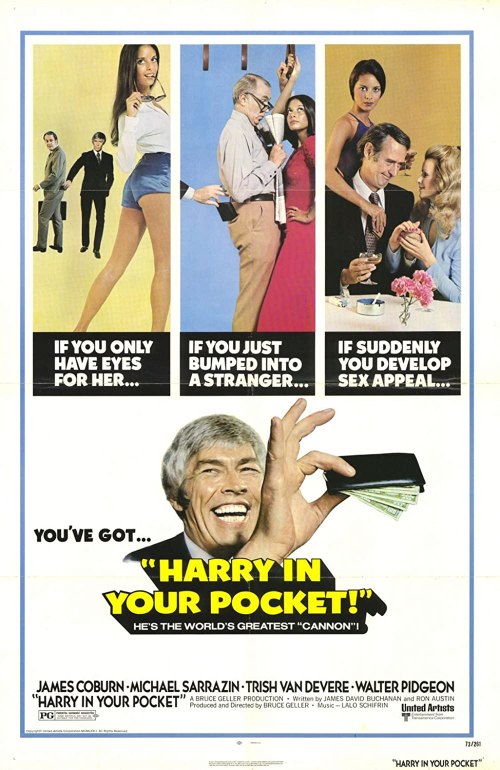
Harry in Your Pocket (1973)

harr1

By Richard Winters

My Rating: 4 out of 10

4-Word Review: They take people’s wallets

Ray (Michael Sarrazin) is an amateur pickpocket who has no luck trying it on his own. He meets Sandy (Trish Van Devere) who has just lost everything and the two decide to get into the pickpocket racket as a simple means for survival.  They get hooked up with Harry (James Coburn) and his mentor Casey (Walter Pidgeon) who teach them the fine art of pickpocketing while preying on summer tourists in Seattle.

The film’s main selling point is the ensemble cast that work off each other quite well. Coburn is engaging and energetic as usual. It is hard to imagine him giving a poor performance and he can usually make even the dullest material interesting and his appearance here proves no exception.

Pidgeon is equally diverting as the elder member of the group. His career was already fading at this point and this ended up being one of his last performances. It is unique in the fact that his character suffers from a major cocaine habit and it is quite possibly the only time in film history where you will see a 77 year old main sniffing up the white stuff, which he does on several occasions.

Sarrazin, who unfortunately passed away last year, is dependable as always. I know female fans fell in love with his big, sad, baby blue eyes, but some critics lambasted him as being ‘boring’ and ‘transparent’, but I always have found him quite competent in dramatic roles in a nice, quietly understated manner.

Surprisingly though it is Van Devere who comes off best and practically ends up carrying the film. She was never given enough varied roles for me to ever formulate any real opinion of her, but here she does quite well. I liked her savvy nature and some of her snappy comebacks. Despite being surrounded by all men she handles herself with ease and even seems at times to intimidate them.

The only problem I had with her character is how she is introduced.  She meets Ray at a train station and after talking to him finds out that he stole her watch. She goes running after him while leaving her luggage and purse unattended. When she is able to retrieve her watch from him she returns only to find that someone has now stolen her suitcase and purse.  She takes this sudden predicament too much in stride and doesn’t even go to the police about it. Instead she decides to get into Ray’s life of stealing even though she has no criminal past. She even ends up going to bed with Ray later that very same afternoon even though I would think most people would be too stressed out for sex at a time like that let alone doing it with a stranger.

The film was done on-location in Seattle. Normally I always applaud films that are shot outside of the studio back-lot, but here it becomes almost a distraction.  Director Bruce Geller seems much too preoccupied with capturing the scenery than he does in propelling the story. There is one segment that takes place in the middle of the film that deals with the four characters taking a very long, drawn out boat cruise that almost morphs into an advertisement sanctioned by the state of Washington’s department of tourism. It features very little dialogue and no character development and seems only done as an excuse to show the picturesque landscape. It even has them feeding the seagulls in slow motion, which really gets to be too much.

If the film fails anywhere it is in the fact that it is too somber and dramatic for its own good. I would have thought this type of idea would have worked well as a comedy, but instead everything is kept at a generally serious level.  Yes, some of the tactics that they use to rob the people have amusing moments, but it tends to play itself out quickly. It sticks pretty much to the tried and true character driven formula that was trendy during that era, but also very predictable and downbeat. The music score has a depressing quality that I did not like and although on a technical end this film is passable it also unremarkable.

My Rating: 4 out of 10

Released: September 23, 1973

Runtime: 1Hour 43Minutes

Rated PG

Director: Bruce Geller

Studio: United Artists

Available: Amazon Instant Video

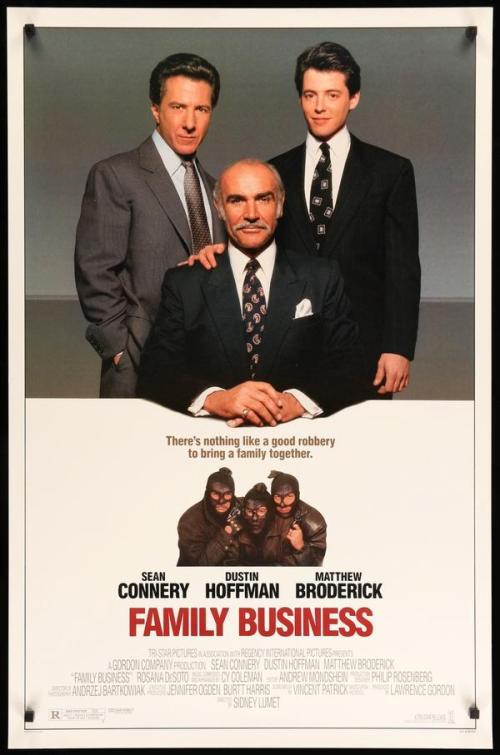
Family Business (1989)

family1

By Richard Winters

My Rating: 4 out of 10

Any movie that casts Dustin Hoffman, Sean Connery, and Mathew Broderick as a father, son, and grandson team of robbers has me hooked before I have even seen the first frame. It was a great bit of inspired casting even if Connery was playing Hoffman’s father and in reality was only seven years older than him.  Throw in the fact that it was directed by the late, great Sidney Lumet and you should have a sure fire winner.

The story involves the grandfather Jessie (Connery) getting out of jail and trying to rekindle relations with both his son Vito (Hoffman) and grandson Adam (Broderick).  Vito wants nothing to do with his father as he has done time himself by getting mixed-up in some of his father’s old schemes and is now trying to go straight by working as a manager at a meat packing facility. However, Adam, who is going to college and has a promising career ahead of him, idolizes his grandfather and relishes the idea of pulling off a robbery himself. He has even come up with one that all three of them can do together. The robbery is unique in that they aren’t stealing from a bank, jewelry store, home of someone rich, or even a priceless artifact at a museum, but instead some important research materials at a science lab.

The crime itself is not elaborate and could have been easily pulled off with just one person. I was anticipating something a little more daring and exciting especially since Jessie and Vito were career criminals. It also takes too long to get to it. The first fifty minutes are spent with them endlessly arguing and rehashing the same old points.

The second part is a little more interesting as it deals with Adam getting caught while the other two are able to get away and all the dilemmas that they then face. Even here the drama becomes strained and talky.  The ending fizzles and leaves no emotional impact.  I saw a lot of similarities with this film and Sidney Lumet’s last film that he did before he died, which was Before the Devil Knows You’re Dead.  Both of these movies deal with robberies and the consequences of family members betraying one another and yet that film was far more gripping while this one falls flat.

I thought Connery was highly engaging and would have enjoyed seeing him take over the movie. Hoffman gives a solid dramatic performance, but his character is bland.

The Adam character got on my nerves. He had been given everything in life and yet refuses to appreciate it and seems almost ungrateful to his father for working so hard to give him a better life. He acts cocky about going through with the robbery and yet when they get there he is ill-prepared and confused. I understand sometimes people become curious about those that live a different lifestyle than they do and that they don’t fully understand, but I still felt there needed to be a little more balance.  I just didn’t understand why this kid would want to throw it all away just so he could be like his career criminal grandfather.

The film gives one a good taste of New York. I liked how it showed the different neighborhoods and boroughs. Not only do we get a good feel of the Bronx, but we also see Flushing, Brooklyn, and downtown Manhattan. Most films that take place in the Big Apple seem to concentrate in only one section of it while this one tried to give a broader feel.

The indoor sets are nicely realized. Everything from the trashed halls of the prison to Vito’s modernistic, sleek apartment, to the science lab and even Jessie’s small, cramped apartment looked authentic and distinct.

I did notice a few logistical errors. One is the fact that they discuss plans of the robbery in a lot of public places, which seemed just plain careless to me especially since these were ‘professional’ thieves. One discussion takes place at a bar, another on a busy sidewalk with pedestrians going by, and the third at a funeral with mourners standing right behind them. There is also the fact that they park their car on the side of the road in front of the lab and put a sign in the windshield stating that they are out of gas and will be back in one hour. I thought this seemed dumb because a policeman could come by and do a check on the license plate to find out who the owner is. Then, the next day when the robbery is reported, they would only have to put the two together to trace the culprits. There is also a scene were Vito fires one of his employees at his plant for stealing. He punches him violently in his office that is surrounded by windows and is in full view of the other workers.  The man leaves with a broken nose and bloodied face, but the workers do not react and go on with their tasks like nothing happened, which didn’t strike me as believable.

The music score is another problem.  It has a big band, show-tune type melody and sound, which might have worked for a Broadway production, but here it seems completely out-of-sync with the mood and tone of the story.

Although competently done this thing still seems like a misfire namely because the material isn’t diverting, or interesting enough for the cast that it has. I was expecting a little more razzle-dazzle and a lot more action and excitement. I almost felt that if this same story had been approached in a comic vein it might have done better.

My Rating: 4 out of 10

Released: December 15, 1989

Runtime: 1Hour 50Minutes

Rated R

Director: Sidney Lumet

Studio: TriStar Pictures

Available: VHS, DVD, Amazon Instant Video

The Verdict (1982)

verdict

By Richard Winters

My Rating: 8 out of 10

4-Word Review: Lawyer makes a comeback.

Frank Galvin (Paul Newman) is a lawyer that has hit rock bottom. He has lost his last four cases and become an alcoholic in the process. His associate Mickey (Jack Warden) hands him what appears to be an open and shut case dealing with a woman who was put into a permanent comatose state after being given the wrong type of anesthesia during the delivery of her child. Both parties are willing to settle out of court and Frank is initially happy to accept the settlement as he is hard up for funds, but after seeing the sad condition of the patient in the hospital he changes his mind.  He becomes convinced that the hospital is trying to hide something, but the other doctors and nurses that where present during the procedure are refusing to talk. He then tracks down the admitting nurse, who was the one person who refused to sign a sworn statement relieving the doctors of any wrong doing. Once he finds her it blows the case wide open.

This marked a turning point in Newman’s career. He was no longer the young, shirtless, virile hero, but now a grey haired, gravely voiced man showing the signs of aging and his roles from then on where all of older characters past their prime. Newman definitely looks tired and washed up and it is so effective that it makes the viewer feel the same way. Yet, he is still able to show the boyish side of his character by way he becomes engrossed with the pinball machine at the bar and getting excited when he achieves a high score.  Newman continues to be one of my favorite actors and his ability to act in a way that seems so effortless never ceases to amaze me. It may seem minor, but I liked when Galvin is forced to take a red-eye flight out of town in order to meet the former admitting nurse (Lindsey Crouse) who has moved to another city, he is shown to be unshaven. Too many times male characters placed in hectic scenarios in most films are clean shaven at all times even when it doesn’t make sense. Yet here Newman’s character isn’t. Being the consummate method actor who was always looking for realism I’m sure he decided to add this extra touch himself. Sometimes what separates the great ones from the average are the little things.

Director Sidney Lumet shows why he is a legend as well. The movie was shot in the late autumn, early winter in Boston. The cold climate and gray skies help accentuate Galvin’s state of mind and stage in life. I remember hearing Lumet state in an interview how he made sure that the color schemes in the entire film where of a dark, brownish color which he felt would reflect the story’s serious tone. In fact the color brown is the one quality I remember most of this film from when I first saw it years ago. I also liked the visual touch Lumet uses of having Frank taking Polaroid pictures of the victim lying motionless in her hospital bed. As the viewer watches the images of the woman on the Polaroids slowly develop it perfectly reflects Galvin’s developing empathy for her. My only quibble is that I wish that Lumet had shown a close-up of the woman so we the viewers could completely take in her sad condition as well. We are only shown the victim from a distance and even then it is never straight on, which doesn’t help us become as upset by her quandary as we should have.

Another thing I appreciated about the script, which was written by David Mamet and based on the novel by Barry Reed who was at one time a practicing attorney, is the fact that is focuses on all the behind-the-scenes tasks that a lawyer must do before the case comes to trial. Most courtroom dramas deal almost exclusively with the trial portion, but here we see how the attorneys prep their clients for questioning and cross-examination. We also take in the process of them interviewing potential jurors, researching legal issues, chasing down witnesses, and even discussing potential strategies with their clients. I found the approach here, as opposed to other legal dramas, to be more thorough, revealing, and satisfying.

The grievances that I had with the film all contain spoilers, so if you are interested in watching this movie then you may want to skip the next two paragraphs.

The first problem I had was with the Lindsay Crouse character who plays the admitting nurse whose bombshell testimony turns the tide of the case in the favor of Galvin’s client. Her scenes are certainly riveting and marked with all the classic ingredients of high drama. Her character states that the admittance sheet that she had filled out that day had been altered by the doctor and that she had the original. Yet neither the viewer nor the jury is shown the original making what she says, as compelling as it may be, seem like hearsay. The judge also orders everything that she said to be stricken from the record and not considered when the jurors come to their final decision. Yet the jurors openly ignore this order and side in Galvin’s favor anyways, which I couldn’t completely buy. I didn’t think all twelve of them would disregard the judge’s order especially when no documentation was ever shown to help verify what the witness stated.

I also did not like the Charlotte Rampling character who plays a woman that Frank meets at a bar and begins to date. She is also paid by the opposing attorney Ed Concannon (James Mason) to spy on Frank and give away all his strategies. I didn’t feel it was necessary to show this, or even bring in the character at all. We are already shown earlier that Concannon is underhanded by the way it is implied that another doctor, who was going to be the star witness for Galvin, was paid off not to testify and then just disappears. Having him go further by using Galvin’s girlfriend as a snitch seemed like over-kill. The movie strives for realism and therefore should keep extreme side-story scenarios like this out of it as I am sure it is not something that occurs every day.

The subject matter is serious and somber. On a dramatic level it is excellent and although some may find it slow and depressing others will appreciate the intelligent script and deliberate pace. It is also an unusually quiet film with long stretches with no dialogue, or music, which is a nice change of pace from most films, which feel it necessary to be loud and noisy, or risk losing the audience’s perceived short attention span.

My Rating: 8 out of 10

Released: December 8, 1982

Runtime: 2Hours 9Minutes

Rated R

Director: Sidney Lumet

Studio: 20th Century Fox

Available: VHS, DVD (2-Disc Collectors Edition), Amazon Instant Video

North Dallas Forty (1979)

north dallas forty

By Richard Winters

My Rating: 8 out of 10

4-Word Review: Ugly side of football.

From the very first frame this film grabs your attention. We see football wide receiver Phil Elliot (Nick Nolte) sleeping in his bed with blood spewing out of his nose and soaking his pillow in red. He wakes up and ambles his way to the bathroom looking like a man of 80 instead of 30. We come to realize that his nose is broken and he sleeps with tissue stuffed up his nostril to keep it from bleeding worse than it really does. We soon learn that this is all part of the business. A player is expected not only to play with pain, but live with it as well. Watching Nolte deal with this is so convincing that it will make you feel like you’re having the same symptoms and bring back vivid memories of any physical discomfort that you once had. It gets so bad that when he is making love to his girlfriend he is having to tell her to switch positions, or not touch certain parts of his body because even sex ends up being too painful. When you read about how many players suffer from lifelong injuries from their playing days you feel almost insulted at how other sports movies seem to gloss over it like it is no big deal when it really isn’t.

The movie is based on the best-selling novel by Peter Gent, who once played wide receiver for the Dallas Cowboys. Although fictionalized to a certain extent one can’t help but see the ugly truth seeping through. Many of the characters closely resemble star Cowboy players from that era including the Mac Davis character Seth Maxwell who has the same personality as real-life quarterback Don Meredith.  There is also B.A. Strother (G.D. Spradlin) who resembles legendary coach Tom Landry. Like Landry he seems devoutly religious and even quotes scripture, but he also is very cold, calculating, and psychologically manipulative.

I thoroughly enjoyed this film and found it riveting from beginning to end. If only all films could be this revealing and honest. The ‘feel good sports movie’ can be nice, but it is becoming too much of a cliché. Most players that get into the business don’t win Superbowls, or championships. They becomes used and abused by a relentless system until their only goal is simple survival and trying not to be cut. Of course I have never played football, but I don’t think the viewer really has to, to appreciate the dead-on truth that is displayed here. Simply being out in the ‘real world’ and working in corporate America should be enough for just about anyone to connect to what the characters here go through.

The dialogue is exceptional and endlessly quotable. Every scene and conversation dissects another ugly side of the business. Some of it is expected, but other parts become rather startling particularly the way players are pushed to play with injuries in order to ‘help the team’ even if there is a strong possibility that it could cause serious and permanent harm.  Some may say things have gotten better, or worse since this was made, but I can’t help but feel that if anything it pretty much the same in a lot of ways, which is why I still maintain that this film is quite possibly the best sports movie ever made.

You also gotta love Charles Durning as the assistant coach constantly carrying with him a bottle of Maalox and looking like the one doing most of the coaching and disciplining while coach Strother stands at a calculated distance. The scene where Durning screams at the players during a team prayer giving in the locker room by a priest is the film’s single most funniest moment. Bo Svenson has one of his best roles playing the very large and intimidating player who goes from being obnoxious and even frightening at parties to looking dumb, confused, and even scared during the games. The only actor I wasn’t impressed with was John Matusek, who was a real-life pro player for a while. It was nice seeing a well-built actor to compliment Svenson, but Matusek just does not have the ability to deliver his lines with any dramatic impact and the fiery tirade that gives Durning at the end fails to be as strong as it should’ve been.

The only other problem I had with this film is the scenes involving the actual game itself. It doesn’t in any way resemble a pro game. The field is small and looks like it was shot at a high school. The crowd is darkened out, looking like there were no spectators at all. I also didn’t like the way director Ted Kotcheff incorporated dramatic music during certain key segments. It came off as heavy-handed and unnecessary. Of course the team’s uniforms and logos look tacky and although this is a little distracting you can’t blame this on the filmmakers as the NFL refused to endorse the film because of its frank nature.

This film hasn’t mellowed at all with age and I was surprised how potent it still is. I would recommend this to anyone, sports fan, or not, who wants to see the game from a different perspective by a player who was there.

My Rating: 8 out of 10

Released: August 3, 1979

Runtime: 1Hour 59Minutes

Rated R

Director: Ted Kotcheff

Studio: Paramount

Available: VHS, DVD, Amazon Instant Video

Straight Time (1978)

straight

By Richard Winters

My Rating: 8 out of 10

4-Word Review: Parolee can’t go straight.

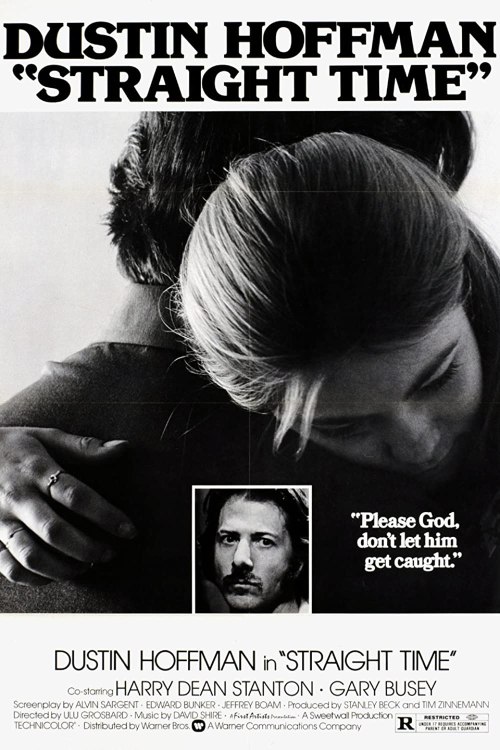
Straight Time is an engrossing, highly realistic drama detailing a parolee by the name of Max Dembo (Dustin Hoffman) who gets released from prison and cannot seem to stay away from the allure of crime despite his initial efforts. The movie is based on the novel ‘No Beast So Fierce’ by Edward Bunker.  Bunker himself was a career criminal who was in and out of jail from 1955 to 1975 and only managed to finally turn his life around when this novel, which he had written while incarcerated and deals with many of his own exploits, got published. Bunker co-wrote the screenplay and appears in a bit part playing a character with a really bad comb-over by the name of Mickey.

I found this film gripping from the second it started and infinitely fascinating the more it progressed. It gives you a whole new perspective on things as you are forced to see it from the viewpoint of the criminal and as an outsider looking in. Every facet of the story and characters is believable and the film does a very good job of being stark and searing without ever getting exploitive, or overtly shocking.  I remember back in 1977 when I toured the new county jail in the town where I grew up when it was first opened and before it housed any inmates. I remember the officer describing the rather degrading procedures all felons had to go through when they were first booked including being stripped searched and forced to take a shower nude while a fully clothed officer stood by and watched them.  The scene where Max and other criminals are ‘welcomed’ to the L.A. County jail worked exactly like that. It was so authentic and frank that it seemed almost like a documentary.

The essence of the story revolves around Max and his relationship with his parole officer Earl Frank that is wonderfully played by noted character actor M. Emmet Walsh. Earl does his job a little too well. He shows a constant distrust of Max and gives him no respect while overzealously tracking his every move until it finally forces Max to snap. It is a terrific indictment on the flawed system as it examines just how hard it is for the criminal to go straight and stay straight even if they want to. It also exposes how it seems almost designed to push the person back into crime in its refusal to ever treat the criminal as a human being. The part where Max finally has enough and overpowers Earl and chains him naked to a fence in broad daylight on a busy L.A. freeway while hundreds of cars drive by him should leave an indelible image on the minds of anyone who sees it.

The remaining supporting cast is great as well. Theresa Russell is surprisingly effective as Max’s girlfriend Jenny Mercer. Usually she has played more glamorous types of roles, but here she is perfect as a very ordinary woman who inadvertently gets caught up in Max’s eventual self-destruction until she finds herself in over her head.  I liked the fact that she wore no makeup and the camera was able to pick up her natural beauty through regular lighting. The only issue I had with her character is that it is never made clear why she would fall in love with Max so quickly and what it was about him that she liked since he shows some clear destructive tendencies right from the beginning. To me it just came off as a bit forced and phony to have an otherwise well-adjusted woman that he meets at an employment agency get so infatuated with him after just one date that she immediately agrees to move in with him, visit him in jail, and even quit her job on the spot and go on the run. I know it is standard practice in a Hollywood film for the anti-hero to always have ‘his girl’ that can be used to humanize and compliment him, but there still needs to be more of an explanation and history shown to her character in order to validate the relationship.

Harry Dean Stanton gives another great performance as Jerry Schue. He was a long-time partner to Max during the robberies he did before landing in prison. Jerry has now turned his life around. He has a nice house in the suburbs, an honest job, and a beautiful wife. However, when Max comes to visit, and the minute his wife leaves the room, Jerry begs him for a crime job that they can do together because he finds his new found life to be boring.  I thought this made a great statement as to how the sterile suburban existence is not the American dream for everyone and how it will not necessarily ‘domesticate’ those that still harbor a reckless urge.  I also found it interesting how Jerry views the art of robbery as an actual profession that he takes a great deal of pride and care in. When one of the men shows up late for a planned robbery Jerry calls him ‘unprofessional’.

The robbery scenes are filmed in a diverting way. In most films the camera gets real close to the action in order to heighten the tension. Here the action is captured from a long shot that allows the viewer to see just how chaotic and frantic a robbery really is as well as showing how the most nervous people in the place are the thieves themselves.

If I have one complaint with the film it is in the fact that the second hour becomes rather difficult to watch as it focuses solely on the self-destructive downward spiral of the main character. Max has some good qualities, which makes it all the more painful to watch. Yes, some of his anger is justified, but his insistence at ‘evening the score’ with everyone who has wronged him ends up only hurting himself. Hoffman is outstanding as usual. It is interesting to compare his role here playing a very violent character with the pacifist one that he played just seven years earlier in Sam Peckinpah’s classic Straw Dogs.

If you are looking for an intelligent, searing drama that is still relevant today then this no-holds-bar character study is highly recommended.

My Rating: 8 out of 10

Released: March 18, 1978

Runtime: 1Hour 54Minutes

Rated R

Director: Ulu Grosbard

Studio: Warner Brothers

Available: VHS, DVD, Amazon Instant Video

Dirty Dancing (1987)

dirtydancing1

By Richard Winters

My Rating: 5 out of 10

4-Word Review: Rubbing bodies is sexy.

Some of my lady friends at the office were surprised to hear that I had never seen this film and suggested that I watch and review it for my next column.  Since Hollywood is now planning on remaking this movie and several websites have already started up protesting it as fans of the original feel this can’t be duplicated, now more than ever seems to be a good time to give this movie a look.

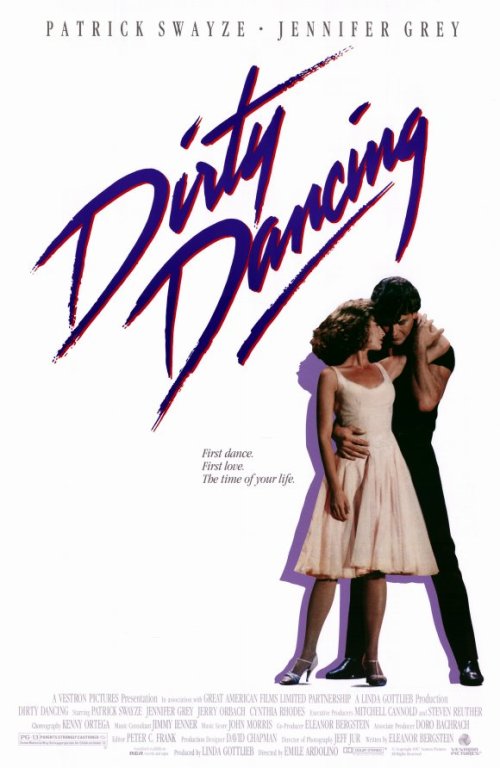
The plot, which is paper thin, deals with a seventeen year old girl named Frances ‘Baby’ Houseman, who while vacationing with her family at a resort in the Catskills Mountains of New York in the early 60’s, becomes involved with the craze of dirty dancing that is done behind the scenes by some of the young people. When one of the lead female dancers named Penny Johnson (Cynthia Rhodes) gets pregnant and has to bow out in order to get an abortion, Francis agrees to take her place in the dance routine. She has no experience with the dancing, but after spending long hours practicing with the male hunk Johnny Castle (Patrick Swayze) she gets pretty good at it and the two fall in love in the process.

The story is loosely based on the real-life experiences of screenwriter Eleanor Bergstein, who traveled to the Catskills during the summers of her youth with her family and got involved with some of the dirty dancing contests that they had up there. The name of Frances that is given to the character was actually the name of her older sister and the nickname of ‘Baby’ was what Eleanor was called in her teen years.

The first thing that impressed me about the film was the on-location shooting. I had also been to upstate New York during the summers in my younger years and felt that the area was quite scenic. The film does a good job in recreating this to the extent that it also becomes like a third character. The only problem was the fact that it was actually filmed in North Carolina and Virginia, but they disguise it well and the ambience of the Catskills is still there.

The chemistry between the two stars is what makes the movie and spiraled it into the hit that it became. I felt the energy and I liked it despite the fact that apparently behind the scenes the stars did not always get along. I thought the casting of Grey, daughter of legendary entertainer Joel Grey, was overall a good choice. The producers wanted someone who could really dance and she fit the bill even though she was actually ten years older than the character she was portraying. However, I did feel it became somewhat of a problem during some of her exchanges with the Johnny character who was supposedly in his twenties. I would have thought that a young lady of only seventeen would have been a little more intimidated dealing with an older man and even a little awkward at times and yet their ‘spats’ came off more like two adults arguing.

I really liked Frances’ relationship with her father Jake (Jerry Orbach). It was a nice and respectful one with neither side talking down to the other. The scene where the two have a falling out and Francis comes to him to ask forgiveness is actually quite emotional. However, the part where Jake, who is also a Dr., helps Penny when she becomes ill after having an abortion with an untrained physician seems a bit glossy. Normally that situation would prove fatal to the woman, but somehow Jake is able to make her ‘all better again’ simply by using medicines inside his doctor bag and she wasn’t even forced to go to the hospital. I also thought that the fact that Frances kept her dancing a secret from her parents seemed to be a bit of a stretch as she spent so many hours with Johnny that I would have thought they would become suspicious as to where she was all that time.

For the most part the recreation of the 60’s era is all right. However, I did not like instituting 80’s songs into the mix. ‘Hungry Eyes’ and ‘She’s like the Wind’ are good songs on their own, but have a distinctly different sound than music from the 60’s. By putting them into the soundtrack they become jarring and, for this viewer at least, threw me out of the time period of the story completely. To me it was a sign of poor filmmaking.

The movie is formulaic and predictable to the extreme, which was the reason that I never went to see it when it first came out because basically if you’ve ‘seen the previews then you’ve seen the movie’. It is always nice if a movie can give you some sort of unexpected twist, or surprise, or even some new level of insight, but this film offers none. Even on a soap opera level the scenarios and complications are awfully light and there are a few moments of hackneyed drama. If one’s only demand is to see a predictable teen romance then on that level it is competently done. If a viewer were to demand anything more than that then they will most assuredly be disappointed.

My Rating: 5 out of 10

Released: August 21, 1987

Runtime: 1Hour 40Minutes

Rated PG

Director: Emile Ardolino

Studio: Vestron Pictures

Available: VHS, DVD, Blu-ray