Tag Archives: Donald Pleasance

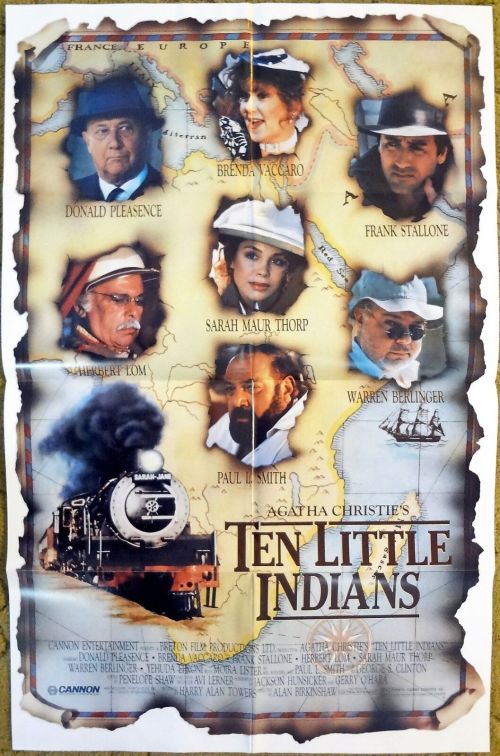
Ten Little Indians (1989)

tenlittle

By Richard Winters

My Rating: 3 out of 10

4-Word Review: Everybody is getting killed.

Ten strangers get together on an African safari. The group includes: A doctor (Yehuda Efroni), a judge (Donald Pleasance), a captain (Frank Stallone), an actress (Brenda Vaccaro), a General (Herbert Lom), a nanny (Sarah Maur Thorpe), a detective (Warren Berlinger), along with a man named Marston (Neil McCarthy), and a couple with the surname Rodgers (Paul L. Smith, Moira Lister). They’ve been invited by a man named Mr. Owen, but upon their arrival he’s nowhere to be found. Instead they hear his voice that’s been recorded onto a phonograph where he tells them that they’ve been invited because they’ve been accused of committing a crime years ago and gotten away with it, but he intends to put a stop to that by killing them off one-by-one. As each guest gets murdered one of the heads from the ten little Indians statues that sits in the middle of the dining room table goes missing.

The film has the distinction of being the third movie version of the story done by producer Harry Alan Towers as the first one was produced in the 60’s and the second, which also starred Lom, in the 70’s. The story itself is based on the Agatha Christie novel ‘And Then There Were None’ though the ending was changed to replicate the stage play, which was considered more upbeat. While in the novel and play the setting was an island here it’s the desert of South Africa, which I liked as it gives the proceedings a distinct atmosphere. However, there’s an unusual moment at the beginning where the natives help carry the guests’ luggage to the camp site, but then halfway there for no explicit reason they turn on them by clicking their tongues in unison and ultimately abandoning them, which is creepy, but there’s never an explanation for why they do this.

The landscape looks hot and dry though there’s no sweat glistening off the actor’s faces leading me to believe it was shot in the winter time and thus the complaints about the heat, which are casually mentioned are invalid. I did get a kick out of one of the tents, the main one, having an upright piano. Don’t know who in the world would want to painstakingly haul a piano into the desert sands, or essentially the middle of nowhere, but the appearance of it gave me a chuckle. I was also amused by the elevated lift, held together by a frayed rope, that each guest is forced to sit-in as it takes them many feet in the air of a wide gorge, in order for them to get to the campsite. The contraption looks flimsy and it’s rather unnerving seeing them get into it and ride it all the way down.

The acting is entertaining and made-up of many B-stars whose faces you’ll recognize though not necessarily their names. Vaccaro fares best as a bitchy, spoiled, Hollywood star whose career has gone on the decline. Lom is good as an aging man whose memories plays tricks on him, but Stallone, who’s the younger brother of Sylvester and could almost pass of as his twin, has little to add. Berlinger had gained a lot of weight to the point that he’s rounder than a beach ball, is adequate, but the normally reliable Pleasance appears elderly and lacking energy making his presence almost sad. Smith continues in the mold of the jail guard in Midnight Express, a part that made him famous, but his heavy breathing and lurking ways are not interesting and his acting one-note.

The mystery angle doesn’t get played-up too well as the guests get killed-off with a boring regularity making it at times seem almost like a low-grade slasher. The characters don’t respond to their stressful conundrum realistically. For instance one of the guests dies by drinking alcohol that was linked with cyanide, but the rest of them in the ensuing days go on eating and drinking even though you’d think they’d be nervous about ingesting anything for fear that whatever they put in their mouths could also poisoned. They also go back to their tents each night and peacefully sleep despite seeing the other guests get offed by a unseen killer, which would’ve made me, and most others too fearful to get any shut-eye and instead stay wide awake for fear that the killer would attack the minute anyone closed their eyes.

Spoiler Alert!

The tension is nil and there’s really no interest in finding out who the culprit is. In the book everyone dies and the authorities are only able to figure out what happened from a message that they find written by the judge. Here both Stallone and Thorp make it out alive though Thorp lets go of the rope that had been around her neck just as Stallone comes to her rescue making me believe that she would’ve hung herself before he would’ve been able to get her out of the noose. The rescue plane flies over them instead of landing making it unintentionally seem like they had been left stranded and not saved after all. Having everyone die except for Stallone, which is what I thought was going to happen, and then having him arrested for the murders he really didn’t commit would’ve been a much more ironic twist.

My Rating: 3 out of 10

Released: May 17, 1989

Runtime: 1 Hour 38 Minutes

Rated PG

Director: Alan Birkinshaw

Studio: Cannon Films

Available: Blu-ray, Tubi
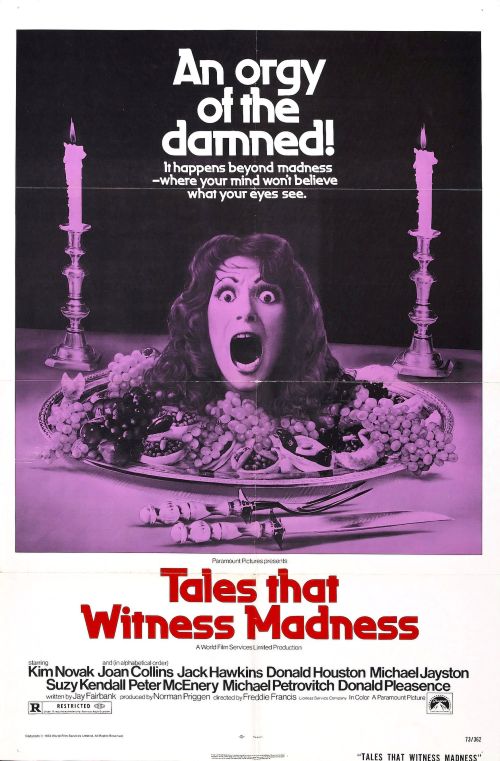
Tales that Witness Madness (1973)

tales

By Richard Winters

My Rating: 3 out of 10

4-Word Review: Four tales of terror.

Directed by legendary cinematographer Freddie Francis, the film revolves around four stories where the protagonist is perceived as having gone mad, but in actuality it’s evil from another dimension that gets them to see or do odd things and in reality they’re the sane ones. The connecting element is Donald Pleasance who acts as their psychiatrist who keeps them at his clinic in an effort to improve their mental state. In the first story we have a boy named Paul (Russell Lewis) who boasts about having a live tiger in his room even though his parents (Donald Houston, Georgia Brown) don’t believe him. The second story deals with Timothy (Peter McEnery) an antique collector who’s able to ride an old Penny Farthing bicycle that allows him to go back into time and inhabit another man’s body. The third tale deals with a man (Michael Jayston) who brings home a dead tree and mounts it in his living room much to the annoyance of his wife (Joan Collins). The final story is about a rich socialite (Kim Novak) who courts a younger man only for him to have show more interest in her beautiful daughter (Mary Tamm).

This Review Contains Spoilers!

The first story is pretty weak mainly because you presume going in that there’s probably, despite the long odds, some sort of tiger present because after all this is a horror movie dealing with the supernatural, so seeing the parents getting attacked at the end isn’t surprising, or even shocking and you’re pretty much just waiting for it to happen from the get-go. Director Francis makes the mistake of attempting to film the attack as it happens by editing in stock footage of a tiger and mannequin parts with red paint standing in for the parent’s bodies, but it all looks quite fake. Since the tiger figures in again at the very end of the movie a better idea would’ve been to keep it a mystery whether he existed, or it was just a homicidal child that had killed his mom and dad. When the parents walked into the son’s room the camera should’ve remained outside in the hall and the viewer hearing their screams, which would’ve been scarier than anemic special effects that we ultimately do see.

The second story is limp as well as it features a picture of ‘Uncle Albert’ whose facial expressions and eyes are constantly moving and changing, which has been parodied in many other films making this one seem more campy than scarry. The third tale is dumb too as anyone who brings a dead tree into their living room and wants to keep it there is mentally ill and the wife would’ve been smart to have left him versus fight for his affections. The twist here is no surprise either as I saw it coming right from the start though Collins does give a good performance and the viewer gets treated to a shot of her breasts although I suspect it was done by a body double.

The fourth segment is the only one that merits any type of mention as it features the bad guys not only killing the daughter, but slicing her up and then serving her to the mother as a piece of ham during a Hawaiian-style luau. The audacious idea deserves some points and Novak’s performance is fun as is Tamm’s in her film debut, who you also get to see nude from the backside, but it fails to make up for the rest of it, which isn’t up to par with the other British Anthology horror films from that period.

My Rating: 3 out of 10

Released: October 31, 1973

Runtime: 1 Hour 30 Minutes

Rated R

Director: Freddie Francis

Studio: Paramount

Available: DVD, Blu-ray, Amazon Video, YouTube

Oh, God! (1977)

By Richard Winters

My Rating: 7 out of 10

4-Word Review: An atheist meets God.

Jerry Landers (John Denver) is a married man with two kids (Moosie Drier, Rachel Longaker) who works as an assistant manager at a local grocery store. He doesn’t consider himself to be religious nor does he attend church (he most likely could be called an atheist, but I assume that term was considered ‘too toxic’ of a label to put on a protagonist that mainstream audiences of the day were expected to like, so he’s just given the much softer description of being a non-believer.) One day he receives a letter in the mail stating that God would like to interview him at a certain location, but Jerry considers this to be a practical joke and throws it away, but when the letter keeps popping up at the most unlikely places he finally decides to take it seriously. He goes to the location and meets God (George Burns) who at first he does not see, but only hears, but eventually the almighty takes the form of an old man. He tells Jerry to spread the word that he exists, which Jerry does only to have it all snowball against him when everyone thinks he’s crazy and even his own family becomes embarrassed to be seen with him.

The film is based on the 1971 Avery Corman novel of the same name though the book had more of a satirical tone and the protagonist was a journalist. The film though manages to retain the same jaded sensibilities of the modern-day public, which is what makes it so amusing and for the most part quite on-target. Denver, who was known more as a singer and did very little acting both before or after this, is quite good here, but only if you can get past his bowl haircut. Burns is excellent as well and I always felt this is the performance he should’ve won the Academy Award for instead of the one in The Sunshine Boys as it easily became his signature role.

The script though by Larry Gelbart is full of incongruities. For instance the God here claims to be a non-interventionist who sets the process in motion and then lets things happen without getting involved. Everyone is given free will and he doesn’t intervene to stop suffering or ‘bad things’ from occurring because that would upset the ‘natural balance’, but then turns around and admits that he had a hand in such superficial things as helping the 1969 New York Mets win the pennant. He is also forced to become a ‘side show magician’ by performing what amounts to being magic acts, like doing a tacky card trick in front of a judge, in order to prove to Jerry and others that he really is the almighty. Yet he then becomes shocked to find that Jerry’s simple word-of-mouth as well as having Jerry pass out God’s ‘calling card’, which is nothing more than a white card with the word God on it, as not being enough to somehow convince others of the same thing.

There’s also a weird conversation, which I found loopy even as a child, where God tries to prove a point by explaining to Jerry that people only dream in black-and-white, which apparently was an accepted belief a long time ago. This idea has later been found to be incorrect, which is good as I’ve always dreamed in color, but it’s still off-kilter to have this supposedly all-knowing God argue a talking point from a debunked myth.

The performances by the supporting cast help  and in fact I consider this to be Teri Garr’s best role as I found her character arch to be more interesting than Denver’s. The aging Ralph Bellamy is good as an aggressive defense attorney and I also like Barnard Hughes as the overwhelmed judge. William Daniels is amusing as Denver’s snippy boss and a type of authoritative character he’d put to perfection years later in the TV-show ‘St. Elsewhere’. Paul Sorvino gets a few laughs too in a send-up of an over-the-top TV evangelist.

The only one that I had a problem with was Donald Pleasance who gets fourth billing, but only 2 lines of dialogue. With such a versatile talent as his you don’t want to waste it by giving him such a small role and unless a lot of his work here ended up on the cutting room floor I’m genuinely surprised why he even took it.

The film is mildly entertaining, but ultimately quite benign and nowhere near as ‘profound’ as some considered it. Nonetheless it was a big hit and even knocked Star Wars out of the top spot for 1-week. It also spawned 2 sequels as well as a TV-movie called ‘Human Feelings’ where Nancy Walker plays a female God set to destroy Las Vegas with a flood unless Billy Crystal, who plays an angel, can find 6 virtuous people that live there.

My Rating: 7 out of 10

Released: October 7, 1977

Runtime: 1 Hour 38 Minutes

Rated PG

Director: Carl Reiner

Studio: Warner Brothers

Available: DVD, Amazon Video, YouTube

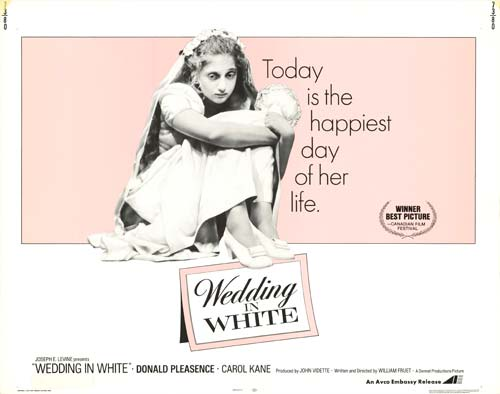
Wedding in White (1972)

wedding in white 1

By Richard Winters

My Rating: 8 out of 10

4-Word Review: Ending is a kicker.

Jeannie (Carol Kane) is a shy 16-year-old girl living in a small, bleak Canadian town just after the war who is raped by her older brother’s army buddy. Her parents (Donald Pleasance, Doris Petrie) respond as if it is her fault and resort to some extreme even shocking measures in order to ‘save the family honor’.

This is a solid little drama with good scene construction. The pacing is deliberate and an ending that really packs a wallop. The sets and location look authentic for the period and the characters are believable. Jeannie’s friend Sara (Christine Thomas) seems like a very typical teenager no matter what time period and her interactions with Jeannie show the realities of teenage friendships and makes for an interesting sidelight from the main story.

Kane is impressive acting in a style I’ve never seen from her before. Pleasance is solid as usual and his Canadian accent sounds almost authentic, but it is a bit overdone. Petrie is also quite good as the mother. She really brings to surface a character that is so cloistered she is unable to make any clear decision for herself.

The story itself is the real strong point. It is convincing, insightful, and well-crafted and brings out a sort of darkness and ‘evil’ that can come from ‘wholesome small towns’ and ‘God fearing people’. It shows how having a rigid morality can sometimes create a sort of immorality and also brings to light the lies people wish to live by and how at times it can cloud their better judgment, but most of all it’s a study at  how easily sensitive, fragile people can get sucked away and how sadly common it is.

This is a film designed to leave you feeling shocked, angered, saddened, and maybe even a little repulsed. This is quality viewing that deserves more attention.

My Rating: 8 out of 10

Released: October 20, 1972

Runtime: 1Hour 43Minutes

Rated R

Director: William Fruet

Studio: Cinepix

Available: DVD

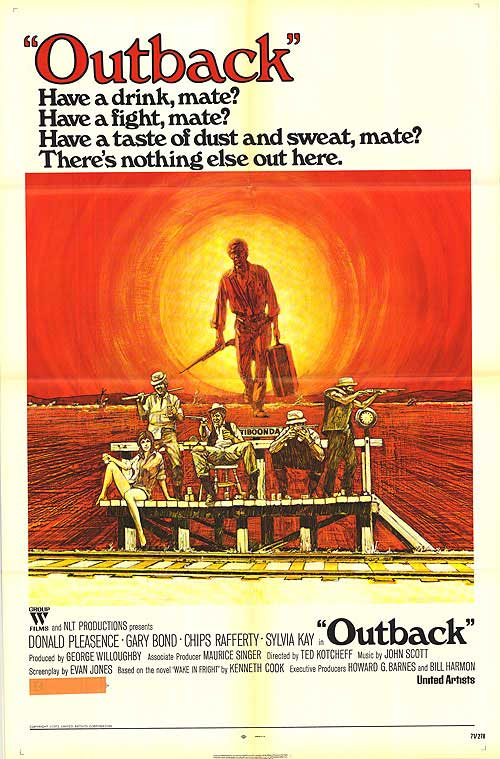
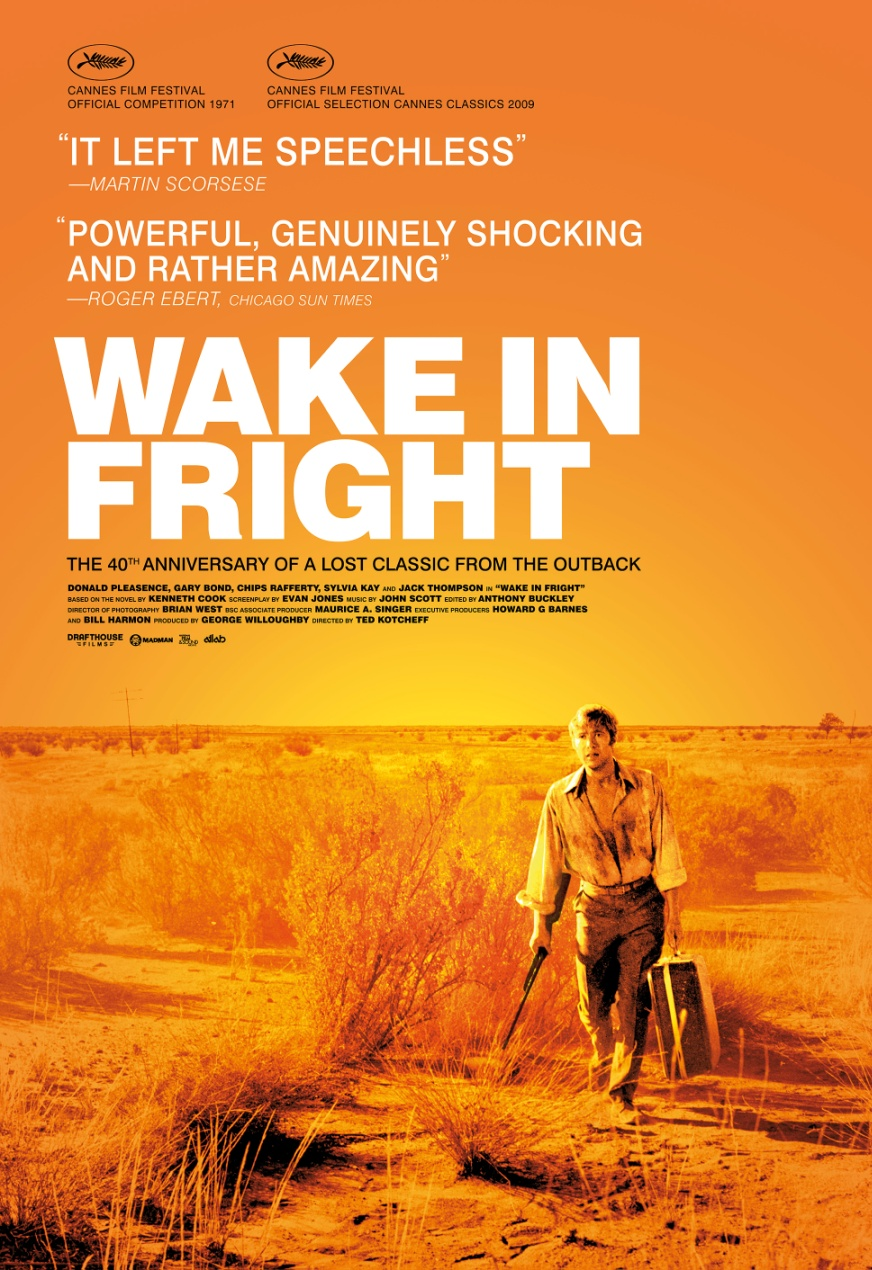
Wake in Fright (1971)

wake in fright 3

By Richard Winters

My Rating: 8 out of 10

4-Word Review: The middle of nowhere.

To an extent this is a one of kind film that is handled in such a raw and unpretentious way that it is like no other film you have ever seen before. The opening shot alone is amazing. You see a birdseye view of an isolated schoolhouse in the outback where our main character teaches. The camera then turns at a full circle and you see that there is absolutely nothing for miles in any direction. The desolation is mind boggling and it’s isolation at its purest.

Not only does this very inspired shot get its point across, but it also becomes the essence of what the film is about by trying to get you to understand the ruggedness of its characters by immersing you into their environment. It’s an uncompromising film full of startling images.

The story deals with a British schoolteacher John Grant (Gary Bond) who, through a loss in gambling, becomes trapped in the isolated outback town of Bundanyabba. He is cultured and educated and his sensibilities can’t mesh with the raw simplistic elements of the people in it.

It’s a highly intriguing viewpoint that not only captures man’s ever daunting task at dealing with nature, but also the overall reality of his existence and even himself. It makes you feel you are right there experiencing the same onslaught with him. There are also some interesting low key scenes proving that one of the biggest hurdles one must fight when in these places is actually just the boredom.

I do have to warn readers that the film has a very prolonged brutally explicit kangaroo hunting scene that features the actual killing of the animals. It even shows the men physically beating up on some wounded kangaroo’s and then viciously slashing their throats in a mocking fashion. Although I do feel that these scenes leave the viewer with the intended strong, raw impact and I like the lighting during the nighttime hunt that allows for a surreal element I still admit this may be a very difficult watch for some and may turn them off from viewing the film altogether. Apparently there were quite a few people that walked out of the film during this scene when it was shown at the Cannes, so be prepared.

Star Bond is excellent. You can relate to his anger and defiance at being somewhere he doesn’t want to be as well as feeling his desperation, exhaustion, and eventual surrender.

For many years this film sat in almost virtual obscurity, but after an exhaustive worldwide search a print of the film was finally found in the back of a Pittsburgh warehouse in a canister with a ‘to be destroyed’ label on it. Fortunately the print was saved and the restoration process is fantastic with colors that are bright and vivid. Director Ted Kotcheff captures the region in all of its rustic, desolate glory including the incredible crystal blue sky.

Reportedly many Aussies dislike the film as they feel it creates a negative stereotype. However, I don’t see it that way. I love the county and people and consider this more of a portrait of what happens when people are stuck in an isolated environment, which technically could be anywhere.

wake in fright 2

My Rating: 8 out of 10

Alternate Title: Outback

Released: October 13, 1971

Runtime: 1Hour 49Minutes

Rated R

Director: Ted Kotcheff

Studio: United Artists

Available: DVD (Region 1 & 2) Blu-ray, Amazon Instant Video