Tag Archives: Don Siegel

Dirty Harry (1971)

By Richard Winters

My Rating: 10 out of 10

4-Word Review: Cop doesn’t like rules.

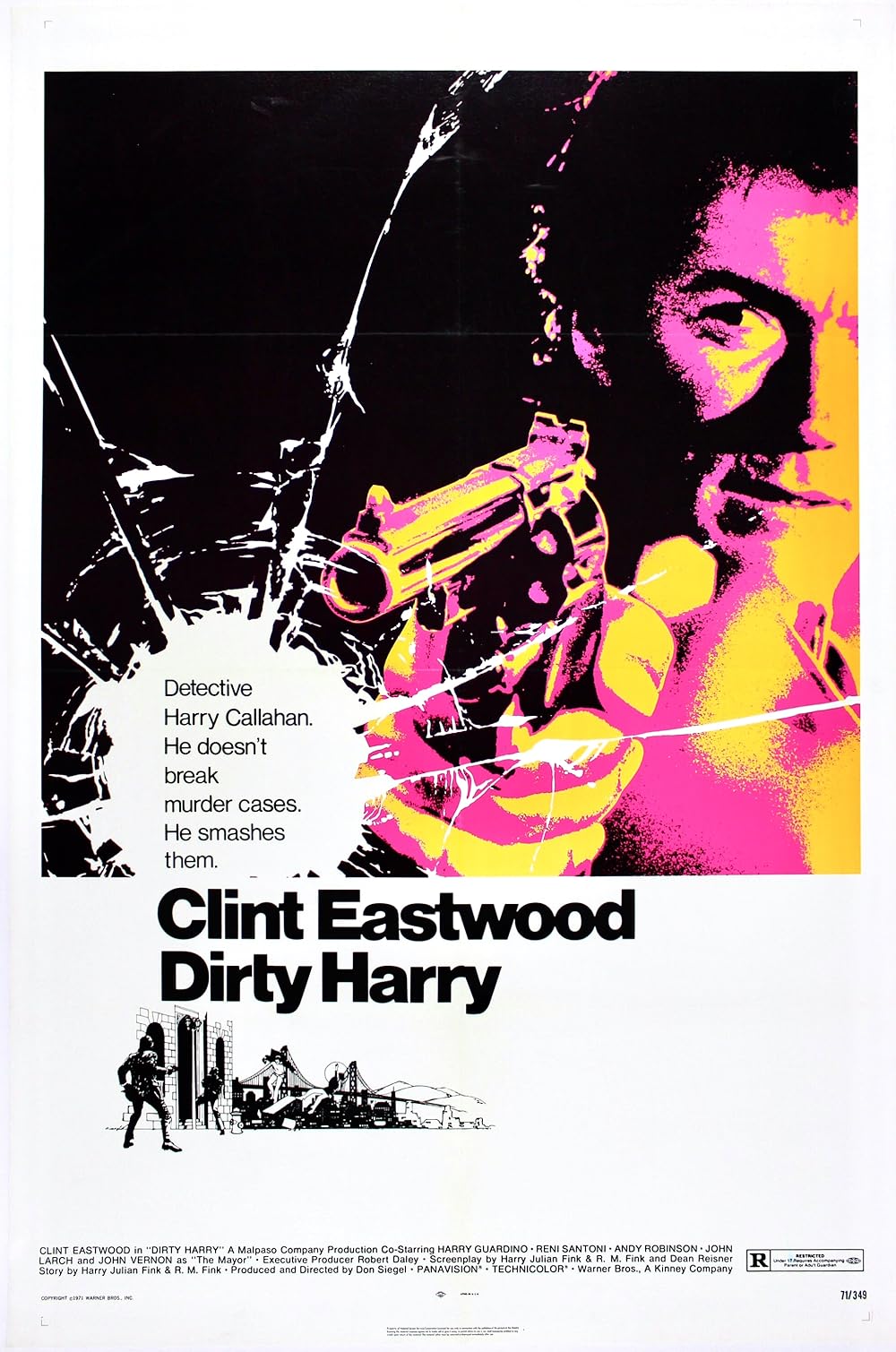
A psychotic who goes by the nickname of Scorpio (Andrew Robinson) has pledged to kill one person a day unless the city of San Francisco forks over $100,000 with his first victim being a woman (Diana Davidson) taking a swim in a pool on a rooftop of a high rise. The mayor (John Vernon) agrees to give into the killer’s demands much to the objections of Harry Callahan (Clint Eastwood) a hard-nosed cop who believes criminals are coddled by the system at the expense of their victims. Yet Harry, who’s known by his fellow cops as Dirty Harry, which he acquired for his well-known ability to circumvent rules that he doesn’t agree with, must go along with the demands of his department forcing him to act as the delivery of the ransom. This causes him to go through the humiliation of running all around the city at the whim of Scorpio who gives him directions of where to go next via different pay phones in the area. When Harry almost gets killed by doing this and then asked to be the delivery guy again, he walks out insisting that appeasing the killer is the wrong way to go. This causes even further irritation when Scorpio is later caught by Harry and then freed on a technicality convincing him that he must work on his own time in order to get the Scorpio put away permanently.

The script was written by the married team of Harry Julian Fink and his wife Rita. The inspiration came from the real-life Zodiac case who terrorized the city of San Francisco during the late 60’s and was never caught. The main character was supposed to be someone in their 50’s and was originally offered to Frank Sinatra, who had difficulty holding the Smith and Wesson gun, and decided to bow out. It was then offered to Paul Newman, Steve McQueen, who had just gotten done playing a cop in a movie and didn’t want to have to do another one, as well as George C. Scott and Burt Lancaster who both rejected it due to their feelings that the story’s theme was right-wing.

As a cop film it’s by far one of the best and has a lot of unique moments. Because Bullit had come out just a few years earlier, which featured a very famous car chase, it was decided not to replicate that one and instead we get treated to some very exciting foot chases with one occurring inside a factory mill and another at Kezar Stadium late at night. What makes these chases so interesting is that there’s no musical score played over them like in most movies, but instead we hear the pounding of their feet on the pavement and other outside ambience that helps to make these sequences grittier and more captivating. When the music does get played it’s when Scorpio is aiming his rifle to kill someone, but has the distinct sound of female vocals, which composer Lalo Schifrin put in to represent the voice he felt Scorpio was hearing inside his head.

Eastwood has made a career of playing this type of role, but here it comes off as fresh and like it was perfectly written for him and no one else could’ve played it better. His patented grimace and squint really work here and it’s interesting seeing the way his crusty exterior softens a bit as the film progresses and I liked the contrast of pairing him with a younger, less experienced cop, played Reni Santoni, that Harry initially thinks very little of, but eventually grows to like and respect. The conversation that he later has with Reni’s wife, played by Lyn Edgington, in which they discuss the emotional toll that being a cop can do to an individual really exposes the challenging job that it is as does Harry’s night on patrol where he’s forced on the spot without preparation to take on many difficult tasks including talking a man down from jumping off a building. This all helps to unglamorized the life of a cop while also revealing the underlying stressful nature of the position and why so many men and women that do it will eventually get burned out. 

Andrew Robinson, in his film debut, is excellent as well with a distinct eyes and face that looks constantly creepy. Normally I’d complain that we learn very little about his character nor the motivation for why he kills, but keeping him as an enigma helps put the focus on the main message, which is the rights of the victims and cops who try to protect them and by making Scorpio have a distinct personality would’ve humanized him and thus deluded the theme. Even so Robinson makes the most of each scene he’s in and he consistently stands out no matter what he’s doing, like the almost comical facial expression he makes when he gets stabbed in the leg. I also liked how after he does get stabbed that he then continues to walk and run with a limp versus other films where someone gets injured and they quickly recover, and it eventually becomes all but forgotten. 

Spoiler Alert!

My only complaint is how at the very end Harry throws away his badge and walks off the job. Director Don Siegel and Eastwood argued about this with Eastwood feeling Harry wouldn’t do this as being a cop was the only job he knew and his relentless pursuit for justice and putting bad guys away would overpower his urge to quit. Even if he was unhappy with some of the police procedures, he’d still put up with it, or fight to improve things from within. This is why at the end he should’ve taken out his badge and looked at it like he was thinking of throwing it, but then eventually put it back into his pocket. 

My Rating: 10 out of 10

Released: December 23, 1971

Runtime: 1 Hour 42 Minutes

Rated R

Director: Don Siegel

Studio: Warner Brothers

Available: DVD, Blu-ray, Amazon Video, YouTube
Jinxed! (1982)

Version 1.0.0

Version 1.0.0

By Richard Winters

My Rating: 3 out of 10

4-Word Review: Blackjack dealer is cursed.

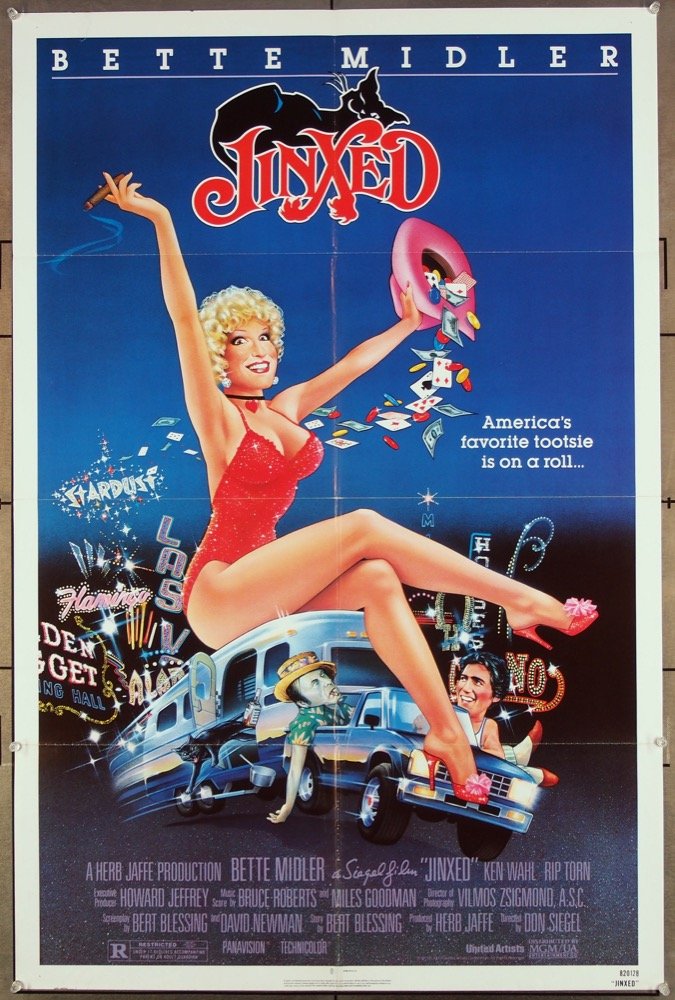
Harold (Rip Torn) is a gambler who can never seem to lose whenever he goes up against one Vegas blackjack dealer in particular, Willie (Ken Wahl). In fact Harold’s winning streak versus Willie becomes so extended that it gets him fired and he’s forced to find a similar job in Reno. Harold follows him up there and Willie’s losing ways start all over again. His supervisor (Val Avery) doesn’t think Harold is doing anything unethical and instead becomes convinced that he’s put some sort of jinx on Willie and for Willie to end it he needs to get something of Harold’s. He drives out to Harold’s isolated trailer where he resides and realizes he has a wife named Bonita (Bette Midler) who also happens to be a lounge singer. She’s sick of dealing with Harold’s abusive ways and makes a deal with Willie that they kill him and then spend the proceeds of his life insurance payout afterwards.

The movie is appropriately titled not so much for what occurs onscreen, but more with what happened behind it. The story was based on the Frank D. Gilroy novel ‘The Edge’, which was published in 1980 and then had the screen rights sold for $300,000. While Gilroy wrote the first draft it was then handed over to David Newman who did a second rewrite and from there passed onto Jeremy Blatt who did a third version before director Don Siegal and Bette Midler began doing further revisions until Gilroy finally asked for his name to be taken off the credits as the plot no longer resembled anything from the book.

The real issue though started with Siegel who was at odds with the leading lady and then eventually became stricken with a heart attack where he ceded directing reins to Sam Peckinpah who completed many of the remaining scenes uncredited. Star Wahl also found getting along with Midler to be difficult and the two feuded throughout making no secret of their disdain for each other even after the shooting was long completed.

From my standpoint the biggest problem was the casting. Midler can be a funny lady, but not in this type of role. She’s known for her snarky, brash, and outgoing personality, but here plays someone who’s shy and pensive something that just doesn’t connect with who she is at all. Maybe she wanted to step out of her comfort zone and that’s why she took the role, but she doesn’t play it convincingly and thus it’s hard to get into. Wahl isn’t up to the demands of being a leading man and it’s no wonder he retired from the business in 1996. His delivery is flat and nothing that he says, or does is engaging. He has a few amusing lines here and there, but overall seems to be phoning it in and the romantic moments between him and Midler come-off as clearly awkward and out-of-place.

There were a few elements that I did like. It captures the rustic side of Nevada quite nicely and not just Vegas, but also Reno and the rural portion of the state. You also get to see an actual, in fact there’s two of them, $10,000 bill, which the fed no longer prints making it the coolest moment in the whole movie. Torn also gives a energetic performance and could’ve put on a clinic for the other two if they had paid attention. Though during his character’s death scene he does blink his eyes and make some brief facial gestures when Midler kneels beside him and slaps him making it seem like he really wasn’t dead even though technically he was. There’s also a few too many shots of his hairy butt crack, which I didn’t particularly care for. A funny scene done inside an adult bookstore, where director Siegel gives himself a cameo as the porn shop clerk, which I found to be a highlight.

Spoiler Alert!

Unfortunately the third act veers off in a weird way where Midler goes on a scavenger hunt using cryptic letters that her deceased husband wrote her before he died, which as critic Roger Ebert describes in his review of the film, ‘paralyzes’ the movie. If anything Wahl should’ve gone along with her as they follow the clues, which might’ve strengthened their chemistry and made them seem more like real couple who could work together to solve things instead of these two individuals doing things mostly on their own.

There’s also no explanation for what exactly was causing the whole jinx thing. Supposedly the luck as it were was coming from the cigars that Torn was smoking, and which Midler later does as well, but why would these cigars bring good luck? Normally smoking cigars can’t help one win at blackjack, so what secret cosmic power did they possess, so that it made a difference in this case? There’s no answer either as to who Torn was calling on his pay phone outside of the trailer he lived in after he lost to Wahl and was now broke. It made it seem like he was conspiring, or in connection with someone else, or maybe some sort of behind-the-scenes organization, criminal or otherwise, and the film should’ve made it clear what this was about, but ultimately doesn’t.

My Rating: 3 out of 10

Released: October 22, 1982

Runtime: 1 Hour 43 Minutes

Rated R

Director: Don Siegel

Studio: United Artists

Available: DVD, Blu-ray, Amazon Video

The Black Windmill (1974)

black

By Richard Winters

My Rating: 5 out of 10

4-Word Review: Agent’s son is kidnapped.

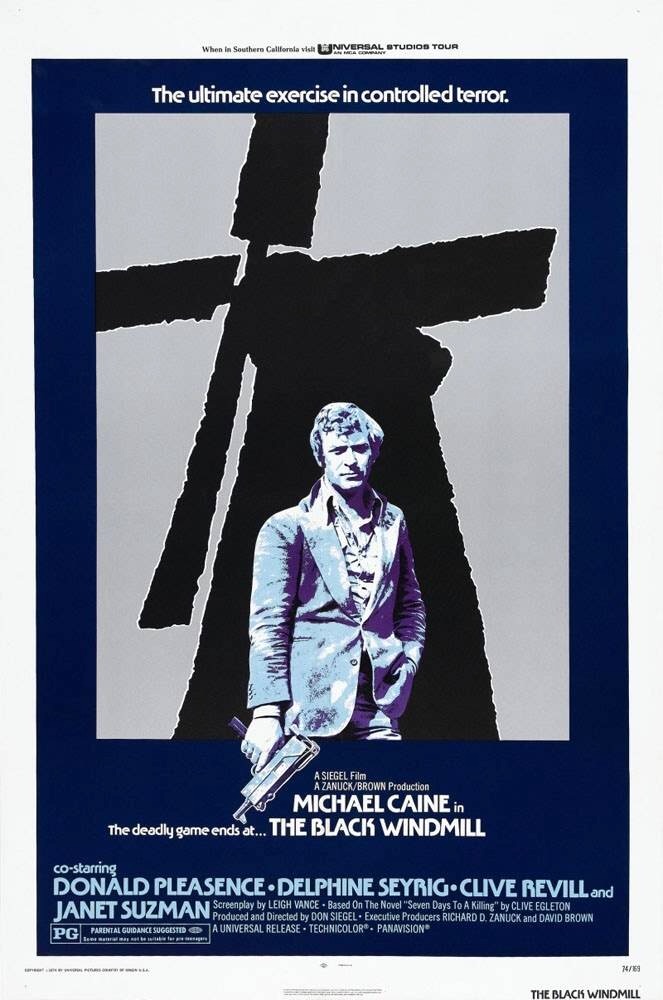
Michael Caine plays Major John Tarrant, a British Intelligence Officer, whose young son David (Paul Moss) gets kidnapped by an underground criminal organization headed by McKee (John Vernon). McKee is aware of John’s profession and insists that to get his son back he must fork-over some uncut diamonds, which had already been purchased to fund another operation. John informs his supervisor, Harper (Donald Pleasance), about their demands, but Harper begins to suspect that John may have orchestrated the kidnapping himself and thus refuses to go along with the turnover of the diamonds. Frustrated John decides to deliver them himself, but finds that he’s put himself into a perilous situation that he might not be able to get out of.

The film is based on the novel ‘Seven Days to a Killing’ by Clive Egleton and directed by Don Siegal who’s most notable for having done Dirty Harry. On the technical end it’s masterful. The lighting and editing are pristine and shot on-location in England in many scenic spots including the historic, but now closed Aldwych underground train station and the Shepherd’s Bush station as well as the climactic sequence, which takes place at the Clayton Windmills, known as Jack and Jill with Jill being built in 1821 and Jack in 1866. There’s also a terrific supporting performance by Pleasance who plays this uppity agent who won’t allow smoking in his office, nervously fiddles with his mustache, and is shocked by the forwardness of one of the other elderly agent’s younger wife, played by Catherine Schell. In fact his eye brow raising expression during his visit with her is one of the more amusing moments in the film.

The story seems a bit pedestrian with elements stolen from other better spy films including a Q-like moment where a  researcher shows Harper and John how they’ve come-up with a new invention, which is a briefcase that can shoot bullets just like a gun. Another segment has John being followed by a bad guy while hopping onto the subway, which looks like it was taken straight out of The French Connection, though much better done there.

There’s also the part where John, upset with Harper’s refusal to deliver the diamonds, breaks into Harper’s office and steals the key to the bank safe that has the diamonds in it, but this seems much too easy. You’d think an operation that has lights on top of the office doors, with green to be allowed in and red to be locked, would have a better contraption to stop someone from breaking in like burglar alarms to sound when somebody trespasses, or laser beams that would trip off and sound alarm on a mobile device carried by a security guard. Yet John is able to break-in with hardly any effort and the way he tries to disguise his voice to sound like Harper is pathetic and should’ve been enough to alert the bank manager that something fishy was going on. Also, you’d think Harper would have his eye on John, or had someone else keep tabs on him since he’d most likely be angry over the news that the agency wasn’t going to help him and thus already be predicting that he’d make an effort to steal the key before it actually happened.

The biggest issue though is that John is not emotional. His stoic nature makes him seem almost inhuman and like he may not actually care about his son’s safety at all. Supposedly this is because he’d been trained as an agent to hide his feelings, but the viewer still needs to see his softer side at some point, so we know he’s suffering inner turmoil about what’s going on and the fact that this is never shown makes it hard for us to side with him. It also gives Caine one of the flattest performances I’ve ever seen and is so stone cold it could’ve been done by a robot and you’d never know the difference.

The kid is far more engaging and if the movie had shown him more it might’ve worked better, or at least shown John and the boy together, we only see a fleeting few seconds of a photo of them, but we should’ve viewed them in a fun activity before the kidnapping, so we could feel the bond that is otherwise quite hollow. John’s relationship with his wife, played by Janet Suzman, doesn’t gel either. They’re already separated apparently because John put his career ahead of the family, but there needed to be more of an arc to make it interesting like having them bitterly at odds at the beginning only to realize they must put their animosities behind them in order to work together to find their son, but here there isn’t enough dramatic friction between the two, so seeing them rekindle things near the end packs no punch at all and like with everything else here emotionally vanquished for the audience.

My Rating: 5 out of 10

Released: May 17, 1974

Runtime: 1 Hour 46 Minutes

Rated PG

Director: Don Siegel

Studio: Universal Pictures

Available: DVD, Blu-ray