Tag Archives: David Dukes

Without a Trace (1983)

without

By Richard Winters

My Rating: 7 out of 10

4-Word Review: Her child goes missing.

Susan (Kate Nelligan) works as a college professor while also raising her 6-year-old son Alex (Danny Corkill) as a single parent. Alex normally walks 2-blocks to his school every morning in their Brooklyn neighborhood, so Susan thinks nothing of it when she waves goodbye to him as he turns the corner towards his school while she goes the other way to her job. However, when she returns home and finds that he’s not there she begins to worry. She calls her friend Jocelyn (Stockard Channing), who has a daughter the same age as Alex, only to learn that Alex never showed up to school that day. She then immediately calls the police and Detective Al Manetti (Judd Hirsh) becomes the lead investigator in the case to find the child.

The story is loosely based on the real-life case of Etan Patz who disappeared one day while walking to school on May 25, 1979. Not only did he become the first child to appear on a milk cartoon for missing children, but it also inspired Beth Gutcheon to write a novel, which was a fictionalized account of the his case that was later purchased by producer Stanley R. Jaffe in the amount of $350,000 to turn it into a film, of which Gutcheon was hired to write the screenplay.

While the film has a riveting quality that keeps you watching it does also have a certain ‘genteel atmosphere’ that critic Leonard Maltin complained about in his review, that keeps it a bit sterile for its own good. The film acts like child abduction is almost a novelty that’s rare to happen and shocking when it does though kids can go missing each and every day in this country. The detective states that children can be sexually molested by adults though if children came forward about it they’d ‘never be believed’ or ‘taken seriously’, which is something that I think has certainly flipped the other way in this day and age. He also brings up the subject of child porn, which gets called ‘chicken porn’ here, and parents respond in a naive way to this concept, which again is something I think most adults in this era would’ve been familiar with its existence and not act like they’re being told about something completely new they had never heard about.  The police also ‘set-up-shop’ in the women’s apartment turning it into a virtual police station and remain there day-and-night for 6-weeks, which I couldn’t see happening now.

The sequence with a psychic, played by Kathleen Widdeos, I found unintentionally laughable. Her ‘visions’ are quite vague and when she gets pressed to give something specific, like the license plate number of the car, or identity of the kidnapper, she can’t. Yet the mother acts relieved when the psychic says the child is still alive, but since her ‘information’ is so nebulous she could be a con artist making it all up and no one would know the difference.

David Dukes, who plays the ex-husband and father of the child, who at this time was best known for playing the man who tried to rape Edith Bunker, in a memorable episode of the classic TV-show ‘All in the Family’ of which he received several death threats, plays the only character that shows any emotion and thus the only one who stands-out. The movie also examines the detective’s home-life, which I didn’t feel was needed. Normally I say it’s good when we learn more about a cop’s private side, but since he wasn’t the film’s protagonist I didn’t find it necessary and only helps to lengthen the film’s runtime, which was too long anyways and could’ve neatly been told in only a 90-minute time frame instead of 110 minutes.

I did come away liking Nelligan’s performance, some critics at the time labeled her as coming-off as ‘cold’, but I felt she did alright, but was kind of disappointed that Stockard Channing didn’t get the lead instead. At the time Nelligan was considered the up-and-coming star while Channing had been mostly relegated to comedy including two failed sitcoms, but in retrospect Channing has become the better known actress and proven to be highly versatile, so seeing her in the part of mother would’ve been quite interesting and she might’ve even been able to do it better.

Spoiler Alert!

My biggest beef though is with the ending, which is much different than in the actual incident. In the Patz case his body was never found and it turned into a cold case for many years before a man named Pedro Hernandez came forward in 2012 and confessed to the crime. Here though the boy gets found alive having been kidnapped to help take care of a man’s disabled adult sister, but it’s very hard to fathom how much help a 6-year-old could be expected to give an adult woman nor has there ever been in the annals of crime where a kidnapping has been done for this reason. Having the kid immediately answer the door of the home he is supposedly being ‘confined in’ hurts the tension and would’ve been more suspenseful had the police had to search the place before finally finding him hidden somewhere. Also, if the kid is able to open the front door then what’s stopping him from running out at some point and finding help?

The fact that a neighbor woman named Malvina Robbins (Louise Stubbs), who lives next door to the kidnappers and keeps calling the police about it, but they ignore her, really hurts the credibility of the Manetti character who we’re supposed to like and he’s portrayed as being ‘super dedicated’. If that’s the case then he should’ve followed-up on every single lead he could’ve even if he thought some of them might be ‘cranks’ it shouldn’t matter because you just never know. The fact that he doesn’t do this even after she calls the police hundreds of times makes it seem like a dereliction of duty who should be investigated for not  following up and certainly not some ‘hero’.

I realize most audiences want some sort of resolution and making a movie like this that doesn’t have one might prove frustrating, but in real-life a lot of cases like these don’t get resolved, or if they do the findings are a grim one. To have a movie stay realistic the whole way only to tack-on a feel-good ending does a disservice to the many parents whose missing children never come home and thus hurts it from being as insightful and compelling as it could’ve been.

My Rating: 7 out of 10

Released: February 4, 1983

Runtime: 1 Hour 50 Minutes

Rated PG

Director: Stanley R. Jaffe

Studio: 20th Century Fox

Available: DVD-R, VHS
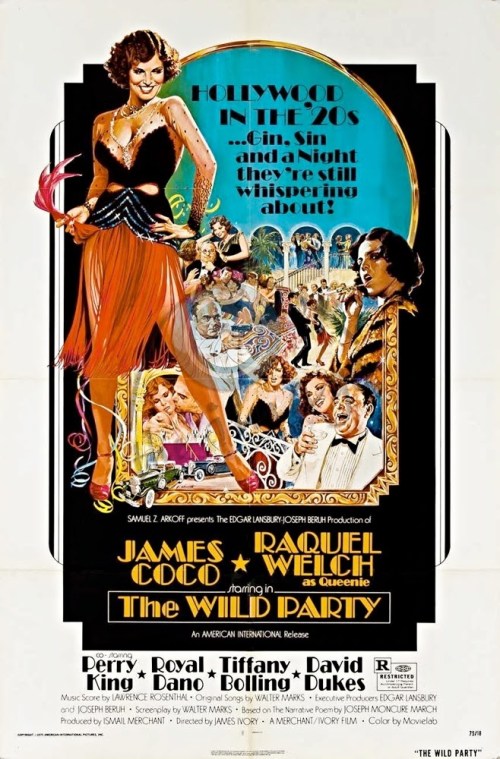
The Wild Party (1975)

By Richard Winters

My Rating: 3 out of 10

4-Word Review: Slumming actor stages comeback.

The year is 1929 and Jolly Grimm (James Coco) the once successful silent film star now finds himself, with the advent of talking pictures, to be in low demand. Although his movies once made a killing his style of humor is now considered cliched and with no studio willing to fund his latest pic he’s forced to use his own money to get it made. He holds a lavish party in his mansion inviting many Hollywood elites who he hopes will show an interest in his movie once he screens it to everyone, but instead his guests are more into each other as the party quickly devolves into a wild sex orgy with even Jolly’s faithful girlfriend Queenie (Raquel Welch) cheating on him with a much younger and better looking actor (Perry King).

The story is loosely based on the 1926 poem of the same name by Joseph Moncure March while the Jolly character was inspired by Fatty Arbuckle a famous silent film comic who was accused and the later acquitted of the rape and manslaughter of actress Virginia Rappe in 1921. The script though by Walter Marks doesn’t seem to know what tone it wants to take as at times it seems like a trenchant drama while at other moments it comes off as a surreal comedy. The original intent was to turn it into a musical, which would’ve been a better idea as the lack of cohesion causes the pacing to be completely off and never allows the film to build any tension or momentum.

The party scenes are not interesting or provocative and in many ways it’s a poorman’s version of Day of the Locust which came out at the same time and had a similar theme, but a far stronger impact. The sex is stagy and mechanical and seeing all the guests sprawled in a symmetric way on the floor the next day throughout the mansion looks too surreal-like to be even remotely believable. The party’s only interesting moment is when Jolly has a meltdown by going on a long angry rant that reveals his ugly side to his guests, but the filmmakers botch this sequence by focusing solely on Coco instead of cutting away to show the shocked reactions of the party-goers.

Coco, in his only starring vehicle, does quite well in a role I didn’t think he was equipped for. Welch gives an equally strong performance, possibly the best of her career, but the relationship of their two characters made no sense. Director James Ivory tries to flesh them out by having the two at different moments go on long soliloquys explaining what attracted them to the other, but in both cases it rings hollow. So what if Coco treated Welch with respect and asked her ‘deep questions’ when they first meet, which is apparently why she fell for him, he’s no longer doing that now, so why stick with him? Coco’s statement, that he couldn’t ‘live without her’ comes off as equally absurd since every time he talks to her he’s abusive.

The relationship angle should’ve been scrapped as it’s Jolly’s mental deterioration that is more interesting.  A far better and more realistic scenario would’ve had Coco coming onto a young starlet such as Queenie at the party but she would reject his advances and then later when he saw her with a younger actor it would set off his already shaky ego, which would then precipitate the violence.

Spoiler Alert!

The shooting that occurs at the end isn’t effective. The film is filled with so many lulls that by the time it finally gets to it you really don’t care who dies and who doesn’t. Having it occur the next morning after the party is already over seems anti-climactic and something that should’ve been witnessed by all the guests. It’s also a bit frustrating to have it end so abruptly without any aftermath or denouncement given.

End of Spoiler Alert!

Tiffany Bolling and Perry King add some zest in support especially with their facial expressions and the sultry dance done by Chris Gilmore (who gets billed here as Annette Ferra) adds a weird sensual vibe. However, having David Dukes’ character break the fourth wall and begin speaking directly to the camera as he describes the party guests is a distraction, which only  further cements this as a misguided misfire that needed better focus.

My Rating: 3 out of 10

Released: March 4, 1975

Runtime: 1 Hour 47 Minutes (Director’s Cut)

Director: James Ivory

Studio: American International Pictures

Available: DVD, Amazon Video

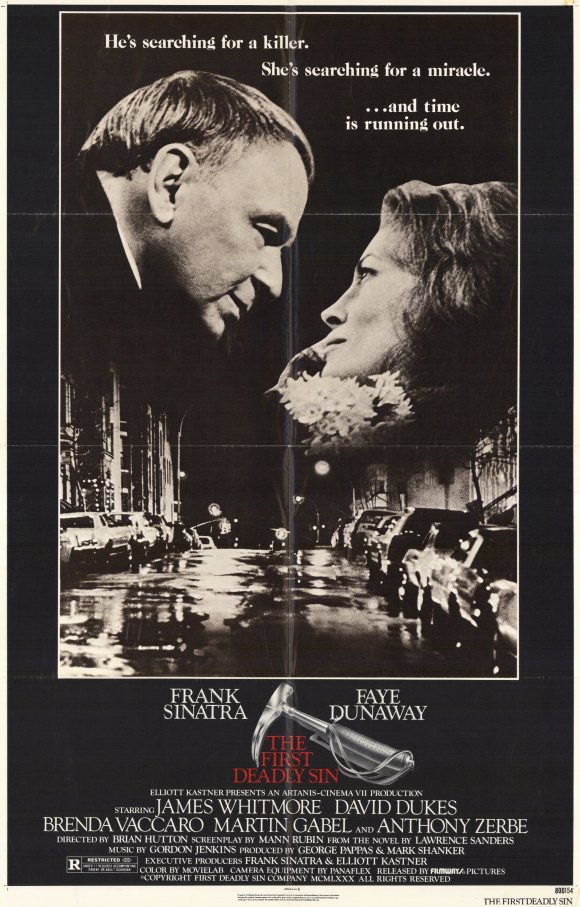
The First Deadly Sin (1980)

the first deadly sin

By Richard Winters

My Rating: 4 out of 10

4-Word Review: Aging cop tracks killer.

Based on the best-selling novel by Lawrence Sanders the story centers around Edward Delaney (Frank Sinatra) a cop only weeks away from retiring who becomes obsessed with tracking down a serial killer who hits people on the back of their heads with a sharp edge hammer as they are walking down the street. The problem is he has only a few clues to go on and his wife Barbara (Faye Dunaway) is in the hospital suffering from a mysterious illness that causes him additional stress and strain.

The film takes a refreshingly different approach to police work than what you will usually find in most Hollywood cop pictures. Instead of emphasizing exciting car chases and thrilling shoot-outs it instead analyzes the meticulous and often times tedious work that goes into following up every little lead while working inside a rigid system and under superiors that aren’t always supportive.  For the most part this is done quite well and at times it is even enlightening, but the whole first half is spent with Delaney trying to figure out what type of weapon was used in the killing even though we the viewer know what it is since we are shown the actual murder at the very beginning thus making the first hour seem quite derivative.

Having the film cut back and forth between scenes of Delaney and the killer doesn’t work. The psycho is played by David Dukes probably best known for playing the man who tries to rape Edith Bunker in a classic episode of ‘All in the Family’. He is a good actor, but scenes showing him alone are clichéd and at times even unintentionally funny. Director Brian G. Hutton should’ve cut them out completely as having the viewer come to realize who it is along with Delaney would have deepened the mystery angle and made it overall more intriguing.

The scenes with the sick wife don’t work either. For one thing we never find out what the mysterious illness is, which is highly frustrating and annoying. It also doesn’t make the plot or character any more interesting. Dunaway is a superior actress and she makes the most of the role’s limitations, but I felt an actress who was more Sinatra’s age would have made it more realistic instead of casting a woman who was 27 years younger.

I have always enjoyed Sinatra in his detective roles, but the character here isn’t as caustic as in some of his older films. For the most part he is pretty benign and even kind of boring. Joe Spinnell though makes the most of his bit part as an overzealous doorman who believes in rigidly following the rules and taking great pride in his doorman duties, but quickly willing to bend them the minute he is given some bribe money.

The final showdown between Delaney and the killer is quite unusual and much more low-key than you might expect. I enjoyed the twist that comes with it, but it lacks a strong impact and the film would have been better served had it had just a little more action.

This movie is also famous as being Bruce Willis’s film debut. He can be seen at the 1Hour 34Minute mark coming into a bar as Delaney walks out. He has a cap over his head and covering his eyes, but you can clearly see just by looking at his mouth that it is him.

My Rating: 4 out of 10

Released: October 3, 1980

Runtime: 1Hour 52Minutes

Rated R

Director: Brian G. Hutton

Studio: Filmways Production

Available: DVD, Amazon Instant Video