Tag Archives: Brenda Vaccaro

Once is Not Enough (1975)

once

By Richard Winters

My Rating: 0 out of 10

4-Word Review: Having a father fixation.

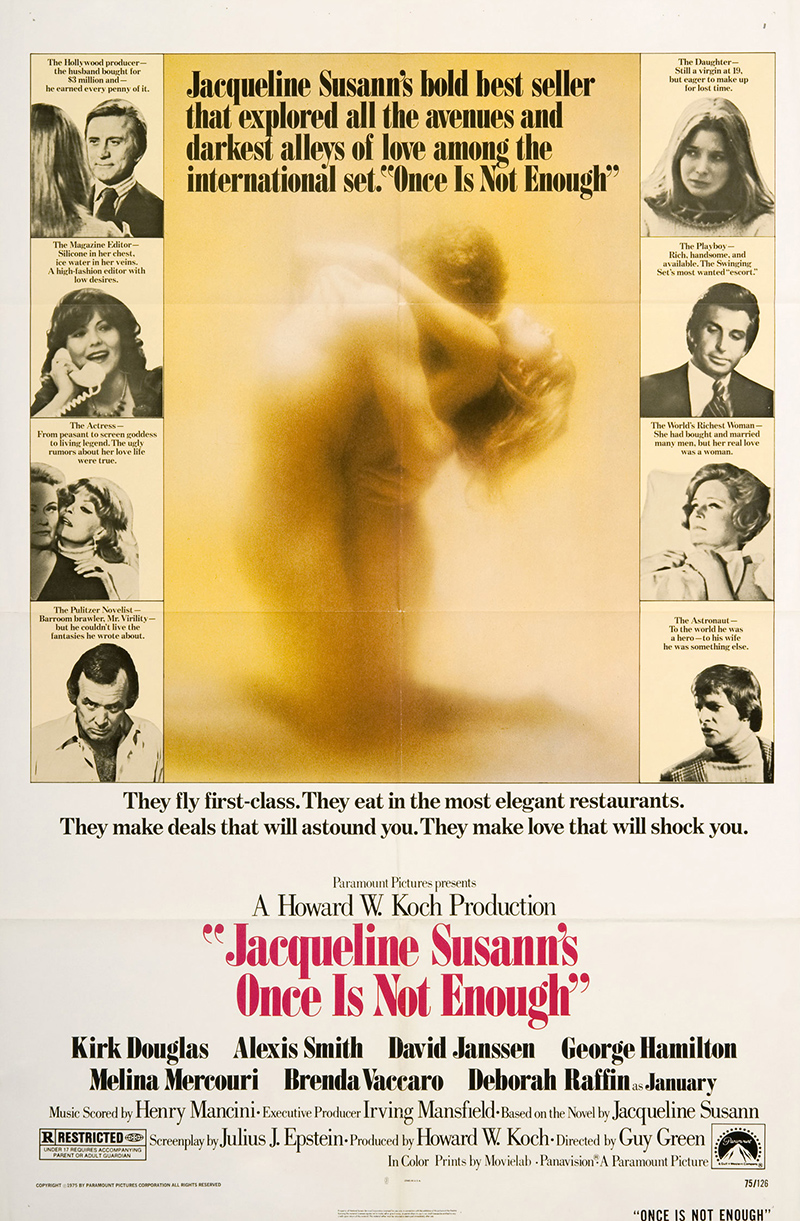
January (Deborah Raffin) is the college-aged daughter of wealthy Hollywood producer Mike (Kirk Douglas) who spent time recovering from a motorcycle accident in Europe and now returns to the states excited to see her father of which she adores immensely. Unfortunately things have changed since she’s been gone. Mike no longer has the clout, or capital that he once did and now can’t get any of his projects off-the-ground. He’s married rich socialite Deidre (Alexis Smith) simply as a way to get his hands on some money as he no longer has any of his own, but she’s more into her lesbian affair that she’s having with Karla (Melina Mercouri). Feeling dejected at how things have turned-out January falls into the arms of Tom (David Janssen) an alcoholic semi-successful novelist who suffers from impotency. When Mike learns of this relationship he becomes enraged as Tom has long been one of his biggest adversaries and so he goes to the apartment where the two are staying determined to have it out with the both of them.

The film is based off of the final novel written by Jacqueline Susann who became famous for having penned the popular Valley of the Dolls 7 years earlier. This book, like her two other ones, shot-up immediately to the top of the Best Seller’s list and she became the first author to ever have her first three novels achieve this, but her ability to savor her success was short-lived as she was diagnosed with cancer shortly after the book went to press and she never lived to see it made into a movie.

The book, like her other ones, was widely panned by the critics, but this movie here does it no justice. When compared to Valley of the Dolls this thing has absolutely no zing and nothing that’s truly salacious or tawdry, which were the main elements that gravitated folks to read Susann’s books in the first place. The only ‘shocking’ moment comes during the lesbian segment, which was considered ‘pushing-the-envelope’ at the time, which shows two older actresses kissing each other on the lips, which by today’s standards will be seen as quite trite and forgettable. The other potentially spicy moments never come to play and it ends flatly making you wonder what were they thinking when they made it.

Raffin, a former model, is quite beautiful and the best thing in it, but her character is too innocent to be believed. She’s a virgin despite being raised in the fast lane of Hollywood, which seemed hard to believe. Supposedly this is because she’s so infatuated with her father she’s subconsciously ‘saving herself’ for him, but a person could have sex outside of a romantic context and I’d think since most of her other friends would’ve have likely done it she’d be at least curious enough to try it out. The same goes for her inexperience with drugs, alcohol, or even dealing with womanizing men such as George Hamilton’s character who fills her glass to the brim with brandy and when she asks why he says so he can ‘get her drunk, so she’ll lose her inhibitions’ and she’s shocked to hear this, but any young women living in L.A. during the swinging 70’s should conditioned and prepared to this age-old ploy and having her so taken aback by it makes her too painfully naive to be believable. Instead of being a producer’s daughter she seems more like some nun snatched from a  convent she’s been living in her whole life and completely out of whack with her surroundings.

Douglas is a complete bore and I can only imagine he took the role simply because he was on a career decline and needed the work, but despite being center stage during the first half, his character slowly fades out and is completely forgotten by the end. Alexis Smith, whose acting work had also been in a downward spiral, this was her first movie role in 16 years, and was only given the part because Lana Turner, who was the producer’s first choice, turned it down as she objected to having to do the lesbian kissing scene, is sufficiently bitchy, but overall wasted.

Brenda Vaccaro won accolades for her performance and was even nominated for the Supporting Oscar for her work, but I was a bit surprised. I’ve always found her an impressive actress, but playing some jaded California gal that likes to openly sleep around isn’t that interesting and her character lacked depth. The part where she tries to quickly clean-up her cluttered bedroom before letting a new man into it was kind of amusing, but otherwise her presence, like all the others, was quite tepid. I did though enjoy Hamilton, this marked his last serious role before he then began to venture into comedy, not so much for his acting, but more because I felt this role most closely resembled his true personality. Janssen has some potential as this brash, abrasive guy, but then having his lifelong impotency suddenly and magically ‘cured’ after seeing Raffin nude in the shower is just downright laughable.

Spoiler Alert!

The biggest letdown is the unexciting ending. In the book January gets into acid and then partakes in a sex orgy only to eventually walk into the ocean and drown after seeing a vision of her dead father. The movie though, in an attempt to be ‘hopeful’, doesn’t show any of this. It just has her walking around the city in a daze and that’s it. A movie like this needs, especially with this type of soap opera material, some sort of salacious pay-off and seeing a once innocent, naive girl in an acid driven orgy would’ve been just the ticket, so for the filmmakers not to give the viewer even that much makes this whole vapid thing pathetic beyond belief.

My Rating: 0 out of 10

Released: June 20, 1975

Runtime: 2 Hours 1 Minute

Rated R

Director: Guy Green

Studio: Paramount

Available: DVD, Blu-ray, Amazon Video, YouTube

Zorro, The Gay Blade (1981)

zorro

By Richard Winters

My Rating: 4 out of 10

4-Word Review: Brothers become masked hero.

Diego (George Hamilton) is living in Madrid, Spain during the 1840’s when he receives a letter from his father ordering him to return to California. Once there he meets Esteban (Ron Liebman) whom he shared a friendship with when the two were children. Esteban has now married Florinda (Brenda Vaccaro) who Diego had a crush on when they were younger. He has also become Magistrate of the region upon the death of Diego’s father who suffered from a riding accident when his horse became startled by a turtle. Later Diego receives his inheritance, which turns out to being the disguise worn by Zorro the famous hero throughout the region. Diego now takes on the hero’s persona as he battles with Esteban who oppresses the already impoverished citizens of the area with high taxes. Unfortunately Diego breaks his ankle while jumping off a high balcony and is forced to turn-over his Zorro duties to his gay brother Ramon (also played by Hamilton) who uses a whip instead of a sword while also wearing flamboyant, color coordinated attire.

Hamilton’s career by the late 70’s had nose-dived to the point it seemed on life support until the surprise hit Love at First Bite helped revive it. This lead to many starring opportunities in the comic vein. He eventually decided to take this one since it allowed him the option to also be producer, but the film ultimately tanked at the box office killing off any more offers and he was never in another film for the rest of the decade and today he’s known less for his screen work and more for his vain persona, perpetual perfect tan, and appearing on reality shows dealing with has-been celebrities.

I’m not sure why this film is so obscure and hard-to-find as it’s not streaming anywhere, nor available on blu-ray while it’s DVD issue is from 20 years ago. Maybe it’s because of a white guy playing a Latino, though with Hamilton’s tan you’d never know, or maybe it’s because of the over-the-top caricature of the gay brother that could be deemed ‘controversial’ by today’s generation, but overall it’s adequately amusing for the most part. Hamilton is especially energetic and is the main reason it’s watchable though I felt it misses-the-mark when Diego goes from regular dude to caped crusader too easily. I would think becoming a masked super hero would bring in a certain learning curve that would invite mistakes to occur along the way. Outside of spraining his ankle no other missteps happen, which loses out on a lot of potential comedy.

Leibman as the bad guy is terrible as he overplays the campiness too much. A villain, even in a comedy, should have some threatening ability and this guy comes-off as a complete doofus from the get-go, so there’s never any suspense since we know this inept idiot’s bark is far worse than his bite. He also conveys his lines in a shrill tone that genuinely hurt my ears though he does have one good bit where he wiggles his hips in an attempt to replicate gay mannerisms, which is the only part of this movie that I remembered from when I first saw it over 40 years ago.

Vaccaro for her part is quite funny as she manages to balance the campiness with character’s personality in just the right way, so it seems organic. If anything I thought she should’ve been the heavy and Leibman could’ve been fully kicked-out. Lauren Hutton on-the-other-hand, who plays the other female lead as an idealistic woman fighting for change, and also Diego’s potential love interest, isn’t funny at all and is quite bland. I felt too that the idealistic period are usually when people are college-aged, so they should’ve cast a woman that was more that age, of which Hutton was clearly way past.

While there is a few chuckles here and there it overall comes-off as quite empty and limp. Not enough happens to make it intriguing and memorable. The sword fights become redundant and the hero is never put in any type of real peril. The humor is too constrained and needed to be played-up much more as does the sexual aspect. This was done when just having a gay character was considered ‘edgy’, but now seems quite pedestrian. There’s also only a few filming locations, so the visual backdrop offers little variety. The final shot has the heroes riding off into the sunset, which looks to be a painted backdrop, and it probably was, that just accentuates the film’s cheap looking production.

My Rating: 4 out of 10

Released: July 17, 1981

Runtime: 1 Hour 33 Minutes

Rated PG

Director: Peter Medak

Studio: 20th Century Fox

Available: DVD

Ten Little Indians (1989)

tenlittle

By Richard Winters

My Rating: 3 out of 10

4-Word Review: Everybody is getting killed.

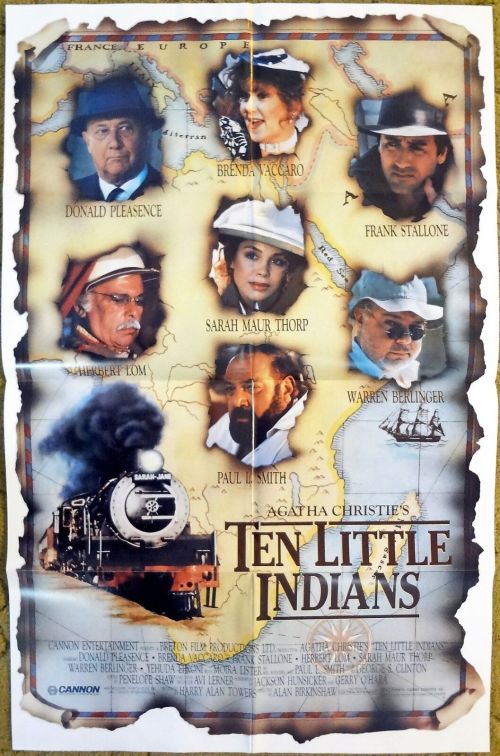
Ten strangers get together on an African safari. The group includes: A doctor (Yehuda Efroni), a judge (Donald Pleasance), a captain (Frank Stallone), an actress (Brenda Vaccaro), a General (Herbert Lom), a nanny (Sarah Maur Thorpe), a detective (Warren Berlinger), along with a man named Marston (Neil McCarthy), and a couple with the surname Rodgers (Paul L. Smith, Moira Lister). They’ve been invited by a man named Mr. Owen, but upon their arrival he’s nowhere to be found. Instead they hear his voice that’s been recorded onto a phonograph where he tells them that they’ve been invited because they’ve been accused of committing a crime years ago and gotten away with it, but he intends to put a stop to that by killing them off one-by-one. As each guest gets murdered one of the heads from the ten little Indians statues that sits in the middle of the dining room table goes missing.

The film has the distinction of being the third movie version of the story done by producer Harry Alan Towers as the first one was produced in the 60’s and the second, which also starred Lom, in the 70’s. The story itself is based on the Agatha Christie novel ‘And Then There Were None’ though the ending was changed to replicate the stage play, which was considered more upbeat. While in the novel and play the setting was an island here it’s the desert of South Africa, which I liked as it gives the proceedings a distinct atmosphere. However, there’s an unusual moment at the beginning where the natives help carry the guests’ luggage to the camp site, but then halfway there for no explicit reason they turn on them by clicking their tongues in unison and ultimately abandoning them, which is creepy, but there’s never an explanation for why they do this.

The landscape looks hot and dry though there’s no sweat glistening off the actor’s faces leading me to believe it was shot in the winter time and thus the complaints about the heat, which are casually mentioned are invalid. I did get a kick out of one of the tents, the main one, having an upright piano. Don’t know who in the world would want to painstakingly haul a piano into the desert sands, or essentially the middle of nowhere, but the appearance of it gave me a chuckle. I was also amused by the elevated lift, held together by a frayed rope, that each guest is forced to sit-in as it takes them many feet in the air of a wide gorge, in order for them to get to the campsite. The contraption looks flimsy and it’s rather unnerving seeing them get into it and ride it all the way down.

The acting is entertaining and made-up of many B-stars whose faces you’ll recognize though not necessarily their names. Vaccaro fares best as a bitchy, spoiled, Hollywood star whose career has gone on the decline. Lom is good as an aging man whose memories plays tricks on him, but Stallone, who’s the younger brother of Sylvester and could almost pass of as his twin, has little to add. Berlinger had gained a lot of weight to the point that he’s rounder than a beach ball, is adequate, but the normally reliable Pleasance appears elderly and lacking energy making his presence almost sad. Smith continues in the mold of the jail guard in Midnight Express, a part that made him famous, but his heavy breathing and lurking ways are not interesting and his acting one-note.

The mystery angle doesn’t get played-up too well as the guests get killed-off with a boring regularity making it at times seem almost like a low-grade slasher. The characters don’t respond to their stressful conundrum realistically. For instance one of the guests dies by drinking alcohol that was linked with cyanide, but the rest of them in the ensuing days go on eating and drinking even though you’d think they’d be nervous about ingesting anything for fear that whatever they put in their mouths could also poisoned. They also go back to their tents each night and peacefully sleep despite seeing the other guests get offed by a unseen killer, which would’ve made me, and most others too fearful to get any shut-eye and instead stay wide awake for fear that the killer would attack the minute anyone closed their eyes.

Spoiler Alert!

The tension is nil and there’s really no interest in finding out who the culprit is. In the book everyone dies and the authorities are only able to figure out what happened from a message that they find written by the judge. Here both Stallone and Thorp make it out alive though Thorp lets go of the rope that had been around her neck just as Stallone comes to her rescue making me believe that she would’ve hung herself before he would’ve been able to get her out of the noose. The rescue plane flies over them instead of landing making it unintentionally seem like they had been left stranded and not saved after all. Having everyone die except for Stallone, which is what I thought was going to happen, and then having him arrested for the murders he really didn’t commit would’ve been a much more ironic twist.

My Rating: 3 out of 10

Released: May 17, 1989

Runtime: 1 Hour 38 Minutes

Rated PG

Director: Alan Birkinshaw

Studio: Cannon Films

Available: Blu-ray, Tubi

I Love My…Wife (1970)

ilove

By Richard Winters

My Rating: 6 out of 10

4-Word Review: He’s bored with marriage.

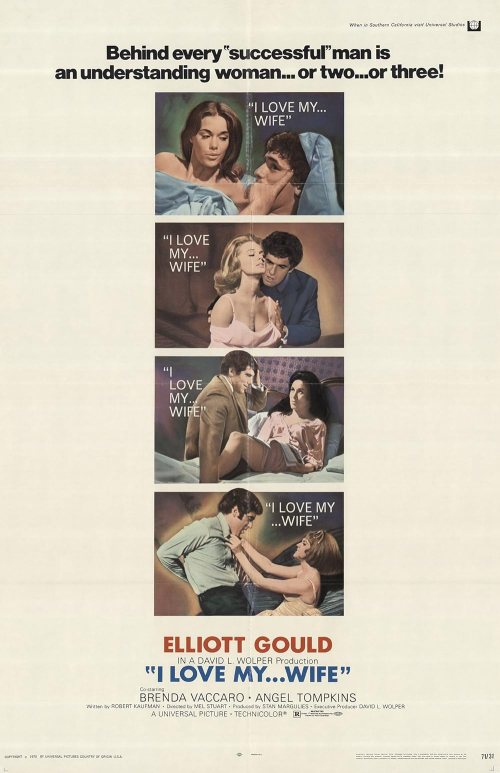
Richard (Elliot Gould) is a medical student when he meets Jody (Brenda Vaccaro) and the two quickly fall-in-love and get married. She then gets pregnant while he’s still in school and they don’t believe they have enough money to financially support a child, so they initially consider an abortion, but at the last minute Richard changes his mind and feels they should have the child. Jody though gains a lot of weight during the pregnancy, which Richard finds unattractive. Once the baby is born she’s unable to burn-off the excessive pounds causing their sex life to go even further into the tank. He has a few flings with some of the nurses before finally setting his sights on Helene (Angel Tompkins) a beautiful model who’s married to a baseball star (Dabney Coleman). At first she resists his advances, but the two eventually bed and then fall-in-love. She insists that Richard leave his wife, so that they can be together and no longer have to meet-on-the-sly. Richard tries to break-up with Jody, but because they have two kids finds that he can’t and instead begins lying to Helene as he plays both women at the same time, which soon turns into a losing situation.

The odd way this thing opens really hurts it and although it does improve a bit as it goes along some viewers may not be patient enough to stick with it. Having the opening credits deal with Richard’s relationship with his mother (Helen Westcott) and the sheltered way that she raised him isn’t funny and because the mother never appears again in the movie it wasn’t worth introducing her at all. Since the wife is the main focus I felt the opening scenes should’ve dealt with their dating period, which the movie breezes over too quickly. The clips from old movies, which get spliced in from time-to-time, add nothing and make it seem too much like Myra Breckenridge, which came out around the same time and best left forgotten. At least in that movie the clips came at predictable intervals, but here it’s sporadic making it seem, when they do get shown, as jarring and out-of-place.

Gould certainly excels at this type of role and he’s quite possibly the only actor who could play a shallow person and still manage to make it come-off as semi-likable. Vaccaro though is the real surprise as she’s usually best at drama and initially I felt she was miscast, but she comes through in making her character complex and even amusing as she goes through her tirades, some of it justified, at Gould. This is also the first movie to ever explore the issue of women who gain weight during their pregnancy, but can’t lose it afterwards and how this could affect their sex life, which I felt deserved kudos for being ground-breaking. The film makes the mistake though of showing too much from her point-of-view to the extent that we start to sympathize with her over the main character and almost start to dislike him in the process.

The introduction of Helene really does help as it’s her presence that gives the story a unique angle. Before this it comes-off more like your typical run-of-the-mill flick about a cad of a husband who can’t stay faithful, which has been done a lot and this movie doesn’t add anything insightful in that vein. However, the affair itself is interesting. For one thing she plays hard-to-get and doesn’t just jump immediately into the bed sheets at Gould’s beck-and-call, which is good as too much of the time, especially in 70’s movies, the women seem way too easy in a way that isn’t realistic. What I liked even more though is that the affair really doesn’t solve anything. Sure he finds her hot and sexy and they do get along, but she also has demands of her own and Gould finds himself in the same quandary as with his wife showing how extra marital flings really aren’t the ‘escape’ that they’re intended, but instead more of a problem.

Spoiler Alert!

The script by Robert Kaufman brings out many harsh truths about marriage and doesn’t insult us with any placid answers. Yet when the movie should go hard it goes soft instead. I liked how Vaccaro, who spent the whole time trying to win him back, finally gives up and starts seeing someone else, but Gould though upset and rebuffed, doesn’t learn anything from it. He goes back to the bar and tries picking-up an attractive stewardess he meets like he’s now making some sort of ‘fresh start’ when the film spent its entire running time exposing how this ‘cruising for chicks’ is a vicious cycle that just leads to more emptiness. Seeing Gould’s character change, or learn from his mistakes and display some regret would’ve been a far better way to have ended it.

My Rating: 6 out of 10

Released: December 21, 1970

Runtime: 1 Hour 38 Minutes

Rated R

Director: Mel Stuart

Studio: Universal

Available: DVD-R (dvdlady.com, modcinema.com)

Summertree (1971)

summertree

By Richard Winters

My Rating: 6 out of 10

4-Word Review: Dropping out of college.

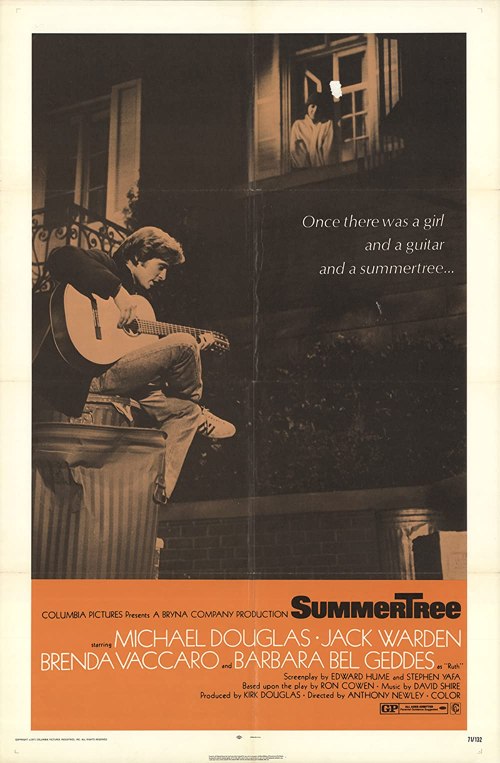
Jerry (Michael Douglas) is a 20-year-old university student who finds going to college to be drag as he’s disinterested in the subjects being taught and would rather play his guitar for a living. Since the year is 1970 his parents (Jack Warden, Barbra Bel Geddes) fear that this could get him drafted and advise against it, but Jerry refuses to listen convinced that he’ll get accepted into the conservatorium, which will restore his student draft deferral. In the meantime he also starts up a relationship with Vanetta (Brenda Vaccaro), a local nurse he meets when he brings in Marvis (Kirk Calloway), a black youth he’s spending time with through the big brother program, into the hospital after he skins his knee. Everything seems to be going Jerry’s way, he even gets a job playing his guitar at a local coffeehouse, but then the draft notice comes in the mail and the  music school decides, to his shock, not to accept him. He feels he has no other choice but to escape to Canada, but Vanetta does not want to go with him and his parents don’t think this is a good idea and secretly plot to prevent it.

The film is based on the stageplay of the same name by Ron Cowen that was produced in 1967 and originally had Douglas cast in the lead only for him to get fired during the rehearsal phase and replaced by David Birney, which so incensed his father Kirk, that he bought the rights to the play in order for it to be made into a film that his son could star in. It’s directed by Anthony Newley, which is an unusual choice since Newley was from Britain and not as affected by the Vietnam war and also for the fact that he was mainly known as an actor, writer, and singer with very little hand in directing. Overall he does okay, but the song done over the opening credits, which is sung by actor Hamilton Camp, is atrocious and makes you want to turn it off before it’s even begun. The stop-action ‘comedy’ done through a home movie type look, that gets shown while the horrible song is played, is bad too making this thing really stumble out of the gate though it manages to recover.

The plot works like three stories compressed into one. The segments dealing with Jerry’s relationship with the child, who is very streetwise and foul mouthed, but still quite engaging, are the best. His attempts to form a relationship with Vanetta though prove awkward as he follows her down a lonely dark alley late at night, which would make him seem by today’s standards like a stalker, and then taking her out to a cemetery on their ‘first date’ when it’s pitch black out would not be something most people would find romantic and instead quite creepy. Vaccaro is a great actress though more in roles featuring strong women and not necessarily as a love interest. This did precipitate a long on-going relationship between the two in real-life that lasted 6 years and for voyeurs you also get to see her topless as she rarely ever did nude scenes, but for whatever reason decided to do it here.

Spoiler Alert!

His relationship and conversations with his parents I initially found interesting. Coming into the movie I thought this would be a long, drawn-out arguments of conservative old-school parents and the liberal kid, but that’s not really the way it works. The parents are against him going to war as much as he is and it’s only the staying in school part that they find disagreement, but then when he decides to go to Canada in a last ditch effort to avoid the draft suddenly they’re against that too even to extent of trying to bribe a mechanic to fiddle with Jerry’s car, so he can’t drive it, but why? The shift in their perspectives seemed too quick. If they’re concerned they might not be able to see him much if he’s stuck in another country it would still be better than him coming home in a body bag and even if he does come out of it alive he’d be emotionally scared, or physically disabled for life, which wouldn’t occur if he was in Canada, so from my perspective the parents should’ve supported his ‘escape plan’ and the fact that they don’t needed more explaining.

The ending in which the parents are in their bedroom, with Jerry now off to war, and them acting like ‘everything will work out’, which is a far cry from what they thought before, gets botched. For one thing there’s an issue of Life magazine sitting on top of the TV talking about the weekly body count from the war on it’s cover, but I would think the parents would’ve thrown that out as they wouldn’t want to be reminded that their son may soon become one of those statistics and just leaving it in a place where they’d constantly be reminded of it didn’t seem realistic. They also both roll over and go to sleep while leaving the TV on, but who does that? Seeing an image of Jerry’s dead body being carried away on the TV isn’t the shocking surprise that the filmmakers though it would be as as the film spends a lot of time priming the viewer that is what it’s leading up to making the final image corny and even tacky instead of riveting.

My Rating: 6 out of 10

Released: June 9, 1971

Runtime: 1 Hour 29 Minutes

Rated R

Director: Anthony Newley

Studio: Columbia Pictures

Available: DVD, Amazon Video, YouTube

Fast Charlie…….the Moonbeam Rider (1979)

By Richard Winters

My Rating: 4 out of 10

4-Word Review: Cross country motorcycle race.

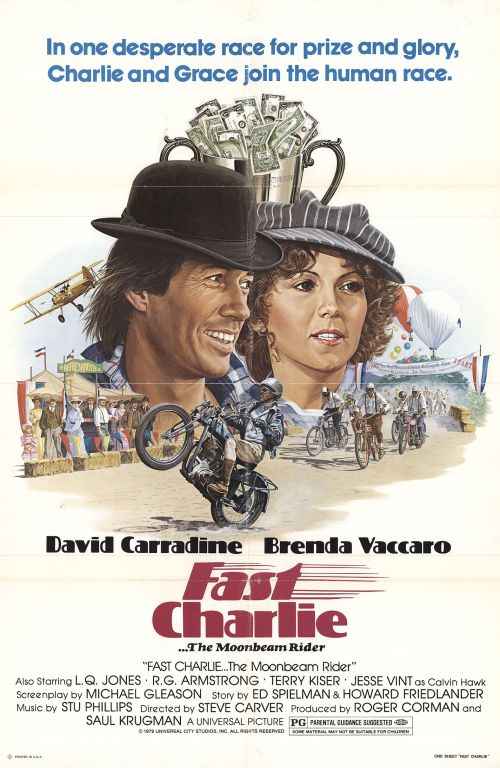
Charlie Swattle (David Carradine) is a WWI veteran and full-time conman who decides to enter into a transnational motorbike race that goes from St. Louis to San Francisco and will offer a big money payout to the winner. He tries to get his army buddies to help him, but they’re reluctant due to the belief that he’s a deserter. He then meets up with a sassy waitress (Brenda Vaccaro) who agrees to offer assistance, but only under stringent conditions.

The film is adequately entertaining but hurt by an uninspired, modest budget look. While efforts were made to make it appear like it were the 1920’s there’s no style to the direction nor any atmosphere. Too much emphasis gets placed on the cutesy comedy, which further erodes any semblance that this is an authentic period piece, which it clearly isn’t.

It takes a full hour before the race even gets going with the whole first half spent on the comic interpersonal relationships/banter that Charlie has with those around him. The race does have a few exciting moments including the point-of-view shots shown from the rider’s perspective as the motorbike careens down the bumpy backwoods dirt roads, but having the entire film shot in Oklahoma is a letdown. This is a race that is supposed to go across many different states and landscapes, but instead we’re given only one type of topography, which was obviously done for budget considerations, but ultimately comes-off like a cop-out.

Things do improve with the presence of Vaccaro, who only did the film due to contractual obligations with the studio. Leonard Maltin, in his review of the movie (or whoever wrote the review for him), incorrectly states that she plays an “early-day biker groupie” , which couldn’t be further from the truth. A groupie as defined by a dictionary search is someone who is: ‘An enthusiastic uncritical follower’ which Vaccaro clearly isn’t. The two instead share a very combative, contentious relationship where she is constantly putting him down and not trusting him, which certainly does not conform to the idol worship of the conventional groupie.

Carradine’s performance is okay. Some of his appearances in other films make it seem like he was sleepwalking through the part, but here he manages to show some oomph. He at least does better in this one than in the other similarly themed movie Death Race 2000where his face was hidden by a mask and he seemed almost like a robot. L.Q. Jones offers good support as his one-legged war buddy, who initially wants to kill Charlie, but then reluctantly agrees to be a part of his team. There’s also a good moment where the two try to desperately outrun a train while on a bridge, which is similar to the famous scene in Stand by Me, but this one was shot five year earlier.

My biggest complaint is that it follows the Rocky formula too closely. Despite being in a different time period it still has all the corny cliches of a feel-good sports movie. The ending is in no way ‘exhilarating’ as intended, but instead painfully predictable. Nothing is more frustrating than watching a movie where you know exactly how it’s going to end right from the start.

My Rating: 4 out of 10

Released: May 4, 1979

Runtime: 1 Hour 39 Minutes

Rated PG

Director: Steve Carver

Studio: Universal

Available: None at this time.

Water (1985)

By Richard Winters

My Rating: 4 out of 10

4-Word Review: Island nation fights back.

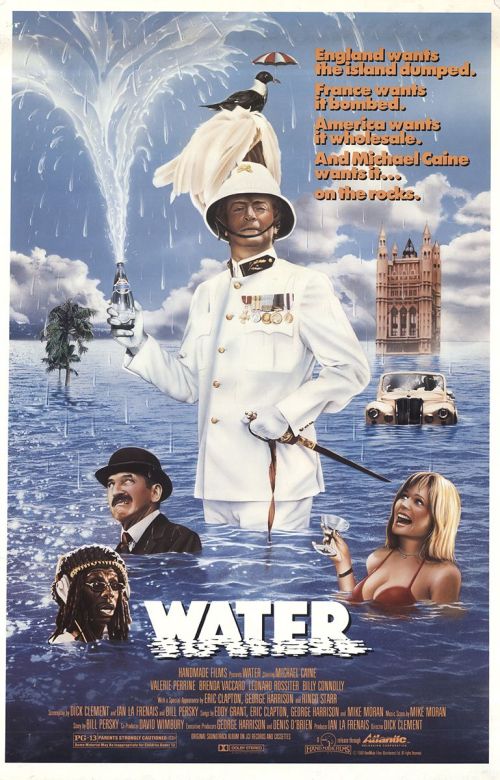
Governor Baxter Thwaites (Michael Caine) runs the British Colony island of Cascara a largely peaceful place that is mostly ignored by everyone else. Then one day one of the oil rigs on the island taps into a underground reservoir of water that has all of its impurities already removed. The delicious tasting drink, that can also be used as a laxative, becomes much sought after from bottling companies across the globe. Now suddenly the British government wants everyone on the island to move out and find some other island to live on while taking over and turning this one into a profit making venture.

The film is patterned after many British satires of the 50’s through the 70’s like The Bed Sitting Room and O Lucky Man that mixes in wacky characters with absurd comic scenarios and also trying to make sharp political observations in-between. Unfortunately this film, which is based on a story by Bill Persky who appears briefly as a TV director, goes soft and is too similar in its vapid tone to Persky’s other social satire flop, Serial, which came out 5 years earlier. The message is too ambiguous and the plot too cluttered with insignificant characters that it becomes almost nonsensical.

The characters are so eccentric that the viewer cannot identify with, or care about any of them. The film in a way comes off as almost racist since the island is populated with black people, but the main characters are all white while the blacks folks get completely pushed into the background. If anything the viewer could’ve sided with the islanders and their quest to protect their homeland, but since all focus is put on the British people who control them, that never happens.

The eclectic cast is the only thing that somewhat holds it together. Brenda Vaccaro, who normally plays in dramatic roles, is very funny as Caine’s feisty wife although I could’ve down without her misguided accent. Valerie Perrine, with her clear blue eyes is fun too as an idealistic social activist although she was already in her 40’s at the time in a role which would’ve been better served by someone in their late teens or early 20’s.

Caine on-the-other-hand isn’t all that entertaining with the exception of the scenes showing him wearing a cocked hat, which are amusing.  He at least seems more comfortable here than in Blame it on Rio, which he did the same year as this one, but due to the subject matter in that one he clearly looked quite awkward and stiff while here he’s having a fun time even if the audience really isn’t.

This also marks the last feature film appearance of Leonard Rossiter, who died in his dressing while waiting to go on stage in a play he was in just a few months after completing his filming here. Normally he’s enjoyable to watch even when he’s playing a stuffy character, which is what he usually did anyways, but here he’s too much of a jerk and I did not find him to be humorous or interesting in any way.

If there is one person that ultimately does comes-off best it would be Billy Connelly who’s hilarious as this rebel leader who refuses to speak and instead communicates everything through singing. Dick Shawn is also quite good as this arrogant actor whose career has declined and now forced, much to his dismay, to being a spokesperson for informercials. You can also spot Joyce Van Patten very briefly in an uncredited role as a TV news reporter.

George Harrison, who also produced the film, appears near the end playing the bass guitar in front of political leaders at the UN while Ringo Starr handles the drums and Eric Clapton does the vocals, but the movie would’ve been more entertaining had all three of them been given roles to play, or at  least it couldn’t have hurt. The film’s title is a bit misleading too as the water ultimately has nothing to do with what saves the island from takeover, or allows them to keep their independence.

My Rating: 4 out of 10

Released: January 11, 1985

Runtime: 1 Hour 55 Minutes

Rated PG-13

Director: Dick Clement

Studio: Atlantic Releasing Corporation

Available: DVD

Cookie (1989)

By Richard Winters

My Rating: 3 out of 10

4-Word Review: Daughter becomes getaway driver.

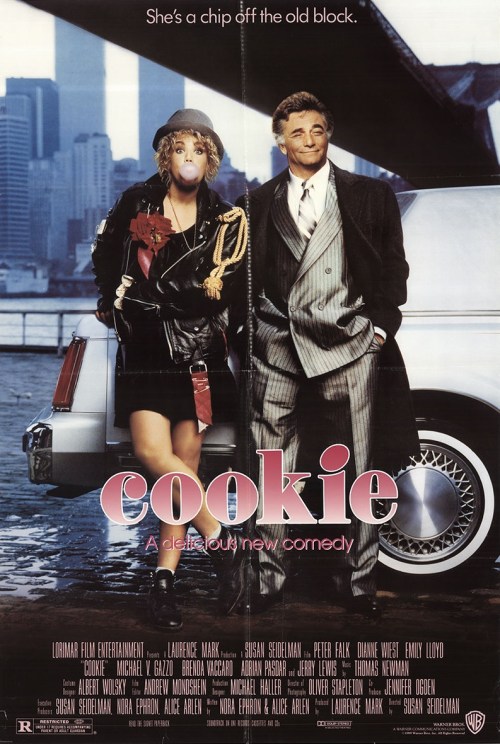
Dino (Peter Falk), a longtime racketeer, gets released from prison after a 13-year sentence. He meets up with his long time crony Carmine (Michael V. Gazz0) only to learn that Carmine sold off his share of the business, but now refuses to give him his entitled proceeds. Dino then plots an elaborate revenge and uses his estranged daughter Cookie (Emily Lloyd) to help him. At first the two don’t get along,but eventually forge a friendship when she proves to be quite resourceful as a getaway driver.

This movie proved to be the start of Lloyd’s career downfall. She burst onto the scene with her acclaimed performance in Wish You Were Here, which had all the critics fawning over her including Roger Ebert who called her performance “one of the great debut roles of a young actress”. With her new found fame she moved to New York at the age of 17 and immediately got the starring role in this film, which unfortunately proved to be her undoing as she showed erratic behavior on the set due to a condition that was later diagnosed as being attention deficit disorder. At one point during filming her irritated co-star Falk slapped her because she repeatedly flubbed of her lines, which caused her to then reportedly slap him.  It was behind-the-scenes stories like these that made studios reluctant to hire her and costing her to miss out on a lot of big roles.

While I’ll commend her ability to put on a very effective Brooklyn accent where you can’t even hear a hint of her native British one I still felt overall her performance here is quite weak and one of the main reasons that the film fails. Her facial expressions are too one-note and she shows an aloof detachment in all of her scenes almost like she really doesn’t want to be there. It’s evident onscreen that she and Falk didn’t care for each other making the bonding that their two characters have come-off as forced and insincere. I didn’t know why her character was even needed, I presume it was done to attract the all-important teen demographic, but she’s not funny and there’s long stretches where she doesn’t even appear. Her attire looks too much like the clothing style worn by Molly Ringwald during the 80’s and while that may have been the fashion it’s still good to have a character come up with a clothing style that is unique to them, so she doesn’t end up looking like just a leftover cast member from a John Hughes’ movie.

The supporting cast are what make this movie funny and had the story centered around them it could’ve been special. Gazzo is great as the mob boss who is intimidating one minute and then frightened and contrite the next. Dianne Weist, is quite funny too, particularly her extended crying bouts, as Falk’s mistress and Brenda Vaccaro steals a few scenes as his dog groomer wife. You can also spot Joy Behar in a brief bit as well as Jerry Lewis although his part is quite colorless and I’m surprised he even took it.

The script by Nora Ephron and Alice Arden relies too much on Mafia cliches while failing to add a unique or interesting spin to it. There’s also too many scenes, three of them to be exact, involving the explosion of a limo. One time is okay, but it saps away the surprise/shock value when it keeps happening and much like the movie itself fizzles out with a whimper.

My Rating: 3 out of 10

Released: August 23, 1989

Runtime: 1 Hour 33 Minutes

Rated R

Director: Susan Seidelman

Studio: Warner Brothers

Available: DVD-R (Warner Archive), Amazon Video, YouTube

Going Home (1971)

going-home

By Richard Winters

My Rating: 6 out of 10

4-Word Review: Father and son reunite.

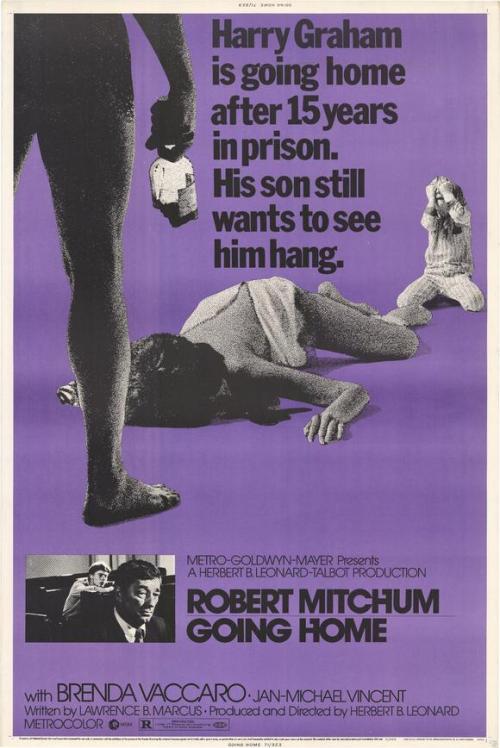
One night during a drunken rage Harry Graham (Robert Mitchum) kills his wife (Sally Kirkland), which gets witnessed by their 7-year-old son Jimmy (Jan-Michael Vincent). 13 years later Harry is paroled and Jimmy uses this opportunity to try and reconcile with his father and find out why he did it, but Harry has moved on. He has a new job and a girlfriend named Jenny (Brenda Vaccaro) and when Jimmy appears it creates an awkward tension that gets progressively worse.

One of the biggest problems with this film is that the characters and their motivations are not fleshed out enough and their actions make little sense. I’ve watched a lot of true-life crime shows and have found that in cases where this situation has occurred in real-life that the adult child will usually cease communication with their father and completely disown them, so it seemed strange why Jimmy would want to restart their relationship. If he was curious to know why Harry did it then he could’ve simply written him a letter with that question, which he never bothered to do while the man was incarcerated.

The film also fails to show what happened to Jimmy during the time Harry was in prison. He is shown arriving at an orphanage, but nothing about what does when he gets there or being put into a foster home and getting adoptive parents, or moving in with relatives, which is what usually occurs. He somehow has no friends or job and if this is because of his childhood trauma then it should get explained or more strongly implied, but it isn’t and it leaves a big void in the story.

Harry’s actions are equally confusing. The murder gets played out at the beginning and we see the stabbed mother crawl down the stairs and beg Jimmy for help and then Harry comes down and looks at the dead body before turning towards the boy with a guilty expression, but if  he feels so bad about what he has just done and the traumatic impact he’s put his son through then he should’ve thought of that beforehand. I would’ve expected to see a completely different set of emotions in the man’s eyes like anger, rage, insanity or even fear because now he knows he’ll will be going to prison, but guilt wouldn’t play into it, at least not that quickly if ever.

Mitchum’s character is straddled with conveying only one emotion throughout, which is guilt. We never tap into the other side of the man that propelled him to commit such a heinous act and his explanation, which is that he ‘just got drunk’ is insufficient. The character also pops up too conveniently at times. One moment is when Jimmy goes back to their former home, which has now been turned into a whorehouse and he hides in the basement. Harry comes looking for him and despite the fact that there are many people there and it’s a large place he immediately goes to the cellar, but how would he have known to look there? Another segment has him magically coming to Jimmy’s rescue when his son is accosted by a group of sailors underneath a boardwalk even though he was bowling in another building and would have no way of knowing what was occurring outside.

The film has solid production values and director Herbert B. Leonard shows flair with the location shooting, which was done in both New Jersey and Pennsylvania. There is also a good scene inside a chicken coop  and actor Josh Mostel (Zero’s son) has an interesting film debut playing Harry’s young, flippant parole officer who delights in demeaning his client as much as possible, but the story leaves open too many unanswered questions and isn’t impactful or relevant.

My Rating: 6 out of 10

Released: December 1, 1971

Runtime: 1Hour 37Minutes

Rated GP

Director: Herbert B. Leonard

Studio: MGM

Available: DVD-R (Warner Archive)

Death Weekend (1976)

death weekend

By Richard Winters

My Rating: 3 out of 10

4-Word Review: She can defend herself.

This Canadian thriller, which is loosely based on actual events deals with a rich playboy named Harry (Chuck Shamata) who invites Diane (Brenda Vaccaro) who is also a model to spend the weekend with him at his isolated lakeside cabin that is miles from anywhere. On their way there they run into a biker gang whose leader (played by Don Stroud) takes an intense disliking to Harry. The gang tracks the two down at their cabin where they proceed to terrorize them before eventually killing Harry and forcing Diane to defend herself alone, which she does valiantly.

In a way this is a poor man’s version of I Spit on Your Grave or Straw Dogs, but not nearly as effective. For one the violent scenes aren’t very intense. This is due mainly to the fact that writer/director William Fruet keeps the camera too removed from the action and never once uses a hand held. There is also no gore as Fruet always cuts away just before anything happens and what little you do see looks tacky. Of course a film doesn’t have to be gory to be scary or intense, but if it is going to have this type of violent theme then it should at least equal it in style. The tension also ebbs and flows and the four hoodlums are too dumb and seem like cardboard cutout caricatures that possess no human qualities whatsoever.
The Harry character does allow for some added dimension, which helps and hurts. I liked the way he sees himself as this ‘refined’ gentlemen and yet views women in the same Neanderthal way as the thugs. He brags of having money and power, but when that gets stripped away from him he becomes amazingly spineless. This makes for a good commentary of the rich and successful, but unfortunately also turns him into being too much of a jerk and when the bad guys proceed to tear his place apart we are not ‘horrified’ at all, but instead enjoy seeing it.

There are actually a few good elements one of which is the music score, which effectively creates an ominous feeling. It was also filmed in Ontario Canada during the autumn and the desolate, bleak landscape helps match the bleakness of the situation and characters. I also loved the morning mist captured during the final chase sequence that gives things a very eerie look. There is also a well-staged car chase at the beginning that was done at high speeds and features some great stunt driving.

The film is saved somewhat by Vaccaro’s interesting performance as a victim. She is independent and self-sufficient and refuses to allow herself to be seen or used as a sex object. This goes along with the film’s overall theme which seems to run on the emergence of the woman in a man’s world and the basic redefining of the female role in society. Yet I felt it would have worked better had the character harbored the old female traits at the beginning and then had these new traits come out as the film progressed.

death weekend

My Rating: 3 out of 10

Alternate Title: House by the Lake

Released: September 17, 1976

Runtime: 1Hour 27Minutes

Rated R

Director: William Fruet

Studio: American International Pictures

Available: VHS