Tag Archives: 60’s Movies

Mackenna’s Gold (1969)

By Richard Winters

My Rating: 4 out of 10

4-Word Review: They all want gold.

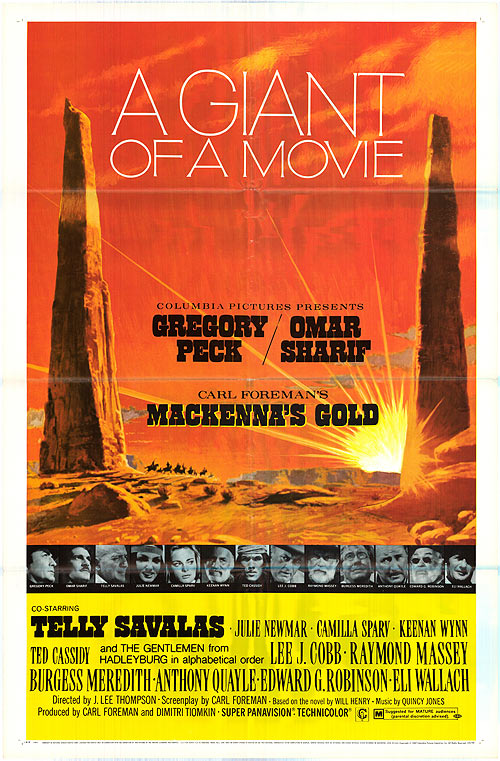
This is a sterile western with some irrelevant offbeat elements thrown in for good measure. The story consists of Mackenna (Gregory Peck) coming upon an old Indian man with a map showing the whereabouts to some gold. Feeling that the map is meaningless he burns it and tries to move on. He becomes entangled with outlaw Colorado (Omar Sharif) who feels that the map was legit, and since Mackenna was the last one to see it, forces him to come along with him and use his memory to show him the location. Ultimately they meet a wide assortment of other characters all searching for the same thing.

The cheap special effects are one of the main drawbacks. They are awful and help bring down the whole movie. The scene involving Peck being tied to the back of a horse and then lead across an old rickety bridge has to rate as the worst as the wide shots clearly shows a miniature bridge with a toy man and toy horse. The climactic sequence involving the cataclysmic destruction of an entire valley is so tacky that it is almost painful to watch. There are also other shots spliced in throughout that were done on a different film stock and this difference in grain is obvious and distracting. Even simple shots of Peck riding his horse are laughable as it becomes obvious that he is not on a real horse, but instead one of those mechanical ones that bop him up and down in perfect rhythm.

Only when the film features its stellar supporting cast does it get interesting. Unfortunately this legendary line up was only given about ten minutes of screen time a piece and then very quickly killed off one by one in ways that are particularly gruesome and demeaning.

Peck is okay in the lead and acts as a sort of stabilizer. This was the film where he starts to look elderly with some gray hair showing and a handle bar stomach. He was also not as agile as his younger costar Sharif.

Julie Newmar as Indian lady Hesh-ke is a stand out and even sexier than she was as Catwoman on the TV-show ‘Batman’. She also displays a real vicious side and this probably rates as her best performance despite the fact that she never says a single word. Camilla Sparv as Inga is almost as sexy and the two share a fun ongoing rivalry.

The film is watchable and has some nice, even exciting, aerial shots. However as a whole it is pretty ordinary. Things added to make it seem unique really end up hurting it. Jose Feliciano’s singing is out of place and the music score overall is bad. Victory Jory’s narrative is unnecessary and a feeble attempt to make the production seem like an epic, which it definitely isn’t and the mystical ending just doesn’t work.

My Rating: 4 out of 10

Released: May 10, 1969

Runtime: 2Hours 8Minutes

Rated M (Brief Nudity)

Director: J. Lee Thompson

Studio: Columbia Pictures

Available: VHS, DVD, Amazon Instant Video
The Passion of Anna (1969)

By Richard Winters

My Rating: 8 out of 10

4-Word Review: Lonely little island retreat.

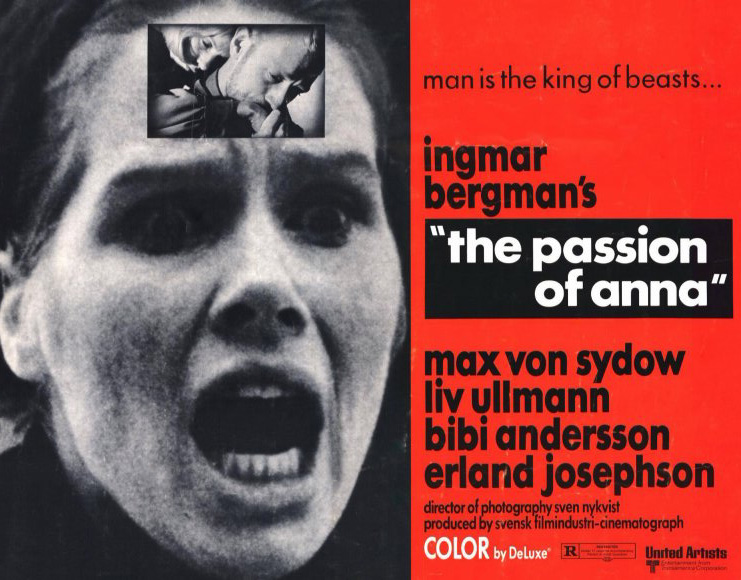
This is an intriguing film that seems quite similar to Roman Polanski’s Cul-De-Sac. Both films have a unique atmosphere and take place in a remote island setting and deal with a turbulent undercurrent that brews just underneath its deceivingly placid exterior.

Here we have Andreas (Max Von Sydow) living a lonely existence on an island retreat. He meets, by chance, Anna (Liv Ullmann) who is still grieving from the death of her first husband. The two form a tenuous relationship that slowly unravels as the dark corners of their personalities are eventually exposed.

In many ways this film has all the right ingredients. It wraps you up in its surreal nature and adds interesting effects. There are some creepy elements including a mad killer running around the island killing and torturing all the animals. Things work at a deliberate pace and leave no clue as to where it is headed. The characters are unpretentious and introspective. They are open about their faults and failures and give good reason as to why they have them. There are also fascinating cutaways to the actors themselves who help explain and interpret their characters motivations, which is a novel idea that gives the viewer a deeper understanding of the characters and adds an extra dimension.

Unfortunately it doesn’t come together and leaves no real emotional impact. There are a few good twists, but you can’t help but feel that it should have gone farther. There a certain scenarios that get touched on, but are never explored. For instance there is Andreas’s relationship with Elis (Erland Josephson).  Andreas has taken a loan out from him, but has also had an affair with his wife. This of course has some potential for fireworks and there is a moment where it begins to sizzle, but it never goes back to it. The same thing can be said for many of the other segments including the identity and reason for the animal killer.

Overall this is an outstanding experimental-like movie. It is not one of director Ingmar Bergman’s best, but it is still richer and more deeply textured than eighty percent of the other movies that are out there. The crisp and revealing dialogue alone makes it worth it and Bergman displays the most realistic perspective on the union of marriage.

My Rating: 8 out of 10

Released: November 10, 1969

Released: 1Hour 41Minutes

Rated R

Director: Ingmar Bergman

Studio: United Artists

Available: VHS, DVD

How to Murder Your Wife (1965)

By Richard Winters

My Rating: 7 out of 10

4-Word Review: Helpful advice for husbands.

            Stanley Ford (Jack Lemmon) is a successful cartoonist living the bachelor dream in a penthouse loaded with perks and helped run by his loyal butler Charles (Terry-Thomas). Things go horribly wrong when one night while attending a bachelor party for one of his friends he becomes drunk and finds himself the next day married to a beautiful Italian blonde who can’t speak a word of English. Despite this she starts to take over his life, running Charles out of the home and ruining his career and friendships in the process. To vent his frustrations he has the main character of his comic strip murder his wife and to insure that it is believable he plays out the murderous sequence in real life, but using a mannequin in the place of an actual body. When his wife sees the comic she becomes hurt and runs off making people believe that she was killed when no one can locate her.

This is a much edgier Lemmon comedy from what he has done in the past and the change is welcome. He plays a more sophisticated extension of the character that he did in Under the Yum Yum Tree. The scenario is clever and original for the most part, but what surprised me was the extreme cynicism it had towards the institution of marriage. Most films both before and after have made some tongue-in-check jokes towards it, but this things treats it like it’s an ugly monster that needs to be beaten with a club. This is done mainly from the man’s point-of-view, which is fun and refreshing simply for the fact that something this politically incorrect could never be made today, but also there are a few scenes were the Claire Trevor character teaches Lemmon’s wife how to manipulate the husband and get away with it. What is said is all right on target with the truth, which may make some cringe while they are laughing, or if you are single it will be just another excuse to gloat. The brilliantly written, hilarious court room segment at the end where Stanley tries to get his lawyer friend Harold (Eddie Mayhew) to press an imaginary button, which he convinces him will kill off his wife and allow him to be set ‘free’ is the best part.

Lisi does well in her role and the fact that she can’t speak any English, at least at the beginning, makes her presence more interesting. Although done many times before, her popping out of a giant cake at the bachelor party is quite steamy and enticing. Her dance on top of a piano is provocative and even more surprisingly is when older actress Trevor does the same dance later on and is almost as alluring.

Thomas is a legendary comic character actor and quite possibly one of the best who ever lived. His presence helps the film immeasurably and it is a shame that he is not in it the whole time. Mayhew is very good as well and although it takes a while for him to get going I found myself enjoying his scenes and his little quirks, including his weird laugh, more and more as it went along. His performance in the climactic courtroom segment is tops.

The script, by George Axelrod, seems a bit disjointed and over-long. It starts out as a quirky comedy then falls into being a contrived, fluffy comedy during a really slow middle part, only to recover with a resounding end. The script could have been tighter, but the finale is so funny that I forgave it and it is well-worth seeking out for the comedy fan looking for something a little different. In fact I am surprised this thing hasn’t acquired a cult following.

My only other complaint is the music score by Neal Hefti, which sounds much too similar to The Odd Couple score that came out only three years later and also starred Lemmon.

My Rating: 7 out of 10

Released: January 26, 1965

Runtime: 1Hour 58Minutes

Rated NR (Not Rated)

Director: Richard Quine

Studio: United Artists

Available: VHS, DVD (The Jack Lemmon Collection), Amazon Instant Video

Easy Rider (1969)

By Richard Winters

My Rating: 10 out of 10

4-Word Review: Drop out of society.

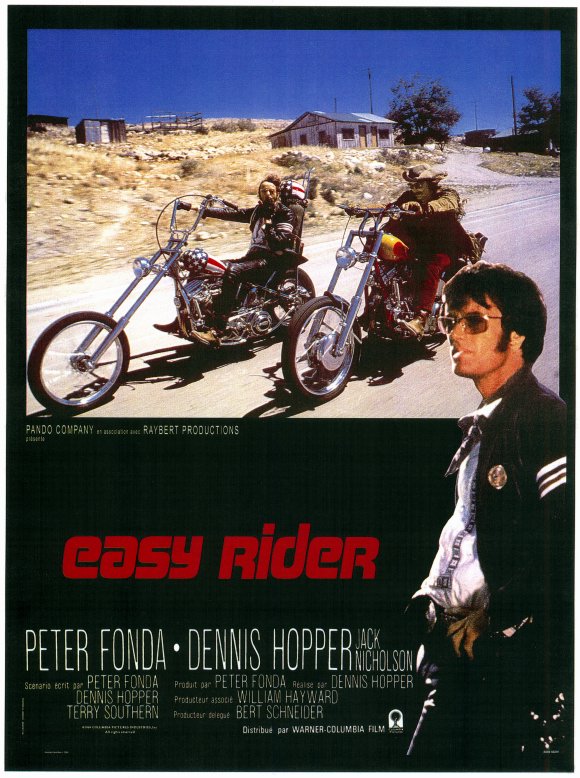
This is still the granddaddy of all road movies as it perfectly captures the era and the angst of those living in it. It examines the harsh reality of life on the open road, but does it with a deep philosophical edge. Wyatt and Billy (Peter Fonda, Dennis Hopper) are two bikers making their way to the Mardi Gras when they pick up lawyer George Hanson (Jack Nicholson) along the way. They face prejudice and apathy from others who do not understand their values, or lifestyle. Although strongly linked to the 60’s many of the statements that the film makes and ideas that it brings out are as pertinent today as ever and this is one movie that should not be overlooked by the serious film fan as it is a classic and far from being just a relic.

The script, which was written by Fonda and Hopper, who also directed, portrays the open road as an odyssey of personal discovery instead of a particular destination. It brings out how one is still always trapped within the confines of the very society they may wish to escape. Above all it questions what true freedom really is, whether anyone has it, and if it can fully exist.

Fonda and Hopper are perfect. They channel their rebellious energies well. Of course it’s Nicholson who steals it playing a slightly goofy character. He exudes a charm here that’s rarely seen in his other performances. He also sports the silliest riding helmet you can imagine.

Lazlo Kovacs cinematography is outstanding. It captures the American landscape like you’re watching a travel show. The hippy commune scene is the best as it is so vivid that it makes you feel like you are right there. There is also a memorable hallucinogenic drug scene in a graveyard that is wickedly surreal and features cult favorite Karen Black in an early role.

Some may say it’s boring, but the slow pacing is deliberate and well-orchestrated. The framing and flash editing are groundbreaking in both its vision and execution. This is a definite trend setter and most importantly a classic.

My Rating: 10 out of 10

Released: July 14, 1969

Runtime: 1Hour 35Minutes

Rated R

Director: Dennis Hopper

Studio: Columbia Pictures

Available: VHS, DVD (35th Anniversary Edition) Blu-ray, Amazon Instant Video

Good Neighbor Sam (1964)

By Richard Winters

My Rating: 7 out of 10

4-Word Review: Pretending to be married.

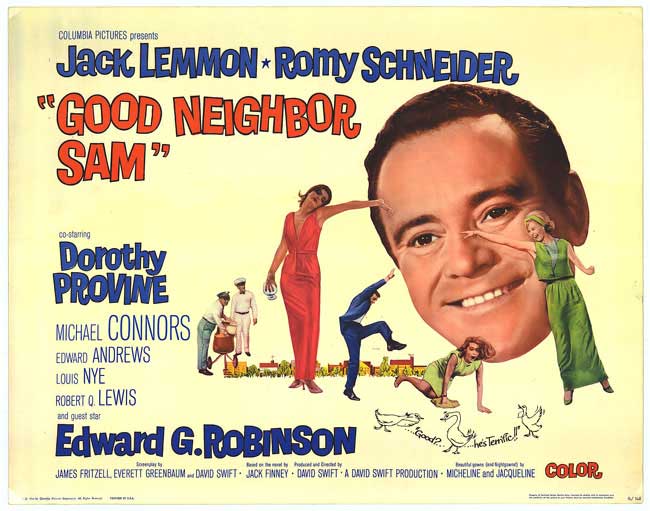
            Sam Bissell (Jack Lemmon) is an advertising executive working for a demanding client (Edward G. Robinson) who is very conservative and insists everyone around him have a clean-cut image and lifestyle. Sam’s wife Minerva (Dorothy Provine) brings home her college friend Janet (Romy Schneider) for a visit and she rents out the neighbor’s place while she is there.  Janet then finds out that she is going to be left a large inheritance, but the will stipulates that she must be married even though Janet is instead going through a divorce. For the sake of allowing her to collect the large fortune, which is 15 million dollars, Sam agrees, with the blessing of Minerva, to pretend to be Janet’s husband by staying at her place until the money is paid out.  A private detective (Louis Nye) is hired to keep a close eye on them and matters become even more complicated when Janet’s ex-husband Howard (Mike Connors) returns.

The concept is original and to my recollection has never been done before, or since, which is amazing when you think about the fact that just about everything else has. It does rely heavily on coincidence and too much of the first hour is spent setting up the plot with some extraneous scenes that could’ve and should’ve been cut. For such fluffy material, even entertaining fluff such as this, a 130 minute runtime is too long.  Three different writers were credited with doing the screenplay and the overall vision seems disjointed as at times it works as a satire, slapstick, and sex comedy, but never coming together completely as a whole. However, there is enough eventual pay off to still make it worth it.

This is one of Lemmon’s better comedy vehicles, if not his all-around best. Sometimes he comes off as too strait-laced and benign in these things, but here it works to the film’s advantage. His best part is when he dreams seeing himself getting out of bed and going over to the bedroom where Janet is and trying to seduce her. She screams so loudly that the entire town wakes up and comes over, which is funny and should have been played-out more.

Schneider though is the best thing about the movie. I loved her bright, beaming smile and effervescent personality. She sparkles in every scene and I was impressed that although she could be pleasant she could also easily get into a shouting match with Howard and the fact that she could switch emotional gears so easily and quickly proves that she had talent. Costume designer Jacqueline Moreau puts her into some snazzy outfits that look great on her including an all red jumpsuit, a strapless evening gown, and a two piece white pajama outfit with pink polka dots that was my favorite. It is a shame that due to her severe depression over the accidental death of her son as well as alcoholism and a three-pack-a-day smoking habit her career and life was cut short as she most assuredly still had a lot of outstanding parts and performances left to do.

Blonde Provine looks almost as good and equally delightful in her role where she tries holding it all together. Connors, best known for starring in the long-running TV-show ‘Mannix’, is surprisingly engaging as the ex. His arguments with Sam are fun and in order to keep the scheme going he pretends to be Sam and stays in the home with Minerva, which culminates with the film’s funniest moment, which is the early morning ‘kissing contest’ the two men have with each other’s wives.

Nye is also amusing as the detective and I got a kick out of his van that was supposedly disguised to be that of a cleaning service with a giant model of a vacuum on top of it that was used as a telescope.

The only one who gets wasted here is legendary actor Robinson who really doesn’t have anything funny to say, or do. However, his dinner party is still memorable simply because everyone gets served on all gold dinnerware, which includes the plates, cups, and utensils.

The music score is bouncy and the climatic sequence that features the main characters defacing area billboards is artsy and creative. On a lightweight, inoffensive level this satisfies and delivers a few laughs along the way.

My Rating: 7 out of 10

Released: July 22, 1964

Runtime: 2Hours 10Minutes

Rated NR (Not Rated)

Director: David Swift

Studio: Columbia Pictures

Available: VHS, DVD (The Jack Lemmon Collection)

Lord Love a Duck (1966)

By Richard Winters

My Rating: 3 out of 10

4-Word Review: She wants it all.

If you ever wondered where political correctness got its start it was probably southern California in the mid 60’s. Here everything is neutralized and modified so as to ‘keep up with the times’. There’s even a drive-in church where the minister proudly exclaims that the Lord answers every prayer because “whatever happens is the answer”.

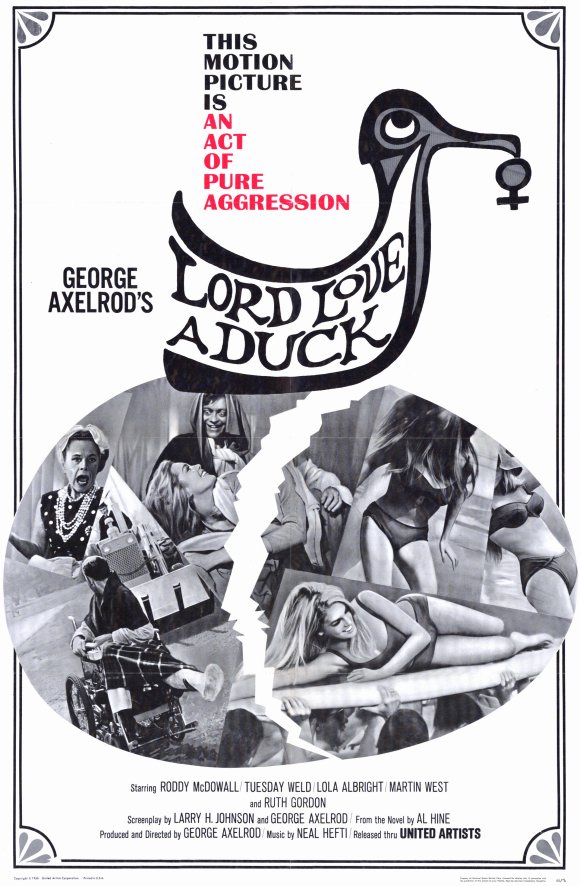
Tuesday Weld plays teenager Barbara Ann Greene who can’t be happy unless she has it all. She meets fellow high-schooler Allan Musgrave (Roddy McDowell) who because of his super intelligence is able to figure out ways for her to get what she wants. Yet the more she gets it the more unhappy she becomes.

It’s a satire on our consumer driven society, but it is too restrained and soft. A supposedly cutting edge film looking at our modernized world should have been filmed in color and not black and white. It also should have been faster paced with a heavier emphasis on the zany and outrageous. Instead we only get hints of this with a lot of slow segments and even some clumsy drama. The funny offbeat bits are spread out to thin and do not make up for the other parts that are boring and contrived.

There are some technical problems too including a lot of ‘outdoor’ shots that were really filmed indoors on a soundstage. They fortunately don’t do this anymore, but when they did it looked tacky. There is also a boom mike that is very obvious to see in several shots.

McDowell is not eccentric, nor unique enough for such an offbeat character. Although perpetually boyish looking he was way, way too old to be playing a high school student as he was 37 when this was filmed. Out of all the performers Harvey Korman comes off as the most amusing playing the overtly congenial school principal.

This film does feature an attractive cast. Of course Weld is always alluring, but she has competition from Jo Collins who was Playboy Playmate of 1965. There is also Lynn Carey daughter of the late actor MacDonald Carey from ‘Days of Our Lives’ fame. She is exceptionally good looking and watching here gyrate in a bikini to the latest dance craze is damn near pornographic. For her age Lola Albright, who plays Weld’s mother, is an absolute knockout and she can officially be crowned as a ‘milf’.

My Rating: 3 out of 10

Released: February 21, 1966

Runtime: 1Hour 45Minutes

Rated: NR (Not Rated)

Director: George Axelrod

Studio: United Artists

Available: VHS, DVD

The Nanny (1965)

By Richard Winters

My Rating: 5 out of 10

4-Word Review: Kid doesn’t like nanny.

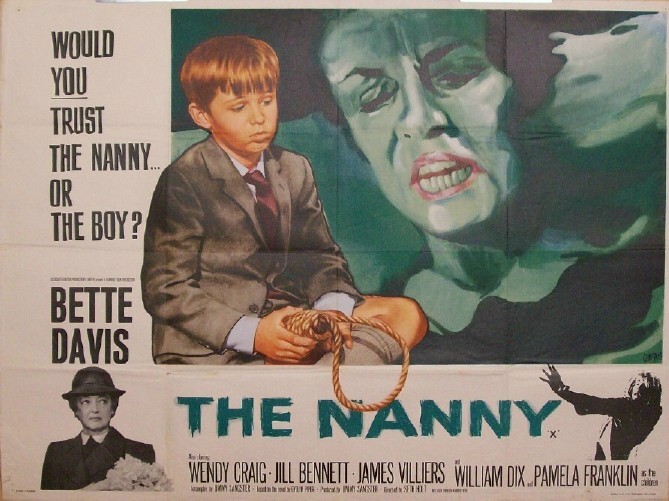
            Bette Davis plays a nanny to an upper-class British family whose oldest son Joey (William Dix) is accused of accidently killing his younger sister. Joey, who is only 10, is sent away to a home for disturbed children. When he returns he accuses the nanny as the one who did the killing and a psychological game of cat-and-mouse ensues.

Davis is sensational. She plays a type of character that she has never done before and the results are fascinating. She is much more subdued and evasive than usual and she falls into the role of the unassuming nanny in a seamless fashion. The different setting works well for her and I commend her tenacity for taking on a project that was not glamorous. She even puts on some thick eyebrows for her part and at times, especially at the beginning, she starts to resemble her most hated rival Joan Crawford.

Dix is amazingly good as the kid and it is a shame that he did only one other picture after this one. I liked the independent nature of the character and he plays off Davis quite well and showed no signs of being intimated by her. Making the adversaries have such extreme age difference and personalities gives the story an interesting edge that helps carry the picture.

The evocative black and white photography helps accentuate the dark-tone. The British setting along with the expected formalities of that culture, particularly that from the father character Bill (James Villers) give the film some distinction.

The first act though goes on way too long. We are given the general premise right up front and then have to spend the whole first hour going through the scenario that Joey doesn’t like his nanny and is suspicious of her again and again until it becomes derivative. When the second act does finally come about it seems too late. The revelation isn’t all that clever or creative and the climactic sequence desperately needed more action and punch. The final result is unsatisfying. The viewer is given an intriguing premise that it can’t sustain to the end ultimately making this a misfire despite the outstanding presence of Davis and some high production values.

There is also the issue of the three-year-old girl who is adorable and an absolute scene stealer and yet right up front you are made aware that she is killed, which makes the proceedings rather depressing. Having to then watch her actual death is disturbing and, for its time period, rather vivid and startling.

My Rating: 5 out of 10

Released: October 27, 1965

Runtime: 1Hour 31Minutes

Rated: NR (Not Rated)

Director: Seth Holt

Studio: Hammer Productions

Available: DVD

The Glass Bottom Boat (1966)

By Richard Winters

My Rating: 7 out of 10

4-Word Review: Doris is a spy.

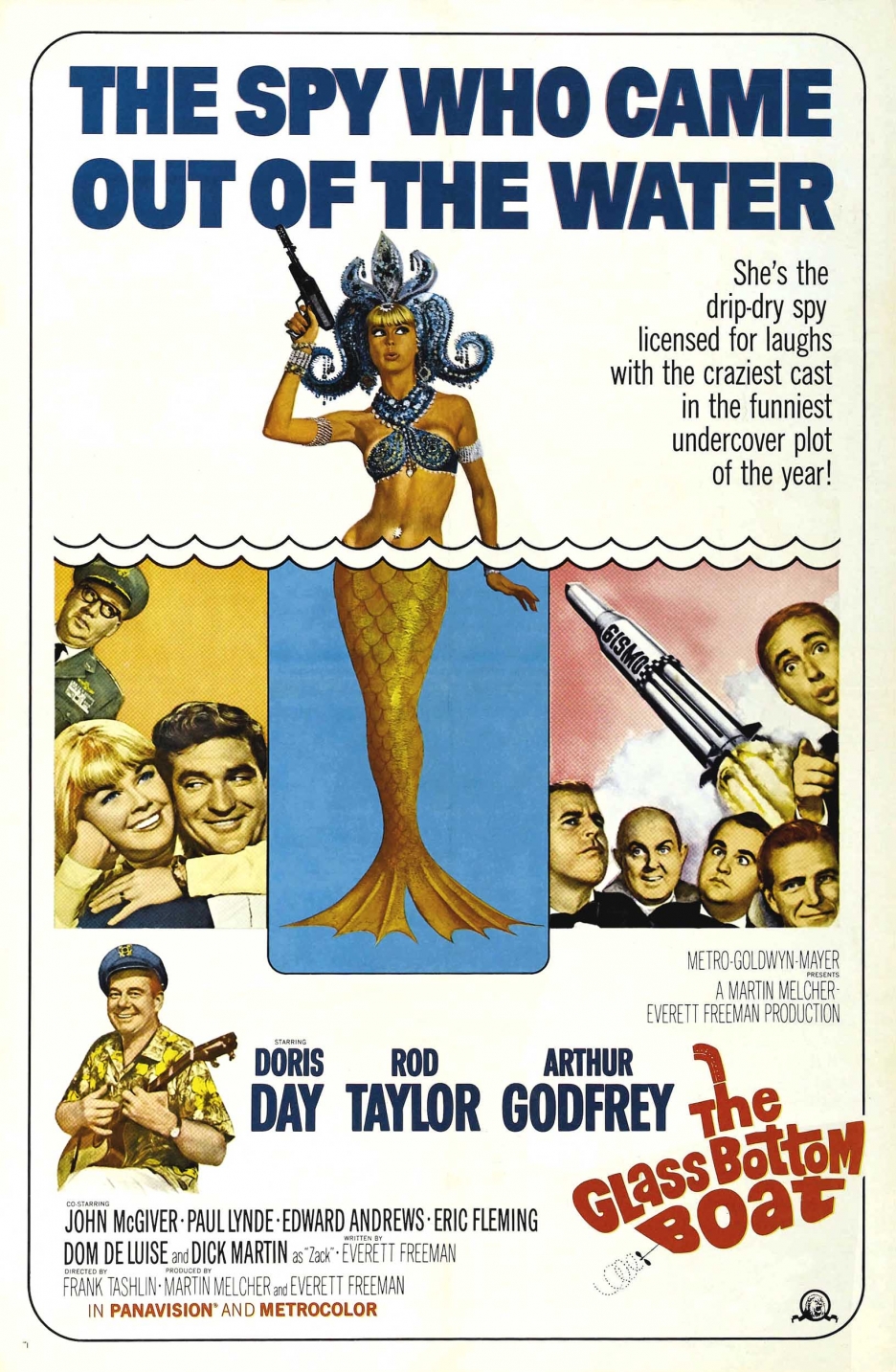
            This is an energetic and zany Doris Day vehicle featuring her as Jennifer Nelson a tour guide at the NASA Space Center. She meets Bruce Templeton (Rod Taylor) who at first she can’t stand, but when she finds out that he is one of the top scientists at the lab and makes a lot of money she immediately becomes infatuated. This certainly does nothing to help fight the gold-digger stigma that some women have, but it was made over forty years ago, so I guess it was more acceptable. Through quirky circumstances she comes under suspicion as being a Russian spy and spends the rest of the time trying to prove otherwise while continuing her romance with Bruce.

Day looks gorgeous and is hammy at just the right level without going overboard and becoming cartoonish. Her best segment is when Taylor imagines here as a Mata Hari spy complete with skimpy outfit, which she looks great in, as well as dreaming that she is blindfolded and speaking in a foreign accent while ready to be shot by a firing squad. She sings the film’s title tune, which is bouncy, and even does, later on, a goofy rendition of her signature song ‘Que Sera Sera’.

Taylor is perfect as the love interest and I think he is the best out of all of Day’s male co-stars. His funniest moment, although brief, is when Day crosses her eyes to be goofy and then keeps them that way, which makes him momentarily panic. I got a kick out of his model of the solar system that he had in his office that displayed the planets in a symbolic fashion after the Greek gods they were named after.

The supporting cast is full of familiar comic pros. Alice Pearce and George Tobias appear as Jennifer’s neighbors and a variation of the Kravitz couple that they played on the ‘Bewitched’ TV-series. Pearce is hilarious and it was a shame that she wasn’t in more scenes and died before the movie’s release. Dom Deluise is amusing as the actual spy, who goes undercover as an electrical repairman. Normally his goofy fat-guy persona becomes tiring, but here it worked especially during the climatic sequence. Paul Lynde, who was always hard to cast and in the process usually got meaningless parts, has one of his best roles as the lab’s security guard and even dresses up in drag at the end. Dick Martin, Edward Andrews, and John McGiver help round out the cast. Arthur Godfrey, as Jennifer’s father, is the only one who is boring, but his part was dull, so it might be hard to completely blame him.

Director Frank Tashlin creates sets with bright, vivid colors and each scene is a Technicolor dream. Being a former cartoonist he creates some nicely played-out comic scenarios including Bruce’s hands-free futuristic kitchen that has a little robot that comes out of the wall and cleans-up any messes that are left behind and ends up attacking Jennifer. The out-of-control boat ride is also amusing, but the best part is the wild, fast-paced ending when Jennifer decides to turn the tables on her accusers.

Sure it is silly, but you know that going in and on a non-think level it is perfect entertainment for all-ages.

My Rating: 7 out of 10

Released: June 9, 1966

Runtime: 1Hour 50Minutes

Rated G

Director: Frank Tashlin

Studio: MGM

Available: VHS, DVD, Amazon Instant Video

Oh Dad, Poor Dad, Mama’s Hung You in the Closet and I’m Feelin’ So Sad (1967)

oh dad poor dad

By Richard Winters

My Rating: 1 out of 10

4-Word Review: Overprotective mother dominates son.

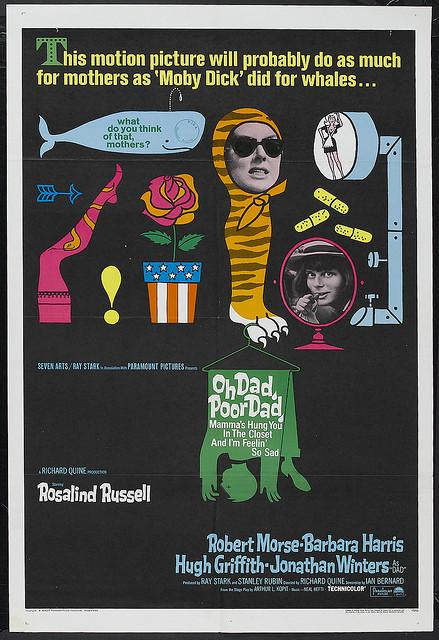
This is an awful, awful film based on the Arthur Kopit stage play of the same name. Overly domineering mother Madame Rosepettle (Rosalind Russell) keeps her son Jonathan (Robert Morse), who is 25, in a near infantile state. She also travels around with her dead husband in a coffin. Problems ensue when they arrive at a resort and meet up with nubile Rosalie (Barbra Harris) who tempts Jonathan and threatens to break him away from his mother’s clutches.

If done right this film could have, I suppose, gained some sort of cult following. Yet it is so poorly realized and so thoroughly botched that it is impossible to know where one could begin to improve it as it deserves to be in the top ten of worst movies of all time.

One of the problems is the setting itself. For some reason it was filmed in Montego Bay, Jamaica. This certainly does provide for sunny and exotic scenery, but it does not at all work with its twisted, dark subject matter. The music score is also really bad. It was done by Neal Hefti the same man who did the music for the “Batman” TV-show and the soundtrack here sounds just like that one. He also has the theme song sung by children which is as irritating as nails scratching on a blackboard. The color schemes are garish and ugly. The humor is flat and the story itself is threadbare. When you get past the weird fringes all you have left is a stale, plodding coming-of- age tale.

Morse seems a natural for the part as the ‘man-child’ since he has always had a very boyish face. Yet, in an attempt to show that he is never let outside, he is made to look extremely pale and the effect is a bit sickening to look at. His infantile state is played too much to the extreme and comes off as pathetic. It is not at all funny even in an absurd, or dark way.

Russell’s presence makes it somewhat interesting. She was a legendary actress and this was certainly a very unique career move. Maybe she wanted to prove herself versatile after her Mother Superior part in The Trouble with Angels, which she had done just a year before doing this, yet in hindsight it was bad judgment. Seeing her in the strange part is fun for a few seconds, but eventually it gets over-the-top. She ends up looking like Faye Dunaway’s Joan Crawford in Mommie Dearest. You do however get to see her wear a variety of wigs and even do a wild water ski stunt at the end.

Harris has always been one terrific actress and she is good even here and the only reason I’m giving this film one point. She made a career out of playing neurotic women, but here plays a more normal one and it is interesting to compare this performance with her others.

Jonathan Winters (no relation) adds some amusing bits doing voice-over as the dead father. He was brought in after the film was completed and some of his lines have nothing to do with the plot.

The message of the story is nebulous. The video box cover states that it is a study of “human confusion”. Yet the characters seem too extreme to be relatable on any human level. They also don’t evolve and act the same idiotic way at the end as they did at the beginning so neither they nor the viewer come to any better understanding of anything. It is a complete waste of time.This film deserves its near extinct status and isn’t fun even as a curio.

My Rating: 1 out of 10

Released: February 15, 1967

Runtime: 1Hour 26Minutes

Rated NR (Not Rated)

Director: Richard Quine

Studio: Paramount

Available: VHS

The Notorious Landlady (1962)

By Richard Winters

My Rating: 4 out of 10

4-Word Review: Landlady could be killer.

            William Gridley (Jack Lemmon) is an American who has arrived in London and looking for a place to stay. He rents a room from a home owned by Carly Hardwicke (Kim Novak) a gorgeous woman who Bill immediately becomes smitten with. The problem is that many people think Carly has killed in her husband even though his body has not been found. When Bill gets word of this he becomes determined to investigate the case and prove her innocence.

You would think a script written by Larry Gelbart and Blake Edwards would be funnier and full of zany scenarios and slapstick, but instead it gets grounded in a lot of dialogue for much of the first hour and forty-five minutes and only starts to get interesting during the final fifteen. The conversations lack any wit, or sharp one-liners, and the premise plods along at a much too leisurely pace. There is a segment where Bill accidentally sets fire to the patio, but I think this was simply thrown in for some action as there is very little else of it. The plot is formulaic and fails to add any new twist or perspective and once it is over it is easily forgettable. Lemmon’s character is bland and transparent and more than a little naïve since he falls in love with her immediately and is then convinced that she is innocent even though he has only known her for a day.

The best part comes at the very end where the two find themselves at a recital for a group of senior citizens that are all sitting in covered wheelchairs. This scene gets drawn out amusingly and includes a bit where an old lady named Mrs. Dunhill (Estelle Winwood) is pushed down the side of a hill, which is nicely captured in a silhouette style with Bill chasing after her. Winwood, who was already seventy-nine at the time, hams it up perfectly as the daffy old woman.  Of course all this comes much too late to really help the picture, or story, but at least it saves the film from being a complete bore, which it otherwise would have been.

Novak gives a surprisingly strong performance and a convincing British accent that I wish she had spoken in for the entire duration.  She was always a stunner, but here she may look her all-time best. One scene taken with her in the bathtub was highly risqué at the time and doesn’t leave much to the imagination. British character actor Lionel Jeffries is engaging as the inspector, but Fred Astaire is essentially wasted as Bill’s boss. The production values are decent, but the results are middling.

My Rating: 4 out of 10

Released: July 26, 1962

Runtime: 2Hours 3Minutes

Rated: NR (Not Rated)

Director: Richard Quine

Studio: Columbia

Available: VHS, DVD (Region 1 & 2)