Lovesick (1983)

By Richard Winters

My Rating: 2 out of 10

4-Word Review: Therapist falls for patient.

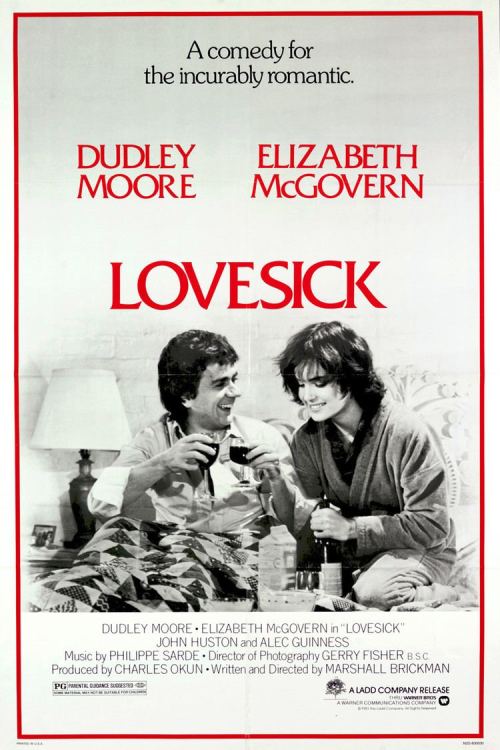
Saul (Dudley Moore), who works as a psychoanalyst, starts to see a new patient, Chloe (Elizabeth McGovern) who he immediately starts having feelings for, but every time he fantasies about her he sees a vision of Sigmund Freud (Alec Guinness) in his head who advises him not to go through with it due to ethical issues. The problem is that Chloe also has feelings for Saul. Can the two work out a relationship despite being up against professional and societal obligations that won’t let them?

The biggest mystery here is why these two stars would choose to act in this project. Moore was coming off two mega hits at the box office and McGovern had just gotten nominated for an Academy Award for her work in the critically acclaimed Ragtime and yet they choose this vapid thing as their follow-up. I realize it was written by Marshall Brickman, who won the Oscar for his Annie Hall script, but not everything he touches will turn to gold and it’s pretty obvious pretty quickly that this screenplay isn’t on par with that one. In a lot of ways this thing, which was critically panned and just barely able to break even at the box office, could be blamed for sinking both of their careers. It also smothers their talents by forcing Moore to play a part in too normal of a way to the point that he isn’t funny at all and completely upstaged by everyone else. McGovern on the other hand, who was only 21 at the time, plays a woman who is more middle-aged, which squelches her youthful beauty and energy.

The supporting cast aren’t allowed to play to the full potential of their talents either. I was intrigued to watch the movie when I read the plot synopsis about Alec Guinness appearing as Freud, which I presumed would be really funny, but the concept does not get played-up enough and becomes completely dull and forgettable. Alan King with his abrasive personality is always good for a few sparks, but here his presence doesn’t add much and it would’ve been funnier had he been cast as a therapist.

The biggest disappointment is how Ron Silver gets misused. He plays the perfect composite of an arrogant, obnoxious actor that manages to give the film a slight boost, but then as it progresses his demeanor gets softened until he becomes as boring as everyone else and then by the second-half he gets dropped completely.

The story itself is unbelievable and hard to fathom how anyone could’ve given it the green light. The part where it jumps-the-shark is when Moore steals McGovern’s house key, breaks into her home, reads her private diaries and then eventually gets caught hiding in her bathtub, but instead of her becoming freaked out about this and running to the police she immediately goes to bed with him!

It’s not like therapists don’t sometimes have romantic feelings for their patients or vice versa, but that doesn’t mean they always follow through with their emotions, or if they did it most likely wouldn’t work out. The film here takes an intriguing concept and then glosses over all of the potential complications that would ensue. Everything works out too seamlessly by packaging a complex issue in too much of a cutesy way.

My Rating: 2 out of 10

Released: February 18, 1983

Runtime: 1 Hour 35 Minutes

Rated PG

Director: Marshall Brickman

Studio: The Ladd Company

Available: DVD, Amazon Video, YouTube

Stoogemania (1985)

By Richard Winters

My Rating: 0 out of 10

4-Word Review: Too much Three Stooges.

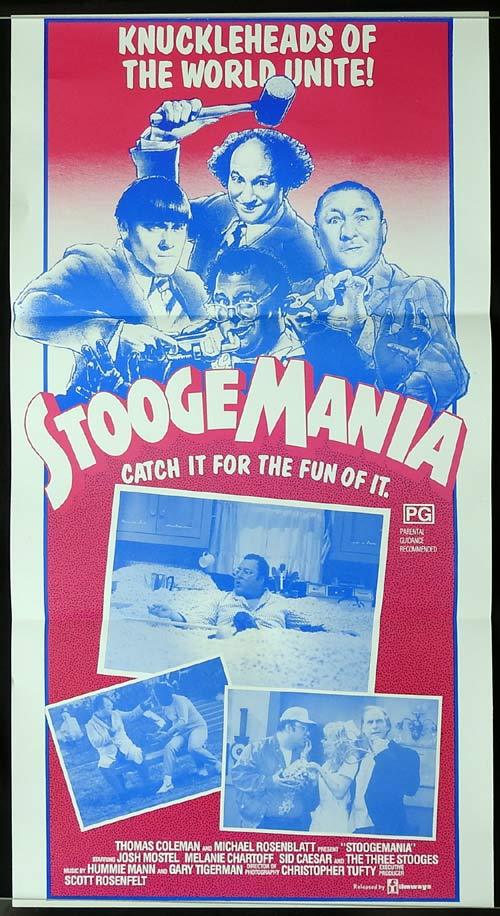
Howard F. Howard (Josh Mostel) is a man suffering from an obsession with the Three Stooges and it’s starting to affect his daily life and even is impending marriage to Beverly (Melanie Chartoff). He finds others that are having the same problem and the only way to cure it is to commit himself to Stooge Hills Sanitarium where he and others like him hope to rid themselves of their ailment through proper psychiatric care, but only if the inmates don’t overrun the asylum first.

It may seem hard to believe, but during the 80’s the Three Stooges franchise enjoyed a renaissance mainly due to its reruns being shown on TBS and the hit 1984 novelty song ‘The Curly Shuffle’. Personally I don’t get what the enjoyment is and  like with ‘Gilligan’s Island’ that somehow caught on with later generations, but in my opinion should’ve been forgotten instead. To me it’s just a lot of inane humor and predictable antics. If you’re 4 their routines might seem ‘hilarious’, but beyond that it most likely would bore anyone else and yet in the 80’s they were people out there that couldn’t get enough of the stooges including a former dentist of mine who had collected all of their film shorts.

If put in the imaginative hands of someone like Tim Burton this concept might’ve  worked, but with Chuck Workman at the helm it sinks fast. Workman has had a lot of success in directing documentaries and even won some awards for them, but his heart clearly wasn’t into this one. I almost wondered if he himself even enjoyed The Three Stooges or was just vomiting out some substandard product simply to collect a paycheck. The humor lacks even a modicum of cleverness and amounts to people acting incredibly stupid and equating this as being ‘funny’. No where is this more painfully evident then in the wedding scene that has first grade level pratfalls coupled with the dumb facial reactions from the actors and annoying cartoon-like sound effects, that are so stupid it starts to make the actual Three Stooges clips of which there are many that get shown here, seem brilliant by comparison.

Mostel is weak in the lead and had it actually been his father Zero Mostel, who had been cast here it would’ve done better. Zero had great ability to play off the camera and wonderful facial expressions and reactions that could keep even the worst of movies that he was in fun, but his son comes-off like some fat blob of a guy who got into the business simply by riding on his father’s coattails. Besides, if this is supposed to be a parody of the Three Stooges then why not have three men in the lead instead of just one?

There’s a host of other famous faces that drop in and out here including: Thom Sharp (who actually is kind of funny here), Sid Caesar, Victoria Jackson and Bill Kirchenbauer, but none of them can save this disaster that amounts to being an embarrassment even to the name of the Three Stooges and will most likely disappoint even those that enjoy them.

My Rating: 0 out of 10

Released: October 10, 1985

Runtime: 1 Hour 23 Minutes

Rated PG

Director: Chuck Workman

Studio: Atlantic Releasing Corporation

Available: VHS

Gandhi (1982)

By Richard Winters

My Rating: 9 out of 10

4-Word Review: Fighting for India independence.

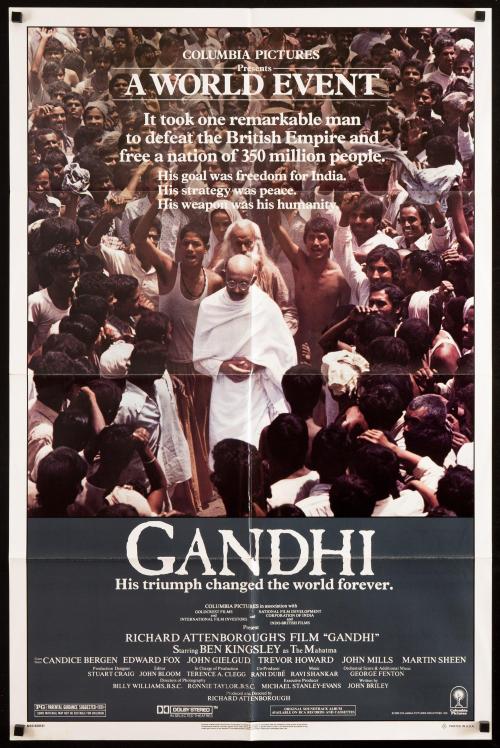
The film follows the life of Mohandas K. Gandhi (Ben Kingsley) starting at the age of 23 when he gets thrown off of a train in South Africa simply for being Indian. After spending many years fighting for Indian rights in that country he then moves back to his homeland of India. It is there that he takes up the challenge of fighting for its independence from Britain by advocating for his followers to practice peaceful civil disobedience.

This film project took director Richard Attenborough 20 years in the making as all the Hollywood studios refused to back it. He also went through many different casting choices in regards to who would play the lead and at one time seriously considered Dustin Hoffman and Anthony Hopkins in the title role. Due to the difficulty of finding backers and other hurdles some of the stars that do appear here were offered their parts many years before the filming actually took place including Candice Bergen, who plays Margaret Bourke-White, who first got approached about it in 1966.

Yet the long wait proved to be worth it as the film comes close to being a masterpiece in just about every conceivable area. I was surprised too that for  such a long runtime it hardly ever seems slow and clips along at a brisk pace. The story is filled with many strong scenes even a few harrowing ones like the recreation of the Amritsar Massacre that is quite disturbing, but thoughtfully handled.

After making his film debut a decade earlier as the bad guy in Fear is the Key and then moving back to the stage Kingsley shines in his Academy Award winning performance . The rest of the cast gets filled with a lot of big names, but many of them have brief appearances that almost amount to walk-on parts. My favorite though was Trevor Howard, who plays a judge and despite have little dialogue and only 2-minutes in front of the camera still manages to make the most of it, which is what great acting is all about.

The film though lacks a complete oversight of Gandhi’s character as we only get introduced to him when he is already 23 even though the crucial formative years are during childhood and it would’ve been revealing and insightful to have seen some scenes of him during that period. His family life also takes a backseat. We see only one scene of him with his children and then they just disappear. He also discusses marrying his wife when he was very young, but a flashback showing it would’ve been stronger.

The film also has its share of dissenters who feel it’s biased as it only shows the positive side to Gandhi’s personality. It even instigated three novels, which paints Gandhi in a much different light by arguing that he fought for Indian rights while in South Africa, but not for the blacks and there’s evidence that he had the same disdain for the blacks in that country as the whites did.

Some also argue that his involvement in the push for India independence was much more minimal than the film portrays and that India most likely would’ve eventually broken off from British rule one way or the other had Gandhi existed or not. All of these counter arguments could have some merit, but I don’t think that was the intended point of the film, but instead the focus was on how peaceful non-violent resistance can make a difference and in that regard the movie succeeds nicely.

My Rating: 9 out of 10

Released: December 6, 1982

Runtime: 3 Hours 11 Minutes

Rated PG

Director: Richard Attenborough

Studio: Columbia Pictures

Available: DVD, Blu-ray, Amazon Video, YouTube

Where the Red Fern Grows (1974)

By Richard Winters

My Rating: 6 out of 10

4-Word Review: Kid raises two hounds.

Billy Colman (Stewart Petersen) is a 12-year-old boy living on a farm in rural Oklahoma during the depression. He becomes obsessed with owning a coon hound which he can train to hunt raccoons. His family is too poor to buy him one, so he spends his summer doing a number of odd jobs until he’s finally able to buy two Redbone Coonhound puppies, which he raises and trains into becoming championship hunting dogs.

The film is based on the 1961 novel by Wilson Rawls, who provides the opening voice-over narration and the script here closely follows the action of the book. It was directed by Norman Tokar, who seemed to specialize in stories of young boys bonding with their pets as he also directed the film versions of Big Red and Rascal. The production was clearly done on the low budget side, which is distracting at first, but eventually meshes with the stark, rural, and economically challenged setting quite nicely.

While the story seems believable enough and may open some viewer’s eyes, such as my own, to the sport of coon hunting, which still thrives today in certain parts of the country, I found certain elements of it to be hard to believe.  For instance Billy decides to walk all the way from his lonely farmhouse to the town of Tahlequah, which is 30 miles away and apparently able to do it in one day. I was also not sure how he would be able to find the town since he did not travel along any type of highway or road, but instead trudged through open fields and without the benefit of either a map or a compass.

The scene where Billy intentionally trips a nasty boy by the name of Rubin (Rex Corley) which causes the kid to fall on the ax that he is carrying and dies seemed questionable from a modern day viewpoint simply because everybody believes the story that Billy tells them and no charges were made. The film and book, which I remember reading in the 6th grade and in fact this is the only part of the story that I remembered, portray this as being an unintentional accident, which it was. However, these days the kid could potentially be put on trial for manslaughter charges especially since there was clearly bad blood between the two, but maybe it is a testament of simpler times that everyone, including seemingly the victim’s parents, believe the story he tells them without question, but in any other era that might not have been the case.

I found it interesting to see Beverly Garland, whom I first became aware of when she played Fred MacMurray’s second wife in the TV-show ‘My Three Sons’ and who looked quite middle-aged then, but for some reasons gets cast here as a young housewife and manages to somehow pull it off despite nearing 50 at the time. Petersen though, who got cast after a long auditioning process of over 500 candidates, is only adequate, but doesn’t quite hit the mark especially with his inability to convey anything other than one facial expression. I also thought the coonskin cap that he ends up wearing made him come off looking like a Davy Crockett or Daniel Boone Jr. although maybe back in the day that was considered ‘cool’.

Certain animal right’s activists of today may not take kindly to what was once considered just a ‘charming’ coming-of-age tale. Although no actual killing of any animal is ever shown it is certainly heavily implied. It got to the point where I started to feel sorry for the raccoons particularly during the hunting competition where night after night different hunters would go out into the forest to see how any many they could catch and then come back with the numerous pelts that they skinned from them making me wonder if there could possible be any raccoons left to kill.

Spoiler Alert!

The film though does manage to end on a strong note although even here this gets botched because as the family goes to the dog’s grave to see this magical red fern growing on top of it we also see a big boom microphone hanging down from the top of the screen , which completely sucks all the magic right out of the scene. This same story was remade in 2003 and in 2018 a 45-minute documentary was released showing behind-the-scenes footage/stills of the movie as it was being made and also featuring interviews with the actors.

My Rating: 6 out of 10

Released: June 21, 1974

Runtime: 1 Hour 37 Minutes

Rated G

Director: Norman Tokar

Studio: Doty-Dayton Releasing

Available: DVD, Amazon Video, YouTube

Liar’s Moon (1980)

By Richard Winters

My Rating: 3 out of 10

4-Word Review: Couple harbors dark secret.

During the summer of 1949 in a small Texas town Jack (Matt Dillon), who has just turned 18, falls for Ginny (Cindy Fisher) who is 17. Jack is from the poor side of town and helps out his father (Hoyt Axton) on a family run farm while Ginny lives a more privileged life as the daughter of the town’s banker (Christopher Connelly) As Jack and Ginny’s relationship progresses they find stiff resistance to it from their mutual parents particularly Ginny’s father, but they don’t know why. In order to get married they go to Louisiana to elope, but Ginny’s father hires a detective (Richard Moll) to track them down and bring his daughter back no matter what the cost.

The one aspect about the movie that I did like is that it paints its small town characters in a generally positive light. Too many times movies that deal with stories that took place in a bygone era always seem to portray the characters as being more dopey than people of today, or more racist and meaner especially if it takes place in the south, but fortunately that doesn’t occur here. Instead we get shown regular, everyday people that you could easily meet today that just so happen to have lived a long time ago.

The film also has a nice leisurely pace to it and the romantic angle doesn’t seem quite as rushed, which is good, but the film also lacks finesse. The only part of the movie that has any atmosphere or cinematic flair is the opening flashback sequence, which gets done in black and white, while the rest of it pretty much flat lines. The scene where three men get royally drunk on some strong whiskey and another one where the town’s young men try to tackle a baby hog at the fair are the only times when there’s spontaneity or verve.

The story itself is too obvious and too many clues are given away, so by the time the ‘shocking’ secret get revealed you pretty much had guessed it way earlier. A few extra twists are thrown in during the final 15 minutes, but overall it becomes soap opera laden and too similar to the tragedy tinged teen romances of the 70’s that gives the whole thing a formulaic feel.

The eclectic cast is really the only interesting aspect about the film with Dillon giving a solid performance and Fisher looking quite beautiful even when she is constantly crying, which is pretty much all she does during the final third. Academy Award winning actor Broderick Crawford, whose last film this was, gets completed wasted in a pointless role that has very little screen time and the same goes for Yvonne De Carlo who speaks here in what sounds to be an Irish accent. Susan Tyrrell though is strong playing another one of her fringe characters, this time in the form of a prostitute, who comes off as cold and snarky at first, but eventually becomes surprisingly sympathetic.

Spoiler Alert!

Two different endings were filmed and distributed and which ending you saw depended on which theater you attended. One has the main character dying while the other one doesn’t, but both come-off as rather cheesy and make you feel like sitting through this thing really wasn’t worth it.

My Rating: 3 out of 10

Released: September 2, 1982

Runtime: 1 Hour 46 Minutes

Rated PG

Director: David Fisher

Studio: Crown International Pictures

Available: DVD, Amazon Video.

Out of Africa (1985)

By Richard Winters

My Rating: 9 out of 10

4-Word Review: An illicit love affair.

In 1913 a wealthy Danish woman named Karen Dinesen (Meryl Streep) gets spurned by the man she is in love with, so on the rebound she decides to accept the marriage proposal of the man’s brother, Baron Bror Blixen (Klaus Maria Brandauer) Despite the fact that neither she nor he are in love with the other, but decide to make it a marriage of convenience. They move together to Kenya where they plan to at first start a cattle farm, but it soon turns into a coffee plantation. Through the years Karen’s marriage to Bror begins to sour as he continues to have affairs with countless other women, so Karen turns her attention to the dashing big-game hunter named Denys (Robert Redford) and the two share a passionate and adventurous love affair, but when Karen tries to turn their relationship into a committed one he refuses.

The film, especially the first hour, comes off more like a broad sketch than a fluid story, or a highlight reel taken from a wide outline. I could never really get any type of handle of who this Karen person really was. I never understood why she would want to leave Denmark for Africa, or why she’d be so quick to settle down with a man that she didn’t love. So what if she got spurned by one guy there’s still other fish in the proverbial sea. Why not wait around for someone she could truly be excited about instead of just jumping in with someone that she really wasn’t?

To some degree I did find the marriage-of-convenience idea an interesting one. It’s rare that both parties admit that neither has the hots for the other, but still decide to make a go of it, which seemed like highly modernistic behavior especially for the time period and I was hoping this whole scenario would be explored more, but the film treats this mainly as a side-story that pretty much fades away after the first hour.

The introduction of the Denys character gets a bit botched too as he keeps popping in and out at the most convenient times out of literally nowhere, like when Karen finds herself ready to be attacked by a lion, and then just as quickly disappearing again almost like he were a magical genie.  The fact that Streep puts in so much effort into her Scandinavian accent, but Redford puts none into conveying an English one is off-putting. Supposedly Redford did initially try to speak with a light accent, but director Pollack apparently found it ‘distracting’ and advised him to speak without it, but in the process it makes the acting seem uneven.

It’s during the second-half where the film really comes together as it focuses solely on the affair though in real-life there was only a two year difference between Karen and Denys, but here there’s a 12 year difference between the actors playing the part and it shows, but despite that discretion this segment really works. I loved watching the different things that the couple did like playing a phonograph record to some monkeys and seeing how they responded to it and watching Karen taking an airplane ride for the first time and all the majestic scenery that she takes in.

The cinematography is indeed sumptuous and one of the things that holds it altogether even when the script jumps precariously and sometimes jarringly from one point in Karen’s life to another. The film would’ve worked better had it focused on only one area, like her relationship with Denys, which could’ve helped create a stronger, more immediate emotional impact with the viewer while also cutting down on the excessively long runtime.

My Rating: 9 out of 10

Released: December 10, 1985

Runtime: 2 Hours 41 Minutes

Rated PG

Director: Sydney Pollack

Studio: Universal

Available: DVD, Blu-ray, Amazon Video, YouTube

Tunnel Vision (1976)

By Richard Winters

My Rating: 1 out of 10

4-Word Review: Lame parody of television.

The year is 1985 and due to a new Bill of Rights an uncensored television network has been created, which causes many viewers to become hooked on its content watching it for hours while neglecting their other responsibilities. The head of the network, Christian A. Broder (Phil Proctor) is brought in for a senate hearing where the network’s programs are examined by a government panel to see if it should be allowed, or if censoring it would be the better option.

What was considered ‘pushing-the-envelope’ in its day would now barely pass as a blip on the radar of the average seventh grader. I was honestly expecting much more sex and nudity here, but ultimately the film offers very little and nothing is worse than smug filmmakers thinking they’re making something ‘edgy’ when they really aren’t. I also got tired of seeing a close-up shot of a plastic eyeball popping out of a woman’s lipstick laden lips, which I suppose might be considered by some as being sort-of sexy looking, but after it gets shown over and over again it becomes annoying.

The overall tone is too inconsistent. Certain provocative bits get lumped in with a lot of goofy, mindless ones, which creates a casual chuckle every 20 minutes or so but then coupled mainly with a lot of groans in between. The film also never cuts away to show any reaction shots of the conservative committee who are supposedly watching these ‘shocking’ clips, which could’ve added in an extra layer of humor. The viewer is also required to be highly familiar with mid 70’s programs and commercials as otherwise many of the in-jokes will go completely over their heads especially to those born at a later time.

The film was written and directed by Neal Israel who managed to have one hit Bachelor Party in 1984, but overall his other output conveys the same mindless, lame comedy as this one and whose talents seem limited. Had there been some visual flair it might’ve helped, but everything looks like it was filmed inside someone’s suburban home using low-budget home movie-like production values. Also, for a film that was supposed to be a peek into the future it certainly doesn’t have much of a futuristic design and instead reeks of mid-70’s sensibilities.

Of course there’s a lot of politically incorrect bits here too, which includes a parody of ‘All in the Family’ that features a Romanian gypsy family that spouts every conceivable ethnic slur, but this segment like so many of the others are just not that funny or imaginative. The only interesting aspect about the film is that, besides showing some young up-and-coming stars at the beginning of their careers, it also features many behind-the-scenes announcers whose voices you’ll immediately recognize, but not their faces, so seeing them in front of the camera for a rare time like Donny Darko who portrays a newscaster named Steve Garvey is kind of cool, but otherwise this thing is nothing more than a dated dud.

My Rating: 1 out of 10

Released: March 3, 1976

Runtime: 1 Hour 7 Minutes

Rated R

Director: Neal Israel

Studio: World Wide Pictures

Available: DVD

For Pete’s Sake (1974)

By Richard Winters

My Rating: 6 out of 10

4-Word Review: Can’t make ends meet.

Henrietta ‘Henry’ (Barbra Streisand) struggles with hardly any money in the bank as her husband Pete (Michael Sarrazin) works a low paying job driving a cab while he tries to finish college. Then Pete gets a tip from a fellow driver telling him to invest in potbellies as they are expected to have a huge gain in the market, but to do so he will need $3,000. Since he does not have this Henry decides to do some jobs that will pay her quick cash including prostitution and hauling stolen cattle, but everything that she does just gets her further into trouble.

Part of the fun of watching films from decades past is seeing how things have changed and in certain circumstances how they haven’t. Here you get to see virtually the same struggles that a young couple of today face and how the companies and banks joyfully screw them over if it means helping them either save or make a buck. Some of the segments at the beginning where she argues with representatives of these companies over either bills or loans are funny and helps give this otherwise innocuous comedy a bit of an edge.  It also allows for a great chance to see Anne Ramsey in an early role playing a rep at a phone company who not only looks way younger than from her better known role in Throw Momma From a Train, but even marginally attractive and with a much softer sounding voice.

Barbra is great in the lead that takes advantage of her rambling, fast-talking manner which she gets whenever she’s exasperated with the best bit being the running joke where she is constantly calling a distant relative in Dallas begging them for money while also updating them on her latest calamity. It’s also great seeing her play against her Hollywood celebrity image by effectively portraying a very drab everyday person sporting short hair, which was a wig created for her by her romantic partner at the time, hair stylist Jon Peters. It’s also interesting seeing this very liberal icon in a very anti-PC moment when she hands a box of Fruit Loops to an effeminate store clerk (played by Vincent Shiavelli) and tells him “I’m sure you’ll love these.”

The comedy has consistent laughs although the first hour works best and I particularly enjoyed the interplay that she has with the male customers she brings into her apartment while working as a prostitute and I wished this segment had been extended more. She also gets in a few juicy jabs towards Estelle Parsons, who plays the snotty, rich wife of Pete’s brother (William Redfield), that are delightfully savage.

Unfortunately the final third gets a bit too silly and exaggerated making the story lose its footing by becoming too frantically dizzying.  There’s still a couple of good bits here like watching the stolen cattle crash through a movie screen that is showing a film with a herd of cattle on it. I also enjoyed The French Connection parody where Babs plays the same cat-and-mouse game on the subway that Gene Hackman did with Fernando Rey only she does it with a police dog. However, some of the other bits including the appearance of Bill McKinney in a weak tribute to Deliverance are sterile  and helps to deflate an otherwise sparkling Streisand vehicle.

The script also suffers from illogical loopholes. Like the fact that despite having financial difficulties they still employ a housekeeper (played by Vivian Bonnell), but why would a young couple struggling with money and living in a tiny one bedroom apartment with no kids and a wife who stays home all day need hired help?

Pete gets exposed as having some major chauvinistic traits too by forebiding his wife from working full-time because ‘his ego couldn’t take it’, which doesn’t make him seem like a ‘great catch’ at all. Forcing his wife to stay stuck in the kitchen/home because that’s where he feels ‘she belongs’ while he’s unable to provide for her with his own job makes him seem like a total dud that’s not only not worth helping, but, especially in today’s world,  have him deservedly kicked to the curb in no time.

My Rating: 6 out of 10

Released: June 26, 1974

Runtime: 1 Hour 30 Minutes

Rated PG

Director: Peter Yates

Studio: Columbia Pictures

Available: DVD, Amazon Video, YouTube

Divorce American Style (1967)

By Richard Winters

My Rating: 2 out of 10

4-Word Review: Couple can’t get along.

Richard and Barbara Harmon (Dick Van Dyke, Debbie Reynolds) appear to have the perfect life living in a sprawling suburban home with two kids, a good job and paid housekeepers, but underneath the facade their unhappy. Neither of them can communicate with the other, so they decide to see a marriage counselor (Martin Gabel), but this just makes things worse. Eventually they get a divorce, but the alimony and child support are so high that Richard is forced to move into a small 1-bedroom apartment and drive around in an old beat-up car. Barbara begins dating an affluent car salesman (Van Johnson) but both find that, despite all their squabbles, the more they’re apart the more they miss each other.

The script was written by Norman Lear who went on to produce the ground-breaking TV-series ‘All in the Family’, but the edge from that one is completely lacking here. I’m not sure if it was the time period this film was made in and what the studios perceived the public was willing to accept, but the satire is mild to non-existent and becomes boring quite quickly. The subject of divorce is handled in such a sanitized way that it barely even touches the surface and in many ways this thing comes off more like a romantic comedy with divorce being only a side-story.

The two leads are incredibly bland. Van Dyke again just seems to be channeling his Rob Petrie character and seemingly unable to play any variation from that. While his squeaky clean image may have made him likable on TV it makes him quite dull and one-dimensional on film. Reynolds fares better, but as a couple there’s nothing unique or interesting about them and the issues that they fight about, which is mainly the fact that they can’t ‘communicate’, comes off as generic and pointless.

The supporting cast are far more engaging. Joe Flynn, who has no problems paying or sex with prostitutes and does not feel it’s cheating because it’s ‘not romantic’ and his wife, played by Emmaline Henry, who wouldn’t go back home to an unfaithful husband even if he ‘hanged himself’ have the type of edge that could’ve made this film far funnier and more memorable had they been made the stars. Even Jason Robards and Jean Simmons have potential playing a divorced couple where the wife still lives in affluence while the husband due to his high alimony and child support lives in the dumps, but dates a pregnant woman (played by Eileen Brennan in her film debut) anyways.

The comedic tone is inconsistent. At times it conveys a surreal flair like having an orchestra conductor come out at the beginning and pretend to direct the voices of all the arguing couples in the neighborhood like there’s a musical quality to it. Having the kids keep a scorecard to their parents fighting is funny too, but these segments get interspersed with long talky moments that drags the whole movie down and things would’ve worked better had it started out right away with the couple already divorced instead of spending the first hour dealing with their protracted arguing.

The anemic insights that it does make about divorce come off as dated and wholly out-of-touch with today’s realities. A modern day divorced couple will most likely find nothing relatable with the story. Tacking on a pseudo happy ending just adds further insult to the topic by making it seem like all marital disagreements can somehow be ‘worked out’ coming off like it was written and produced by those who really hadn’t dealt with divorce issues in their real lives and did very little research on it.

My Rating: 2 out of 10

Released: June 21, 1967

Runtime: 1 Hour 49 Minutes

Not Rated

Director: Bud Yorkin

Studio: Columbia Pictures

Available: DVD, Amazon Video, YouTube

A New Leaf (1971)

By Richard Winters

My Rating: 7 out of 10

4-Word Review: Marrying for her money.

Henry Graham (Walter Matthau) has been living off of his vast inheritance for years only to find that his overspending and has now made him broke. Since he has no work history and no interest in getting a job he decides the only other alternative is to marry a rich woman. He finds his target in the form of Henrietta (Elaine May) who is an heiress to a massive family fortune. She is also quite homely, socially inept, and very into botany. Henry decides to ask for her hand in marriage and then once they are hitched kill her off and acquire her fortune for himself, but nothing goes as planned.

The plot is based on a short story ‘The Green Heart’ by Jack Ritchie and is full of many ingenious twists that helps propel the dark comedy along at a very even tone. Director May’s use of dry, subtle humor comes in perfectly for this type of material. So many other Hollywood comedies feel the need to bombard the viewer with broad, in-your-face gags so it’s genuinely refreshing to have a film take a more restrained approach by allowing the humor to peculate more. Instead of a rapid fire, gag-a-minute pace the film stretches the comical bits out for several minutes allowing the actors to play up the scene to a full crescendo with Henrietta’s inability to wear her evening nightgown properly on their honeymoon being quite possibly the funniest.

The characters are made up of extreme caricatures and in less talented hands could’ve been a detriment, but Matthau manages to play his part so astutely that the viewer ends up liking him anyways and his arc, where he reluctantly and quite unexpectedly ends up helping Henrietta out of several jams that she wasn’t aware of, is quite satisfying. George Rose, who sadly and ironically ended up having the same fate that almost befell the May character here when in 1988 in an attempt to get his hands on Rose’s fortune the teenage son that he adopted killed him while trying to make it look like a car accident, lends great support as Matthau’s wise and loyal butler.

Like with May’s other projects including the notorious Ishtar this film suffered many cost overruns and production delays most notably the 10 months it took to edit the film, which initially ended up having a 180 minute runtime and featured a secondary story dealing with Matthau poisoning a blackmailer played by William Hickey. The then head of Paramount Robert Evans decided, much to May’s objections, to cut this part out, which shortened it to 102 minutes, which I personally feel was a good idea. While I usually like director’s cuts the story here is too thin for a 3-hour length and in many ways goes on a bit too long the way it is although it would still be cool to see the extra footage, which is rumored to have been either lost or destroyed, as a bonus feature on a future DVD/Blu-ray release.

As a simple black comedy it comes off pretty well and even has a cute twist ending. Although a box office flop at the time it has garnered strong acclaim and since become a cult classic. The two stars also reunited 8 years later playing another couple in the Neil Simon farce California Suite

My Rating: 7 out of 10

Released: March 11, 1971

Runtime: 1 Hour 42 Minutes

Rated G

Director: Elaine May

Studio: Paramount

Available: DVD, Blu-ray, Amazon Video, YouTube