Blackout (1978)

blackout

By Richard Winters

My Rating: 6 out of 10

4-Word Review: Criminals invade apartment complex.

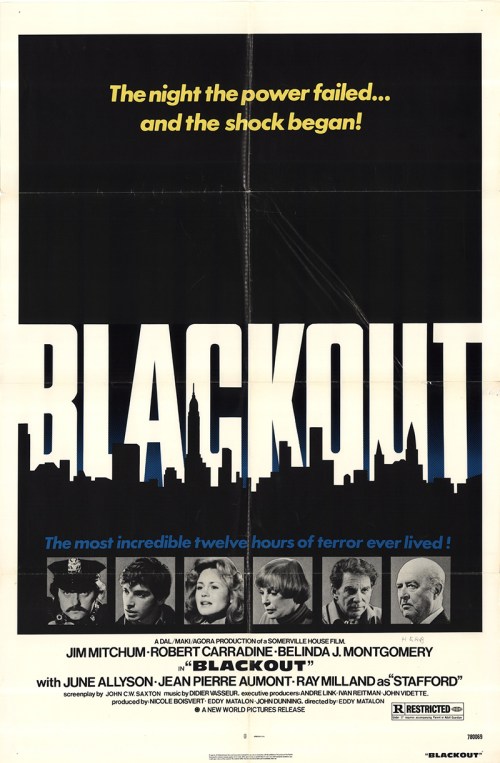
Inspired by the actual power blackout that occurred in New York City on July 13-14, 1977 the story centers on a group of felons lead by Christie (Robert Carradine) who are being transported to another prison. Along the way their police van crashes and the van drivers are killed instantly, but the felons survive. When they climb out they find that the city is without power. Using the police uniforms of the two dead drivers as well as their weapons they’re able to sneak their way into a nearby apartment complex under the pretext that they’re policemen and therefore the security guard allows them in only to be immediately killed once he does. The crooks then terrorize the residents by conning their way into each of the apartments the same way they did to get into the complex. Once they’re inside they rob the tenants and at certain points even kill them. Dan (James Mitchum) is an off-duty police officer who breaks into the complex to help save Annie (Belinda Montgomery) who’s being attacked and screaming for help from her balcony. He then single-handily goes about trying to track down the armed group despite being outnumbered.

This was yet another example where the entry in Leonard Maltin’s book does not accurately describe what occurs as whoever wrote the review states that it’s ‘balanced with black comedy’ though there’s really no comedy in it except for a brief exchange between a husband and wife attending a Greek wedding, which occurs at the beginning, but after that it’s all gritty drama.

The production was directed by Eddy Matalon who started his career doing music videos for Bridgette Bardot during the 60’s before graduating to soft-core porn in the 70’s under the pseudonym Jack Angel. He eventually, in 1977, tried his hand at horror with the universally derided Cathy’s Curse before following-up with this one, which fares better and as a grim thriller even succeeds though it’s not perfect.

My biggest complaint is that it cuts out too many pivotal moments. It shows how they enter into one apartment and even choose another because it has triple locks cluing them in that a rich person with a lot of expensive stuff must live there, but there’s other times when it does not show why they break into the apartments that they do. There’s hundreds of dwellings inside the complex and they weren’t going to be able to bust into all of them, so the reason for why they choose the ones that they do needed to be shown each time. There’s also a segment where Mitchum shoots and kills one of the perpetrators in the hallway, but it’s never documented where they take the body, or if they just leave it there for all to see.

Some of the stuff gets a bit over-the-top like when they kill the guard and then stage it to look like a suicide, but why would these desperate crooks care to take the time to do that? They’re in a rush to rob as many residents as they can before the power comes back on, who why not just put the dead guard’s body into a back room and be done with it? Tying Mitchum up into a contraption that would electrocute him once the power came back-on seemed too similar to the campy predicaments that would be the cliffhanger for each episode of the ‘Batman’ TV-show. These two-bit thieves wouldn’t have the care, or sophistication to do that. Either kill the guy, or tie him up the conventional way, but getting excessively overboard with it seemed too theatrical and predictably gives him just enough time to escape.

Mitchum is enjoyable. I liked how at the beginning he tries to chase down a purse snatcher, but fails, which shows that he’s not perfect and relatable, which makes you want to root for him even more to stop the bad guys. I did though have misgivings with Montgomery’s character who gets raped, but immediately after that she saves two people trapped in an elevator and even delivers a baby, which is too quick a recovery from such a traumatic event.

Aging stars from Hollywood’s gold era appear as the residents, but are given little to do especially June Allyson who’s seen for less than 5-minutes. Ray Milland’s segment had potential as he plays this rich, stuffy guy who refuses to give the intruders the combination to his safe even as they torture his wife. Eventually he gives in, but it would’ve been fun had he remained stubborn. They’d burn-up his place, which they do anyways, and kill his wife, but he’d still refuse to give it out. Then when the cops finally do arrive he could say in his last dying breath amidst the burned cinders “At least they never got the combination.”

My Rating: 6 out of 10

Released: August 25, 1978

Runtime: 1 Hour 32 Minutes

Rated R

Director: Eddy Matalon

Studio: Cinepix Film Properties

Available: DVD, Blu-ray

Carbon Copy (1981)

carbon

By Richard Winters

My Rating: 1 out of 10

4-Word Review: His son is black.

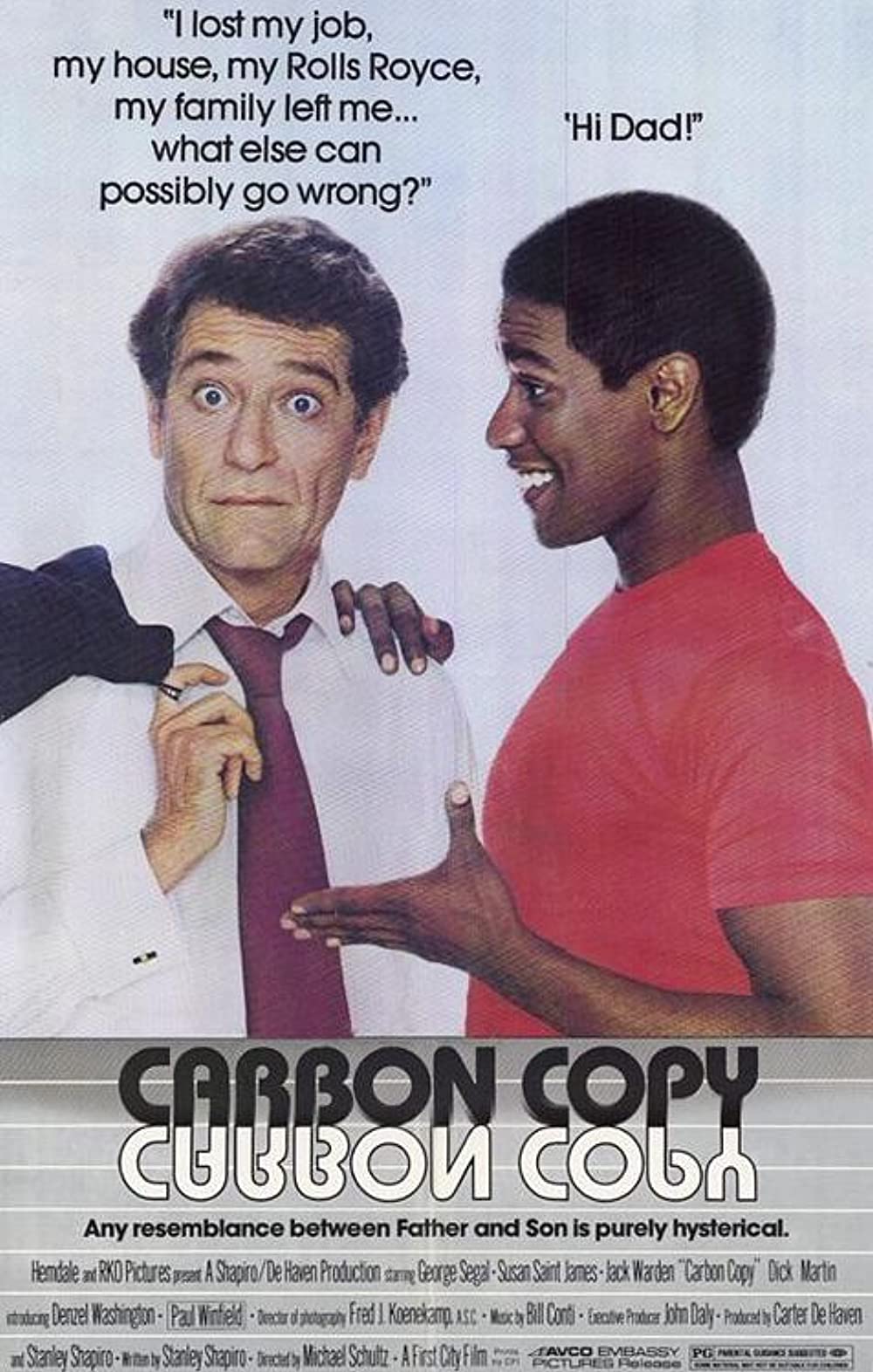
Walter (George Segal) is living the American Dream as a rich company executive residing in the gated community of a posh suburb while also driving a Rolls Royce. However, he’s not happy with his wife Vivian (Susan Saint James) who’s frigid, nor his daughter-in-law Mary Ann (Vicky Dawson) who’s mouthy and spoiled. Yet he remains in the marriage because Vivian’s father Nelson (Jack Warden) is also Walter’s boss and climbing the career ladder is important to him. Then one day Roger (Denzel Washington) drops by and introduces himself as Walter’s son from a relationship Walter had with a black woman many years ago. Walter enjoyed his time with her, but broke it off due to pressure from Nelson who said it would stymie his career. Now Walter feels guilty from what he’s done and wants to make it up by allowing Roger to move in with him, but once his wife finds out she gets him fired. All of his money is tied up in company stocks that is either under his wife’s or father-in-law’s control, so without any income he’s forced to move into a hotel with Roger and then eventually to a rundown apartment in a dangerous area.

The script was written by Stanley Shapiro who received accolades in the early part of his career for scripting many Doris Day movies during the 50’s and 60’s, but he clearly got in over-his-head with this one. The concept and overall reactions from the characters is dated even for 1981. I was around in ’81 living in a small Midwestern town and I didn’t see half the overt racism that the characters here display despite the fact that it all takes place in California known as the liberal capital of the world. I’m not saying there isn’t some racism everywhere, but it gets exaggerated.

The Saint James character is particularly problematic. She plays the part in a funny way, but it’s a caricature. It would’ve been more revealing had she not been this stereotyped rich white person who feels comfortable displaying her bigotry, which would’ve been socially taboo in L.A. and she’d know it, but instead pretending to be okay with it, or even being an outward liberal who tries to be hip with race relations, but then, in more subtle ways, becomes increasingly less comfortable as it goes along.

Segal’s character comes-off as a massive conformist who will do whatever is takes to a part of ‘acceptable’ society. He even changes his last name to hide the fact the he’s Jewish, so where is this rebel side who moved-in with this black lady back in the 60’s when that would’ve created outrage and scandal? Some may argue that people change, sure that can sometimes happen, but there needs to be some factor that created it and the movie does not make that clear. The fact that he morphs into somebody that was so different from what he used to be makes him seem like two different people with no connecting thread at all. A more plausible storyline would’ve had him getting drunk one night and picking-up a black women at a bar for a one-night-stand, or secretly hiring a black prostitute just because he was curious about having sex with someone of a different race and then thought nothing more of it once it was over. 

Susan’s character has the same issue. She coldly kicks Walter out of the house and then for some unexplained reason turns-up at the doorstep of his ratty apartment with her father and begs for him to come back, but with no clear rationale for what created this radical change-of-heart. I don’t think a racist, snotty woman like that would ever dare come into a dangerous area for any reason. She would’ve only done it had she been accompanied by armed guards, or maybe carrying a gun herself and openly flashing it, which could’ve been funny, but of course this stupid movie doesn’t even think to go there.

The over-the-top situations become increasingly ridiculous without a hint of nuance and as satire it’s about as sophisticated as an episode of ‘Gilligan’s Island’. That’s not to say there can’t be some excellent films about race relations as I found The Landlord to be terrific, but this thing lacks any serious insight. Many consider Soul Man to be the worst 80’s film about a white man trying to understand the black experience and get in-touch with their own inner bias and the bias of those around them, but this I consider to be just as bad. Denzel Washington, who makes his film debut here, is the only good thing about it, it’s just a shame they couldn’t have given him better material.

My Rating: 1 out of 10

Released: September 25, 1981

Runtime: 1 Hour 32 Minutes

Rated PG

Director: Michael Schultz

Studio: AVCO Embassy Pictures

Available: DVD/Blu-ray

The Baltimore Bullet (1980)

bal

By Richard Winters

My Rating: 7 out of 10

4-Word Review: Pool hustlers travel country.

Nick (James Coburn) is an aging pool hustler who’s best days are behind him. Many years earlier he took a young 15-year-old boy named Billie Joe (Bruce Boxleitner) under his tutelage and taught him the tricks-of-the-trade. Now as a man Billie is able to play the game as well as Nick. The two travel the countryside attending pool halls where they hustle patsies for money. Nick though holds a grudge because a ways back he lost a crucial match to The Deacon (Omar Sharif) another hustler whose just been released from jail. Nick wants a rematch, but The Deacon doesn’t think he’s worthy of his time. Nick though got’s a scheme that will get him to change his mind by playing in a nationally televised pool tournament that The Deacon plans to attend.

For a film that has never had an official US DVD release and was only shown sporadically on late night TV I was surprised at how engaging it is. Screenwriters John Brascia and Robert Vincent O’Neill have written a highly amiable script that features funny vignettes and amusing banter. The focus isn’t on the game of pool, which seems almost like a side-light, but more on the scraps they get into along the way. The two also come into contact with those trying to cheat them and this culminates in an almost surreal like confrontation, that comes around the middle mark, inside a house of mirrors at a carnival side show.

The film also has a segment that seemed prolific in movies that came out during the late 70’s and early 80’s which features what would be considered sexual assault now. The scene has Nick betting Billie Joe that the breasts on a waitress at a cafe that they’re in is silicone and not natural. Billie then proceeds to go into the kitchen to feel-her-up without her consent. While what he does is not shown we do hear her scream and drop her tray of dishes before he walks back out with a broad smile on his face, which back in the day was just considered ‘light comedy’.

Coburn is a great actor, but looks horribly aged. He was only 60, but could’ve easily passed-off as 70 or 75 making his fight scenes look inauthentic as I don’t believe in his elderly condition he would’ve been able to hold his own. Boxleitner is dull and seems only able to display a broad ‘good-ole-boy’ smile and not much else. A more dynamic actor, or one maybe more Coburn’s age, could’ve made the buddy angle better.

I found Sharif to be too soft spoken and he approaches his part in a weird way. For instance when he’s playing a senator at poker he displays moments of outward nervousness, but if he’s truly a cocky, confident player that wouldn’t have been the case. Ronee Blakely is weak as well proving that her appearance in Nashville was her only good performance though her singing is nice and she’ll remind one a lot of Shelley Duvall with her looks. Jack O’Halloran, the former boxer who’s best known for playing Non the henchmen to the evil Zod in the Superman movies, is very funny as Max an inept hit man.

Spoiler Alert!

The ending unfortunately gets convoluted. Having the game broadcast and featuring live play-by-play and commenting by pool legend Willie Musconi is cool, but I wanted to see the ultimate match between Nick and Billie Joe to prove which one was truly better. The script teases this idea, but then adds in too many other unnecessary ingredients like having Nick be pressured to dump the game while there’s also a robbery happening and then eventually the place is raided by the feds. By the time it gets to The Deacon taking-on Nick it’s anti-climactic especially since no one else is around (it should’ve been televised on TV for all to witness). Having it focus more on the game and the strategies, which it starts to do slightly near the end, would’ve given it more substance and what little they do talk about I found to be genuinely interesting.

My Rating: 7 out of 10

Released: April 1, 1980

Runtime: 1 Hour 43 Minutes

Rated PG

Director: Robert Ellis Miller

Studio: AVCO Embassy Entertainment

Available: DVD (Reg 2 Import)

The Prime of Miss Jean Brodie (1969)

prime1

By Richard Winters

My Rating: 8 out of 10

4-Word Review: Teacher influences her students.

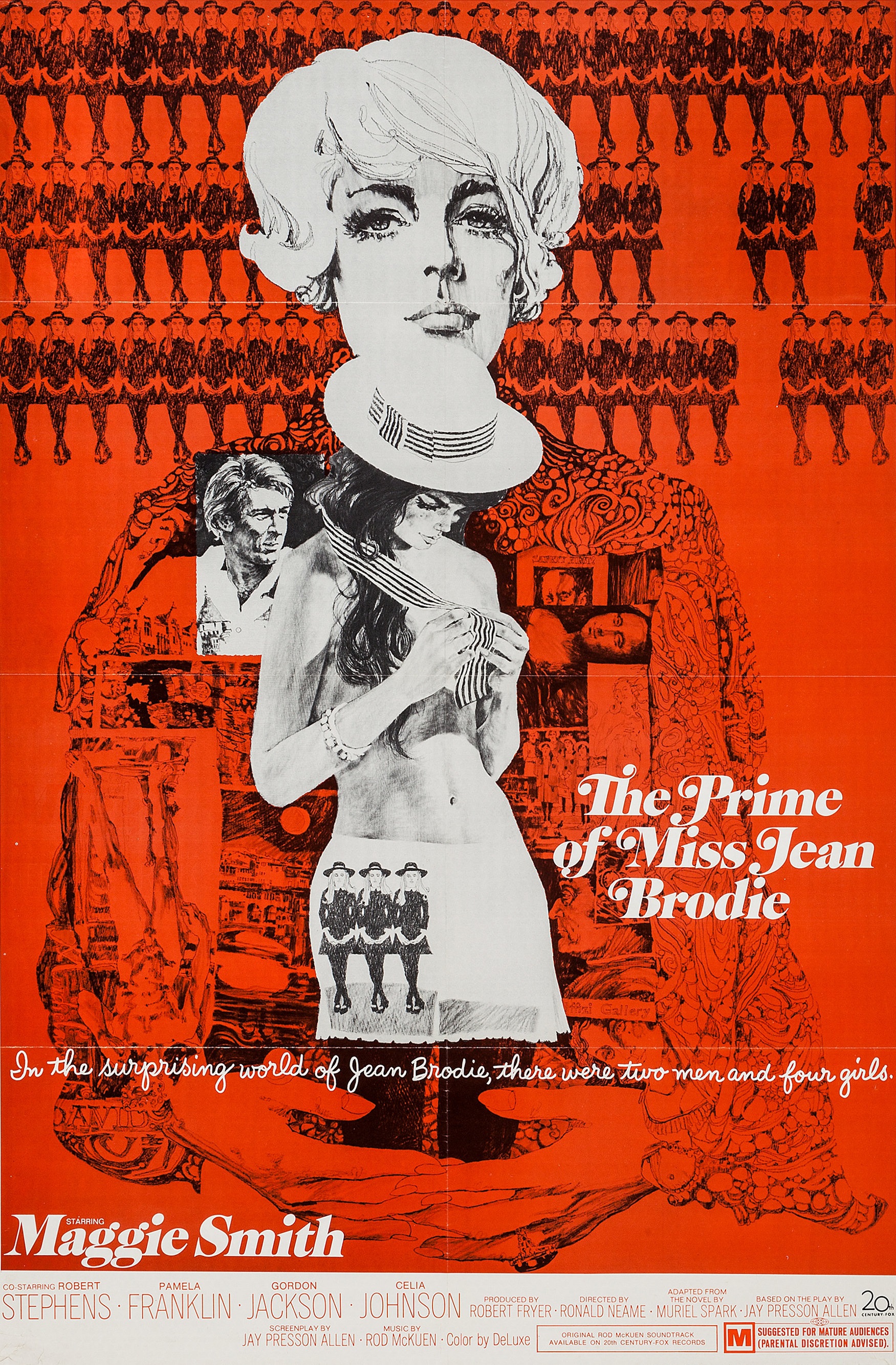
Jean Brodie (Maggie Smith) is a teacher at an all-girls school in Edinburgh, Scotland in 1932.  She routinely strays from the core curriculum and instead instills her own quirky value system, like her admiration for fascist dictators, onto her students. She views them as empty vessels there to be programmed to her liking as she routinely will say: “give me a girl at an impressionable age and she’s mine for life”. The school’s Headmistress, Miss Mackay (Celia Johnson) is aware of Brodie’s unorthodox teaching methods, but unable to do much about it, despite the repeated warnings that she gives to her, due to the fact that Brodie has tenure and been at the school longer than she. Sandy (Pamela Franklin) is one of Brodie’s students, who used to admire her teacher, but now has turned on her and comes up with a way to have her fired, which leads to a dramatic confrontation between the two.

One of the first things that struck me about the story, which is based on the play of the same name by Jay Presson Allen that was based on the novel by Muriel Spark that some feel was inspired by a teacher named Christina Kay who taught at James Gillispies School that Muriel went to as a child, is that it works against the grain of most films. In our individualistic culture the modern day movie centers around the rebel, or those that choose to work outside the system of an autocratic institution and the people that uphold those rules and enforce them are usually the villains. Here though it’s the stuffy authoritarians that ultimately become the makeshift heroes while the non-conformist gets exposed as a ‘loon’ that got too far off-base and needed a serious reeling-in.

It’s also the perfect study of someone who seeks control over others and cannot function in relationships were both sides are on equal footing. We see this not only with the way Jean openly humiliates her students by ridiculing them for even minor infractions like having their shirt sleeves rolled-up, but also in her maladjusted love life. Since she cannot have a healthy relationship with them as that would require selfless behavior from her, which she can’t give, so instead she emotionally manipulates two men (Robert Stephens, Gordon Jackson). She enjoys the attention they give her and gives them just enough incentive to keep on doing it, but never more than that. When the Jacskon character finally does get married to someone else, her sad expression isn’t about losing a person she loved, but more upset that she could no longer have this simp at her convenient disposal.

The recreation of the 1930’s girl school atmosphere was impeccable. Too many times I feel movies dealing with a bygone era don’t recreate it in an accurate way, or it gets viewed through a warped modern lens, but here I came away convinced it was accurate and this in large part could be credited to director Ronald Neame, who was alive when the story took place and therefore better able to feed-off his memory and experience. The scene where the girls all get up out of their seats and stand at attention the second the headmistress walks into the room is one of my favorite moments. To some degree it would be nice if kids today could show that kind of respect to an adult figure, but on the other hand it also reveals the dark side to extreme obedience to authority, which creates an atmosphere that allows someone like Jean to incorporate her will and beliefs onto the students without them ever questioning it.

In the end this is a terrific portrait of how teacher’s where viewed back in the day and the tremendous amount of influence they could hold over their pupils. There were no teen idols, singers, celebrities, or social media influencers back then, so the teacher was the center of most children’s lives sometimes even more so than their parents. While some things have changed the debate about what a teacher chooses to convey in the classroom and how far they should be allowed to stray from the core curriculum rages on today. No matter what side of that issue you may stand it just proves that this story is even more relevant now as it was back then.

My Rating: 8 out of 10

Released: February 24, 1969

Runtime: 1 Hour 56 Minutes

Rated M

Director: Ronald Neame

Studio: 20th Century Fox

Available: DVD/Blu-ray

The Villain (1979)

villain

By Richard Winters

My Rating: 2 out of 10

4-Word Review: An inept western robber.

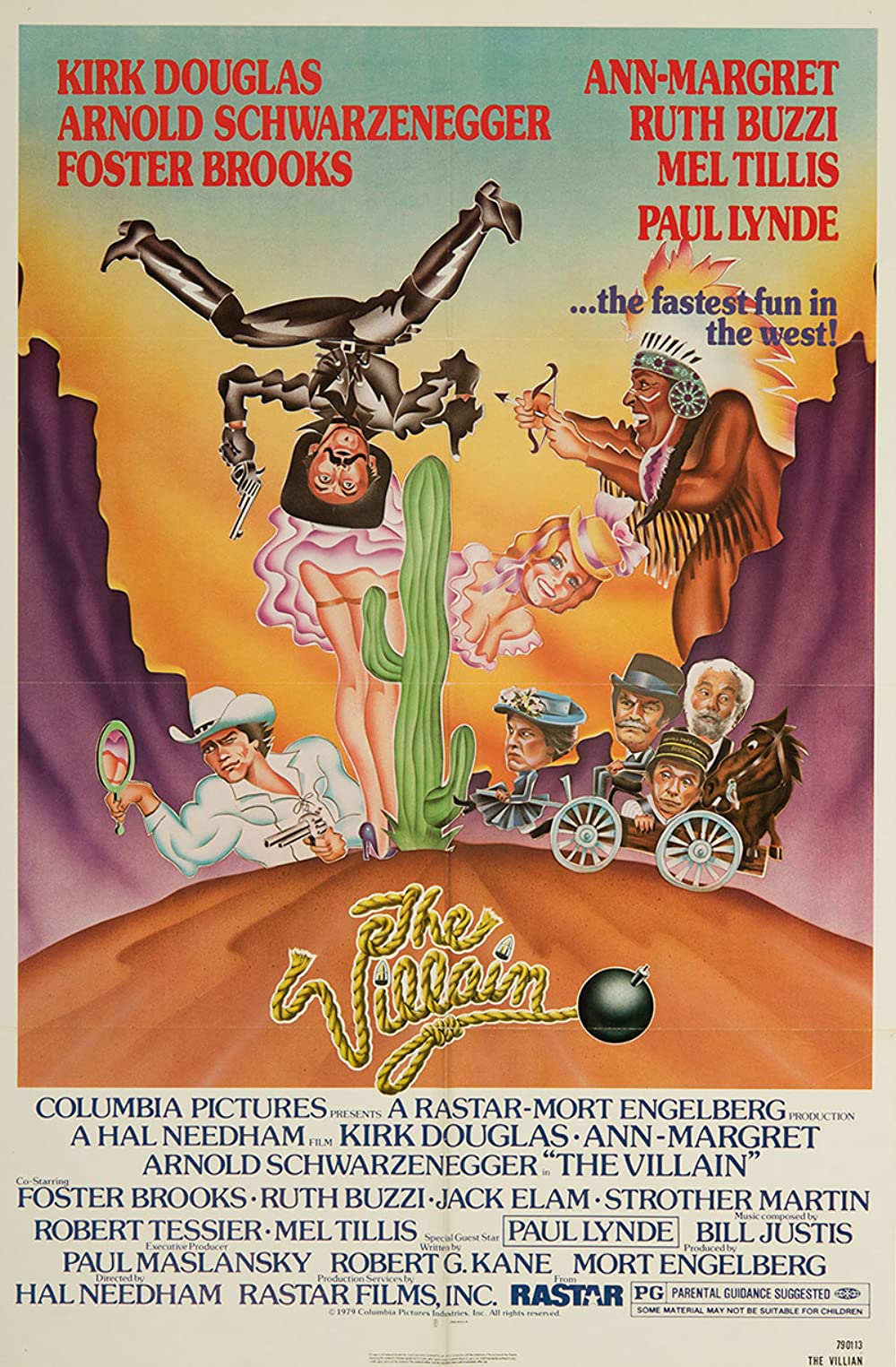
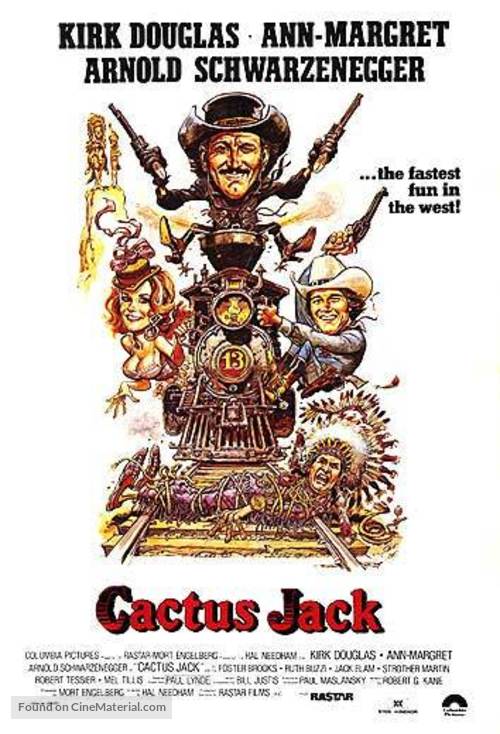
Cactus Jack (Kirk Douglas) is an aging western outlaw who’s hired by Avery Simpson (Jack Elam) to commit a robbery. Charming Jones (Ann-Margaret) is a beautiful, young woman who’s being escorted west by Handsome Stranger (Arnold Schwarzenegger) and is also carrying a large sum of money. Cactus Jack sets up an array of elaborate traps to try and rob them, but fails each time, so he enlists the help of a local Indian tribe headed by Nervous Elk (Paul Lynde) to assist him.

After the box office success of Smokey and the Bandit and Hooper executives at Columbia Pictures were apparently convinced that stunt man-turned-director Hal Needham could do no wrong and thus gave him a ton of money to direct a movie of his choice. Needham decided to do a send-up of the Road Runner cartoons, but as a live-action. The result though isn’t amusing, or lively with not enough stunt work and what you do see had already been shown many times before in other movies. The script by Robert G. Kane, who was a former joke writer for Dean Martin, is unimaginative and gets stuck in a one-dimensional gear where Cactus Jack continually tries to rob the two, but fails, which takes over 90-minutes to play-out while the old Road Runner cartoons where able to do it in less than 5.

There’s also quasi-surreal moments where Jack paints a tunnel opening onto the side of a mountain with black paint and yet Arnold and Ann are able to drive through it like it were a real tunnel. There’s another segment where Jack pours glue onto some train tracks, which Arnold and Ann are able to drive over without getting stuck while Jack does, but why? I realize this is supposed to be a silly movie and logic should not be demanded, but it just shows how lame it is where the director and writer do not challenge themselves to come-up with a clever way, that works within the realm of reality, for the protagonist to get out of their jam and instead lowers the bar to such an extent that they throw-out anything stupid and figure it will suffice.

Kirk for his part has a lot of fun. Some may feel he took it because his career was waning, but Needham had been the stunt coordinator on many of his movies back in the 60’s, so the two were friends and Douglas eagerly accepted the offer. At age 61 he looks great and did many of his own stunts, which is even more impressive, but no matter what the pratfall his character never gets injured. Despite the common belief many cartoons do at times show the antagonist like Wily E. Coyote getting banged-up and wearing bandages, bruises, and even walk with a crutch, so having Jack get that way and yet still determined to commit the crime would’ve been funnier.

Schwarzenegger is funny too simply for being this big, brawny guy who’s painfully naive though why someone would be walking around in the old west speaking with an Austrian accent needed to be questioned. Mel Tillis does mention at one point that he ‘talks funny’, but I felt that should’ve been a running joke where all the characters mention it when they meet him. It also would’ve been nice to have seen his character evolve and not remain so clueless by upping-the-ante with an exciting climactic battle/gunfight between he and Kirk at the end, which doesn’t happen.

Famous character actors like Strother Martin, Ruth Buzzi, and Foster Brooks are completely wasted. Mel Tillis does his stuttering routine (twice), which I’ve never found amusing though he also does the soundtrack and his singing is great. Initially I thought Ann-Margaret was miscast as she was too old for the part, but they make her look convincingly young and by the end I appreciated her presence.

The best by far is Paul Lynde as Indian Chief Nervous Elk, or as he says it N-e-e-e-e-rvous Elk. Today’s more sensitive audiences may not like a white guy playing a Native American, nor wearing an Indian styled head dress. I don’t know this for sure, but I suspect it’s the reason why the movie has never received an official studio DVD/Blu-ray release nor is it available on streaming, which is unfortunate. Yes, it’s political incorrect, but it’s done in such a goofy, campy way that it manages to become stupid funny and the only part that had me chuckling.

Everything else borders on being pathetic and all it succeeds at doing is getting you wanting to watch an actual cartoon, which will be far more sophisticated and entertaining than anything you’ll see here.

villain2

Alternate Title: Cactus Jack

My Rating: 2 out of 10

Released: July 20, 1979

Runtime: 1 Hour 29 Minutes

Rated PG

Director: Hal Needham

Studio: Columbia Pictures

Available: DVD-R

Don’t Cry, It’s Only Thunder (1982)

dont

By Richard Winters

My Rating: 6 out of 10

4-Word Review: Medic helps out orphanage.

Brian (Dennis Christopher) is an army medic during the Vietnam War who’s stationed at a hospital in Saigon. Young and idealistic he initially cannot handle the death and carnage that he comes into at the clinic and feels he’s not making much of a difference especially as he sees the severely injured soldiers come-in and die with very little that they can do. He then makes a promise to one of them to look in on an orphanage and try to find a safe new location for the children and two nuns who look after them. At first Brian is not into the kids, but eventually he bonds with them especially Anh (Mai Thi Lien) a 12-year-old girl who cannot speak and who he wishes to adopt despite all the red tape that he must go through.

The film is loosely based on the actual experiences of Paul G. Hensler, who first wrote it into a novel before being commissioned to turn it into a screenplay. His motive was to show more of the humanitarian side to the war versus the battle scenes that made up so much of the other films that dealt with the Vietnam conflict. In a lot of ways it’s a refreshing change of pace and unlike with M*A*S*H, that focused on medics during the Korean War, there’s no humor, or pranks, but instead solely focuses on the serious side of taking care of the wounded and how emotionally exhausting it can become. There’s a few moments where a passing character will make a joke, I suppose as an ode to M*A*S*H, but instead of laughs from the others it’s met with eye rolls, which is how it should be as there’s certain situations where humor just isn’t going to help things and in some ways such as here just plain out-of-place.

Christopher, who’d been acting in films since he was 15, but rose to critical acclaim in Breaking Away only to make a bad career turn by starring-in the offbeat dud Fade to Blackredeems himself with his performance here. He does though look incredibly young almost like he’s only 14, but his youthful appearance helps explain his character’s sometimes naive nature and tendency to be overly idealistic and thus makes some of the things that he does, which an older more seasoned person might refrain from, more understandable.

I wasn’t as keen with Susan Saint James. She was 10 years older than Dennis, but looked more like it could’ve been 20 and thus making the eventual love scene between them come-off as forced and mechanical. I’ll give her credit she does have an effective emotional moment, but her character is too Jekyll and Hyde-like as she initially is really into helping the orphanage and even gets Brian more into it and then suddenly like a light switch doesn’t want to have anything to do with it, only to eventually to go back, kind of, to helping the kids out, which is like watching someone with a ping pong personality. If anything I really enjoyed the two Vietnamese nuns (Lisa Lu, Shere Thu Thuy) and the way they would sometimes compromise their moral beliefs for the sake of the kids.

The film manages to be gritty most of the way and despite being filmed in the Philippines still gives one an adequate feeling of the civilian experience in Vietnam during that time. However, the segment where a song gets played that was supposedly sung by the kids while we view a montage of them playing is over-the-top sentimental and even jarring as we were used to the background noise of battle and thus comes-off as sappy and out-of-place. Watching the kids having a bit of fun is fine, but we didn’t need the added music.

Brian’s insistence and almost obsession at adopting a preteen girl will be considered cringey by today’s standards. The film makes clear that his intentions are pure, I suppose this is why there was the sex scene thrown between he and Susan to alleviate any viewer concern that he wasn’t a red-blooded All-American guy who was into chicks his own age, but it still looks even in the most charitable way as kind of questionable especially since he can’t even have any conversations with her since she doesn’t speak. He contends that he’s the one guy who can help her, but how since he has shown no background in dealing with those with speech issues? The book cover of which the film is based has a picture of the real Hensler, of which Brian is supposed to represent, holding an infant girl, which I presume is who he wanted to adopt. Having the girl character being a baby like in the book instead of 12 going on 13 would’ve worked better, or having him try to adopt a group of kids to bring home with him, like 3 or 4 that was an even mix of boys and girls, but to have him get overly infatuated with just one makes it unintentionally seem likes his grooming her to being a Lolita in the making. A bratty child (Truong Minh Hai) even alludes to this at one point, which makes you wonder; did he know something the rest of us didn’t?

Spoiler Alert!

Overall, despite tanking at the box office, it’s an decent drama though its never been released on DVD and trying to find a print of it is difficult.  It also goes on about 15-minutes too long and loses some of its potency by the end. A perfect example of this is when the orphanage gets unexpectedly bombed without warning, which is genuinely horrific, but when another unexpected bomb goes off later the shock effect is no longer there and thus they should’ve kept it down to just one.

My Rating: 6 out of 10

Released: May 3, 1982

Runtime: 1 Hour 48 Minutes

Rated PG

Director: Peter Werner

Studio: Sanrio Communications

Available: VHS

The Rubber Gun (1977)

rubber1

By Richard Winters

My Rating: 6 out of 10

4-Word Review: Making cash dealing drugs.

Steve (Stephen Lack) is a cash-strapped would-be artist who hasn’t made any money with his art exhibits in the past 5 years and has turned to drug dealing in order to bring in some income. He lives in a cramped, rundown studio apartment in Montreal with his makeshift ‘family’ who are also dealers as well as addicts. Bozo (Allan Moyle) is a student at nearby McGill University who is doing a thesis paper on drug use with the controversial position that it has positive effects and chooses Steve’s family as his subject, but without letting them know what he’s doing. Steve though is beginning to have second thoughts about being in the business as he sees what it does both on himself and those around him especially Pierre (Pierre Robert) a bi-sexual heroin addict who’s the father of a young daughter that he doesn’t seem able to take care of and whose addiction has caused him to become a narc with the police feeding him heroin in order to get info on Steve and the family.

Fascinating, experimental film that’s quite similar to Dealingbut with much more of an avante-garde flair. Director Allan Moyle, whose first film this was, takes the Paul Morrissey approach where he gives the actors a general idea of what the scene was about, but then lets the performers ad-lib the lines. The result is much more of a conversational quality where discussions ramble on a bit, much like in real-life, but remain revealing and amusing throughout.  Instead of feeling like you’re watching a movie it seems more like a documentary giving one a rare vivid view of the counterculture movement north of the border.

Probably the biggest surprise is Stephen Lack, who also co-wrote the screenplay and co-produced. I saw him in Scannerswhich he did 4 years after this one, and felt he gave one of the worst performances of a leading man I had ever seen and one of the main reasons that film didn’t succeed as well as it could’ve. Here though he’s amazingly engaging. Maybe it’s because he’s playing an extension of himself as I have no doubt that this is loosely based on his own experiences as a struggling artist, but the guy is quite funny in virtually everything that he says and does and I enjoyed how we see all different sides to his character from his partying one to more of a responsible one and by the end disillusioned with dealing. He even has a scene where he talks about regularly visiting his parents each week, who are quite conservative and unaware of his ‘occupation’, though it would’ve been even more fun to see the actual visit versus just discussing it.

My favorite character was Rainbow a small child, the daughter of Pierre and his girlfriend, who couldn’t have been more than 3 who goes on with her playing as the grown-ups in the room talk about drugs and other things. The image of innocence inside a room of jaded debauchery is darkly amusing. What’s better is that unlike most other movies she’s not given any cutesy lines to say and simply allowed to be herself, which makes her all the more engaging. Despite what’s initially perceived as ‘bad parenting’ you still get the feeling that these fringe adults do love the kid and in their dysfunctional way care for her, which ultimately makes the characters more appealing to the viewer instead of less.

The film has an obvious low budget look, with faded color, grainy stock, muffled sound, and choppy editing. Some may consider this a detraction, but it also helps accentuate the fringe realism with a kick-ass soundtrack to boot. In an era now where everyone his trying to make a movie on their phones with virtually no money this film should be used as a prime example on how to get it done by creating multi-dimensional characters and then allow the actors to fill-out the details through their improvisation, which helped lead writer/director/star Moyle to a Hollywood contract where he went on to make even more interesting movies on a bigger budget.

My Rating: 6 out of 10

Released: April 24, 1977

Runtime: 1 Hour 26 Minutes

Not Rated

Director: Allan Moyle

Studio: St. Lawrence Productions

Available: None

Shoot It Black, Shoot It Blue (1974)

shoot1

By Richard Winters

My Rating: 3 out of 10

4-Word Review: Killing caught on film.

Herbert G. Rucker (Michael Moriarty) is a cop with a chip on his shoulder. Having been recently demoted due to a infractions violation he angrily goes about his foot patrol shift on the streets of Kansas City quietly brooding over his feelings of being unfairly wronged. He then chases after a black man who’s stolen a lady’s purse. When he catches up with him in a lonely, back alley he decides to shoot the man despite the fact that he didn’t resist. Unbeknownst to him Lamont (Eric Laneuville), a high school student and amateur filmmaker, caught it on his camera through the back window of his apartment’s fire escape, which was several stories up. While Herbert thinks there are no witnesses and thus will not be caught he instead learns that he’s being charged for murder, but Lamont’s identity is being kept a secret for his own protection until the trial begins. In the meantime Herbert goes hunting for him even though he’s not sure who it is while Lamont continues to follow Herbert secretly recording, both with his camera and tape recorder, everything Herbert does, which leads to him uncovering even more crimes that he admits to.

This film is very similar to Deadly Herowhich came out a year after this one and had the same theme of a cop abusing his authority and inexplicably killing a black man while hoping, even expecting, to get away with it. While that film wasn’t perfect it still fared better than this one. Both films worked off of the public’s growing mistrust of the police departments and some of the inner racism that was on the force. That movie though had much better tension that consistently built-up while this one has long, boring segments that doesn’t feel like it’s propelling the plot. I liked the idea of showing the antagonist in a non-stereotype way where he wasn’t just this one-dimensional sociopath, but instead portrayed as someone with a very low self-esteem who doesn’t feel like he makes much of a difference and kills the other man simply as a way to have empowerment over someone else. The approach though is too leisurely with too many scenes filled with extraneous dialogue and scenery, like having Herbert attend a wedding and even visit a zoo, which aren’t compelling.

I initially thought that the casting of Moriarty was a good thing as his erratic and sometimes bizarre behavior behind-the-scenes on many of the productions that he’s worked on, both for film, television, and stage, that has essentially gotten him blacklisted and deemed too difficult to work with. I was hoping he would channel this inner craziness into his character, but instead he gives a flat performance. We see Herbert’s beaten down side, but never the hidden anger making his time in front of the camera dull and not riveting.

Sorvino as the prosecuting attorney and Earl Hindman as Herbert’s partying friend convey a lot more energy and therefore more fun to watch. Laneuville though fares best as his scenes help move the plot along while Moriarty’s moments make it feel like it’s stagnating. I was disappointed too that there’s no ultimate confrontation between them and Lamont’s ability to follow Herbert around without getting detected seemed dubious as most cops acquire a keen sense of awareness with their immediate surroundings through the dangerous nature of their job and thus I’d think he’d pick up on the fact that he was being followed/monitored much sooner than he does.

Spoiler Alert!

The twist at the end has the victim’s brother shooting the tires of a car that Herbert’s driving, all from a tip given to him from Lamont, which sends Herbert’s car careening out-of-control and eventually killing him. This was ‘street justice’ due to their belief that Herbert would never have been convicted. This though needed to be shown and not just presumed. Seeing a judge or jury acquit Herbert despite the ample evidence would’ve been more impactful. The added trial scenes would’ve also made the script more compact with the boring moments trimmed down. If the killer was indeed going to be acquitted anyways because the jury system is rigged and so he later on gets shot at while driving, is fine, but a court room battle was needed either way.

My Rating: 3 out of 10

Released: August 4, 1974

Runtime: 1 Hour 33 Minutes

Rated R

Director: Dennis McGuire

Studio: Levitt-Pickman

Available: VHS, DVD-R

Beyond Reason (1985)

beyond

By Richard Winters

My Rating: 1 out of 10

4-Word Review: He’s losing his sanity.

Filmed in 1977, but never released to the theaters and only eventually finding its way to VHS 8 years later. Written and directed by Telly Savalas the story centers on Dr. Nicholas Mati (Savalas) who works at a mental hospital and has an unorthodox way of treating his patients, which does not go over well with the young, blonde Dr. named Leslie Valentine (Laura Johnson) who feels his methods go too far. Suddenly after witnessing the suicide of one of his patients Mati begins having weird hallucinations. Those around him fear he may be losing his grip on reality, but Mati thinks Leslie may have something to do with it by attempting to drive him crazy she can have him fired from his job, so Mati sets out to expose her scheme.

While the concept is an interesting one the execution is not. I did feel the scenes done inside the hospital had a gritty touch, so it gets a few points there, but the story takes too long to get going. The scenes meander, too much extraneous dialogue, and not enough dramatic moments to keep it compelling, or even mildly engaging. It’s also unclear what genre to fit this into, or the target audience, which makes it easy to see why the studio refused to release it as it clearly was going to clunk at the box office and most critics who reviewed it would’ve gotten as bored as I did watching it.

I do like Savalas and usually enjoy his presence especially when he plays bad guys. While he can also play good guys well it’s never in the same dynamic type of way. His character here is limp and poorly defined. Since he starts out behaving a bit goofy right from the beginning his transition to loonyville isn’t much of a contrast, or shock. He also acts borderline creepy and at one point in a pre-Me Too moment even pinches one of his nurse colleagues in the ass. In any event you really don’t care if he goes mad or not and his journey, or why it’s occurring, won’t hold most viewers interest.

The most disappointing thing is that Priscilla Barnes, best known for playing Teri on ‘Three’s a Company’, was originally cast to play the part of Dr. Valentine and is even seen in a scene where a group of doctors tour the facility, but then got fired midway through the production and replaced by Johnson. Johnson, who looks quite similar to Barnes, is just not as good of an actress. Her confrontations with Savalas offers no spark, or fire. I honestly believe Barnes would’ve done better and while I’m not sure what the reason was for her being let go it’s a shame it occurred as it’s the one thing that might’ve helped made the movie better.

Spoiler Alert!

There is a diverting moment near the end where we see a fast-cutting mosaic of the weird visions going on inside Mati’s head, but this stuff needed to be trickled all the way through to help give the film more of a visual dynamic. As for the resolution I couldn’t make much sense of it though by that time I was just glad it was over and really didn’t care. There are though fans of the film who will insist it’s a ‘brilliant ending’ as Mati was apparently intentionally making himself go mad, as they explain it, to help him understand what his patients must go through, which is all a part of his ‘love centered therapy’. However, it’s not done in a way that makes it clear to most viewers and many will leave feeling confused and that it was a big waste of time.

My Rating: 1 out of 10

Released: September 26, 1985 (CBS Television Network Broadcast)

Runtime: 1 Hour 28 Minutes

Rated PG

Director: Telly Savalas

Studio: Arthur Sarkissian Productions

Available: VHS

The High Country (1981)

high

By Richard Winters

My Rating: 2 out of 10

4-Word Review: Escaping into the mountains.

Jim (Timothy Bottoms) is arrested for dealing marijuana and taken by police car to jail when the brakes in the vehicle go out and the car overturns, which allows him to escape, but not before being shot in the arm by one of the officers. Kathy (Linda Purl) is an adult woman, who can’t read while also suffering from other learning disabilities. She leaves the family that she’s been staying with and goes hitch-hiking when she comes upon the injured Jim. Initially the two have nothing in common, but she’s able to help him with his injury and guide him over a rugged mountainous terrain, which will be out of reach to the authorities who are after him and in the process the two begin to form an unlikely bond.

While the film doesn’t have much to cheer about I did at least like the mountain scenery, filmed on-location at the Banff National Park in Alberta, Canada. There’s also a few marginally tense moments where the two scale the side of the mountain, where like in the movie Deliverance, it’s the actors doing the actual climbing and not stunt people. I also enjoyed the offbeat humor of having Jim attend a bar where a sign hangs that read’s ‘absolutely no profanity allowed’ (what sort-of self-respecting bar would have this rule. I guess only in ‘nice’ Canada) and a brawl breaks-out when one of the patrons decides to swear.

The performances are engaging especially Purl’s whose blue-eyes exude the perfect look of innocence. I was though frustrated that we never get to see these ‘cigarette trees’ that she mentions and says is somewhere in the mountain country as I was expecting the movie to have an answer since the script brings it up. The film also initially shows Kathy reading a story to some children making it look like she can read, but we’re told later that she was only ‘telling’ the story, but a good director would clue the viewer in right away that something isn’t right with her reading and those around her can sense it.

Bottoms is strong too though it’s surprising how far his career had tumbled where in the early 70’s he was getting starring roles in acclaimed Hollywood movies, but by the 80’s was relegated to low budget indie projects and foreign films. His character here is a bit snarky and he’s hard to warm-up to though the scene where he saves Kathy helps remedy this. The fact though that he has a bullet lodged in his body and is initially in great pain with a bad infection and yet this all magically gets healed without ever receiving proper medical care seemed dubious.

Spoiler Alert!

I was not so happy with the father character who arrives pretty much out of nowhere in the third act and is somehow able to track the two down when no one else can. It’s never clear whether this guy is meant to be a nemesis, or not and he should’ve been introduced earlier and made a stronger impression upfront. He also looks way too young to be Kathy’s father, who’s clearly in her 20’s and yet he doesn’t have any gray hair and with his big bushy mustache and muscular physique looked better suited for a 70’s gay porno.

The dumbest thing though is how at the end it implies that Jim and Kathy get into a romantic relationship, which defies all credibility. There’s too much of an extreme mental disparity between the two. It will always be a parent-child scenario versus that of two people on equal footing. In fact that’s one of the reasons I got bored with it as there’s clearly limits to how far this quasi friendship, with Kathy being stuck with the mind of a 10-year-old, can go and the fact that the film creates this idea of a wondrous romance is just too absurd to swallow. The start of a nice little friendship where they become pen-pals would be cute enough, but anything more than that; no!

My Rating: 2 out of 10

Released: March 20, 1981

Runtime: 1 Hour 38 Minutes

Rated PG

Director: Harvey Hart

Studio: Crown International Pictures

Available: None