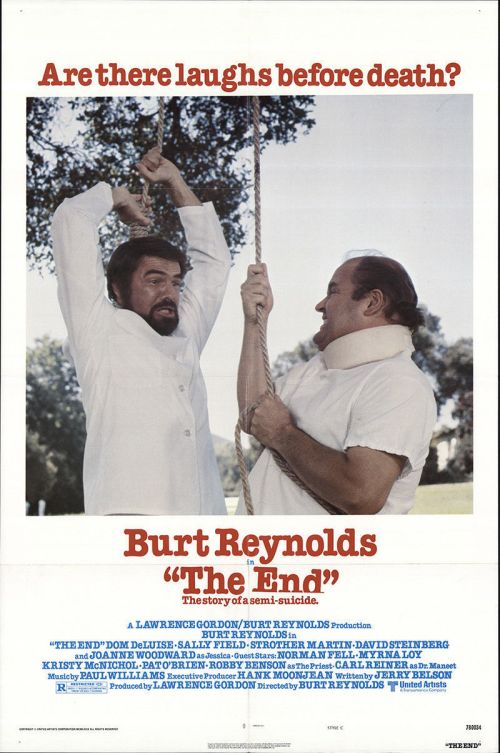
The End (1978)

end2

By Richard Winters

My Rating: 7 out of 10

4-Word Review: His days are numbered.

Sonny (Burt Reynolds) is a real estate broker known to make crooked deals. He gets diagnosed with an incurable disease and told he has only a limited time left. He says goodbye to his ex-wife (Joanne Woodward) who seems more interested in her new boyfriend, his daughter (Kristy McNichol) and his folks (Pat O’Brien, Myrna Loy) and even his live-in girlfriend (Sally Field) without actually telling them his condition. He then attempts suicide, but this gets him stuck in a mental hospital where he comes into contact with Marlon (Dom DeLuise) who agrees to help kill him, so Sonny can avoid going through the agony of the disease, but then after several aborted attempts Sonny decides he wants to live, or at least as long as he can, while Marlon continues to try and kill him and can’t seemingly be stopped.

The script was written by Jerry Belson, who also did the brilliant satire Smile and the original Fun With Dick and Jane, two of the funniest films to come out during the 70’s. This one is no exception, yet despite be written in 1971 and purchased by a studio, no one seemed to want to touch it. Many stars and producers felt the theme was too maudlin and wouldn’t be able to sell as a comedy. Reynolds though felt it was one of the funniest scripts he had read, and the character most closely identified to who he really was, and therefore jumped at the chance to direct and star in it though the studio was still reluctant and only agreed to finance it once he accepted starring in Hooper, which they felt was the sure money-maker though this one ended up doing quite well, surprising many, at the box office too.

Much of the credit goes to Reynolds who plays the part perfectly. Somehow he can create the slimiest of characters, and this one is a bit scummy with his admittedly shady real estate deals, and yet with his comic talent are still able to make him seem endearing. The studio had wanted the character’s profession to be a stock car racer, but this seemed too stereotypical, so I was happy that he kept it in the white collar realm and openly able to expose all of his personal flaws, which made him quite relatable. It’s also one of the rare times you get to see him with both a mustache and beard, or at least through the whole movie. The studio wanted to nix this too, but it helps give him a distinctive look.

Like with most actors turned director Burt allows for long takes, particularly during the first act, where the supporting cast is given ample time to play out their scenes without any interruption, which leads to many funny moments. I enjoyed Norman Fell as the doctor, and Robby Benson’s as a young priest who listens to Burt’s confession while he takes off his collar and puts it into his mouth, which creates a weird popping noise. These segments have an entertaining quality, but come-off more as vignettes and don’t help to propel the story along.

The second act, in which Burt ends up in the mental ward, are the best and his teaming with DeLuise is hilarious. I realize not all the critics enjoyed Dom’s take on a crazy man, Variety Magazine, labeled his performance as being ‘absolutely dreadful’, but there’s no denying the infectious chemistry he and Burt have, making the scene where he tries to drop Burt from a bell tower, or the segment where he tries to hang him up by a noose, quite memorable. The segment though where Burt goes swimming out into the ocean in an attempt to drown and then has a change of heart and tries getting back to shore and the voice-over prayer that he gives to the Almighty he order to help him back is laugh-out-loud and not only the top comedy moment in this movie, but quite possibly any movie ever.

Spoiler Alert!

The only problem I had was with the ending. In the original script the DeLuise character was supposed to kill Burt after he got out of the ocean, but Burt felt the movie needed some ‘hope’, so instead he has DeLuise attempting to chase Burt along the shoreline, in a sort of stop-action way that looks cartoonish. I felt there needed to be more of a resolution. If Reynolds does decide to live out the rest of his days what does he do with it? Does he try to mend his ways by paying back all those he had swindled? Or does he make amends with the people in his life including his ex and daughter? None of this gets answered, which is disappointing. A good movie needs a healthy character arch and this one doesn’t really have any. A better third act would’ve shown how the diagnosis had changed him and had the film not labored so much with the comical vignettes of the first half we might’ve gotten there and it’s just a shame that we never do.

My Rating: 7 out of 10

Released: May 10, 1978

Runtime: 1 Hour 41 Minutes

Rated R

Director: Burt Reynolds

Studio: United Artists

Available: DVD, Blu-ray, Amazon Video, YouTube

The Purple Rose of Cairo (1985)

purple1

By Richard Winters

My Rating: 7 out of 10

4-Word Review: Breaking the fourth wall.

Cecilia (Mia Farrow) is a lonely woman living in 1935 who’s stuck in a dead-end job and an abusive marriage. As an escape she regularly goes to the movies and becomes especially entranced with one called ‘The Purple Rose of Cairo’ particularly the dashing young man character named Tom (Jeff Daniels). Tom notices Cecilia continuing to attend each showing and thus breaks out of the black-and-white movie he is in and into the real world just so he can speak with her as he feels he’s falling in love. Cecilia tours him around the small New Jersey town where she lives while the rest of the cast in the movie he’s left sit around and hope he’ll come back, so they can continue on with the story. The actor, Gil Shepherd (also played by Daniels), who played Tom in the movie hears about Tom jumping out of the screen and heads to New Jersey in order to coax him back, but Tom is having too much fun getting to know Cecilia and has no intention of returning to the phony life of the movie world. In the meantime Gil also meets up with Cecilia and the two begin to hit-it-off. Will Cecilia choose Gil over Tom and if so will this get Tom to go back into the movie once and for all?

This was the first of Woody Allen’s nostalgic picture that would replicate the time and place of when he grew up and in fact the theater where Cecilia watches her movies was the Kent Playhouse, which Allen had gone to when he was 12 and which he describes ‘one of the great, meaningful places of my boyhood’. His ability to capture working class life and Cecilia’s bleak existence is completely on-target making the opening 20-minutes one of the most impactful of the whole film. Farrow is nothing short of excellent and Danny Aiello, who got this part to make-up for getting passed over in Broadway Danny Rose, is quite good too particularly with the way he’s able to show the human side of his character despite him being quite abusive and domineering to his wife otherwise.

The comedy takes off when Tom literally jumps out of the screen and Allen is very creative at thinking out every conceivable angle at not only how the other patrons in theater respond, which is some of the funnier bits in the film, to the characters onscreen, who are also quite amusing most notably Zoe Caldwell who plays the Countess and has some great zingers, but also the film’s producer (Alexander Cohen) and how he responds to the ‘calamity’. Some may argue that it’s missing a cause, since film characters don’t jump out of the screen everyday what allowed it to happen in this case, which the movie never answers, but for me that’s what made it even more amusing as everyone reacts in wildly different ways to the unexplainable and if anything Allen at least doesn’t cop-out by turning it into some sort of dream that Cecilia had, which would’ve been disappointing. I’d rather have as some odd fluke in the universe than reverting to an overused dream gimmick.

My one complaint was Daniels who’s deadly dull. He has a few amusing responses to things, but he’s bland most of the way. Michael Keaton was cast in the part initially, but after 10-days of filming Allen decided he seemed ‘too contemporary’ and thus had him replaced, which is a shame as Keaton has a more dynamic onscreen presence while Daniels seems too transparent. I didn’t like the entering in of the actor character either as that just started to make it too confusing. The actor should’ve been wildly different than the character he played, extreme narcissistic ego, which would’ve been hilarious. While he does show some of these traits it’s not enough and it gets hard telling the difference between the two. Having a rich Hollywood actor, who would most likely already be in a relationship anyways, falling in love with a nondescript housewife didn’t make a lot of sense. While the scenes between Cecilia and Tom are quite endearing, the moments between her and Gil are boring and start bogging the whole thing down.

Spoiler Alert!

Some have complained about the so-called ‘unhappy ending’, which Leonard Maltin in his review described as ‘a heartbreaker’, but I found it to be a perfect. The odds that a relationship between a up-and-coming Hollywood star and a New Jersey housewife would actually work are pretty slim. Besides Cecilia’s love affair wasn’t with people anyways, but with movies and their ability to sweep her away from her sad existence and into a fantasy world and on that level it’s a happy one as Cecilia returns to the theater all broken-hearted only to again forget her troubles when she gets wrapped-up in a Fred Astaire and Ginger Rogers flick proving that movies would always be there for her even when people won’t.

My Rating: 7 out of 10

Released: January 26, 1985

Runtime: 1 Hour 22 Minutes

Rated PG

Director: Woody Allen

Studio: Orion Pictures

Available: DVD, Blu-ray, Amazon Video, Tubi, YouTube

Summertree (1971)

summertree

By Richard Winters

My Rating: 6 out of 10

4-Word Review: Dropping out of college.

Jerry (Michael Douglas) is a 20-year-old university student who finds going to college to be drag as he’s disinterested in the subjects being taught and would rather play his guitar for a living. Since the year is 1970 his parents (Jack Warden, Barbra Bel Geddes) fear that this could get him drafted and advise against it, but Jerry refuses to listen convinced that he’ll get accepted into the conservatorium, which will restore his student draft deferral. In the meantime he also starts up a relationship with Vanetta (Brenda Vaccaro), a local nurse he meets when he brings in Marvis (Kirk Calloway), a black youth he’s spending time with through the big brother program, into the hospital after he skins his knee. Everything seems to be going Jerry’s way, he even gets a job playing his guitar at a local coffeehouse, but then the draft notice comes in the mail and the  music school decides, to his shock, not to accept him. He feels he has no other choice but to escape to Canada, but Vanetta does not want to go with him and his parents don’t think this is a good idea and secretly plot to prevent it.

The film is based on the stageplay of the same name by Ron Cowen that was produced in 1967 and originally had Douglas cast in the lead only for him to get fired during the rehearsal phase and replaced by David Birney, which so incensed his father Kirk, that he bought the rights to the play in order for it to be made into a film that his son could star in. It’s directed by Anthony Newley, which is an unusual choice since Newley was from Britain and not as affected by the Vietnam war and also for the fact that he was mainly known as an actor, writer, and singer with very little hand in directing. Overall he does okay, but the song done over the opening credits, which is sung by actor Hamilton Camp, is atrocious and makes you want to turn it off before it’s even begun. The stop-action ‘comedy’ done through a home movie type look, that gets shown while the horrible song is played, is bad too making this thing really stumble out of the gate though it manages to recover.

The plot works like three stories compressed into one. The segments dealing with Jerry’s relationship with the child, who is very streetwise and foul mouthed, but still quite engaging, are the best. His attempts to form a relationship with Vanetta though prove awkward as he follows her down a lonely dark alley late at night, which would make him seem by today’s standards like a stalker, and then taking her out to a cemetery on their ‘first date’ when it’s pitch black out would not be something most people would find romantic and instead quite creepy. Vaccaro is a great actress though more in roles featuring strong women and not necessarily as a love interest. This did precipitate a long on-going relationship between the two in real-life that lasted 6 years and for voyeurs you also get to see her topless as she rarely ever did nude scenes, but for whatever reason decided to do it here.

Spoiler Alert!

His relationship and conversations with his parents I initially found interesting. Coming into the movie I thought this would be a long, drawn-out arguments of conservative old-school parents and the liberal kid, but that’s not really the way it works. The parents are against him going to war as much as he is and it’s only the staying in school part that they find disagreement, but then when he decides to go to Canada in a last ditch effort to avoid the draft suddenly they’re against that too even to extent of trying to bribe a mechanic to fiddle with Jerry’s car, so he can’t drive it, but why? The shift in their perspectives seemed too quick. If they’re concerned they might not be able to see him much if he’s stuck in another country it would still be better than him coming home in a body bag and even if he does come out of it alive he’d be emotionally scared, or physically disabled for life, which wouldn’t occur if he was in Canada, so from my perspective the parents should’ve supported his ‘escape plan’ and the fact that they don’t needed more explaining.

The ending in which the parents are in their bedroom, with Jerry now off to war, and them acting like ‘everything will work out’, which is a far cry from what they thought before, gets botched. For one thing there’s an issue of Life magazine sitting on top of the TV talking about the weekly body count from the war on it’s cover, but I would think the parents would’ve thrown that out as they wouldn’t want to be reminded that their son may soon become one of those statistics and just leaving it in a place where they’d constantly be reminded of it didn’t seem realistic. They also both roll over and go to sleep while leaving the TV on, but who does that? Seeing an image of Jerry’s dead body being carried away on the TV isn’t the shocking surprise that the filmmakers though it would be as as the film spends a lot of time priming the viewer that is what it’s leading up to making the final image corny and even tacky instead of riveting.

My Rating: 6 out of 10

Released: June 9, 1971

Runtime: 1 Hour 29 Minutes

Rated R

Director: Anthony Newley

Studio: Columbia Pictures

Available: DVD, Amazon Video, YouTube

Zelig (1983)

zelig1

By Richard Winters

My Rating: 4 out of 10

4-Word Review: Wanting to fit in.

Leonard Zelig (Woody Allen) is a man living in the 1920’s and 30’s who has an uncanny ability to reflect the personalities and features of those he’s surrounded with. Even if he’s in the company of someone of a different race, or ethnicity, he can still acquire their traits, including their skin color, until he looks exactly like them. He becomes known as a the human chameleon and Dr. Eudora Fletcher (Mia Farrow) , a psychiatrist, becomes determined to find the root cause. She takes him on as a patient and under intense hypnosis comes to the realization that his deep need to be liked by others causes him to conform to the most extreme ways imaginable. Through her therapy she gets him to become more confident in expressing his own opinions, but this leads to him arguing with others over the most mundane reasons, which leads to several fights. She again puts him under hypnosis, so that he’ll become more of centrist, but this then leads to even further complications.

Allen was inspired to do this movie when his friend Dick Cavett was hosting a history series on HBO and a segment was done where Cavett’s likeness got spliced into an historical image. While the effects of using old newsreel footage and photos from long ago and inserting in cast members to make it seem like they were there when the picture was taken may not seem like that big of a deal today, but back in the 80’s it was very much talked about. I remember an entire segment of CBS Morning News hosted by Diane Sawyer going in depth about the ‘incredible’ special effects and ‘how did they do it?’ With digital filmmaking and movies like Forrest Gump we’re used to it, but back then it was state-of-the-art and got nominated for several awards. To help make it look as authentic as possible cinematographer Gordon Willis used vintage cameras and lenses from the 20’s and then stomped on the negatives of the film in his shower to help create the crinkles and scratches.

While telling the story through newsreel footage is certainly diverting and many times amusing I was fully expecting after about 20 minutes or so that it would eventually become more like a normal movie with the plot being propelled by actual characters, dialogue, and conventional scene structure, but instead it sticks with the novelty until the bitter end, which for me was a mistake as it makes the viewer too detached from the people in the movie to the point that they become distant caricatures that we really care nothing about. Much comedy is also lost as everything hinges on the voice-over narration of Patrick Horgan and how he describes what’s going on versus having it played out. A great example of this is when Allen gets into an argument with someone over whether ‘it’s a nice day, or not’, but all we see of it is some grainy, black-and-white figures in a distance that appear to be squabbling when witnessing the actual argument in real-time would’ve been so much funnier.

My favorite moment had nothing do with the special effects, but instead was the scene with Farrow and Allen where she tricks him, using reverse psychology, into admitting he really wasn’t a psychiatrist like her, and the movie needed more segments like this one. The vintage footage is nice for awhile and highly creative, but ultimately makes it come-off like a one-note joke, or an experimental film that’s misses the most basic elements of a good story, which is character development. It’s a shame too as Farrow gives a strong performance, which gets overshadowed. Usually she’s best at playing emotionally fragile types, but here is a strong woman and does quite well though I thought it was ridiculous that in color segments where here character is speaking in the modern day as an old woman another actress, Ellen Garrison, plays the part when they could’ve easily had Farrow doing it by dying her hair gray and putting on a few wrinkles. So much effort was put into the black-and-white vintage stuff that they forgot about the simplest of all special effects: stage make-up.

There’s also a host of other famous faces that have cameo bits as they talk about the fictional Zelig in the modern-day like historians discussing a past event, or famous person. Of these includes Susan Sontag, Saul Bellow, Irving Howe, and John Morton Blum, but like with the newsreel element it gets overplayed and derivative. It also brings to question what exactly was the movies’ point. Was it a satire on conformity and if so it could’ve gone much deeper, or poking fun at documentaries, which could’ve been played-up much more too. In either case it’s a misfire that’s engaging for awhile, but eventually, even with its short runtime, wears itself out.

zelig2

My Rating: 4 out of 10

Released: July 15, 1983

Runtime: 1 Hour 19 Minutes

Rated PG

Director: Woody Allen

Studio: Orion Pictures

Available: DVD, Blu-ray

Corky (1972)

corky

By Richard Winters

My Rating: 7 out of 10

4-Word Review: Race driver self destructs.

Corky (Robert Blake) works as a car mechanic during the day, but on weekends he drives in some of the local races. He’s aggressive nature though causes many accidents and damages in the race, so his boss Randy (Patrick O’Neal) decides to replace him with another driver named Steve (John Gruber). Corky resents being replaced and thus enters the next race anyways and rigs the front hood of his car, so it will pop-up at a strategic time, so that he can crash into Steve’s car while feigning that it was an ‘accident’ because he couldn’t see where he was going due to the hood. The crash though puts Steve in the hospital and it’s enoough for Randy to fire Corky from his job. Now, with no money left, he goes traveling to Georgia with his buddy Billy (Christopher Connelly). They enter a few races there, but Corky parties away all the winnings and eventually come back to Texas penniless. He tries to get back with his wife Peggy Jo (Charlotte Rampling), but finds that Randy has been helping her out and giving her enough money, so that she can go back to school to get a diploma and eventually be able to earn a living without Corky. This causes him to seethe with rage and he goes back to Randy’s place of work in order to exact a violent revenge.

The film was directed by Leonard Horn, who shot to fame for having directed some of the highest rated episodes of the ‘Mission Impossible’ TV-series, which garnard him enough attention to get him a contract to helm two cinematic features. His first one was The Magic Garden of Stanley Sweatheartwhich starred Don Johnson and while it wasn’t completely successful, and very little seen, it did have an interesting cinema verité style. This works the same way with a strong emphasis on atmosphere that gets small town living in rural Texas just right. Even the little moments like when Corky turns on his friend Billy in the middle of a desolate road during an impending rain storm leaves a memorable impression as does the envelope-pushing moment where Corky decides to strip down and go skinny dipping with two young boys (Matt Nelson Karstetter, Richard McGough) at a country watering hole.

Robert Blake is excellent. Sometimes it’s hard to imagine him as a leading man due to him at one time being a part of the ‘Little Rascals’ ensemble, and then rising to becoming a TV-star before falling into infamy at being accused of killing his child’s mother. However, with all that being said he was still a great actor who probably didn’t get as much starring roles as he deserved, but he plays the angry loner role to a perfect-T. Rampling as his wife, who was born in England, masks her British accent quite well and creates an odd, but interesting sounding Texas one in the process. I also liked that she sports blonde hair. O’Neal is good in support and there’s an fun collage of actual race driving champions like Richard Petty and Cale Yarborough who appear briefly as themselves though I was upset to read that Roddy McDowell’s scenes, where he plays a salesmen, got cut out completely as his appearance could’ve added an intriguing element.

Spoiler Alert!

The story itself is rather tepid at first. There were many films from the 70’s dealing with rugged individualists and hard drinking, womanizing rebels who couldn’t, or didn’t want to conform to societal rules and thus hit the road looking for adventure and to ‘find themselves’. This though, at least during the first two acts, adds nothing to the equation, or give us any new insights and in fact seems more like the same old, same old generic character study, but all that changes in the third act when Corky unravels completely and goes on a shooting spree. The films from that era always had the non-conformist getting ‘reeled-in’ at some point usually through the love of a romantic partner, or some familial obligation, but here it’s a meltdown to the extreme and it’s a movie way ahead of its time as it deals with what’s commonly known as a mass shooter these days. At that time this concept was rarely seen and for that it deserves definite kudos as does the message that being too irresponsible will catch-up with you and one can’t just live the outlaw image and not eventually have to pay the price.

My Rating: 7 out of 10

Released: March 15, 1972

Runtime: 1 Hour 28 Minutes

Rated PG

Director: Leonard Horn

Studio: MGM

Available: DVD-R (Warner Archive)

The Onion Field (1979)

onion2

By Richard Winters

My Rating: 7 out of 10

4-Word Review: Guilt over partner’s death.

Los Angeles police detectives Ian Campbell (Ted Danson) and Karl Hettinger (John Savage) are on-duty driving around in an unmarked police car when they spot two men, Gregory Powell (James Woods) and Jimmy Smith (Franklyn Seales), driving suspiciously, so they pull them over. While Campbell is talking to Powell, Powell is able to pull out a gun he had hidden in his trousers forcing Campbell to drop his weapon. Hettinger is then told to give up his weapon as well, which he does, or risk seeing his partner get shot. The two cops are then taken at gunpoint to an remote onion field where in the darkness of night Campbell is shot and killed, but Hettinger escapes and manages to run 4 miles until he finds someone and gets help. While the two criminals are eventually apprehended and found guilty it is Hettinger that suffers the most from the guilt of surviving when his friend and partner didn’t and from the humiliation of being the subject of a police video detailing what not to do when stopping a vehicle, which leads him to a severe mental breakdown in both his personal and professional life.

The story is based on the actual incident that occurred on March 9, 1963 with the traffic stop happening on the corner of Carlos Avenue and Gower Street in Hollywood and the murder happening off of Interstate 5 near Bakersfield. It was written into a novel by former cop turned author Joseph Wambaugh in 1973. I remember reading it when I was 14 and finding it captivating from beginning to end. While the film stays faithful to it I still felt it wasn’t as effective and in a lot of ways not as gripping. Even though it was a long time ago I remember the part about Powell’s ‘disguise’ where the only thing he changed about his features was putting a distinctive mole on his left ear lobe, which sounded completely absurd. This is discussed in the movie, which gets a subtle eye roll from Smith his partner, but the irony is, which is talked about in the book and not the film, is that the witnesses from the robbery that Powell was in described the mole to the police and this litrerally threw the detectives off for awhile as they kept searching for a man with a distinctive mole that Powell had since removed, so as silly as it sounded, his idea had actually worked, but the movie never gives this pay-off.

The chase through the onion field is also really hurt. I remember finding this section the most captivating part of the book and finding it a truly tense and horrifying moment that seemed to go on forever and a major element of the story, but in the movie this moment gets trimmed down significantly. Years ago, when I first saw the movie on TV, I thought it was because they had edited it down due to time constraints in order to get more commercials in, but when I finally viewed the full version on DVD I found this wasn’t the case. For whatever reason the chase in the onion field lasts for only a few minutes and not done from Hettinger’s perspective, which is what made it such an intense reading and it’s a real shame as it makes the movie much less impactful then it could’ve been. It turns the whole onion field incident into a side story instead of the main event.

The performances by Woods and Seales are outstanding and the element that really gives the film its energy they also look exactly like the people they’re playing to the point it’s almost freaky. Woods is especially creepy and he literally demands your attention with each moment he’s in it. Seales though, whose career never really took off and he died at the young age of 37 from AIDS, is excellent too as he plays someone who is very timid especially when initially with Powell, but brazen at other points and the way his and Powell’s relationship evolves both through their criminal and then when behind bars is quite fascinating. The scream that he lets out when Campbell gets shot, which was not in the script and completely improvised, has a very riveting effect and the one thing about the film that I had remembered from watching it decades earlier.

Unfortunately the two leads, the people we’re supposed to be the most connected with, are quite boring. It’s not like it’s the actors faults either. Danson, this was his film debut, is not bad, but his character isn’t fleshed out enough. Other than enjoying playing the bagpipes we don’t learn much else about him and nothing he says his captivating, or interesting. The same with Savage his inner turmoil and mental breakdown really doesn’t have the intended emotional impact in fact his moments bogs the movie down and you can’t wait until they get back to the bad guys who as rotten as they are what gives the movie its liveliness. I realize that Wambaugh felt it was very important to get Hettinger’s story out there and it was the whole reason that motivated him to write the book, but I came away feeling, at least movie wise it would’ve worked better had it just focused on the two crooks and their weird ‘friendship’.

On the whole it’s still an adequate production that holds enough interest and makes some good points about an important event that shouldn’t be forgotten, but at times it also seems like an overreach. Wambuagh’s insistence that everything be as accurate as possible gives the narrative a cluttered feel particularly with all the various court proceedings with each one having a different set of attorney’s, judges, and courtrooms which becomes dizzying instead of riveting. Pairing certain elements down would’ve helped as it’s not quite a completely effective, despite the great effort, as it could’ve been and without question another incidence where the book is far better.

My Rating: 7 out of 10

Released: September 19, 1979

Runtime: 2 Hours 6 Minutes

Rated R

Director: Harold Becker

Studio: AVCO Embassy Pictures

Available: DVD, Blu-ray

The Champ (1978)

champ1

By Richard Winters

My Rating: 7 out of 10

4-Word Review: Idolized by his son.

Billy (Jon Voight) is a former boxer whose been out of the ring for 7 years. Now at age 37 he works as a horse trainer. His 8-year-old son T.J. (Ricky Schroder) idolizes him and refers to his as ‘The Champ’ instead of dad. Billy though suffers from many inner demons including his perpetual drinking and gambling as well as not making enough money to sufficiently support either himself, or his son. Nonetheless he continues to go out gambling whenever given the chance and he manages to win enough money to buy his son a horse, which they name She’s a Lady. They enter Lady into a race where T.J. meets Annie (Faye Dunaway). Unbeknownst to T.J. Annie is his mother whom she gave up at birth, but now that she’s married to a wealthy man (Arthur Hill) she wants to have custody. Billy refuses to allow it, but when he loses the horse because of a gambling debt and Annie gives him the money to pay it off he eventually relents and has T.J. go live with her while he’s in jail for assault. Once he’s released the father and son reunite, but Billy realizes he must make more money in order to keep him and thus decides to go back into the ring one last time despite warnings from Jackie (Jack Warden), his former manager, that to do so could be life threatening.

The film is remake of the 1931 classic with Wallace Beery playing the part of the father and Jackie Cooper as the son. Director Franco Zeffirelli remembered watching it as a child and it having a profound effect on him. Then years later while he was in his hotel room while on-location filming another feature he saw it come on television and the film again moved him in such a way that he decided he wanted to do a remake. This though wasn’t the first remake as it had already been done in 1953 as The Clown starring Red Skelton though the story had been revised without the boxing theme and the climactic event at the end doesn’t take place at a sporting event, but instead a dangerous stunt that the lead character must do during a live broadcast of a TV special.

While this one stays more faithful to the original concept it was still panned by many critics as being overly sentimental and soap opera-like. Many who were fans of the original felt this one fell far short and complained about the long running time, this one runs of full 2-hours while the older one was only 83 minutes, with the feeling that it stretched the plot out too much and at spots was too slow. Though I’ve never seen the 30’s version I found myself genuinely wrapped up in the drama and the characters.

Many at the time complained that Voight was going back to the same type of Joe Buck character that he played in Midnight Cowboy, but I disagreed. That character was genuinely stupid, but Billy isn’t he’s just down-on-his-luck and suffering from basic human frailties, which made his situation far more compelling.

Schroder is an absolute jewel. He got the part after beating out over 2,000 others and it’s easy to see why. His ability to cry on demand with real tears streaming down his face is amazing and not something other actors are able to do. He’s cute and engaging without it ever getting forced, or overdone. His presence gives the film its energy and virtually the sole reason for why it works as well as it does.

The main complaint that I did have was with Annie. She’s marvelously played by Dunaway, who’s always been one of my favorite actresses and it’s a good role for her acting style as she’s excellent at playing characters that have a bit of a cold and aloof manner while not easily able to show their soft side, but with that said I still couldn’t understand what made the character tick, or her motivations. For one thing she seemed to have nothing in common with Billy, so what brought them together in the first place was a mystery and then having her abandon the kid while she went off living her life seemed pretty extreme. In most cases it’s the father that shirks the responsibility of raising the child, but here it’s reverse, but with no clear explanation as to why. There’s a vague excuse later on that it was so she could ‘pursue her career’, but then this doesn’t explain why she now wants to get close to her son. If she was selfish back then what made her change to suddenly want to be loving and caring? She went 7 years without ever seeing the kid, and did pretty well without him, so why now must she have him? I felt there needed to be some extra context added like she had been addicted to drugs when she had TJ, which then made her deemed unfit to raise him, but now that she had kicked the habit she wanted him back, or maybe she had suffered a miscarriage with her second husband and this made her feel guilty about the child she had let get away and this motivated her to want to seek out TJ, but without any of this added information the character comes-off as transparent, unrealistic, and unrelatable.

I will agree with Leonard Maltin in his review where he states that it looks like Faye wants to go to bed with her own kid. This occurs during the scene where Ricky is on her yacht and looking off in the distance while Faye comes up behind him and begins sniffing his hair like she’s getting turned-on by him. To call this a cringey, awkward moment is an understatement and it’s unintentionally laughable. Why it was left in, or why Zeffirelli thought it would be a good idea to put in I don’t know. The movie manages to recover, but it’s a segment that is indeed ridiculous.

The boxing element is another problem as it gets introduced way too late. It gets briefly mentioned throughout the first 2 acts and there’s even a quick scene where Billy shows up at a gym, but overall it gets played-out as a side-story only to suddenly, 90-minutes in, becomes the main focus, which gives the film a very disjointed feel. Jack Warden’s character doesn’t appear at all until near the end almost like it’s a tacked-on bit that doesn’t really flow with everything else that came before. The boxing scenes are impressive and helps to effectively expose the brutality of the sport, but I felt Billy’s training and decision to enter the ring should’ve been made sooner and the boxing scenes mixed-in throughout, but either way it’s still an competent tearjerker that shouldn’t leave a dry eye in the house.

champ2

My Rating: 7 out of 10

Release: March 20, 1979

Runtime: 2 Hours 3 Minutes

Rated PG

Director: Franco Zeffirelli

Studio: MGM

Available: DVD, Amazon Video, YouTube

Vigilante Force (1976)

vigilante1

By Richard Winters

My Rating: 4 out of 10

4-Word Review: Veteran takes over town.

After oil is found near a small California desert town many people, including oil workers, move in looking for work. All the new people coming in causes a great deal of  crime in the community and the local police force is too small to handle the influx. Ben (Jan-Michael Vincent), a longtime resident, decides to hire his brother Aaron (Kris Kristofferson), a veteran of the Vietnam War, to help act as a peacekeeper. Aaron then brings along some mercenaries to assist him, but he and his new associates begin acting more like the bullies forcing everyone to submit to their ways of doing things, or face the consequences. This causes Ben to come to the painful realization that his brother is more of a problem than the solution and forcing him to take matters into his own hands in order to rid the town of him.

This was the third film directed by George Armitage, who did Private Duty Nurses and Hit Man before this one and all three being produced within the Roger Corman family, this one by Roger’s older brother Gene, who approached George about the project having only the title in mind and no actual story. Armitage, who had only 30-days to film, decided to make it an allegory of the Vietnam War where a group of strangers would come into a town, much like the American soldiers did when they came upon a small village in Vietnam, and take it over while focusing on the helpless nature of the residents who could do seemingly little about it.

While the concept had lots of potential the execution is rushed making the story come-off as cluttered and unfocused. It’s one of the few films made where there’s violence and action immediately before there’s barely any onscreen credits, but the motivations of why it’s happening is not clear, so it’s more confusing than exciting.  The plot doesn’t make much sense. Why are these new people all resorting to criminal behavior including robbing a bank? Other towns that boast job opportunities don’t necessarily have a  dramatic spike in crime especially if the new people coming in are actually getting employed, which the film intimates they are, so then why the anger and chaos? It seemed to me that there needed to be some sort of crime boss behind it, but there really isn’t. There’s a certain figurehead shown briefly later on, but he seems to be more of a symptom of the crime that’s already had been occurring versus the main orchestrator.

The setting also has a strong country feel with men folk walking around and behaving like blue collar cowboys making Texas a better location for the town than California. Even if for budget reasons is still had to be done in Cali I would’ve at least made it seem like it was the Lone Star state, which is considered a ‘rebel’, redneck state to begin with and thus making the behavior of the townspeople seem a little more organic.

I loved Kristofferson whose laid-back demeanor comes-off as creepy and menacing, but I would’ve liked his dark side to have been played down more at the beginning. The viewer should’ve been roped-in into believing he was a good guy, or hero, and then had the big reveal in the third act that he really wasn’t versus it being obvious right from the start that there was something not right about him.

Bernadette Peters, who plays his on-again, off-again girlfriend, is a delight, but Vincent is not as good. He’s unable to equal Kristofferson’s screen presence and way too naïve. It’s obvious to everyone his brother is trouble, but he remains oblivious for too long making him seem dumb and then when he finally does catch-on he comments that he was aware of his brother’s ‘problematic side’ ever since they were kids, but if that were the case then why did he hire him in the first place?

If you like basic 70’s action, including car chases, fist fights, and explosions, then this may suffice even with the wobbly story. Anyone though expecting anything more will most assuredly walk away disappointed as the script lacks nuance and surprise.

My Rating: 4 out of 10

Released: September 9, 1976

Runtime: 1 Hour 29 Minutes

Rated PG

Director: George Armitage

Studio: United Artists

Available: DVD-R (MGM Limited Edition Collection), Blu-ray

Bedroom Eyes (1984)

bedroom1

By Richard Winters

My Rating: 1 out of 10

4-Word Review: Voyeur witnesses a murder.

Harry Ross (Kenneth Gilman) is a businessman who enjoys taking a late night jog in the Toronto neighborhood in which he lives. One night he steps in dog poo and as he’s trying to scrape it off he notices a light coming from a nearby window. Out of curiosity he peers in and sees a half-naked woman (Jayne Catling) dancing provocatively. It turns him on and he decides to make it a point to peer into the window each night when he goes for a run. He though begins to feel guilty about what he’s doing and thinks he may be a ‘pervert’ and thus schedules an appoint with Alex (Dayle Haddon), who is a psychiatrist, so that they can talk it through. During their sessions he also becomes attracted to her and things slowly work into a relationship. While this is going on he continues to look into the window each night, but eventually witnesses the woman getting murdered and now must go into hiding inside Alex’s apartment as not only the police, who mistakenly think he did it as they get his prints off of the window, are after him, but so is the killer.

This film was directed by William Fruet, a prolific writer/director from Canada, who shot to fame with the excellent Wedding in White and then followed that up with a lot lame thrillers and horror films. While some of those were diverting this one isn’t and the tacky set-up is the biggest problem. The fact that Harry isn’t portrayed as being a life long voyeur, but instead quite literally just ‘stumbles’ upon it is farfetched and the character would’ve had more depth if this had been a constant trait that he had to deal with. Having him ‘panic’ that he was afraid this made him a ‘pervert’ was ridiculous too as I’d think just about any heterosexual guy would get aroused seeing a hot lady cavorting around erotically. The way he peers in, the camera captures it from the inside looking out, is quite obvious as his face is fully light, from the indoor lamps, and thus all the people needed to do was glance up briefly to see him, which I would think would’ve occurred at some point especially since he continues to do it over multiple nights. The fact that they always leave the window shade half open seems like they’re inviting someone to look in though the movie acts like this is unintentional and just a ‘coincidence’. The place is lit in a way that makes it seem like it’s a set for soft core porn flick and the woman behaves like an adult actress, which completely ruins any sliver of plausibility.

Initially I liked seeing Haddon, who was at one time a super model before she got into acting, cast as the therapist as this was traditionally at that time still more of a man’s profession, so she was playing against type, but having Harry immediately asks her out on a date was dumb. Due to this being a professional doctor and patient relationship he should’ve at least waited until after several sessions before he got up the nerve to do it and even then it’s putting her in an unethical spot and he should’ve known that. Fortunately she tells him ‘no’ the first couple of times, which is what she should’ve done, but I knew, going by how stupid this script had already been, that she’d eventually cave and of course she does, which makes the whole premise become even more ludicrous. Having her spot him at a fancy restaurant was too coincidental in such a big city and having his girlfriend perform a sexual act while inside the place with all sorts of people around was over-the-top. If anything Haddon should’ve just been cast as his girlfriend, who just happens to work as therapist, and he could’ve still spoken to her about his voyeurism in private when they were together and this would’ve helped made it more believable.

It does get a bit intriguing for a few minutes when the police begin to close-in on Harry and I enjoyed the inner-rivalry of the police department where the two lead detectives became irritated at how a young ‘wet-behind-the-ears’ kid (Alf Humphreys) was always coming up with new leads and clues before they did, but other than that there’s very little to recommend. The climactic sequence in which the killer ties Harry up while he’s inside Haddon’s apartment, is quite boring and the female actor who plays the culprit shows no panache and thus making her scenes quite dull. In 1989, at the request of no one, this was made into a sequel, but with a completely different writer, director and actors with the only thing connecting the two being the Harry Ross character.

My Rating: 2 out of 10

Released: November 30, 1984

Runtime: 1 Hour 30 Minutes

Rated R

Director: William Fruet

Studio: Pan-Canadian Film Distributors

Available: DVD-R

Vice Squad (1982)

vice1

By Richard Winters

My Rating: 2 out of 10

4-Word Review: Violent pimp kills prostitutes.

Princess (Season Hubley) is a business woman who is having some financial trouble and thus decides to go back to being a prostitute in Hollywood in an effort to support her young daughter. She becomes aware that her friend Ginger (Nina Blackwood), who is also a prostitute, has been killed after getting beaten-up by a violent pimp named Ramrod (Wings Hauser). Tom (Gary Swanson), a police detective, gets her to agree to be wired, so that she can get Ramrod to incriminate himself when she goes back to his place for a rendezvous.  The sting works and Ramrod is arrested and put into police custody, but he’s able to escape and spends the rest of the night chasing after Princess and determined to exact a revenge on her while the cops remain always one-step behind and unable to apprehend him.

This was Gary Sherman’s fourth theatrical feature and third horror one. He had started out with British cult hit Raw Meat in 1972 about a group of underground cannibals living in a London subway tunnel was met with rave reviews and fans, but his subsequent horror foray Dead and Buried and Phobia, which he co-wrote only, didn’t do as well. This one is more of a sleazy thriller meant to ‘inform’ the viewer about the brutalities of street life, but is really just an excuse to be exploitive and get cheap points for nudity and violence with characters that are cliched and situations highly derivative.

My main issue was with the prostitutes themselves for instance Ginger who runs away from Ramrod and hides out in a seedy hotel only to let him into her room the minute he comes knocking at her door. Once inside he immediately kills her while asking ‘I can’t believe you were that stupid’ and I felt like saying the same thing. It’s hard to sympathize with characters when they do incredibly dumb things and the scene would’ve worked better if Ramrod was only able to get in by crashing through the window, or breaking down the door, but having her allow him in shows no common sense especially from someone that is supposedly ‘street smart’.

This then brings up the second problem that I had, which is the fact that these women have absolutely nothing to defend themselves with in case things get ugly. They should all have guns, knives, or the very least some pepper spray especially if they’re supposedly ‘street smart’, but instead if things get bad they’re virtually helpless as is the case of when one of the male customers decides to rob Princess of her money and all she can do is give him some veiled threat that her pimp would come after him, which seemed almost laughable. Another scene has her being attacked by Ramrod where she manages to get her hands on a metal pipe and she uses it to hit him twice with it and then drops it to go hide somewhere, but why not continue to hit him until he’s either dead, or comatose? She hated his guts for killing her friend, so why back-off from giving it to him when she had the chance? At the very least, if she is going to run-off, at least continue to carry pipe, so she could use it for protection when he gets back up.

The motivations of the Princess character made no sense. She’s supposedly this L.A. businesswoman living in a nice suburban house, who’s now in financial trouble for whatever reason, but why turn to prostitution? There seemed to be hundreds of other income avenues she could’ve considered before leaping into streetwalking. If it was a high end escort gig where the male clientele could be filtered and scrutinized so it would not just be any scumbag and the prices would be high enough and in a safe neutral area, so she would just have to service one a night instead of ten, then maybe. However, here she’s forced to do one after another submitting that whatever crazy kink they wanted in whatever scuzzy locale they took her to. If she was on drugs, or teen runaway with no money, it might be a little more understandable, but the film portrays her as being smart and educated and she somehow ‘chooses’ to do this, which for me made her seem completely insane and therefore not any one that I could relate to.

The film does have some great acting by Hauser, who also sings the closing song, and Gary Sherman is good as the detective as he doesn’t have the chiseled features of a Hollywood good guy, but instead is more non-descript like how most policemen look, which I liked. Sunset Boulevard, where most of it was filmed, gets captured in a cool way giving it a surreal presence where all the action takes place exclusively at night and once the sun rises all the dark characters go symbolically back into their caves. There’s even a nifty car chase, but overall it’s flat, and predictable, and only for those who enjoy sleazy B-movies.

My Rating: 2 out of 10

Released: January 22, 1982

Runtime: 1 Hour 37 Minutes

Rated R

Director: Gary Sherman

Studio: AVCO Embassy Pictures

Available: DVD, Blu-ray, Amazon Video, YouTube, Tubi