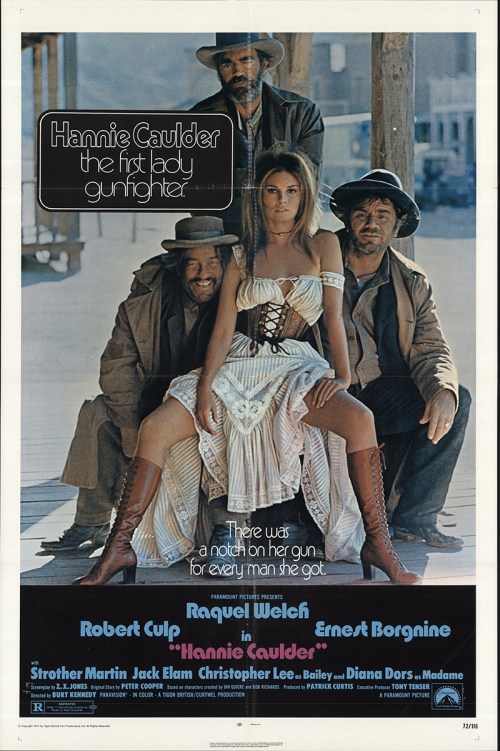
Hannie Caulder (1971)

hannie1

By Richard Winters

My Rating: 5 out of 10

4-Word Review: Hannie gets her revenge.

Three outlaw brothers (Ernest Borgnine, Jack Elam, Strother Martin) on the run from a botched robbery come upon an isolated house in the dessert. There they kill the husband and then gang rape the wife whose name is Hannie Caulder (Raquel Welch). They set the house on fire and then ride away laughing.  She manages to escape the blaze and makes a personal pledge to get her revenge. She has never used a gun before in her life, but with the help of a kindly bounty hunter named Thomas Price (Robert Culp) she learns the art of being a gunfighter.

The film nicely symbolizes the emerging force of women in 70’s society while using it inside a western motif. When we first see her she is in the kitchen with an apron on and cooking.  She learns though how to survive in a man’s world, do everything they can, and earn their respect in the process. It follows the same formula used in later cult hits I Spit on Your Grave and Ms. 45 except those titles were far more explicit and violent.

Critic Leonard Maltin, in his review of the film, called it a ‘bizarre, mystical western’, but I saw little of that.  In a lot of ways it was very routine with the only difference coming in the fact that it was a women single-handily seeking revenge instead of a man. There were only a few offbeat qualities that stood out enough to be mentioned. One was detailing the making of a gun, which I found to be interesting as well as the Hannie’s training and the different, subtle techniques that a gunfighter uses. British horror actor Christopher Lee is cast as a Mexican gunsmith. There is also one shootout segment that is done in slow motion, which is very cool.  Otherwise the majority of it is standard fare that is adequate, but not real impressive.

The idea of having the bad guys play it up as comical goofballs was a mistake.  It hurts the tension because we should want to see Hannie get her justice on these guys.  It also seems to minimize the savage act that they do and make the brutal subject matter seem lighthearted and silly when it shouldn’t be. Now, with that said, I still found some of the lines Strother Martin was given to be amusing and he almost became a scene-stealer

Raquel is looking gorgeous and wears a few revealing outfits, but there is no actual nudity, which would have helped. I still feel her acting ability is a bit lacking and the range of characters that she can play is limited. I did like her attempt at portraying a gritty character and taking a role that wasn’t glamorous. For a leading lady she has very few lines of dialogue. It wasn’t until the end when she says a few snappy one-liners at the bad guys that her part begins to click.

Robert Culp is all wrong as the bounty hunter and love interest. He can be a good actor in certain roles.  I always liked him as Peter Falk’s main nemesis in the Columbo series, but here he just doesn’t seem rugged enough. He wears glasses and is middle-aged and looks like a tenured college professor instead of a gunfighter.  The budding romance between the two doesn’t work either. He was about 12 years older than Raquel and always behaved more like a father to her right from the start.  The scene showing them holding hands while walking along a beach seemed almost creepy.

To me the film doesn’t come together until the end when she tracks the outlaw brothers down one by one in unusual locales. One is at a whorehouse, the other in a ladies clothing store, and the third is in an abandoned prison. This is the best moment as the prison itself is very isolated and the sound of the blowing wind and the late afternoon sun gives the scene a lot of atmosphere.

This is not a bad movie, but it is not a particularly good one either.  It is quite compact, running only 85 minutes, and the pace is quick. Despite the subject matter it runs pretty much on the light side. Western and Welch enthusiasts may find this more interesting than others. Borgnine fans may also like it as he is effectively slimy here.

My Rating: 5 out of 10

Released: November 8, 1971

Runtime: 1Hour 23Minutes

Rated R

Director: Burt Kennedy

Studio: Paramount

Available : VHS, DVD, Blu-ray, Amazon Instant Video
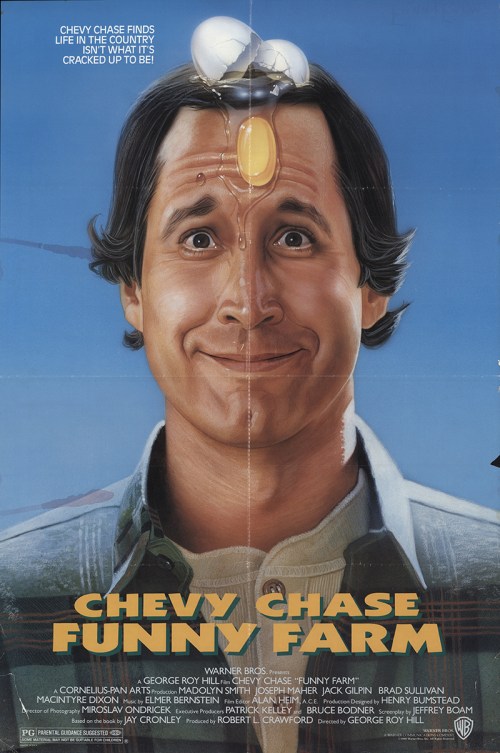
Funny Farm (1988)

funny1

By Richard Winters

My Rating: 3 out of 10

4-Word Review: Novelist moves to country.

Uninspired comedy about a man named Andy Farmer (Chevy Chase) who receives an advance from a publishing company, which he uses to quit his job and buy a cabin out in the country with his wife Elizabeth (Madolyn Smith) in order to write his novel. Unfortunately the local citizens are eccentric in very clichéd ways and their time there is spent dealing with one crazy misadventure after another.

Right from the start this film proves to have no footing in reality. Publishing companies only pay advances to authors who are already published and proven. They do not shell out $10,000 to some average unpublished Joe with only a vague idea for a story. Many publishers won’t even look at a finished manuscript from someone unless they are already represented by an agent and have some sort of track record, which renders this entire premise as ridiculous.

The movie starts off too quickly with them moving to the country without any set-up. The characters themselves are extremely bland and the script does not take advantage at all of Chase’s cynical, sardonic humor, or impeccable comic timing. Smith is certainly pleasant on the eyes, but things could have been more interesting had they been played-up as spoiled city slickers like the Lisa Douglas character from the TV-series Green Acres and then forced to adjust.

The humor is sloppy and uninspired and shows no level of sophistication. It is thrown in haphazardly without any consideration for story progression, or character development.  Much of it is not funny and the whole thing seems like a stretched out episode from the old Newhart TV-series and in fact the film was shot in Vermont were that series took place. The only mildly amusing moment comes when Andy goes fishing with some of the men from town and ends up accidently throwing them all overboard and even that is worth only a small chuckle. The final segment were Andy and Elizabeth convince everyone in the town to act like people from a Norman Rockwell painting and have them study covers from old issues of the Saturday Evening Post, as  they think this will make things seem more appealing to prospective buyers, is utterly preposterous.

The only time this film has any possibilities is when Elizabeth ends up not liking the story that Andy has written. Being a writer myself and having dealt with other writers I can attest that this can happen more than you think. In fact famous horror novelist Richard Laymon stated that his number one rule of things not to do was giving your manuscripts to friends and family members to read because it can create needless acrimony. Things get dicey when Elizabeth writes a story that sells, but the sterile script by Jeffrey Boam fails to take full advantage of this scenario and the results become as disappointing as everything else.

I did like that it was shot on location. The cottage is nestled away in a scenic area and the viewer gets the feeling that they are ‘getting away from it all’ along with the characters.  Capturing it during all four seasons is another plus. I also thought that the realistic looking stuffed squirrel was cool and I wish I could find one of those for myself.

Sadly, this was director George Roy Hill’s last film. He had much more success with Butch Cassidy and the Sundance Kid, Slapshot, and The Sting to name just a few. None of his genius shows up here as it is quite mechanical and formulaic.

My Rating: 3 out of 10

Released: June 3, 1988

Runtime: 1Hour 41Minutes

Rated PG

Director: George Roy Hill

Studio: Warner Brothers

Available: VHS, DVD, Blu-ray, Amazon Instant Video

Under the Yum Yum Tree (1963)

under yum

By Richard Winters

My Rating: 3 out of 10

4-Word Review: Landlord likes pretty woman.

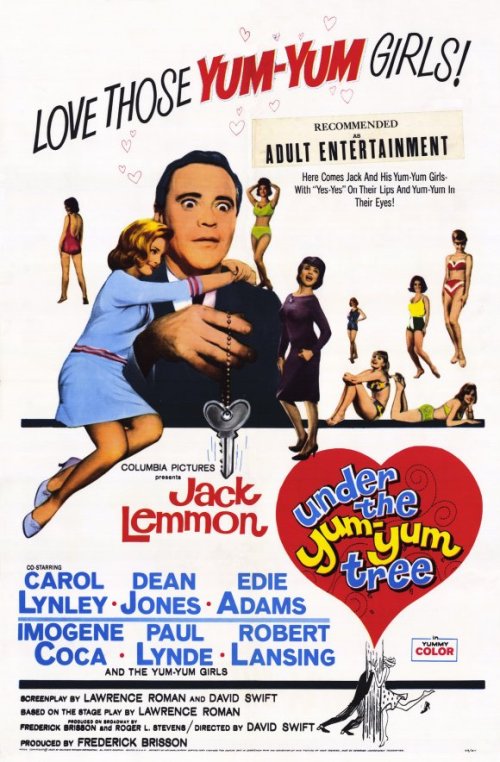
Jack Lemmon plays Hogan, an apartment landlord who charges $450 a month to men, but only $75 a month to a young beautiful woman. He then puts on his moves and most of the time ‘scores’ with his nubile tenants. He sets his sights on attractive college co-ed Robin Austin (Carol Lynley) who has just moved in.  Unbeknownst to him she is also bringing in her boyfriend Dave (Dean Jones). The two have decided to live platonically, so they can see if they can get along together before taking the big step and getting married. Hogan is unaware of her male counterpart as when she signed up she simply told him her roommate was a brunette and Hogan presumed it was female. When he finds out who it really is it puts a crimp on his plans, but he still persists anyways.

Although the premise of two young people who are in love cohabiting without having sex may seem antiquated and remnants of a bygone era, the truth is the characters and filmmakers were probably a little more worldly-wise then one might presume initially. For one thing Dave considers the arrangement to be ‘nutty’ and states ‘no one could live that way’. He also, towards the end of the film, gets her to drink some strong tequila in order to get her drunk and allow him to seduce her. The characters, particularly the apartment’s husband and wife maintenance crew (Imogene Coco, Paul Lynde) do not condone Hogan’s playboy lifestyle, but are also privately jealous of it and in the case of the Lynde character even fantasizes about it. I also thought it was a hoot when Robin asks her college instructor Irene (Edie Adams) whether her and her husband ‘did it’ before they were married and although Irene acts all aghast at the suggestion she is also careful not to specifically answer it either.  So even though things are not as explicit as today’s films the underlying leering elements are still there.

This was pretty much Lemmon’s vehicle and he does alright. He has never played the part of a lecherous cad before, so it was fun seeing him do something different and away from his otherwise clean-cut good guy image. The best thing though may actually be the way his apartment was decorated. It is painted in a garish, bright red and this includes the carpets, drapes, and bed sheets. He also wears shirts, socks, and a watch band with the same bright red color making the place look like hell and he the devil. I also got a kick out of a pair of violins that he has stored in a case and at the press of a button they rise up and play romantic music with the help of electronic, robotic hands.

Carol Lynley is sensational as the female lead and quite possibly the best thing about the movie. Her portrayal of a young female college student who is sweet and polite, but still headstrong and full of ideals seems timeless. I also liked that the college students here were portrayed as thinking, breathing young adults and not just one-dimensional, stoned party- animals.

Jones does well as the boyfriend who sees right through Hogan’s schemes and does not allow him to get the upper hand. However, some of the stunts that Hogan pulls including walking in on the couple unannounced at different times of the day and night as well as having him eavesdrop on them and even admit to it, would not go over in the real world and would likely get him sued.

The biggest problem with the film is that fact that there is really no plot. The entire movie is made up of these silly little schemes that Hogan tries to pull to get Dave out of the way and his hands on Robin. None of these are clever, funny, or imaginative. The one-joke premise gets stretched until it becomes excruciatingly monotonous. Most of these films that are based on hit stage plays at least have some funny banter and sharp one-liners, but this movie doesn’t even have that.  This all might have worked as a cute 30 minute episode on the old Love American Style TV-show, but at 110 minutes it is outrageously over-long. Even for a fluffy 60’s sex farce it’s incredibly vapid and lifeless.  Legendary comic character actors Coco and Lynde are wasted.

A young Bill Bixby can be seen briefly as a college student trying to rent an apartment.

My Rating: 3 out of 10

Released: October 23, 1963

Runtime: 1Hour 50Minutes

Rated NR (Not Rated)

Director: David Swift

Studio: Columbia Pictures

Available: VHS, DVD, Amazon Instant Video

Walk Don’t Run (1966)

walk don't run

By Richard Winters

My Rating: 6 out of 10

4-Word Review: Three is a crowd.

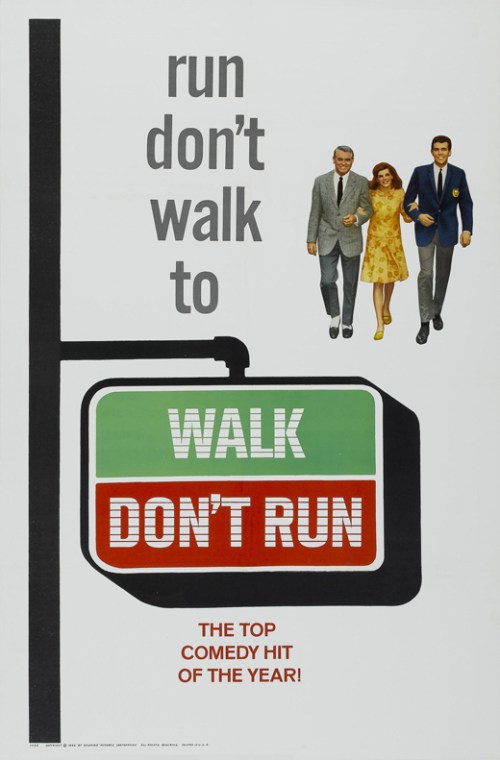
This film marked Cary Grant’s final on-screen appearance and was also a remake of the 1943 screwball comedy The More the Merrier, which was directed by the legendary George Stevens. The story is about a British businessman named Sir William Rutland (Grant) who travels to Tokyo on business during the 1964 summer Olympics and is unable to find a place to stay as everything is booked up. He spots an ad asking for a roommate on a nearby bulletin board. When he goes to the address he finds that the apartment is being rented by an attractive young lady by the name of Christine Easton (Samantha Eggar).  She at first is reluctant to accept the arrangement as she is rather old-fashioned and feels that a man sharing an apartment with a woman would not look appropriate, but William manages to talk his way in. The next day while at a business meeting William meets a young man who is participating in the Olympics, but will not tell anyone what event he is in. His name is Steve Davis and he is played by the late actor Jim Hutton, who is probably best known to today’s audiences as the father of actor Timothy Hutton as the two look almost exactly alike. Steve is looking for a place to stay as well so William invites him to the apartment, which makes Christine even more apprehensive, but after several ‘Three’s a Company’ type scenarios they eventually get along and Steve and Christine end up falling in love.

I found the first hour to be highly enjoyable.  Grant is an old-pro and goes through his role with amazing ease. Every scene he is in is amusing and I would highly recommend the film simply for his appearance alone. I felt the film started to stagnate when they introduced the romance angle. This was another situation were in my opinion the relationship was forced and formulaic and simply put in because the producers felt it would be ‘cute’. It didn’t seem to make a lot of sense why the characters would fall in love anyways since they had only known each other for a couple of days.  It is one thing if a person is desperately looking for someone, but that was not the case with Steve who is very independent and tells everyone he has no interest in marriage. There is nothing shown as to what about Christine’s personality would click with him to begin with.  Yes, she is pretty, but she spends most of the film being rather defensive towards them and more concerned with keeping a ‘proper’ distance. The two stars show no real chemistry either.

This was an unusual foray for actress Eggar as she rarely does comedy. She mainly works in horror films and thrillers and is best known for her performances in The Collector, The Walking Stick, The Brood, and The Lady in the Car with Glasses and a Gun. I felt in those types of roles she did exceptionally well, but here her comic timing seemed off and almost non-existent when compared to the two male leads.

There is also a very silly subplot dealing with Steve being accused as a spy and this culminates with a protracted scene at a Japanese police station where all the characters get interrogated by actor George Takei from ‘Star Trek’, which isn’t good for even a few chuckles. Another scenario involves Christine’s fiancé, Julius Haversack (John Standing), and William’s attempts to keep him away from Christine so that Steve can be with her. This storyline falls flat as well simply because the Julius character is so over-the-top stupid and gullible that William’s shenanigans don’t come off as being all that clever or amusing.

About the only thing that revives the film is the climactic race where the participants are required to walk and not run, hence the film’s title. I found this interesting because I had never seen or heard of this type of race before, but apparently it is a regular event at the Olympics and has been since 1928. The difference in a walking race as opposed to a running one is that the participants must always keep a part of their foot on the ground at all times. The result looks kind of goofy, like an old person trying to run, which explains why Steve was too embarrassed to tell anyone what he did.  I found this segment interesting although the story again gets too exaggerated as the other characters get into a cab and drive alongside Steve during the race, which I didn’t think would happen because there would be enough police officers and Olympic officials there to block them. However, I loved the part where William strips down to his underwear and starts fast-walking alongside Steve and then when he is finished he goes onto a bus and rides home still in his undies with everyone staring at him.

I felt like this was two story’s put into one with the first half being much better than the second. I almost wished they had just kept it focused on the three cohabitating together and not even brought in the romantic angle at all, or maybe just at the very end.  The movie is funniest when Grant is involved and any scene without him seems to fizzle. The music score by legendary Quincy Jones is cool and I wished they had played more of that as well.  It was filmed on-location in Tokyo, but you never really get a good feel of the city, or the Japanese culture. I think more filming in the downtown locations as well as certain landmarks was needed. There were also a few outdoor scenes that despite being nicely detailed where clearly done on an indoor soundstage.

My Rating: 6 out of 10

Released: June 29, 1966

Runtime: 1Hour 54Minutes

Rated NR (Not Rated)

Director: Charles Walters

Studio: Columbia Pictures

Available: VHS, DVD, Amazon Instant Video

All the Marbles (1981)

By Richard Winters

My Rating: 5 out of 10

4-Word Review: These wrestlers are hot.

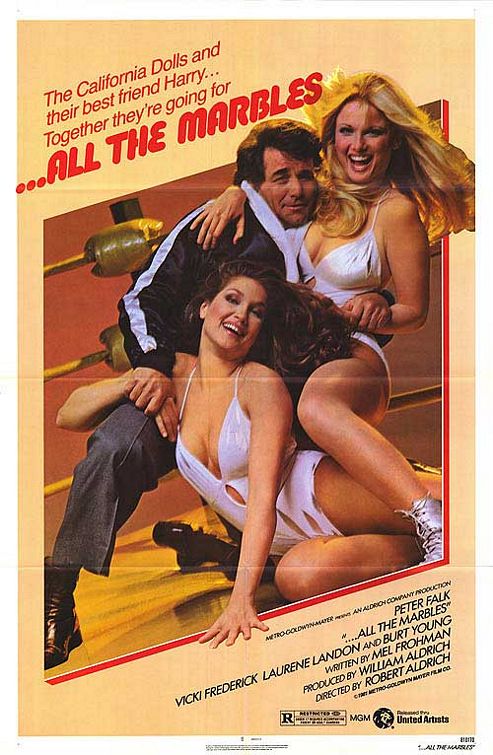
Peter Falk does another terrific job playing a lovable, but eccentric character. Here he takes on the role of a con-man type manager of two lady wrestlers (Laurene Landon, Vicki Frederick).

This film marked the final project by director Robert Aldrich who did such classics as Whatever Happened to Baby Jane, The Dirty Dozen, and Kiss Me Deadly. Although it didn’t do too much on its initial release, it has since acquired a small, but fervent following. These people insist this is the best movie about wrestling and some even go as far to say it is the best sports-themed movie ever. Warner Brothers has become aware of the attention and has now added it to its special-order DVD collection that can be purchased for twenty-five dollars from its archive website.

I remember when this film was released and after seeing the previews I was convinced it was just a mindless T&A picture, but I have read about enough people who have liked it that I decided I needed to give it a view. However, I came away from the film unimpressed with the majority of it. The main problem is that, although labeled a comedy, they stick in some awkward drama in order to show the downside of the wrestling profession. It doesn’t work because the two women playing the wrestlers can’t act. Landon in particular is a problem. She plays the blonde half and has an annoying monotone quality to her voice making her sound like she is simply reading her lines straight off of the script. Both lady characters seem to react to everything in predictable ways and thus become boring. The scenarios and conversations are soap opera like and end up bogging the whole thing down.

I like the attempt at showing the gritty side of the business and even inserting some realism, but this could have been down in a satirical form while still keeping it consistently funny.  A film like Smile from 1975 made some trenchant comments about the beauty pageant business, but remained funny and clever throughout without any of the strained drama like here.

Now with that said, I can still see why this film has attracted some fans and that is based solely on the wrestling scenes, which are excellent. The two actresses were trained by Mildred Burke a famous female wrestler from the 30’s and 40’s.  The techniques they use are true to form and look very authentic and, at times, even painful. Aldrich captures the action from different angles and it is fast and furious. I am no wrestling fan, but found myself caught up in it. The wrestling scenes are without question the best part of the film and there should have been more of them. The climatic match closely resembles the Rocky formula and it is a lot of fun. The highlight here comes when the two women attack and beat-up the crooked referee (played by Richard Jaeckel).

I must also mention that I like Burt Young as the heavy. He gives off one of the creepiest, weirdest laughs you will ever hear.  It was alsogreat to see legendary Los Angeles Lakers announcer Chick Hearn as the ringside announcer during the final match. He even ends up saying the film’s title.

If you don’t like wrestling than this otherwise obscure film is not worth checking out. If you do like wrestling than this film may be worth it however, I would suggest just fast-forwarding to those scenes and skipping the rest.

My Rating: 5 out of 10

Released: October 16, 1981

Runtime: 1Hour 53Minutes

Director: Robert Aldrich

Studio: MGM

Available: DVD (Warner Archive), Amazon Instant Video

Rock ‘N’ Roll High School (1979)

rock

By Richard Winters

My Rating: 1 out of 10

4-Word Review: They like The Ramones.

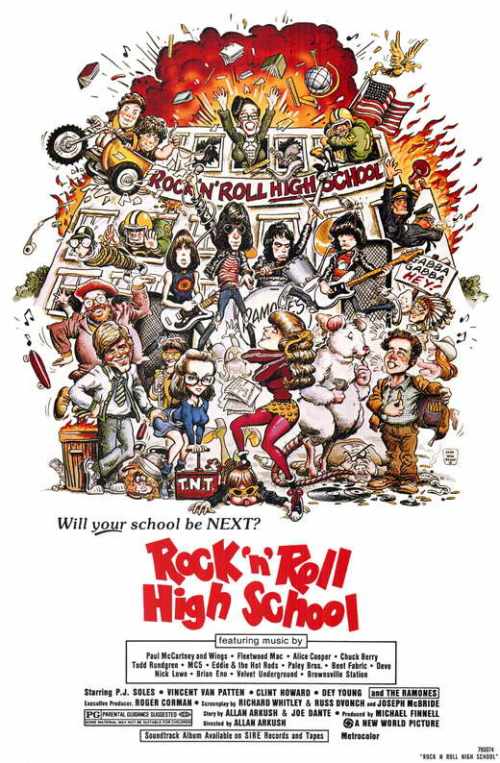
Vapid, schlocky nonsense about high school students rebelling from an oppressive new principal named Miss Togar (Mary Woronov) with the help of the punk rock band The Ramones.

The film was produced by Roger Corman, who was known to be quite stingy with his budget, and it shows. As a joke the crew put in birds in the background to chirp ‘cheap, cheap’ over the credits.

There really is no storyline here. It is just a rapid-fire parade of one corny, lame gag after another that gets progressively worse as it goes along. Despite being labeled a teen comedy the humor is embarrassingly kiddie with the expected sex jokes and innuendos at a minimum. Normally, even in the worst of comedies, I can usually find a few lines, or scenes, to be funny, but here I found nothing that was amusing, or even halfway clever.

What is worse is the fact that there is no nudity! What kind of self-respecting teen comedy doesn’t have nudity? Not that a few fleeting naked bodies would have saved it, but at least it would have helped.

P.J. Soles won a cult following for her rambunctious performance as the student leading the rebellion, but her acting is very hammy. Vincent Van Patten, son of actor Dick Van Patten, is cast against type as the good-looking blonde All-American, who seemingly can’t get laid. Unfortunately, he has always had a very blank, ‘deer-in-headlights’ stare and I find his acting follows in the same suit.

Woronov is ineffective as the heavy. She is just not mean, or repressive enough and stupidly falls for all the dumb tricks that the students play on her. Her character should have been played-up more and her evilness more accentuated, which would have, even on a minor level, allowed for more tension and made the film seem less one-dimensional.

If I liked anybody here it would be Dey Young, who is the younger sister of actress Leigh-Taylor Young and the two look a lot alike. She is real cute, but in a nice natural way that is not overdone. She seems to be having a good time throughout and I enjoyed her spontaneity. Male viewers may also like her revealing gym outfit.

The punk band The Ramones appear as themselves. Initially the producers had wanted singer Todd Rundgren, who would’ve been better, but he refused. They then tried to get Van Halen, but backed down when they heard they were wild and too hard to control. For a while they even considered bringing in a disco band and calling it ‘Disco High School’.  For what it was worth I was not into their music, or at least from what I heard here, as their songs sounded too much alike with no harmony, or melody, and a beat that was too repetitive. Also, their vocals sounded more like shouting than singing. They showed no screen presence and reportedly their acting was so bad that the majority of their lines were cut. For the record though their lead singer Joey looks almost exactly like radio personality Howard Stern.

Sometimes, if done right, teen comedies can be fun because they allow one to harken back to their own high school years and bring back fond memories like John Hughes’s Sixteen Candles and The Breakfast Club do. However, those films at least had some shred of reality to them while here the characters and situations are too cartoonish and over-the-top. Nothing is relatable and even for satire it goes overboard. It’s a ‘bomb’ in every respect.

My Rating: 1 out of 10

Released: August 24, 1979

Runtime: 1Hour 33Minutes

Rated PG

Director: Allan Arkush

Studio: New World Pictures

Available: VHS, DVD, Blu-ray

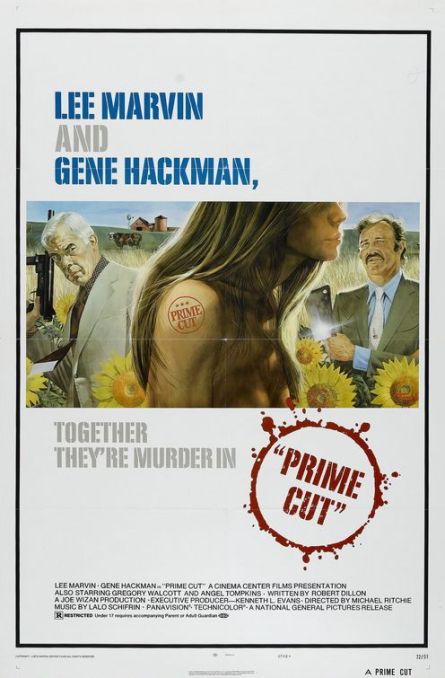
Prime Cut (1972)

By Richard Winters

My Rating: 8 out of 10

4-Word Review: Shoot-out in Kansas.

If you enjoy a great compact action flick, but are tired of the same old formula then Prime Cut may be for you.  It is the story of Nick Devlin (Lee Marvin) who is head of the crime syndicate in Chicago who travels to Kansas City to take on the head of their syndicate and avenge the death of one of their men as well as recouping an unpaid debt.

The movie has a lot of great offbeat touches that starts during its opening montage that takes place in an actual slaughterhouse.  Here you get a graphic glimpse of the inner mechanics of meat packing while soft, romantic piano music is played in the background.  The credits are displayed in a way that makes them look like they are being sliced by a meat cutter with cool meat cutting sound effects.  From here the quirky elements just keep coming. There is a wild chase through a wheat field where Marvin and Sissy Spacek find themselves attacked by a giant wheat thrasher that eats up their limousine and spits out the car parts into hay bails.  There is also a well filmed shootout amidst a sunflower field as well as Spacek’s revealing see through dress, which she wears to a posh restaurant and a giant plastic cow that gets shot up with holes and spews out milk.

This film is so unique that I am amazed it hasn’t acquired a stronger cult following. It stands up very well by today’s standards and even seems a bit shocking as it includes a scene involving white slavery where drugged young women are caged naked in stalls just like cattle and ranchers inspect and bid on them.

Marvin does well in his tongue-and-check role and pretty much steals it. He speaks his snappy lines in his usual terse manner with his famous stone expression, but he does it with a wink in his eye and at times even shows a soft side.  Sissy Spacek, in her film debut, looks young and fresh faced here. She is pretty and appealing in a very natural way. Only Gene Hackman as the villain named Mary Ann seems wasted. He does a good job for the material that he is given, but he needed more screen time and his character is not allowed to evolve at all.  Honorable mention also needs to go to Gregory Walcott as Hackman’s slimy henchman named Weenie.  The two get involved in an amusing scuffle while their accountants sit at their desks and busily add up their numbers and futilely try to ignore them.

Director Michael Ritchie nicely captures the Kansas landscape and gives it a very picturesque quality. It is probably the best on-location shooting of Kansas since Picnic. I did wish that the film was a little longer and showed more of a history between the two adversaries. It also seems to run out of steam at the end with a final shoot-out that isn’t all that clever or exciting and not up to the standards of the rest of the film.  Still this movie should appease any action fan and the story and direction are consistently original.

My Rating: 8 out 10

Released: June 28, 1972

Runtime: 1Hour 28Minutes

Rated PG

Director: Michael Ritchie

Studio: National General Pictures

Available: VHS, DVD

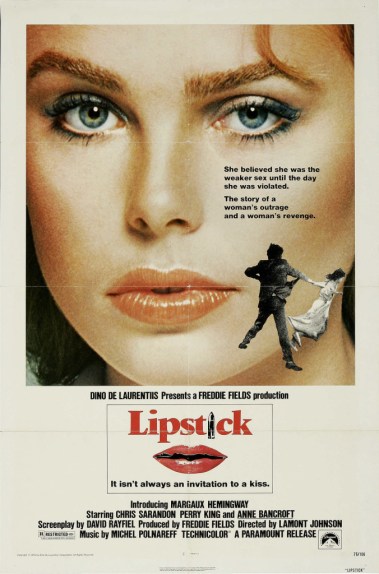
Lipstick (1976)

By Richard Winters

My Rating: 3 out of 10

4-Word Review: Don’t get her angry.

During the mid-70’s, Margaux Hemingway, granddaughter of the legendary author Ernest Hemingway, was one of the most photographed and highest paid models in the business, in fact she was the very first model ever to be awarded a million dollar contract.  After appearing on the June, 1975 cover of Time magazine she caught the eye of famous Hollywood producer Dino De Laurentiis who thought he could turn her into a star. The idea was to prove that she wasn’t just another pretty face by casting her in the difficult and challenging role of a rape victim, which they hoped would affirm her as a ‘serious’ actress. The gamble failed and she appeared in only a few more B-pictures even though her kid sister Mariel, who was cast in the film by Marguax’s suggestion, ended up having her career take off. Alcoholism and depression followed before she eventually committed suicide in 1996 at the age of only 42.

The story is basically just another tired exercise in the now cluttered rape and revenge genre. Chris McCormick (Marguax) is a beautiful lipstick model who is brutally victimized by a weirdo named Gordon Stuart (Chris Sarandon). She is dragged through the long and arduous court proceedings only to have him found not guilty and then start to stalk her younger sister (Mariel), which forces her to take matters into her own hands.

Right from the beginning this film comes off as very clumsy dramatically. Gordon is the high school music teacher of her younger sister Kathy. Chris is introduced to him at one of her photo shoots, but is too busy to listen to his music tapes, so she gives him her home address and tells him to ‘stop by anytime’.  Now, back in the 70’s people may have been a little less cautious than they are these days, but giving one’s home address to a man that she barely knows and isn’t interested in just to listen to one of his weird music tapes seems utterly ridiculous.

The rape happens almost right away before there is any character development. It almost seemed like this was the intended leering ‘highlight’ of the film with the rest just thrown in as second-rate filler. Wikipedia describes this scene as being one of the most ‘infamous in film history’.  That may have been the case at the time, but since then there have been many films that have exceeded what you see here, most notably in the controversial French hit Irreversible. Personally, I didn’t find it to be all that extreme. The one good thing I could say about it is that Sarandon is effectively menacing. I also liked the way his character is initially shown to be very meek and geeky and his inner-rage only comes out after he feels he has been slighted, which I felt made him a little less one-dimensional.

The courtroom scenes fall flat. Normally I find a good court drama to be riveting, but here it is stagy, phony, and uneven. The best thing about this segment is the presence of Anne Bancroft as Chris’s attorney Carla Bondi. She helps give the picture some stature and I wished she could have been in more of it.

If the film comes together at any point it is after the assailant is found innocent and Chris is forced to try to move on with her life and career despite the emotional toil and stigma. This segment has a certain socially relevant drama quality and to an extent it works even though it is brief. It also conveys some rather alarming statistics including the fact that only 10, 000 out of an estimated 50,000 rape cases every year actually ever get reported and only 2 out of 100 rapists ever get convicted. Since the credits list experts in the field that were consulted I can only assume that these numbers were accurate. Things may have hopefully improved since then, but the figures still seemed startling. However, all of this gets undermined by a tacked-on, manufactured, over-the-top, Rambo-like finale that relies too much on extreme coincidence and severely stretches the credibility.

I also found the film’s visual style to be unappealing. The colors are garish and gaudy while captured through a soft focus lens that resembles a model shoot in a glamour magazine and gives one a glossy trash perception.

I can see why Mariel made a strong impression with viewers. Her testimony on the stand is both touching and heart-wrenching and her emotionalism seems genuine and gripping. Marguax does not fare as well. Although her performance improves as the film progresses I still felt she was in way over her head and her nasal sounding voice is a bit irritating.

Although this film was pretty much panned by critics and audiences alike upon its initial release there is a new generation of people who feel it is underrated as evidenced by the many positive comments about it at IMDB. I approached this with an open-mind, but couldn’t help but come away from it feeling it was exploitation from beginning to end and even at that level it seemed derivative and uninspired. The whole thing left me cold and feeling like I wasted 90 minutes.

My Rating 3 out of 10

Released: April 2, 1976

Runtime: 1Hour 29Minutes

Rated R (Rape, Violence, Mature Theme, Language)

Director: Lamont Johnson

Studio: Paramount

Available: DVD, Amazon Instant Video

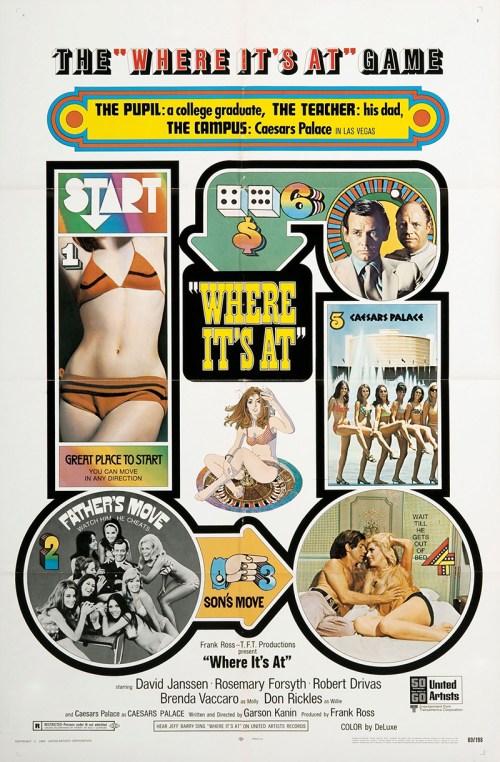
Where It’s At (1969)

where1

By Richard Winters

My Rating: 2 out of 10

4-Word Review: Father and son argue.

Garson Kanin, best know for penning such comedies as Adam’s Rib (1949), The Girl Can’t Help It (1954), and Born Yesterday (1950), tries his hand at drama here.  David Janssen plays a Las Vegas Casino owner who tries to train his son (Robert Drivas) in the business, so he can take over.  The father is a hard-bitten realist while the son, who has just graduated from college, is a strong idealist.

One of the main problems with this film is that there is nothing distinctive about it.  The arguments between the father and son are  typical stuff. The same topics were argued between ‘Meathead’ and Archie in ‘All in the Family’, but at least there they were funny.  Despite Kanin’s reputation, and despite what some sources list, this film is definitely not a comedy.  There are a few amusing bits by Brenda Vaccaro, who plays Janssen’s secretary and easily steals the film, but that is it.  The rest is  by-the-numbers drama that gets played out in a methodical way.

Despite the Las Vegas setting the sets are dull looking and unimaginative. The opening theme song by Jerry Ball is terrible and the characters unappealing.  I could never get myself involved in the story and kept checking my watch the whole time.

I was interested in seeing this film simply for the presence of Janssen.  I am a big fan of the old ‘The Fugitive’ TV series and was impressed with his work on it.  This film certainly does prove that he can act as his character here is the exact opposite of the Richard Kimble one on the TV show.  There he was always mild-mannered and self-effacing.  Here he is obnoxious and abrasive.  Unfortunately the character stays too one-dimensional in a negative way.  There is never any soft side revealed and thus causing the viewer to be uninterested in seeing what happens to him.

Robert Drivas as the son is another talented and interesting actor whose life and career was sadly cut short by AIDS in 1986.  He had some memorable performances in various TV-shows including ‘The Wild Wild West’ as well as in the movies The Illustrated Man (1969) and Joseph Strickland’s independent classic Road Movie (1974). However, his best ability was in conveying a dark brooding side to his characters, which doesn’t work here.  You never believe for an instant that the character is all that innocent, or honorable because the dark elements start coming out from the beginning.

Don Rickles appears briefly as a card dealer who starts stealing from the house.  When he is caught he breaks down into a long crying spell before he is demoted to a full-time dish washing job until he can pay the money back.  Rickles as a comedian is funny, but as a serious actor he is limited.  Yet it was still fun seeing him play such a wimpy and passive person because it goes completely against his persona.  The film might have been stronger had there been a few more scenes with him.

The film does have a bit of an interesting twist towards the end where the son decides to turn the tables on his father and takes advantage of one of his father’s shady deals by purchasing the casino from under him and then throwing the old man out on the street.  This of course shocks the father and forces him to reevaluate his values as well as what he has taught his son. This might have been more intriguing had the exact same theme not been done so much better in The Godfather movies as well as Harry Chapin’s classic son ‘Cat’s in the Cradle’.

My Rating: 2 out of 10

Released: May 7, 1969

Runtime: 1Hour 46Minutes

Rated R

Director: Garson Kanin

Studio: United Artists

Available: Amazon Instant Video

Thieves (1977)

By Richard Winters

My Rating: 1 out of 10

4-Word Review: A couple drifting apart.

Sally and Martin Cramer (Marlo Thomas, Charles Grodin) are a middle-aged, married couple whose relationship is slowly drifting apart.  They were once connected through their youth and idealism, but now Martin is older and more cynical. He just wants to settle down and live the quiet life as he feels ‘the world is not worth saving’. Sally is still the idealist, she teaches at an inner-city school and even wants to adopt a young African-American boy, which Martin does not want because of the boy’s propensity to steal things. Sally is also pregnant and considering an abortion. The film consists mainly with them arguing about these issues while considering divorce and having affairs.

The film did not go over well with the critics at the time of its release and I was surprised because it was written by renowned playwright Herb Gardner.  I was impressed with Gardner’s talents after seeing the film A Thousand Clowns, which was based on one of his plays. I enjoyed his offbeat characters and situations as well as the sharp one-liners.  I was expecting more of the same here, but found this to be flat and slow going. The idea of having a couple argue almost endlessly for the entire movie can be tough to pull off, but has been successfully done. Most notably in Made for Each Other starring real-life husband and wife Joseph Bologna and Renee Taylor as well as Can She Bake a Cherry Pie?. However, in both of those films the characters were eccentric and interesting and their fights were lively and animated.  Here the characters are dull to the point that there is really no reason to care how their marriage turns out, or even what happens to them. Their arguments become almost soap opera like. Yes, some of the dialogue is eloquent and you can tell it was done by a playwright, but there still needed to be more action and cutaways. The overall mood of the film is very downbeat and paints the city of New York and modern life in general as an urban hellhole.  There could be some truth to this, but it ends up becoming real depressing when the viewer gets beaten over the head with it the whole time.

Although billed as a comedy there is very little of it. The majority is heavy drama and the comedy that they do have comes off as forced, unimaginative, and heavily reliant on stereotypes. For instance Sally makes all her inner-city students put their weapons into a box before they enter her class. I thought it would have been more believable had one of them decided to use them on her, but they never do. Despite the ‘rough and tough’ image the kids seem strangely compliant.  Martin is a principal at a snotty private school, so his problems are at the other end. One scene has him ‘negotiating’ with a spoiled ten year old to come out of his limousine and into class, which is equally contrived.  There is also the strange neighbor who lives in the apartment beneath theirs and is played by actor Hector Elizondo.  He makes random, weird comments throughout that supposedly are used for comic relief, but end becoming quickly irritating.

I thought it would be fun to see Marlo Thomas in a film role as she has done very few of them in her career. She is most well-known for playing the part of Ann Marie the struggling actress in the 60’s TV-series That Girl. Her character was known to be very naïve and proper in that series. Here her character is more jaded and savvy, which makes for an interesting comparison although she is known as a feminist and liberal activist in real-life, so if anything this character more closely identifies with her true personality. She does end up giving an excellent performance overall. Charles Grodin does not fare as well. Usually his sardonic humor and dry approach can elevate even the blandest material, but here the maudlin script ends up pulling him down. Even Grodin fans who have seen this film stated that he seems to be just going through the motions. I also didn’t like the fact that he has a flute and ends up constantly playing the same sad tune. Noted character actors Gary Merrill and Mercedes McCambridge appear as homeless people, but are not given a single line of dialogue, which I found to be frustrating and a waste of their talents.

If there is one positive thing to say about this dreary production that has no visual or cinematic style it is in the presence of Irwin Corey, who plays Sally’s racist and scatological father.  He manages to liven up all the scenes that he is in and I came away impressed as he is mainly a stand-up comedian famous for his bawdy Professor Irwin Corey act. I was even more impressed to find that as of this writing he is still alive and well at the ripe old age of 97 and still doing his comedy act while married to the same woman for over 70 years. A documentary about his life and career called Irwin and Fran is set to be released later this year. Judging just from the trailer it looks more interesting and enjoyable than this film.

My Rating: 1 out of 10

Released: February 11, 1977

Runtime: 1Hour 32Minutes

Rated PG

Director: John Berry

Studio: Paramount

Available: Netflix Streaming