Straight Time (1978)

straight

By Richard Winters

My Rating: 8 out of 10

4-Word Review: Parolee can’t go straight.

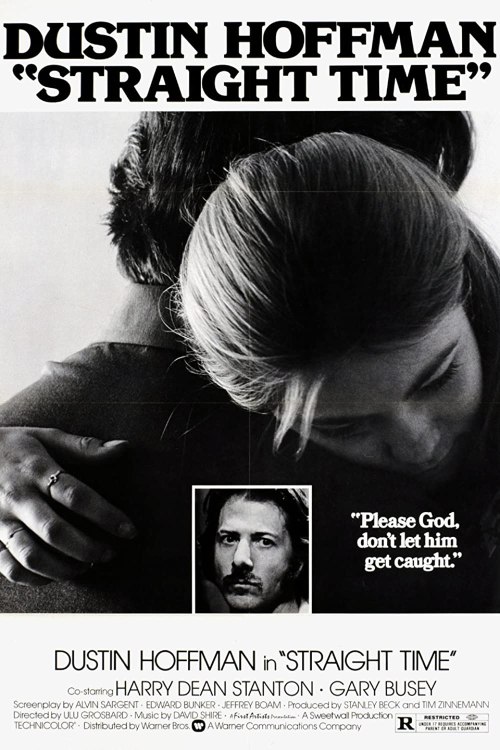
Straight Time is an engrossing, highly realistic drama detailing a parolee by the name of Max Dembo (Dustin Hoffman) who gets released from prison and cannot seem to stay away from the allure of crime despite his initial efforts. The movie is based on the novel ‘No Beast So Fierce’ by Edward Bunker.  Bunker himself was a career criminal who was in and out of jail from 1955 to 1975 and only managed to finally turn his life around when this novel, which he had written while incarcerated and deals with many of his own exploits, got published. Bunker co-wrote the screenplay and appears in a bit part playing a character with a really bad comb-over by the name of Mickey.

I found this film gripping from the second it started and infinitely fascinating the more it progressed. It gives you a whole new perspective on things as you are forced to see it from the viewpoint of the criminal and as an outsider looking in. Every facet of the story and characters is believable and the film does a very good job of being stark and searing without ever getting exploitive, or overtly shocking.  I remember back in 1977 when I toured the new county jail in the town where I grew up when it was first opened and before it housed any inmates. I remember the officer describing the rather degrading procedures all felons had to go through when they were first booked including being stripped searched and forced to take a shower nude while a fully clothed officer stood by and watched them.  The scene where Max and other criminals are ‘welcomed’ to the L.A. County jail worked exactly like that. It was so authentic and frank that it seemed almost like a documentary.

The essence of the story revolves around Max and his relationship with his parole officer Earl Frank that is wonderfully played by noted character actor M. Emmet Walsh. Earl does his job a little too well. He shows a constant distrust of Max and gives him no respect while overzealously tracking his every move until it finally forces Max to snap. It is a terrific indictment on the flawed system as it examines just how hard it is for the criminal to go straight and stay straight even if they want to. It also exposes how it seems almost designed to push the person back into crime in its refusal to ever treat the criminal as a human being. The part where Max finally has enough and overpowers Earl and chains him naked to a fence in broad daylight on a busy L.A. freeway while hundreds of cars drive by him should leave an indelible image on the minds of anyone who sees it.

The remaining supporting cast is great as well. Theresa Russell is surprisingly effective as Max’s girlfriend Jenny Mercer. Usually she has played more glamorous types of roles, but here she is perfect as a very ordinary woman who inadvertently gets caught up in Max’s eventual self-destruction until she finds herself in over her head.  I liked the fact that she wore no makeup and the camera was able to pick up her natural beauty through regular lighting. The only issue I had with her character is that it is never made clear why she would fall in love with Max so quickly and what it was about him that she liked since he shows some clear destructive tendencies right from the beginning. To me it just came off as a bit forced and phony to have an otherwise well-adjusted woman that he meets at an employment agency get so infatuated with him after just one date that she immediately agrees to move in with him, visit him in jail, and even quit her job on the spot and go on the run. I know it is standard practice in a Hollywood film for the anti-hero to always have ‘his girl’ that can be used to humanize and compliment him, but there still needs to be more of an explanation and history shown to her character in order to validate the relationship.

Harry Dean Stanton gives another great performance as Jerry Schue. He was a long-time partner to Max during the robberies he did before landing in prison. Jerry has now turned his life around. He has a nice house in the suburbs, an honest job, and a beautiful wife. However, when Max comes to visit, and the minute his wife leaves the room, Jerry begs him for a crime job that they can do together because he finds his new found life to be boring.  I thought this made a great statement as to how the sterile suburban existence is not the American dream for everyone and how it will not necessarily ‘domesticate’ those that still harbor a reckless urge.  I also found it interesting how Jerry views the art of robbery as an actual profession that he takes a great deal of pride and care in. When one of the men shows up late for a planned robbery Jerry calls him ‘unprofessional’.

The robbery scenes are filmed in a diverting way. In most films the camera gets real close to the action in order to heighten the tension. Here the action is captured from a long shot that allows the viewer to see just how chaotic and frantic a robbery really is as well as showing how the most nervous people in the place are the thieves themselves.

If I have one complaint with the film it is in the fact that the second hour becomes rather difficult to watch as it focuses solely on the self-destructive downward spiral of the main character. Max has some good qualities, which makes it all the more painful to watch. Yes, some of his anger is justified, but his insistence at ‘evening the score’ with everyone who has wronged him ends up only hurting himself. Hoffman is outstanding as usual. It is interesting to compare his role here playing a very violent character with the pacifist one that he played just seven years earlier in Sam Peckinpah’s classic Straw Dogs.

If you are looking for an intelligent, searing drama that is still relevant today then this no-holds-bar character study is highly recommended.

My Rating: 8 out of 10

Released: March 18, 1978

Runtime: 1Hour 54Minutes

Rated R

Director: Ulu Grosbard

Studio: Warner Brothers

Available: VHS, DVD, Amazon Instant Video

The April Fools (1969)

By Richard Winters

My Rating: 2 out of 10

4-Word Review: Affair between married people.

Director Stuart Rosenberg was on a high note in 1967.  He had just won rave reviews for his cult hit Cool Hand Luke and many felt he was well on his way to being Hollywood’s next top director only to follow it up with this incredibly vapid and stupid romance movie.

It involves a married man by the name of Howard Brubaker (Jack Lemon) who meets an attractive woman named Catherine Gunther (Catherine Deneuve) at a party. They spend the evening walking around outside and having nothing more than a casual conversation, which is enough to make him decide to leave his wife (Sally Kellerman) and child, quit his high paying executive job, and run off with her to Paris.

The story is pretty threadbare and filled with a lot of characters and situations that are not fleshed out at all.  This almost seems like a partial treatment to a main script that never got completed.  This movie provides no real tension, conflict, or subplots.  Most movies dealing with potential romances usually has one or both of the participants second guessing themselves as to whether they should move ahead with the relationship especially when both of the people are married like they are here.  These two fall in love so amazingly quickly that they make the art and act of dating seem completely unnecessary.

A much better idea would have been to have this quick romance act as only the starting point.  The film then should have cut to 5 or 10 years later where we could have seen how this relationship fared, or evolved. This would have given much better perspective to both the movie and characters.

I also have never felt that two people having an affair is a real good catalyst for a love story because it seems to go against the whole ‘true and everlasting love’ theme that propels most romance stories.  After all if someone can’t stay fully committed to one person what is to say that they will be able to do so with someone else.  To give the argument that they are just ‘crazy’ about this new person doesn’t work because at some point they must have been ‘crazy’ about the person they are currently with or they wouldn’t have married them. So what is to say that in a few years time when the newness of the relationship wears off that the whole vicious cycle won’t just get repeated.  I don’t have the exact statistics in front of me, but research has shown that people who cheat on one person are prone to doing it with their next partner simply because it is in their nature.

In some ways I could see why Catherine would consider leaving her husband, which is well played by Peter Lawford, simply because the guy is a womanizing lout in the worst way.  It is understandable that she may have been initially mesmerized by his wealth and charisma and only had her eyes opened to his shallowness years later.  However, Howard’s marriage didn’t really seem that bad and what is worse is the fact that he had a 5 year old son whom he seemed to have no problem abandoning without even a second thought.

The whole thing comes off like some uninspired idea by some studio head who wanted to make a ‘sure-fire’ hit by throwing together every contrived romantic element he could think of, piecing it together with a flimsy script, and then using the star-power of Lemon and Deneuve to cover up all the holes.  Everything here seems forced and that includes the humor.  Lemon’s duel with Charles Boyer is overdone and irrelevant.  There is also a scene where Howard’s friend (Jack Weston) drives him to the airport while being completely drunk and weaving in and out of on-coming traffic.  Today’s audiences would find this to be highly irresponsible and also terribly unfunny, which it is.

There are some potentially funny ideas that scriptwriter Hal Dresner never seems to think of.  For instance Catherine ends up being the wife of Howard’s new boss.  This could have been a goldmine of a lot of funny scenarios as the two tried sneaking around behind his back. The Lawford character does eventually corner Howard at the airport just as he is ready to board the plane and go off to Paris with Catherine, but even this potential confrontation gets botched badly.

I did really like Deneuve and her presence is the only real good thing about this movie. She looks radiant and I enjoyed the cool, chic way she responds to all the situations she is put in. This also marked her American movie debut.

Lemon though does not fare as well.  He overplays the high-strung businessman persona until it becomes tiresome.  He is nervous and befuddles every second that he is on the screen until you wonder how he was ever able to impress anyone enough to be able to obtain the prestigious position that he has at his company.

The supporting cast is stellar, but not used enough.  Jack Weston has a funny bit as he explains the goofy way that he handled an affair of his own.  Harvey Korman is amusing as a man who tries stealing the alluring Deneuve away from Lemon at the last minute.  It is also fun to see Melinda Dillon in her film debut.  She is best known for her supporting dramatic roles, but here she plays a giggling, ditzy blonde.  She is paired up with comic character actor Kenneth Mars and the two have the makings of being a great hammy couple. Unfortunately they are not given enough screen time, nor enough good lines, to really make it gel. Myrna Loy and Charles Boyer, as a long-time married couple, are essentially wasted.

Besides Deneuve there were a few other things that I did like about the movie.  The Burt Bacharach score is certainly pleasing on the ears.  There is a funky, mod 60’s party that takes place at the beginning of the film that features a lot of weird art exhibits that are nicely realized by award-winning set designer Richard Sylbert. I found the exhibit that featured a faucet dangling in mid-air while running a constant stream of water to be fascinating. I also enjoyed the scene where Deneuve and Lemon go to a wild nightclub where they are handed pop guns as they sit down which they can use to shoot at the rear-ends of the waitresses when they want to get their attention. I thought this was a genuinely neat idea that should be used at every restaurant.

My Rating: 2 out of 10

Released: May 28, 1969

Runtime: 1Hour 35Minutes

Rated PG

Director: Stuart Rosenberg

Studio: National General Pictures

Available: VHS, DVD (Import)

Entertaining Mr. Sloane (1970)

By Richard Winters

My Rating: 3 out of 10

4-Word Review: The first gay marriage.

Based on the Joe Orton play of the same name, this film deals with a handsome young stranger named Sloane (Peter McEnery) who becomes a lodger at an isolated household in the English countryside. He is on the run from a murder he committed and feels this will be a safe haven due to the only other inhabitants being a quirky old lady name Katherine (Beryl Reid) and her equally quirky father Kemp (Alan Webb).  Katherine, or Kath, takes a sexual interest in Sloane despite their wide age difference, which Sloane doesn’t mind as he uses this to manipulate her. When Kath’s brother Ed (Harry Andrews) arrives and takes an amorous interest in Sloane as well, he does the same thing to him. Then Kemp recognizes Sloane as the killer and Sloane is forced to kill him, which culminates with ironic results.

Playwright Orton was years ahead of his time. His plays always had a dark, sexual, even explicit nature to them and his characters were always perverse and amoral in a darkly hilarious way. It is unfortunate that he was bludgeoned to death in 1967 by his jealous gay lover and his career was cut short. However, this adaptation done by screenwriter Clive Exton seems to miss the mark. The dialogue is endless with very little action. The other adaptation of Orton’s work that was made into a film, Loot, was much more lively and full of a lot of campy, zany humor as well as quick edits and imaginative camerawork. This film is visually dull and all the action is jammed into a cramped, dark house with bland decorations. It never really gets going until the final 15 minutes when you get to see the world’s very first gay marriage performed, but by then it is much too late.

For 1970 this film does seem edgy and even controversial in certain parts. The gay erotic subtext is quite strong especially the way the camera scans Sloane’s tan, half naked body. There is also Ed’s pink Cadillac that he drives around, which I got a real kick out of. I liked the way it squeaked as he drove it and was constantly bouncing up and down.  There is also his very provocative hood ornament of a naked man that the camera hones in on. The best part comes when Ed washes his car and is more focused on the ornament, which he lovingly caresses with his towel, than the rest of the vehicle.

However, 40 years later this stuff seems pretty tame and there are too many segments where nothing happens and is handled too conventionally.  It seemed like director Douglas Hickox really didn’t get, or appreciate the material enough, or interpret it in some interesting way because the final result is nothing more than a filmed stage play. The music that is used is terrible and almost enough to get you to turn off the film. It also gets overused and played over scenes when it isn’t needed and hurts the film’s mood in the process.

The biggest problem with the film may actually be with actress Reid herself. Don’t get me wrong this is a wonderfully unique actress who has done some memorable work. I especially liked her in The Killing of Sister George, and she is quite good here as well. However, I do have two issues. The first is a small one. It involves the fact that the character wears dentures. In one scene Sloane supposedly knocks them out and breaks them, but then Reid turns around and screams and you can see that she still has teeth in her mouth.  The other, much more serious issue is the fact that near the beginning of the film she is seen walking through a cemetery in broad daylight wearing a see through blouse. Now with some woman this can be quite sexy and I certainly wouldn’t complain, but when they are 60 and looking more like 70 this is a bad idea, even for perversely comical purposes as it is here it is still a bad idea. What is even worse is when she turns around and a gust of wind blows up her skirt and you can see her entire bare backside, which might be enough to make some viewers sick.

Now, before anyone accuses me of ageism let me relate an interesting experience that happened to me. Back in 2003 I was home from work and decided to take in a movie. I was living in Chicago at the time and I went to the neighborhood theater to see the interesting French mystery Swimming Pool starring Ludivine Sagnier and Charlotte Rampling.  It was a Tuesday and little did I know that it was senior discount day and the place was packed, literally, with people all looking well over the age of 70. The lady that sat beside me looked to be at least 80 and came in using a walker. The film featured an abundance of nudity from the young and attractive Sagnier, which I thought might shock and offend the seniors, but no one reacted to it and everyone went on enjoying the film. Then, towards the end of the movie, 58 year-old actress Rampling starts to take off her clothes and this indeed elicited a nervous response from the crowd. The lady next to me even said ‘oh dear’. In all fairness Rampling didn’t look all that bad naked, but it still hits home the point that even old people don’t want to see other old people naked.

My Rating: 3 out of 10

Released: July 27, 1970

Runtime: 1Hour 34Minutes

Rated R

Director: Douglas Hickox

Studio: Continental Distributing

Available: VHS, DVD (Region 2)

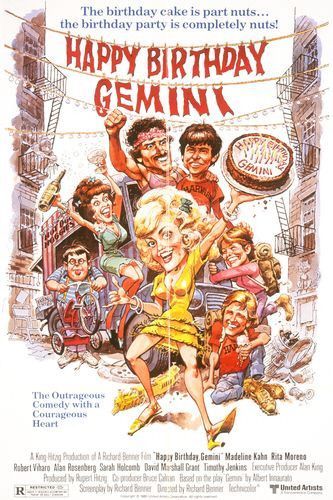
Happy Birthday Gemini (1980)

happy1

By Richard Winters

My Rating: 5 out of 10

4-Word Review: Gay son comes out. 

A brother and sister by the name of Judith and Randy Hastings ( Sarah Holcomb, David Marshall Grant) travel to Philadelphia over the summer to visit their college friend Francis Geminiani (Alan Rosenberg).  Judith dated Francis during the school year and wants to continue the relationship. Francis though has come to terms with his homosexuality and realizes that he is now more attracted to her brother.  The story examines their adjustments and attitudes to this news as well as the many eccentric characters that make up the neighborhood.

Despite not rating well with the critics, I kind of liked this movie for the most part. The film was directed by Richard Benner who received acclaim for the directing the groundbreaking Canadian film Outrageous. I think he captured the row houses and inner-city neighborhoods of Philadelphia well. My Mother is from the city and I spent many summers visiting there. I enjoyed the bright color schemes of the different houses as well the character’s costumes. The movie has a very European feel featuring a lot of long takes and a leisurely pace. The characters are also much more open-minded and accepting of each other’s transgressions than you would usually find in an American film.  The toe-tapping ragtime music and upbeat ending help fill it out.

Kudos must also go to Madeline Kahn and her performance as Bunny Weinberger. I was very impressed with this woman’s comedic skills after seeing her in What’s Up Doc as well as in Paper Moon. I didn’t think anything could top those, but this comes close. Her portrayal of a foul-mouthed, ditzy blonde with a very heavy eastern accent is outstanding and a highlight of the whole movie.  Her scenes in a courtroom where she has to defend herself from a battery charge as well as a nicely photographed scene where she threatens to jump off an abandoned building are two of her best moments.

Where the film fails is in the fact that there is little cohesion between the scenes. The film goes off on long tangents, particularly with the Bunny character, until it seems like Francis’s problem is only a side-story. There is a lot of extraneous dialogue that goes nowhere and was not needed. A 115 minute runtime is much too long for this kind of material.  For a comedy the laughs are lacking and the script needed to be injected with a lot more witty conversations and sharp one-liners. Rita Moreno is completely wasted as the character of Lucille Pompi.  She has nothing funny to say and it would have been more entertaining if they had built up more conflict between her and the Bunny character as the two had very contrasting values. The subject matter itself is no longer fresh or groundbreaking and the film failed to put any new or interesting spin on the topic. Although I liked the positive message I still felt that it glossed over the homophobic sentiments that are still out there and did not do its subject matter any real justice.

Fans of Kahn should see this, but others may find it placid and lacking in any type of distinctive quality.

My Rating: 5 out of 10

Released: May 2, 1980

Runtime: 1Hour 47Minutes

Rated R

Director: Richard Benner

Studio: United Artists

Available: VHS

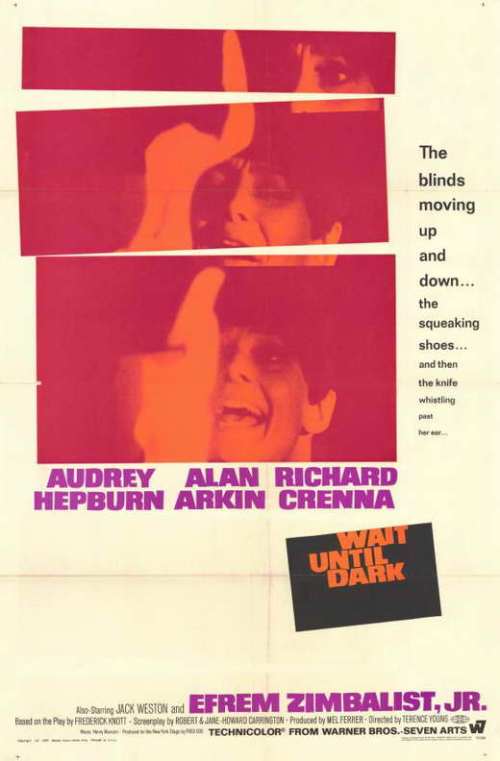
Wait Until Dark (1967)

wait

By Richard Winters

My Rating: 8 out of 10

4-Word Review: They want the doll.

Horror writer Stephan King, in his non-fiction book ‘Dance Macabre’, lists Wait Until Dark as the scariest movie ever made and Alan Arkin as one of the scariest film villains. Of course that is a statement that could be wildly debated, but as a thriller it is very well structured with a original storyline, a fantastic heroine, and a terrific climatic sequence that still rates as one of the best.

The film is based on the hit Broadway play by Frederick Knott and follows that script very closely.  It centers on a recently blinded woman named Susy Hendrix (Audrey Hepburn) who accidently acquires a doll filled with heroin and then becomes terrorized by the three drug dealers (Alan Arkin, Jack Weston, Richard Crenna) when they come to retrieve it. Trapped in her small apartment by the three men with her phone line cut off, she decides her only possible recourse is to smash all the light bulbs and then, in the pitch blackness, use her handicap to her advantage and try to escape.

Normally stage plays transferred to film don’t usually work too well namely because all the action takes place in one setting, which eventually creates visual boredom, but here this becomes an asset.  As the story progresses the viewer begins to feel claustrophobic and as entrapped as Susy as well as successfully tapping into the fear of isolation. The lighting is also impressive.  It may not be something one consciously thinks about, but good lighting can really help accentuate a film’s mood and style, which it does here.  I enjoyed the interesting color schemes and the contrasts between light and shadows that becomes more apparent as it goes along.

Of course the element that really makes this film special is the fantastic performance of Hepburn, which I consider to be her best.  She was nominated for the Academy Award and she should have won it.  She displays just the right level of emotions, which creates empathy from the viewer almost immediately. Her reactions as well as the fear and panic that she shows are very convincing. Arkin, as the villain, tends to get a little too flashy and hammy. I felt Hepburn easily out performed him and everyone else. The film just would not have been as good had anyone else played the part.  This also marks her career pinnacle as she went on a nine year sabbatical after this and when she did finally return, the films she did weren’t all too great.

I also like Julie Herrod as the child named Gloria who lives upstairs and becomes a very crucial link to the story.  So many movies portray children as either total brats, or overly wide-eyed innocents solely put on this planet to say cute and amusing things on cue.  Here the balance is just right and so believable she will remind you of kids that you know in real life as it certainly did with me.  She is sneaky and precocious at certain times, but also genuinely helpful and concerned at others, just like adults are.  The line she says to the Hepburn character just before she runs out to find help is a gem.

The climatic sequence still ranks as one of the best.  The clever ways that this petite, handicapped woman manages to outwit the brutal thugs are classic.  The viewer also gets the satisfaction of seeing the character grow and find an inner strength that she didn’t even know she had. It also features a very well staged scare/shock that sent viewers jumping out of their seats when it was first released and still does today as evidenced by the other people who watched the film with me and all screamed out loud when it happened.

As with any film released 40 years ago, there are some dated qualities that do hurt it.  Some of the ‘tough guy’ talk between the thugs seems a bit stilted.  The film was released a year before the ratings system took effect, so there is no cursing, but a little bit of it would have helped make it more authentic.  It would have also been a little more gritty had the bad guys actually carried guns instead of the brass knuckles and silly looking knives.  Air travelers of today will also be shocked at just how easily it was for people to get through airports in the old days.

However, even with these few weaknesses I still feel this film is a pretty solid, compact thriller that can be used as a blueprint for all other thrillers to follow.  There is also the excellent music score by Henry Mancini that is really creepy although the song played over the closing credits should have been avoided.

My Rating: 8 out of 10

Released: October 26, 1967

Runtime: 1Hour 48Minutes

Rated NR (Not Rated)

Director: Terence Young

Studio: Warner Brothers

Available: VHS, DVD, Blu-ray, Amazon Instant Video

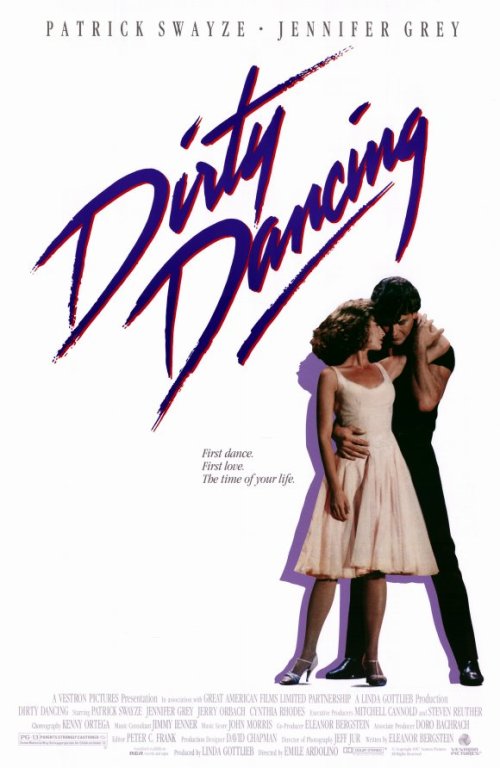
Dirty Dancing (1987)

dirtydancing1

By Richard Winters

My Rating: 5 out of 10

4-Word Review: Rubbing bodies is sexy.

Some of my lady friends at the office were surprised to hear that I had never seen this film and suggested that I watch and review it for my next column.  Since Hollywood is now planning on remaking this movie and several websites have already started up protesting it as fans of the original feel this can’t be duplicated, now more than ever seems to be a good time to give this movie a look.

The plot, which is paper thin, deals with a seventeen year old girl named Frances ‘Baby’ Houseman, who while vacationing with her family at a resort in the Catskills Mountains of New York in the early 60’s, becomes involved with the craze of dirty dancing that is done behind the scenes by some of the young people. When one of the lead female dancers named Penny Johnson (Cynthia Rhodes) gets pregnant and has to bow out in order to get an abortion, Francis agrees to take her place in the dance routine. She has no experience with the dancing, but after spending long hours practicing with the male hunk Johnny Castle (Patrick Swayze) she gets pretty good at it and the two fall in love in the process.

The story is loosely based on the real-life experiences of screenwriter Eleanor Bergstein, who traveled to the Catskills during the summers of her youth with her family and got involved with some of the dirty dancing contests that they had up there. The name of Frances that is given to the character was actually the name of her older sister and the nickname of ‘Baby’ was what Eleanor was called in her teen years.

The first thing that impressed me about the film was the on-location shooting. I had also been to upstate New York during the summers in my younger years and felt that the area was quite scenic. The film does a good job in recreating this to the extent that it also becomes like a third character. The only problem was the fact that it was actually filmed in North Carolina and Virginia, but they disguise it well and the ambience of the Catskills is still there.

The chemistry between the two stars is what makes the movie and spiraled it into the hit that it became. I felt the energy and I liked it despite the fact that apparently behind the scenes the stars did not always get along. I thought the casting of Grey, daughter of legendary entertainer Joel Grey, was overall a good choice. The producers wanted someone who could really dance and she fit the bill even though she was actually ten years older than the character she was portraying. However, I did feel it became somewhat of a problem during some of her exchanges with the Johnny character who was supposedly in his twenties. I would have thought that a young lady of only seventeen would have been a little more intimidated dealing with an older man and even a little awkward at times and yet their ‘spats’ came off more like two adults arguing.

I really liked Frances’ relationship with her father Jake (Jerry Orbach). It was a nice and respectful one with neither side talking down to the other. The scene where the two have a falling out and Francis comes to him to ask forgiveness is actually quite emotional. However, the part where Jake, who is also a Dr., helps Penny when she becomes ill after having an abortion with an untrained physician seems a bit glossy. Normally that situation would prove fatal to the woman, but somehow Jake is able to make her ‘all better again’ simply by using medicines inside his doctor bag and she wasn’t even forced to go to the hospital. I also thought that the fact that Frances kept her dancing a secret from her parents seemed to be a bit of a stretch as she spent so many hours with Johnny that I would have thought they would become suspicious as to where she was all that time.

For the most part the recreation of the 60’s era is all right. However, I did not like instituting 80’s songs into the mix. ‘Hungry Eyes’ and ‘She’s like the Wind’ are good songs on their own, but have a distinctly different sound than music from the 60’s. By putting them into the soundtrack they become jarring and, for this viewer at least, threw me out of the time period of the story completely. To me it was a sign of poor filmmaking.

The movie is formulaic and predictable to the extreme, which was the reason that I never went to see it when it first came out because basically if you’ve ‘seen the previews then you’ve seen the movie’. It is always nice if a movie can give you some sort of unexpected twist, or surprise, or even some new level of insight, but this film offers none. Even on a soap opera level the scenarios and complications are awfully light and there are a few moments of hackneyed drama. If one’s only demand is to see a predictable teen romance then on that level it is competently done. If a viewer were to demand anything more than that then they will most assuredly be disappointed.

My Rating: 5 out of 10

Released: August 21, 1987

Runtime: 1Hour 40Minutes

Rated PG

Director: Emile Ardolino

Studio: Vestron Pictures

Available: VHS, DVD, Blu-ray

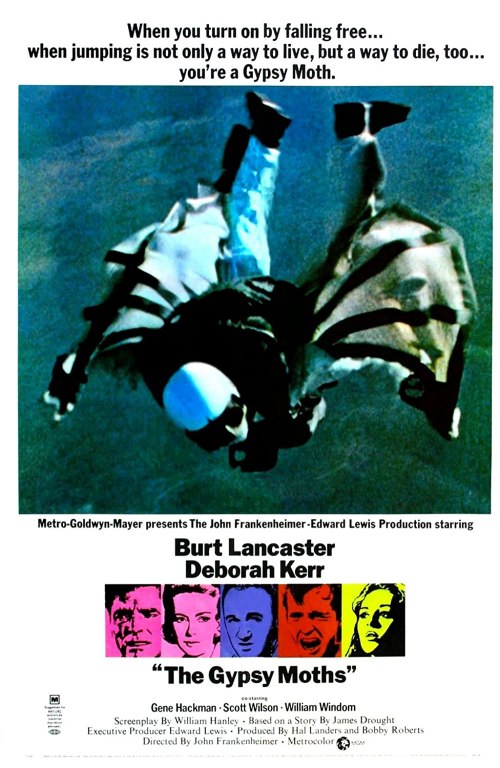
The Gypsy Moths (1969)

gypsy

By Richard Winters

My Rating: 4 out of 10

4-Word Review: Skydivers travel to Kansas.

Three skydivers, who make a living going around the country doing airshows for the public, stop off at a small Kansas town on a fourth of July weekend that ends up changing all of their lives. Mike Rettig (Burt Lancaster) is the eldest and the leader of the group. He seems unhappy and suffering from some inner turmoil that he is reluctant to elaborate on.  He ends up having an affair with one of the attractive middle-aged women in town named Elizabeth Brandon (Deborah Kerr).  Joe Browdy (Gene Hackman) is restless and impatient and has a fling with the town stripper (Sheree North).  Malcolm Webson (Scott Wilson) is the introspective member of the trio.  He grew up in the town that they are in and uses the visit as a way to reconcile with his demons from the past.

MGM was hoping for a big hit with this one as it reteamed Lancaster and Kerr 16 years after their famous embrace in From Here to Eternity. The film broke ground as it was the first to feature an established and respected actress who was nearly 50 years of age doing a nude scene. Kerr, who looked great both with her clothes on and off, can be seen fully nude from the front and back during a lovemaking scene with Lancaster.  Yet the film failed to gel with the public.

There were some things that I did like. One is the fact that it was filmed on location in Kansas. The opening shots capturing the countryside of the Midwest really gives a strong visual sense of Americana.  The scenes taking place in the neighborhoods of the small town give the film an added dimension that a studio back-lot just couldn’t do.  The skydiving sequences, which take up the majority of the time, are breathtaking and exciting. The aerial photography makes you feel like you are right there jumping out of the plane and free falling into the air.

The basic plot though is dull and uninteresting.  The characters and situations are contrived and derivative.  It is almost like the story was a second thought to the stunt work and put in merely as filler. I also didn’t like the pretentious quality of the production that made it seem like it was making some sort of profound statement when in reality it was nothing more than second rate soap opera.  The whole thing would have worked better had they skipped the story and made it into a documentary on skydiving instead.

Spoiler Alert!

The most frustrating thing about the movie is the fact that the Mike character dies at the end when he decides, for no apparent reason, not to open his chute and goes, literally, splat on the ground right in front of a throng of spectators. I actually thought this was one of Lancaster’s better later career performances and I was intrigued as to what was causing his character’s inner-strife, but the film offers us no clue, or hint.  I thought there should have been a backstory and even some flashbacks. The ambiguity leaves the viewer cold and unsatisfied and makes the film seem incomplete.

The only possible explanation may come through researching actual Gypsy moths and then correlating the species to the characters. Per Wikipedia, the female gypsy moth is unable to fly. This would then explain why Elizabeth refused to run off with Mike despite her unhappy marriage simply because she could not ‘spread her wings’.  The adult male moth always dies in July, which would then explain Mike’s death. No reason for his demise was needed because his life cycle was ending regardless. July is also the time when the moth lays her eggs, which would explain why Joe and Malcolm, who were much younger than Mike, decided to go off on their own separate ways at the end.

End of Spoiler Alert!

I  ended up finding more misses than hits with this one and can’t help but label it as a misfire.

My Rating: 4 out of 10

Released: August 28, 1969

Runtime: 1Hour 47Minutes

Rated R

Director: John Frankenheimer

Studio: MGM

Available: VHS, DVD

The Eiger Sanction (1975)

By Richard Winters

My Rating: 5 out of 10

4-Word Review: Clint goes mountain climbing.

Dr.  Jonathan Hemlock (Clint Eastwood) is a retired assassin and mountain climber now working as a college art and history professor. However, due to his penchant of collecting rare paintings he is sucked in to doing hits from time to time by an obscure government bureau in order to help pay for his expensive collection of artwork. His assignment this time is to track down the Russian assassin who killed his old army buddy that at one time had saved his life while back in the war. The identity of this killer is not known, the only thing that is known is that the man walks with a limp and is a part of a team of mountain climbers set to scale the foreboding Eiger Mountain in the Swiss Alps.

Eastwood’s foray into the spy genre while entertaining enough to be considered passable still ends up being a misfire. Sure it is fun to see him go a bit against type especially with the accepted image of the spy. Here he wears glasses and actually turns down the advances of beautiful women at least when approached by an attractive student who states she is willing to do ‘anything’ in order to get better grades. It is even fun hearing him speak like a flaming homosexual when he disguises himself as a gay delivering man. However, the overall hokey premise does not suit Eastwood’s rugged persona and mentality. He seems stiff, out-of-place and unemotional most of the way and never believable. I also couldn’t buy into the idea that this paid assassin was actually a deep and philosophical man who abhorred the violence.  A person who becomes as good of a killer as this character is purported to being would have to have some deep dark passion for it in order to spend as much time doing it as he does.

The supporting cast does not fare much better. Dragon (Thayer David) who is head of the secret government bureau that recruits Roger is over-the-top and cartoonish as an albino man who must live in almost complete darkness in an underground temperature controlled room. George Kennedy gets another bland, thankless role this time as Ben Bowman the man who helps train Roger to climb the mountain. It seems like once he won the Academy Award for Best supporting actor in 1967 for Cool Hand Luke his career when straight downward. I also didn’t like the names given to the characters, which were supposedly done as an ‘inside joke’. The last name of Hemlock for the main character is too obvious and naming the black prostitute Jemima seemed even worse.

The only actor and character that comes off well here is Jack Cassidy as the gay man named Miles Mellough who walks around with a pet poodle named Faggot while playing a crafty game of cat and mouse with Jonathan. The character is both threatening and amusing and it was a real shame that he gets killed off in the middle as he could have made the tension more interesting had he stayed on until the end.

Most critics have described the pacing as ‘sluggish’ although I thought it was alright and it gets sprinkled so much with Eastwood’s amusing one-liners that it is always entertaining. The only real issue I had in this area is the first part, which seems unnecessary. It has Jonathan flying out to Switzerland to kill one of the killers only to come back and then fly out again to get the other one. This all becomes redundant and the scene involving the assassination of the first killer is poorly choreographed and edited.

The film’s main redeeming quality is the mountain climbing sequences, which is impressive. I loved the bird’s-eye view camera shots that captured the majestic landscape both in the scenes at Monument Valley as well as in Europe. The fact that Eastwood did almost all of his own climbing and stunts is equally impressive. There looks to be a lot of research put into the making of this film and the climbing segments are well shot and authentic looking. The climax atop of the Eiger becomes a bit drawn out and if anything I found the climb that Eastwood and Kennedy did on the ‘Tootem Pole’ in Utah in the middle of the movie to be more exciting and breath taking.

(Spoiler Alert)

The biggest, most glaring problem that I had with this movie comes at the very end with the ‘surprise’ identity of the killer, which turns out to be the Kennedy character who is finally seen walking with a limp. This though makes no sense because if the man had a limp how was he able to disguise it for so long during the many weeks that he spent with Jonathan during their training and how was he able to climb up the mountain with Jonathan in Utah. The fact that none of this gets answered and almost seems over-looked really makes this thing seem pointless and poorly thought out.

(End of Spoiler Alert)

Rod Whitacker who wrote the novel of which this movie is based labeled this film as being ‘vapid’ and I would have to agree. The story seems to borrow a lot of the same ingredients from other spy films without adding anything new or original of its own.

My Rating: 5 out of 10

Released: May 21, 1975

Runtime: 2Hours 3Minutes

Rated PG

Director: Clint Eastwood

Studio: Universal

Available: VHS, DVD, Amazon Instant Video

Privilege (1967)

By Richard Winters

My Rating: 5 out of 10

4-Word Review: Teen idol is pawn.

A British pop singer by the name of Steven Shorter (Paul Jones) becomes a major hit with the young teen audience of the day and his managers realize they have a powerful and influential weapon on their hands.  They assign him to do an ad for apples and soon everyone is eating apples. They then use him as an example to support God and Country by making him sing a rock rendition of ‘Onward Christian Soldiers’.  With the help of some high-ranking church leaders they get him to introduce a Nazi type salute to everyone in order for them to show their allegiance.  Steven is aware of how he is being manipulated and is unhappy with it, but can’t seem to find a way out it.

This reminded me a lot of the Fonzi character on the old ‘Happy Days’ TV-show from the 70’s, a character with a rebel image who eventually became benign and unrealistic when the producers tried to turn him into a role model for his young audience. The film’s message is certainly a good one and as pertinent today as ever.   Unfortunately it is done in an extremely heavy-handed way that made this viewer feel like he was being hit over-the-head.

I became a fan of director Peter Watkins after seeing the pseudo-documentary Punishment Park where a group of hippies are thrown into the dessert and forced by the military to play a brutal game of survival.  That film featured some emotionally charged scenes that were amazing and the execution was so flawless that it seemed almost authentic.  This film takes the same documentary approach, but it is not as consistent with it nor as effective.  The result is a weird mishmash between the surreal and allegorical to the dramatic and satirical and it never comes together as a whole. It does contain a few moments of funny humor, but there needed to be more of it and most of it comes in film’s first half. The drama is awkward and at times clumsy. It ended up leaving me alienated with it.

I had equally mixed feelings with the lead character.  He was played by Paul Jones better known as the lead singer to the 60’s group Manfred Mann who did such hits as ‘Do-Wah Diddy’ and ‘Mighty Quinn’.  He certainly had the chiseled, boyish good looks that one would expect from a teen idol and resembled Jim Morrison from The Doors.  However, he seems passive to extreme with no ability to ever stand up for himself.  Although looks are certainly one element, a rock star also needs to have some charisma and this guy had none and I would think the public would quickly see that.  He allows his managers to almost completely dominate him and the constant shots of his pained and unhappy facial expressions become, like everything else in the film, way over-done.  I could never understand why a singer with millions of adoring fans would feel so powerless. I would think he would have a healthy ego and sense of empowerment and if was unhappy with his managers then he would simply fire them, which happens all the time in the music world.

I did think that the camera work and cinematography were excellent and probably has a lot to do with director Watkins background.  The scene at the assembly where there is a giant picture of Steven and then the actual Steven stands in front of it making it look like he is being devoured by his own image was effective symbolism.

The points that the film makes in regards to conformity, those in position of power, and the superficiality of pop idols are all right on target.  I just wished that the narrative and storyline were done in a little more sophisticated way and that the characters were more fleshed out. The works of British director Lindsay Anderson came to mind as I watched this film. A lot of his films had the same types of themes like If, Britannia Hospital, and O Lucky Man. However, those films were more cerebral and layered and the wit was more consistent and biting.

My Rating: 5 out of 10

Released: February 28, 1967

Runtime: 1Hour 43Minutes

Rated NR (Not Rated)

Director: Peter Watkins

Studio: Universal

Available: DVD

The Fury (1978)

By Richard Winters

My Rating: 5 out of 10

4-Word Review: Blow up the body.

Another Brian De Palma/Hitchcock wannabe, this one involving a sinister secret government agent named Ben Childress (John Cassavetes) who wants to use the amazing psychic abilities of a young college-aged man named Robin Sandza (Andrew Stevens) for his own nefarious purposes. While he is in Israel with the father and son he decides to stage a terrorist attack, which he hopes will kill the boy’s father Peter (Kirk Douglas) and allow him to whisk Robin away to an underground research lab where no one will find him. However, Peter manages to survive the attack and goes on a relentless pursuit to find his son. This occurs while a young woman named Gillian Bellaver (Amy Irving) with equally strong parapsychological traits starts to have visions of Robin and his whereabouts while attending a school that specializes in people with these abilities and eventually she teams up with Peter to help him in his quest.

I liked the opening sequence being shot on-location in Israel, which gives the film an exotic feel. The attack is well-handled and comes as a surprise without any set-up, but I felt there was a fatal flaw with the premise. This is namely the fact that with Robin’s amazing psychic abilities you would think he could figure out that his Dad was still alive and be able to find him while also outsmarting the people who are holding him.

The secret agency thing and what they are using him for is vague and we see only a few scenes with him there. I felt this should have been more detailed and less time spent with Gillian at the psychic school, which is not very compelling and rather draggy.     There are a few good action moments, but unfortunately they come at the beginning and end with a talky middle that lacks any real suspense.

However, Peter’s escape from some gunmen by jumping out of an apartment window and onto the ‘L’ tracks along Wabash Avenue in Chicago is amazingly well shot and nerve-wracking.  A scene where Robin tortures a female Dr. (Fiona Lewis) by using his telepathic powers to spin her around a room until  blood oozes from her body and sprays all over the walls and furniture deserves some merits, but I wished it had been more extended. There is also the exploding body that is the film’s final shot and possibly its best and it is shown several times at different angles. I also enjoyed the darkly humorous scene where Robin uses his powers to send a ride at an indoor amusement park out of control and throwing the riders through the window of a nearby restaurant.

De Palma’s trademark over-direction is in full gear. Sometimes it works, but other times it is a distraction. For instance he uses a lot of panning shots showing one person talking and then panning to the other person and then back again. During a funny scene where Peter breaks into an older couple’s apartment while looking for a disguise this really works, but De Palma continues to go to this well throughout and eventually it becomes annoying. There is also a foot chase that is done in slow-motion, which to me sapped the tension and excitement right out of it. He does have a few bird’s-eye view shots, which while not adding anything to the story, are still kind of cool.

Andrew Stevens, son of actress Stella Stevens, is well cast as the young man who starts out likable, but slowly becomes evil as the film progresses. Stevens has a good knack for this as he can go from nice to menacing very quickly and I first noticed this during a classic episode of Murder She Wrote. His clear blue eyes can give off a creepy stare as well.

John Cassavetes is an excellent bad guy.  He is best remembered as an independent film director with a unique vision, but with his dark features, cryptic glare, and intense delivery he can also be a very good villain. I don’t think the film made the most of it, but it was astute casting.

Although billed as the star Douglas does not have the most screen-time and there are long periods where he isn’t seen at all. This was really a vehicle for Irving, who is convincing and makes the viewer sympathetic to her quandary of having super-powers that she does not fully understand, cannot control and doesn’t really want.

It’s an interesting idea, but doesn’t go far enough with it. There weren’t enough twists to justify sitting through almost two hours. The pacing is poor and had it been trimmed to 90 minutes it would have worked better. The special effects are decent, but there needed to be more of them and they might not hold-up to contemporary standards. John Williams’s orchestral sounding score helps elevate what is really just bubblegum material.

This is a great chance at seeing some young stars in their film debuts including Darryl Hannah, Laura Innes, and James Belushi. There is also an amusing scene featuring Dennis Franz with a full head of hair playing a nervous and befuddled Chicago cop.

My Rating: 5 out of 10

Released: March 10, 1978

Runtime: 1Hour 58Minutes

Rated R

Director: Brian De Palma

Studio: 20th Century Fox

Available: DVD, Amazon Instant Video