Good Neighbor Sam (1964)

By Richard Winters

My Rating: 7 out of 10

4-Word Review: Pretending to be married.

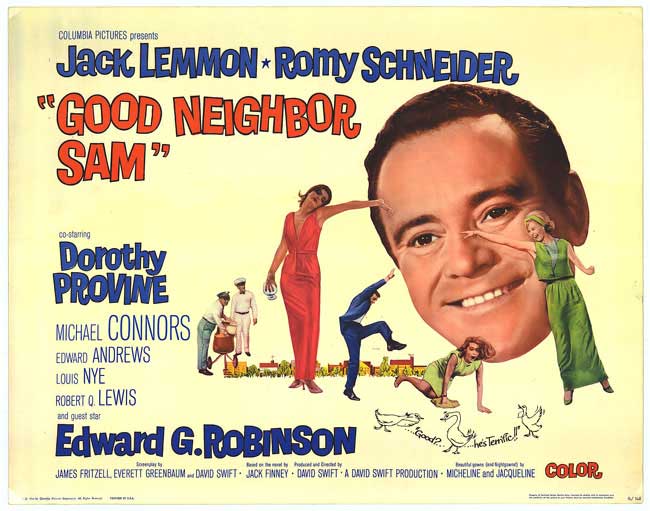
            Sam Bissell (Jack Lemmon) is an advertising executive working for a demanding client (Edward G. Robinson) who is very conservative and insists everyone around him have a clean-cut image and lifestyle. Sam’s wife Minerva (Dorothy Provine) brings home her college friend Janet (Romy Schneider) for a visit and she rents out the neighbor’s place while she is there.  Janet then finds out that she is going to be left a large inheritance, but the will stipulates that she must be married even though Janet is instead going through a divorce. For the sake of allowing her to collect the large fortune, which is 15 million dollars, Sam agrees, with the blessing of Minerva, to pretend to be Janet’s husband by staying at her place until the money is paid out.  A private detective (Louis Nye) is hired to keep a close eye on them and matters become even more complicated when Janet’s ex-husband Howard (Mike Connors) returns.

The concept is original and to my recollection has never been done before, or since, which is amazing when you think about the fact that just about everything else has. It does rely heavily on coincidence and too much of the first hour is spent setting up the plot with some extraneous scenes that could’ve and should’ve been cut. For such fluffy material, even entertaining fluff such as this, a 130 minute runtime is too long.  Three different writers were credited with doing the screenplay and the overall vision seems disjointed as at times it works as a satire, slapstick, and sex comedy, but never coming together completely as a whole. However, there is enough eventual pay off to still make it worth it.

This is one of Lemmon’s better comedy vehicles, if not his all-around best. Sometimes he comes off as too strait-laced and benign in these things, but here it works to the film’s advantage. His best part is when he dreams seeing himself getting out of bed and going over to the bedroom where Janet is and trying to seduce her. She screams so loudly that the entire town wakes up and comes over, which is funny and should have been played-out more.

Schneider though is the best thing about the movie. I loved her bright, beaming smile and effervescent personality. She sparkles in every scene and I was impressed that although she could be pleasant she could also easily get into a shouting match with Howard and the fact that she could switch emotional gears so easily and quickly proves that she had talent. Costume designer Jacqueline Moreau puts her into some snazzy outfits that look great on her including an all red jumpsuit, a strapless evening gown, and a two piece white pajama outfit with pink polka dots that was my favorite. It is a shame that due to her severe depression over the accidental death of her son as well as alcoholism and a three-pack-a-day smoking habit her career and life was cut short as she most assuredly still had a lot of outstanding parts and performances left to do.

Blonde Provine looks almost as good and equally delightful in her role where she tries holding it all together. Connors, best known for starring in the long-running TV-show ‘Mannix’, is surprisingly engaging as the ex. His arguments with Sam are fun and in order to keep the scheme going he pretends to be Sam and stays in the home with Minerva, which culminates with the film’s funniest moment, which is the early morning ‘kissing contest’ the two men have with each other’s wives.

Nye is also amusing as the detective and I got a kick out of his van that was supposedly disguised to be that of a cleaning service with a giant model of a vacuum on top of it that was used as a telescope.

The only one who gets wasted here is legendary actor Robinson who really doesn’t have anything funny to say, or do. However, his dinner party is still memorable simply because everyone gets served on all gold dinnerware, which includes the plates, cups, and utensils.

The music score is bouncy and the climatic sequence that features the main characters defacing area billboards is artsy and creative. On a lightweight, inoffensive level this satisfies and delivers a few laughs along the way.

My Rating: 7 out of 10

Released: July 22, 1964

Runtime: 2Hours 10Minutes

Rated NR (Not Rated)

Director: David Swift

Studio: Columbia Pictures

Available: VHS, DVD (The Jack Lemmon Collection)
The House That Cried Murder (1973)

By Richard Winters

My Rating: 5 out of 10

4-Word Review: The bride goes nutzo.

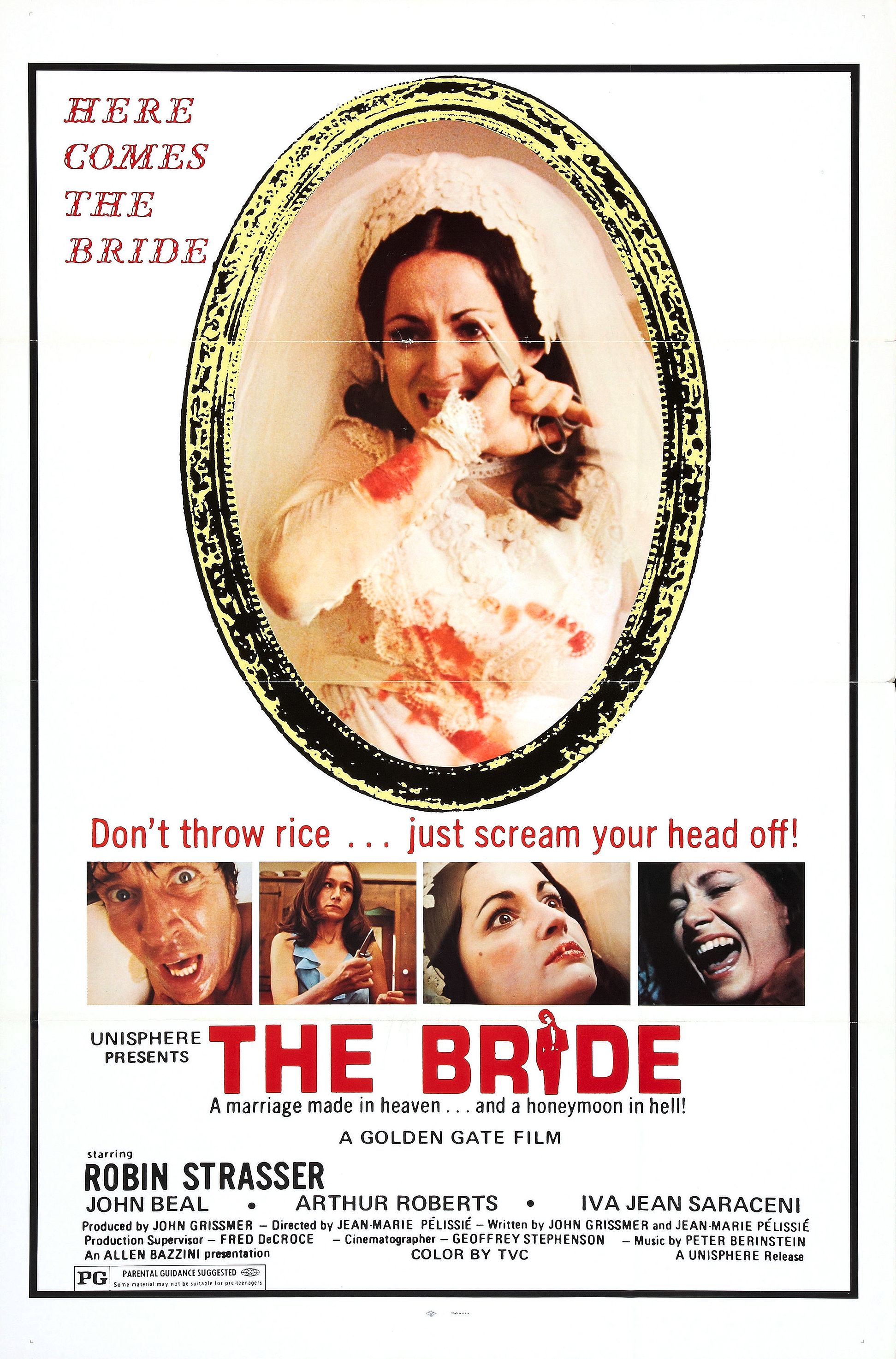
Despite a low budget this is an intriguing horror film with a unique vision. Barbara (Robin Strasser) is a young headstrong woman who designs an ominous looking, modernistic home, which she then has built. She plans on moving into it with her fiancé David (Arthur Roberts) who is caught fooling around on their wedding day, which sends Barbara into reclusion. Soon David begins experiencing strange occurrences, which leads him back to the house where an odd climatic sequence ensues.

This film stands out from the other low budget, cardboard horror movies of the 70’s simply because director Jean-Marie Pelissie shows a good understanding of the genre and how to effectively create eerie sequences. The house itself is an odd spectacle that looks like something designed by Frank Lloyd Wright while drunk. It’s erected in a large, empty field which gives it a very pronounced presence. The inside of the place was unfinished, and Pelisse uses the large windows of the home to casts unusual shadows along its white plastered walls and gives it a spooky look  as the camera goes spinning around it. Some of the imagery used during a nightmare sequence is equally creepy.

Strasser herself is quite frightening and flies into authentic looking rages easily. One good segment has her walking in front of all the wedding guests wearing a blood stained gown while behaving erratically. She then runs off with only hints that she may or may not be lurking in the shadows, which nicely taps into the fear of the unknown and mysterious.

The unfaithful groom is a good character with all the qualities that you love to hate. He is good looking, but amoral. He uses people while climbing the social ladder, but is quite dumb in the process. He tells his bride that he will be gone “for only a minute” and then has the audacity to go to an upstairs room of the house where they are having the wedding party and fools around with his former girlfriend, but doesn’t think to lock the bedroom door. When he gets his eventual comeuppance you have no problem seeing it.

As Strasser’s father John Beal is unimpressive. He is supposed to be a man of money and power, but instead comes off like a wimpy old man. Iva Jean Saraceni,,who portrays David’s old girlfriend Ellen, looks too much like Strasser, which doesn’t help.

Although this film has potential the low production values almost destroy it. The lighting is flat and certain segments are so dark you can barely see what is happening. Many scenes were filmed in small, cramped looking rooms with tacky props in the background. The music used during the scary scenes is good, but the soundtrack played over the rest of the film sounds like a bad rendition of Herb Alpert and the Tijuana Brass.

If you’re into cheap 70’s horror flicks then this is one you should check out. It definitely has some distinctive moments and is an interesting forerunner to A Nightmare on Elm Street since Barbara terrorizes David and his girlfriend through their dreams.

My Rating: 5 out of 10

Alternate Title: The Bride

Released: December 14, 1973

Runtime: 1Hour 25Minutes

Rated PG

Director: Jean-Marie Pelissie

Studio: Golden Gate Productions

Available: VHS, DVD

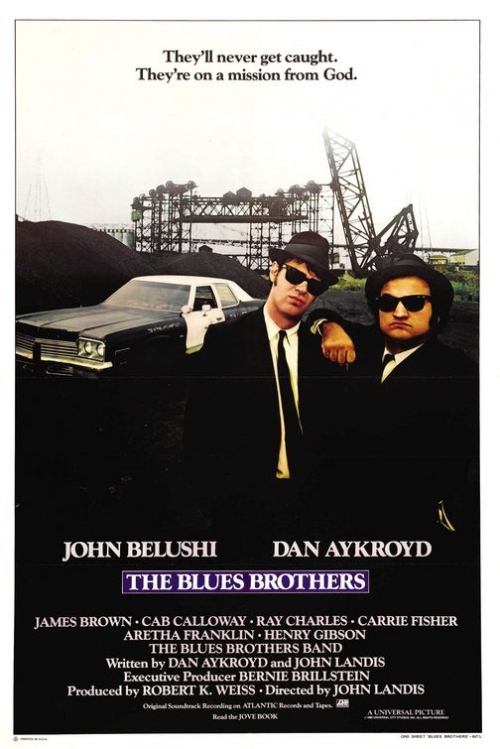
The Blues Brothers (1980)

By Richard Winters

My Rating: 7 out of 10

4-Word Review: A mission from God.

Jake (John Belushi) is released from jail and joins his brother Elwood (Dan Aykroyd) in starting up their old band so as to raise money for their old orphanage. Trying to get the members back proves harder than they thought, but because they are ‘on a mission from God’ nothing deters them including having every police agency in the state (and various other riff-raff) on their tail.

If you take away the songs and the extended car chases you have only 20 minutes of actual comedy and even then it is not real hilarious just amusing. Sometimes it gets downright silly like an old Disney movie with no edginess or satire. There isn’t even the expected crudeness or sophmorics and having this thing rated ‘R’ is ridiculous.

For such a simple comedy it is well staged almost like a grand scale spectacle. The stunts are spectacular and at certain times breathtaking. Director John Landis seems to have shut down the whole city of Chicago to do it and it definitely set a new standard for car chases.

Some of it makes you grab the edge of your seat especially when you see in fast motion, from their viewpoint, careening down the street as they dodge cars and pedestrians that seem to pop up at you. It also helps the validity to have them run into some road construction because in Chicago that’s pretty much all you see. I lived there for 18 years and the saying they have is that there are two seasons ‘winter and road construction’. Yet it would have been nice to see them wearing their seatbelts! Anyone else would have been killed or injured with any number of things they do and this thought takes away from some of the fun. It also would have helped the plausibility to have a couple of the bullets shot at them at least hit the car. There is a scene where over a hundred different policemen shoot at the car and not even one hits it!

The songs are great and it’s more of a musical anyways. There is a nice emphasis on the blues that bring out a distinct Chicago flavor. Cab Calloway is terrific doing his famous rendition of ‘Minnie the Moocher’ while the Blues Band plays along dressed like a 1920’s swing band. The numbers done by the Blues Brothers themselves is the most rousing as they guys can really sing! Their rendition of ‘Rawhide’ is hilarious.

Kathleen Freeman has probably the funniest part in a nifty send up of those Catholic school nuns that loved to use a ruler as a disciplinary tool. Carrie Fisher is engaging as a jilted bride out for revenge as she always did have a very ‘Don’t mess with me’ look in her eyes even when she was doing Star Wars. Henry Gibson shows his usual sinister style as the head of the local Nazi party and yet it is Aykroyd who is the real star as he is at his deadpan best throughout.

Look quickly for Paul “Pee Wee Herman” Ruebens as a French waiter. Also the DVD version has 18 minutes of extra footage.

My Rating: 7 out of 10

Released; June 20, 1980

Runtime: 2Hours 13Minutes

Rated R

Director: John Landis

Studio: Universal

Available: VHS, DVD, Blu-ray, Amazon Instant Video

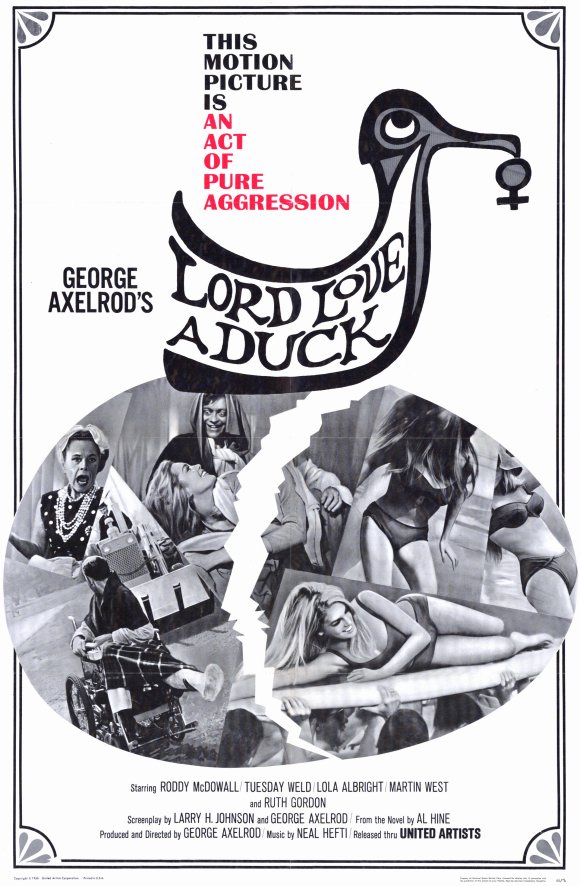
Lord Love a Duck (1966)

By Richard Winters

My Rating: 3 out of 10

4-Word Review: She wants it all.

If you ever wondered where political correctness got its start it was probably southern California in the mid 60’s. Here everything is neutralized and modified so as to ‘keep up with the times’. There’s even a drive-in church where the minister proudly exclaims that the Lord answers every prayer because “whatever happens is the answer”.

Tuesday Weld plays teenager Barbara Ann Greene who can’t be happy unless she has it all. She meets fellow high-schooler Allan Musgrave (Roddy McDowell) who because of his super intelligence is able to figure out ways for her to get what she wants. Yet the more she gets it the more unhappy she becomes.

It’s a satire on our consumer driven society, but it is too restrained and soft. A supposedly cutting edge film looking at our modernized world should have been filmed in color and not black and white. It also should have been faster paced with a heavier emphasis on the zany and outrageous. Instead we only get hints of this with a lot of slow segments and even some clumsy drama. The funny offbeat bits are spread out to thin and do not make up for the other parts that are boring and contrived.

There are some technical problems too including a lot of ‘outdoor’ shots that were really filmed indoors on a soundstage. They fortunately don’t do this anymore, but when they did it looked tacky. There is also a boom mike that is very obvious to see in several shots.

McDowell is not eccentric, nor unique enough for such an offbeat character. Although perpetually boyish looking he was way, way too old to be playing a high school student as he was 37 when this was filmed. Out of all the performers Harvey Korman comes off as the most amusing playing the overtly congenial school principal.

This film does feature an attractive cast. Of course Weld is always alluring, but she has competition from Jo Collins who was Playboy Playmate of 1965. There is also Lynn Carey daughter of the late actor MacDonald Carey from ‘Days of Our Lives’ fame. She is exceptionally good looking and watching here gyrate in a bikini to the latest dance craze is damn near pornographic. For her age Lola Albright, who plays Weld’s mother, is an absolute knockout and she can officially be crowned as a ‘milf’.

My Rating: 3 out of 10

Released: February 21, 1966

Runtime: 1Hour 45Minutes

Rated: NR (Not Rated)

Director: George Axelrod

Studio: United Artists

Available: VHS, DVD

Marathon Man (1976)

By Richard Winters

My Rating: 7 out of 10

4-Word Review: Dentist doesn’t use novocain.

            Thomas ‘Babe’ Levy (Dustin Hoffman) is a post graduate student at Columbia University and part-time marathon runner who spends a harrowing 48 hours being tortured and terrorized by a sadistic Nazi war criminal. It all starts when his brother Henry ‘Doc’ Levy (Roy Scheider) who works for a secret government organization known as ‘The Division’, secretly tracks Dr. Christian Szell (Laurence Olivier) a dentist at Auschwitz who has traveled to New York in order to collect a cache of diamonds. When Doc moves in too close Szell stabs him and despite being covered in blood Doc manages to make it all the way to Babe’s apartment before collapsing. Szell fears that Doc might have told Babe something before he died and has his men kidnap Babe where they then tie him to a chair in an abandoned warehouse and Szell tortures him by drilling into his teeth forcing Babe to use his running skills in an effort to escape.

This is an original thriller that stays intriguing and intense throughout. In the first thirty minutes alone the viewer is treated to some interesting and exciting scenarios including watching two elderly men drag racing with each other in their antique cars down a crowded neighborhood street. There is also an exploding baby carriage and an exciting fight sequence where Doc battles an attacker who tries to strangle him from behind with a metal wire. This scene is unique in that it cuts between seeing the action up close as well as viewing it from the point-of-view of an elderly man watching from across the street.

Director John Schlesinger shows visual flair with a variety of camera angles and settings. I particularly liked the part where Doc meets Szell at the red steps statue in the Arco Plaza. Having the climactic showdown between Babe and Szell take place in a pump room at the reservoir in Central Park gives the sequence added energy and distinction. I also enjoyed Babe’s cramped, drab, and cluttered apartment that had a very lived-in look and resembled exactly what a bachelor pad with someone on a low income would look like. The scene taking place at a country house is memorable simply for its extreme remoteness. I was disappointed though that although Schlesinger does a great job in setting up the atmosphere of the scene by doing a long shot looking out at the barren landscape the weather suddenly goes from cloudy to sunny in the minute it takes for the bad guy’s car to pull up the driveway. I realize certain scenes are sometimes shot over several days and this is not the first movie to have sudden weather changes during outdoor shots, but it is distracting nonetheless.

The infamous torture scene didn’t work for me. I appreciated the set-up especially the prolonged way that Szell plugs the drill into a wall outlet while talking to Babe in a calm tone. Constantly asking Babe the question ‘Is it safe?” has become a classic line and the fact that the dental torture gets extended when you think it is over is well done. Still, it didn’t seem violent enough and although pain is implied I didn’t think that the viewer really ‘feels’ it. I wanted more shots from Babe’s point of view especially as Szell sticks his metal instruments into Babe’s mouth. A close-up of Babe’s tooth and seeing the drill touch it would have helped as well. Also, Babe needs to scream in pain a lot more, he does it once briefly, but someone going through that would be doing it constantly.  Apparently the producer’s cut out portions of this scene when it upset the test audiences who saw it, but I would like that footage put back in as I feel it would make the movie stronger and give it an added kick that otherwise is missing.

Olivier is tremendous in the villainous role. His face exudes evil and this is one of his best later career roles. Scheider has his best role here and I found Marthe Keller impressive as Babe’s girlfriend. She wears an attractive hairstyle and I couldn’t get over how diametrically opposite she was compared to her character in Black Sunday that was done the very same year. She is definitely an under-rated actress that deserves more accolades as well as more parts in American productions. However, the way Babe pursues her for a date seemed to border on ‘creepy’  and overly aggressive and act as a turn-off to most women.

The film does seem derivative at certain points especially the way it portrays New York as an urban hellhole, which was quite common during the 70’s. The fact that Babe avoids confrontation and is picked on by a Hispanic gang that lives across the street seemed too reminiscent of Hoffman’s earlier film Straw Dogs. There are several flashback sequences showing Babe as a child that is done with faded color and no dialogue and look too similar to the childhood sequences done in Midnight Cowboy, which was an earlier Schlesinger/Hoffman project. Hoffman, for what it is worth, gives another one of his dedicated performances, but this film really does show in glaring detail how very puny he is and I really could have done without having to see his naked rear.

The electronic score is nice and the part where Szell gets recognized by an elderly concentration camp survivor on a busy city sidewalk and who then begins to chase after him is memorable. However, when it is all over I still felt it didn’t completely click. I’m not sure what it is. I know the ending was changed from the one in the book, but I liked this one better and felt Babe’s revenge on Szell was creative. Although controversial and edgy for its time, the torture scene seems too toned down for today’s standards. Either way, if you are looking for a competent and entertaining thriller this should fit the bill, but it is not a classic.

My Rating: 7 out of 10

Released: October 8, 1976

Runtime: 2Hours 5Minutes

Rated R: (Violence, Language, Adult Theme, Brief Nudity)

Director: John Schlesinger

Studio: Paramount

Available: VHS, DVD,  Blu-ray, Amazon Instant Video 

Maniac (1980)

By Richard Winters

My Rating: 5 out of 10

4-Word Review: He wants their hair.

A loner (Joe Spinell) terrorizes New York City by killing young women and scalping them. He then takes their hair, brings it home, and places it (actually he nails it) onto the heads of some mannequins that he has.

In a lot of ways this is the same old mechanical slasher flick as it has all the predictable characteristics of the others that dominated the early 80’s. The story is simple and strung along by long, drawn-out murder sequences. There is some suspense, but it is minimal since we know exactly what is going to happen. The victims are young, good looking women, who are clueless to the dangers that are lurking until it is too late. One segment in particular features a nurse getting off of work late at night, who mentions her fear of the killer and yet for some reason she still foolishly refuses a ride home from her friend and instead walks down a dark, lonely street and into, of course, eventual carnage.

There are also some rather glaring technical errors. One features a woman (the same one who refused a ride) running from the killer by going into an empty subway. Although isolation is the whole factor here there is one shot, taken from inside a departing subway car that clearly shows a whole bunch of people standing just across from her on the other side of the tracks. There is also a segment where Spinell takes his girlfriend to his mother’s grave. When the car pulls up to the cemetery it is a nice, bright afternoon, but when they reach the actual grave it has become pitch black with a strange unexplained fog that has rolled in. Lastly there is the ending. This is a man that has terrorized a whole city and yet only two policemen in an unmarked squad car come to his residence and when they do they don’t even bother to secure the site.

Despite the low-budget problems there are a few things that raise this slightly above the rest. One is the fact that it actually manages to get inside the killer’s head. You hear the inner conversations between his ‘good’ side and his ‘bad’ side. Of course this only touches the surface of a true schizoid personality, but it does offer a little more depth than most. It also helps create a good portrait of a tormented soul and you end up feeling more sadness than fear for the man. The film also consistently has a dark, grainy look, which helps accentuate the ugly theme. Having it take place in New York City gives it a little more distinction and atmosphere.

The special effects are good. The part where he blows a man’s head off, through a car windshield, looks very realistic and has become the film’s most famous scene. The surreal ending, where the mannequins all come to life and exact a sort of revenge, is also well-handled and imaginative. Makeup artist Tom Savini, who also appears as the character of ‘Disco Boy’, has had a lot of success, but the stuff here may be his best.

Director William Lustig shows some panache and Spinell, who also co-wrote the screenplay, gives a surprisingly strong performance, but their attempts at creating a better understanding of a crazed killer prove placid and simply done for shock value.

My Rating: 5 out of 10

Released: December 26, 1980

Runtime: 1Hour 27Minutes

Not Rated (Graphic Violence, Brief Nudity, Language, Adult Theme)

Director: William Lustig

Studio: Magnum Pictures

Available: DVD, Blu-ray (30th Anniversary Edition)

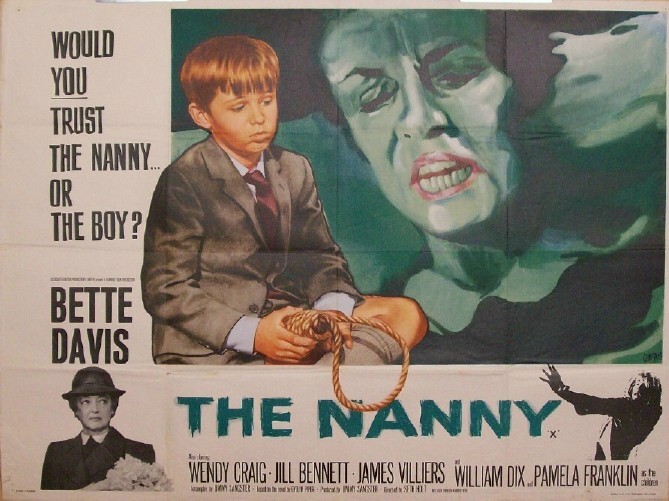
The Nanny (1965)

By Richard Winters

My Rating: 5 out of 10

4-Word Review: Kid doesn’t like nanny.

            Bette Davis plays a nanny to an upper-class British family whose oldest son Joey (William Dix) is accused of accidently killing his younger sister. Joey, who is only 10, is sent away to a home for disturbed children. When he returns he accuses the nanny as the one who did the killing and a psychological game of cat-and-mouse ensues.

Davis is sensational. She plays a type of character that she has never done before and the results are fascinating. She is much more subdued and evasive than usual and she falls into the role of the unassuming nanny in a seamless fashion. The different setting works well for her and I commend her tenacity for taking on a project that was not glamorous. She even puts on some thick eyebrows for her part and at times, especially at the beginning, she starts to resemble her most hated rival Joan Crawford.

Dix is amazingly good as the kid and it is a shame that he did only one other picture after this one. I liked the independent nature of the character and he plays off Davis quite well and showed no signs of being intimated by her. Making the adversaries have such extreme age difference and personalities gives the story an interesting edge that helps carry the picture.

The evocative black and white photography helps accentuate the dark-tone. The British setting along with the expected formalities of that culture, particularly that from the father character Bill (James Villers) give the film some distinction.

The first act though goes on way too long. We are given the general premise right up front and then have to spend the whole first hour going through the scenario that Joey doesn’t like his nanny and is suspicious of her again and again until it becomes derivative. When the second act does finally come about it seems too late. The revelation isn’t all that clever or creative and the climactic sequence desperately needed more action and punch. The final result is unsatisfying. The viewer is given an intriguing premise that it can’t sustain to the end ultimately making this a misfire despite the outstanding presence of Davis and some high production values.

There is also the issue of the three-year-old girl who is adorable and an absolute scene stealer and yet right up front you are made aware that she is killed, which makes the proceedings rather depressing. Having to then watch her actual death is disturbing and, for its time period, rather vivid and startling.

My Rating: 5 out of 10

Released: October 27, 1965

Runtime: 1Hour 31Minutes

Rated: NR (Not Rated)

Director: Seth Holt

Studio: Hammer Productions

Available: DVD

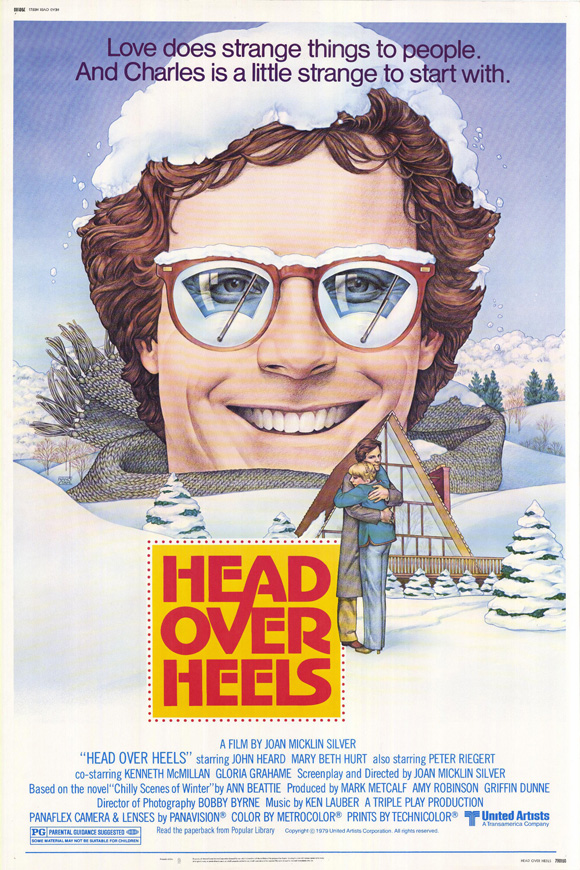
Chilly Scenes of Winter (1979)

By Richard Winters

My Rating: 8 out of 10

4-Word Review: Can’t get over her.

            Charles (John Heard) meets Laura (Mary Beth Hurt) at his job and immediately becomes smitten.  She is married and upfront about it, but since it is not going well she decides to go out with him. They soon move-in together, but it only lasts for a couple of months before Laura goes back to her husband. This is a crushing blow to Charles who obsesses about her constantly and tries any way he can to win her back.

This is in many ways a dated movie and normally I would consider that a detriment, but here I found it to be an asset. It is refreshing and fun to see a person drink a little on the job, or playfully touch a female co-worker as he walks past them and not have it become an immediate sexual harassment lawsuit. There is also the part where Laura invites Charles back to her home after only their first date, which could be considered reckless, but it’s nice to go back to an era that was more trusting and not everyone was labeled a potential psycho until proven otherwise.

There is of course the subject of stalking which is what Charles does, but here it is natural and actually kind of sweet. Some of it may be considered a little ‘creepy’, or even pathetic, but none of it is menacing, or done with criminal intent. To me this makes more sense and is more realistic to expect that when someone has strong feelings for someone else and spent special times with them that they would have trouble ‘moving-on’ when the other person breaks it off and their inability to do so shouldn’t necessarily make them ‘crazy’, or ‘maladjusted’ and this film very effectively shows that.

This is a terrific movie about relationships. The characters are real and relatable. The situations they go through are universal and the best thing is that it stays that way until the bitter end without pulling any punches. Anyone who has gone through difficult relationships will appreciate the honesty and it’s a real shame they don’t make movies like this anymore.

Heard is excellent and plays an extension of the same 60’s radical character begrudgingly moving into adult life that he did in Between the Lines, which was his first collaboration with writer-director Joan Micklin Silver. A young Peter Reigert is appealing as Charles’s roommate Sam. Kenneth McMillan, a looks- challenged character actor who usually plays slimy people, is surprisingly likable as Charles’s stepdad. Legendary screen actress Gloria Grahame, in one of her last roles, is highly amusing as Charles’s crazy mother. I was never quite sure what any of her scenes had to do with the main story, but her presence was fun anyways.

The film also contains some offbeat scenes and an original sense of humor. This includes the scene where Charles makes a miniaturized replica model of the home that Laura lives in and then uses dolls to play the parts of Laura and her husband and child. There is also the part where Charles meets Laura’s husband under the guise of being a home buyer and then stands up in front of him and states his undying love for his wife as well as a goofy conversation that he has with a wacky elderly lady roommate when he visits his mother in the hospital. The best though is the running conversation that Charles has each day with the blind cashier at a candy counter that gets better and better as the movie progresses.

The film nicely captures the wintry Utah landscape and although the original title for the film was Head over Heels this other title works much better and not only fits the season in which the story takes place, but also the ever difficult and complicated dating scene as well.

My Rating: 8 out of 10

Alternate Title: Head over Heels

Released: October 19, 1979

Runtime: 1Hour 32Minutes

Rated PG: (Brief Nudity, Adult Theme)

Director: Joan Micklen Silver

Studio: United Artists

Available: VHS, Netflix Streaming

The Gong Show Movie (1980)

By Richard Winters

My Rating: 5 out of 10

4-Word Review: Jaye P. Morgan topless.

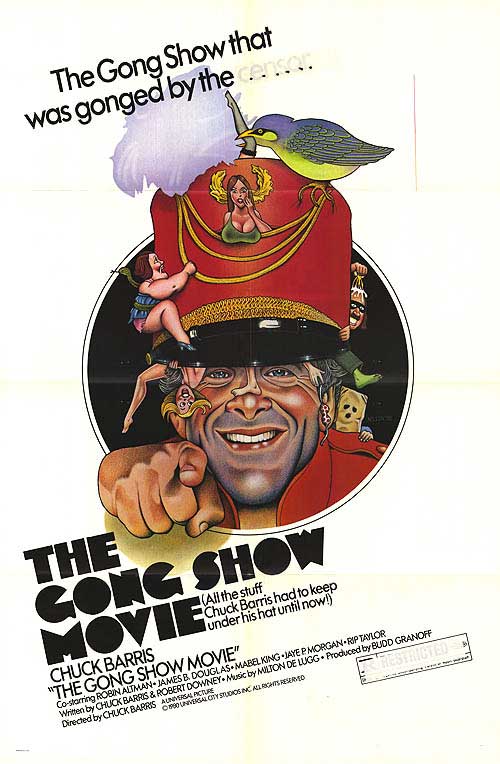
A very fractured, offbeat look at game show host Chuck Barris and his trials and tribulations as producer and host of the hit 70’s game show ‘The Gong Show’. In between there are some very short snippets of acts that never made it past the network censor. If you are unfamiliar with the show it featured three B-celebrities, usually Jamie Farr, Artie Johnson, and Jaye P. Morgan, who would watch talent acts performed by amateurs. The acts were usually done in the comic and absurd vein and could include anything from singing, dancing, or stand-up comedy. If they were really bad the celebrities would get out of their seats and bang a big gong that was behind them, which would have the performer thrown off. If the participant avoided being gonged they would then have the potential of winning a monetary prize at the end.

If you were not a fan of the show then you probably won’t be a fan of this movie either. If you were a fan you still might not like it because Barris acts consistently embarrassed by his creation and seems to want to disown it.

The film lacks cohesion. It mixes absurdity with surrealism and even trashy segments thrown in for good measure. The quirky bits are forced and the ‘hilarious’ dialogue is just plain stupid. There is also too many scenes involving a stuffy, uptight network boss who is so over- the-top clichéd that he becomes annoying.

Barris never seemed completely cut out for a game show host and even less as a leading man. He has no charisma and  spends the whole time moping around. He comes off as very burdened making you wonder if his stories about being a part-time CIA hit man were true. Either way he is not an engaging centerpiece for a movie. It would have been better had it broadened out and shown more of “The Gong Show” cast especially Jaye P. Morgan who is as raunchy as ever in the few scenes that she is in including her topless part!

The show always had a unique and perverse brilliance, which comes out every time it features one of the acts from the show making me feel that using this simply as a highlight reel of all of the best and most outrageous acts would have been a better idea. The ones that they show aren’t bad, but they are cut pretty short. A few of the ones that I liked featured two teenaged girls performing fellatio with their popsicles. Another one has three men standing at a urinal and making music with their zippers until one of their zippers gets caught! There is also two obese Siamese twins singing the Captain and Tennille hit ‘Love Will Keep Us Together’.

My Rating: 5 out of 10

Released: May 23, 1980

Runtime: 1Hour 29Minutes

Rated R (Language, Brief Nudity, Raunchy Humor)

Director: Chuck Barris

Studio: Universal

Available: None

The Glass Bottom Boat (1966)

By Richard Winters

My Rating: 7 out of 10

4-Word Review: Doris is a spy.

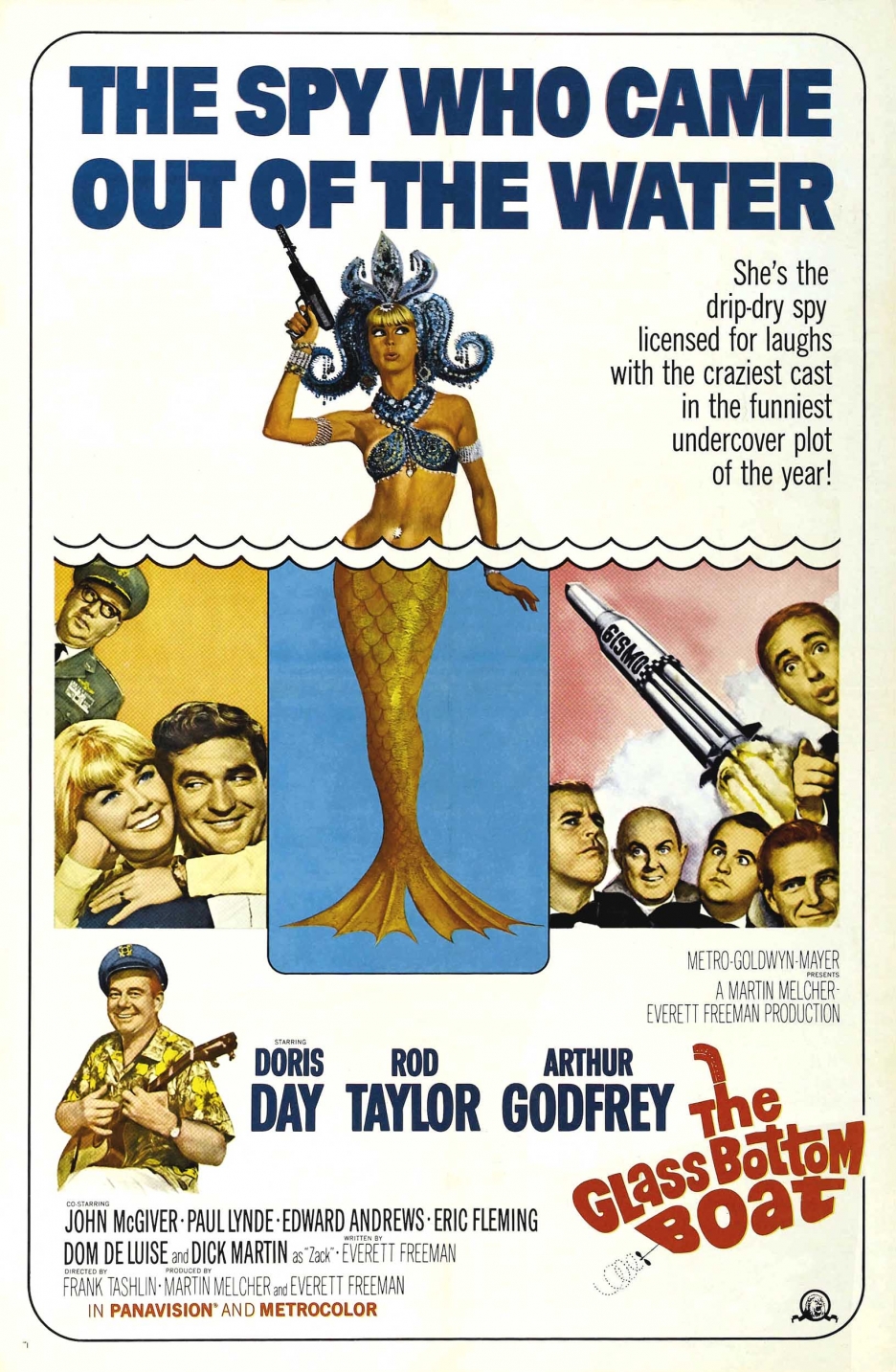
            This is an energetic and zany Doris Day vehicle featuring her as Jennifer Nelson a tour guide at the NASA Space Center. She meets Bruce Templeton (Rod Taylor) who at first she can’t stand, but when she finds out that he is one of the top scientists at the lab and makes a lot of money she immediately becomes infatuated. This certainly does nothing to help fight the gold-digger stigma that some women have, but it was made over forty years ago, so I guess it was more acceptable. Through quirky circumstances she comes under suspicion as being a Russian spy and spends the rest of the time trying to prove otherwise while continuing her romance with Bruce.

Day looks gorgeous and is hammy at just the right level without going overboard and becoming cartoonish. Her best segment is when Taylor imagines here as a Mata Hari spy complete with skimpy outfit, which she looks great in, as well as dreaming that she is blindfolded and speaking in a foreign accent while ready to be shot by a firing squad. She sings the film’s title tune, which is bouncy, and even does, later on, a goofy rendition of her signature song ‘Que Sera Sera’.

Taylor is perfect as the love interest and I think he is the best out of all of Day’s male co-stars. His funniest moment, although brief, is when Day crosses her eyes to be goofy and then keeps them that way, which makes him momentarily panic. I got a kick out of his model of the solar system that he had in his office that displayed the planets in a symbolic fashion after the Greek gods they were named after.

The supporting cast is full of familiar comic pros. Alice Pearce and George Tobias appear as Jennifer’s neighbors and a variation of the Kravitz couple that they played on the ‘Bewitched’ TV-series. Pearce is hilarious and it was a shame that she wasn’t in more scenes and died before the movie’s release. Dom Deluise is amusing as the actual spy, who goes undercover as an electrical repairman. Normally his goofy fat-guy persona becomes tiring, but here it worked especially during the climatic sequence. Paul Lynde, who was always hard to cast and in the process usually got meaningless parts, has one of his best roles as the lab’s security guard and even dresses up in drag at the end. Dick Martin, Edward Andrews, and John McGiver help round out the cast. Arthur Godfrey, as Jennifer’s father, is the only one who is boring, but his part was dull, so it might be hard to completely blame him.

Director Frank Tashlin creates sets with bright, vivid colors and each scene is a Technicolor dream. Being a former cartoonist he creates some nicely played-out comic scenarios including Bruce’s hands-free futuristic kitchen that has a little robot that comes out of the wall and cleans-up any messes that are left behind and ends up attacking Jennifer. The out-of-control boat ride is also amusing, but the best part is the wild, fast-paced ending when Jennifer decides to turn the tables on her accusers.

Sure it is silly, but you know that going in and on a non-think level it is perfect entertainment for all-ages.

My Rating: 7 out of 10

Released: June 9, 1966

Runtime: 1Hour 50Minutes

Rated G

Director: Frank Tashlin

Studio: MGM

Available: VHS, DVD, Amazon Instant Video