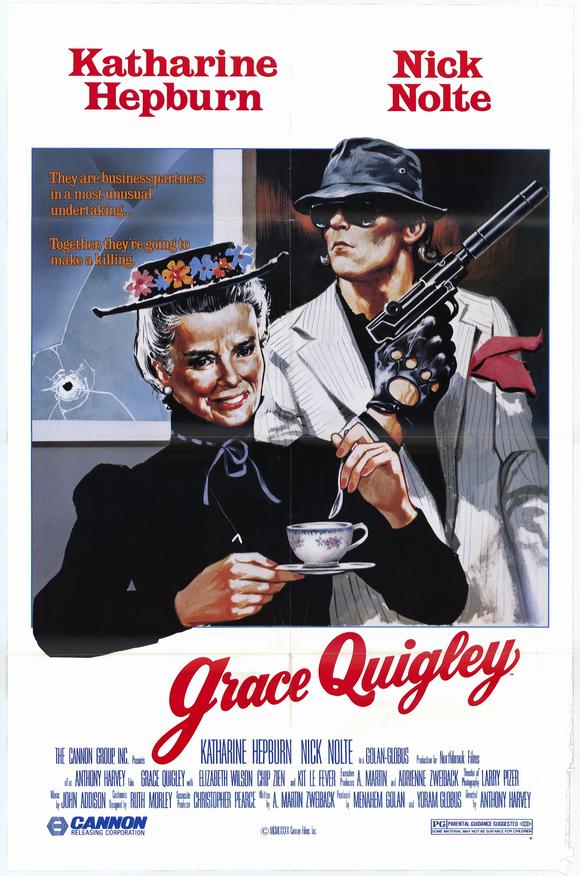
Grace Quigley (1984)

grace quigley1

By Richard Winters

My Rating: 4 out of 10

4-Word Review: Granny hires hit man.

Grace Quigley (Katharine Hepburn) is an elderly lady living alone on a limited budget who’s being forced out of her apartment due to having a pet bird, which her slumlord (Harris Laskawy) does not allow. She has nowhere to go and feels like ending her life, but has tried suicide before with unsuccessful results including swallowing a bottle of pills and having her stomach pumped, which she promised herself she would never go through again. Then she meets hired hit man Seymour Flint (Nick Nolte) and feels he’s the solution. He can not only bump her off, but her other elderly friends who no longer wish to go on as well. The problem is that Seymour doesn’t want to do it as he has grown attached to Grace and even starts calling her ‘mom’.

The first 60 minutes aren’t bad and even a bit humorous, but the final 30 brings in a weird story thread involving a cantankerous taxi driver (Christophe Murney) that seems thrown in simply to pad the running time. The ending, which was changed from the one in the original cut, is flat and helps to make this potentially tart black comedy a misfire.

Hepburn herself is awesome. She plays against type as she is usually a forceful and independent minded character, but here is much more vulnerable and sympathetic. Her shaking/wobbling head, which became an issue and even a distraction during her later years, is strangely not as apparent. Nolte is okay, but his character is wracked with psychosomatic quirks that are too silly and it would’ve been more fun had the character been played straight as a typically cold, soulless hit man who only softens after his friendship with Grace.

There are a few funny moments with my favorite being the striptease that Seymour’s hooker girlfriend (Kit Le Fever) does in front of Grace’s elderly and shocked friends. The running gag of people getting bloody noses every time they feel guilty does not work and the bloody nose that Hepburn’s character gets almost looks like a giant bug coming out of her nostril. The climatic chase involving five hearses careening down the city’s streets is forced although the slow motion shot of one of them driving into the New York harbor merits a few points.

The idea that people would want to die simply because they are old just doesn’t ring true especially since these folks still had their health and friends (at least with each) and were not bound to a wheelchair. There are many seniors who enjoy their golden years and still excited about life and yet the film doesn’t balance itself by portraying any of those. The attempt at showing the more serious side of aging by having Grace take Seymour on a tour of a rest home exposes little and ultimately helps makes the film’s potential social statement weak and simplistic.

My Rating: 4 out of 10

Alternate Title: The Ultimate Solution of Grace Quigley

Released: October 2, 1984

Runtime: 1Hour 28Minutes (VHS Version)

Rated PG

Director: Anthony Harvey

Studio: Cannon Film Distributors

Available: VHS

St. Elmo’s Fire (1985)

st elmos fire

By Richard Winters

My Rating: 3 out of 10

4-Word Review: Introducing the brat pack.

Seven friends from college start out on the rocky road of adulthood while learning to hold down full-time jobs and having long term relationships. Kirby (Emilio Estevez) is obsessed with an older woman (Andie MacDowell) who doesn’t reciprocate his same interest. Alec (Judd Nelson) wants to get married to Leslie (Ally Sheedy) despite the fact that he has already cheated on her with several other women. Wendy (Mare Winningham) is secretly in love with Billy (Rob Lowe) who is married to someone else and Kevin (Andrew McCarthy) has a secret crush on Leslie while Jules (Demi Moore) still seems to be in perpetual party mode.

I would’ve liked some explanation as to why there was a nude fat guy walking around in the opening scene at the hospital, but otherwise I felt the beginning was okay. The dialogue has a believable conversational quality and friends sticking together lends out a nice vibe although the scene where Alec dunks Billy’s head into a toilet after he loses his job would’ve ended that friendship for me quite quickly. The setting was supposed to be Georgetown University, but ended up being shot at the University of Maryland instead. I liked the tree lined streets and snazzy apartment neighborhoods, but was surprised how kids just out of college could afford such ritzy places.

The main fallback is the male characters that even for guys seem too full of extreme contradictions. Alec expects loyalty from his girlfriend Leslie even though he’s fooled around on her, but because somehow they were ‘meaningless’ to him then they should be overlooked. Billy is already married and has a kid, but shows no ability or interest in holding down a job and expects his wife to still ‘believe in him’ even though he hits on every woman in sight. Kevin expresses major cynicism towards marriage and relationships and then suddenly expounds on his ‘love’ for Leslie when he is alone with her like he is speaking straight out of a Harlequin romance novel.

The worst though is Kirby who shows definite signs of being a creepy stalker/psycho by chasing after a woman that clearly isn’t that in to him. He sniffs her pillows when alone in her apartment and disrupts one of her parties by barging into it dripping wet with rain and angered that he wasn’t invited. Then when she doesn’t show up to one of his parties he becomes enraged and travels all the way up to her remote mountaintop ski lodge and pounds on her door like he is ready to beat her senseless. What’s even more ridiculous is that she finds his behavior to be ‘flattering’ instead of scary making me wonder if she’s crazier than he is.

The women fare better. Winningham is a great nerdette and Sheedy allows for some genuine sympathy. I even liked Moore who does a fun caricature of an 80’s party girl and her scene inside a homeless shelter was interesting, but having her flip-out so severely and quickly after losing her job was, like with everything else, overdone.

The film’s musical score is the best thing while the drama is over-the-top and impossible to take seriously.

My Rating: 3 out of 10

Released: June 28, 1985

Runtime: 1Hour 50Minutes

Rated R

Director: Joel Schumacher

Studio: Columbia Pictures

Available: VHS, DVD, Blu-ray, Amazon Instant Video, YouTube

The Ragman’s Daughter (1972)

the ragmans daughter

By Richard Winters

My Rating: 5 out of 10

4-Word Review: Reminiscing about old times.

Tony, who is a middle-aged man (Patrick O’Connell) working a boring job at a cheese factory and stuck in an equally dull marriage with two kids, reminisces about his younger years when he met a beautiful woman named Doris (Victoria Tennant) and they committed petty thievery while also riding around on his motorbike. The film then intercuts between scenes of him when he’s younger, which is played by Simon Rouse in his film debut, and his life now where he struggles to make ends meet.

This film marks the directorial debut of Harold Becker as well as the acting debut of the lovely Tennant. It also marked the last of the British ‘kitchen-sink’ dramas that focused on the hardships and struggles of the working class. The story is a strange mix of gritty reality and romantic fantasy that has a few good moments, but as a whole doesn’t really work and if there is one thing that holds it all together its Kenny Clayton’s soothing and distinctive melodic score.

Part of the problem is that not enough happens. Tony is able to break into shops with too much ease and the way he is able to crack open a safe in less than a minute would make even a professional safe cracker jealous. Their robberies needed to have a little more tension or comedy to help keep it interesting instead of sliding into a pace that meanders so leisurely that it eventually becomes boring.

Tennant’s character is another issue. She is incredibly gorgeous and looks ripe for a magazine cover as a fashion model, which made me wonder why she would so quickly fall head-over-heels for Tony who has no money or job and is average looking at best. To some degree I could understand her need to break free from her oppressive and strict parents, but a beautiful woman like that would have many other potential suitors in her life and not simply dependent on Tony as being her only outlet.

Spoiler Alert!

The final twenty-minutes improves as Tony ends up getting caught and going to jail, which helps add some genuine drama. However, when he finally gets out he learns that Doris died tragically in a motorbike accident, which seemed unnecessarily severe. A much better ending would’ve had them reuniting for just one day and although now married to other people still managing to share some sort of special bond.

End of Spoiler Alert!

The film, which had a very limited release, has some potential, but suffers from a visual approach that at times looks too much like a shampoo commercial and a premise that doesn’t have enough action elements to keep it compelling.

My Rating: 5 out of 10

Released: November 11, 1972

Runtime: 1Hour 34Minutes

Not Rated

Director: Harold Becker

Studio: 20th Century Fox

Available: DVD (Through Netflix)

Tag: The Assassination Game (1982)

tag 1

By Richard Winters

My Rating: 6 out of 10

4-Word Review: Playing with dart guns.

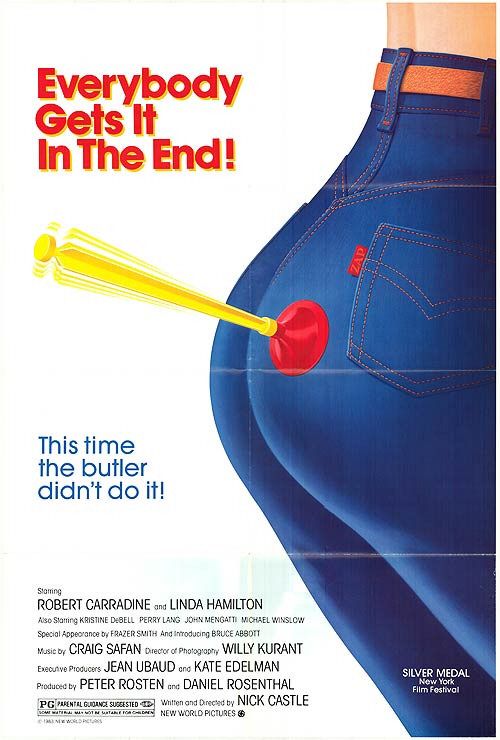
A new fad has caught on at a nondescript college campus where students play an assassination game by killing off other students with dart guns. The one who assassinates the most while still surviving wins. Alex (Robert Carradine) who writes for the school newspaper decides to do an expose on the game in an attempt to better get to know its star player Susan (Linda Hamilton). Unfortunately for them the game’s 5-time champion Gersch (Bruce Abbott) has gone over to the dark side and now using real bullets in his gun. As the game whittles down to just Susan and Gersch the tension mounts for her to catch on to his murderous plans before it is too late.

For a low budget film with only the most modest of settings this thing isn’t too bad. The dialogue is snappy and the story proceeds at a good pace. The opening credits, which is a parody of the ones done on James Bond films is cute and it’s great to see Linda in her official film debut playing the same type of strong-willed female that brought to greater prominence in The Terminator franchise. Carradine is good too as her awkward suitor and the fact that this film plays against sexual stereotypes by having the male in more of a passive role is refreshing.

The film’s playful parody and the way the players take this silly game so very seriously is funny and having the second half shift to more of the conventional ‘psycho-on-the-loose’ plot made it less original and more formulaic. I understood why Gersch kills the first player using a real bullet, but was confused why he would keep on killing them and not go back to just using darts. He could’ve still retained his champion title and passed off the first killing as being possibly just an accident, but by continuing to kill people and harboring their corpses in the closet of his room was clearly going to lead to an eventual long jail sentence that even the craziest of persons could see coming. It also might have been more interesting had the identity of who was using real bullets was kept a mystery until the end.

Even with these drawbacks I still found myself entertained and the film has strong cult potential for fans of low budget 80’s flicks. It’s also interesting to note that Hamilton and Abbott, who first met while filming this, later ended up getting married and having one child.

My Rating: 6 out of 10

Released: April 20, 1982

Runtime: 1Hour 30Minutes

Rated PG

Director: Nick Castle

Studio: New World Pictures

Available: VHS

The Killing of Sister George (1968)

killing of sister george

By Richard Winters

My Rating: 6 out of 10

4-Word Review: TV character gets axed.

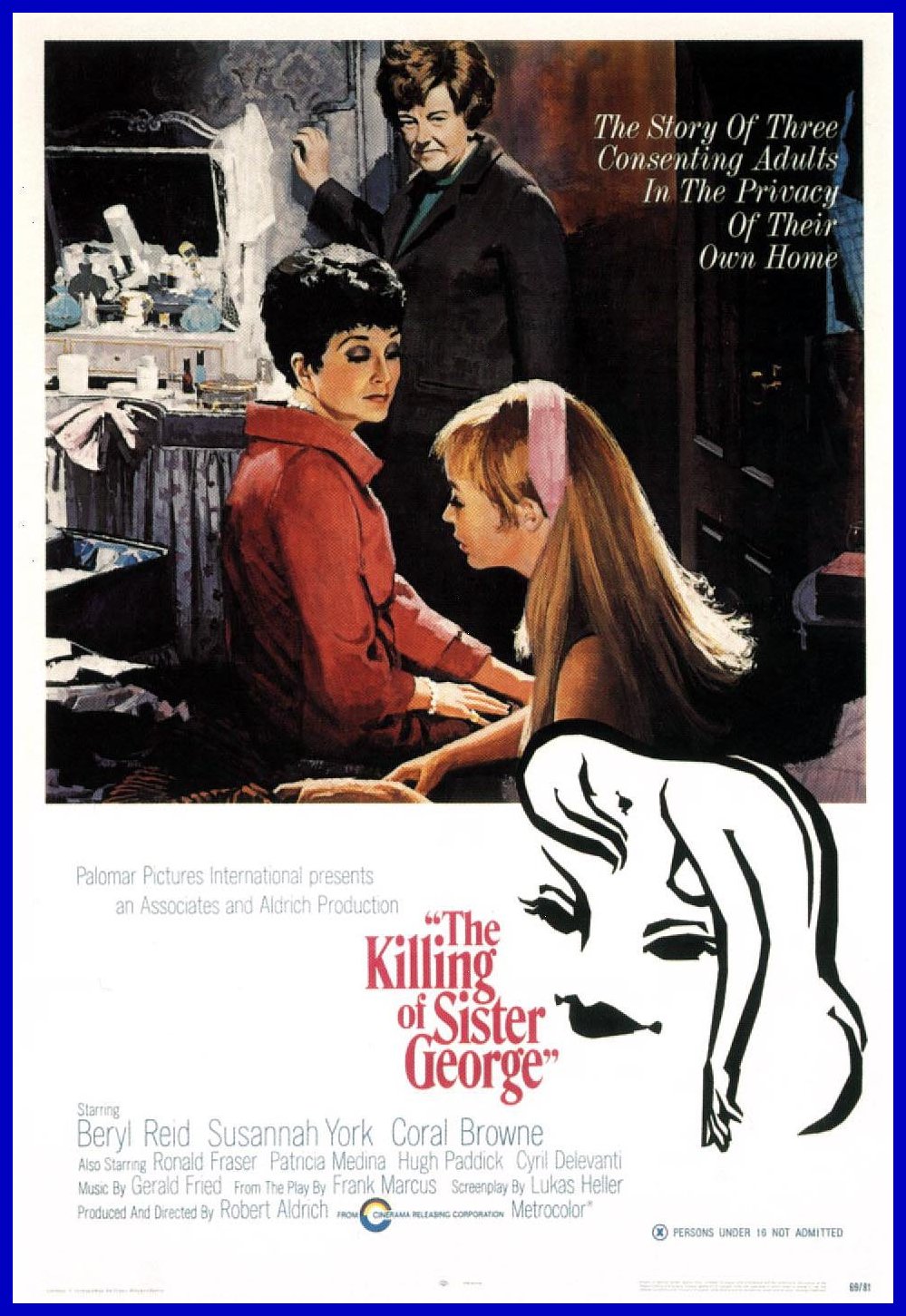
June Buckridge (Beryl Reid) is an aging actress playing the character of Sister George a scooter riding nun in a long running British TV soap opera. Her character no longer has the popularity that it once had and the producers have decided to kill her off by having her die in an ugly road crash with a truck. June is upset with this news as at her age parts are hard to come by and she takes her frustrations out on Childie (Susannah York) her much younger live-in lesbian lover, but she may lose her as well as one of the show’s producers Mercy (Coral Browne) has inklings to lure Childie away from June so she can have her all to herself.

After the immense box office success of The Dirty Dozen writer/director Robert Aldrich was given free rein to start up his own production company and he choose this as his first project. In many ways it is quite similar to his earlier and more well-known film What Ever Happened to Baby Jane?, but with sexual undertones. The film is based on the Frank Marcus play of the same name that ran for 205 performances and was nominated for the 1967 Tony Award. For its time this was considered quite controversial and groundbreaking especially the final scene that features a highly explicit sex scene between two women. It also is the first film to have a character utter the word ‘bullshit’ and one of the first to say the word ‘fuck’. Although the word itself gets drowned out by a car horn you can still clearly tell by reading Reid’s lips what she is saying.

The three female leads and their snarky exchanges with each other are the film’s chief asset especially Reid who recreates the same character that she played in the stage version that netted her a Tony. Her emotional, angry outbursts are entertaining and the scene where she forces Childie to eat and swallow the butt of her cigarette as ‘punishment’ is still quite edgy. Browne is equally good specifically during her provocative love scene with York, which was made all the more daring since she was 30 years older than York at the time.

The film’s overall staginess is a drawback. Many scenes are too talky and should’ve been trimmed while York and Reid’s Laurel and Hardy routine could’ve been cut out completely. Flashbacks showing how they first met would’ve helped and there needed to be an explanation to the weird child-like manner of York’s character, which quite possibly was based on an age-old gay stereotype. I also didn’t like the foreboding quality of the music that gets played just before Browne and York have their lesbian love scene, which seemed to suggest that something ‘creepy’ and ‘unnatural’ was about to take place and convinced me that despite the daring and ahead-of-its-time nature of the subject that the filmmakers themselves still had some very dated ideas about gays much like the majority of people from that era.

My Rating: 6 out of 10

Released: December 12, 1968

Runtime: 2Hours 18Minutes

Rated X (Reissued as R)

Director: Robert Aldrich

Studio: Cinerama Releasing Corporation

Available: DVD

The Big Chill (1983)

big chill

By Richard Winters

My Rating: 6 out of 10

4-Word Review: Friends from college reunite.

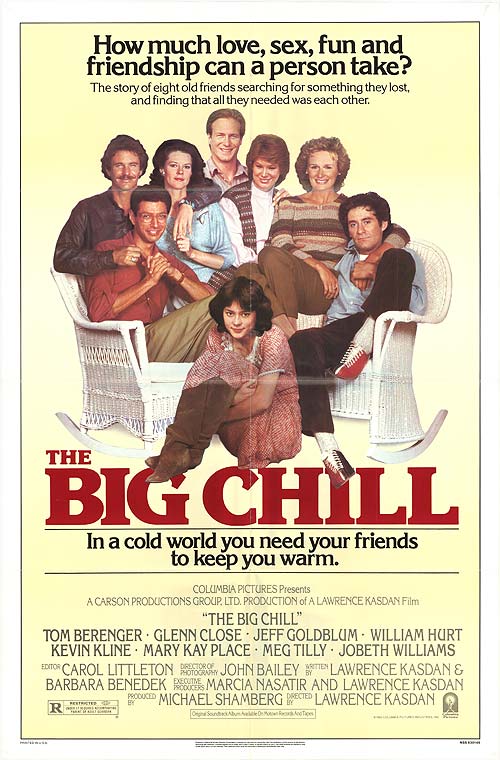
When one of their friends from their college days commits suicide the other seven get together for his funeral. Alex was living the unconventional, hippie lifestyle and with his much younger girlfriend Chloe (Meg Tilly) still connected to the ideals of his college days while his other friends had ‘sold out’ and taken on the more materialistic values of the ‘80’s. Alex’s death then represents the ultimate demise of their carefree, idealistic ‘60’s existence and how much they have changed since then, which they now must all learn to come to terms with.

This film has been closely compared with Return of the Secaucus Seven, which was reviewed last week. According to writer/director Lawrence Kasdan he never saw that film or even heard of it when he did this one. I actually preferred this over the John Sayles movie. For one thing it made a little more sense. Having old friends reunite for a funeral seemed more realistic than having them come together each year like in that one as most people once they enter into adult life have a tendency to move on making new relationships and not always have time for their old ones. There’s also no magical ‘cosmic bond’ holding this group together either. Many of them have evolved more than some of the others including William Hurt’s character who is still a recreational drug user while Kevin Kline’s has taken on more of the responsible adult role and this contrast comes to an interesting head at one point.

Tilly’s performance as a young flower child personified is great because it forces the others to see how they once were, but now can no longer relate to. Don Galloway plays the older husband of Karen (JoBeth Williams) while representing the ‘50’s generation and their contempt for the counter-culture. He has an interesting scene in which he expounds on what he feels was Alex’s ‘lack of focus and responsibility’ that clearly gets on the nerves of the others and I had wished the character had remained for the duration as it his presence was brimming for a great ultimate confrontation.

The entire thing was filmed on-location in Beaufort, South Carolina apparently because of Kasdan’s love for the film The Great Santini, which had also been done there. The deep south certainly seems like an odd setting as it doesn’t reflect the ‘60’s values or lifestyle at all, but it’s scenic nonetheless especially the scene where Hurt and Kline go jogging down a deserted main street of town that has an almost surreal quality.

Scenes where shot with Kevin Costner playing Alex, but then cut, which was a mistake as the character starts to attain too much of a mythical and elusive quality and seeing some moments with him even in flashback would’ve helped create an image of an actual person for the viewer. Some of the more existential conversations that the characters having during their group discussions are superb and right on-target and help to demystify the ‘60’s experience and those that lived it, which I found refreshing since other media forums for nostalgic reasons seemed to want to perpetuate it instead. In some ways it’s a shame that the characters and story has to be so closely tied to the Baby Boom generation as it stigmatizes it as a period piece when by-and-large the experiences they have going from the college stage to the adult one are quite universal.

My Rating: 6 out of 10

Released: September 30, 1983

Runtime: 1Hour 45Minutes

Rated R

Director: Lawrence Kasdan

Studio: Columbia Pictures

Available: VHS, DVD, Blu-ray, Amazon Instant Video

The Driver’s Seat (1974)

drivers seat 1

By Richard Winters

My Rating: 3 out of 10

4-Word Review: Crazy lady goes traveling.

Lise (Elizabeth Taylor) is a middle-aged woman with seemingly no past who travels to Rome looking for someone to kill her. Her erratic behavior and weird motivations confuse those that she comes into contact with. She then meets Bill (Ian Bannen) a man who’s more interested in her sexually than anything else and he follows her around in a veiled attempt to get ‘lucky’ despite her repeated rebuffs.

The film is basically a mess that goes nowhere. It was based on a novel by Muriel Spark, who had written some acclaimed stuff in her day including ‘The Prime of Miss Jean Brodie’, so I can only imagine that the book made more sense and only bits and pieces of it were taken to create this screenplay. In either case it was a highly strange career move for Miss Taylor who made a lot of weird movie choices in the 70’s, which helped to destroy her once megastar status and tainted her other stellar work.

Her performance by itself isn’t too bad and it’s the one thing that helps keep things watchable. The way that she can go from being passive and helpless to snippy and bitchy within seconds is kind of fun and on a purely camp level even enjoyable. The whole thing seems almost like an extension of the character that she played in Who’s Afraid of Virginia Woolf? , which became her signature role during her later years.

Bannen lends good support as his leering Cheshire cat grin is a perfect counterpart to Taylor’s crazed glare and he effectively equals her nuttiness. I also loved his so-called macrobiotic diet in which he must attain one orgasm a day for it to work and if he misses one then he must make up for it by having two the next day, which ultimately gives him ‘indigestion’. Mona Washbourne a character actress noted for playing delightfully daffy old ladies is also on hand as one of the people Taylor befriends and their encounter inside the stall of a public bathroom is a gem.

Director Giuseppe Patroni Griffi manages to infuse some interesting visuals, which along with its fragmented narrative helps keep things cheaply alluring, but it eventually plays itself out and by the end becomes quite tiring and tedious. The biggest issue is that there never is any explanation for who this woman is or why she’s doing this, which makes the whole thing quite empty and pointless.

My Rating: 3 out of 10

Released: May 20, 1974

Runtime: 1Hour 42Minutes

Rated R

Director: Giuseppe Patroni Griffi

Studio: AVCO Embassy Pictures

Available: DVD-R, Amazon Instant Video

Paternity (1981)

paternity

By Richard Winters

My Rating: 1 out of 10

4-Word Review: Bachelor wants a son.

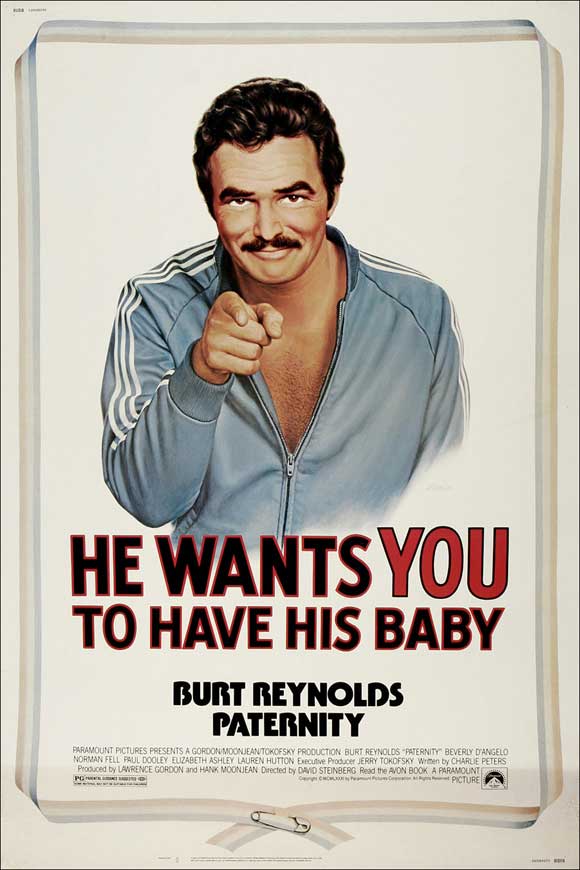
Despite managing Madison Square Garden, having lots of money and good looks Buddy Evans (Burt Reynolds) is still single at 44. He is happy with his bachelorhood, but still longs for a having a son. He comes up with the idea of paying a woman to have his child while treating it solely as a business proposition without any romance or relationship attached to it, after interviewing several ‘candidates’ he finally settles on Maggie (Beverly D’Angelo) a waitress who can use the money to further her education. Things are expectedly awkward at first, but as the process continues Maggie finds herself falling in love with him and trying to turn it into a relationship despite his reluctance.

Reynolds is a dynamic star with an engaging onscreen presence particularly in comedies, but his appearance here hurts the picture more than it helps it. For one thing it doesn’t make sense why this great looking guy with tons of cash can’t find a woman. And just why is he so reluctant to get into a committed relationship? What about this character’s background makes him the way he is? It never gets explained, but would’ve helped give the film more depth had it been. A better concept would’ve been portraying the character as being a rich guy who is also short, fat, bald and lacking in the romantic graces, but woman still tolerate because of his money, which would’ve ultimately made this more realistic, edgier and funnier.

I really liked D’Angelo and considered this her best performance, but having her fall in love with the guy and turning this into just another formulaic, sterile romantic comedy was a ridiculous stupid idea and makes it almost excruciating to watch. The guy spends the whole time acting like he owns her by telling her what to eat and do while being outrageously ambivalent to her feelings or needs. Any woman that would fall in love with a guy that her treats that way should see a psychiatrist and get some self-respect.

Comedian David Steinberg makes his directorial debut here and I liked the way he begins the film by having pictures of baby’s faces lining the screen during the credits all to the sound of them cooing and crying. He also pays loving tribute to his adopted city of New York by having some fabulous shots of the skyline and some scenic moments in Central Park that accentuate the fall foliage. In fact it is for these two reasons only that I generously give this thing a measly 1-point.

My Rating: 1 out of 10

Released: October 2, 1981

Runtime: 1Hour 34Minutes

Rated PG

Director: David Steinberg

Studio: Paramount

Available: VHS

Return of the Secaucus Seven (1980)

return of the secaucus 7

By Richard Winters

My Rating: 3 out of 10

4-Word Review: They like to talk.

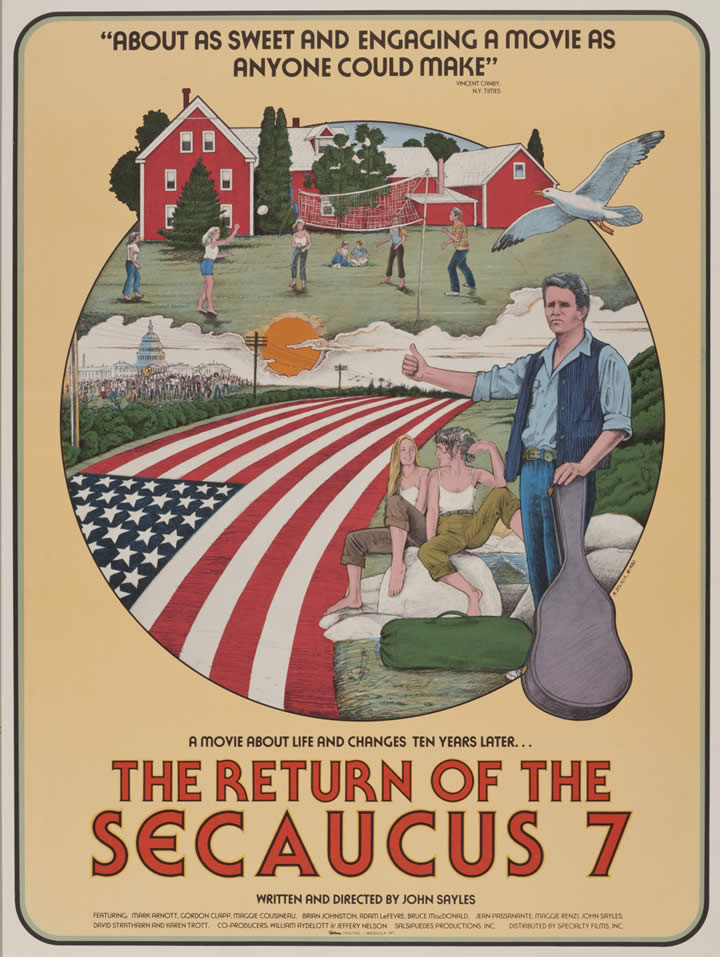
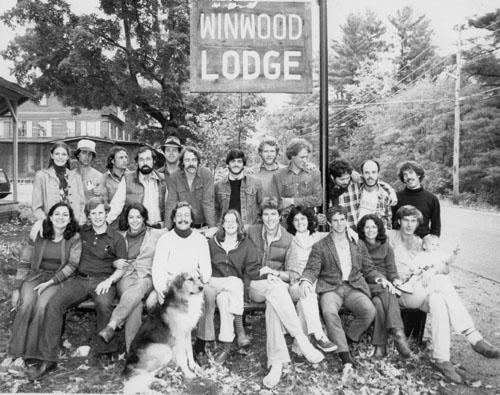
Seven people who were friends during college reunite ten years after having been arrested while on their way to a demonstration of the Vietnam War. Mike and Katie (Bruce MacDonald, Maggie Renzi) are the hosts and live together while also both being school teachers. J.T. (Adam LeFevre) is a struggling musician looking to finally take a stab at the big time by moving to L.A. Irene (Jean Passanante) is a speech writer for a conservative politician who brings along her new boyfriend Chip (Gordon Clapp) while Maura (Karen Trott) has just broken up with her boyfriend Jeff (Mark Arnott) and starts a fling with J.T. only to have Jeff reappear and wanting to start the old relationship back up.

This film is noted as being the forerunner of the independent film movement. It was made on a budget of less than $60,000, but first time director John Sayles manages to camouflage it well. The variety of shots and camera angles never allow you to realize that the whole thing was done in one location, a ski lodge that he managed to rent out for the summer at a low rate. The dialogue has a great conversational quality and the characters are nicely textured and multi-dimensional making it seem like the camera is capturing an actual reunion. The acting, which was mainly done by performers who had never appeared in a film before is equally good with my favorite being Sayles himself who appears as the character Howie who has one really good scene where he warns his friend Mike to think ‘long and hard’ about getting married while his wife stands behind him looking none too happy hearing him say it.

The biggest problem is that not enough happens. There’s a lot of talking, but story wise it is almost plotless. The few action segments deals with the men playing a rough game of basketball and also a trip to a river bed where they go skinny dipping to the background music of yodeling, but these scenes tend to meander while adding little to the character development.

It’s nice seeing a movie that attacks gender stereotypes by having the woman being the one to change a flat tire as well as having all the nudity shown being that of the men and not the ladies. There are also a few touching moments where Irene is willing to give J.T. a significant amount of money to help him in his struggling career without expecting any payment back, but in the end it all goes nowhere. The characters are just too genteel, which fails to create any type of interesting drama. I was more intrigued with exploring what these people were like in college and how they had changed after entering the adult world, but the film barely touches on that, which to me made it boring and empty.

return of the secaucus 7 2

My Rating: 3 out of 10

Released: April 11, 1980

Runtime: 1Hour 43Minutes

Rated R

Director: John Sayles

Studio: Salsipuedes Productions

Available: VHS, DVD, Hulu

A Jolly Bad Fellow (1964)

jolly bad fellow 2

By Richard Winters

My Rating: 5 out of 10

4-Word Review: He poisons his enemies.

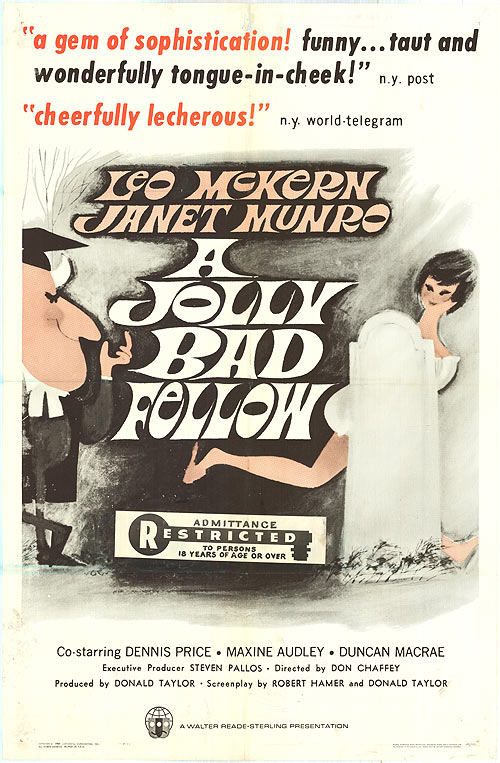
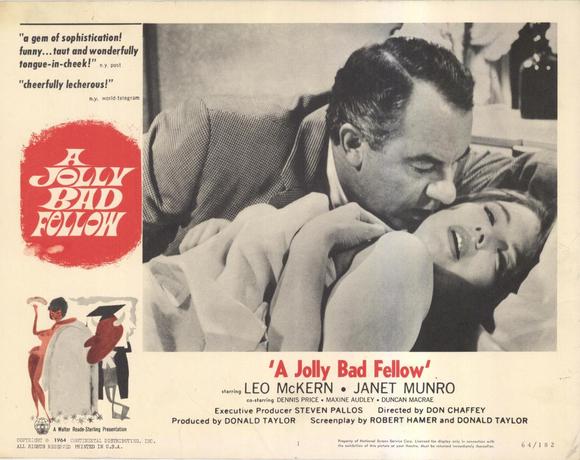
Professor Kerris Bowles-Ottery (Leo McKern) is a college professor working in the university’s science lab where he conducts experiments on mice. One day he accidently comes upon a poison that kills the mice, but only after sending them into a brief euphoric state, which he then decides to use on his enemies. Only a little bit of it is needed to work, so he is able to use all sorts of methods to get them to ingest it including putting it into their drinks, as well as the cigarettes they smoke, and even dabbing a bit of it on a tip of a pencil, which one of the character’s routinely likes to lick before he begins writing with it. Things go quite smoothly until his wife Clarinda (Maxine Audley) leaves him, which upsets him enough that he become careless and eventually culminates with ironic results.

The film’s chief asset is McKern’s presence whose acerbic delivery and facial expressions perfectly captures a stuffy, pompous curmudgeon in highly humorous fashion. He nails every scene that he is in, but his best moment comes at the very end when he hops into his car and begins driving at high speeds throughout the English countryside while giving off a loud, long maniacal laugh.

The plot is thick with satire, but doesn’t go far enough with it. Just when it seems to be catching its stride it bogs down with an affair that McKern has with a much young woman (Janet Munro) that didn’t make a lot of sense. I could see why he’d be into her, but no so much why she would have the hots for him although the fact that he does seem to truly love his wife even when he fools around on her and becomes upset when she decides to leave him was excellent irony.

The funniest element is when he poisons his enemies and rivals many of whom are as pompous and stuck-up as he is. Watching these refined, stuffy people suddenly act silly and child-like is quite amusing, but again the film stops short of packing the punch as these scenes should’ve been more extended, which is the one thing that makes this potentially hilarious film not half as funny as it could’ve been.

jolly bad fellow 1

My Rating: 5 out of 10

Alternate Title: They All Died Laughing

Released: March 15, 1964

Runtime: 1Hour 34Minutes

Not Rated

Director: Don Chaffey

Studio: British Lion Film Corporation

Available: DVD