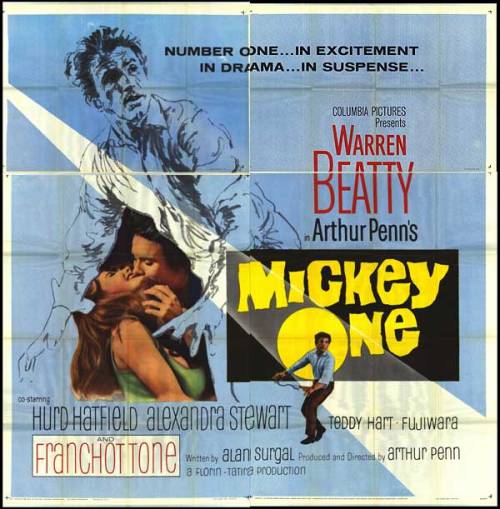
Mickey One (1965)

mickey one 1

By Richard Winters

My Rating: 6 out of 10

4-Word Review: Comic hides his identity.

Warren Beatty plays a successful night club comic who’s living the good life until he falls into disfavor with the mob. He decides to go on the run by burning his social security card and getting a new one with a Russian name on it that is so hard to pronounce that everyone just calls him Mickey One. After spending time on the streets of Chicago he finally gets himself another gig at a club run by Ed Castle (Hurd Hatfield), but the better things get for Mickey the more paranoid he becomes convinced that he is being watched and followed at every turn and unable to relax for even a second.

This film marks the first pairing of Beatty and director Arthur Penn and their next project, Bonnie and Clyde, was a great success, but the results here are only so-so. The idea of trying to replicate the artsy French New Wave films of the late ‘50s and early 60s is intriguing, but poor pacing and a lack of consistent style hurts it. An early scene taking place inside an automobile junkyard has just the right combination of crisp editing and camerawork to give it an enticing visual quality, but then the film veers off into too many talky segments. It manages to recover at the end by giving the viewer a strong sense of the paranoia that the main character is feeling, but wide shifts in the film’s dramatic tone hurts it overall making this more of an interesting curio than a classic.

Beatty is okay, but he tends to be a bit too detached and his attempts at stand-up comedy are unfunny despite the many shots of audience members laughing. Hatfield is terrific in support and his presence significantly helps. Franchot Tone is also quite good in a part that features no lines of dialogue.

The film does have some unique and memorable moments. Tone’s strange art exhibit that he names the Yes Machine that he constructs on the ice rink of the Marina Towers is engaging particularly when he sets it on fire only to have it put out and ruined by the Chicago fire department. The best moment though is when Beatty tries to do a stand-up routine in an empty and darkened room with only a bright spotlight shining on him and a mysterious, unseen man sitting behind it, which has the perfect blend of mood and style and a scene I wished had been extended.

My Rating: 6 out of 10

Released: September 27, 1965

Runtime: 1Hour 32Minutes

Not Rated

Director: Arthur Penn

Studio: Columbia Pictures

Available: DVD-R, Amazon Instant Video
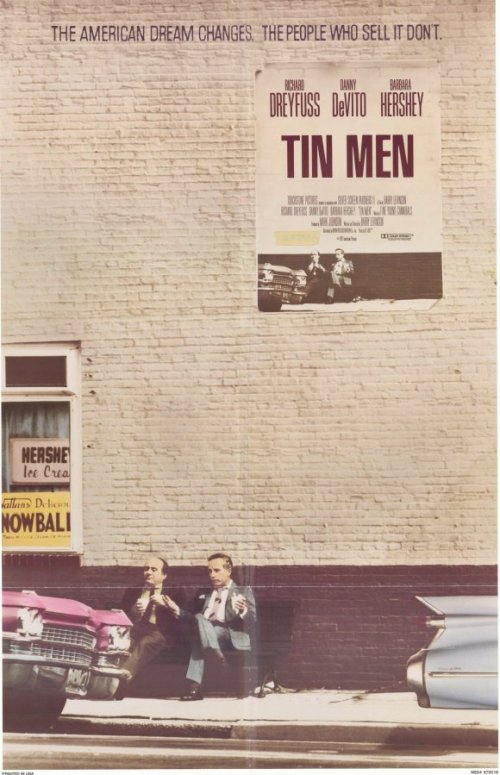
Tin Men (1987)

tin men

By Richard Winters

My Rating: 6 out of 10

4-Word Review: Feuding between two salesmen.

Bill (Richard Dreyfuss) and Ernest (Danny DeVito) are two aluminum siding salesmen living in 1963 Baltimore who one day find themselves involved in a minor car accident. Their feuding though escalates as each blames the other for the fender bender, which leads them to vandalizing each other’s cars when the other isn’t around and even having Bill begin an affair with Ernest’s wife Nora (Barbara Hershey). Yet as a federal commission begins honing in on their unscrupulous sales practices the two find that they may need to learn to work together in order to survive.

This is one film that is hard to gauge. For the most part I liked it. The cinematography and period detail are bright and vivid and I loved the row of track houses that the DeVito character lives in. The dialogue is sharp and Dreyfuss is good at playing the type of character DeVito usually does while DeVito is surprisingly more sympathetic. In fact I felt this may be the best performances of both of their careers.

The humor though fluctuates between being subtle to farcical and the over-the-top feud between the two becomes quite strained. For one thing I didn’t think the DeVito character had enough time to be sneaking around trying to destroy Dreyfuss’s car since he was barely able to make ends meet with his job. The fact that both he and Dreyfuss destroy the other’s car, but then don’t sue or even call the police when it continues made little sense. These two watch every little penny that they have, so having Dreyfuss’s car mysteriously get repaired after it was vandalized was questionable as most insurance policies won’t cover that type of repair and it’s highly unlikely he would’ve paid for it out of his own pocket when he clearly knew who had done it.

I also had issues with the Hershey character. Her acting is outstanding, but the fact that she decides to have an affair with Dreyfuss after only a brief meeting with him while inside a grocery store seemed unlikely. For one thing this was 1963 and before the sexual revolution, so even considering an affair was filled with shame and stigma and having her openly discuss it with her friend at work seemed quite dubious. She also ends up moving-in with Dreyfuss even before was she was divorced, which was another big no-no and makes her behavior far too liberated and completely out-of-place for the time period.

The film improves as it goes along, but the incessant fighting gets overdone and quickly loses its edge. Having them learn to get along at some point was needed. It eventually does occur to some extent at the very end, but it takes way too long to get there and it should’ve happened sooner and given the story and characters an extra dimension. There is also a scene where the two get together to play a game of pool where the winner gets to have Nora, but the film then cuts away without ever showing the game getting played, which was a bit of disappointment since the scene had potential for some interesting nuances.

My Rating: 6 out of 10

Released: March 13, 1987

Runtime: 1Hour 52Minutes

Rated R

Director: Barry Levinson

Studio: Buena Vista Pictures

Available: VHS, DVD, Amazon Instant Video

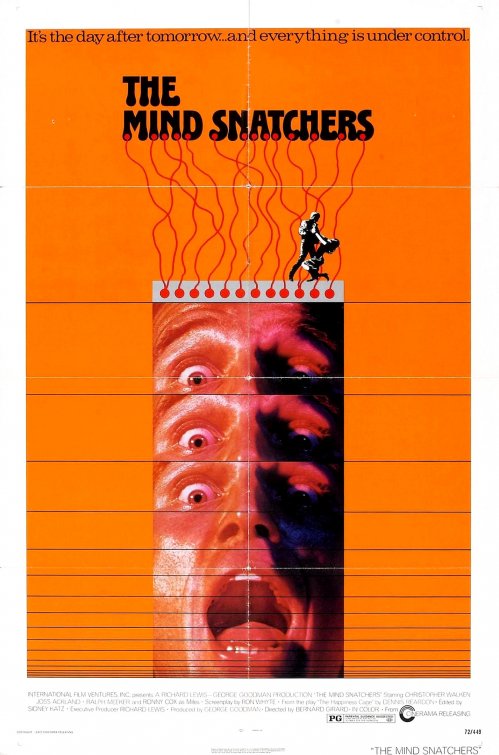
The Happiness Cage (1972)

mind snatchers

By Richard Winters

My Rating: 5 out of 10

4-Word Review: They control his mind.

Christopher Walken plays James Reese a veteran of the Vietnam War who has issues with aggression. After numerous arrests he gets shipped off to a hospital in Europe run by Dr. Frederick (Joss Ackland) and overseen by a U.S. General (Ralph Meeker). There they do tests on the patients by implanting special devices into their brains that connects to their pleasure centers and can quell their aggressive behavior by having them feel a pleasurable sensation every time a button is pressed from a remote.

Walken’s performance is outstanding and Ronny Cox as his fellow patient is also quite good especially the part where he has the device implanted into his own brain, which turns him into a sad, pathetic, child-like state. Bette Henritze gives an interesting performance as well as a naïve, middle-aged nurse hired to make the patient’s stay more ‘happy’ by supplying them with books and board games only to be attacked and raped by Cox and then forced to play a game of checkers with him afterwards.

The story, which was based on a play by Dennis Reardon, certainly has its moments. In fact I was surprised how caught up into I got since the production values are close to appalling. The film was shot in Denmark in a building that looks like it was formerly a rundown mansion converted into a makeshift hospital for the sake of the movie. It all looks embarrassingly cheap and the idea of having a big hospital with a full-time staff and even a barbed wire fence and guard dogs, but only three patients is quite hard to believe.

Had the budget been bigger it might’ve been able to reach a broader audience. Bernard Girard’s direction is okay for the limitations that he was given, but the film’s faded, grainy stock and overall amateurish look becomes a turn off from the beginning and something that it cannot overcome. The plot itself is interesting, but the concept has been filmed before and with better results.

Alternate Title: The Mind Snatchers

My Rating: 5 out of 10

Released: June 28, 1972

Runtime: 1Hour 32Minutes

Rated PG

Director: Bernard Girard

Studio: Cinerama Releasing Corporation

Available: DVD, Amazon Instant Video

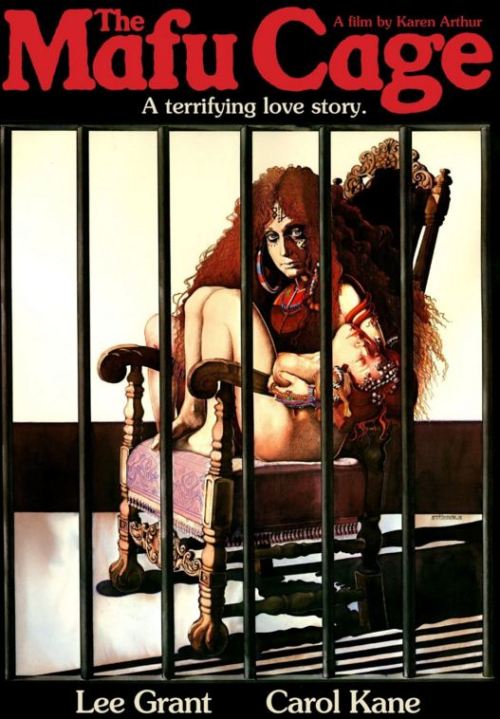
The Mafu Cage (1978)

Capture 66

By Richard Winters

My Rating: 3 out of 10

4-Word Review: Her sister is psycho.

Ellen and Cissy (Lee Grant, Carol Kane) are two sisters living together in a dilapidated mansion, where they keep a pet ape named Mafu locked in a cage that sits in their living room. One day Ellen finds that Mafu has died so at the insistence of Cissy, who says she will kill herself unless they get another one, she goes to a local zoologist (Will Geer) and buys another. Things go well at first, but Cissy’s behavior becomes increasingly more erratic and she takes her frustrations and anger out on the new ape in abusive ways.

The film was directed by actress-turned-director Karen Arthur by a script written by Don Chastian who was another actor and based on a play by Eric Wesphal. I really wasn’t sure what these characters or this bizarre story was supposed to mean. I thought being the ‘70s and a female director that it would have symbolic connections to feminism or even lesbianism, which does get alluded to briefly, but overall the message is confusing and unfocused. The pacing is poor and about 10 minutes in I was already quite bored with it.

The only real saving grace is Kane’s presence who gives a startling performance as a psychotic woman. I had always admired her talent, but became even more impressed with her after seeing this. Her most amazing/bizarre moment is when she dresses up as an African warrior complete with red body paint and then later soaks in a tub filled with blood red water while carrying on an impromptu phone conversion with herself.

I had mixed feelings in regards to Grant whose age difference between Kane is 25 years making her look more like a mother figure than a sister. It was also hard to sympathize with her character as she refuses to have Cissy institutionalized or even examined by a mental health professional even though her behavior is dangerously erratic and only a completely irrational person would choose to ignore it or think that it will somehow ‘magically’ improve, which of course it doesn’t

The ape was the one performer that I enjoyed the most and fortunately a real one was used. The way the chimp responds to things and interacts with Kane are genuinely fascinating to watch and makes him a natural scene stealer without even trying. However, the part where she beats him with a metal chain is quite disturbing supposedly he was never actually hit and the credits do list an animal agency was present during filming and monitored it, but it’s difficult to watch nonetheless.

Patient viewers may find certain segments and imagery to be interesting and the film does improve a bit as it progresses, but overall it’s a weird curio that will leave most people indifferent and confused.

Alternate Title: Don’t Ring the Doorbell

My Rating: 3 out of 10

Released: December 1, 1978

Runtime: 1Hour 42Minutes

Rated R

Director: Karen Arthur

Studio: Clouds

Available: VHS, DVD


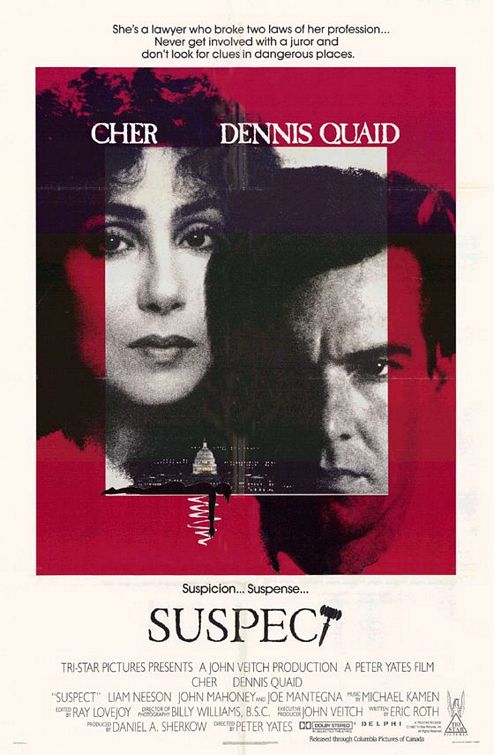
Suspect (1987)

suspect 3

By Richard Winters

My Rating: 4 out of 10

4-Word Review: Juror helps solve case.

Kathleen Riley (Cher) is a public defender who suddenly finds herself embroiled in what initially seems like an open-and-shut case. She’s been hired to defend Carl (Liam Neeson) a Vietnam Veteran who through illness is now both deaf and mute and living on the city streets as a homeless vagrant. He was caught near the body of a former file clerk to the justice department whose corpse was found floating near the Potomac River. As the case progresses Kathleen finds an unusual ally in Eddie (Dennis Quaid) who is one of the jurors on the case and who does some investigating of his own only to dig up evidence that points to the murder being connected to a top ranking political figure (Phillip Bosco).

The film starts out well and has all the ingredients of being a crafty court battle wrapped around an intricate mystery, but unlike most other courtroom dramas this one is not based on a novel written by an author with a legal background. Instead the story was penned directly for the screen by Eric Roth, who’s had plenty of success in his own right, but no expertise in legal proceedings, which would explain why this would-be drama ultimately becomes implausible and over-the-top.

The biggest problem I had was trying to understand why a juror would go so out of his way to investigate a case on his own. Nothing about the character’s background revealed a personality trait that would make him want to do this and if anything working as a lobbyist seemed to make him more of an opportunist than a truth seeker. The character was initially reluctant to even fulfill his jury duty requirement, so why does he suddenly make a 180 degree turn and spend his free time going into dangerous areas of the city simply to help solve a case that he has no emotional attachment to whatsoever? The concept makes no sense and is also illegal. The story would’ve been more believable had the character been a young member of Riley’s legal team and in an effort to prove himself went out of his way to find clues that would help solve the case.

The fact that the victim’s car remains impounded in the lot where she last parked it and never towed away even well after she had been murdered seems equally implausible as does the fact that Riley nor the police don’t think to search it until the case is almost over. There is also another scene where Eddie, in an effort to get out of the hotel room after the jury has been sequestered, puts a flame to a fire alarm to make it go off and thus create enough diversion to allow him to leave the building undetected, which he does, but it never shows how he is able to get back into his room undetected, which most likely could prove just as dicey.

Yet despite all these other issues, it is actually the theatrical, Hollywood-like court room showdown at the end that is the most absurd and relies too much on extreme circumstance and coincidence for it to be even remotely believable. Katherine’s foot chase through the darkened corridors of the court building by a shadowy figure is equally out-of-place and better suited for a thriller.

Cher is okay in a role that seemed to be stretching her acting range, but the fact that a juror feeds her all the clues and does almost all the investigative legwork that either her or her legal team should’ve done initially makes her character look lazy, sloppy and incompetent.

John Mahoney is effective as the stern, grim-faced judge and Liam Neeson does well cast in role that has no speaking lines, but his character doesn’t get shown enough and there are long stretches where he isn’t seen and the viewer almost forgets all about him. The segment though where Riley asks him if he committed the murder as he is sitting on the stand and his face goes from pale white to beet red in a matter of seconds is probably the film’s best moment.

My Rating: 4 out of 10

Released: October 23, 1987

Runtime: 2Hours 1Minute

Rated R

Director: Peter Yates

Studio: TriStar Pictures

Available: VHS, DVD, Amazon Instant Video, YouTube

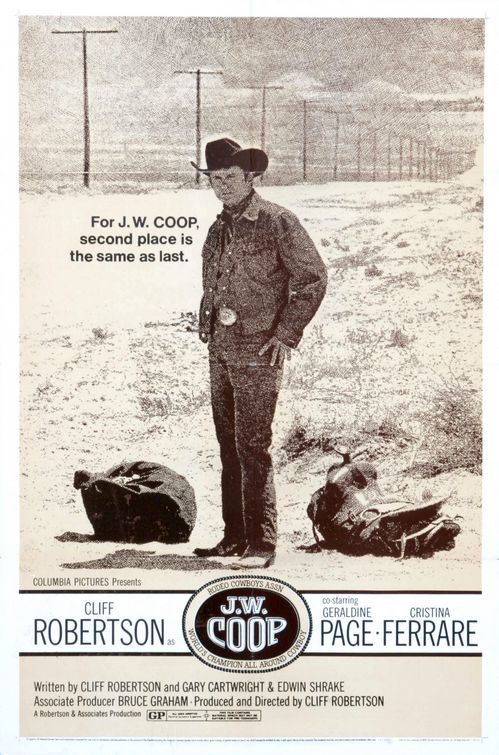
J. W. Coop (1971)

jw 2

By Richard Winters

My Rating: 8 out of 10

4-Word Review: Rodeo star makes comeback.

J.W. Coop (Cliff Robertson) has just spent 9 years in prison. After finally being released he finds that the world has changed quite a bit. He’s no longer the big rodeo star that he once was and younger, more educated men have now taken his place. There’s also the new hippie movement that he isn’t quite sure what to make of. With his mother (Geraldine Page) growing senile and no other friends to turn to he decides to take one last stab at the rodeo circuit and determined to beat the odds and become the champion because for him second place is the same last.

The film has a wonderfully gritty quality to it that fully immerses the viewer into the western rodeo landscape and lifestyle. The rugged characters and conversations seem authentic without ever being condescending. The film reveals a lot about the inner toughness needed to survive in that environment as well as the competiveness and eventual loneliness.

Robertson’s stab at directing is flawless and convinced me that he should’ve done more movies behind the camera. He uses several techniques that make the rodeo experience vivid for the viewer including filming a point-of-view shot from on top of the bronco as well as even more impressively showing one taken from underneath a horse as it is running. I also liked the shot where the screen gets split into four squares with each of them showing some of the many hotels that he stays at during his travels on the circuit, which visually hits home how exhausting life on the road can be. There’s also a haunting segment shot late at night at a lonely oil rig that is brief, but quite memorable.

Former model Cristina Ferrare, who is probably best known as being the ex-wife of automaker John DeLorean as well as host of ‘Home and Family’ gets a rare turn at acting playing a hippie who falls in love with Coop.  Her performance is solid even though I found it hard to believe why such a young woman would fall for a man who is so much older, less educated and having not much more money than she does. Their relationship goes on far longer than I realistically would expect, but I still liked the idea of how two people from two very different backgrounds and generations can still manage to connect. Robertson’s performance is equally good and the film also has the novelty of casting Page as his mother even though in real-life she was actually one year younger than he was.

The segment where a throne of teen girls jump out of a trailer and beg for Coop’s autograph as well as the ending in which Coop, with his leg in a cast, attempts to ride a bull are the only two times that it overreaches in a film that is otherwise quite honest and uncompromising and particular good at mixing subtle comedy with stark drama.

My Rating: 8 out of 10

Released: October 3, 1971

Runtime: 1Hour 52Minutes

Rated PG

Director: Cliff Robertson

Studio: Columbia Pictures

Available: DVD, Amazon Instant Video

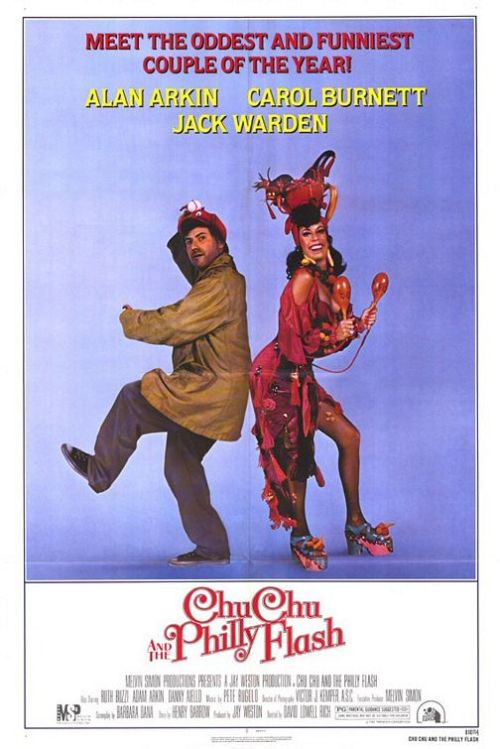
Chu Chu and the Philly Flash (1981)

chu chu 4

By Richard Winters

My Rating: 3 out of 10

4-Word Review: Goofy couple steals briefcase.

Flash (Alan Arkin) is a former big league pitcher who is washed up while living on the city streets selling stolen watches that don’t work. Emily (Carol Burnett) is a former dance instructor who is equally down-and-out and now makes a meager living doing dance routines on the streets while wearing a Carmen Miranda outfit. The two inadvertently meet one day while coming into contact with a briefcase that has stolen government documents. They agree to give it back to the men who are demanding it, but only for a price, which only helps to get them into more and more trouble.

This offbeat comedy, which was written by Barbara Dana who at the time was married to Arkin, has a few funny, dry humored moments at the beginning that makes it somewhat passable, but it’s unable to sustain any type of momentum and does not have enough action or comedy to keep it engaging. The middle half is slow and boring and the ending, which takes place at an amusement park, is too full of forced humor and sloppy slapstick to be considered either funny or entertaining. The film also never explains what specifically these secret plans are, or who these men are that are chasing after it, which only proves how poorly thought out and threadbare the plot really is.

The relationship between the two main characters doesn’t work either. They seem to let their guards down too easily for people that have been living alone and on the skids for so long and having them share more of a bickering and distrustful chemistry would’ve made it more realistic and edgy. The whole middle half is spent hearing them telling each other about their woeful pasts, which is neither compelling nor insightful and only bogs the film’s already slow pace down even further. These are the type of wacky character who can only be effective if put into comically frantic scenarios of which there needed to be much more of.

Arkin manages to give a pretty good performance playing a surprisingly subdued character that does not go off on hyper rants like the characters in some of his other film roles do, which is a good thing. However, Burnett is completely wasted despite seeing her in a Carmen Miranda outfit, which is a definite hoot. The only one who is genuinely funny is Danny Aiello as the exasperated bad guy.

Danny Glover can also be spotted in an early role as a homeless person trying to spy on Burnet and Arkin to see what they’re up to, but his part is one of the corniest ones in the movie and should’ve been dropped completely. The San Francisco setting may remind one of the classic comedy What’s Up Doc?, which also took place in that city and had a similar storyline dealing with a misplaced briefcase, but that film was far more consistently funny and took more advantage of the bay area locales while this one only focuses on the rundown areas of the city.

My Rating: 3 out of 10

Released: August 28, 1981

Runtime: 1Hour 32Minutes

Rated PG

Director: David Lowell Rich

Studio: 20th Century Fox

Available: VHS

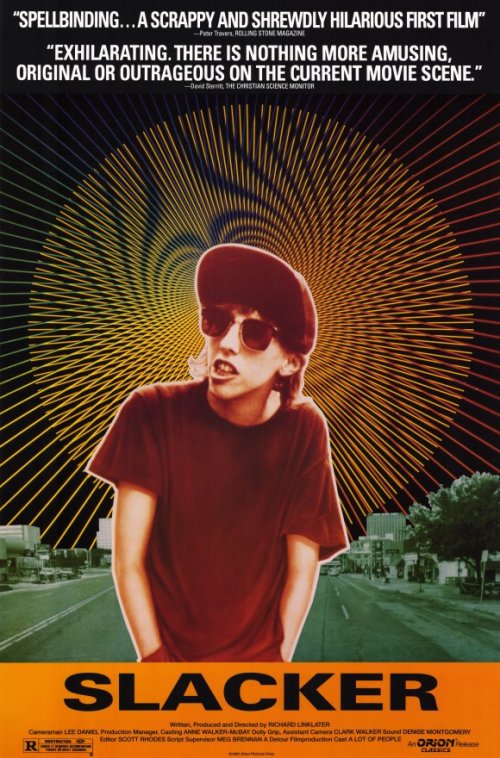
Slacker (1991)

slacker

By Richard Winters

My Rating: 8 out of 10

4-Word Review: A movie about nothing.

A look at a day-in-the-life of society’s left behinds that filter the streets, bars and coffee shops of Austin, Texas. The viewer hears a wide variety of weird topics, theories and extreme political points-of-view from the detached 20-something crowd as the camera winds its way from one conversation to the next and never stopping on any one person for longer than a few minutes.

This was considered at the time of its release to be a major breakthrough for the independent film movement and one that remains an inspiration for many indie filmmakers today. It succeeds because it proves you don’t need a big budget, state-of-the-art effects or even a compelling story to work. It washes all those things away and gets down to the very essence of why we watch movies, which is because we are all secretly voyeurs intrigued with seeing how the ‘other half’ lives without having to get our own feet wet in the process. The characters, as offbeat as they and their conversations may be, have a definite element truth to them and this film manages to convey reality far better than 95 percent of the other movies out there.

Some of my favorite conversations, which seem mostly ad-libbed, involved the one with the guy who was obsessed with the JFK assassination and his ‘shocking’ new revelations involving Jack Ruby’s dog. There are also the two young men inside a bar who talk about the ‘subliminal messages’ of the Smurf cartoons and the film’s director Richard Linklater who opens the film with a discussion on how every choice that we don’t make continues off and has a reality of its own. I also liked the anarchist (Louis Mackey) who talks about the man who assassinated President McKinley simply because all you ever hear about are the Kennedy and Lincoln assassinations and never anything about anything about the other two.

I also liked Teresa Taylor, who was the former drummer for the Butthole Surfers, playing a woman trying to sell a vial containing singer Madonna’s Pap smear and the guy who locks himself inside a room with what seems like hundreds of TV’s that run all day and night. However, I was a bit disappointed that during this scene we get shown a video of a man who supposedly shots the camera with his rifle and although he does indeed aim his gun at the lens he never fires it, which I found to be a letdown.

Some may consider these characters, in our very job oriented culture, to be ‘losers’ simply because they ‘aren’t working’ and being ‘productive members of society’, but director Linklater takes a different perspective by stating in an interview that he feels slackers are instead a ‘step ahead’ and ‘rejecting the social hierarchy before it rejects them’.

To some extent I agree as I was pretty much the same way at that age, but I also couldn’t help but think what these same characters were doing now 20 years later. It’s easy to be detached when you’re younger, but when a person reaches middle-age and the financial responsibilities become stronger, it’s not, so I kept wondering if these same people may have now ‘sold-out’ or even ‘grown up’. I also wondered how they may have evolved in other ways for instance the guy who was so into the conspiracies of the JFK assassination may now have crossed over to ones involving 9/11 and the young man that was really into TV’s may now be a Blu-ray player nut instead. If anything this is a movie crying out for a sequel and one that could easily be just as fascinating as the first one especially if it involved the same people.

My Rating: 8 out of 10

Released: March 22, 1991

Runtime: 1Hour 37Minutes

Rated R

Director: Richard Linklater

Studio: Orion Classics

Available: VHS, DVD, Blu-ray (Criterion Collection), Amazon Instant Video


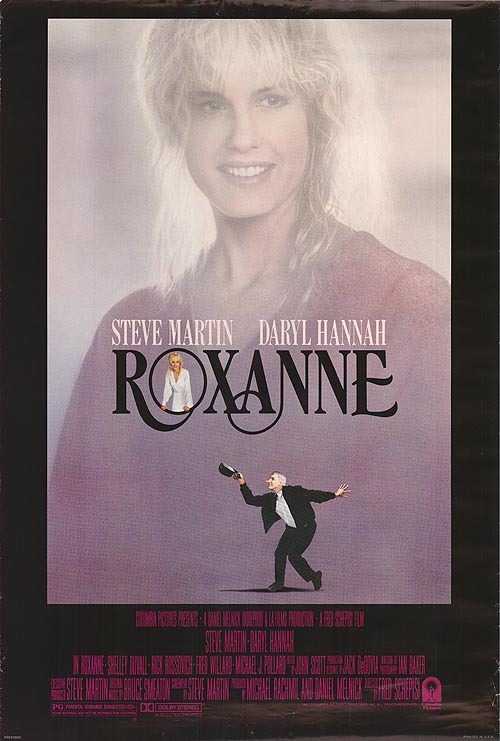
Roxanne (1987)

roxanne

By Richard Winters

My Rating: 7 out of 10

4-Word Review: His nose is big.

Charley (Steve Martin) runs the local fire department and just happens to have a really long nose, which at times causes him to be the butt of jokes. Roxanne (Daryl Hannah) is a beautiful student of astronomy who is spending the summer in the small town of Nelson studying a comet. Charley becomes smitten with her, but doesn’t dare ask her out due to his fear that she will reject him. Chris (Rick Rossovich) is the good looking guy who moves to the area and immediately catches Roxanne’s eye. The problem is that he is very shy with women, so Charley helps him out by writing letters to her while pretending that they were done by Chris, which captures Roxanne’s heart without her realizing that the man she is really in love with is Charley.

There have been many remakes old movies and in this case an old stage play named Cyrano De Begerac and for the most part they fail and only help to make the viewer long for the original, but this is the rare case where the updating of the story actually works. One of the main reasons is that it doesn’t try, in an effort to be ‘hip’, to go for the crude angle like a lot of modern remakes do and instead keeps it charming and breezy while having a main character with a sense of humor and not drowning in self-pity.

The on-location shooting, which was done in the small town of Nelson, British Columbia, helps as well. The hilly, green landscape gives the film a serene feeling and the quirky supporting characters seem very much like people you’d bump into when passing through one of these places. The humor is also top notch particularly the running gag involving the incompetent fire department.

Martin remains the film’s biggest selling point particularly the scene where he tries to use eye shadow to help darken his nose and make it less conspicuous or the moment when he lets a parakeet perch itself on it. His best part though comes when tries to come up with 20 insults to say to someone with a big nose.

Hannah is stunningly beautiful to the point of being breathtaking and fortunately this was years before she had her ill-advised plastic surgery, which now makes her looks far less appealing. Rossovich is also quite good and tends to be overlooked due to Martin’s presence, but manages to be quite funny as well especially the scene where he tries to meet Roxanne in person while having Charley telling him what to say through a radio transmitter.

Shelley Duvall, Michael J. Pollard and Fred Willard also deserve mention for their supporting work here and this marks the film debut for Kevin Nealon who appears in an early bit as a bully who tries to make fun of Charley’s nose, but learns the hard way that he shouldn’t.

My Rating: 7 out of 10

Released: June 19, 1987

Runtime: 1Hour 47Minutes

Rated PG

Director: Fred Schepisi

Studio: Columbia Pictures

Available: VHS, DVD, Blu-ray, Amazon Instant Video, YouTube

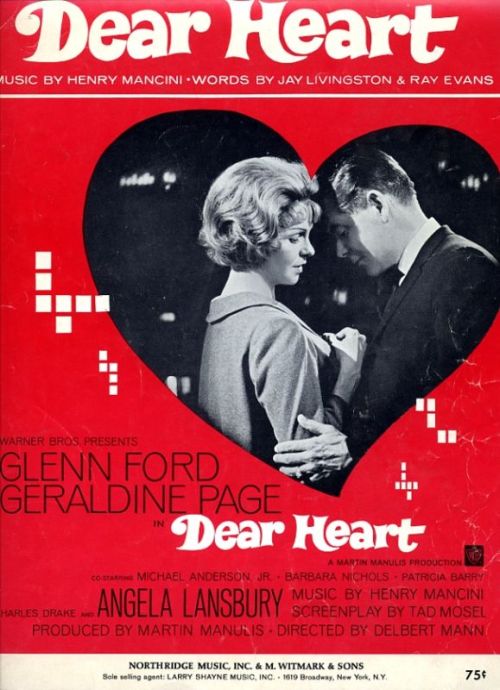
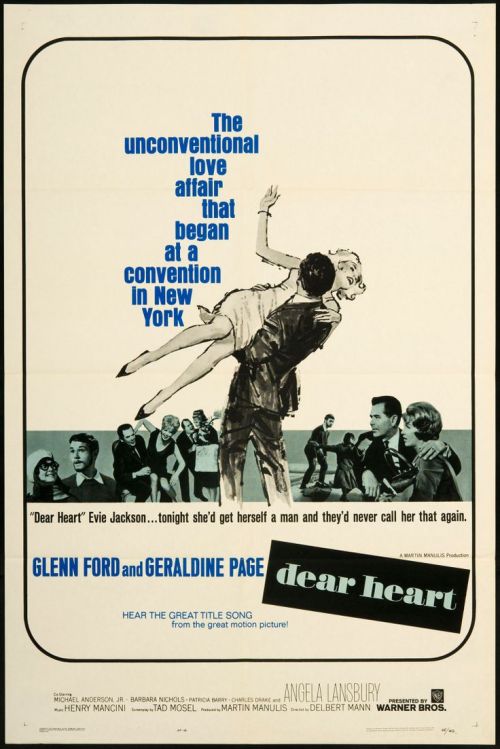
Dear Heart (1964)

dear heart 3

By Richard Winters

My Rating: 7 out of 10

4-Word Review: Love at a convention.

Harry Mork (Glenn Ford) is a greeting card salesman traveling through New York on business when he bumps into the quirky and very lonely Elvie (Geraldine Page) who’s attending a convention there and eyes Harry as a potential catch. Harry though is already engaged to Phyllis (Angela Lansbury) a woman he has only known through correspondence, but is starting to have second thoughts about when he meets her grown son (Michael Anderson Jr.). Elvie tries putting on some moves, but Harry keeps backing away unsure at age 48 if he even wants to settle down at all as he has at times still feels the itch for the occasional fling.

One of this film’s crowning achievements and something that becomes like a third character are the crowd scenes. This may sound inconsequential, but many films have a hard time getting background extras to behave like people amidst large groups of strangers do, but here for whatever reason it gets it right and seeing the dizzying stream of people going back and forth leaves a strong impression and helps accentuate the loneliness and isolation of the main characters particularly Elvie.

I also liked the way the characters hemmed and hawed with each other during the beginning stages. At times Elvie seems more into Harry than he is with her and then other times it gets reversed. Both characters at different points put up an array of defenses and it takes a while for either of them to trust the other and come out of their shells and move into an actual relationship, which is far more realistic than most movies that usually jumps ahead too quickly and never shows the awkward phase that most anyone else goes when testing the waters with someone that they’ve just met.

Page is excellent as always playing the eccentric type of character that she’s proven to be quite adept at, however her myriad of strange quirks got a bit ridiculous and overdone.

Ford is equally good especially with this type of comedy where he plays nervous characters unsure of how to deal with some of the offbeat people around him. I was disappointed though that there was a long drawn out sequence where he tries to get a clerk at the gift card shop (Barbara Nichols) up to his hotel room for a fling, but the film then cuts away and never follows through with what occurred once they got up to the room even though it is later intimated that things didn’t go too well.

The supporting cast of familiar faces lends great comic support, but the most memorable thing about the film is that it features both actresses who went on to play the Mrs. Kravitz character in the ‘Bewitched’ TV-Show. There’s Alice Pearce, who played Mrs. Kravitz for the first two seasons before she died of cancer and then Sandra Gould who replaced her and there’s even a surreal moment where the two have a bit of a confrontation, which I found to be pretty cool.

dear heart 2

My Rating: 7 out of 10

Released: December 2, 1964

Runtime: 1Hour 54Minutes

Not Rated

Director: Delbert Mann

Studio: Warner Brothers

Available: VHS, DVD (Warner Archive), Amazon Instant Video