The Picture Show Man (1977)

picture show man

By Richard Winters

My Rating: 4 out of 10

4-Word Review: They show silent movies.

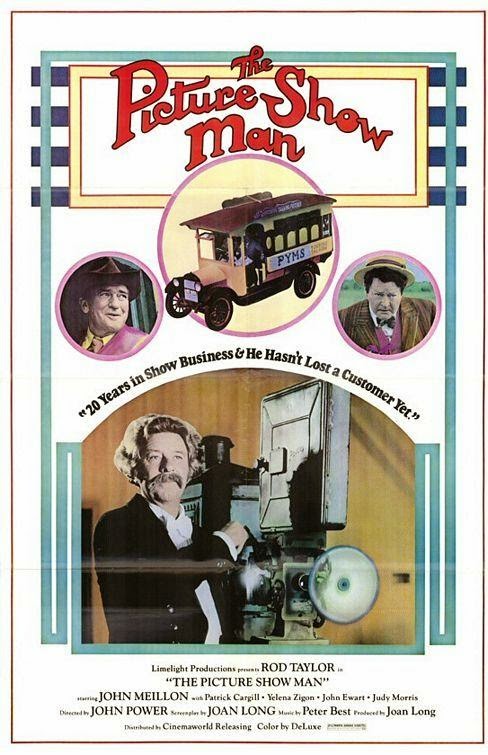
During the 1910’s Pym (John Meillon) travels the Australian countryside with his son and piano player (John Ewert) while renting out the local theaters in the small towns that they come upon and showing silent movies to the townsfolk. He makes just enough to survive and keeps all of his money in his pocket as he doesn’t trust the banks. His biggest problem is the advent of talking pictures as well as competition from Palmer (Rod Taylor) a man who Pym personally trained in the business, but now seems to be making more of a splash.

What should’ve been a nice slice-of-life period piece turns out to be meandering and pointless instead with a script that lacks a plot and everything broken up into vignettes that are just barely passable. The film would’ve done better with a more centralized character and point-of-view as well as adding in some conflict and drama. It also should’ve stayed more focused on the silent movie theme instead of veering into other directions including romance and even horse racing, which are just not as interesting.

Upon his death last year at the age of 85 many obituaries listed this film as being Rod Taylor’s last major role, but it really isn’t. He appears only sporadically and seems to have almost a mystical presence about him. His confrontations with Pym are contrived and his character adds very little.

The only mildly interesting aspect of the movie is the addition of Major Lockhart and his wife (Don Crosby, Judy Morris) who come onboard with Pym to do fake psychic readings during the intermission of his movies. The couples constant bickering is amusing and the scene where the husband catches his wife making out with Pym in the projection room and proceeds to attack them with an ax and sets fire to the film while the customers sit on the other side of the wall singing a song and completely oblivious to what is going on behind them is pretty funny.

I also got a kick out of the shot showing the faces of the people who are completely mesmerized to the screen as they take in hearing dialogue for the first time in a movie. The dialogue itself is banal and even corny, but the fact that the people remain so compelled to it makes it without a doubt the best moment in the movie.

I also found Leonard Maltin’s review of this movie to be pretty amusing as well. In the 1991 edition of his Movie Guide he gives this film three-and-a-half-stars while calling it “Funny and moving” and “A must for buffs”. Then in his 2013 edition he gives this same movie only two stars and describes it as meandering and lacking in energy.

My Rating: 4 out of 10

Released: May 5, 1977

Runtime: 1Hour 39Minutes

Rated PG

Director: John Power

Studio: Roadshow Distributors

Available: DVD
Clue (1985)

clue

By Richard Winters

My Rating: 3 out of 10

4-Word Review: Inspired by board game.

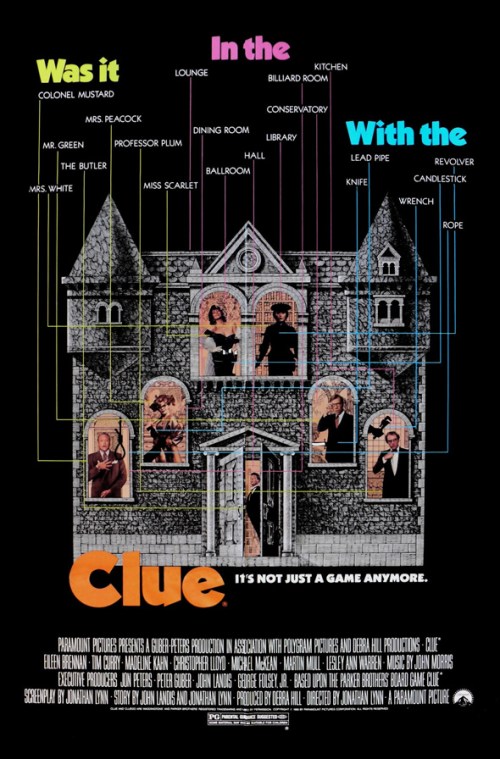
Six individuals (Martin Mull, Eileen Brennan, Lesley Ann Warren, Madeline Kahn, Michael McKean, Christopher Lloyd) are invited to an isolated New England mansion at the behest of Wadsworth (Tim Curry) the butler to the mansion’s owner. It seems that these six people have been blackmailed by Mr. Boddy (Lee Ving) and now Wadsworth, who is employed by Boddy, has decided it’s time to let them off the hook, but not before Boddy himself turns up dead having been murdered by one of the guests. As they try to unravel the mystery more homicides occur forcing the rest to find the killer before he/she finds them.

Initially this film, which is based on the famous Parker Brothers board game and currently being remade, is okay entertainment. The fast paced dialogue has a few good lines and the mystery element lends for some mild intrigue. The performances are also spot-on with each actor perfectly cast for their part. I especially liked Eileen Brennan as the nervous Mrs. Peacock as well as Warren as the sarcastic and snarky Miss Scarlet.

Unfortunately after an agreeable first 40 minutes it finally, like with its many victims, goes down with a thud. The concept just isn’t solid enough for feature length material and the idea of trying to stretch it out by adding more victims only convolutes things and makes an already ridiculous premise even more so. Having Curry spend the final part going back through all the things that had occurred before in an effort to ‘solve’ the case while rushing the rest of the cast from one part of the mansion to the other as he explains it is not amusing, but instead dizzying, redundant and pointless. What may have seemed initially like a novel idea instead becomes just another excursion into silliness and way too similar to Neil Simon’s Murder by Death, which came out in the ‘70’s and also starred Brennan.

True mystery buffs will be the most disappointed as the emphasis is completely on comedy and not in creating any type of elaborate whodunit for the viewer to figure out. The plot itself contains no real ‘clues’ and everything that occurs during the course of the film has nothing to do with who ultimately ends up being the culprit.

The film’s only real unique element is that it featured three different endings with different ones shown at various theaters. The DVD features all three with option to choose one at random. However, the first two are lame and only the third one, which features everyone as the murderer, is the only one that is halfway decent and should’ve been the sole one used.

My Rating: 3 out of 10

Released: December 13, 1985

Runtime: 1Hour 34Minutes (Includes all three endings)

Rated PG

Director: Jonathan Lynn

Studio: Paramount

Available: DVD, Blu-ray, Amazon Instant Video

There Was a Crooked Man…(1970)

there was a crooked man 2

By Richard Winters

My Rating: 8 out of 10

4-Word Review: Money in snake pit.

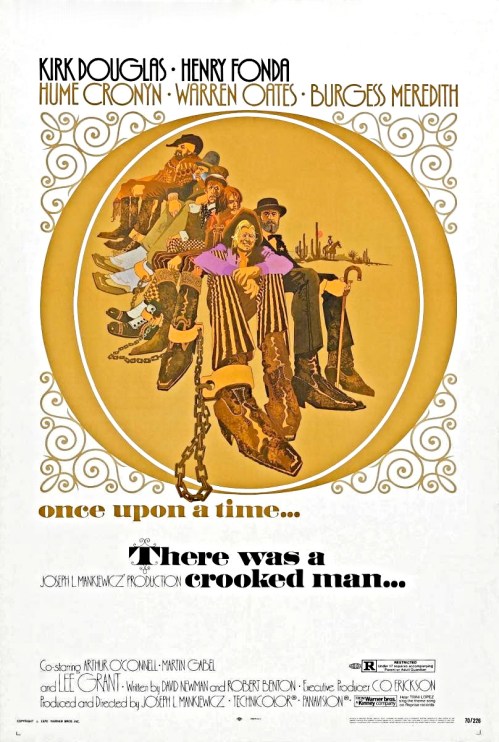
Paris Pittman (Kirk Douglas) is a rugged bandit who at times can be quite charming, but also cunning and ruthless. When he gets sent to an escape-proof Arizona prison he becomes determined to find a way out while using the skills of his fellow prisoners, who he has all promised will get a share of some stolen loot that he has hidden in the desert, to help him do it. Woodward Lopeman (Henry Fonda) is the prison’s new warden. He’s on to Paris’s manipulative ways and becomes equally determined to stop him from escaping while also subtly attempting to reform him.

During the social/sexual revolution of the late ‘60’s many film genres took on society’s new attitudes while also taking full advantage of the new found freedoms by showing things that had previously been taboo. Comedies, dramas, action films and even sci-fi movies were suddenly breaking new ground, but the western for the most part remained entrenched with the old-school values at least until the ‘70’s, but this film is one of the early entries into what became known as the revisionist western where age-old dramatic trappings where suddenly given a whole new spin and the caricatures of good and evil became much murkier.

Here the ‘good guy’ is to some extent the bandit who works outside of the system while seeing all the hypocrisies from those still working within it. The people getting robbed are no longer ‘God-fearing’ innocent town folk, but instead the greedy establishment who enslave blacks and use the façade of religion for their own self-interests.  Woman are no longer virginal maidens waiting to be properly married, but instead sexually oppressed young ladies eager to pursue their horny desires behind their parents back if they can get away with it. Those that still remain loyal to the old ways of doing things such as with Fonda’s character are now seen as being out-of-touch and unreasonably rigid to an inflexible, dated system.

Watching the western genre suddenly ‘grow-up’ as it where and show things that only a few years earlier would’ve been unthinkable is a lot of fun and the script meshes in a good amount of snarky humor, which keeps things consistently lively and comical. Even the music score gets a new slant. Typically music themes in westerns had a booming, orchestral sound, but here it’s much jazzier and modern.

Douglas is engaging and makes a great adversary to Fonda. Fonda, who just a year earlier shocked filmed audiences with his brilliantly creepy portrayal of a psychotic gunman in Once Upon a Time in the West goes back to his old form as the stoic good guy and does it quite well although I was confused why he is seen in the first half walking with a limp and a cane due to being shot only to go without it and walk normally during the second half.

The support cast, all men in their 50’s and 60’s and seen for years in the old fashioned westerns, but now clearly relishing the chance to be bawdy and irreverent are in fine form as well. Burgess Meredith is quite funny as an old codger who has worn the same underwear for 35 years and refuses to take it off even for a bath. Hume Cronyn lends equally good support and I loved the scene where he adds giant tits onto a drawing of an angel. This also marks the film debut of Pamela Hensley who became best known for her work on the TV-shows ‘Buck Rogers in the 25th Century’ and ‘Matt Houston’.

There are clearly other comical westerns out there, but this one, with a script co-written by Robert Benton, manages to still have a good story, some very exciting moments and even a great twist ending. The prison used in the film was built specifically for the production and great effort was put in to make it seem authentic to the period. The detail that was put into it along with the rock quarry where the prisoners work in is impressive and worth catching just for that.

My Rating: 8 out of 10

Released: December 25, 1970

Runtime: 2Hours 6Minutes

Rated R

Director: Joseph L. Mankiewicz

Studio: Warner Brothers

Available: DVD, Amazon Instant Video

The Lady in the Car with Glasses and a Gun (1970)

lady in the car

By Richard Winters

My Rating: 5 out of 10

4-Word Review: Dead body in trunk.

Dany (Samantha Eggar) works as a secretary for Michael (Oliver Reed) who asks her to come to his place one evening to help him type an urgent report that needs to go out the next day. She agrees and then spends the night in his guest bedroom. The next morning she travels with his family to the airport where they board a plane for a vacation while she is instructed to drive their car back home, but along the way she takes a wrong turn and begins to come upon people who say they’ve seen her before even though she can’t remember them. Then she finds a dead body in the trunk and things get really bizarre.

The film, which is based on the novel by Sebastien Jasprisot and remade in 1992 and then again in 2015, has a certain appeal as the story is offbeat enough to keep you intrigued and manages to give a logical, or at least an attempted one, explanation at the end for why everything that occurs to Dany happened and the reason behind it. Unfortunately Anatole Litvak’s direction is bland despite a colorful opening montage and Reed, with his hair dyed gray, is miscast as a stuffy businessman.

One of the biggest issues though is the main character who behaves in ways that make little sense. Going to her boss’s place after work hours to write a report and even be instructed to drive his car back from the airport seems to be going well beyond the normal duties of an ordinary secretary and one that most likely would be met with resistance by anyone else and yet Dany obliges to his demands without question like she is a robot. Later a strange man (John McEnery) enters her car and makes an aggressive pass at her. Instead of leaving or running for help she instead gets into the car with him and takes him back to her hotel and goes to bed with him before she even knows what his first name is.

Spoiler Alert!

At the end we find out that Dany’s boss has set the whole thing up to make it look like Dany shot the man, whose dead body was in the trunk, in order to cover up for his wife (Stephane Audran) who was the one who really did it. Apparently she had been having affairs with many different men and shot this one when he refused to continue to see her. The husband was aware of all of these transgressions and would pay off the men to quit seeing her and when he found out that his wife had killed this one he concocts an elaborate scheme to get her off the hook, but why? Most men would not feel the need to come to the defense of an unfaithful wife especially one that continues to do it over and over again, which makes the whole storyline quite weak since it’s completely off-the-mark in terms of realistic human behavior.

End of Spoiler Alert!

My Rating: 5 out of 10

Released: October 22, 1970

Runtime: 1Hour 38Minutes

Rated R

Director: Anatole Litvak

Studio: Columbia Pictures

Available: None at this time.

The Hitcher (1986)

hitcher

By Richard Winters

My Rating: 7 out of 10

4-Word Review: Chased by homicidal hitchhiker.

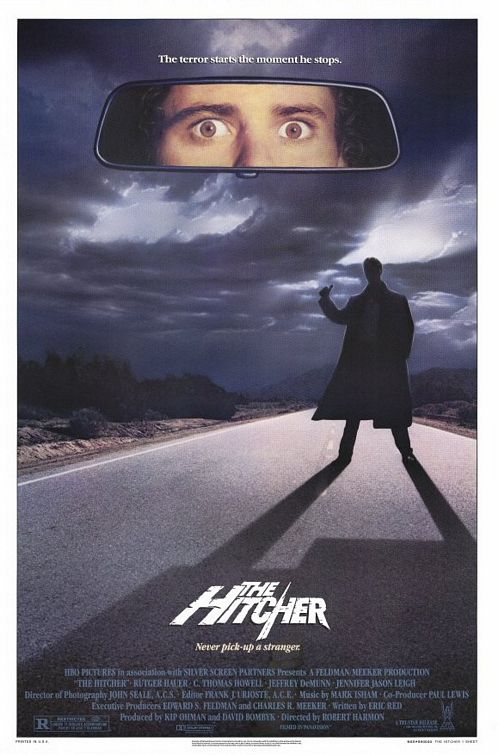
Jim Halsey (C. Thomas Howell) who is driving from Chicago to California finds himself falling asleep at the wheel as he travels late at night down a lonely desert highway. To keep himself awake he decides to pick-up a hitchhiker named John Ryder (Rutger Hauer) who immediately begins to behave strangely. Jim manages physically kick John out of the car when his life gets threatened, but then notices that he is continually coming upon him as his drive progresses. Soon the police are after him thinking that he is the one committing the murders that are really being done by John.

This film manages to be a nice blend between Spielberg’s TV-movie Duel and the classic episode of ‘The Twilight Zone’ in which Inger Stevens constantly sees the same hitchhiker as she drives her way through the desert. There are some really good suspenseful moments and a great performance by Hauer that almost makes up for its many transgressions, which unfortunately become more and more numerous.

Now, I did like this movie and tried to overlook a few of the logic loopholes, but eventually they become just too overblown. The biggest one is that John somehow manages to steel Jim’s wallet while also planting a knife on him that has blood from the victims that he has killed, but the only time they are together is when they are traveling in the car and I think Jim would’ve noticed John fishing through his pockets if that were the case. There’s also a lot of timing issues. For instance passengers stop and get off a bus to go inside a roadside café presumably for lunch, but then go right back into the bus just a couple of minutes later, which isn’t enough time for them to eat, go to the bathroom, or even stretch their legs. Another scene has Jim’s girlfriend Nash (Jennifer Jason Leigh) getting kidnapped from her hotel room by John who somehow is able to enter the room without explanation and then takes her out to the parking lot and ties her up between two trucks before the police get called in and try to intervene, but this all occurs in seemingly only a couple of minutes as Jim is in the bathroom when he hears Nash being taken out and he quickly runs out into the parking lot only to see Nash already tied up and the police there.

There is also the issue of how is John able to escape out of a police van after he is caught and handcuffed, which the movie doesn’t even bother to explain or show. Another question some viewers have brought up is why is Jim driving through Texas anyways, which is where this all occurs, since it seems too far to the south from where he needs to go. Some have speculated that maybe he was going to the southern portion of California and therefore would need to pass through the Panhandle of Texas to get there, which is plausible, but the landscape is all wrong. I live in Texas and know that the panhandle region, which I’ve been to, is flat and green and has farmland while the place Jim goes through is barren, sandy and very much a desert.

The film wasn’t even shot in Texas, but instead done in the Mojave Desert in California, which made me wonder why the setting couldn’t have been there since that was supposed to be Jim’s ultimate destination anyways. Then I realized that the police are portrayed as being quite hick and redneck and since Texas unfairly still has that stereotype I’m sure that was the reason for why it was chosen.

The script could’ve certainly been better thought out, which wouldn’t have required the viewer to take such massive leaps in logic in order to enjoy it, but overall I still liked it. I think this was mainly because of Hauer who is terrifically creepy as well as for an extremely exciting car chase that features incredible stunt work and without relying on any of computerized crap either.

My Rating: 7 out of 10

Released: February 21, 1986

Runtime: 1Hour 37Minutes

Rated R

Director: Robert Harmon

Studio: TriStar Pictures

Available: DVD


Come Back to the 5 & Dime Jimmy Dean, Jimmy Dean (1982)

COME BACK TO THE FIVE & DIME, JIMMY DEAN, JIMMY DEAN, Sandy Dennis, Cher, Karen Black, 1982, (c) Cinecom Pictures

COME BACK TO THE FIVE & DIME, JIMMY DEAN, JIMMY DEAN, Sandy Dennis, Cher, Karen Black, 1982, (c) Cinecom Pictures

By Richard Winters

My Rating: 3 out of 10

4-Word Review: Disciples of James Dean.

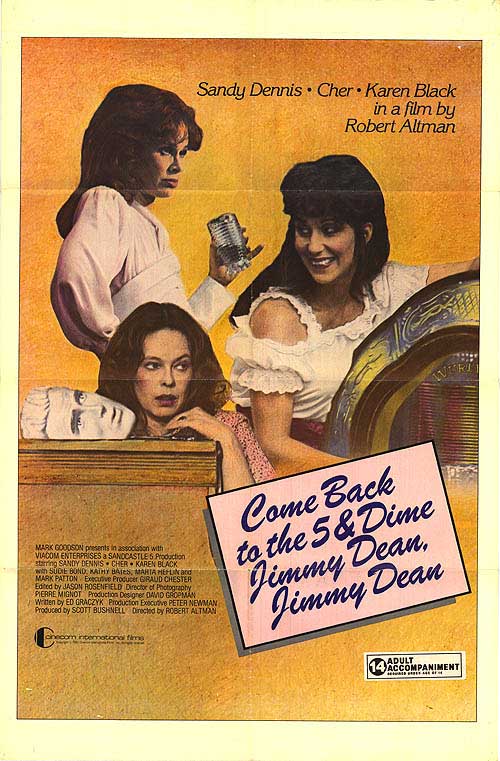
Twenty years after his untimely death five women (Cher, Sandy Dennis, Karen Black, Kathy Bates, Marta Heflin), who were big fans of James Dean and called themselves his disciples, decide to hold a reunion at a thrift shop in a small town not far from Marfa, Texas where the film Giant was made. However, the reunion is not a happy one as old wounds and secrets come to light that forces the women to analyze themselves and their lives in uncomfortable and unpleasant ways.

One of the things that really annoyed me about this movie and at times just downright confused me is that the characters show no signs of aging at all as it shifts between 1955 and the present day of 1975. Twenty years is a significant period of time and most everyone will show some signs of age, or at least changes to their hairstyle and outfits and yet with the exception of the Joe character there is no distinguishable differences between the others from one period to the next. The Cher character was particularly perplexing as her hair remains jet black for two decades and even the same exact style. One could argue that maybe she dyed it, okay, but she also manages to somehow retain her same girlish figure, which is even less likely.

I also found it hard to believe that she could afford to make a living by working at little thrift store for 20 years, or that she would even be needed as the place was small enough for one person to run and through the course of the entire movie never once does a single customer even enter the place. Her character was attractive enough to find a man, get married and run off to another town or place that had more potential. We learn through the course of the movie that she was married at one point, but then dumped, however I would think she would’ve been able to find someone else in a 20 year time span especially since she was still quite good looking.

Keeping all of the action inside the thrift store makes the film seem almost claustrophobic. I realize this was based on a stage play, but most plays that get transferred to film will have certain scenes, or cutaways added in to avoid this feeling. Even having some outdoor shots done over the opening credits would’ve given it a little more of a visual variety.

The performances are the best thing about the movie and probably the only reason to see it. All three leads recreate their parts from the stage version. Cher is sensational and in my opinion gives the best performance. Dennis is solid doing her patented fragile caricature and who displays some interesting emotional eruptions at completely unexpected times. Black is excellent as well. Usually she plays flaky types, but here is more reserved and steely. Bates is good as a loud and abrasive woman and Sudie Bond lends fine support as the shop’s overtly religious owner.

The script is passable, but the revelations that come out are stuff you’d find on a second-rate soap opera. I also found it hard to believe that these women would get together after 20 years and not have other things to talk about. Usually when people meet after not seeing each other for an extended period of time there’s always a lot of ‘catching up’ to do where they talk about all the things that have happened to them since, but here there’s none of that. Instead they come off like people frozen in time clinging to bygone issues that just about anyone else would’ve moved on from long ago.

The film ends with several shots of the store shown in an abandoned and rundown state, but with no explanation of what time period it was taken in. At first I thought this meant that maybe the reunion had never occurred. That maybe it had just been imagined, which is a concept that I liked and would also have filled in some of the gaping plot holes that I’ve described above, but then I saw the reunion banner still hanging in a tattered state from the ceiling. Others on IMDb have debated that it may represent the reunion that they had planned for 1995 that never came about, which is a good guess, but with business being as slow as it  was at that place I think it would’ve been abandoned long before 1975 let alone 1995.

come back 1

My Rating: 3 out of 10

Released: November 12, 1982

Runtime: 1Hour 50Minutes

Rated PG

Director: Robert Altman

Studio: Cinecom Pictures

Available: DVD

Nobody Waved Goodbye (1964)

nobody waved goodbye 1

By Richard Winters

My Rating: 8 out of 10

4-Word Review: Teen learns hard lesson.

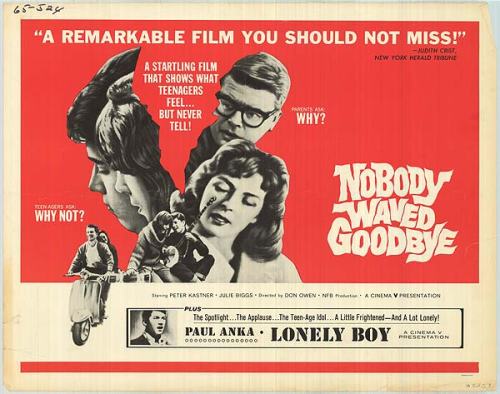
Peter (Peter Kastner) is 18 and looking to spread-his-wings, but doesn’t like what he sees in the adult world. Everyone seems trapped by their dull jobs and mundane routines, which is something he doesn’t want to fall into. He has big dreams. He wants to run away with his girlfriend Julie (Julie Biggs) and live a life based completely on his own whims while never becoming a slave-to-the-system like everyone else. Then he gets in a fight with his parents and they kick him out and after struggling to find work without even a high school diploma his attitude quickly changes.

If you can get past the wretched opening song, which is sung by Kastner and played over the credits, then this film really hits-the-mark. I was impressed with the camera work especially during the dinner time conversations amongst the family members where director Don Owen shoots it with a hand-held camera and zooms in and out on the person’s face as they are speaking. This is something that is quite common today especially on TV-shows, but back then was rarely if ever used, which makes this well ahead-of-its-time and even groundbreaking. I also enjoyed the conversational quality of the dialogue and having two conversations going on at the same time, which again didn’t come into vogue until years later when Robert Altman did it in M*A*S*H.

The film also clearly allows for ad-libbing amongst its actors. There is a scene in which Peter and Julie go paddle boating and come upon a large sofa submerged in the water and then comment on it. Clearly the filmmakers didn’t put the sofa into the lake simply to film the short scene that has nothing to do with the rest of the story, but it still helps set the tone for keeping things fresh and real.

Kastner is great and it’s refreshing to have a protagonist in a film that you like at some points and feel like wringing-his-neck at other times. Too many movies today, especially Hollywood ones, create lead characters that are politically correct caricatures while this movie instead has real human beings that are not tailored made to conform to the likings of any particular demographic.

It’s a shame to say that a movie that came out over 50 years ago is still considered cutting-edge, but compared to the tired, formulaic glop coming out today it really is. The script is uncompromised and holds-no-punches while keeping things gritty and stark and making profound, universal points along the way. I also found it fun that the main character here, who was clearly a baby boomer, displays the same anti-establishment, anti-work attitude that now gets placed squarely onto the ‘dreaded millennials’ and yet it seems the boomers were just as reluctant to get into the rat race as all the generations that have followed them and therefore shouldn’t be waiving their finger at anyone.

nobody waved goodbye 2

My Rating: 8 out of 10

Released: August 13, 1964

Runtime: 1Hour 20Minutes

Not Rated

Director: Don Owen

Studio: National Film Board of Canada

Available: None at this time.

Rosalie Goes Shopping (1989)

rosalie goes shopping

By Richard Winters

My Rating: 4 out of 10

4-Word Review: Shopaholic turns to crime.

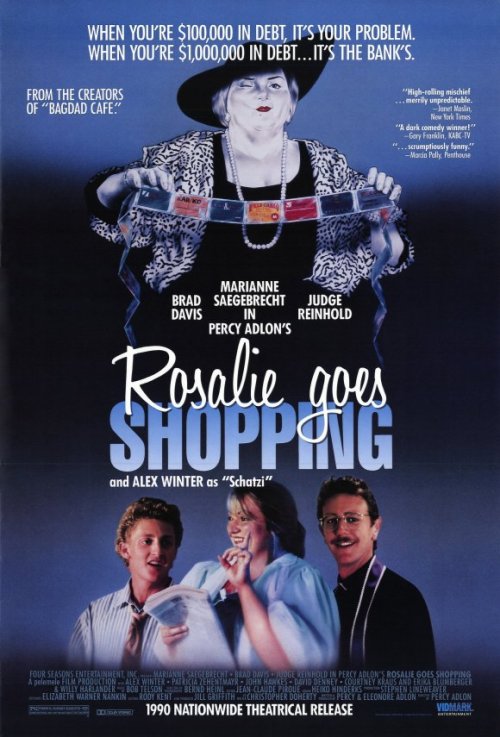
Rosalie (Marianne Sagebrecht) is a German immigrant who has married an American crop duster (Brad Davis) and moved onto a small ranch just outside of Stuttgart, Arkansas. There they raise a large family while also becoming obsessed with American consumerism by recording all the TV-shows on their VCR, but only so they can watch the commercials. Rosalie becomes a particularly obsessive shopper buying things that she really doesn’t need even when her money and credit become tapped out. She then figures out a way to hack into the accounts other people and companies via her home computer, which allows her to continue to pay for all her items by embezzling it from others.

This marks the fourth teaming of director Percy Adlon and star Sagebrecht and straight after their big success in the cult classic Bagdad Café. The film was made on-location in Arkansas, but financed by a German production company. I’m not sure what camera lens was used or the film stock, but the color contrast is quite unique and gives the whole thing an Avant-garde appearance. The storyline is original as well and veers off into unpredictable ways while making a great point, which is that unbridled capitalism can be just as dangerous and oppressive as any other form of government.

Sagebrecht is a delight and the moment where tears trickle down her checks as she becomes homesick for her native land while watching home movies taken in Germany is touching. Judge Reinhold is funny as the priest who becomes aware of Rosalie’s shenanigans through hearing them during confession, but completely exasperated about what to do about it. Brad Davis, a highly underrated actor who died too young, plays a rugged country man that’s completely against type from his more famous roles in the homoerotic films Midnight Express and Querelle.

Unfortunately the script, which was co-written by Adlon and his wife Eleonore veers too far into the whimsical and shows too much of a naiveté in regards to cyber technology. The idea that Rosalie could somehow ‘guess’ what everybody’s password was even those used by big companies and major banks is too farfetched and even if she did somehow figure them out all they’d have to do is change them once they realized their accounts had been hacked, which would’ve ended Rosalie’s cybercrimes right there.

The fact that she is able to cover up her crimes by doing even more outrageous ones and never, ever having to face the consequences of her actions is far too fanciful. It also makes light of a genuinely serious issue where the poor and lower middle-class do not have the same resources to get out of their financial predicaments as the rich do. They also do not have the convenience to magically cheat-the-system like the character here and those that do will almost always have it catch up with them where they will ultimately face harsh repercussions no matter how ‘justified’ they may have felt they were in doing it.

Some may argue that this was just a wish-fulfillment comedy, but even then there still needs to be some realm of possibility to it for it to be satisfying and this has none and it also makes the so-called clever twists lose their edge once you realize that none of it is plausible.

My Rating: 4 out of 10

Released: May 19, 1989

Runtime: 1Hour 34Minutes

Rated PG

Director: Percy Adlon

Studio: Pelemele Film

Available: VHS, DVD (Region 2), Amazon Instant Video

Night Moves (1975)

night moves 1

By Richard Winters

My Rating: 7 out of 10

4-Word Review: Searching for runaway teen.

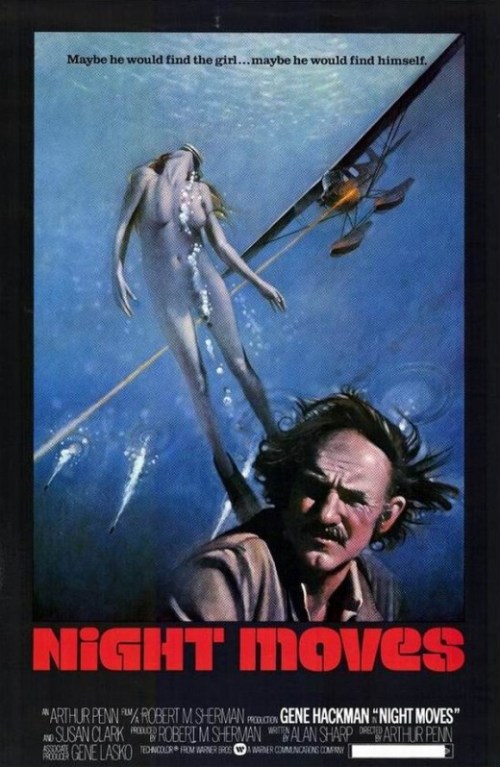
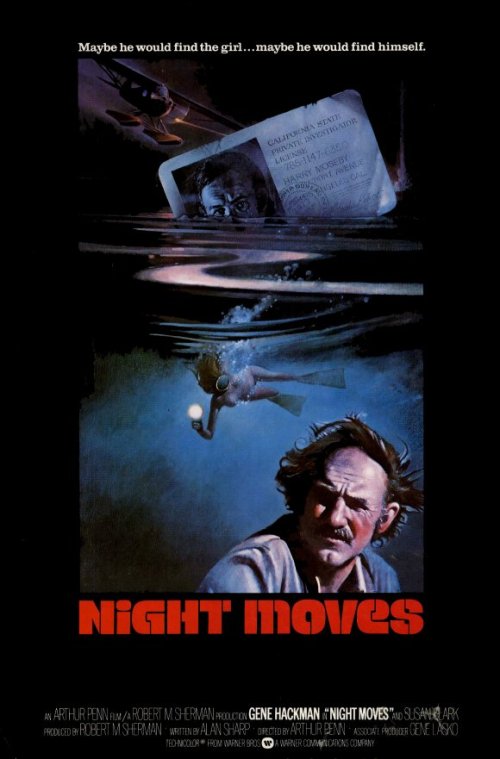
Harry Moseby (Gene Hackman) is a down-on-his-luck former football player who is now working as a private detective. The cases are not interesting and when his wife (Susan Clark) begins having an affair he feels like his life has hit rock bottom. Then he gets what he thinks is just another routine case which is finding the missing runaway teenage daughter (Melanie Griffith) of an aging, alcoholic actress (Janet Ward). The case though harbors many dark and unexpected turns that eventually gets Harry wrapped up into a world of art smuggling and murder.

To me one of the lasting impressions of the film, which I have seen many times over the years, is the way it incorporates nighttime into the story. The majority of the action and dialogue take place very late and makes full use of the sound of the night bugs croaking and chirping. In fact this becomes ‘the music’ for the scenes and helps create a third character as it reveals the darkness harboring inside the characters.

Hackman gives another outstanding performance playing a protagonist struggling against loneliness and frustration while realizing that it may be an inevitable part of life and something that cannot be ‘defeated’. His best line comes when he describes where he was when the Kennedys were shot. When John F. was assassinated he was playing football and still full of dreams, but then 5 years later when Bobby was killed his life had already fallen into an apathetic rut.

Jennifer Warren is good in support and looks terrific during a topless lovemaking scene. Griffith, Edward Binns and James Woods do quite well in their respective roles and the lesser-known Janet Ward plays a pathetic, boozing old broad about as well as anyone could.

The majority of the story is talky, but still intriguing. The only action comes near the end when Harry gets attacked by a seaplane while he is out on a boat. This scene is especially good because it plays off of the famous airplane segment in North by Northwest and is almost as riveting including the memorable and unique way Harry is finally able to identify the mysterious pilot.

The script, by Alan Sharp is overall smart, but does suffer from a few moments where things don’t make complete sense. One of those is when Griffith finds out that Harry plans on taking her back to her mother which she insists will ‘never’ happen, but then in the next shot we see her getting into his car, which I would think she’d resist doing for fear that she would be placing herself into too much of a vulnerable position and he would use the opportunity to ‘kidnap’ her and take her back to where she didn’t want to go.

Another moment comes when Griffith leaves a message on his answering machine that alerts Harry about something she feels he should look into. He begins listening to it, but then shuts it off when his wife enters the room yet he never goes back to listen to the rest of it even after Griffith later turns up dead.

When a death occurs on a movie set Harry is the one who gets called in to analyze the film footage showing the mishap, which isn’t realistic as the police would’ve been the ones doing the investigation and they most likely would’ve confiscated the footage in order to be used later as possible evidence.

night moves 2

My Rating: 7 out of 10

Released: June 11, 1975

Runtime: 1Hour 39Minutes

Rated R

Director: Arthur Penn

Studio: Warner Brothers

Available: DVD, Amazon Instant Video, YouTube

Another Nice Mess (1972)

another nice mess 1

By Richard Winters

My Rating: 2 out of 10

4-Word Review: Spiro and Tricky Dick.

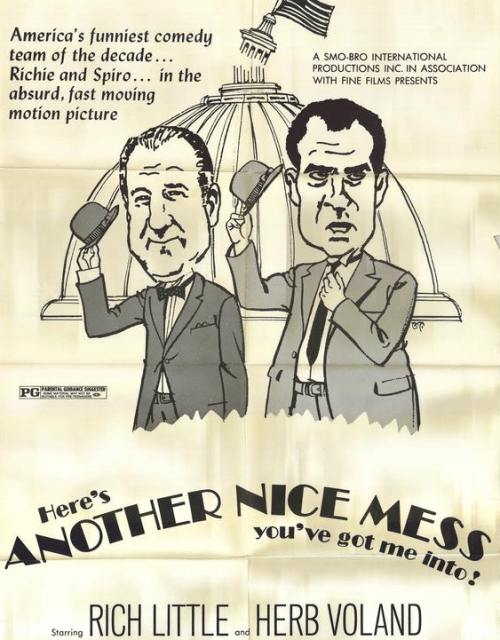
This film is an odd, misfired concoction from writer/director Bob Einstein (Albert Brooks’ older brother) who had just won an Emmy for his writing on ‘The Smothers Brothers Show’ and decided to try his creative muscle at filmmaking. The idea might’ve seemed clever at the time, but it has not aged well. The premise has President Richard Nixon (played by Rich Little) and Vice President Spiro Agnew (played by Herb Voland) behaving like Laurel and Hardy and spending the entire runtime going through some of that classic duo’s more famous routines.

If you were alive during Nixon’s administration than this may come off as being a bit funnier than to those who weren’t however, taking potshots at the President is no longer fresh and for the most part even a bit tiring to watch. The vaudeville-like routines are predictable and this thing had me bored two-minutes in and even with its brief running time still was a major drag to sit through.

Voland is much funnier than Little and seems to imitate the comic legend of Stan Laurel far better than Little does with Hardy, but the characters are played up to be completely moronic and having to watch them do and say one mind numbingly stupid thing after another becomes very one-dimensional.

The film Hail was a Nixon satire that came out around the same time, but that film fared much better and was even quite clever at times. The main reason was that they had a plot while this one is just a non-stop gag reel with a first-graders level of sophistication.

If there’s one redeeming quality for watching this it would be in seeing Steve Martin in his film debut playing a hippie. He doesn’t have his patented white hair here and instead it’s long, curly and brown. I probably wouldn’t have even recognized him if it weren’t for his voice and mannerisms.

My Rating: 2 out of 10

Released: September 22, 1972

Runtime: 1Hour 6Minutes

Rated PG

Director: Bob Einstein

Studio: Fine Films

Available: None at this time.