Category Archives: Surreal/Fantasy

Shadey (1985)

shadey

By Richard Winters

My Rating: 6 out of 10

4-Word Review: His thoughts onto film.

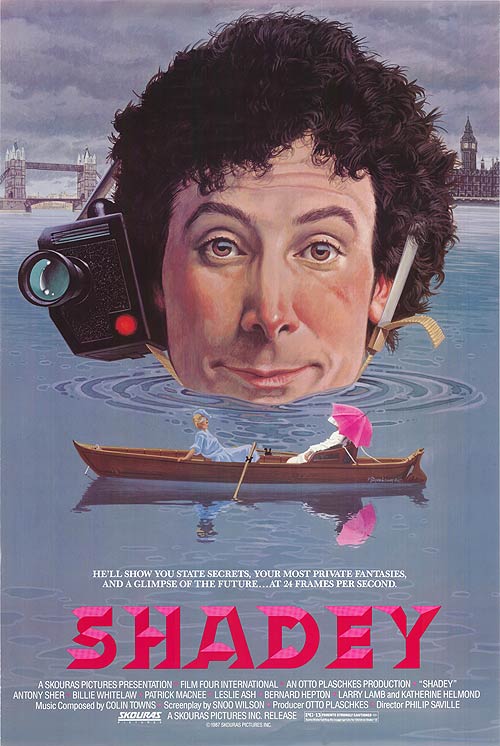
Oliver Sher (Anthony Sher) finds out that he has an amazing ability. Not only can read other people’s minds, but he can also transfer those thoughts onto film. He tells his secret to Cyril (Patrick Macnee) a wealthy businessman hoping he can use his unique ability for some purpose and thus pay him enough money for a sex change operation, which is his ultimate goal. His only condition is that his ability not be used for military purposes. Unfortunately Cyril disregards this and strikes a deal with Doctor Cloud (Billie Whitelaw) who does experiments for the military and sees Oliver as her next guinea pig. Soon Oliver finds himself and his ability being exploited, but gets his revenge by taking advantage of Cyril’s emotionally fragile wife Constance (Katherine Helmond) in a weird and interesting way.

This film is quite original and manages to hold up all the way through. Some of the caricatures are a bit predictable mainly in the way it portrays the older brass businessman and military, but otherwise it defies all genres. It has a nice cerebral quality to it as it moves between being sad and dehumanizing to sharp and satirical sometimes in the very same scene. The humor is laced with drool, dry British wit that makes it engaging and fun.

The old British pros really help here. Macnee with his perpetually stern expression and terse delivery is fantastic. Whitelaw is also good as always as she plays her cold business-like character perfectly.

The best performance though goes to Helmond. She is best known for play Jessica Tate on the 70’s sitcom ‘Soap’ as well as co-starring in the 80’s TV-show ‘Who’s the Boss?’ yet her appearance here may be her career highlight. She has always had a wonderful ability at conveying child-like qualities in adult characters and here that comes to great use. Her facial expressions are both touching, unnerving as well as humorous and the scene where she eats coal from a fireplace while crouching on the ground is unforgettable.

The script could have gone further with its intriguing premise, but manages to be provocative nonetheless. The points it makes are good as it shows how those that are exploited will eventually do the same to others and how you never really know or understand someone no matter how much you think you get inside their head as well as examining how the image can sometimes take on more importance than the reality. The interesting chase that takes place at the end where Shadey continuously rides an elevator from the top of a building to the bottom while the bad guys busily run up and down the stairs to catch him is just one of the many unique scenes in this movie that makes it worth catching for those with an offbeat frame of mind.

My Rating: 6 out of 10

Released: November 18, 1985

Runtime: 1Hour 30Minutes

Rated PG-13

Director: Philip Saville

Studio: Skouras Pictures

Available: VHS
Brewster McCloud (1970)

brewster mccloud 1

By Richard Winters

My Rating: 9 out of 10

4-Word Review: Flying in the Astrodome.

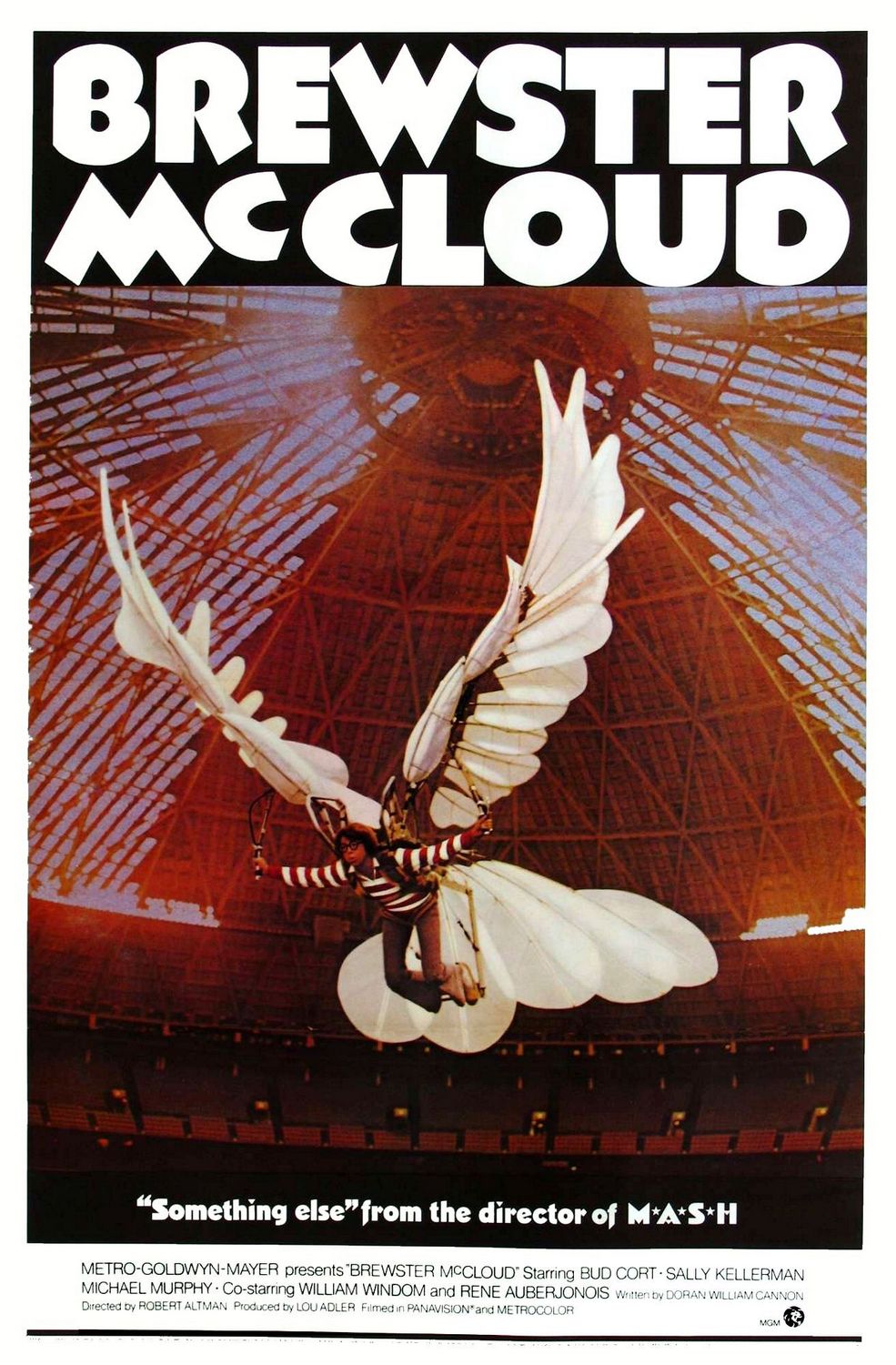
Brewster McCloud (Bud Cort) is a young man who lives and hides inside the giant Astrodome in Houston, Texas. He dreams of one day flying like a bird and secretly works on building a contraption that will help him do it while being aided by a mysterious guardian angel named Louise (Sally Kellerman). Meanwhile strangulations start occurring all over the city and the police become convinced that Brewster may have something to do with it. As he gets ready to ‘spread his wings’ and fly for the first time the police surround the place and try to arrest him.

This film is reportedly director Robert Altman’s favorite out of all the ones that he did and it is easy to see why. The quirky, offbeat script by Doran William Cannon nicely compliments Altman’s free-form, cerebral style. The film works on many different levels with every shot and scene being unique and a kind of story in itself. The dream-like quality is nicely balanced with harsh realities creating an interesting theme that touches a wide array of senses. Although this film is never mentioned in relation to car chases the one that is has is exciting and well photographed without any of the jump cuts that you normally see.

The city of Houston gets captured well and I liked the fact that Altman stayed away from the downtown and instead focused more on the neighborhoods and city streets. The filming of the inside of the Astrodome is the most impressive and the building becomes like a third character. It may seem hard to believe now, but at one time it was considered ‘the eighth wonder of the world’ and was the very first dome stadium in existence. Watching Cort fly around on the makeshift wings he creates gives off an exhilarating feeling especially with the way Altman captures it against the backdrop of the stadium’s ceiling filled with skylights. The best shot in my opinion though is the bird’s-eye view of seeing Kellerman walking the entire length of the field and out the exit.

The broad and amusing characterizations are fun and Altman gives his actors wide range to create them. Some of the best ones are Stacy Keach who is unrecognizable under heavy make-up as an elderly, cantankerous and greedy landlord who goes reeling down the city streets in nothing but a wheel chair. Bert Remsen is good as a corrupt and racist policeman who even beats and berates his own family. Michael Murphy is interesting as a narcissist, hotshot detective who ends up killing himself and Rene Auberjonois as the lecturer who slowly turns into a giant bird as the film progresses. There is even the aging Margaret Hamilton who says a few curse words and dies while wearing her ruby red slippers.

The film is one-of-a-kind and perfect fare for those looking for something offbeat and diverting. The kooky opening and ending title sequences alone make it worth it. My only real complaint would be the fact that supposedly a bird is committing all these strangulations, but we never see how. All the viewers see is the victims getting bird poop on them and nothing more. I realize this might have been technically difficult to film or visualize, but for such an otherwise creative movie this seems like a bit of a cop-out.

My Rating: 9 out of 10

Released: December 5, 1970

Runtime: 1Hour 45Minutes

Rated R

Director: Robert Altman

Studio: MGM

Available: VHS, DVD

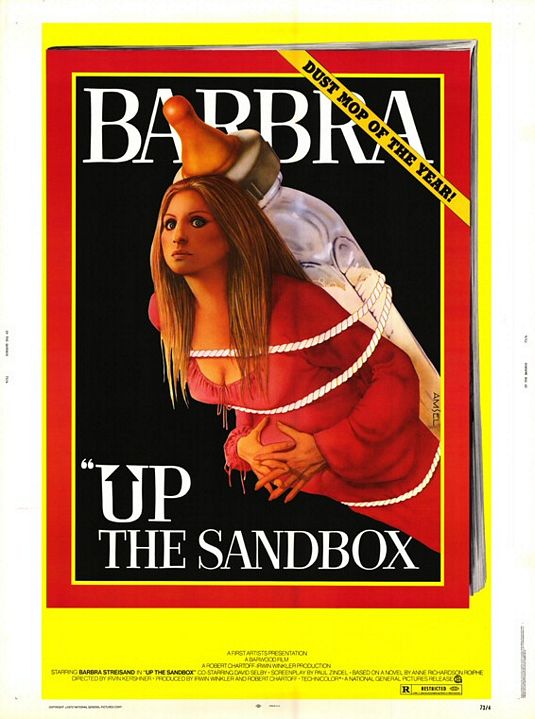
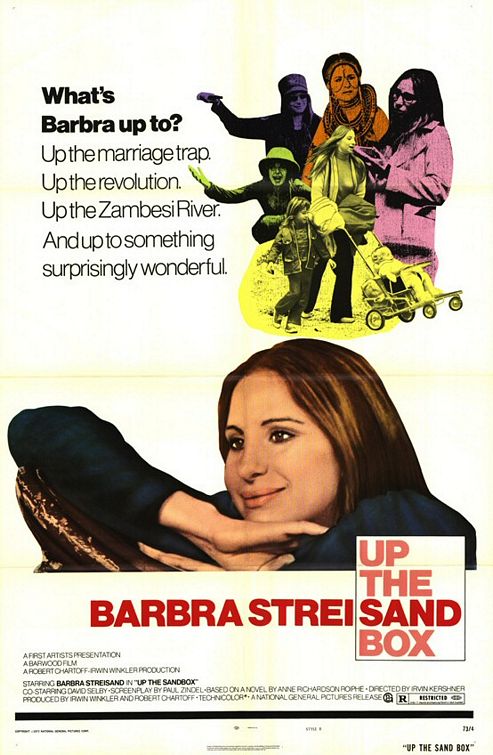
Up the Sandbox (1972)

up the sandbox 2

By Richard Winters

My Rating: 7 out of 10

4-Word Review: Housewife has secret fantasies.

Margaret (Barbra Streisand) is a neglected housewife taking care of her two children while her husband Paul (David Selby) busily works on his novel and thesis. She lives in a rundown New York apartment that seems to have bugs crawling from everywhere. Her nagging mother (Jane Hoffman) pressures her to move back with them to the suburbs, but she enjoys the excitement and independence of city life over lily white suburbia, so she resists. Now she finds that she is pregnant with her third child and this along with the other stresses causes her to slip into secret fantasies that become more and more outlandish.

This film didn’t do well upon its initial release and is a bit forgotten, but deserves a look simply for its unique and memorable fantasy segments. The scene where she joins a black militant group that gets inside the Statue of Liberty and wires it with explosives is pretty good as is the part at a party where her stomach suddenly balloons out as if she is pregnant and when she pushes it in it makes her breasts larger. The scene where she meets a Fidel Castro-like dictator who takes off his shirt to expose that he has female breasts is funny and the finale that takes place inside an abortion clinic is interesting. The best though is when she is captured by an African tribe of topless women. The shot of their grossly overweight leader whose gigantic, sagging breasts seem to overlap her entire body ends up being the film’s most lasting image.

Hoffman is hilarious and a perfect caricature of a meddling mother of adult children. The part where Margaret fantasies about stuffing her mother’s face into an anniversary cake and then the two roll around on the floor where Margaret then punches her in the face had me laughing-out-loud.

Paul Zindel’s script nicely balances the fantasy with the gritty reality of urban living. It also envelopes the feminist issues with the social upheaval of the times and the speech that Margaret gives about women needing to be less like men and more like themselves is excellent.

Director Irvin Kerschner makes fine use of the New York locales giving the viewer an eclectic taste of its crowded neighborhoods and street culture as well as its epic skyline. I loved the cinema vertite style that has a sophisticated and trendy feel.

Streisand herself seems to be having a lot of fun and purportedly this is her favorite out of all the films that she has done. This was just before she went through her frizzy hair phase and the long straight style that she has here I feel makes her look sexy.

The pace is unusual especially for a comedy in that it isn’t frantic and does not have any quick edits. Instead the set-ups are quite slow and seem at times to be almost dramatic before throwing in a surprise punchline. Personally I liked this approach, but the unconventional style might have proved confusing to certain audience members who didn’t know what genre to place it in and may have been the reason for the poor box office returns, which is shame as the production overall is excellent and intriguing.

up the sandbox 1

My Rating: 7 out of 10

Released: December 21, 1972

Runtime: 1Hour 37Minutes

Rated R

Director: Irvin Kerschner

Studio: National General Pictures

Available: VHS, DVD

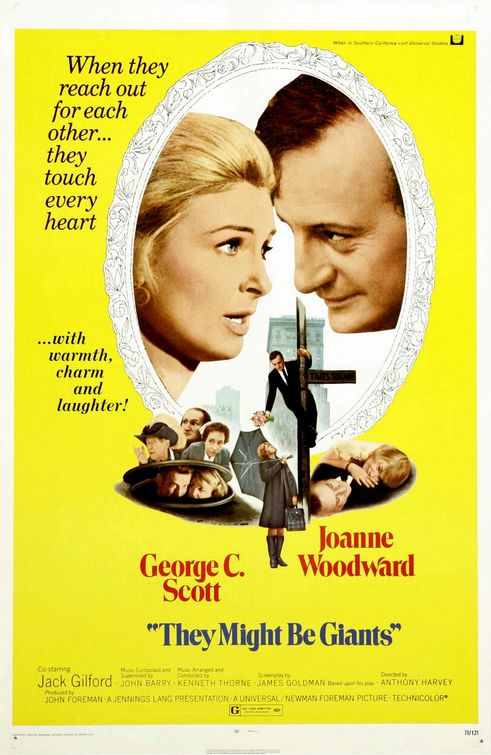
They Might Be Giants (1971)

they might be giants

By Richard Winters

My Rating: 4 out of 10

4-Word Review: He thinks he’s Holmes.

After the death of his wife Justin Playfair (George C. Scott) starts to think he is Sherlock Holmes and begins playing the part by smoking a pipe, wearing a deerstalker cap and playing a violin. His brother Blevins (Lester Rawlins) feels he needs to be institutionalized and hires a psychiatrist named Dr. Watson (Joanne Woodward) to analyze him. Watson finds Justin’s fantasy role-playing to be intriguing and reluctantly begins following him around on his fanciful jaunts to find clues from the evil Professor Moriarty and eventually the two begin a quirky romance.

The film, based on a play written by James Goldman, starts out with some potential. The musical score by John Barry has an interesting ominous quality to it. The idea of pitting the practical minded Dr. against the fanciful Playfair is initially engaging. Watching Woodward getting more and more exacerbated by Scott’s constant whims of fancy and refusal to ever to see reality is funny and lightly satirical. The film though drops off terribly when Watson loses all judgment and falls in love with the man despite the knowledge that he is clearly mentally ill. Watching the two frolic through New York City searching for meaningless clues to a mystery that doesn’t really exist makes the film pointless as well as losing all tension, momentum and plot. Having her fall in love with him at the very end might have worked, but having this otherwise sensible and intelligent woman get sucked into Playfair’s fantasy world so quickly is jarring and unbelievable. What is worse is that initially Playfair seems to be working on a real case and there is even a scene where he gets shot at, but then this side-story is frustratingly dropped without any explanation or conclusion.

Scott is in top form and this is an interesting follow-up to his Patton role that he did just before this. Woodward though steals it. She has never done much comedy in her career, but proves to be quite adept to it here. One of the funniest scenes has her trying feebly to cook a meal for Playfair in her cramped apartment despite having no skill at it.

Anthony Harvey’s direction is okay. I liked the way he captures the downtown streets of Manhattan during the rain. However, the film’s most interesting segment takes place in an all-night grocery store where over a loudspeaker are announcements of great sales and deals despite the fact that there are no customers. Eventually a police chase takes place inside there, which ends up being genuinely amusing on a silly level.

The vague wide-open ending cements this as being a complete waste of time and makes the whole thing a big build up to nothing. I realize that this is intended to be whimsical, but even then there needs to be some grounding and this film has none.

My Rating: 4 out of 10

Released: June 9, 1971

Runtime: 1Hour 38Minutes

Rated G

Director: Anthony Harvey

Studio: Universal

Available: VHS, DVD, Netflix streaming

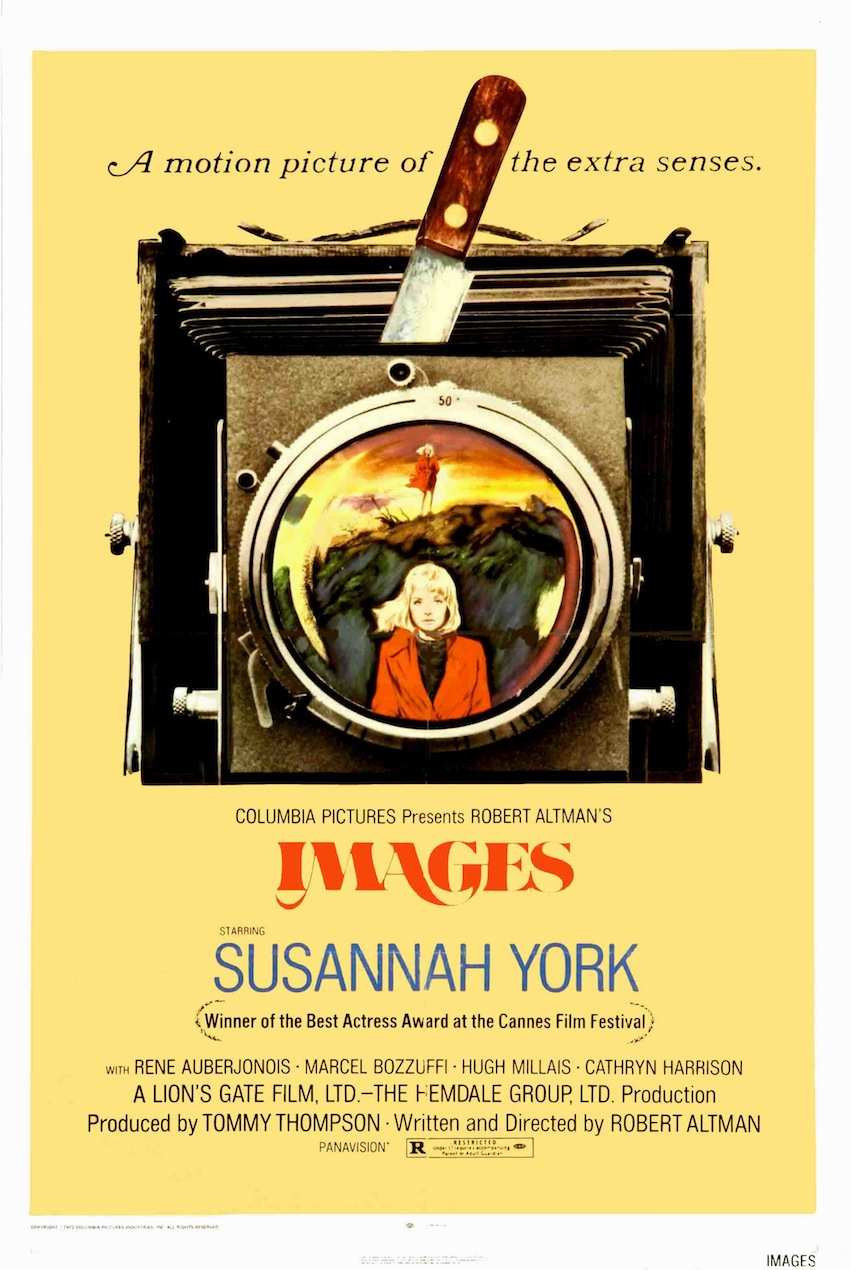
Images (1972)

images

By Richard Winters

My Rating: 8 out of 10

4-Word Review: Demons of the mind.

This is the missing link for any Robert Altman fan or detractor as this is different from any of his other films and completely original from beginning to end. Not only was it way ahead of its time, but proves that he is deftly skilled at handling any directorial task or material.

The story involves a tormented and emotionally fragile woman named Cathryn (Susannah York) who starts to see strange visions. These visions seem so real that she can no longer tell if they are all just inside her head and decides the only way to get rid of them is to mentally ‘kill’ them, but this in turn only leads to further complications.

What really makes this a unique film is that you get inside this woman’s head and actually start to understand her logic and experience her torment. The film also makes terrific use of silence and uses it to accentuate the isolation that the character feels. The setting has a sort of surreal quality and the location of the house is impressively remote.

York has a knack for playing victimized and vulnerable women. In many ways her role here seems like an extension of her character from The Killing of Sister George. Although she makes you sympathetic to her predicament her screams are too screechy and fail to attain the shrillness that would create the startling effect that the filmmakers desired.

The real star may actually be Vilmos Zsigmond and his cinematography. His framing and composition is not only flawless, but breathtaking. He makes the wintertime Irish countryside look like a whole different world and the stillness of the lake that is shown seems almost unreal.

There are a few too many obvious and clichéd shots of mirrors and puzzles and it could also gone much further with its unusual premise. Still this is a unique and entertaining movie that should keep you guessing all the way to the end. The pace is slow, but deliberate with a payoff that is worth it.

My Rating: 8 out of 10

Released: December 18, 1972

Runtime: 1Hour 41Minutes

Rated R

Director: Robert Altman

Studio: Columbia Pictures

Available: DVD

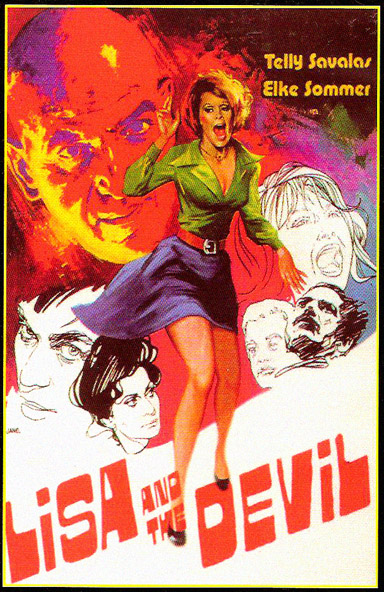
Lisa and the Devil (1973)

lisa and the devil

By Richard Winters

My Rating: 3 out of 10

4-Word Review: Where is the plot?

Lisa (Elke Sommer) is a tourist in Spain who gets lost and finds shelter inside a large mansion run by a butler Leandro (Telly Savalas) and a Countess (Alida Valli). Soon Lisa begins to experience strange occurrences and visions. People turn up dead and then alive again. When she tries to escape she finds that she can’t and is now stuck in a surreal world with no exit.

I am use to watching Italian horror films being strong on the visual end and weak with the plot, logic and character development especially when they attached to either Mario Bava or Dario Argento, but this one goes to the extreme. Nothing makes sense and scenes are thrown in haphazardly and go nowhere. The basic premise is too general and unfocused and the entire production seems to be an exercise in interesting camera work and nothing more. Yes there are a few atmospheric moments, but it all adds up to very little.

Had the special effects been gory or impressive I might have forgiven it, but for Bava standards they are lacking as well. For one thing there is very little gore to begin with and what we do see looks amateurish. The scene where a man gets run over by a car clearly looks like a mannequin and as the driver backs up and runs him over several more times it becomes even more obvious.

Sommer makes for a weak heroine. Her character is as vague and mysterious as all the others, so the viewer never gains any empathy or concern for her fate. Her short shoulder length haircut makes her look middle-aged and dowdy. Also, Sylvia Koscina her costar has facial features that are too similar to Elke’s and for a while I thought she was Elke with a brunette wig. Her best moment is actually her nude scene of which she looks great although I noticed her eye lids constantly fluttering when her character was supposedly asleep.

Normally I love Telly Savalas and he can be effectively menacing, but here he is sorely underused. The character pops in and out sporadically, but really doesn’t do much. I did like that he is constantly sucking on lollipops, which later became his trademark during his run on the ‘Kojak’ TV-series.

I was hoping for some grand over-the-top finale to make up for having to sit through all this, but it never came. The climax, which takes place inside a jet airliner no less, is as underwhelming as everything else. Not surprisingly this film was edited into a completely different story and reissued as The House of Exorcism, which will be reviewed tomorrow.

My Rating: 3 out of 10

Released: May 9, 1973

Runtime: 1Hour 32Minutes

Rated R

Director: Mario Bava

Studio: Leone International

Available: DVD, Blu-ray, Amazon Instant Video, Netflix streaming

Daisies (1966)

daisies 1

By Richard Winters

My Rating: 7 out of 10

4-Word Review: Girlfriends rebel from society.

Two young women (Ivana Karbanova, Jitka Cerhova) who are both named Marie decide that society has nothing to offer them and that they will not comply with its norms. They then proceed to jaunt through the streets of Prague causing havoc and destruction everywhere they go and with everyone they meet while also trying to find themselves and their true purpose in life.

This film is similar to Ingmar Bergman’s Persona, which was released the same year. Both films rely heavily on quick edits, jump cuts, bizarre imagery and unconventional narrative structures. The only difference is that at least Persona had a story behind it and two interesting characters. This film has neither. The two women behave too strangely to be relatable and the scenes seem disconnected. This is one film that takes the avant-garde, experimental approach to the most extreme. The result is a bit off-putting and took me until the halfway mark before I could get into it. Others may not even make it that far. Personal taste will gauge how much one gets into it as well as how much they get out of it.

On a completely visual level it is fascinating. The film goes from being black-and-white to color and then back again at random intervals. There is one scene in a restaurant where the scene changes to a different color filter each time a character speaks a different line of dialogue. The segment showing photos of a variety of butterflies done at a rapid fire pace is also interesting. The best part is probably near the end when the girls walk into a banquet hall and proceed to eat up all the food that is in it. In fact the film shows an amazing amount of eating. It seems like every other shot has the girls stuffing their mouths with some sort of edible. However, instead of making you hungry it ends up kind of grossing you out.

If there is anything that got on my nerves it was director Vera Chytilova’s use of sound. There was too much repetition of noises. For instance in the opening scene there is what sounds like a squeaking door that is implemented after each actress says her line that quickly becomes irritating. The slobbering, chewing sound as the girls eat the banquet food is overdone as is their background whispering that occurs near the end.

Many feel this is a movie about budding feminism and I would agree on that for the most part. I enjoyed how the women did not feel that they needed a man in their life to ‘be whole’ and in many ways seemed to manipulate and make fun of the male characters, or simply become bored with them especially when the men would convey to them their ‘undying love’.  However, to me it was more about the rebelling and disdain of the communist regime and living in an environment that promoted hard work and not much else. I liked the segment at the end where the two women proceed to be ‘good’ instead of ‘bad’ and try to clean up the mess that they made while trying to convince themselves that working hard will make them happy even though it really doesn’t.

I’ve seen a lot of weird sixties movies, but this one tops them all by a mile. It certainly doesn’t seem dated and easily transcends its era. Not only was it ahead-of-its-time, but I would maintain that it STILL is.

Although the runtime is listed as being 74 minutes the version I saw, which was from Czech New Wave, came out to being only an hour.

My Rating: 7 out of 10

Released: December 30, 1966

Runtime: 1Hour

Not Rated

Director: Vera Chytilova

Studio: Ustredni

Available: DVD

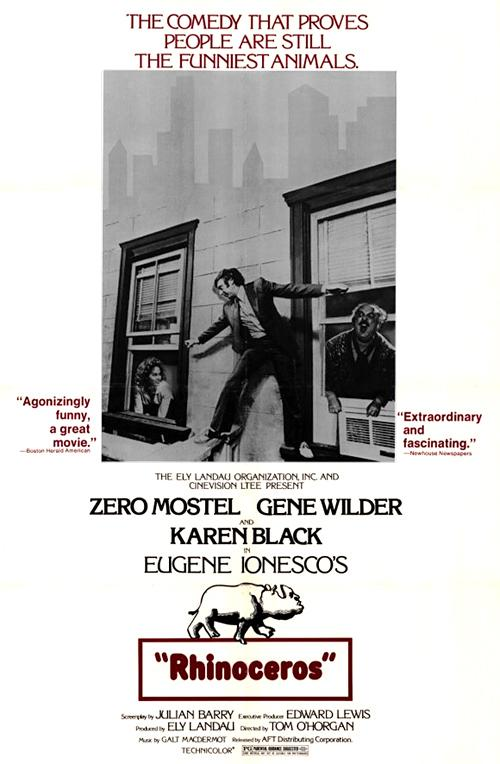
Rhinoceros (1974)

rhinoceros

By Richard Winters

My Rating: 6 out of 10

4-Word Review: People turn into rhinos.

Much maligned film is really not as bad as its reputation states. Yes the scenes and scenarios are at times awkward and stilted. The sets and color schemes run from being drab to horribly garish. The music is loud and obnoxious and doesn’t fit the mood of the film at all. Also despite having the name in its title and being all about rhinos you never actually see one. Sure it’s low budget, but even some stock footage of one from “Wild Kingdom” would have helped.

Yet even with all this the film still has its moments. It’s based on the Eugene Ionesco play and involves everyone getting turned into a rhinoceros. Zero Mostel, Gene Wilder, and Karen Black all resist, but slowly unravel to the ‘peer pressure’ and wanting to be ‘part of the crowd’. The outrageous premise is simply a front to examine the human phenomenon known as conformity, both on those that do and those that don’t. It is rare that anything tackles this subject with any serious study, yet this one does. The observations are, believe or not, quite interesting and accurate and Wilder really does make a terrific non-conformist.

The best part though may actually be one of filmdom’s most bizarre scenes ever. It features Wilder and Mostel alone in a room where Mostel slowly turns into a rhino. The scene goes on for well over twenty-five minutes and features no special effects or makeup. It relies totally on Mostel and his acting range to pull it off. He gives it an amazing amount of energy and seems more than up to its weird demands. It’s definitely worth a look for this scene alone.

My Rating: 6 out of 10

Released: January 21, 1974

Runtime: 1Hour 44Minutes

Rated PG

Director: Tom O’Horgan

Studio: American Film Theater

Available: DVD, Amazon Instant Video

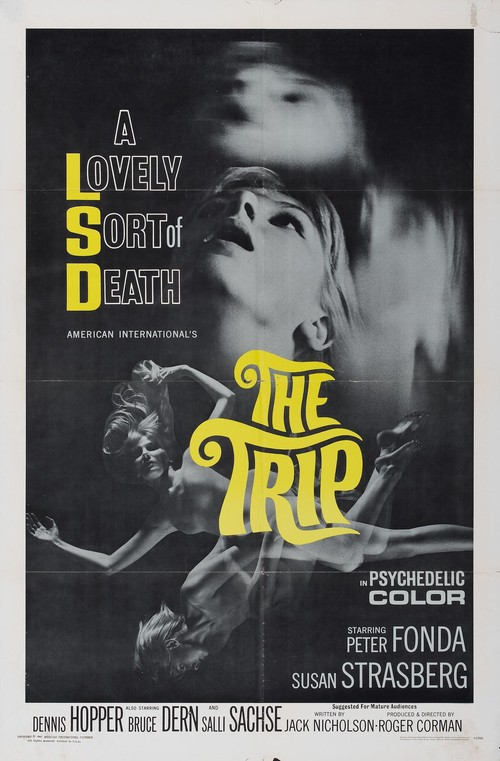
The Trip (1967)

the trip

By Richard Winters

My Rating: 5 out of 10

4-Word Review: He tries some acid.

Jack Nicholson wrote the screenplay to this film which is based loosely experiences he had while taking LSD as well as the break-up of his marriage to actress Sandra Knight. The story centers on Paul (Peter Fonda) a director of TV commercials whose marriage to Sally (Susan Strasberg) is on the rocks. He has a need to ‘find himself’ and seeks help from his friend John (Bruce Dern) who is a self-styled acid guru. John gives Paul some acid while promising that he will stay with him during his drug induced trip. The rest of the film then deals with Paul’s experiences both in his mind and in his dealings with the outside world while he is hallucinating.

To prepare for the film Nicholson, Fonda and Dennis Hopper, who appears in a minor supporting role, all took part in a group LSD trip and the various visions that they experienced are incorporated here. Director Roger Corman also tried LSD at a different time to prepare for the film. The only one not to try it was Dern who was staunchly opposed to recreational drug use and in fact even his character doesn’t take any as evidenced by a scene where everyone is taking a puff of some marijuana and when it gets passed to him he simply passes it to the next person without trying even though everyone else does.

The scenes recreating the acid trip are not all that interesting or imaginative. It’s all pretty much what you would expect with a barrage of artsy colorful designs popping up at the viewer in split second intervals that reminded me very much of looking through a kaleidoscope. The images aren’t coherent, nor meant to be, and become vapid in the process. The scene involving Paul sitting on a merry-go-round while trying to justify his existence to Hopper who is dressed in a devil-like costume gets quite tedious.

Things improve during the second half when John, who promised he would stay at Paul’s side during his trip, ends up leaving him momentarily to retrieve some apple juice. During this time Paul escapes from the home he is in and goes out onto the city streets. The editing and effects here are impressive and ahead of its time. Some of the visits he has with the people he meets prove interesting including an offbeat conversation that he has with a lady that he meets inside a Laundromat as well as one he has with a very young girl inside her house.

Although he starts out shaky I felt Fonda’s performance was pretty good and this may be one of the best roles of his career. Strasberg who receives second billing appears just briefly and has very few speaking lines. Dern is always fun when he is playing eccentric or intense characters, but here where he is playing a relatively normal one he is boring. His part was originally written for Nicholson to play and I think he would have done better.

I was expecting some sort of tragic or profound-like ending especially with the opening paragraph that starts the film and is read by a narrator with a very authoritative newsman-like voice describing the ‘horrors’ of drug use and how it is becoming a serious societal problem. However, nothing really happens. The movie just kind of stops and that is it. The weak conclusion hurts what is already a so-so film making it like the drug itself an interesting experiment, but nothing more.

My Rating: 5 out of 10

Released: August 23, 1967

Runtime: 1Hour 25Minutes

Not Rated

Director: Roger Corman

Studio: American International Pictures

Available: VHS, DVD, Amazon Instant Video

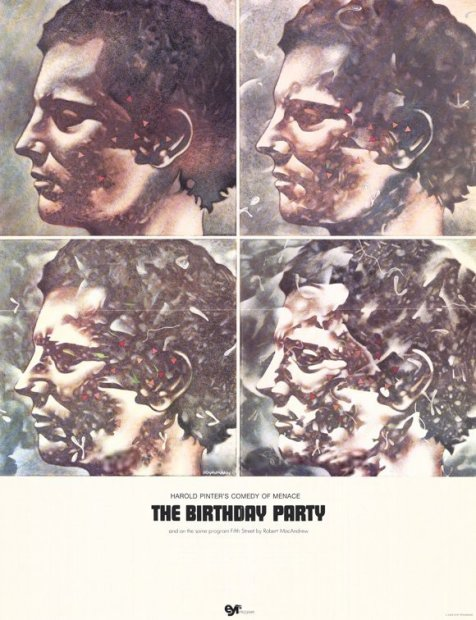
The Birthday Party (1968)

the birthday party 3

By Richard Winters

My Rating: 8 out of 10

4-Word Review: Tear up the newspaper.

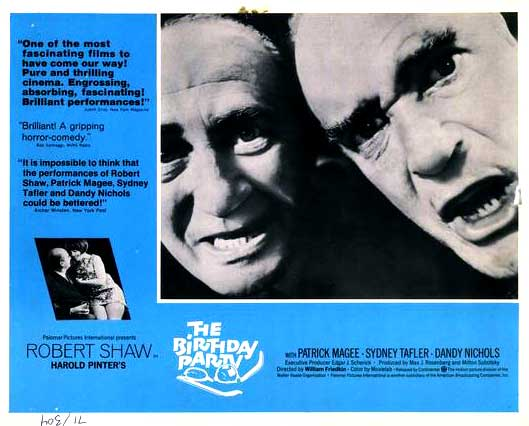
Since tomorrow will be my birthday I wanted to come up with a film that had birthdays as its theme and found this bizarre but fascinating obscurity. It is the story based on the play by Harold Pinter of Stanley Webber (Robert Shaw) a mysterious and private man who takes up lodging in a rundown British seaside house. He rents an upstairs room from Mr. and Mrs. Bowles (Moultrie Kelsall, Dandy Nichols) who are quite odd themselves. One day two men dressed in black suits (Patrick Magee, Sydney Tafler) come to pay Stanley a visit. They know something about Stanley’s past and their presence frightens him to the extent that it causes him to have a nervous breakdown.

On the surface this film shouldn’t work. There is an excessive amount of talking with dialogue that doesn’t say much and at times seems absurd. The set is drab and dirty with the camera seemingly locked down inside of it. There is never any explanation about Stanley’s past or what he is running from nor who the men are or what they know about him. The ending is elusive and the viewer will go away feeling more confused than they did at the start.

However, it is these ingredients that make the film so thoroughly intriguing. The seemingly banal dialogue is simply a façade for underlying thoughts and feelings. What Stanley is trying to run from is unimportant because it is really not about him at all and is instead more about ourselves, human nature and the quandary of our existence. It’s an examination of people’s futile attempts at trying to escape from who they are only to have society and life catch up with them. The set could be a metaphor for the inside of Stanley’s head. The grimy and decayed place symbolizes his decayed soul and the men in black suits are his conscience coming to haunt him.

Once you adjust to the eccentric narrative it then becomes a fantastic film for observing subtitles and nuance. Director William Friedkin shows a keenness for detail not only visually, but with the sound as well. The way the Magee character tears up a newspaper and the sound used for it could actually unnerve some viewers. Stanley’s meltdown scene is very unique and overall the direction is superb for such difficult material.

This movie was years ahead of its time, but for some it may be off-putting. However, it should be enjoyed by those who crave the avant-garde. It is also a rare chance to the see the normally strong-willed Shaw playing a very weak and vulnerable character. Nichols is also a stand-out playing an Edith Bunker type with a perverse streak lying just beneath the surface.

the birthday party 1

My Rating: 8 out of 10

Released: December 9, 1968

Runtime: 2Hours 3Minutes

Rated G

Director: William Friedkin

Studio: Palomar Pictures International

Available: VHS, DVD (Region 2)