Category Archives: Sequels

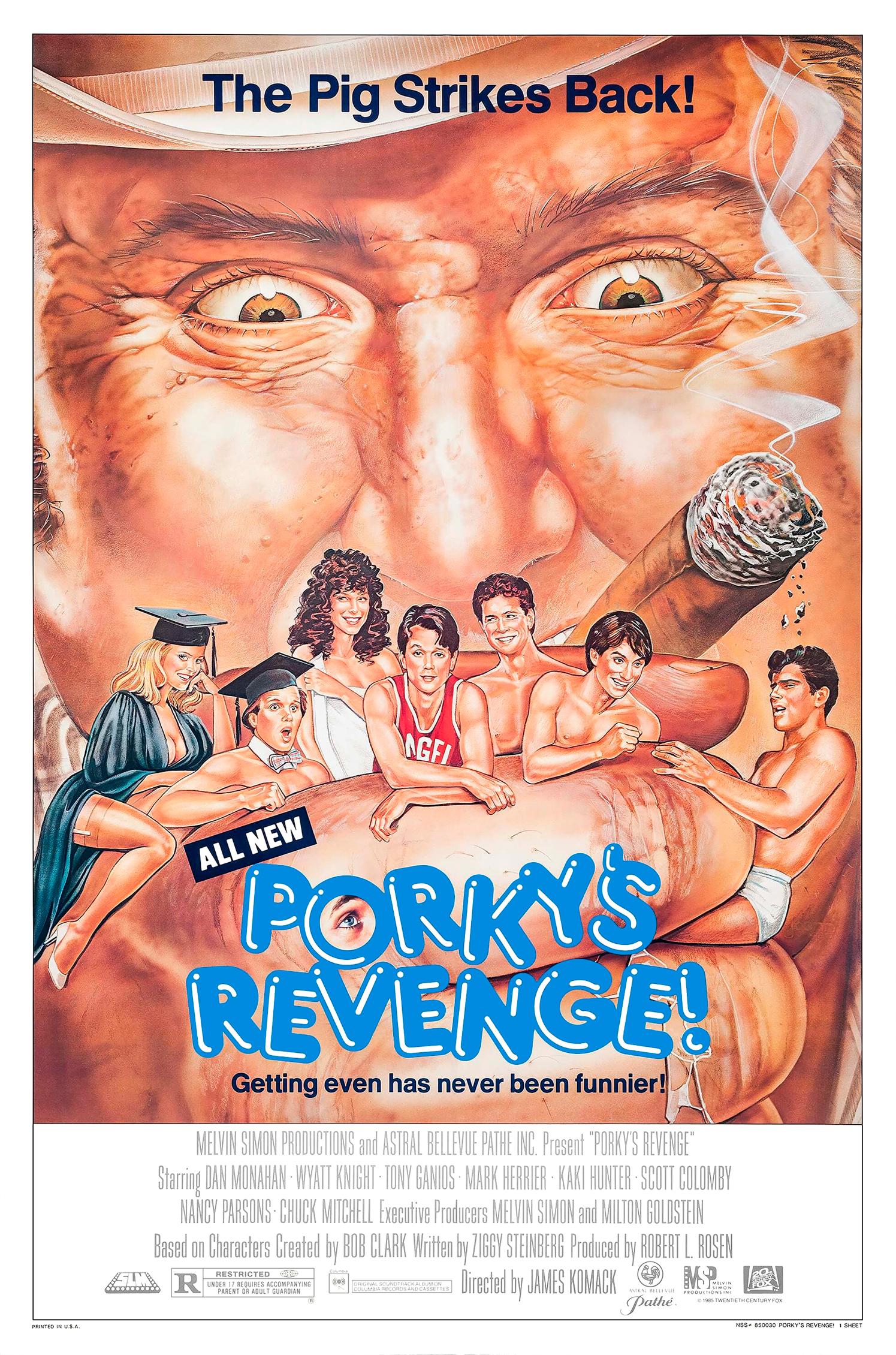
Porky’s Revenge (1985)

By Richard Winters

My Rating: 4 out of 10

4-Word Review: Rescue from shotgun wedding.

Porky (Chuck Mitchell) has rebuilt his casino that was destroyed by the teens in the first film by turning it into a riverboat. To help pay for this he extorts Coach Goodenough (Bill Hindman) for money and other such favors since he owes him on a gambling debt. Pee Wee (Dan Monahan) and his friends try to come to their coach’s rescue by sneaking onto the boat and taking pictures of the illegal gambling activity, which they hope to show to the district attorney. Porky though catches them in the act and threatens revenge, so to get out of their jam they agree to throw their next basketball game, so that Porky can bet against them and win a lot of money. Meanwhile Meat (Tony Ganios) is having problems of his own when he gets ‘forced’ into having sex with Porky’s daughter Blossom (Wendy Feign) causing Porky to insist that the two now must get married.

While fans of the franchise traditionally rate this at the weakest of the three films I found it to be a step up and even, at least at the beginning, to be moderately amusing particularly the pool scene where the cheerleaders concoct a scheme to get the boys to take off their bathing suits and prance around in front of the parents naked. The script was written by Ziggy Steinberg, whose career is the perfect encapsulation of Hollywood, where if you’re considered ‘up and coming’ you can find plenty of work, but the second your material is perceived as getting stale you can quickly become a leper and no offers to be found. This though came at a point where he was still a sought-after commodity, and I felt the script was better structured and seemed much more like a sequel continuing the elements from the first one versus going off on wild tangents like the second one did.

It helps having Chuck Mitchell back as the title character. It’s not like his acting is all that great, but his big presence and gruff, unfiltered delivery keep it fun and he offers a bona fide nemesis for the kids to go after. The casino boat is impressive, and the majority of the film’s $8 million budget was used just to build it. Seeing it get destroyed, which comes near the end, is exciting too and probably more memorable than the destruction of Porky’s original backwoods casino.

The characters though lack growth. Pee Wee for example is still obsessed about getting laid even though he had already lost his virginity in the first film, so his personality needed to evolve into something else. He should, especially being a senior, be the confident one who now takes some insecure freshman under his guidance to show him how it’s done instead of acting as a perpetually immature junior high kid, which by this point is no longer even remotely interesting.

The pranks continue to go overboard and boarder on cruelty. The one that gets played on Beulah Balbricker (Nancy Parsons) is especially stupid. She is set up to believe that she’s going to have a rendezvous with her long-lost boyfriend Snooky (Sandy Meilke), so she goes to a hotel room lying in bed in her nightie waiting for him to enter, so that they can return to their ‘passionate ways’ of the past. In reality though it would never work that way. These two had not seen, or corresponded with each other in many years, so there was no guarantee that both would still have the same feelings for the other. Since so much time had passed they were by this point theoretically strangers, so to avoid embarrassment and possible rejection they would instead get together at a restaurant, or over drinks in order to ‘catch up’ with things and then if they still both felt the same spark they might check into a hotel room, but nobody would just do that right off the bat.

I did though like the way her character changes, she’s the only one that does, by having her behaving like a completely different person once she’s finally able to get together with the real Snooky. However, I feel it would’ve made more sense had she been portrayed as someone who had never had sex versus one that just hadn’t had it in a while. Having her being lifelong frigid would’ve explained better why she was so hyper obsessed with suppressing everyone else’s sexuality. A better payoff would’ve had her really have sex with Tommy (Wyatt Knight) and found much to her surprise to liking it and this would then inspire her evolution.

Spoiler Alert!

The prank involving the bridge operator (Mal Jones) gets botched as well. It hinges on him believing that Wendy (Kaki Hunter) and Tommy are jumping off it to commit suicide, which distracts him enough so that he leaves to bridge operator room and allows Pee Wee to go in and close the bridge and thus destroy Porky’s boat that is trying to go underneath it. However, the bridge isn’t high enough from the water to be that dangerous. In fact, if it was truly that dangerous then both Tommy and Wendy would’ve died when they jumped off of it, but they don’t so the operator would never have been fooled. If anything, he would’ve thought they were just a couple of teens going out for a late-night skinny dip and wouldn’t have panicked at all.

My Rating: 4 out of 10

Released: March 22, 1985

Runtime: 1 Hour 32 Minutes

Rated R

Director: James Komack

Studio: 20th Century Fox

Available: DVD, Blu-ray

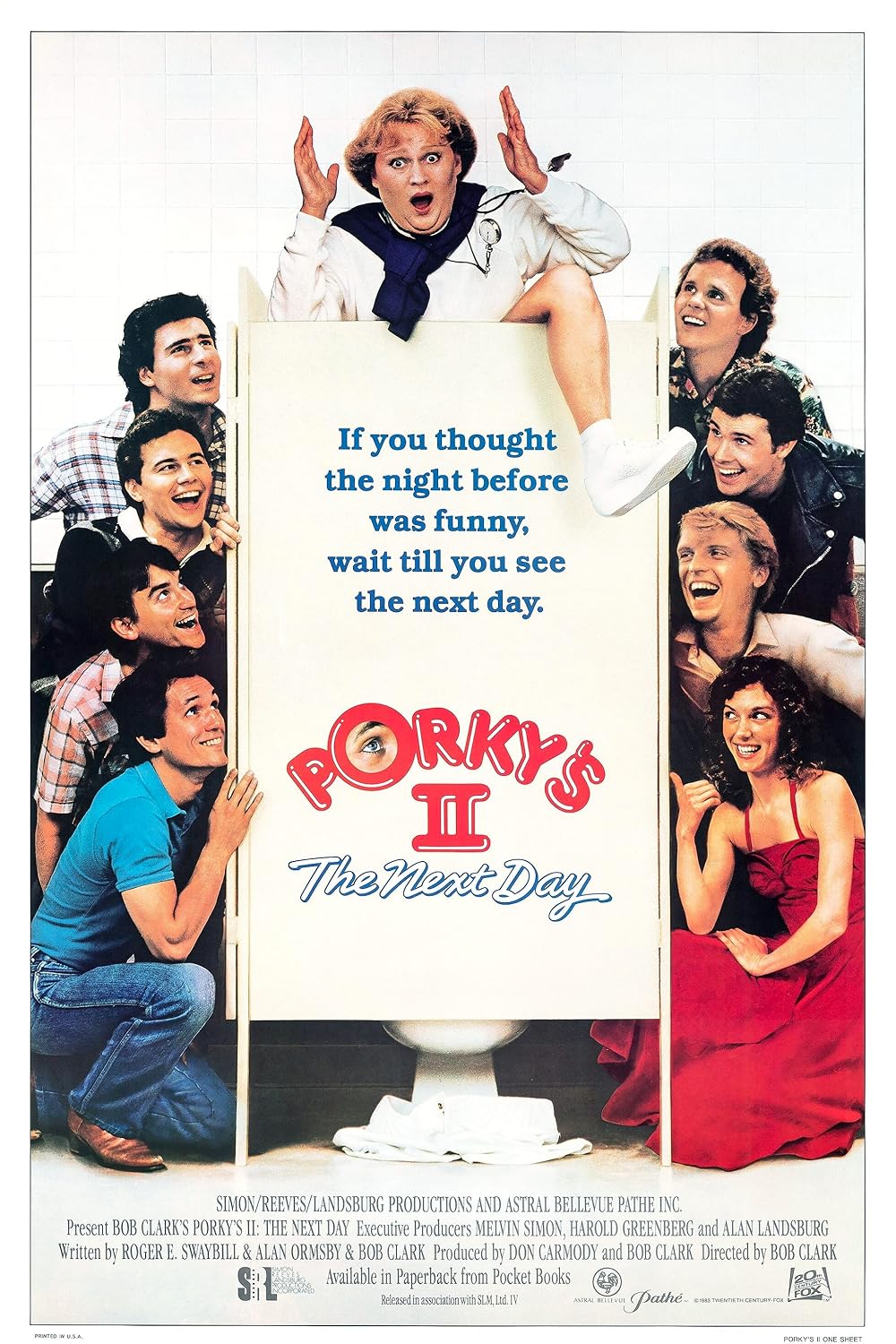
Porky’s II: The Next Day (1983)

By Richard Winters

My Rating: 0 out of 10

4-Word Review: Banning a Shakespeare play.

Now that Pee Wee (Dan Monahan) has lost his virginity to Wendy (Kaki Hunter) they decide that their next project will be putting on a production of ‘Romeo & Juliet’ at their high school, which will be directed by Mrs. Morris (Ilse Earl) Pee Wee’s mother. Problems though ensue when John Henry (Joseph Runningfox), a Seminole Indian, gets cast in the lead where he will then kiss Wendy, a white woman, on stage, which gets the local Klux Klan upset and they proceed to ambush things, so it won’t be able to proceed. There’s also outcry from a local Reverend named Bubba Flavel (Bill Wiley) as he and his religious constituents feel that the play is ‘obscene’ and therefore must be shut down in the name of ‘decency’. The teen cast then visits the office of County Commissioner Bob Gebhardt (Edward Winter) hoping he can use his influence to help keep the play going and while he initially promises them that he will, he eventually renegades. This angers the kids, and they devise an elaborate revenge on not only him, but the Klan and Reverend Flavel.

It’s quite clear that writer/director Bob Clark, who was working on Christmas Story while helming this one, had no idea that the first installment was going to be as big of a success as it was and there had clearly been no plans for a sequel. When the studio came begging for one, he felt obliged and spent 6 months, with the help of two other screenwriters, to come up with something. The result though is a movie in desperate search for a story with a script that’s a mishmash of over-the-top nonsense. What made the first one so good was that as crude as it was it still showed teens as they were with dialogue and situations that rang true, but here all of that gets thrown out with everything played up in an extreme way simply for the sake of a cheap laugh.

The most annoying aspect are the one-dimensional characters particularly the Reverend who is a cartoonish caricature in a silly send-up of a southern preacher. The same goes with the City Commissioner that is well played by Winter, which helps keep it remotely entertaining, but portraying a politician as being sleazy and two-timing is quite cliched and redundant. The return of Beulah Ballbricker, played by Nancy Parsons, is problematic as well. In the first film she was very strict with the rules, but here she’s turned into a religious fanatic, which seems like two different people. The scene where she sits on a toilet and begins singing loudly is dumb. Sure, people may talk on the phone while taking a dump, or read a magazine, or even browse the internet, but bellowing out a loud rendition of ‘That Old Black Magic’ while in a public stall is not one of them making her beyond ‘goofy’ and more into someone who should be institutionalized.

The pranks come off as unnecessarily cruel especially the scene in a graveyard where Pee Wee is made to believe that he accidentally killed a prostitute while having sex with her, which could be quite traumatic for someone and yet his ‘friends’ act like it’s ‘all in fun’. What’s worse is that Pee Wee never brings it up afterwards apparently having no qualms whether a sex worker dies at his hands or not just as long as he’s not blamed, which unintentionally makes him cold and uncaring.

The climactic bit where Wendy dresses up as a big bosomed 17-year-old prostitute who makes a major scene at a posh restaurant in an effort to embarrass the commissioner gets overdone too. For one thing it’s seems awfully extreme to put so much effort to get revenge on what’s nothing more than a tacky high school play with cheap props that isn’t going to make any money and cast members who weren’t all that excited about being in it, so why get so upset if it gets canceled? It also begs the question why these kids are so sure they can get away with their hijinks and not suffer any consequences. The ‘prank’ that gets done inside the restaurant causes a lot of damage and since these teens live in the same community as the adults they would most assuredly get recognized by someone and be either arrested for causing a disturbance and handed a very hefty bill for the repairs, or their parents would, which for them would be just a bad.

The only small funny bit, and I kid you not, comes at the very end during the closing credits, when the head waiter at the now ravaged restaurant tries to save face by convincing the patrons that it had all been an ‘April Fool’s joke’, which got me to chuckle. It’s also kind of amusing how Pee Wee gets so aroused by pics in National Geographic, or sexually stimulated by strippers who aren’t even naked, but just scantily clad enough to excite him anyways, which in this porn saturated era probably wouldn’t be deemed all that titillating, so in that aspect it’s interesting, but everything else is a disaster. It doesn’t even have Porky. How can you have a film titled ‘Porky’s’ if that character never actually shows up though he does reappear in the third installment, which will be reviewed next.

My Rating: 0 out of 10

Released: June 24, 1983

Runtime: 1 Hour 38 Minutes

Rated R

Director: Bob Clark

Studio: 20th Century Fox

Available: DVD, Blu-ray

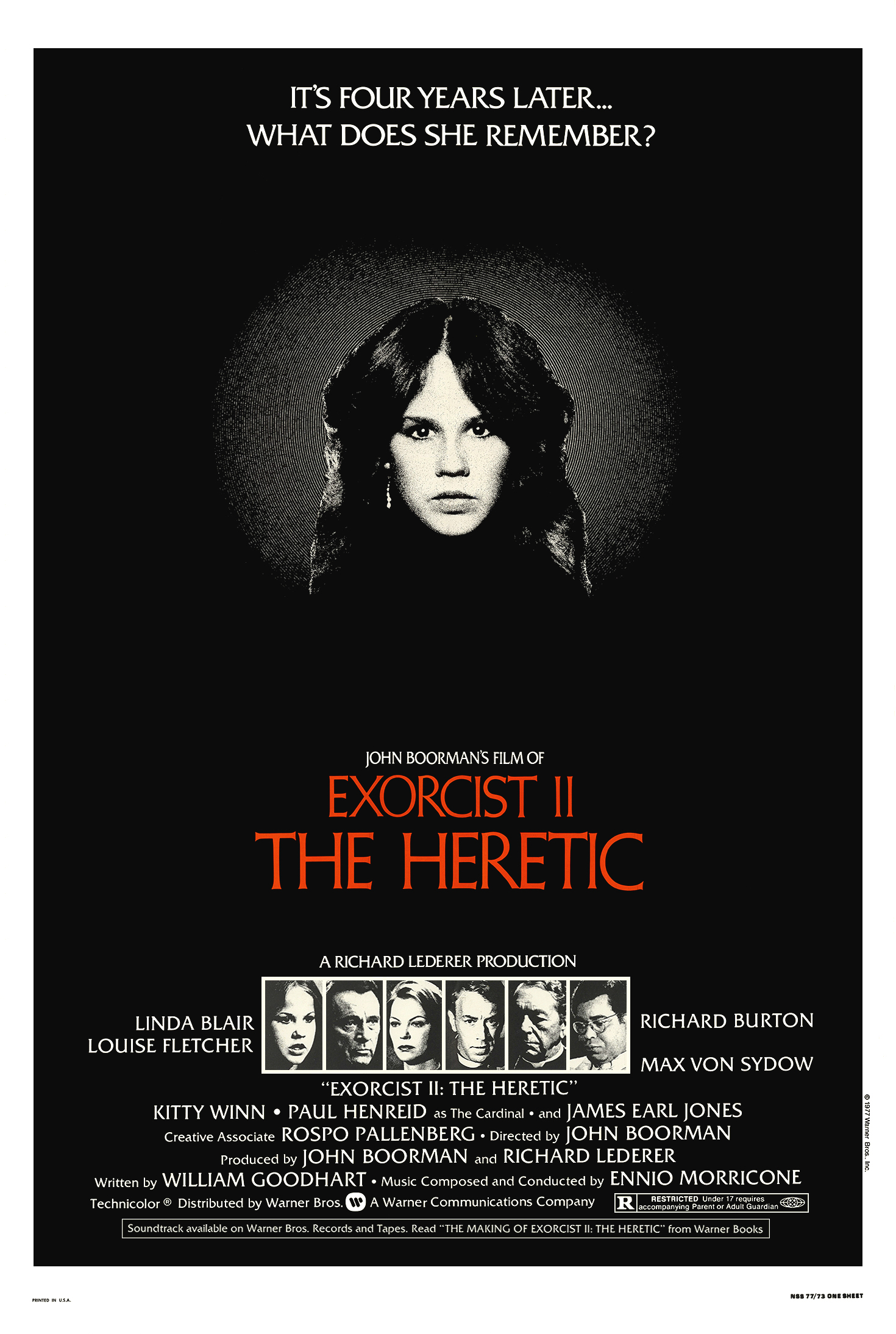
Exorcist II: The Heretic (1977)

By Richard Winters

My Rating: 0 out of 10

4-Word Review: A really awful sequel.

It’s been four years since Regan (Linda Blair) had her bout of possession and is now living a seemingly normal life in New York City with her guardian Sharon (Kitty Winn). Regan does still see a psychiatrist, Dr. Tuskin (Louise Fletcher), who despite Regan’s denials that she can’t remember anything, is convinced that she does have some dormant memories that need to come to the surface. Philip (Richard Burton) is a priest who has been assigned to investigate the death of Father Merrin (Max Von Sydow), who was the priest who died while performing the exorcism on Regan. He meets with Dr. Tuskin and Regan and gets hooked up to a machine called the syncronizer, which allows Philip’s and Regan’s brainwaves to be connected, so he can explore the inner depths of her mind. It is here that he learns about the evil spirit Pazuzu, that was the one that inhabited Regan’s body years earlier, and how Father Merrin had rid a young boy named Kokumo of this same spirit while in Africa. When Philip learns that the now adult Kokumo (James Earl Jones) has developed a special power to defeat Pazuzu he travels to the continent to meet him.

Doing a sequel to the hit movie wasn’t a bad idea per say as there were still some open-ended questions like why did Pazuzu choose Regan’s body to inhabit instead of some other girls and what mental issues would Regan have to deal with after going through such a traumatic event? None of those were ever answered in the first film, but intriguing enough to me that I felt a second film was warranted and could’ve been quite compelling. Unfortunately, what we get wouldn’t even qualify as second-rate. Most of the problem lies with director John Boorman, who admitted in later interviews that his biggest crime was that he didn’t give the viewer what they wanted, which is the truth. I don’t mean to bash the guy as he’s helmed some classics in his own right, but when he professes that he was offered the job to direct the first installment but turned it down because he thought it was ‘repulsive’ then that should’ve disqualified him from getting any consideration to doing the second one.

Everything gets botched right from the beginning including a misguided reenactment of the final segment in the first film that honestly comes-off like a cheap parody. For one thing Father Merrin is seen standing at the end of Regan’s bed, when we know clearly from the first film that he was kneeling on the right side of the bed when he died. Also, due to Blair’s insistence that she didn’t want to go through the grueling routine of having to put on the demon make-up, so a stand-in took her place, but the results are clownish. The silly-‘synchonizer’ further hampers things as it appears more like a child’s toy and the cliched idea of simply attaching a few wires to each participant’s foreheads and that would be enough to get their mind’s ‘in-sync’ looks like something straight out of a tacky B-sci fi flick from the 50’s.

Not able to get Ellen Burstyn to sign-on really hurts though I can’t blame her for being reluctant but trying to use Kitty Winn as her replacement bombs. For one thing the Sharon character didn’t have that much of a prominent role in the first one, I barely even remembered her, and she was Burstyn’s secretary who didn’t interact that much with Blair, so for them to now be so ‘connected’ seemed like a stretch and having Winn sporting short hair, in an attempt I presume to make her ‘seem’ like Burstyn, was tacky. Von Sydow suffers a similar fate. He gets portrayed as being a younger version of his character here but only appears in flashbacks and doesn’t have much to say or do making it seem like it wasn’t even worth the effort.

Fletcher is good in that she played a cold, bitchy nurse in her previous film, One Flew Over the Cuckoo’s Nest, but here shows her great acting ability at playing the total opposite and doing it convincingly. However, her character doesn’t help propel the action and is only there to react to things, which ultimately makes her presence one dimensional. Burton, whose talents I have always greatly admired even when he took less than stellar roles, but his appearance here has to be rock bottom. He admitted that he only did this for the paycheck, due to an expensive divorce he was going through with Liz, but the material doesn’t match his ability and it’s a career low even for him as he was known to make some bad project choices during the 70’s, but this was by far the worst.

To top things off there’s James Earl Jones wearing a giant bug outfit that nearly had me laughing out of my seat. The numerous shots of locusts and the sandy African landscape make it seem more like a nature movie, but whatever it is it’s not scary. It’s so convoluted it’s not even good enough to fall into the ‘so-bad-it’s-good’ category. It is cool though at least see a young Dana Plato playing an autistic child in a small but pivotal part.

My Rating: 0 out of 10

Released: June 17, 1977

Runtime: 1 Hour 57 Minutes

Rated R

Director: John Boorman

Studio: Warner Brothers

Available: DVD, Blu-ray, Amazon Video, Tubi, YouTube

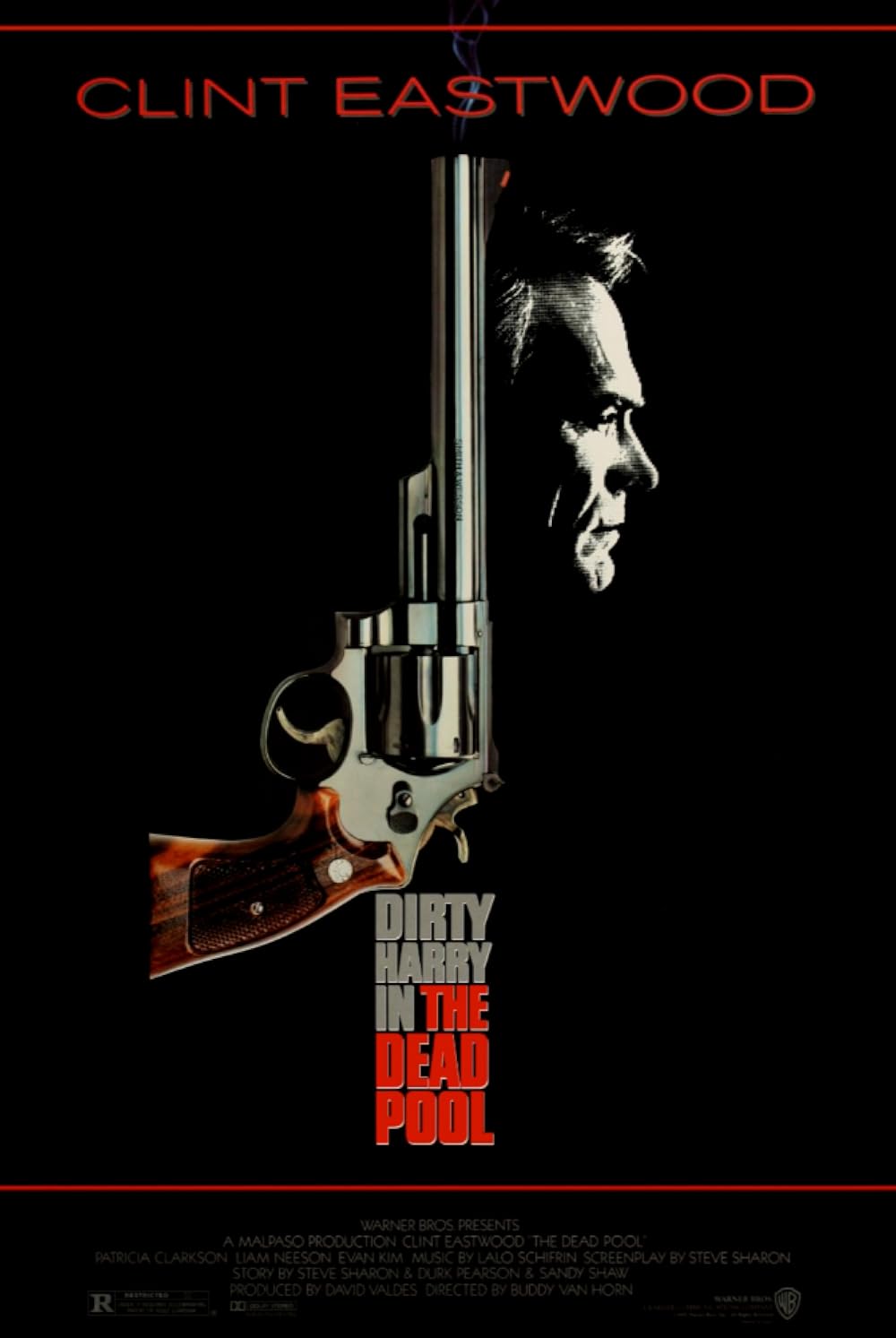
The Dead Pool (1988)

By Richard Winters

My Rating: 4 out of 10

4-Word Review: Harry marked for murder.

Inspector Harry Callahan (Clint Eastwood) is still getting ambushed by assassins hired by the criminals he puts away. The department decides to assign him with a new partner, Al Quan, (Evan C. Kim) who’s judo skills will come in handy. The two begin working on a case involving a dead pool, which is a list of San Francisco area celebrities that are expected to die soon either by natural causes, or by murder. The list was created by B-horror director Peter Swan (Liam Neeson) who immediately comes under suspicion when one of the stars of his own movie, Johnny Squares (Jim Carrey) turns up dead from what initially seemed like a drug overdose but later deemed murder. Harry is not happy to find his name is also on the list and this leads to an interview by local TV-reporter Samantha Walker (Patricia Clarkson) who wants to do a bio on him, but Harry resists convinced that she’s only trying to exploit the situation for ratings. 

This marked the fifth and last entry in the Dirty Harry series, which was a film Eastwood had not wanted to do, but was a part of the bargain he made with Warner studio in an effort to get his pet project Bird, which was a bio of jazz musician Charlie Parker, financed. Eastwood along with the studio were aware that that film most likely wouldn’t be a box office hit, so he agreed to do this one, which was sure to be a definite money maker. Yet this one ended up being the least successful of all the films from the series and ultimately helped hasten an end to ever producing another one. 

The formula had clearly run its course by this point, and the action is too predictable to be fun anymore. Things start out absurdly right away when the car Harry is driving gets hit with a hundred different bullets and yet our hero comes out completely unscathed, but there’s no way that could’ve realistically happened. Since the film’s theme is a movie-within-a-movie this part should’ve been done as a cameo appearance that Harry did for one of Swan’s movies, which might’ve offered a cute twist, or an even better idea would’ve had Harry getting injured by one of the bullets and no longer able to, at least for a while, use his hand to pull a trigger and thus forced to come up with creative ways to put away the bad guys, which would’ve added a needed wrinkle that would’ve kept this sequel fresh and different from the others versus the stale way that it quickly becomes.

Teaming him up with an Asian American isn’t interesting either. The other entries all dealt with him partnering with a minority, so by this time the concept lacked any edge. It also wastes Kim’s talents as it’s kind of cool seeing him take down bad guys using his karate talents, but unfortunately, it’s only shown once briefly when it should’ve been spread out all the way through. Having Kim and Harry not see eye-to-eye on things or even challenging his approach would’ve offered some dramatic energy, but overall, the scenes between them, where Kim is compliant and easy going just like all of Harry’s previous partners, makes their moments generic and dull. 

Spoiler Alert!

Harry’s relationship with the reporter is equally unengaging. At first the two sparred and I felt that’s where it should’ve remained but having them eventually ‘connect’ saps away all of the potential spice. Even the mystery angle gets botched. Granted we really don’t know who the killer is as his identity during the killings isn’t shown though we’re led to believe it’s Neeson then it turns out it’s somebody completely different, but it’s a character that isn’t shown upfront, so the viewer can’t try to figure out who it is on their own and the ultimate explanation for what motivates the killer is too pseudo psychological. The final confrontation that he has with the villain, played by David Hunt, who again is a weaker actor and not completely right for the part (Neeson would’ve been far better) is so achingly cliched that it’s almost laughable. 

It does feature a unique car chase, which was one of the few elements from Steven Sharon’s original script that the producers decided to leave in, that has Harry driving a regular sized car as he desperately attempts to outrun a miniature toy car that’s packed with explosives. Everything else though is quite formulaic and uninspired. It’s a good thing that this was the last one as any more would’ve just tarnished the brand further though it would’ve been good to have some finality to it. Instead of just having Harry walk-off after killing what seems to be his 500th bad guy he should’ve been shown handing in his badge and retiring as he was at that age anyways and after having gone through all the violent ambushes he had most would’ve done it much sooner.

My Rating: 4 out of 10

Released: July 13, 1988

Runtime: 1 Hour 31 Minutes

Rated R

Director: Buddy Van Horn

Studio: Warner Brothers

Available: DVD, Blu-ray, Amazon Video, YouTube

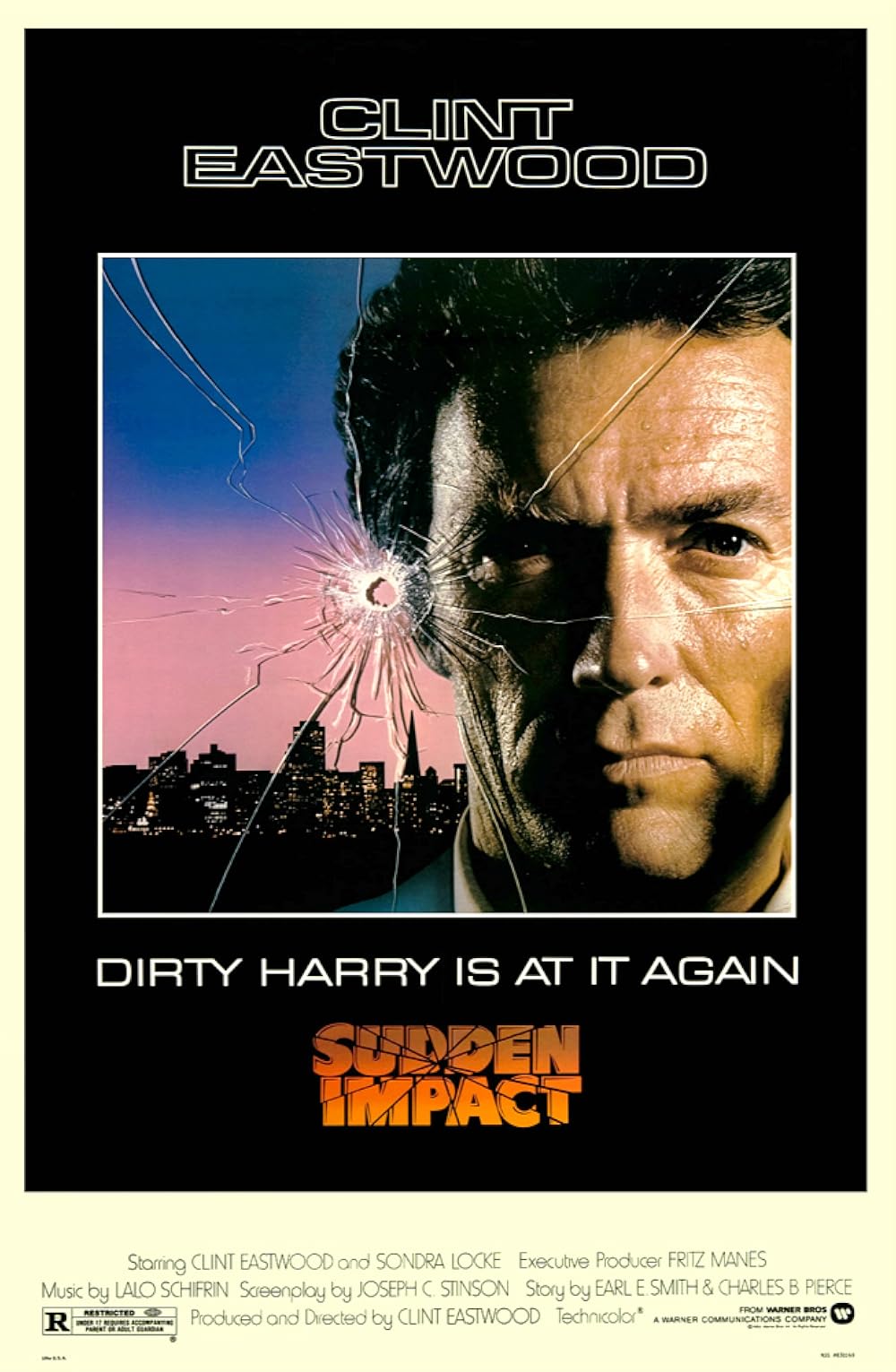
Sudden Impact (1983)

By Richard Winters

My Rating: 6 out of 10

4-Word Review: Harry investigates revenge killings.

Inspector Harry Callahan (Clint Eastwood) continues working in the San Francisco police department despite his perpetual disregard of proper police procedures, which gets many of the crooks that he has arrested freed due to legal technicalities. His superiors are frustrated with him, but since he does get results keeps him on the force though reassigned to the small town of San Paulo where he works with a sheriff Jennings (Pat Hingle) in hopes he’ll be less problematic. It’s there that he comes upon a case of various men being found shot to death in similar ways. This is being done by Jennifer (Sondra Locke) an artist in residence who 10 years earlier was raped along with her younger sister by a group of men and now she’s out to get her revenge by killing them off one-by-one. Harry is starting to piece together the clues but is surprised that Jennings is reluctant to follow-up on them giving him the impression that the sheriff may have something to hide.

The story is based on a script written by Charles B. Pierce better known for his rural horror movies from the 70’s that were shot in Arkansas and loosely based off of real events like The Town that Dreaded Sundown. This was meant to be a starring vehicle for Locke, but when Eastwood decided to renew the franchise after several years of dormancy, he felt the plotline here would be a good fit for the next Dirty Harry movie and thus hired Joseph Stinson to revise it.

The result is a mish-mash that’s never quite as compelling as it should. For the majority of the runtime Eastwood’s heroics and Locke’s crimes are working in a parallel universe and not connected making it seem like two different movies. Harry’s non-stop shootouts with crooks becomes redundant and cartoonish while Locke’s killings and flashbacks make it too reminiscent of other better-known films like I Spit on Your Grave and Death Wish. The bad guys are caricatures to the extreme making their moments boring and predictable. If the violence wasn’t so over-the-top you’d be convinced, like critic Pauline Kael mentioned in her review, that this thing was meant to be a parody.

Locke and Eastwood are both good and this is the last film that they did together as a couple before their break-up. In Locke’s case I liked how her cynical and brash persona mixes with Eastwood’s brooding and quiet one. Eastwood speaks more here than in the previous entries, but the character doesn’t seem to be evolving. The opening scene inside a courtroom where Harry is shocked to learn that the criminals he apprehended will be set free because he didn’t get a search warrant seemed ridiculous as after being on the force for so many years, and going through the exact same predicaments in the earlier films, that you’d think by now he’d learn his lesson and do things that conform within the legal framework, or at the very least not be so surprised when a judge sees it differently. The number of near-death shootouts he goes through is exhausting making me wonder how he maintained his mental state and didn’t take the vacation time when he’s asked even if he’s ‘not up for it’.

My biggest grievance though is with the structure. I really felt it would’ve worked better had it been approached as a mystery. We could’ve still seen the killings being done, but the identity of the killer would’ve been masked. Instead of Locke being an artist she could’ve been on the police force working on investigating the case and Harry could’ve started up a friendship/quasi relationship with her and at the start been impressed with her work only to slowly become aware that she was intentionally mudding the evidence. Sheriff Jennings too could’ve initially been portrayed as a ‘good guy’ with down to earth sensibilities that Harry liked and then as it progressed would his intentions become more dubious. The flashback sequences, which get interspersed throughout, could’ve instead been saved until the very end.

Spoiler Alert!

The film also continues to reveal Harry’s zig-zagging moral logic. In the first film he was all for playing outside the rules, then in the second installment he came to determine that vigilantism wasn’t the answer. Now here, by letting Locke off-the-hook and not arresting here, he’s acting like street justice is okay. It makes you wonder; is he really growing as a person and seeing things differently or simply floating along with whatever way the plotline wants?

My Rating: 6 out of 10

Released: December 9, 1983

Runtime: 1 Hour 57 Minutes

Rated R

Director: Clint Eastwood

Studio: Warner Brothers

Available: DVD, Blu-ray, Amazon Video, YouTube

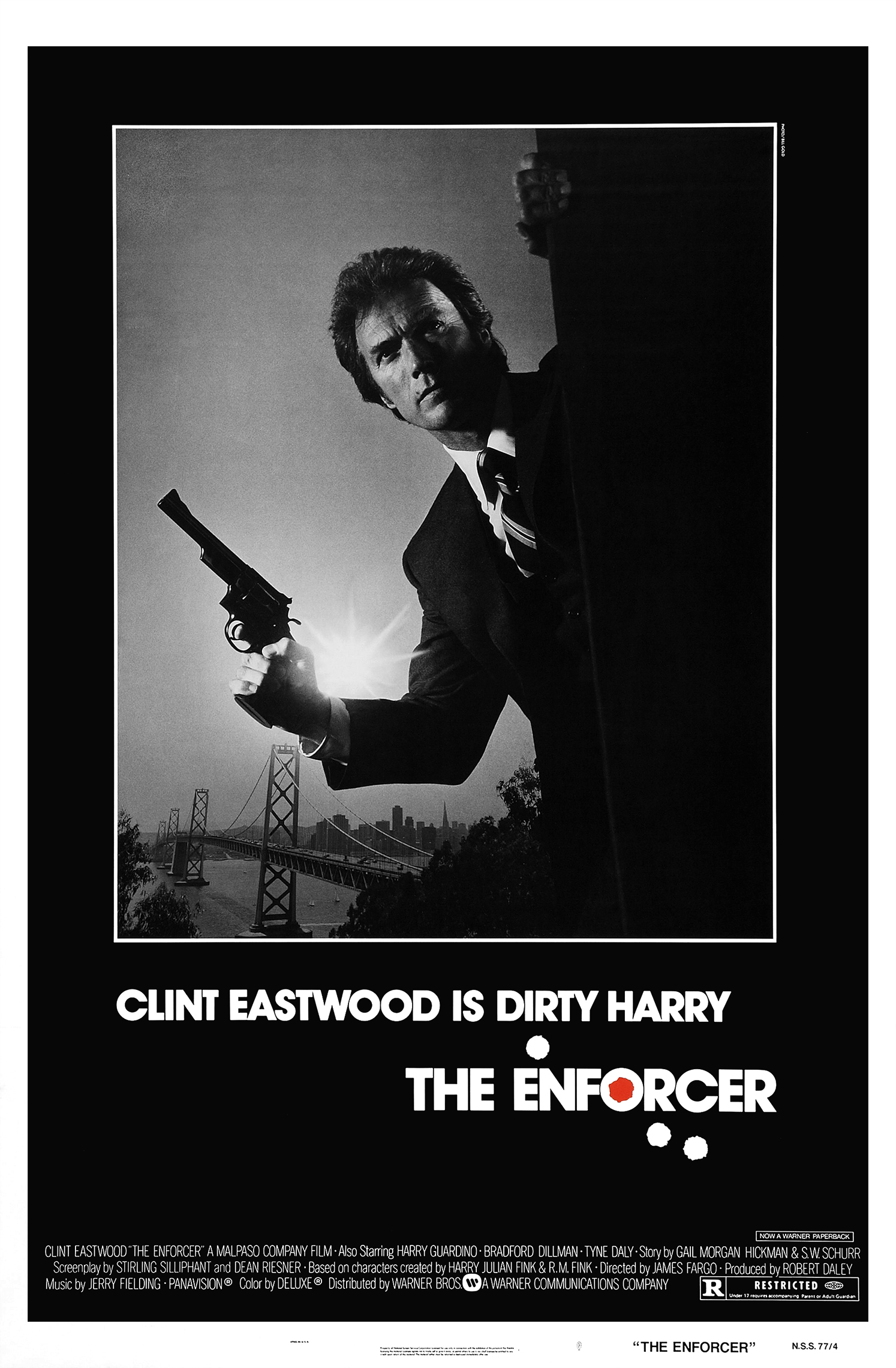
The Enforcer (1976)

By Richard Winters

My Rating: 7 out of 10

4-Word Review: Partnering with a woman.

Bobby Maxwell (DeVeren Bookwalter) leads a group known as the People’s Revolutionary Strike Force that is made up of young adults engaged in underground criminal activities. Harry (Clint Eastwood) must work with Big Ed (Albert Popwell) the leader of a black militant group, in an effort to track down Bobby before they do any more damage, but his efforts are stymied by his superior Captain Jerome Kay (Bradford Dillman) who arrests Big Ed before Harry is able to get the information he needs. Things are further complicated by pairing him with Kate (Tyne Daly) as his new partner. Harry doesn’t think much of having women on the force and feels she won’t be able to meet the demands of the job though Kate is intent to prove him wrong.

The original script was written by two young San Francisco area film students who based it off of the 1974 kidnapping of Patty Hearst by the Symbionese Liberation Army. Then after watching some Dirty Harry movies, they decided to rewrite it by incorporating his character into the story. They then visited the Hog’s Breath Inn, a restaurant owned by Eastwood, and handed the script to his business partner Paul Lippman, who in turn gave it to Eastwood. Another script by Stirling Silliphant had already been given to Clint that involved Harry being partnered with a lady cop, a concept that he liked, though he didn’t feel there was enough action in it, so he hired Dean Reisner for a rewrite that would combine elements of both scripts, which is what ultimately became this movie.

The franchise seems to have lost some of its magic. Watching Harry come upon a crime in progress and casually blow away the criminals is no longer as riveting, or shocking and in many ways comes-off as predictable and even cartoonish. The first film did a good job of showing how police work wasn’t always exciting and sexy and could entail doing some boring duties, but here it creates the idea that it’s one pulverizing shootout after another. I didn’t care for the pounding score played over the chase sequences, which the first one didn’t do and was better for it as the music gets a bit distracting and more formulaic like something out of a cop TV-show. Bradford Dillman’s character, as an exasperated police chief, is a complete caricature like a puppet created solely so it can yap at Harry and get him to snarl in return. I wasn’t so crazy either about the humor that seeps in as the first two films had a very serious tone though the scene involving a group of old ladies sitting around a table writing love letters while inside a whorehouse is a definite gem. 

The casting is unique particularly Bookwalter as the head of the criminal gang, who up to this point was best known for starring in Andy Warhol’s experimental film Blow Job, which was a 35-minute movie that had the camera focus solely on Bookwalter’s face as he received fellatio. He also had a brief bit in the second installment of the series playing a naked man who gets killed in a shootout during a sex orgy. Here though he doesn’t have enough of an acting presence to make his moments onscreen interesting like Andrew Robinson did in the first one. He pretty much just seems like a male model with an angry stare and a gun. It’s the same result with popular radio deejay Machine Gun Kelly (Gary D. Sinclair) who gets cast as the priest who runs cover for the bad guys but clearly doesn’t have much acting ability and it’s quite possible that Eastwood intentionally put these guys into these roles knowing this, so that way they’d have no chance of upstaging him. 

I did though like Tyne Daly as Harry’s new partner. She had rejected the role three times due to issues with the script and how her character was portrayed but eventually agreed to get on board once her demand for revisions were met and I’m sure glad she did. She’s not sexy, or beautiful, which is good, and portrays a no-nonsense quality and genuinely seems like she wants to prove herself and dedicated and thus making her appealing right from the start. The only issue is that she’s constantly carrying around a shoulder purse, but why? I’ve never seen a policewoman have one and it seems ridiculous as it impedes her ability to chase after people as she has to grab a hold of it so it doesn’t flop against her body as she moves. 

Spoiler Alert!

Fortunately, the two don’t end up falling in love, the original script had this happening, but this was one of the things Daly insisted had to be taken out before she’d agree to do it, which is good because in real life, especially between professionals, that shouldn’t be occurring. Having her die at the end took me by surprise but is good too as it shows how dangerous police work is and how not every time is the good guy going to come out of a shootout unscathed. 

My Rating: 7 out of 10

Released: December 22, 1976

Runtime: 1 Hour 36 Minutes

Rated R

Director: James Fargo

Studio: Warner Brothers

Available: DVD, Blu-ray, Amazon Video, YouTube

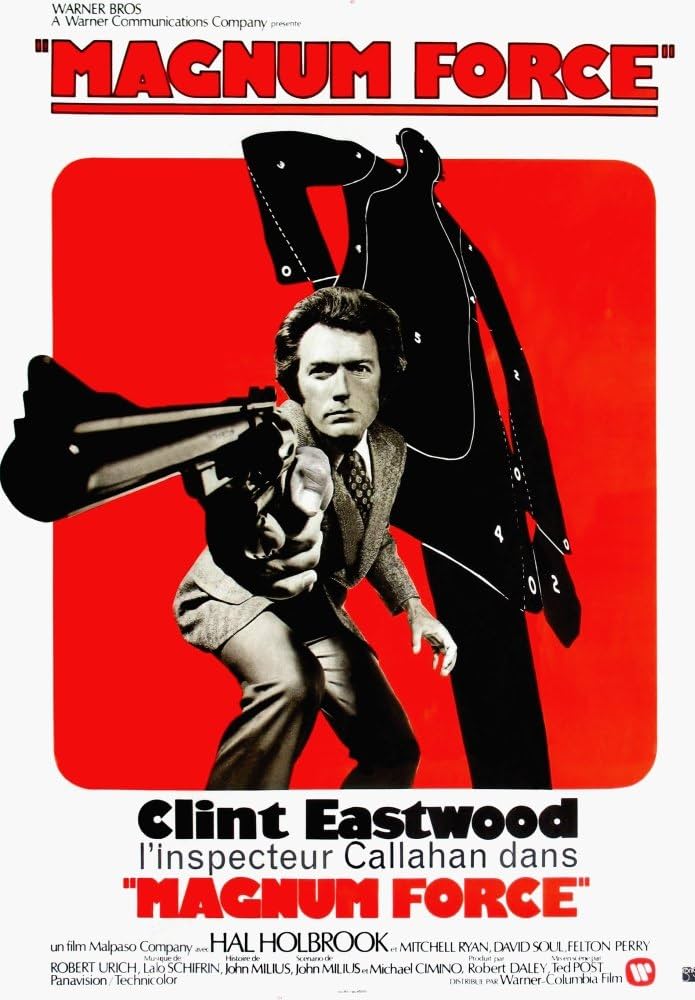
Magnum Force (1973)

By Richard Winters

My Rating: 8 out of 10

4-Word Review: Harry battles renegade cops.

Somebody is killing San Francisco’s well-known criminals who have been able to manipulate the courts in a way that they’ve gotten off and have not served any time. “Dirty” Harry Callahan (Clint Eastwood) isn’t sure at first who’s behind it, but every time he tries to get investigate his superior, Lt. Neil Briggs (Hal Holbrook) tells him to essentially ‘back off’ and go back to stakeout duty of which he’s been assigned, but in his off hours he continues to pursue it. He comes to the conclusion, after a pimp is shot at close range while sitting in the driver’s seat of his car, that a policeman pretending to be a traffic cop is behind it. He then begins to focus in on four new recruits (David Soul, Robert Urich, Kip Niven, Tim Matheson), who all show remarkable aim on the gun range, as being the ones behind it, but how does he prove it before they kill again, or set their sights on him in order to keep him quiet?

In this follow-up to the classic Dirty Harry the direction isn’t as stylish as Don Siegal didn’t return to helm this one, so the reins were handed over to Ted Post who’s better known for his TV work and which Eastwood knew through them working together on the ‘Rawhide’ TV-show from the 50’s. While not all bad there were certain segments that appeared a bit off like when the motorcycle cop pulls over the mob boss, played by Richard Devon, who’s riding in a limousine. The car clearly comes to a stop on a well-traveled bridge, but when the men inside the vehicle get shot you can see through the rear window that the car now appears parked in some urban neighborhood street. The segment where Harry drives into the parking garage of his apartment complex and then gets out of his car after parking it only to be surprised when the four renegade cops, who are also parked there on their motorbikes, begin speaking to him, is botched too as Harry would’ve seen them already there when he drove up and thus the scene should’ve been shot from his point-of-view through the front windshield of his car.

The action segments though are top notch. The scene inside an airplane where Harry disguises himself as a pilot in order stop hijackers from taking it over is both funny and tense as is his shooting down thieves trying to rob a grocery store. The gun range segment, where he and David Soul compete to see who’s the most accurate shooter, is well-handled as is the final chase inside an abandoned airplane hangar in a shipyard. There’s also a cool, but grisly sex orgy shootout in which a naked woman’s body tumbles out a high-rise apartment and then down several flights. You can also spot a nude Suzanne Somers during a poolside massacre.

The film also features the infamous Drano scene where a pimp, played by Albert Popwell, forces a prostitute, played by Margaret Avery, to swallow drain cleaner, which inspired a group of criminals in Ogden, Utah to try and replicate it when they robbed a record store and took the employees hostage on April 22, 1974 in what became known as the Hi-Fi Shop murders. However, instead of instantly killing the victims like it did in the movie it instead created blisters on their mouths and internal burning, which caused them to go through extreme suffering for hours.

My biggest complaint is how Harry is too nice and has lost some of his edge that made him so interesting. In the first film he was described as someone that didn’t like minorities, but here he’s matched up with an African American partner, played by Felton Perry, right off-the-bat with no complaints. He’s also seen with children in one segment and seems to enjoy them, but I’d think with Harry’s irritable temperament he’d find kids running around and making noise to be annoying. A downstairs neighbor lady, played by Adele Yoshioka, comes on to him quite strongly, she literally walks out into the hallway as he’s coming home and asks him what she needs to do in order to go to bed with him, which seemed too forward even for the carefree 70’s. I agree with John Milius who wrote the original draft of the screenplay where that scene was not in there but got added later at Eastwood’s behest. Harry was not the sociable type and if anything, he’d be doing prostitutes simply as a release for his sex drive. The character really didn’t have the capacity nor desire for a relationship and if he was married to anything it would be his job and mowing down bad guys making this romantic segment forced and not believable.

The bad guys are a bit too cliched and dull, especially the mob bosses, which is a far cry from the first one where Andrew Robinson made his psycho character quite distinct and intriguing. One scene has a group of mafia guys sitting around a table eating Chinese food, but none of them says a word, which to me was not realistic. Even bad people still follow sports, weather, and current events and would like to chat a little with those around them, supposedly these are their ‘friends’ since they work closely together, and not just eat in stone cold silence, which paints them too much as robots with no life, or personality outside of being killing machines.

While it’s fun seeing Urich and Soul in early roles and in Urich’s case looking downright boyish, the four renegade cop’s presence onscreen is quite flat. There’s no distinction between their personalities and no backstory given to how they came together, or what brought them to becoming vigilantes. Did they have a loved one, for family member die at the hands of a criminal who then was given a lenient sentence? This is never explained, or elaborated on, but really should’ve.

It’s also confusing to have Harry, who in the first installment was fed-up with the politics of policework and looking to work ‘outside the system’ suddenly dislike these guys for doing what he himself had previously advocated. Would’ve been more interesting had they invited him to join the group, and he initially obliged thinking this would be a good to solution to criminals getting off easy only to eventually realize the group was taking things too far and then work to stop them. 

My Rating: 8 out of 10

Released: December 25, 1973

Runtime: 2 Hours 3 Minutes

Rated R

Director: Ted Post

Studio: Warner Brothers

Available: DVD, Blu-ray, Amazon Video, YouTube

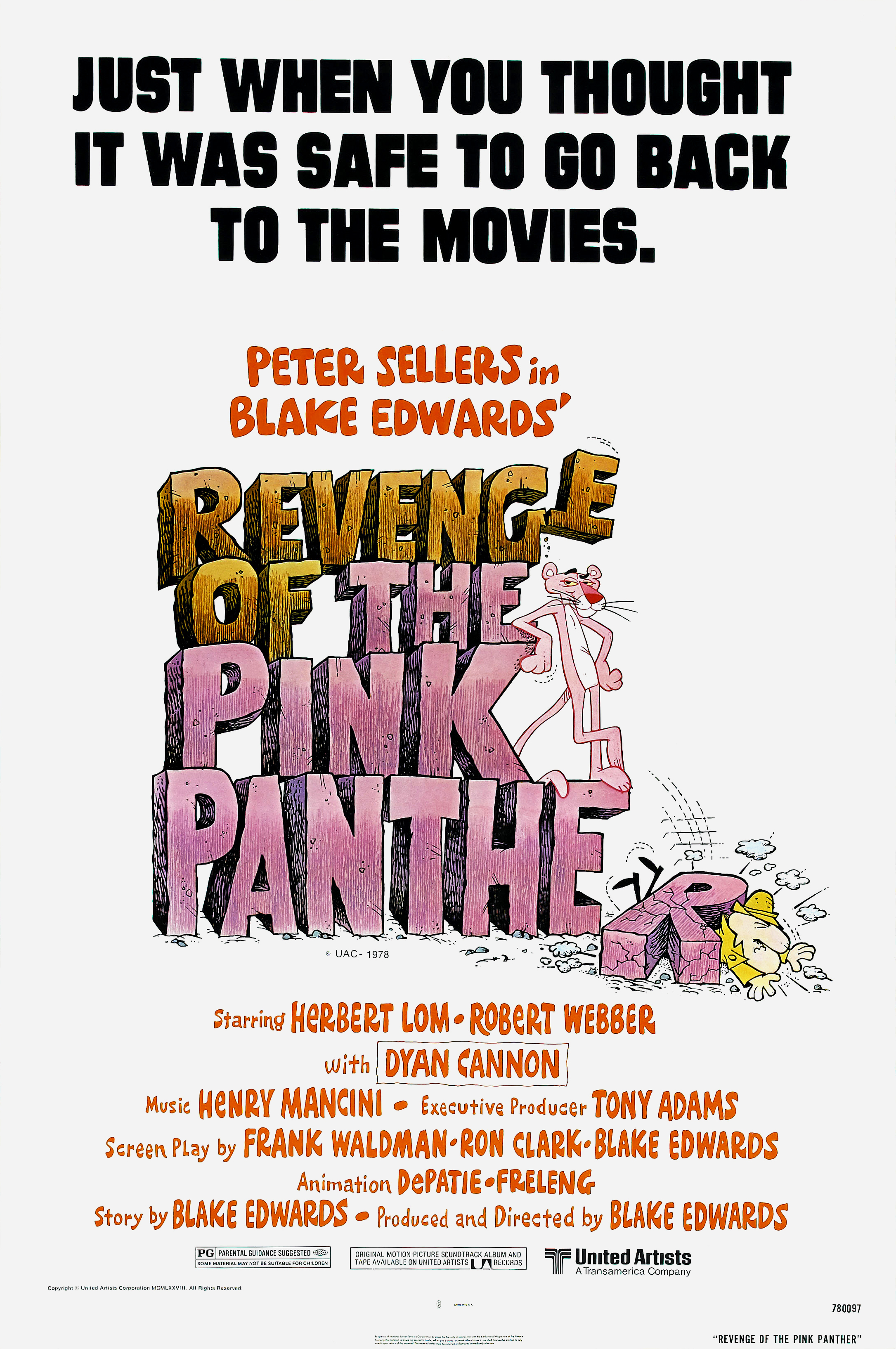
Revenge of the Pink Panther (1978)

By Richard Winters

My Rating: 6 out of 10

4-Word Review: Out to get Clouseau.

Philippe (Robert Webber) is a successful businessman who’s secretly the head of the French criminal underground. Some though are questioning his leadership considering him to be too weak to remain in that position. In order to squash the impending threat, he decides to make a bold move by having Inspector Clouseau (Peter Sellers) killed. Clouseau was considered a master detective by the outside world and only known to be an incompetent by those who worked with him, so by having him out of the way the drug dealers would feel relieved and thus Philippe would remain in power. However, things don’t get as planned as Clouseau manages to miraculously evade all attempts on his life. The media though mistakenly announces that he has died, which allows Clouseau to go undercover along with his manservant Cato (Burt Kwouk) to find out who’s after him.

This marked the fifth entry in the series and is probably the funniest. Initially director Blake Edwards had wanted to reuse footage that had been cut from the previous entry and then film new scenes around those, but star Sellers insisted he wanted an all-new story and that was probably for the best. Sellers by far gets the most laughs whereas in the one that came before this, The Pink Panther Strikes Againit was Herbert Lom as the unhinged Dreyfus, that was the most memorable, but here his part becomes much more benign, though he still gets one good scene where he tries not to breakout laughing while giving a eulogy at Clouseau’s funeral. Sellers though comes out on top here especially in his disguises like when he pretends to be a sea captain with an inflatable parrot on his shoulder, or in a hilarious send-up as a Mafia Don.

It’s great to see Kwouk, who was usually relegated to the ‘fight’ scene between him and his boss Clouseau, become more involved in the story, as the two go to Hong Kong in disguise to track down the bad guys. Dyan Cannon is a refreshing change of pace. Usually, the women in these films were young models whose sole purpose was to allude sex appeal, but here she’s middle-aged, but still attractive, and shows much more of a feisty personality. She helps build a strong secondary character and is better interwoven into the plot versus simply appearing as a potential romantic interest.

Webber though as the main villain is a detriment. I have no doubt that the notoriously insecure Sellers didn’t like the way Lom stole the film as the nemesis in their last outing and wanted to make sure that didn’t happen again. Not only is the Dreyfuss character far more neutered, but so is Webber making him seem like he’s almost sleepwalking through his role. It would’ve been more interesting had his character has some personal vendetta against Clouseau, possibly because it was Clouseau who had sent him, or one of his men to jail, and now he wanted revenge. Just having him out to get Clousau because it might bolster his own image didn’t seem to be enough of an incentive and the two, outside of one comic moment where Clouseau’s is in one of disguises, never have any ultimate confrontation. Watching him get chased around his desk and cower from Dyan Cannon may have been intended as funny, but it just further erodes his villainy making him seem even more impotent than he already is. Even a comedy still needs a bad guy that can elicit some tension and this one doesn’t.

The implementation of Mr. Chong, played by martial arts instructor Ed Parker, has potential. Supposedly he’s an ‘invincible’ fighter that can beat-up anyone and not be stopped as proven when he takes down several other men while in Webber’s office but then he gets comically defeated once he comes into contact with Clouseau. While watching him go through the floor/ceiling of several apartments below as he crash lands is visually funny it would’ve been more engaging if he had come back at some point and continued his relentless attack on Clouseau albeit with injuries in order to reclaim his reputation that he couldn’t be defeated, but in the process just became more hurt and ineffective.

Spoiler Alert!

The climactic sequence that occurs in Hong Kong is a cop-out and comes-off like they’d run out of ideas, so they tried to save it with a calamity filled chase that plays more like a cartoon, or something better suited for a live action Disney movie. Introducing yet another Mafia boss, this one played by Paul Stewart, makes things too cluttered and there should’ve been just one main bad guy that was the boss of everyone. The finale inside a firecracker factory should’ve proven dangerous and in fact we do see the entire place explode from a distance and yet everyone comes out of it unscathed, which doesn’t exactly make a lot of sense.

My Rating: 6 out of 10

Released: July 20, 1978

Runtime: 1 Hour 39 Minutes

Rated PG

Director: Blake Edwards

Studio: United Artists

Available: DVD, Amazon Video, YouTube

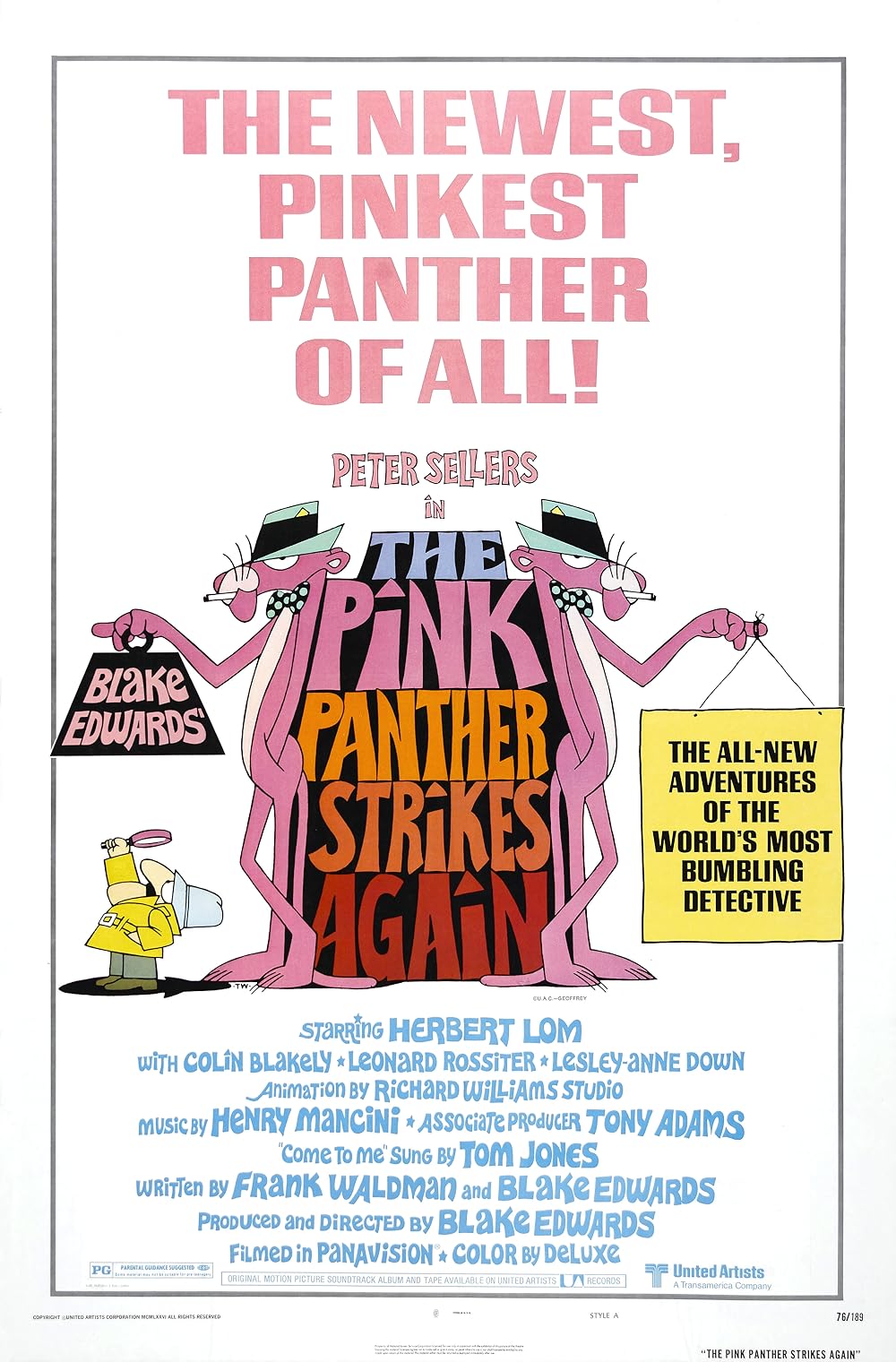
The Pink Panther Strikes Again (1976)

By Richard Winters

My Rating: 7 out of 10

4-Word Review: Clouseau battles doomsday weapon.

Dreyfuss (Herbert Lom) has been informed by his psychiatrist (Geoffrey Bayldon) that he has been cured of his obsession with Clouseau (Peter Sellers) and now deemed sane. He’ll be recommending his release from the mental institution he’s been in later that day at the sanity board of which Dreyfuss is elated. However, Clouseau shows up unannounced planning on speaking to the sanity board on behalf of Dreyfuss, but when he gets there the two meet and after several mishaps, all inadvertently caused by Clouseau, occur it sends Dreyfuss spiraling back into insanity. He then though is able to escape and goes on a mission to kill Clouseau, first on his own and then with the help of several worldwide assassins. When this doesn’t go as planned, he kidnaps a nuclear physicist (Richard Vernon) and blackmails him to create a doomsday weapon that can take out entire buildings with its laser beam and which Dreyfuss has no problem using against the world unless he’s given Clouseau in return.

After the unexpected success of The Return of the Pink Panther, director Blake Edwards was given an immediate green light to write and direct a follow-up. Since he had originally intended for this to be a TV-series he used one of the scripts he had written for that one and expanded it for feature film length. The original cut came out to 126 minutes, but the studio insisted it be trimmed to 95-minute runtime with the excised scenes being used as material for the Curse of the Pink Panther, which released 6 years later after the passing of star Sellers.

Despite constant behind-the-scenes struggles between Edwards and Sellers this film is widely considered their best output second only to The Party, which they collaborated on 8 years earlier. A lot of the reason why it works is the excellent pacing with an almost rapid-fire collage of jokes and mishaps, the scenic European locations and the pleasing yet still bouncy Henry Mancini score.

The humor hits the target in almost all cases, unlike most comedies where there’s usually a few misses, with some of the best moments coming from the supporting players like stuntman Dick Crokett who plays a perfect parody of then President Gerald Ford and Lesley Ann-Down, who replaced Maude Adams who was originally cast, but then fired after she refused to appear nude, as a Russian spy whose attempts to get Clouseau in bed with her proves quite funny. The ongoing confrontations between Lom and Sellers though are still the highlights and the two really work well together with Lom’s angry abrasiveness a nice contrast to Seller’s benign ineptness and in fact this is a rare instance where Sellers gets upstaged as it’s Lom’s performance with his over-the-top villainy that you come away remembering the most after it’s over.

Yet with all of its successes the script is still full of logical loopholes and missing key moments. For instance, Dreyfuss escapes from the mental hospital, but it’s never shown, which I felt since it’s so integral to the storyline needed to be seen and explaining how he was able to do it. What he did to gain access to the apartment downstairs from Clouseau’s should’ve been inserted as well and some sort of answers for how he was able to avoid injury from the bomb going off as it destroyed Clouseau’s apartment and the fallout from it would’ve most assuredly affected the apartment beneath it as well. Clouseau’s ongoing physical confrontations with his house servant Kato (Burt Kwouk) becomes problematic too as they’re constantly damaging the furniture during their fights and if this happens every time he comes home then the furniture should already be in disarray from their last battle as there wouldn’t have been time to have cleaned it up and replaced it with new stuff.

Spoiler Alert!

While the film does at least have Dreyfuss masterminding a major bank heist, which helps to explain how he got funding to build the giant laser and purchase the castle that he and his crew move into, it still makes it seem that they’re able to build the elaborate weapon and all the computers that go along with it, almost overnight, which of course isn’t believable. It also at one point has the laser beam striking Lom making his legs disappear, but he’s still able to somehow walk around anyways as well as maintain his same height, making it seem that his legs are still there and simply invisible.

There’s also the issue of Dreyfuss disappearing at the end, due to the effects of the laser, but in the following installment, Revenge of the Pink Panther, he’s fully intact and no mention of his previous madness to destroy the world. Fans of the series say this is because this whole film was meant to be a dream that Dreyfuss had, which would’ve made a lot of sense. He was already obsessed with Clouseau, so having nightmares about things one is constantly focused on would be logical and the film should’ve had at the very end Dryefuss waking up and still in a strait-jacket, but it doesn’t making it an oversight and not properly thought through.

My Rating: 7 out of 10

Released: December 15, 1976

Runtime: 1 Hour 43 Minutes

Rated PG

Director: Blake Edwards

Studio: United Artists

Available: DVD, Amazon Video, YouTube

The Return of the Pink Panther (1975)

By Richard Winters

My Rating: 7 out of 10

4-Word Review: Tracking down stolen diamond.

Inspector Clouseau (Peter Sellers) has been demoted to street cop by Chief Inspector Dreyfuss (Herbert Lom) due to Clouseau’s continual incompetence, which is starting to drive Dreyfuss completely mad. However, inside the country of Lugash a prized diamond known as the Pink Panther is stolen and since Clouseau had success retrieving it the first time it went missing during a heist he is put on the case to find it again much to Dreyfuss annoyance. Clouseau suspects that the culprit is Charles Litton (Christopher Plummer), who is a notorious thief. Clouseau attempts to use several different disguises in order to infiltrate Litton’s home that he shares with his wife Claudine (Catherin Schell) in order to find incriminating evidence against Litton so that he can turn him in, but his attempts to try and a take Litton down prove to be comically inept. 

This marked the fourth installment of the Pink Panther series and the first in 10-years that reunited writer/director Blake Edwards with Sellers. Both had said after doing the second film A Shot in the Dark, that they never wanted to work with the other again due to much infighting during the production, but both had since then fallen on hard times. Edwards was by the early 70’s considered box office poison after the colossal failure of Darling Lilli which managed to recoup a measly $3 million from a $25 million budget and his other films from that era Wild Rovers and The Carey Treatment hadn’t done much better. Since Pink Panther had been his last success, he was interested in reviving it and even wrote up a 14-page treatment but found no takers amongst the major studios. Then producer Lew Grade agreed to finance it in exchange for Edward’s wife Julie Andrews agreeing to star in a British TV-special that he wanted to produce. Since Sellers career had also bottomed out, he came onboard to most everyone’s surprise without much hassle.

The film was shot in many scenic locations including Morrocco giving the optics an exotic flair and the proceedings a sophisticated European vibe making it seem like a step-up from just a silly comedy. In the first two installments all the characters were written to be funny and goofy particularly the second film, which had been based on a stage play. Here though the comedy is wisely given over to Sellers while the couple he’s after remain savvy, which makes it more intriguing as you want to see how this inept idiot takes them down, or is able to trip them up at their own game. I also liked how funny bits are interspliced with some legitimate action, especially the opening scene that features the heist, which could’ve easily fit into a realistic film dealing with a robbery. These moments help add a bit of relief from all the laughs, a sort of chance to catch your breath, while making the plot seem like it’s not just all about being a farce.

Lom adds terrific support as Clouseau’s exasperated supervisor, and his assertive acting style works nicely off of Sellers clownish one making the interplay between the two a highlight. It’s good too that Plummer replaced David Niven, who played the character in the first one, but wasn’t able to do it here due to scheduling conflicts, as Niven would’ve been too old and not plausible to have outrun the bad guys like Plummer does. 

My only issue is that Claudine is shown attempting to hold in her laughter at Clouseau right from the start like she knows he’s an idiot before she even met him, but this goes against the premise. Clouseau is considered an accomplished detective by the outside world hence why he was selected to head the case and it’s only the people that work with him and know him who are aware of his ineptness. This is the whole reason why Dreyfuss gets driven mad by him because the rest of the world celebrates the man that he knows is really a fool, so Claudine should’ve initially thought of him as being sharp and only came to the conclusion he was incompetent by the end after having dealt with him. It actually would’ve been funnier had she and Charles feared Clouseau upfront having believed his celebrated reputation and misreading his bumbling as being ‘genius’ ploys and remained that way throughout. In either case seeing her covering her mouth and shielding her giggles makes almost seem like she’s falling out of character and a blooper, similar to how Harvey Korman would unintentionally crack-up during Tim Conway’s antics on the ‘The Carol Burnett Show’ and for that reason it should’ve been avoided. 

My Rating: 7 out of 10

Released: May 21, 1975

Runtime: 1 Hour 54 Minutes

Rated PG

Director: Blake Edwards

Studio: United Artists

Available: DVD, Blu-ray, Amazon Video, YouTube