Tag Archives: Robert Urich

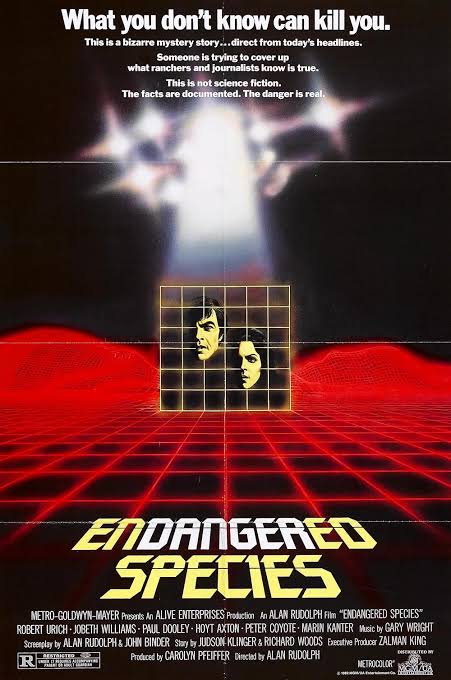
Endangered Species (1982)

By Richard Winters

My Rating: 4 out of 10

4-Word Review: Investigating mysterious cattle mutilations.

Ruben (Robert Urich) is a recovering alcoholic who quits his job as a cop and decides to move to rural Colorado with his teenaged daughter MacKenzie (Marin Kanter).  Along the way their vehicle breaks down in the small-town of Buffalo.  They decide to make their temporary home there and Ruben meets up with Harriet (JoBeth Williams) the newly elected sheriff. He learns that she’s investigating, with the help of local newspaper reporter Joe (Paul Dooley), some mysterious cattle mutilations that has been plaguing the area. Ruben, who grows fond of her, helps her in the pursuit for answers and comes to determine that it may have something to do with a nearby abandoned military complex as well as a neighboring cattle baron Ben (Hoyt Axton) who seems awfully worried about anyone snooping around.

The film’s direction, done by the still budding Alan Rudolph, is probably the best thing to recommend about what’s otherwise a pedestrian story. I liked the soundtrack, which despite the setting being quite rural, has a cool sci-fi vibe, and the grainy cinematography gives it a documentary feel. Rudolph’s use of capturing dialogue, which was clearly inspired by his mentor Robert Altman, is cool too as the camera will focus on one person, but we’ll hear the conversation of two other characters who are not in the shot. Unfortunately, the plot is unimaginative, and the mystery portion becomes too obvious.

Urich is miscast in the lead, the part was intended for Robert Mitchum who would’ve been far superior. Urich’s a nice guy and all, but not convincing as a brash, hard-edge cop making his entire performance come off as affected. His character arch, which focuses on an alcoholic trying to redeem himself, both with his career and relationship with his daughter, is too formulaic to be either gripping, or compelling though it’s interesting to hear him casually utter the slur ‘faggot’ at one point as it would be impossible for someone in a movie today to say that and still be deemed the hero.

I also didn’t feel an outsider was needed here as Urich seems to come up with all the clues that you’d think somebody living in the town would’ve deduced far earlier. A good example is when he follows some trucks to the military complex and starts to connect this to the cattle killings, but any other resident could’ve done this too and most likely would’ve. Most small-town people are characteristically suspicious of government agencies, so knowing that there was an abandoned federal outpost nearby would’ve made that area number one on their suspect list and would not have required the assistance of some big city cop to get them there.

Jobeth looks awkward and uncomfortable in her police uniform. I dug the idea of having a female sheriff, which hasn’t been done too much, so it offers a unique angle, but it approaches it in an illogical way. For instance, it has her attempting to break up a male bar fight by her trying to somehow tackle one of the men, who immediately fling her away as if she were a rag doll and it looks as pathetic as it sounds. Clearly, she should’ve gone into that with some backup by male deputies, or a taser, but for her to go in it alone and think somehow, she can ‘handle it’ makes both her and the film look like it has no common sense.

I will though give some credit to the scene where Urich is in her shower and he makes a pass at her and she in returns gives him a gut punch, which was unexpected as I was afraid it was going to turn into some sort of sappy, stereotypical love scene, which does occur later, but I at least enjoyed the momentary attempt to go against the grain.

Spoiler Alert!

I did enjoy Axton’s bad guy part. He performance isn’t anything spectacular and his poisoning moments, where he brushes his teeth with a contaminated toothbrush that causes his gums to bleed looks more like he’s just swishing around red Kool aid in his mouth. I also thought it was ridiculous that Urich would force Axton to drive the pick-up at gunpoint when he was clearly in a weakened and distressed state that could’ve killed them both. However, his death scene, where he kneels on the highway and has his abdomen burst out of his body, is awesome and the film’s best moment though it could’ve been extended.

The ending unfortunately offers no resolution. It has the night helicopters of the bad guys flying away while JoBeth and Urich remain on the ground watching helplessly. To sit through nearly 2-hours of this thing, which is at times a bit slow, there needed to be more of a finale. Preferably nabbing the baddies and breaking open the case and the fact that this doesn’t happen makes the whole thing feel like one big waste of time.

My Rating: 4 out of 10

Released: September 10, 1982

Runtime: 1 Hour 37 Minutes

Rated R

Director: Alan Rudolph

Studio: MGM

Available: DVD, Blu-ray, Amazon Video, YouTube
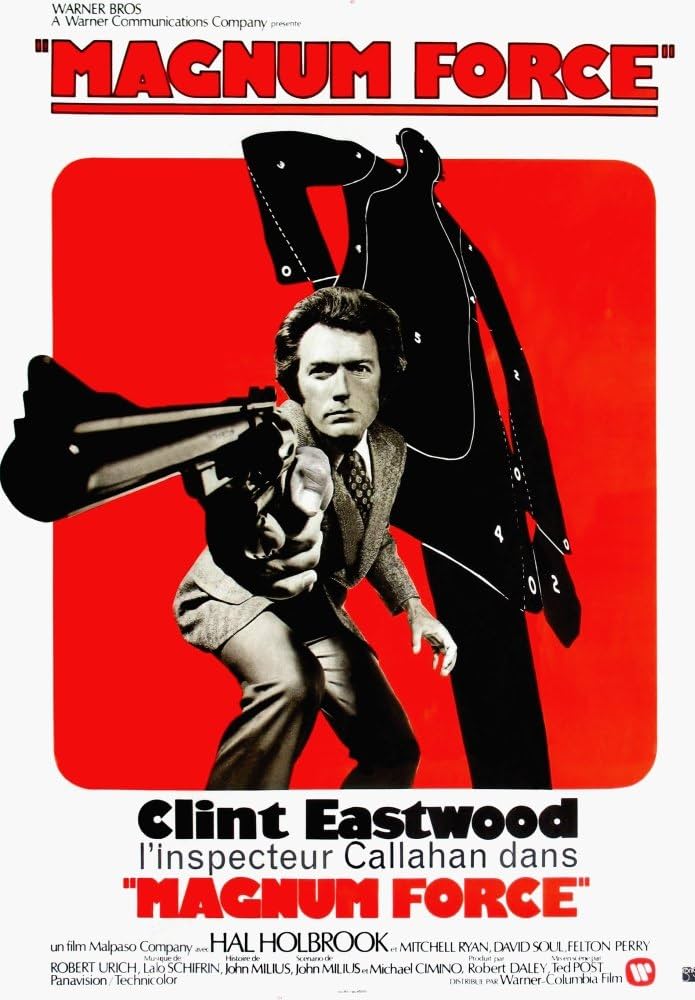


Magnum Force (1973)

By Richard Winters

My Rating: 8 out of 10

4-Word Review: Harry battles renegade cops.

Somebody is killing San Francisco’s well-known criminals who have been able to manipulate the courts in a way that they’ve gotten off and have not served any time. “Dirty” Harry Callahan (Clint Eastwood) isn’t sure at first who’s behind it, but every time he tries to get investigate his superior, Lt. Neil Briggs (Hal Holbrook) tells him to essentially ‘back off’ and go back to stakeout duty of which he’s been assigned, but in his off hours he continues to pursue it. He comes to the conclusion, after a pimp is shot at close range while sitting in the driver’s seat of his car, that a policeman pretending to be a traffic cop is behind it. He then begins to focus in on four new recruits (David Soul, Robert Urich, Kip Niven, Tim Matheson), who all show remarkable aim on the gun range, as being the ones behind it, but how does he prove it before they kill again, or set their sights on him in order to keep him quiet?

In this follow-up to the classic Dirty Harry the direction isn’t as stylish as Don Siegal didn’t return to helm this one, so the reins were handed over to Ted Post who’s better known for his TV work and which Eastwood knew through them working together on the ‘Rawhide’ TV-show from the 50’s. While not all bad there were certain segments that appeared a bit off like when the motorcycle cop pulls over the mob boss, played by Richard Devon, who’s riding in a limousine. The car clearly comes to a stop on a well-traveled bridge, but when the men inside the vehicle get shot you can see through the rear window that the car now appears parked in some urban neighborhood street. The segment where Harry drives into the parking garage of his apartment complex and then gets out of his car after parking it only to be surprised when the four renegade cops, who are also parked there on their motorbikes, begin speaking to him, is botched too as Harry would’ve seen them already there when he drove up and thus the scene should’ve been shot from his point-of-view through the front windshield of his car.

The action segments though are top notch. The scene inside an airplane where Harry disguises himself as a pilot in order stop hijackers from taking it over is both funny and tense as is his shooting down thieves trying to rob a grocery store. The gun range segment, where he and David Soul compete to see who’s the most accurate shooter, is well-handled as is the final chase inside an abandoned airplane hangar in a shipyard. There’s also a cool, but grisly sex orgy shootout in which a naked woman’s body tumbles out a high-rise apartment and then down several flights. You can also spot a nude Suzanne Somers during a poolside massacre.

The film also features the infamous Drano scene where a pimp, played by Albert Popwell, forces a prostitute, played by Margaret Avery, to swallow drain cleaner, which inspired a group of criminals in Ogden, Utah to try and replicate it when they robbed a record store and took the employees hostage on April 22, 1974 in what became known as the Hi-Fi Shop murders. However, instead of instantly killing the victims like it did in the movie it instead created blisters on their mouths and internal burning, which caused them to go through extreme suffering for hours.

My biggest complaint is how Harry is too nice and has lost some of his edge that made him so interesting. In the first film he was described as someone that didn’t like minorities, but here he’s matched up with an African American partner, played by Felton Perry, right off-the-bat with no complaints. He’s also seen with children in one segment and seems to enjoy them, but I’d think with Harry’s irritable temperament he’d find kids running around and making noise to be annoying. A downstairs neighbor lady, played by Adele Yoshioka, comes on to him quite strongly, she literally walks out into the hallway as he’s coming home and asks him what she needs to do in order to go to bed with him, which seemed too forward even for the carefree 70’s. I agree with John Milius who wrote the original draft of the screenplay where that scene was not in there but got added later at Eastwood’s behest. Harry was not the sociable type and if anything, he’d be doing prostitutes simply as a release for his sex drive. The character really didn’t have the capacity nor desire for a relationship and if he was married to anything it would be his job and mowing down bad guys making this romantic segment forced and not believable.

The bad guys are a bit too cliched and dull, especially the mob bosses, which is a far cry from the first one where Andrew Robinson made his psycho character quite distinct and intriguing. One scene has a group of mafia guys sitting around a table eating Chinese food, but none of them says a word, which to me was not realistic. Even bad people still follow sports, weather, and current events and would like to chat a little with those around them, supposedly these are their ‘friends’ since they work closely together, and not just eat in stone cold silence, which paints them too much as robots with no life, or personality outside of being killing machines.

While it’s fun seeing Urich and Soul in early roles and in Urich’s case looking downright boyish, the four renegade cop’s presence onscreen is quite flat. There’s no distinction between their personalities and no backstory given to how they came together, or what brought them to becoming vigilantes. Did they have a loved one, for family member die at the hands of a criminal who then was given a lenient sentence? This is never explained, or elaborated on, but really should’ve.

It’s also confusing to have Harry, who in the first installment was fed-up with the politics of policework and looking to work ‘outside the system’ suddenly dislike these guys for doing what he himself had previously advocated. Would’ve been more interesting had they invited him to join the group, and he initially obliged thinking this would be a good to solution to criminals getting off easy only to eventually realize the group was taking things too far and then work to stop them. 

My Rating: 8 out of 10

Released: December 25, 1973

Runtime: 2 Hours 3 Minutes

Rated R

Director: Ted Post

Studio: Warner Brothers

Available: DVD, Blu-ray, Amazon Video, YouTube