Category Archives: Romance

Coming Home (1978)

coming

By Richard Winters

My Rating: 10 out of 10

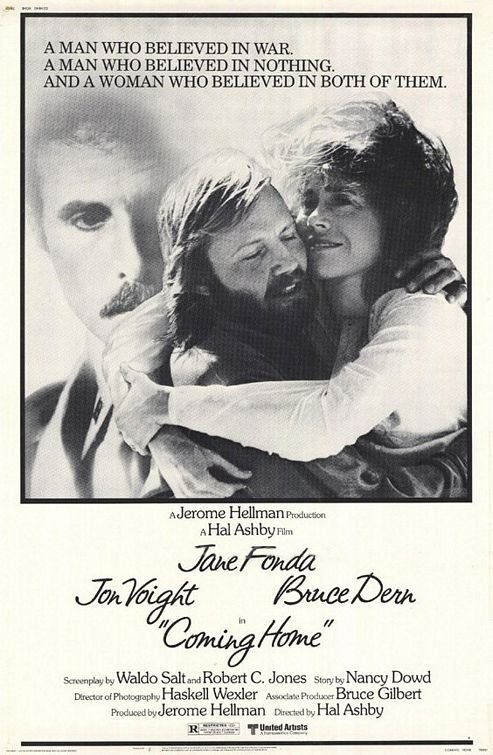
4-Word Review: Falling for injured vet.

Sally (Jane Fonda) is the military wife to Bob (Bruce Dern) who’s been deployed to Vietnam. Since she now has more free time she decides to volunteer at her local VA Hospital. It is there that she meets Luke (Jon Voight) a former classmate from high school who has now come back from the war a paraplegic. Luke is very embittered about his condition and he’s initially angry and confrontational with Sally. Eventually he softens and Sally invites him to her house for dinner. It’s there that their romance begins to bloom and eventually they become intimate. Bob though, having suffered a leg injury, returns to the states and while Sally and Luke agree to keep their affair a secret Bob soon finds out, which leads to an ugly confrontation between the three.

The idea for the film was inspired by Fonda’s meeting with Ron Kovic, an injured vet who had written his autobiography Born on the Fourth of July that later, in the 80’s, became a movie starring Tom Cruise. Fonda though wanted to make a film with a character that was similar to him and got together with screenwriter Nancy Dowd in 1972 to write a script, which initially focused completely on the hospital setting without the affair, or B-story dealing with the conservative military husband. After many rewrites and bringing in Oscar winner Waldo Scott to help bolster the story the script finally managed to gain interest amongst the studios though many were still cautious about producing a movie dealing with the after-effects of the war, which at that time had never been done before, up until then only films dealing with the war, or those coming back with psychological issues, but not actual physical impairments and thus making this a first in that category.

Since Fonda was instrumental in getting the project produced she was the only choice to play Sally. I think she’s a fine actress who deservedly won the Supporting Oscar for her work here, but since she was on the front lines of the war protest and in many ways even became the face of it, the transition of her character isn’t as profound. Having an actress whose name wasn’t so aligned with left politics and who could better fit-into the part of a conservative housewife would’ve then made the character’s arch more dramatic. I felt too that Sally is too understanding of Luke right-off, the history of them going to high school together should’ve been excised, and instead she should’ve feared Luke when she first encounters him as he does act out-of-control and the romance between them happens too quickly.

Also, once her character changes her hairstyle from the old-fashioned straight to curly it should’ve remained as this visually establishes her character’s changing perspective and not go back to the straight look when she visits Bob in Hong Kong. To remedy this she should’ve decided to keep the curly look even if she feared Bob might not approve, she was technically becoming more empowered with him away anyways, and this would’ve signaled to Bob that she wasn’t the same person he knew when he left, or had the hair change occur after the Hong Kong visit, but having the hair style flip-flop works against the arch, which should be linear and not zig-zagging.

Voight, who won the Best Actor Oscar, and who had to lobby hard for the role as the producers originally wanted Jack Nicholson, is outstanding and there’s not a flaw in his performance with his best moment coming at the very end when he gives a lecture to a room full of high school students about his war experiences. My only complaint, which has nothing to do with his acting and more with the script, is when he bluntly tells Sally, when he goes to her place for dinner, that he dreams of making love to her, which seemed too forward especially since they end up having an impromptu kiss later. Since movies are a visual medium it should’ve settled with the kiss exposing the underlying brewing romance without his character having to explicitly state it. I also found it interesting that the DVD features a commentary track with Voight, Dern, and cinematographer Haskell Wexler, but Fonda is conspicuously not present and I wondered if this may have been due to Voight becoming a hardened conservative as he’s aged and because of their political differences Fonda not wanting to be in the same room with him.

Dern, like the other two, is excellent. His improvisational Dernisms as I like to call them come into play particularly when he gets intense I even learned what the slang term Jody meant, which is what he calls Voight at one point. You also, at the end, get a full view of his bare ass. Now, on the celebrity male naked ass scale I still say it’s a distant third to Dabney Coleman’s in Modern Problems  and Tim Matheson’s in Impulsebut it’s not bad.

Accolades must also go to director Hal Ashby, who was not the first choice as the studio initially wanted John Schlesinger. While Schlesinger could’ve been great I felt Ashby’s use of all natural lighting is what really makes the difference and becomes the over-riding look of the film. He displays keen use of the music too at the end when the song ‘Time Has Come Today’ by the Chamber Brothers is played and the lyrics are used to expose the underlying ticking time bomb of the situation that the three characters are veering speedily into.

My Rating: 10 out of 10

Released: February 15, 1978

Runtime: 2 Hours 7 Minutes

Rated R

Director: Hal Ashby

Studio: United Artists

Available: DVD, Blu-ray

Overboard (1987)

overboard

By Richard Winters

My Rating: 1 out of 10

4-Word Review: Rich bitch loses memory.

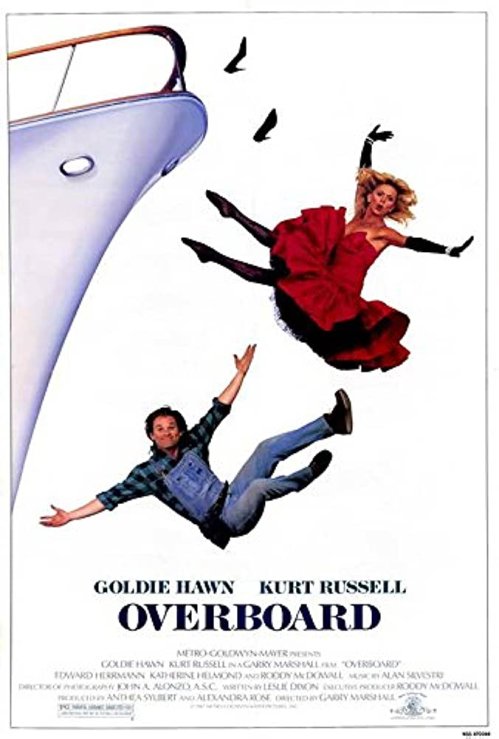
Heiress Joanna (Goldie Hawn) is a wealthy and snobby woman who hires Dean (Kurt Russell), a carpenter, to remodel the closet that she has on her yacht. Since Dean is a widowed father of four boys (Mike Hagerty, Jared Rushton, Jeffrey Wiseman, Brian Price) he’s more than happy to take on the job in order to bring in extra money, but Joanna, treats Dean poorly, is unsatisfied with his work and refuses to pay him. She ends up throwing him overboard with his tools. Later that night while still on the yacht she goes on deck to retrieve a lost ear ring and falls overboard causing her to hit her head and lose her memory. She is rescued and taken to a local hospital. News shows report on the incident along with pictures of Joanna asking if anyone knows who she is. Dean, who is with friends at a bowling alley, sees the report and concocts a scheme to take advantage of her amnesia by pretending she is his wife and bringing her to his home to do chores and take care of his kids in order to repay her debt to him. The  plan starts out seamlessly, but eventually she begins to bond with both the kids and Dean and then her real husband, Grant (Edward Herrmann) arrives at Dean’s residence in order to take her back with him.

Russell and Hawn began their real-life relationship while working on Swing Shift and wanted to do another picture together. This uninspired script, which was written by Leslie Dixon who had better success with Outrageous Fortuneis a misguided hybrid between Houseboat, a 50’s romantic comedy that starred Cary Grant and Sophia Loren, and Swept Away, a classic 70’s Italian film involving a rich, snotty woman stranded on an island with a working-class man. Unfortunately all nuance gets thrown overboard (pun intended) and we get left with the most extreme caricatures possible. While Hawn is certainly a fine actress her over-the-top character is too cliched and heavy-handed to be even remotely interesting or believable and the film falls hopelessly apart before it even gets going.

The basic premise is full of loopholes. The idea that just anyone could show up at a hospital and insist that some woman is his wife when that women shows no recollection of him and he’s able to bring her home without showing any type of documentation, marriage license, or photograph of the two together is beyond ridiculous. Just saying he recognizes a tattoo on her rear end wouldn’t be enough; maybe the two had a one-night-stand, but it wouldn’t be proof positive that he was married to her and yet for this hospital staff it was. Also, it’s very unlikely that Grant, Joanna’s real husband, would be able to get away with denying her existence as long as he does. He pretends he doesn’t recognize her when he goes to the hospital, so he can then bring young women onto his yacht to fool around with, but his friends and most certainly Joanna’s meddlesome mother, played by Katherine Helmond, would’ve seen the news reports too and gotten on him to go retrieve her, but for some reason in this movie rich people don’t watch the news only the poor folks.

Russell seems to enjoy his part, but like with Hawn his character is a tired caricature that’s not remotely original, or unique in any way. While the movie tries hard to get you to like him I still felt what he does with Joanna by tricking her into thinking she’s his wife was highly exploitive and not forgivable even when factoring in the poor way she had treated him.

The four boys are yet another issue. With the exception of the one who talks in Pee Wee Herman’s voice, which was apparently ad-libbed and not a part of the script, there was no distinction between any of them and they all could’ve been combined into just one. It’s also hard to believe that they’d all agree to play along with Dean and pretend she was their mother when they really knew she wasn’t as most kids are notorious for not be able to keep a secret. I was surprised too that the kids would all accept this new woman into their life and forget that their real mother ever even existed. These kids, or at least one of them, would’ve had some bonding with the real one and been reluctant to just let that go and welcome in her ‘replacement’. The kids were also used to having no rules and doing what they wanted while their dad was away at work, so having a new person come in out of nowhere and start enforcing discipline would most likely caused a rebellion instead of them all embracing this newfound orderly lifestyle.

Had the characters and comedy been more subtle like perhaps having the Hawn character not being a super rich heiress, but just a suburbanite living in a better part of town who has a slight disagreement with Russell when he comes to her house to do some work, then this idea might’ve had potential. However, as it is, the caricatures are too silly and overblown for any viewer with discernable tastes to get into. Also, for such slight and predictable material it takes way too damn long to play-out. Should’ve only been 80 minutes not almost 2-hours.

My Rating: 1 out of 10

Released: December 16, 1987

Runtime:  1-Hour, 52 Minutes

Rated PG

Director: Gary Marshall

Studio: MGM

Available: DVD, Blu-ray, Amazon Video

The Greek Tycoon (1978)

greek

By Richard Winters

My Rating: 4 out of 10

4-Word Review: Marrying a rich man.

Originally intended as a fact based bio of Aristotle Onassis and his marriage to Jacqueline Bouviar Kennedy where Jackie was offered $1 million to play herself, but when she turned it down the producers decided to turn it into a ‘fictional’ story where the names of the characters were changed, but many of the elements remained the same. The plot deals with a Greek shipping tycoon named Theo Tomasis (Anthony Quinn) who is known to fool-around on his wife Simi (Camilla Sparv). One day while hosting a posh party on his yacht he sets his sights on Liz (Jacqueline Bisset) who is the wife of a politician James Cassidy (James Franciscus) who’s running for the democratic nomination for the U.S. Presidency. While Theo and Liz are able to get away from the rest of the guests and talk he’s unable to admit how smitten he is with her due to her marriage. Liz returns to the states with her husband and he’s elected President, but then is assassinated. Now widowed she decides to return to Greece and meets-up with Theo. Theo in-turn leaves his wife, who was tired of his philandering ways, and marries Liz though their marriage ends-up being a rocky one as well as Theo is unable to change his old habits making Jacki feel she’s just another ‘notch-on-his-belt’.

Producer Nico Mastorakis is probably better known for having directed the controversial horror film Island of Death, which to this day remains one of the most notorious movies ever made, but before he got into filmmaking he was a reporter, who under the guise of being a musician for a rock group, gained access to Onassis’ yacht the Christina while Aristotle was hosting a party with guests Jackie and Ted Kennedy. He hid a small camera inside the his guitar and was able to take pictures of the event before having the negatives confiscated by Ted Kennedy’s security detail. Nico though remained fascinated with Onassis and his experiences while on the his yacht convinced him he’d make a perfect subject for a movie. Quinn, met with Onassis just months before his death where he reportedly gave him blessing to play the role, so Quinn initially agreed to do it only to back-out later when he spoke with Jackie who asked him not to do it. However, months later, she then publicly snubbed him at a restaurant, which got him so angry that he changed his mind and called Nico to tell him he wanted to go through with it and play the part, of which he was paid the handsome figure of $500,000.

As a soap opera, which is all this amounts to, it’s watchable with the biggest asset being the exotic European locales. The plot moves along breezily enough to keep it mildly compelling though no effort is made to make it conform to the early 60’s time period when it all began making it seem instead like it could’ve all occurred during the 70’s. The assassination is especially surreal as James gets shot as he and Jackie are walking along the beach, but no sniper is ever seen. The camera pans over to where the shots were fired and all we see are trees like some phantom gunmen came out of nowhere to kill him and then just disappeared into thin air with no explanation for who did it, or why.

Quinn’s acting though is really impressive and one of the few reasons to watch it. Quinn has always had a magnetic energy that grabs the viewer into  his characters and makes you fascinated enough in them to keep you engrossed though the dark glasses he’s seen constantly wearing was a distraction. He wears them all the time even while inside and at night, which seems weird and makes him appear almost like he’s gangster. There’s a few times when the glass lenses inside the frames are clear and not darkened, but no explanation for why, or how they changed. His propensity for Greek line dancing only succeeds in reminding viewers of another more famous movie that he was in, Zorba the Greek, and for that reason alone it should’ve been avoided altogether.

Bisset on the other-hand doesn’t have much of a presence. Normally she’s a great actress, but her character here isn’t fleshed-out enough to make anything that she says or does interesting. It’s a transparent composite of what one might deem a First Lady to be, but with nothing unique, or distinct added into it and thus making her time onscreen seem quite blah. She does have one energetic moment when she gets into a fight with him after he embarrasses her in front of a few men and even proceeds to attack him physically, but other than that her performance, like the rest of the movie, is sterile with very little to recommend.

My Rating: 4 out of 10

Released: May 12, 1978

Runtime: 1 Hour 47 Minutes

Rated PG

Director: J. Lee Thompson

Studio: Universal Pictures

Available: DVD, Blu-ray

Circle of Two (1981)

circle3

By Richard Winters

My Rating: 4 out of 10

4-Word Review: Old man/young teen.

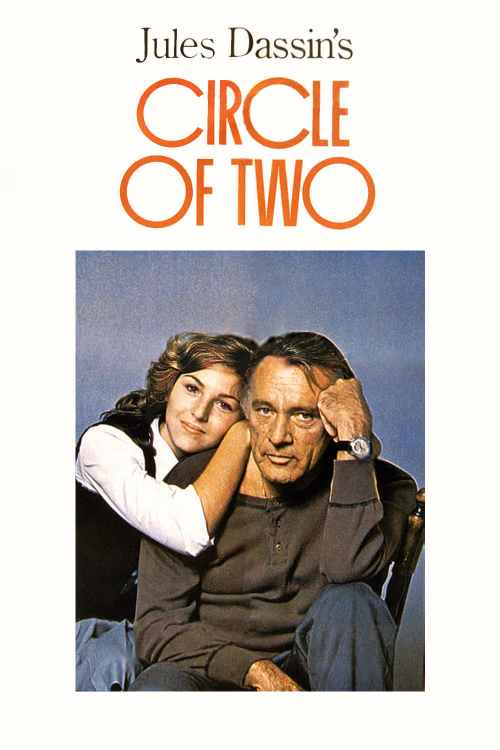
Ashley St. Clair (Richard Burton) is an aging painter of 60 who has lost his passion and hasn’t either sold, or attempted to do a painting in over 10 years. Sarah (Tatum O’Neal) is an unhappy 15-year-old who’s tired of dating guys her own age as she finds them to be immature and only interested in one thing…sex. She then meets Ashley, first after she sneaks into an adult theater to watch an X-rated movie and then later at a coffee shop. Despite the extreme differences in their ages they still connect through their mutual interest in art. Ashley even begins to paint again and the two share an enjoyable, but platonic friendship. However, once Sarah’s parents (Robin Gammell, Patricia Collins) find out about they put an immediate stop to it by locking her in her room and and in protest Sarah refuses to eat.

Based on the novel ‘A Lesson in Love’ by Marie-Terese Baird this film marks the final one to be directed by famed Greek director Jules Dassin and in many ways this may be the weakest one that he did. The whole way the relationship gets going is very rushed and forced. Bumping into the same person twice in one day, in the big city of Toronto, doesn’t seem likely and then having Sarah fall so head-over-heels for him to the point she starts spouting out the ‘L’ word quite quickly is dingy. A more plausible scenario would’ve had Ashley teaching an art class (he no longer paints, but still has to bring in an income somehow) of which Sarah attends and then through the course of several months a bond is slowly created.

The sex angle is a complete mess. Fortunately Ashley makes no moves on her, but Sarah does aggressively begin to come-on to him and at one point stands completely naked in front of him. In her autobiography ‘A Paper Life’ O’Neal expressed great discomfort in having to do this scene though I didn’t detect this, but maybe that’s just because she’s such a great actress, but either way the scene was completely unnecessary.  It’s also inconsistent with the character as she broke-up with her boyfriend Paul (Michael Wincott) because he was trying to pressure her into having sex and she was still a virgin, so if she didn’t want sex with a guy her own age why would she want it with one who was way older and is this era of pre-Viagra how could she even be sure he could do it? A better scenario would’ve had sex never coming into play and it was simply their other mutual interests that connected them and it was only outsiders, like Sarah’s parents, that presumed the worst when it really wasn’t occurring.

The one bright spot is the acting with both leads being superb. O’Neal proves that her strong and memorable performance in Paper Moon was no fluke and the only thing that keeps the film watchable. Burton is excellent as well. Although he usually has a strong presence here he wisely takes a step back playing someone who’s weak and tentative, which in many ways reflected his own career at the time where many felt he was washed-up and the years of alcohol abuse certainly did age him making him look even older than 60 when he really wasn’t, and thus a perfect fit for the part. The only issue here is that Tatum seems way too mature for 15 both physically and personality-wise and having her play someone who was 17 would’ve been more appropriate.

While the film remains marginally compelling the talky ending in which Burton goes on a long speech like a tenured professor lecturing to a college class practically ruins it. I was also frustrated that we never learn much about the old man, played by George Bourne Sr., an elderly gentleman who agrees to let Ashley paint his portrait for a fee, which in-turn revitalizes his career and I felt this character should’ve been in it more, or at least a few scenes showing what they talked about as his portrait was being done.

Tatum’s abstaining from all food plays-out poorly as well. For one thing she doesn’t change physically, so we’d never know she wasn’t eating if it weren’t mentioned. She then travels to New York and I was fully expecting her to pass-out in the middle of crowded Grand Central Station from a lack of nutrients, but apparently in-between time she had eaten something, but this should’ve been shown and the fact that it isn’t is a sign of shoddy film-making, which despite Dassin’s previous output, this whole movie ends up pretty much being.

My Rating: 4 out of 10

Released: May 7, 1981

Runtime: 1 Hour 46 Minutes

Rated PG

Director: Jules Dassin

Studio: World Northal

Available: DVD-R, Amazon Video

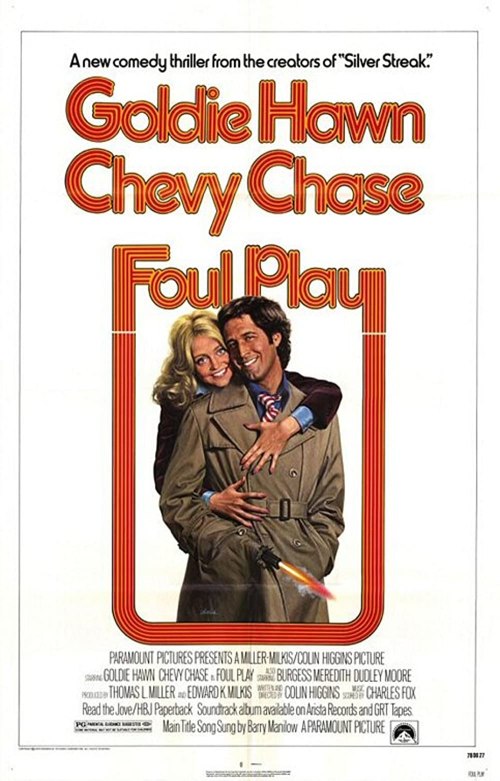
Foul Play (1978)

foul

By Richard Winters

My Rating: 7 out of 10

4-Word Review: Beware of the dwarf.

Gloria (Goldie Hawn) is a recent divorcee who takes a car trip along the San Francisco coast where she comes upon a stranded motorist (Bruce Solomon). Since she is looking to meet new people she decides to give him a ride. The man says his name is Scotty and that he’s looking to give up smoking and gives her his pack of cigarettes in an effort to stay away from them. Unbeknownst to Gloria the pack holds a microfilm that a secret organization is after. That evening the two meet-up at a theater to watch a movie, but Scotty, who has already been stabbed, dies while sitting in his seat. Gloria runs to notify the theater manager (Chuck McCann), but when they return the body is gone. Later that night Gloria gets attacked in her apartment by a man (Don Calfa) with a facial scare. She stabs him with her knitting needles and he falls over dead, at least she thinks so, before she herself passes-out. When the she comes to two policemen are in her place, but with no evidence of a body. One of the officers (Brian Dennehy) thinks she may be nutty, but the other one (Chevy Chase) finds her attractive and therefore makes an effort to research her story and while Gloria and he work together to investigate the case they begin a romantic relationship.

While Leonard Maltin, in his review, or whoever wrote if for him, describes this film as ‘Hitchcock plagiarism’ I found it similar to High Anxiety that came out a year before, and more of a homage. Many other films that try to replicate Hitch’s style usually fail because they go overboard with the theatrics, or too much parody, but this one has a nice balance that is both intriguing and funny.  Another great quality of the film is the way it lovingly photographs the city and landscape of Frisco Bay from its beautiful shore line, to row houses, to the scenic boat houses where the Chase character resides. It’s almost enough to compel one to move there if only a person who wasn’t super rich could afford to live there.

The supporting cast is delightful and everyone of them has some really laugh-out-loud moments. Dudley Moore is the best, in a part written specifically for Tim Conway who shockingly turned it down, as a sex starved bachelor who brings Gloria to his pad filled with blow-up sex dolls thinking the two will have sex only to learn that’s the last thing on her mind. Marilyn Sokol as Gloria’s fiercely feminist friend is quite amusing as is dwarf actor Billy Barty as a bible salesmen who Gloria mistakes as being the killer. Burgess Meredith, as Gloria’s kindly old landlord, doesn’t come-off as well and gets upstaged by his pet python. It also would’ve been good had his character brought-up his judo skills earlier in the story instead of having it introduced later on when they must confront the bad guys, which was just a little too convenient though the karate match that he has with Rachel Roberts is quite entertaining and something I wished had gone on longer.

I did though have some issues withe the two leads. Goldie is as enjoyable as ever, but her character makes what I felt were grossly misguided decisions. One is picking-up a stranded male stranger on an isolated road, which from a simple common sense perspective is a major no-no. She also later-on blithely walks into her apartment even after she becomes aware that the front door has been broken into. In another scene she’s given mace and a pair of brass knuckles from her friend Stella to use for protection and Gloria is able to escape from a locked room and knock-out the bad guy with the help of these items, but then she throws them away before running out, but any logical person would hold onto them in-case they were needed again.

Chase playing a police detective was something that I just couldn’t buy into. He initially comes-off, when Gloria first meets him at a party, as a lecherous lounge lizard looking to hit on hot babes and not serious about much else. He’s also seen as being highly klutzy, so having this clownish womanizer suddenly turn into a dedicated cop doesn’t jive and seemed more like two completely different people. Brian Dennehy gives a far more realistic portrayal of a policeman and is actually funnier in his exasperated responses to Gloria’s crazy story, so he should’ve been the sole investigator and Chase could’ve been this ordinary doofus that she meets and because he has the hots for her he agrees to ‘humor her’ and help her out on the case. The story and romance could’ve remained the same, but casting Chase as a regular Joe, which he’s far better playing at, would’ve made better sense.

The story does become strained at the end with a speeding car sequence that’s more nerve-wracking than fun, though the elderly Asian couple that can speak no English and sit in the back seat of the speeding limo are amusing. The whole reason behind the crime and attempted assassination of the Pope is hooky and it would’ve been better had no explanation been given at all than explaining it away the way they do. However, the climactic sequence done during a performance of ‘The Mikado’ at the San Francisco Opera House, is terrific and a nice finish to what is otherwise perfect escapism.

My Rating: 7 out of 10

Released: July 14, 1978

Runtime: 1 Hour 56 Minutes

Rated R

Director: Colin Higgins

Studio: Paramount

Available: DVD. Blu-ray

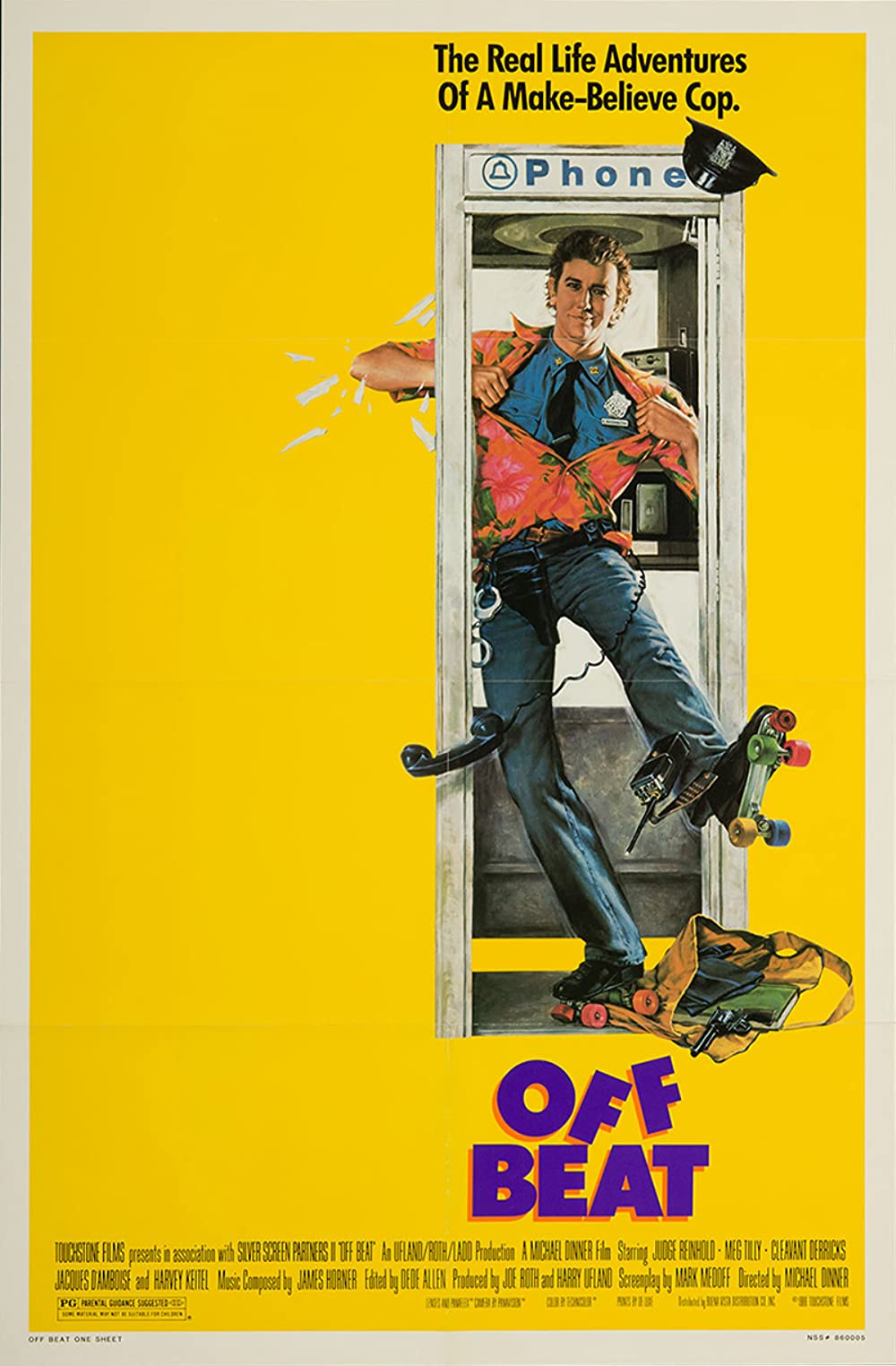
Off Beat (1986)

offbeat1

By Richard Winters

My Rating: 4 out of 10

4-Word Review: Not really a cop.

Joe (Judge Reinhold) works in the basement of a library. While he doesn’t hate his job he’s still looking for direction in life and feels he has missed his calling though he’s not really sure what that is. He’s friend with Abe (Cleavant Derricks) who is a New York City cop. One day Joe inadvertently messes-up a criminal sting that Abe was working on and in an effort to make it up to him Joe agrees to volunteer for a charity event that will require him to do ballet. It’s part of a city wide effort to get one policeman from each precinct to take part and Abe was chosen by his supervisor, but he has no interest, so he gets Joe to take his place while Joe pretends that he’s a cop in order to qualify for the audition. Joe is convinced he won’t make the cut, but when he meets the beautiful Rachel (Meg Tilly), who’s a cop that’s also trying out for the performance, he decides to press-on with it and in-turn finds that dancing gives him the interesting challenge that was otherwise missing in his life as well as a romantic relationship with Rachel. 

One of the things that really hurts the film right from the start is the totally wacky premise that seems to stretch all credibility. I found it very hard to buy into the idea that a policeman would be obligated, and in some ways almost forced, to get involved in a charity event that would take-up so much of his free time and require an extraordinary amount of rigorous training for no pay. Asking some cops to spend a few hours on one weekend at a soup kitchen passing out meals to the homeless is more reasonable, but pushing people into ballet that have no skills, or business in doing is just plain far-fetched. I felt too it was testing the friendship to obligate Joe in what turns out to being a very time consuming endeavor. Granted he learns to enjoy it, but upfront I can’t expect anyone to go that out of their way, even for a friend, over some simple mistake that the made earlier. Originally, and I can’t remember where I read this, the premise was for the characters to be prisoners and getting involved in the dance charity event would allow them the potential of getting their sentences shorten, which made much more sense, but the producers wanted to take advantage of the spate of comical cop movies that were popular at the time and therefore changed the characters into cops, but this just makes it dumb. 

The attempted comedy doesn’t gel either. It starts out at a park with undercover cops secretly listening into a conversation of two people, which seemed to have been taken right out of the opening scene in the far better movie The Conversation. It’s not made clear if that was meant to be an attempted parody of that one, but it doesn’t work either way and it’s best not to imitate a classic if you can’t improve on it as it ends up reminding one of that movie and how much more entertaining it was than this one. Later on there’s a bank robbery segment, which again seemed strikingly similar to another 70’s classic Dog Day Afternoonand again it’s not clear if this was intentionally stealing from that one in an effort to be amusing, but it doesn’t click either way. 

Reinhold shows why his Hollywood leading man career never lasted. He’s just not funny and all he seems good at is having that wide-eyed deer-in-headlights look and not much else. Other talented actors like Joe Mantegna, as Reinhold’s dance rival, and John Turturro, as Reinhold’s obnoxious boss, don’t get enough screen time and the friction that their characters create isn’t played-up enough, or results in any interesting confrontation. I did though really like Meg Tilly, who plays against type, as she’s usually cast as soft-spoken, flighty characters, but here plays someone who is tough and outspoken and does quite well.

The script, which was written by Mark Medoff, who had better success penning stageplays like Children of a Lesser God and When You Comin’ Back, Red Ryder?, does have a few heartfelt moments and having a main character feeling lost and directionless in this confusing world will be easily relatable to many, but there are just too many segments where the comedy misses-the-mark. The scenes where Reinhold is forced to try and chase down a thief and another moment where he has to arrest someone, but because he’s not a trained cop he doesn’t really know what he’s doing, could’ve been comical gold, but the film doesn’t play it out enough to be effectively hilarious. It peters-out with a fizzle by the end making it a definite misfire that didn’t do well with either the critics, or at the box office. 

My Rating: 4 out of 10

Released: April 11, 1986

Runtime: 1 Hour 32 Minutes

Rated PG

Director: Michael Dinner

Studio: Touchstone Pictures

Available: VHS, DVD (Region 2)

A Tiger’s Tale (1987)

tiger

By Richard Winters

My Rating: 3 out of 10

4-Word Review: Falling for girlfriend’s mother.

Bubber (C. Thomas Howell) is a high school student who’s dating Shirley (Kelly Preston) yet becomes more interested in Rose (Ann-Margaret) Shirley’s mother. The problem is Rose is an alcoholic and scared of snakes, which Bubber has as a pet and tigers, which Bubber also has as a pet. Despite all this the two slowly hit-it-off while keeping it a secret from the increasingly suspicious Shirley. Eventually she catches them in the act when she sees the two running naked at a drive-in where they tried to make love outside, but got attacked by fire ants. To get revenge Shirley pricks a hole in Rose’s diaphragm, so that she gets pregnant with Bubber’s baby. Bubber though intends to move-in with Rose to help her raise it, but Rose considers an abortion.

It’s impossible to say where this movie goes wrong mainly because it never gets going in the first place. It’s based off of the novel ‘Love and Other Natural Disasters’ by Allen Hannay III, who was paid $80,000 to have the rights to it sold to Vincent Pictures, which was owned and run by Peter Douglas, the third son of Kirk Douglas and brother of Michael. Peter then converted it into a screenplay, but without having read the book I couldn’t help but feel that something got lost in the transition. This is a big problem when novels get turned into movies as films don’t have as much depth to the story and characters as books typically do, which is why most people who enjoyed the story in book form usually end up disappointed when they see it as a movie. The elements are there for something potentially interesting, but Douglas, who also directed, doesn’t have the ability to put it altogether, which is probably a good reason why he’s never written, or directed any movie since.

I liked the setting, filmed in Waller County, Texas, but it doesn’t give the viewer enough feel of the region. Just showing the exterior of the homes and the drive-in isn’t enough. We need to see the town that they live-in in order to understand the characters and learn what makes them tick and the environments they are brought up in can have a lot to do with that, but when that environment gets captured in an ambiguous way, like here, it doesn’t help.

The story seems to want to tap into the themes of The Graduate, but that was a brilliant film and if you can’t top that, or at least equal it, then it’s best not to even try. Ann-Margaret is supposed to be an alcoholic, but we only see her with a drink in her hand at the start and then the rest of the time she seems quite sober. I also didn’t like the way she see-saws between being vampish at one moment and then a mature adult who gets real preachy with Bubber the next. It’s like someone with a split personality who isn’t fleshed-out and the same can be said for Howell’s character too.

There was potential for some funny bits like when Rose goes over to Bubber’s house and tells him she’s really frightened of snakes and then gets undressed and into bed with him. The camera then pans down to show a snake slithering under the covers and I thought this was the beginning of a really hilarious moment, but then the film cuts away. Later on Rose is shown to be comfortable in the presence of Bubber’s snake, but we never witness her transition, which was a missed opportunity for character development.  The scene where Rose and Bubber going running naked at the drive-in is dumb too because apparently only Shirley notices them even though with the screaming that the two were making it would’ve made anyone at the drive-in look-up and not just her.

Even the reliable Charles Durning gets wasted and becomes as dull as the rest. In fact the only thing that  I did enjoy was the tiger. I must commend Howell for being willing to get into a cage with it and stick his hand inside it’s mouth, but I was confused why the tiger is playful one second and then proceeds to try and attack Howell the next. Also, why would Howell want to get back into the animal’s cage later after he almost got his leg bite-off before? Even with that in mind I still felt the tiger was cool, the scene where he kills and eats a pooch of some customers that were just passing through is amusing in a dark sort of way and when he’s eventually set free is the only memorable moment in what is otherwise a misfire.

My Rating: 3 out of 10

Released: August 22, 1987

Runtime: 1 Hour 37 Minutes

Rated R

Director: Peter Douglas

Studio: Vincent Pictures

Available: DVD-R (dvdlady.com)

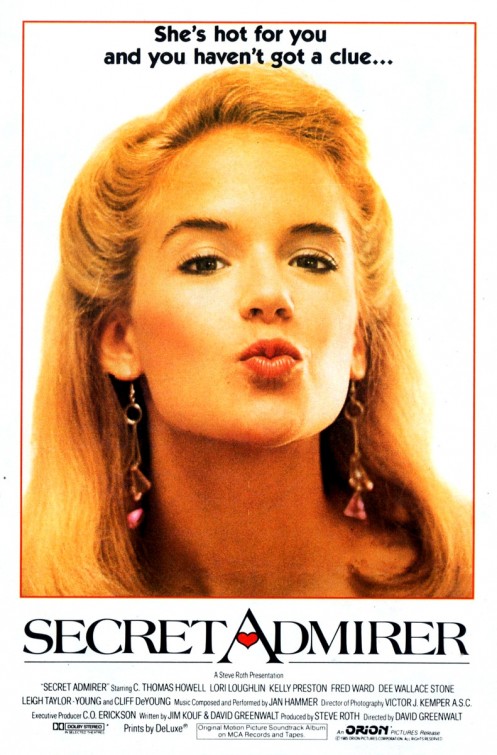
Secret Admirer (1985)

secret1

By Richard Winters

My Rating: 4 out of 10

4-Word Review: Anonymous letter creates confusion.

Michael (C. Thomas Howell) is a teen secretly infatuated with Deborah (Kelly Preston), who’s considered the hottest babe in school. He wants to date her, but is too shy to approach her. He then receives an unsigned letter in his locker from someone stating that they’re in-love with him. Michael is convinced that it’s from Deborah. His friend Toni (Lori Laughlin) convinces him to write a letter to her, but his attempts to write something romantic prove futile, so Toni decides to do it for him, but still make it seem like it came from him. Once Deborah reads the letter she falls instantly in-love and the two go out on a date, but meanwhile Michael’s mother Connie (Dee Wallace) reads the letter and thinks it’s been written to her husband George (Cliff De Young) and that he’s been fooling around behind-her-back. George also reads the letter, but thinks it’s from Elizabeth (Leigh Taylor-Young) who’s teaching a evening class that George is taking and is also Deborah’s mother. George uses the opportunity to make a pass at her and the two agree to go out on a date while Connie gets with Lou (Fred Ward), Elizabeth’s husband and Deborah’s father, in an attempt to stop it, but find that they too have more in common than they thought and begin to contemplate an affair of their own.

An unusual and offbeat 80’s teen sex comedy that fares a bit better than most of the others. The dialogues between the teens seems more realistic and they aren’t extremes caricatures like what you usually get in this tired genre. I was even surprised that they at one point have a discussion of the film Doctor Zhivago and even know the actor’s names who are in it even though it was an old film even back then. There’s a segment where Michael and Deborah attempt to have sex and it turns into a painful and awkward experience for both, which I liked, because too many times these types of movies would portray sex, even if it was the first time for both partners, as being an exhilarating, fun time, which it isn’t always. The parents aren’t portrayed as being ‘out-of-it’ or overly authoritarian like in other teen comedies and cutting back-and-forth between the adult escapades and the teens is at least initially a refreshingly original concept.

The performances are engaging even Howell does well here particularly at the end when he tries frantically to chase down Toni. The adults though are a bit more engaging despite De Young looking too boyish to be playing the part of a father of a 17-year-old. Wallace and Ward are the scene-stealers especially Dee and the way she breaks-out crying when she gets really upset and Ward’s overly-protective father persona is funny too and the film should’ve just been centered around them.

Spoiler Alert!

The jumping back and forth though between the adults and the teens starts to seem like two different movies with the parent’s storyline being the better one. I didn’t like the way it got wrapped-up with the couples going back to their former spouses like everything was back to normal even though there seemed to be clear issues in both marriages for them to so easily consider affairs when they thought there was a chance. It would’ve worked better and even been more believable had it ended the other way where the couples swapped partners and thus became more compatible.

I didn’t understand why Michael saw Toni only as a friend, even tough she was clearly into him. I considered Toni to being better looking than Deborah, or at least certainly in the same league, so unless Michael had a fetish for blondes over brunettes it didn’t makes much sense why he’s so tirelessly chase after Deborah when he already had a good thing with Toni. For it to believable Toni needed to be less beautiful, even plain looking, then it would be understandable why Michael would overlook her, but eventually see her in a romantic way once he realized all the nice things she did for him. It would’ve also have sent a good message that a female didn’t have to be cover girl quality, which both Laughlin and Preston were, and could still be able to find love.

End of Spoiler Alert!

While this film sat for several decades in virtual obscurity it finally came to prominence in 2016 when it was part of a controversy dealing with the Puerto Rico movie Vasos De Paper, which was written and directed by Eduardo Ortiz. That film was a virtual scene-for-scene remake of this one despite the director insisting that it wasn’t. When the evidence became too much Ortiz finally broke down during a radio interview and admitted that he had ‘done a very bad thing’ and stole the idea without giving proper credit to the original writer and director. The cast of that film were unaware of this one and had no idea they were taking part in a plagiarized script. Once they did they apologized for their involvement and the movie was pulled from the theaters.

My Rating: 4 out of 10

Released: June 14, 1985

Runtime: 1 Hour 38 Minutes

Rated R

Director: David Greenwalt

Studio: Orion Pictures

Available: DVD, Blu-ray

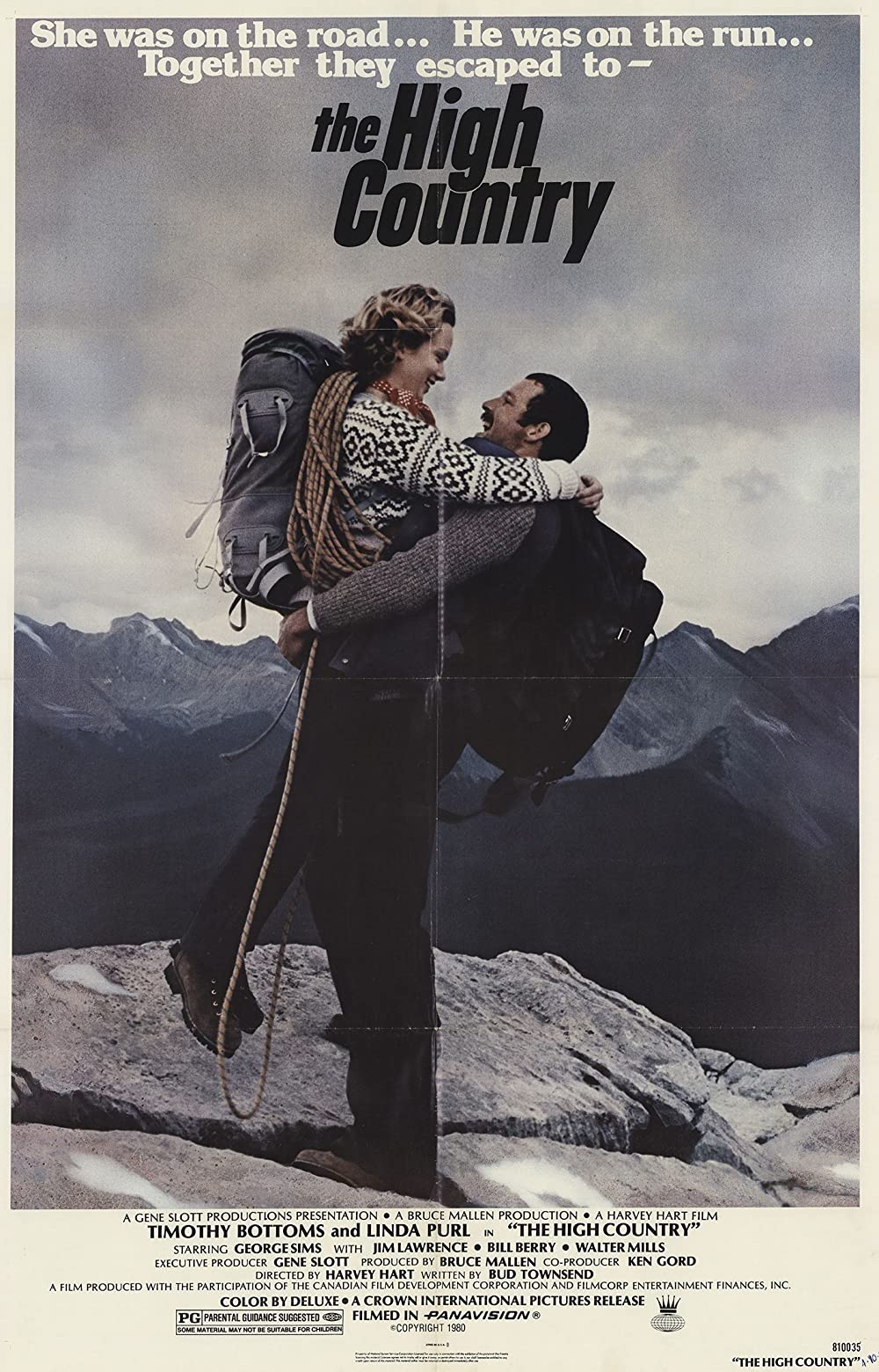
The High Country (1981)

high

By Richard Winters

My Rating: 2 out of 10

4-Word Review: Escaping into the mountains.

Jim (Timothy Bottoms) is arrested for dealing marijuana and taken by police car to jail when the brakes in the vehicle go out and the car overturns, which allows him to escape, but not before being shot in the arm by one of the officers. Kathy (Linda Purl) is an adult woman, who can’t read while also suffering from other learning disabilities. She leaves the family that she’s been staying with and goes hitch-hiking when she comes upon the injured Jim. Initially the two have nothing in common, but she’s able to help him with his injury and guide him over a rugged mountainous terrain, which will be out of reach to the authorities who are after him and in the process the two begin to form an unlikely bond.

While the film doesn’t have much to cheer about I did at least like the mountain scenery, filmed on-location at the Banff National Park in Alberta, Canada. There’s also a few marginally tense moments where the two scale the side of the mountain, where like in the movie Deliverance, it’s the actors doing the actual climbing and not stunt people. I also enjoyed the offbeat humor of having Jim attend a bar where a sign hangs that read’s ‘absolutely no profanity allowed’ (what sort-of self-respecting bar would have this rule. I guess only in ‘nice’ Canada) and a brawl breaks-out when one of the patrons decides to swear.

The performances are engaging especially Purl’s whose blue-eyes exude the perfect look of innocence. I was though frustrated that we never get to see these ‘cigarette trees’ that she mentions and says is somewhere in the mountain country as I was expecting the movie to have an answer since the script brings it up. The film also initially shows Kathy reading a story to some children making it look like she can read, but we’re told later that she was only ‘telling’ the story, but a good director would clue the viewer in right away that something isn’t right with her reading and those around her can sense it.

Bottoms is strong too though it’s surprising how far his career had tumbled where in the early 70’s he was getting starring roles in acclaimed Hollywood movies, but by the 80’s was relegated to low budget indie projects and foreign films. His character here is a bit snarky and he’s hard to warm-up to though the scene where he saves Kathy helps remedy this. The fact though that he has a bullet lodged in his body and is initially in great pain with a bad infection and yet this all magically gets healed without ever receiving proper medical care seemed dubious.

Spoiler Alert!

I was not so happy with the father character who arrives pretty much out of nowhere in the third act and is somehow able to track the two down when no one else can. It’s never clear whether this guy is meant to be a nemesis, or not and he should’ve been introduced earlier and made a stronger impression upfront. He also looks way too young to be Kathy’s father, who’s clearly in her 20’s and yet he doesn’t have any gray hair and with his big bushy mustache and muscular physique looked better suited for a 70’s gay porno.

The dumbest thing though is how at the end it implies that Jim and Kathy get into a romantic relationship, which defies all credibility. There’s too much of an extreme mental disparity between the two. It will always be a parent-child scenario versus that of two people on equal footing. In fact that’s one of the reasons I got bored with it as there’s clearly limits to how far this quasi friendship, with Kathy being stuck with the mind of a 10-year-old, can go and the fact that the film creates this idea of a wondrous romance is just too absurd to swallow. The start of a nice little friendship where they become pen-pals would be cute enough, but anything more than that; no!

My Rating: 2 out of 10

Released: March 20, 1981

Runtime: 1 Hour 38 Minutes

Rated PG

Director: Harvey Hart

Studio: Crown International Pictures

Available: None

Slow Dancing in the Big City (1978)

slow1

By Richard Winters

My Rating: 2 out of 10

4-Word Review: Journalist falls for dancer.

Lou (Paul Sorvino) is a successful columnist for a major New York newspaper and is known throughout the city where ever he goes. He’s been in a casual sexual relationship with Franny (Anita Dangler), an early version of what’s now called ‘friends with benefits’, for quite awhile, but he’s ready to move-on. He then meets Sarah (Anne Ditchburn) a professional dancer who’s moved into an apartment next to his. She’s getting ready to star in a big ballet production, but is finding that during rehearsals she’s having a lot of difficulty doing her routines. She visits a doctor and learns that she has a degenerative condition that will make her continued dancing impossible. If she tries to dance for even a little while more it could mean she’ll lose her ability to walk. She wants to perform one last time in the premiere of her play, but will Lou, whose just learned of her condition, be able to talk her out of it?

This was director John G. Avildsen’s follow-up to his mega-hit Rocky and many in the film going public, both fans and critics alike, were excited in anticipation at seeing his next big project. Some promos even described this as a ‘female Rocky’, but after it premiered no one was impressed. It ultimately died at the box office and tainted Avildsen, who had struggled for many years before Rocky, with a lot of low budget independent stuff that was never seen by a wide audience, as being a ‘one hit wonder’. Of course it didn’t help that he went on to direct the wretchedly bad Neighbors, but in either case this was the start of his career downfall that was somewhat saved with The Karate Kid, but not completely.

One of the things that I did like were the two stars. Ditchburn, whose only other starring role in a feature film was in the Canadian slasher Curtains, I felt was super. She was a professional dancer and initially I thought she had been the inspiration for the story, but apparently that wasn’t the case as Avildsen had already auditioned over 400 other people for the part before he settled on her, which came after he saw a picture of her and her beauty so mesmerized him he couldn’t get her image out of his head. While her acting during her audition was by her own admission ‘a disaster’ Avildsen was determined to make it work and they went through long and exhausting acting lessons until it improved. Some critics labeled her performance as ‘wooden’, but her initial frosty reaction to Sorvino, who came-off like a middle-aged poon-hound, seemed reasonable and what most other women would’ve done. The many headbands that she wears throughout was an attempt to cover-up a bad haircut that she had gotten just before filming began and in my opinion they had a sexy appeal.

Sorvino is genuinely engaging playing a prototype of famous New York columnist Jimmy Breslin and while others have played a similar type of role, including Breslin himself, I felt Sorvino did it best and his presence helps keep the film watchable. I did though question why his character, who writes for a major newspaper and known seemingly throughout the city and occasionally even gets spotted as if he were a celebrity, would still have to be living in a rundown, two-bit apartment building like he does.

The empty-headed script by actress-turned-screenwriter Barra Grant is the biggest culprit.  There’s simply no rational, logical reason for why these two complete opposites, with a drastic age separation, would suddenly go ga-ga for each other at virtually first sight. For Sorvino I could see why an out-of-shape middle-aged man would lust after a cute young thing who’s moved in next door and hope if he heaps enough attention on her he might get lucky, but I didn’t understand why Sarah would fall for a guy who was so much older. She was previously in a relationship with another older man, played by Nicholas Coaster, but no explanation for why she liked guys who could’ve been her father, even though in an effort to make her motives more understandable, there should’ve been one.

To make the concept believable the two should’ve been put into some situation where they had to rely on each other to succeed and in the process fell-in-love. It could’ve been helping each other out of some disaster like an apartment fire, or car accident. Or working together on a long-term project. Having the female protagonist then get afflicted with some ‘disease-of-the-week’ just makes it even more corny.

Spoiler Alert!

The ending in which we get to see the musical Sarah’s been preparing for is actually the best part as the stage production allows for some visual creativity, which had been otherwise lacking, but I didn’t like the tension of whether she was going to be able to make it through her illness without collapsing. The fact that she’s able to perform and only collapses the second the play is over is incredibly hokey. It also ends too abruptly with Sorvino carrying the crippled Sarah onstage where she gets a standing ovation by the audience, but no denouement showing what happened afterwards. Does she get the operation, which would allow her to walk again, or does she become permanently confined to a wheel chair and if so does that affect their budding relationship? These are questions that should’ve been answered, but aren’t.

My Rating: 2 out of 10

Released: November 8, 1978

Runtime: 1 Hour 44 Minutes

Rated PG

Director: John G. Avildsen

Studio: United Artists

Available: DVD, Blu-ray