Category Archives: Romance

Nice Girls Don’t Explode (1987)


By Richard Winters

My Rating: 1 out of 10

4-Word Review: Love meets spontaeous combustion.

April Flowers (Michelle Meyrink) has a serious problem. Whenever she goes out on a date with a guy and gets even the slightest bit aroused by him she starts inadvertently setting off fires. Smoke comes popping out of nowhere and before her dates know what is happening their clothes are on fire or worse her date’s fancy cars. April is always sure to bring along protection and in this case that means a small fire extinguisher, but they can’t always put out all the fires that she creates. What April doesn’t know is that it is really her mother (Barbara Harris) who is setting the fires. She buys the explosive ingredients from a pyrotechnic (Wallace Shawn) secretly follows April on her dates and then at just the right moment she uses her remote control to set them off, but now April is dating Andy (William O’Leary) who is on to what the mother is doing and determined to expose her shenanigans to April.

Had this film stayed with the idea that April had some sort of ability to start these fires herself it might have worked as there are a plethora of different and interesting avenues that the story could have taken. Having the plot take the avenue that it does brings up more questions and loopholes and doesn’t really make any sense. Are we to believe that April has now grown into young adulthood and never once suspected that her mother is following her around everywhere and doing what she is doing? And what would compel a mother to torment her daughter in such a way and does she actually believe that she can go on achieving this bizarre stunt for the rest of her daughter’s life and never get caught? None of these questions get answered or even touched upon and instead we are given corny humor that becomes increasingly cartoonish as it progresses until is insulting to anyone with any resemblance of an intellect.

The movie is basically a bad example of a one-joke idea getting stretched out farther than it can or should. After the first five minutes the novelty wears off and has nowhere to go and limps along until it becomes excruciatingly boring and mindless.

Harris gives it her all and to some extent succeeds. I have always enjoyed her work no matter how bad the script, but this one really pushes it. I found it surprising why a woman who was nominated twice for the Academy Award, won several Tonys on Broadway, and was Alfred Hitchcock’s last leading lady would have to settle for this low-grade silliness simply to make a living. Unless of course screenwriter Paul Harris was in some way related to her, so she decided to do it as a favor, but that has never been confirmed.

Meyrink is appealing. She has a geeky quality, but still pretty with a good comic delivery and it is a shame that she did only one more movie after this before dropping out of the business completely. Shawn is also fun as the fire expert, but everyone else is either dull, or has no ability to act.

Someone really should have set fire to this script. Filmed on-location in Lawrence, Kansas this may be the only film in history that lists a stunt double for a cat.

My Rating: 1 out of 10

Released: February 22, 1987

Runtime: 1Hour 28Minutes

Rated PG

Director: Chuck Martinez

Studio: New World Pictures

Available: VHS

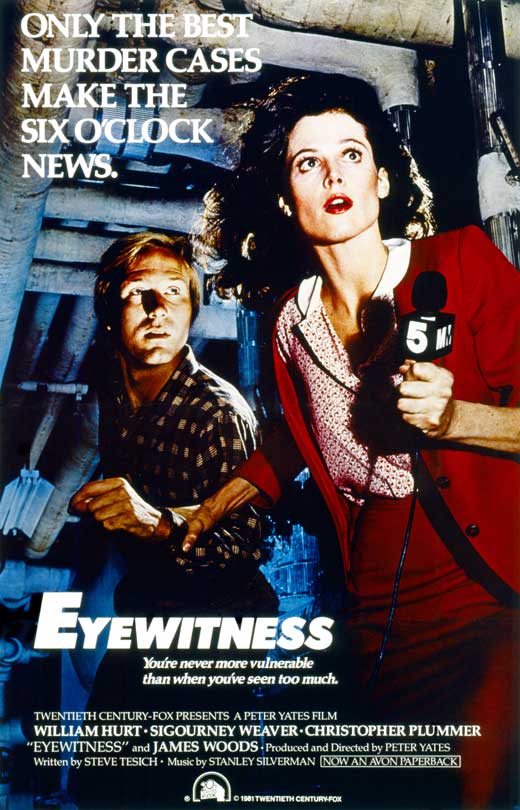
Eyewitness (1981)

eyewitness

By Richard Winters

My Rating: 4 out of 10

4-Word Review: Janitor loves news reporter.

Daryl (William Hurt) is a nighttime janitor at a large Manhattan office building. He spends his otherwise lonely existence obsessing over a local news reporter Tony Sokolow (Sigourney Weaver) and records every news broadcast she is in and watches them each night when he gets home. Then a murder occurs in his office building and Tony covers it for her program. Daryl tries to use his inside knowledge to get closer to Tony, but is reluctant to tell her all the information he knows since he fears that it was his friend Aldo (James Woods) who committed the crime.

Hurt, who usually plays the intellectual type, does well here in the low-key role. Weaver is also excellent doing what she does best which is playing a tenacious no-nonsense woman who can take care of herself. My favorite part with her is when she is accosted by a couple of men with guns, but doesn’t scream, keeps her composure, and manages to get away.

The romantic angle is the film’s strong point. Tony’s on-camera interview with Daryl when she tries to get more information out of him, but he instead gushes about his undying love for her is funny. It is refreshing that when Daryl tells Tony about how he obsesses over her she doesn’t freak out and consider him a stalker, but instead is charmed by it. The two use each other for their own purposes, but the viewer is giving the impression that these are genuinely nice people who just have very contrasting personalities and approaches, which is what makes the budding relationship interesting. However, having them go to bed together and confirm their affections for each other seemed anti-climactic as it was more intriguing wondering if Tony really was starting to have feelings for Daryl, or just using him to get information and the film should have stayed at this level until the very end.

The mystery portion gets lost in the shuffle. The film is slow with very little tension. There are a few good action moments, but there needed to be more. The scene where Daryl almost gets crushed in a trash compactor had definite potential, but needed to be played-out longer. The part where he and Tony are attacked by a dog is very intense, but the climatic sequence where Daryl is chased by the killer through some horse stalls is certainly slick and well-shot, but it comes too late and I had already become bored and detached with it. The identity of the killer was a definite surprise, but it is also a bit preposterous and a little too convenient in the way it somehow manages to tie all the characters into it especially Tony.

Director Peter Yates does some excellent on-location shooting of New York City especially with the crowded streets and neighborhoods as well as Central Park, but the musical score is sparse and lacking. There is a pleasing jazzy score near the beginning that has a nice easy going beat to it, but then outside of a few tense moments there is nothing. This creates a film that is too quiet. Adding an urgent score could’ve helped make it more compelling, or at the very least given it more energy and personality.

There are a lot of familiar faces in supporting roles, but the majority of them are wasted. Morgan Freeman and Steven Hill as the police investigators who banter endlessly
with each other are dull and useless. Kenneth McMillan as Daryl’s handicapped father is dynamic, but pointless to the story as a whole. Christopher Plummer is always reliable, but he has done better. James Woods is good because he is a master at playing unhinged characters and I liked the casting of Irene Worth as Tony’s mother simply because she looked almost exactly like what Sigourney would end up looking when she reaches that age. This is also a great chance to see Pamela Reed in an early role as Daryl’s fiancée.

The film ends up biting off more than it can chew and the idea of mixing a cutesy romance with a murder mystery doesn’t gel and leaves a sterile effect in both areas.

My Rating: 4 out of 10

Released: February 13, 1981

Runtime: 1Hour 43Minutes

Rated R

Director: Peter Yates

Studio: 20th Century Fox

Available: VHS, DVD, Netflix streaming

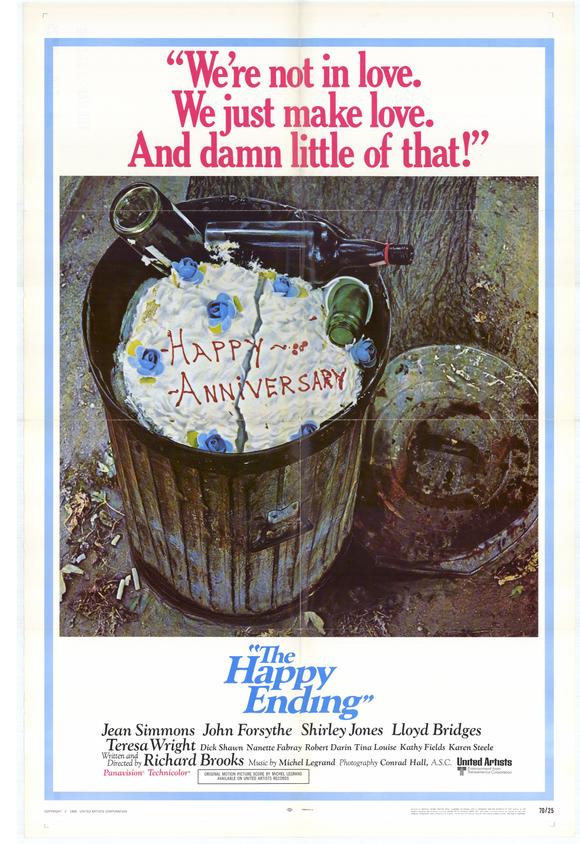
The Happy Ending (1969)

happy ending

By Richard Winters

My Rating: 4 out of 10

4-Word Review: The problems of marriage.

If there was ever a film with a misleading title it is this one. There is no happy ending here and in fact there is nothing in its entire 117 minutes that is happy as the film examines every negative and depressing thing it can think of about the institution of marriage and then rhythmically beats it into the viewer like a victim in a bar fight being pummeled by a brawler. The format works like a boring college professor lecturing endlessly about some tepid subject while tirelessly pinpointing every monotonous detail and not knowing when to stop.

The story is about Mary (Jean Simmons) who at one time was madly in-love with Fred (John Forsythe) and had extremely high ideals in regards to love and marriage when she married him. Now after fifteen years of living in a relationship that no longer has any passion she has turned into a depressed and disillusioned alcoholic looking for any way to escape the confines.

The film itself is intelligently done and well executed and makes some good hard-hitting points. The dialogue and conversations between the characters are realistic and well written and it is nice having adults acting and talking like real people. The only real issue is the question of why the filmmakers would think anyone would actually want to sit through something that is so endlessly downbeat. Sometimes these types of things work better in a satire format where they can still make the same points, but allow the viewer a few laughs as well. As it is the film is in desperate need of some levity and none is ever offered.

I also felt that film was too one-sided. I realize that there are a lot of unhappily married people out there, but there has got to be some couples that are happy with it. By never balancing it out and showing no other viewpoint makes the film come off like one long and unending rant.

Writer-director Richard Brooks infuses certain directorial touches that are novel to some extent, but heavy-handed as well. Showing clips of famous old romantic movies like It Happened One Night and Father of the Bride during Mary’s wedding is creative, but too obvious as is the segment when Mary is on a beach and a young couple asks her to take a picture of them and inside the camera’s viewfinder Brooks inserts an image of Mary and Fred when they were a young and in-love. There is also too much footage of Casablanca shown, which does nothing but make the viewer want to watch that over this dreary thing.

Simmons gives a strong performance and looks as beautiful as ever. She is also straddled with a few difficult scenes but does them well including a harrowing segment where she is rushed to an emergency room after swallowing some pills and has a hose stuffed down her throat in an attempt to vomit them out. Tina Louise is great in support as is Dick Shawn in a rare dramatic turn. Shirley Jones is also good as Mary’s jaded friend Flo and she is given some of the film’s best lines.

Forsythe is okay as the husband, but not too exciting though he never usually is. He should have had the big mole in the center of his forehead surgically removed as my eyes always seemed to fixate on it every time he was shown in a close-up. I got to admit I was amazed his character did not kill his wife on the spot when he found out that she had run up his credit card in one day on $11,421 worth of charges on clothes. This was 1969 dollars and I have no idea what astronomical figure that would be for today, but it would be beyond outrageous nonetheless. Of course he was caught fooling around, so I suppose this was her way of getting back at him and boy did she ever.

The film does have a few powerful scenes that I did like. The part where Fred defends Mary after she has run out on them and their daughter Marge (Kathy Fields) feels that her mother no longer loves her is really good as is the final conversation between Fred and Mary as well as Mary’s conversation with her mother (Teresa Wright) about the happiness of her mother’s own marriage. The moment when the very cynical Flo becomes all teary-eyed and excited when the married man that she has been fooling around with decides to divorce his wife and propose to her despite the fact that she has spent the rest of the movie considering the idea of marriage to be over-rated is savvy.

Like with the sappy and over-played Michael Legrand song ‘What Are You Doing the Rest of Your Life?’ the film goes on too long and there are just not enough good things about it to justify sitting through.

My Rating: 4 out of 10

Released: December 21, 1969

Runtime: 1Hour 57Minutes

Rated PG

Director: Richard Brooks

Studio: United Artists

Available: VHS, Amazon Instant Video, Netflix streaming

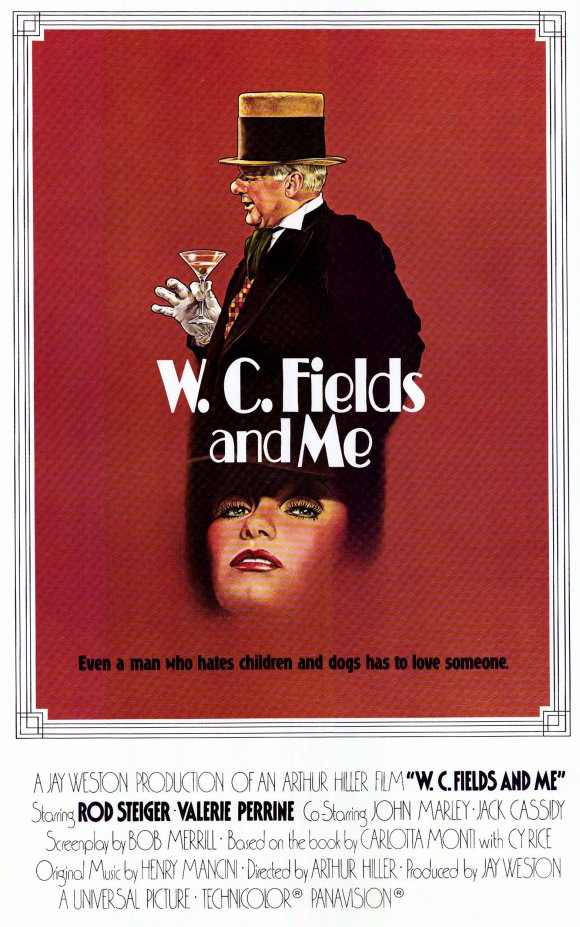
W. C. Fields and Me (1976)

W. C. Fields and me

By Richard Winters

My Rating: 6 out of 10

4-Word Review: Fields had a girlfriend.

Based on the memoirs from Carlotta Monti who was W.C. Field’s (Rod Steiger) companion for 14 years this film looks at their relationship as well as W.C.’s alcoholism and difficult personality.

This biography is highly romanticized and very light on the details. Apparently only one scene from the book is actually used in the movie. If one watches this in hopes of learning more about Field’s the man they will be disappointed. The tone seems similar to Oliver Stone’s The Doors where the intent is more on perpetuating the myth of its subject instead of tearing it down and showing the complete person. Just about everyone is familiar with Field’s drinking and cantankerous behavior, so having the film dwell exclusively in this area for the entire time is not interesting, or captivating.

The story would have been better served if it had been a complete bio beginning with Fields life as a child and then going all the way through to his death. Apparently he was born to an alcoholic father who beat him forcing Fields to run away from home at the age of 11 and live in a hole in the ground where he became dependent on stolen food and clothing for survival. He was in many fights and in and out of jail for most of his youth. Showing this could have been quite revealing, but instead the film skips past all of it and starts instead with Fields already in vaudeville and recreating a lot of corny comedy routines before having him drive off to Hollywood where his ascent to stardom seems much too easy and superficial.

Things improve during the second act when he begins his love-hate relationship with Carlotta (Valerie Perrine). Part of the reason this works is because Perrine is excellent. Her down to earth sensibilities really help balance the flamboyant ego’s around her and fit the character well. She is the one, not Steiger, who carries the movie and it was worthy of an Oscar nomination.

Steiger thought for sure that he would nab his second Oscar for his portrayal here, but instead didn’t even get nominated. His mimicking of Fields voice comes off as too rehearsed and effected. At times it gets annoying and just makes one want to watch a movie with the real Fields instead. His dialogue is too cutesy using lines borrowed from many of W.C.’s famous jokes and punch-lines. As expected he does induce the character with his famous Steigerisms and manages to not make it a complete misfire that it otherwise is. The scene, near the end, where Fields meets his now grown son that he hadn’t seen since he was three is his best moment.

Jack Cassidy is great in support as actor John Barrymore. The scene where he dies and his friends prop his dead body up into a chair and have him holding a liquor glass is amusing. Dwarf actor Billy Barty is good as Ludwig one of Field’s long-time friends. Some of the scenes the two share together are actually quite touching.

The film does a commendable job of recreating the period atmosphere. The music has a nice soothing quality to it and on the charm level it scores a bullseye. Despite my reluctance I found myself entertained by it, but as a biography it is flimsy, fictional and irrelevant.

My Rating: 6 out of 10

Released: March 31, 1976

Runtime: 1Hour 51Minutes

Rated PG

Director: Arthur Hiller

Studio: Universal

Available: Amazon Instant Video

Any Wednesday (1966)

any wednesday 2

By Richard Winters

My Rating: 6 out of 10

4-Word Review: Wednesday is hump day.

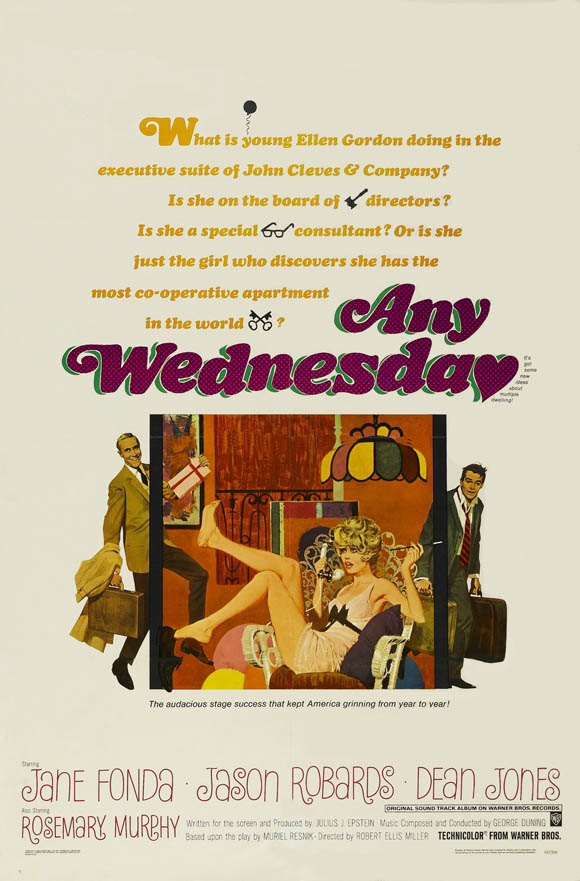
Ellen (Jane Fonda) is a single lady of thirty living in an apartment building in New York City that is about to be bought out. Ellen wants to remain there and the only way she can is if she allows the place to be purchased by millionaire John Cleves (Jason Robards) who will allow her to stay rent free just as long as Wednesdays remain available so he can use the place to bring in his lady friends for sexual trysts. John has been cheating on his wife Dorothy (Rosemary Murphy) for years and uses the excuse of ‘business trips’ to fool around with other women. John also has his eyes on Ellen and after he buys her place he succeeds in getting her where he wants her, but then young Cass Henderson (Dean Jones) drops in and much to John’s consternation starts to have an interest in Ellen and her to him. Things get really crazy when Dorothy also shows up and turns the thing into a madcap bed-hopping farce.

Although this is not one of her better known roles Jane is terrific. The character to me is believable. A young attractive woman living alone who is racked with insecurities and indecision is almost a given. In many ways she is like how the Cass character described her as a ’30-year old child’ and Fonda plays the part humorously with a very goofy whine and cry. Some may find the character offensive due to the fact that her only ambition is to get married and feels like she is ‘not a complete woman’ unless she does. She even asks Cass to marry her after only knowing him for a day, which may be extreme, but I felt in that era women were under that type of pressure and thinking process, which is why I bought into it.

The Cleves character borders on being highly obnoxious. He seems to feel that because he has a lot of money he can act arrogant and get anything he wants, which could easily rub most viewers the wrong way. Fortunately Robards manages to craftily infuse his charm into the performance, which therefore makes it tolerable.

Jones lends some nice stability and Murphy is surprisingly alluring. She was already 40 at the time, but is seen provocatively bathing in a tub, which was unusual since older women especially in that time period were never shown that way and she pulls it off in an interesting way.

Director Robert Ellis Miller tries to keep what was originally a stage play from getting too stagy yet the story really can’t hide its roots. I did like the bright vivid colors of the set and the way New York was captured in the spring time. However, the scene where Ellen and Cass go to a sunny park is initially nice, but I didn’t understand when they sat down on some swings that it had to cut away to them in front of a blue screen inside a studio. The blue screen technique, which is rarely done anymore, was always tacky looking. Here it was even worse because the actors were at a real park, so he should have just left them there.

The story itself is trite, but for the first half I found it enjoyable. An older man having an affair with a younger woman that at times acts like an adolescent was rather edgy for the period as was their open discussions about sex. The conflicts create some interesting tensions and character development, but falls apart in the second act.

Spoiler Alert!

The problem really comes when Dorothy finds out about the affair and instead of being upset by it treats Ellen like a friend and even lets her move into John’s mansion while Dorothy takes up residence in Ellen’s old apartment. However, nothing is ever shown in Dorothy’s personality to forewarn us that she would respond in such an unusual way and thus making this comic twist not as clever as intended. Yes, there is an amusing irony at having Ellen come back to her old place and feeling ‘betrayed’ at finding John and Dorothy in bed together, but having John rekindle his passion with his wife is forced and contrived ultimately making this as silly and forgettable as all the other fluffy romances from that period. Fonda’s terrific performance is the only thing that makes if slightly above average.

My Rating: 6 out of 10

Released: October 13, 1966

Runtime: 1Hour 49Minutes

Not Rated

Director: Robert Ellis Miller

Studio: Warner Brothers

Available: VHS, DVD (Warner Archive), Amazon Instant Video

Happy New Year (1973)

happy new year

By Richard Winters

My Rating: 8 out of 10

4-Word Review: A robbery with romance.

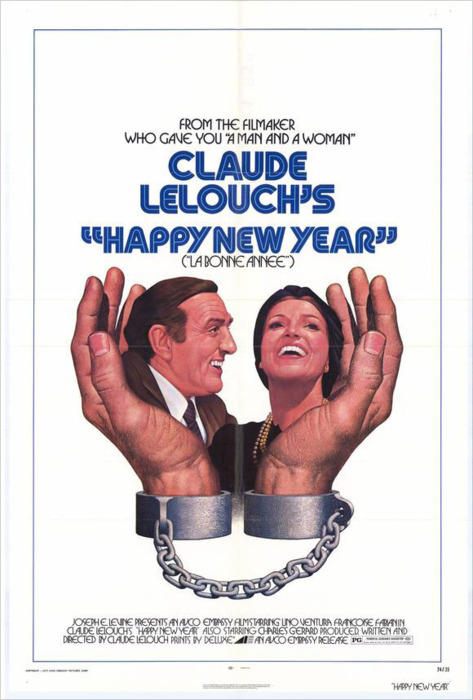
Stylish, moody, charming, serene, glossy, and evocative are just a few of the words that come to mind when you view this film and that’s just after the first five minutes. This is truly a French picture. It has all the ingredients that lovers of that cinema enjoy. Unlike American films, French films take their time in telling their story and everything is leisurely paced. The viewer is actually allowed to soak in the visual experience without being told what to think. Director Claude Lelouch is a master at work. He wisely realizes that film viewing is a very personal experience. What the viewer will take from that experience is unique only to them. Thus you have a picture that stays rather wide open in regards to structure. The camera takes many wide shots, thus allowing the individual viewer to focus on whatever it is that intrigues them personally. The story, while still being focused, stays elusive and subtle throughout.

To say the plot is about a planned jewelry store heist is misleading since this only takes up a part of the movie. There is also a running mix of character study, romance, comedy, satire, and even drama. Some will enjoy the amusing banter and love-hate relationship of the two male leads. Others will like the blossoming romance between one of the crooks and a beautiful antique shop owner. Still others will like the wide array of conversational topics some of which include: unique observations on marriage, hairstyles, churchgoers, psychology, men’s definition of women, and women’s definition of men. There’s even a playful critique of an earlier Lelouch film A Man and a Woman.

Overall it’s perfectly made for the viewer with distinct tastes even though when you get right down to it, it really is just a piece of entertainment fluff made more intriguing because of its sophisticated approach. Like with its Wizard of Oz-like format where the beginning and end are in black and white while the middle is in color. Why do it this way? No reason, except, why not. Same with the long slow shots of actor Lino Ventura’s very lined and expressionless face, which manages to hold an unexplainable captivation.

The rather abrupt and elusive ending seems to be the film’s only real weak point and yet when taken into context with everything else, this too has its allure. An American version of this movie was made in 1987 under the same title and starring Peter Falk, but that version is far inferior to this one and not worth seeking out.

My Rating: 8 out of 10

Released: April 13, 1973

Runtime: 1Hour 30Minutes

Rated PG

Director: Claude Lelouch

Studio: Les Films 13

Available: DVD (Region 2)

Between the Lines (1977)

between the lines

By Richard Winters

My Rating: 6 out of 10

4-Word Review: Newspaper get corporate takeover.

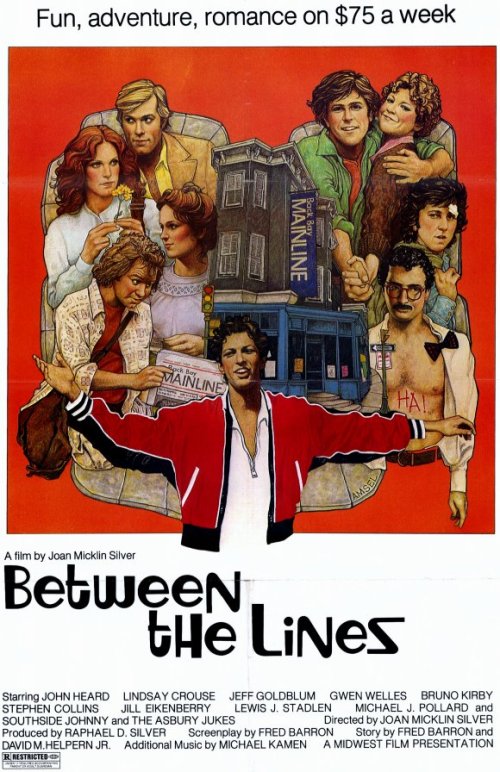
This is a look at an underground/counter-culture newspaper staff and the conflicts and concerns that they have at being taken over by a no-nonsense corporate owner (Lane Smith).

The film almost immediately takes you back to the bygone era of the late 70’s. The attitudes and conversations are realistic for that period and anyone who lived through it will most assuredly feel nostalgic .John Heard, Jeff Goldblum, and Bruno Kirby are engaging in their respective parts as is most of the cast. Stephen Collins is good also, but in an unusual role for him as he usually plays nice sensitive types, but here is a more driven, intense, and confrontational. This also works as a good unofficial statement to the death of the counter-culture movement and the eventual rise of materialism.

The story starts out well as it looks at the inside workings of an underground newspaper, but then spends too much of the middle part focusing on the relationships of some of the characters. Only at the end when the new owner takes over does it get back to the newspaper angle. Unfortunately it concludes just as things are getting interesting and we never get to see how the characters survive and adjust to the takeover. The film would have been much stronger and original had it stuck to scenarios involving the newspaper business and scrapped the relationship stuff, which tended to be derivative. Jon Korkes and Michael J. Pollard’s characters are seen too little and needed more screen time.

Also, when the film deals with the relationships there seems to be too much of a feminist bias as the men are always shown to be the ones at fault due to their ‘insensitive and selfish natures’ while the women come off the ones who are ‘reasonable and unfairly neglected’. This could be a product of the fact that it was directed by a woman as well as the era where men were somehow supposed to feel guilty simply because they were men.

This is fun as a time capsule as well as a great chance to see young stars in the making. However, the story does not take advantage enough of its original concept and ends up dealing with a lot of the same old scenarios and story lines that we’ve all seen before. Director Joan Micklin Silver and John Heard teamed up again two years later for Chilly Scenes of Winter, which I felt was better.

My Rating: 6 out of 10

Released:  April 27, 1977

Runtime: 1Hour 41Minutes

Rated R

Director: Joan Micklin Silver

Studio: Midwest Films

Available: DVD (MGM Vault)

The Grass is Greener (1960)

grass is greener

By Richard Winters

My Rating: 4 out of 10

4-Word Review: They all fool around.

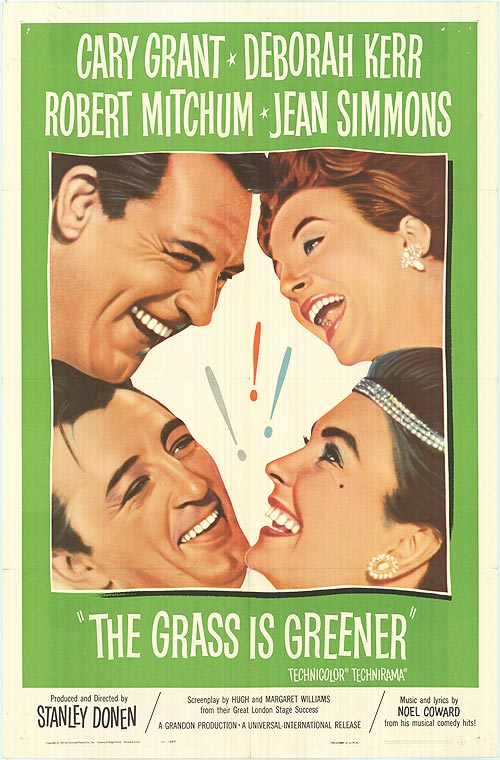
Hilary (Deborah Kerr) is married to Victor (Cary Grant) and they are low on funds so they give guided tours of their castle in order to make ends meet. Then one day rich American businessman Charles Delarco (Robert Mitchum) stops by and takes an immediate liking to Hilary and her to him. Soon they are having an affair and Victor along with his friend Hattie (Jean Simmons) devises a plan to win her back.

The film starts out well with a funny montage of cute babies in goofy poises shown during the opening credits, but then things go rapidly and irrevocably flat. One of the main problems is that there is simply too much talking and most of it isn’t funny or engaging. In fact none of the conversations between any of the four leads is interesting. The best dialogue in the whole film is the ones between Victor and his butler Trevor (Moray Watson) who is doing the job while working on his novel.  I wished there had been more of Trevor and that the story had revolved around him as the rest is trite and predictable.

Mitchum just doesn’t seem right as the love interest. He is best in parts requiring a rugged or villainous character as his romantic appeal is lacking. I actually thought he came off as downright creepy especially with the way he barges into Hillary’s room unannounced and is reluctant to immediately leave when he realizes he has walked into the wrong place. Most women would have considered him a stalker and his squinty eyes don’t help things.

I also thought Hillary throws herself at him a little too quickly. He is a stranger who pops out of nowhere. The two have a boring ten minute conversation and then are in a passionate embrace. Victor tries like crazy to win her back while I’m thinking why bother keeping a woman who jumps at any man who has money. Might as well just hire a good lawyer and take the hussy for all she’s worth.

The fact that Victor immediately figures out about the affair was another negative in my opinion as it doesn’t allow for hundreds of potential comic scenarios of them carrying on behind his back. As it is scenarios of any kind are woefully lacking. There is one scene where Victor takes Charles out fishing and another where they have a dual, but both end up being much too brief. For the most part it is just a static filmed stage play with background sets that a boring and color that looks faded and washed out.

Of course I did like Cary it is hard to dislike him simply because he is so good at being Cary. If anything his charm manages to keep this waterlogged thing afloat. Simmons isn’t bad either. I loved her variety of outfits and spunky personality. Kerr though looks and acts tired and not able to keep up with the comic timing of the other two.

If you like an old-fashioned but still very tasteful bedroom farce then this would at best be passable although Grant fans may like it a bit more while others will find it stagnant.

My Rating: 4 out of 10

Released: December 23, 1960

Runtime: 1Hour 43Minutes

Rated NR (Not Rated)

Director: Stanley Donen

Studio: Universal

Available: VHS, DVD, Amazon Instant Video

The Year of Living Dangerously (1982)

By Richard Winters

My Rating: 5 out of 10

4-Word Review: Experiencing life in Indonesia.

      Guy Hamilton (Mel Gibson) is a reporter who travels to Indonesia in 1965 just as the government is ready to be toppled. He experiences all the chaos as well as the poverty of the people and apathy from his fellow newsmen. He falls in love with a beautiful diplomat Jill Bryant (Sigourney Weaver) who works with a dwarf photographer named Billy Squires (Linda Hunt in her Academy Award winning performance), and eventually finds himself reluctantly thrust into the middle of the turmoil.

     The film is great at recreating the environment and atmosphere of that period. One gets a very good understanding and feeling at just how poverty stricken and desperate the Indonesian people where. Linda Hunt is unique and memorable as the male dwarf. She also has a great line when a fellow photographer asks her opinion of a picture that he took of a naked woman. He wants to know if she thinks it is art or pornography. Her reply, “If it is out of focus it’s art, if it is in focus it is pornography.” It is also fun to see journeymen supporting actor Michael Murphy playing against type. Usually he is saddled with rather transparent types of roles, but here his character is quite obnoxious.

      It would have been better had the film given the viewers a little bit more of a historical background before it just plopped the characters into a very chaotic and confusing situation. Most people probably have no clue as to the history of Indonesia let alone finding it on a map. It would have also been more interesting had the film been based on real people who really lived through the situation instead of predictable prototypes. A very young Gibson seems a bit overwhelmed with his role. His character seesaws from being boring to exasperating. He gets a huge crush on the Weaver character and chases after her like she is the only thing on his mind and then when she gives him an important piece of information he pounces on it even if it means losing her and their relationship. The pace is hurt by having the film spend too much of its middle section focusing on the romance, which really isn’t all that interesting or diverting. The ending is much too pat for a story that takes place in such a dangerous and complex environment.

      This is a grand idea that becomes too muddled and doesn’t place enough emphasis on the historical background and context. The lead character is boring and the pace is not compelling enough.

My Rating: 5 out of 10

Released: December 17, 1982

Runtime: 1Hour 55Minutes

Rated PG

Director: Peter Weir

Studio: MGM/UA

Available: VHS, DVD, Amazon Instant Video

Man’s Favorite Sport (1964)

By Richard Winters

My Rating: 2 out of 10

4-Word Review: Winning a fishing contest.

            Roger Willoughby (Rock Hudson) works at a sporting goods department store and uses the information he overhears from his customers to become an ‘expert’ at fishing and best-selling author on the subject despite never having done it himself. Things unravel when his boss (John McGiver) enters him into a fishing contest and he must use the help of beautiful brunette Abigail Page (Paula Prentiss) to show him the techniques and save his reputation.

Billed as another screwball comedy much in the same vein as Howard Hawk’s classic Bringing Up Baby. However, this film doesn’t even come close to that one. It is extremely slow and the comedy bits are thrown in with a haphazard style. The pacing is none existent and the plot is far-fetched and contrived. I was willing to forgive it a little figuring that by the second half things would kick-in, but it never does. The jokes are simplistic and unimaginative.  I found none of it to be funny and mainly strained and labored. With the slight exception of the scene involving Roger’s inflatable wading pants I didn’t find any of it to be even engaging. Roger’s attempts at fishing are particularly disappointing as this scenario could have been played up a lot more.

Hudson is weak as the lead. His voice always has a hollow tone and his delivery is wooden. Cary Grant would have been a much better choice and the film could have been a lot funnier with his presence. When Grant became irritated it was always amusing, but with Hudson it comes off as forced and boring.

Paula Prentiss is the best thing about the movie. Many fans agree that this is her best performance of her career. She has a nice free-form style to her delivery and avoids having that stiff drama school touch. I liked the gaze of her brown eyes and at times it reminded me a lot of Karen Black’s. Her younger, more relaxed presence helps compensate against Hudson’s stiff older one. I’m surprised her career fizzled in the 70’s as she has an interesting and unique style that I would have liked to have seen more of. Her sparing with Hudson is the only thing that gives this film any energy. However, having them end up falling in love was formulaic and forced. The two really didn’t have the right chemistry and showing them not getting along, or getting on each other’s nerves was more entertaining.

My Rating: 2 out of 10

Released: January 29, 1964

Runtime: 2Hours 1Minute

Rated NR (Not Rated)

Director: Howard Hawks

Studio:  Universal

Available: VHS, DVD