Category Archives: Romance

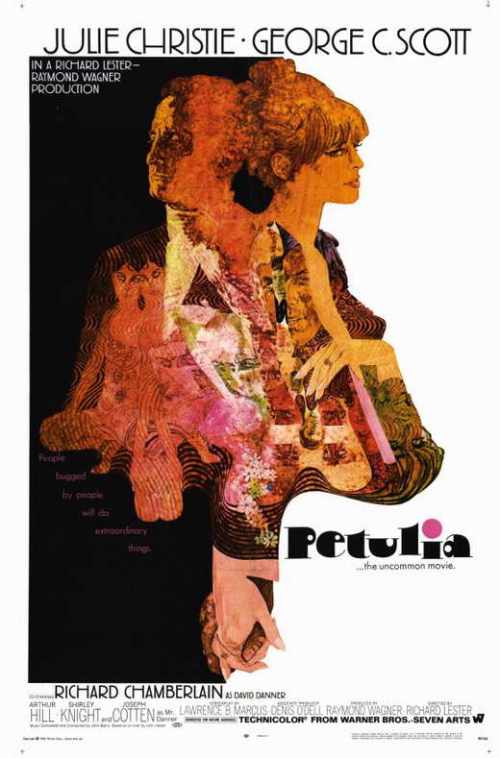
Petulia (1968)

petulia 2

By Richard Winters

My Rating: 9 out of 10

4-Word Review: A very brief affair.

While attending a medical fundraiser Petulia (Julie Christie) who is a married rich socialite, decides to come-on to Archie (George C. Scott), a doctor who performed a life-saving surgery on a young Hispanic boy (Vincent Arias) that she brought to him a few months earlier. Archie is still hurting from his recent divorce to his wife Polo (Shirley Knight) and not sure he wants to jump into another relationship so quickly especially with a woman that behaves in such an eccentric way. However, her kooky personality and good-looks get the better of him and the two spend the night together. In the days that follow Archie learns of her abusive relationship with her husband David (Richard Chamberlain), but when he makes an attempt to help her get out of it she resists, which causes him a great deal of frustration as he is unable to get a good grasp on why she behaves the way that she does.

The film is based on the novel ‘Me and My Arch Kook Petulia’, which was written by John Haase who worked as a dentist and wrote his stories between his appointments. What makes this plot stand out from the rest of the romances is that it focuses on the chance meeting between two people who share an immediate attraction, but are unable due to various extraneous circumstances to ever get it into a relationship stage. They become like two-ships-passing-in-the-night and go on with their lives and even other relationships while quietly longing for ‘the-one-that-got-away’. Most movies portray romances where everything falls into line and works out while blithely ignoring the ones that get shown in this film even though these are much more common.

Director Richard Lester, who is better known for his slapstick comedies, shows an astute eye for detail and his fragmented narrative works seamlessly. I enjoyed the quick edits and color detail as well as the subliminal symbolism including showing the David and Petulia characters wearing all-white to display their sterile marriage as well as capturing David’s father (Joseph Cotton) sitting in front of a giant window that looked like a cobweb to help illustrate how he had entangled Petulia into his own personal web. The film, which was shot on-location in San Francisco, features great shots of the Golden Gate Bridge and the world famous cable cars as well as an interesting scene at the Jack Tar Motel, which has now been demolished but was famous for its ability to check customers into their rooms without the use of a live clerk, but instead through close circuit TV and a room key that would light up when the person passed by their assigned room.

The two leads give strong performances particularly Scott who for a change doesn’t play a character with a forceful personality, but instead someone who inadvertently gets bowled over by a woman who has an even stronger one than he. Even Chamberlain does well. Normally I find him to be quite bland, but here he is surprisingly effective.

This movie also marks the film debuts of many performers who are seen in brief, but quirky bits including: Richard Dysart as a virtual hotel clerk, Howard Hesseman as a hippie, Rene Auberjonois as a seat cushion salesman and Austin Pendleton as a hospital orderly. Members of the Grateful Dead get some funny moments while inside a grocery store and Janis Joplin can be seen onstage singing during the opening party sequence.

Romance fans will like this, but so will those living in the Bay area during the ‘60s as the city gets captured well. However, fans of that decade will also like it as it expertly exudes the vibe from the period and making it seem very real to the viewer even if they weren’t alive during the time it was made. Also, John Barry’s haunting theme nicely reflects the character’s mood and evasive film style.

petulia 1

My Rating: 9 out of 10

Released: June 10, 1968

Runtime: 1Hour 45Minutes

Rated R

Director: Richard Lester

Studio: Warner Brothers

Available: DVD, Amazon Instant Video, YouTube

King Kong (1976)

king kong 1

By Richard Winters

My Rating: 7 out of 10

4-Word Review: Giant ape terrorizes Manhattan.

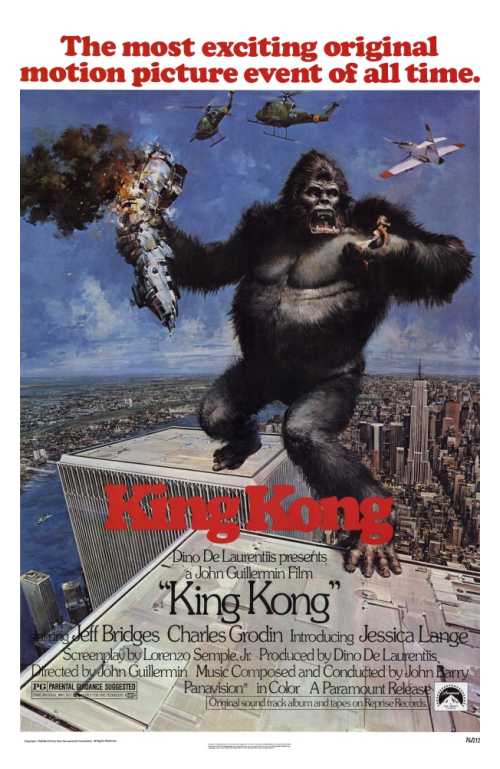
Fred Wilson (Charles Grodin) works for the Petrox Oil Company and heads an expedition in search of hidden petroleum reserves. He is particularly interested in a small, isolated island that is perpetually shrouded in fog and along the way they rescue Dwan (Jessica Lange) a beautiful, but flighty girl that is a lone survivor of a shipwreck. When the crew arrives at the island they find that it is inhabited by natives who perform some ancient, tribal ritual for a beast that they have caged inside a fenced-in area. They are intent in sacrificing one of their women to the beast, but when they spot Dwan they decide to use her instead where she then becomes the source of fondness to a giant gorilla named Kong. The crewmen are able to rescue Dwan and take the gorilla back to New York where Fred hopes to exploit the beast for his own monetary gain, but the gorilla escapes from his cage and goes on a rampage through the streets of New York looking for Dwan who he considers to be his.

This is a remake of the 1933 classic, which was later remade for a third time in 2005. Out of the three this one is considered to be the weakest, but I found that to be unfair as it still, while not being perfect, holds up well. The story itself is a bit dull and it takes too long until we are finally able to see the ape, a whole 50 minutes to be exact, but once the special effects get going it is impressive.

Some of the best moments come when he goes on a rampage in Manhattan and singlehandedly derails a subway car from its tracks and shakes it until all the people come tumbling out. His ride back to the states inside a freighter and the moment when he bursts through the giant fence on the island are equally exciting visually.

The gorilla is played by special effects artist Rick Baker inside an ape suit, which is something that he has done in other films as well. For the most part he does an excellent job, but I was bothered at the way the animal’s walk gets portrayed. To me it was too fast like the way a human walks instead of an animal and most apes walk on all-fours most of the time, so the fact that this one didn’t appeared unnatural. There are times too when the fur clearly looks like its sewn into a suit and not coming from the skin.

I also didn’t like the moment when the ape gets unveiled for the first time to the American spectators and he is shown wearing a giant crown. Adding in the crown gave it too much of a campy flair and hit home the exploitation theme in a heavy-handed way that was not needed. I also found it hard to believe how they were able to measure the beast’s head, build the crown to a correct proportion and then somehow get it on as they would’ve had to use a crane to do it and he would’ve fought with them while they did and most likely ripped it off the second it was put on.

Grodin is fun as the egoistical, but clearly clueless leader of the expedition and he ends up getting most of the film’s laughs.  Lange though in her film debut is fantastic and I loved her free-spirited, thrill-seeking character who is partially scared of the beast, but also intrigued by him and so consumed with getting media attention that she compromises her better judgement in the process.

My Rating: 7 out of 10

Released: December 17, 1976

Runtime: 2Hours 14Minutes

Rated R

Director: John Guillerman

Studio: Paramount

Available: DVD, Blu-ray, Amazon Instant Video
The Only Game in Town (1970)

only game in town 1

By Richard Winters

My Rating: 7 out of 10

4-Word Review: A Vegas love story.

Fran (Elizabeth Taylor) is an aging Las Vegas showgirl living alone in a two-bit hotel room while awaiting the return of her lover (Charles Braswell) who has disappeared yet again while he goes off to his wife that he consistently promises he will eventually divorce. In her loneliness she decides to go out to a piano bar and order a pizza. It is there that she meets Joe (Warren Beatty) and the two quickly hit-it-off while also spending the night together. Joe has a gambling problem, but promises that the minute he saves up $5,000 he’ll be out of Vegas for good. He moves into her hotel room where she helps him save up the necessary dough to achieve his dreams even though with his gambling addiction he will fritter it all away the moment he gets his hands on it. Then Fran’s long lost lover returns and ready for marriage. Will she go back with him, or stay with the self-destructive Joe that she has despite her better judgement fallen in love with?

The script by Frank D. Gilroy is based on his stage play and it’s not particularly rich in character development or plot. In fact the play itself fared poorly when it ran on Broadway and had only 16 performances before being shut down. However, despite its lack of originality I still found myself enjoying it and a major reason for this is the casting.

Taylor shines in a role that didn’t seem to be a particularly good fit for her. She spent the latter part of her career playing bitchy old dames that always seemed one step away from the sanitarium or a nervous breakdown. Here her character merits some sympathy and her usual overacting is actually entertaining and helps propel the flimsy plot along. The pairing of her with Beatty is an odd one, but then again the relationship is supposed to be awkward, so it ends up working to the script’s advantage.

Beatty’s performance is equally impressive. Normally he specializes at playing characters that are cool, calm and in control, but here he portrays one that is quietly crumbling and manages to pull it off to complete perfection. The scenes of him at the craps table and compulsively blowing all of his hard-earned money away is genuinely difficult to watch, especially since real cash gets used, and one of the most effective looks at the gambling addiction that I’ve seen.

This also marks the last film to be directed by the legendary George Stevens. He was known for helming some epic Hollywood productions, so it is a bit surprising that he choose to do this one since the storyline and setting were far more constrained from what he was used to working with. In fact the majority of it was shot in Paris, France and not Las Vegas, which many critics at the time felt was a detriment, but to me it made it even more fascinating to watch because of it. For one thing the crew did spend 10 days in Vegas shooting some of the outdoor shots, so you still get some legitimate Sin City scenery regardless. What I enjoyed though was the way Stevens was able to camouflage the rest of the scenes including having the bright daytime light seeping through the hotel room windows, which convincingly looked like the natural sunlight reflecting off of the sandy desert landscape. The recreation of the giant Las Vegas grocery store was impressive as well and strangely one of my favorite moments from the movie.

If you enjoy quirky love stories particularly between characters who are painfully human and less than glamorous you may enjoy this film better than most. It’s also a terrific chance to see two very fine actors playing against type and doing so in splendid fashion.

My Rating: 7 out of 10

Released: January 21, 1970

Runtime: 1Hour 53Minutes

Rated M

Director: George Stevens

Studio: 20th Century Fox

Available: Blu-ray

Valley Girl (1983)

valley girl

By Richard Winters

My Rating: 4 out of 10

4-Word Review: Like totally, for sure.

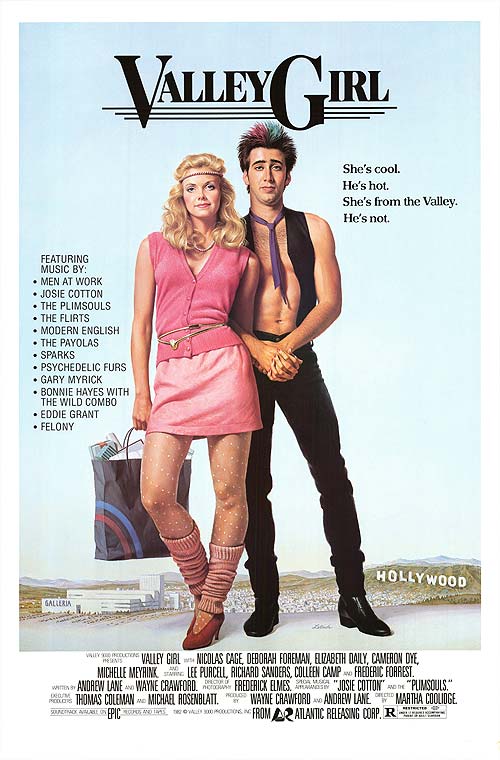
Julie (Deborah Foreman) is a popular teen who is attracted to Randy (Nicholas Cage) who is not a part of her snotty clique. Stacey (Heidi Holicker) and Suzi (Michelle Meyrink) are her friends who want her to go back to dating the two-timing Tommy (Michael Bowen) even though she gets along with Randy far better. Her hippie parents (Frederic Forrest, Colleen Camp) aren’t sure what advice to give her, so she’s forced to choose between her friends and true-love while being threatened with ostracism if she goes out with the ‘wrong guy’.

The film was inspired by the Frank Zappa song, which is far funnier than anything that goes on here. The song had Zappa’s 14-year-old daughter Moon Unit putting on a fake southern California accent and speaking in a valley-speak lingo, which was right on-target. Here though we don’t get any of that. The girls only do the valley-speak thing at the very beginning and then it’s dropped and becomes just a pedestrian story of ordinary teens doing very ordinary teen-like things.

To me a valley girl represented a rich, plastic, entitled teen insulated from real-world issues who charged their Daddy’s credit card like it was a hobby and felt they were ‘too cool’ to work and more concerned with the latest teen fashions than anything else and yet the lead character here doesn’t represent any of this and in fact is the complete opposite.

The cast is also way too old for their roles. Foreman was already 21 and Bowen was 30! In fact none of the lead cast is of the right age range for their characters and making it look much more like college students or even young adults than high school. The party scenes are lame with the kids dancing like zombies moving their bodies in a robotic fashion with no sense or feel to the music or beat. The whole thing lacks hipness and comes off like a mild, sanitized concoction created by middle-aged adults far removed from the teen scene and unable to recreate it in any effective type of way.

Forrest and Camp are mildly amusing as the parents, but aging hippies running some backwoods type health food store probably wouldn’t be able to afford living in the valley let alone getting along with their more elitist neighbors. I was also disappointed that the Lee Purcell character just disappears without any denouncement. She plays Suzie’s very hot-looking mother, and with the possible exception of Foreman is quite easily the best looking member of the cast, who comes-on to one of her daughter’s guy friends (David Ensor) only to later catch the two in bed together, but what should’ve been a funny and lively confrontation and aftermath never gets addressed, which is a letdown.

On a purely romantic level the film could be considered ‘cute’ and the soundtrack has some cool tunes, but the story lacks oomph and fails to take advantage of the true valley girl persona ending up seeming more like just a mild ‘80s update of Gidget instead.

My Rating: 4 out of 10

Released: April 29, 1983

Runtime: 1Hour 39Minutes

Rated R

Director: Martha Coolidge

Studio: Atlantic Releasing Corporation

Available: DVD

Flashdance (1983)

flashdance 2

By Richard Winters

My Rating: 6 out of 10

4-Word Review: Dancing is her passion.

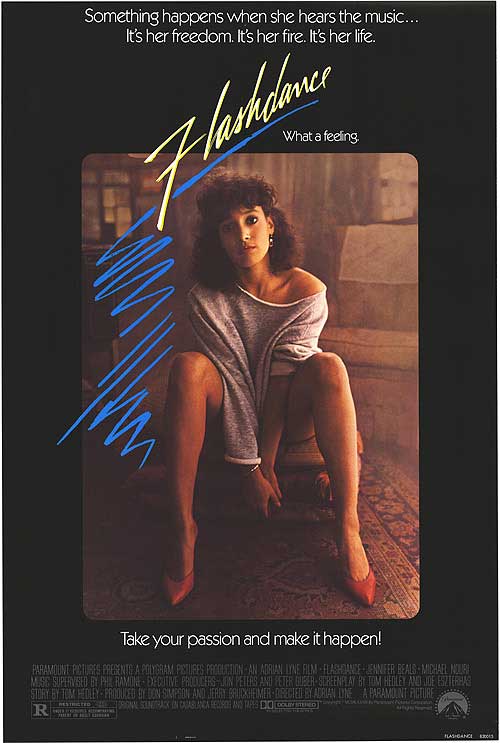
Alex Owens (Jennifer Beals) is a young lady of 19 who works as a welder during the day, but moonlights as an exotic dancer by night. She dreams of one day joining the dance institute and train to work in the professional ballet, but when she goes to their admissions desk they demand that she show some proof of prior training, which she doesn’t have and this is enough to intimidate her from applying at all.  She eventually starts up a relationship with Nick (Michael Nouri) who is the owner of the factory where she works. He uses his money and influence to pull-some-strings at the dance conservatory so that she’ll be able to get an audition, but she resents his help and threatens to not only pull out of their relationship because of it, but her audition as well.

The film is loosely based on the real-life story of Maureen Marder and the plot is relatable to anyone who dreams of one day rising above their humble beginnings, which is what makes the film interesting. Beals does well in the title role and has a very appealing face, but I was surprised how little dancing there actually was. Out of the whole runtime there are only three dance routines that the Beal character does, which was a shame as the routines are well staged, have a lot of energy and creativity and the most unique part about the film while its contrived romantic angle is  a complete bore.

The Alex character has issues as well as she comes off as too much of a mish-mash of different extremes making her more like a caricature than a real person. I realize human beings can be a bag of contradictions, but this character takes it too far. The biggest one is when she goes every week to confession even though she doesn’t behave at all like she is a religious person in any other way. I would think a devoutly Catholic individual wouldn’t feel as relaxed about getting on stage and gyrating her body let alone stripping off her clothes the minute she brings her new boyfriend back to her place, going to bed with him on their first date and even aggressively flirting with him at a restaurant.  In either case the confession scene was unnecessary because all it does is have the character verbally explain what the viewer has already been able to pick-up on visually.

The character is also highly volatile in ways that could easily get her pegged as being a borderline psycho these days. First she throws a rock through her boyfriend’s window when she thinks he is seeing another woman, then she jumps out of a moving car in the middle of a tunnel that could’ve caused a major traffic accident and then tops it all off by rushing onstage to drag her friend Jeanie (Sunny Johnson) off at a strip club and then callously throwing the dollars that Jeanie had earned into a puddle of water all because she consider herself to be a ‘good friend’, which brings up another point; why does this character consider stripping to be so ‘sleazy’ while being an exotic dancer is ‘respectable’? Granted she doesn’t take her clothes off as an exotic dancer, but the outfits she wears are quite revealing and the dance numbers are so sexually tinged that in my opinion there wasn’t that much of a difference.

I was also surprised how the male characters at her factory job seemed to treat her as being ‘just-one-of-the-guys’ as this was a highly attractive single woman making me believe that a lot of the guys would be hitting on her besides just the owner. I would also expect that she would be sexually harassed at the work place by some of them since she spends her evenings playing into their fantasies with her sexy dancing and the fact that the film fails to tackle this subject even briefly makes it poorly thought-out.

Overall though I found it to be an enjoyable watch and I think this was mainly due to Adrian Lyne’s direction and his use of lighting that made each shot seem like a visual design and his ability to photograph the grimy, steel mill setting in a way that made it seem artsy and evocative as well as the film’s rousing dance number at the end that despite its cheesy nature is still inspiring and fun.

My Rating: 6 out of 10

Released: April 15, 1983

Runtime: 1Hour 34Minutes

Rated R

Director: Adrian Lyne

Studio: Paramount

Available: DVD, Blu-ray, Amazon Instant Video, YouTube

Another Chance (1989)

another chance 1

By Richard Winters

My Rating: 2 out of 10

4-Word Review: Jaded playboy seeks redemption.

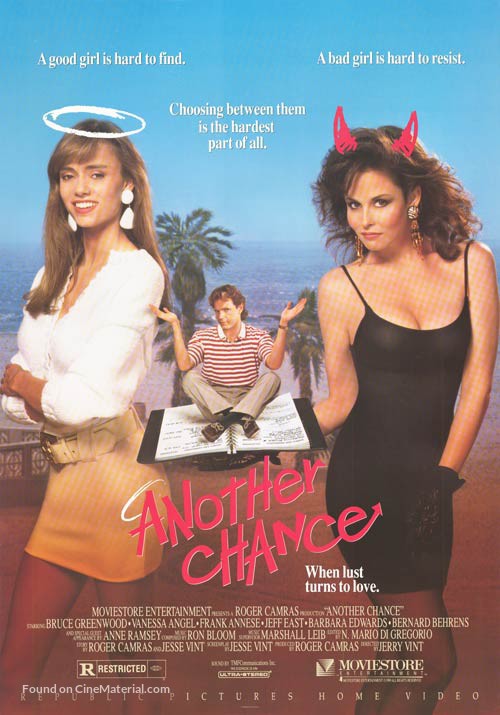
John Ripley (Bruce Greenwood) enjoys trying to bed every attractive woman that comes along. He even has his dog Rocky trained to bite on their purses and lead them over to him wherever he may be sitting. He is a big star on the daytime soaps and uses this position to take advantage of every young, nubile starlet willing to go to have sex with an established actor if it can in some way help boost their career. Then he meets the beautiful Jackie (Vanessa Angel) and starts to have strong feelings for her, but she catches him with another woman and it’s all over. He tries to win her back, but in the process loses his job and home. While working a part-time gig at a look-a-like show he gets into an ugly confrontation with a psychotic man resembling Humphrey Bogart (Robert Sacchi) who pulls out a gun and shoots him on the spot. John then finds out that he has been banished to hell, but pleads for one more shot at redemption, which he is given, but only if he can win back Jackie’s heart.

The film, which was written and directed by B-actor Jesse Vint, certainly has a crazy wide open storyline that seems to want to mix in the mindset of today’s modern world with that of spiritual one, which doesn’t work at all. Initially I thought the heaven and hell thing was thrown in simply as a plot device, but the more it continued the more I became convinced that this movie was intended to be religious one even though it gets enveloped inside the jaded world of modern day Hollywood, which just makes it all the more loopy.

In more competent hands this might’ve worked as an interesting curio, but the script needed to be better focused and the editing much tighter. The narrative is too heavy-handed to take seriously and everything gets photographed in a flat sort of way making the whole thing seem on par to a TV-movie instead of a theatrical one.

Greenwood gives an engaging performance and helps make a potentially unlikable character more tolerable. Angel is good too and it’s too bad she couldn’t have been in more scenes. The supporting female cast is overall quite attractive, but they’re all made to dress and act like bimbos. Anne Ramsey is on-hand for a brief bit as John’s crabby landlady and Allan Rich has a supporting role as a sleazy agent, but overall the one thing I liked most about the movie was Rocky the dog and that’s about it.

My Rating: 2 out of 10

Released: May 5, 1989

Runtime: 1Hour 38Minutes

Rated R

Director: Jesse Vint

Studio: Moviestore Entertainment

Available: VHS

Independence Day (1983)

independence day 2

By Richard Winters

My Rating: 3 out of 10

4-Word Review: Getting out of Texas.

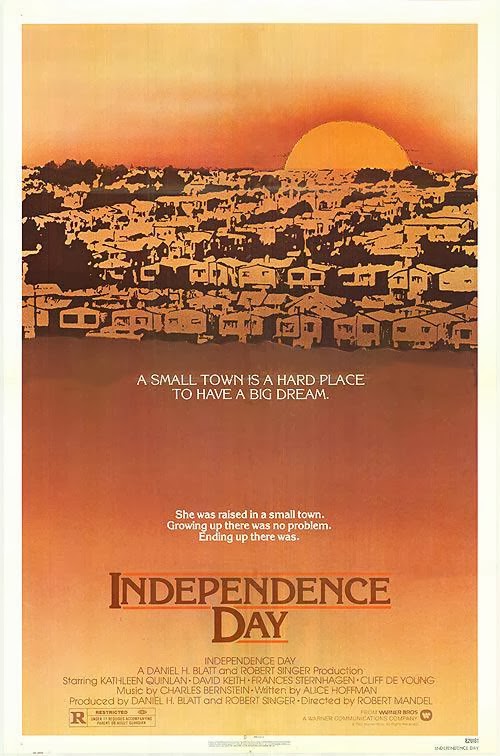
Mary Ann Taylor (Kathleen Quinlan) works as a waitress at her father’s café, but dreams of leaving her sleepy Texas town and going to school in California to study photography. Her mother (Frances Sternhagen) though is in declining health and her current boyfriend Jack (David Keith) wants her to stay which makes her decision to leave all the more difficult.

Shot on-location in Anson, Texas the film is a pleasant time-filler that fortunately doesn’t go overboard with Texas stereotypes, but it’s also rather bland and predictable. Feeling trapped in a small town is by no means a unique feeling and the film doesn’t go far enough with that theme and for the most part just touches the surface. Adding in a second storyline dealing with Jack’s sister (Dianne Weist) being abused by her husband (Cliff De Young) is a bit jarring and doesn’t really fit as there are long periods where Mary Ann is not seen at all and it would’ve made more sense had it been her sister that was being abused and not Jack’s and thus giving her more screen time.

The dramatic arcs are a bit too obvious as well and at times even bordering on being corny. For one thing the abuse issue gets introduced by having Jack visit his sister and asking her husband to borrow some money and then for no reason the husband begins throwing lit matches at his wife while right in front of Jack. Abusive people can certainly be cruel, but they’re not stupid and hurting a woman while her well-built brother sits right there is most assuredly going to get the husband into trouble, so why do it? Having Jack find out about the abuse by coming to the home one day unannounced and hearing shouting and maybe looking into a window and seeing the husband hit her would’ve made far more sense.

Having Mary Ann’s mother, who otherwise looks and acts quite healthy, suddenly fall over with fainting spells and suffering from some disease that never gets explained seemed too manufactured. Mary Ann’s arguments with Jack over whether she should go to school or stay in Texas is equally transparent especially since the two really didn’t have all that much in common and could’ve easily found other dating partners quite quickly.

Having one of the official’s from the photography school drive out to her rural home and personally offer her a full scholarship while telling her she was one of the greatest photographers he had even seen was pretty loopy too. All she did was take pictures of the town’s buildings and people’s faces, so what this guy managed to see that was so ‘brilliant’ and ‘special’ from that is hard to figure.

Quinlan and Wiest give great performances, but the movie is nothing more than lightweight drama that fails to distinguish itself from all the other B-dramas out there.

My Rating: 3 out of 10

Released: January 21, 1983

Runtime: 1Hour 50Minutes

Rated R

Director: Robert Mandel

Studio: Warner Brothers

Available: DVD (Warner Archive)

Nobody Waved Goodbye (1964)

nobody waved goodbye 1

By Richard Winters

My Rating: 8 out of 10

4-Word Review: Teen learns hard lesson.

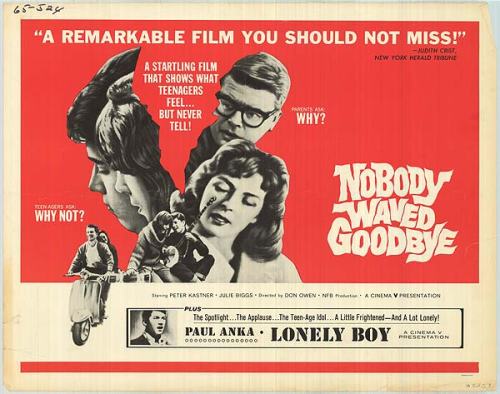
Peter (Peter Kastner) is 18 and looking to spread-his-wings, but doesn’t like what he sees in the adult world. Everyone seems trapped by their dull jobs and mundane routines, which is something he doesn’t want to fall into. He has big dreams. He wants to run away with his girlfriend Julie (Julie Biggs) and live a life based completely on his own whims while never becoming a slave-to-the-system like everyone else. Then he gets in a fight with his parents and they kick him out and after struggling to find work without even a high school diploma his attitude quickly changes.

If you can get past the wretched opening song, which is sung by Kastner and played over the credits, then this film really hits-the-mark. I was impressed with the camera work especially during the dinner time conversations amongst the family members where director Don Owen shoots it with a hand-held camera and zooms in and out on the person’s face as they are speaking. This is something that is quite common today especially on TV-shows, but back then was rarely if ever used, which makes this well ahead-of-its-time and even groundbreaking. I also enjoyed the conversational quality of the dialogue and having two conversations going on at the same time, which again didn’t come into vogue until years later when Robert Altman did it in M*A*S*H.

The film also clearly allows for ad-libbing amongst its actors. There is a scene in which Peter and Julie go paddle boating and come upon a large sofa submerged in the water and then comment on it. Clearly the filmmakers didn’t put the sofa into the lake simply to film the short scene that has nothing to do with the rest of the story, but it still helps set the tone for keeping things fresh and real.

Kastner is great and it’s refreshing to have a protagonist in a film that you like at some points and feel like wringing-his-neck at other times. Too many movies today, especially Hollywood ones, create lead characters that are politically correct caricatures while this movie instead has real human beings that are not tailored made to conform to the likings of any particular demographic.

It’s a shame to say that a movie that came out over 50 years ago is still considered cutting-edge, but compared to the tired, formulaic glop coming out today it really is. The script is uncompromised and holds-no-punches while keeping things gritty and stark and making profound, universal points along the way. I also found it fun that the main character here, who was clearly a baby boomer, displays the same anti-establishment, anti-work attitude that now gets placed squarely onto the ‘dreaded millennials’ and yet it seems the boomers were just as reluctant to get into the rat race as all the generations that have followed them and therefore shouldn’t be waiving their finger at anyone.

nobody waved goodbye 2

My Rating: 8 out of 10

Released: August 13, 1964

Runtime: 1Hour 20Minutes

Not Rated

Director: Don Owen

Studio: National Film Board of Canada

Available: None at this time.

Pretty in Pink (1986)

pretty in pink

By Richard Winters

My Rating: 5 out of 10

4-Word Review: Poor girl dates preppy.

Andie (Molly Ringwald) is a teen girl from the poor side of town who one day while working at a record store meets Blaine (Andrew McCarthy) a rich, handsome, preppy kid that she immediately takes an interest in. A few days later he asks her out much to the dismay of her geeky friend Duckie (Jon Cryer) who has a secret crush on her. Blaine’s friend Steff (James Spader) is also angered about it because he had asked Andie out earlier and been rejected and these two factors cause a strain on their relationship and forces both of them to consider ending it.

One of the problems that I had right away with the film is the fact that with the exception of Ringwald, the majority of the cast who are playing these so-called teenagers were in reality way past adolescence and looking too mature. Kate Vernon, who plays a snotty girl named Benny, actually looks older than her female instructors. McCarthy and Cryer were also in their 20’s and manage to pull it off, but Spader who was 25 at the time doesn’t. He gives a great performance nonetheless, but I kept wondering with so many star struck teens out there dying to get into the business that the producers couldn’t have gotten performers that were more at the actual age of the characters.

Ringwald is fantastic in a vehicle tailored made for her and one that she really cruises with. I particularly liked her facial expressions while she attended a frat party and the moment where she decides to go to the prom despite not having a date simply to show them that they can’t ‘break her’ is fantastic. However, I wasn’t so crazy about the inferred idea that she was dating Blaine simply because he was from a rich family and could help her escape from her otherwise poor/ humble surroundings as it toys with the concept of ‘marrying-into-wealth’ which is too old fashioned. A young lady today should feel that she can work her way up the social/economic ladder on her own and not be dependent on some guy to do it for her.

I had equally mixed feelings involving Duckie. Cryer certainly gives an engaging performance, but the character’s excessive and constant need for attention-seeking humor gets overdone and I wished it had been toned down and the character made to be a little less geeky. The part where he has an instant meltdown when he finds out that Andie is dating someone else is also too extreme as it makes him seem dangerously possessive especially since he and Andie were just friends. Later when he is rude to Blaine at a nightclub only helps to make him look even more emotionally unstable.

I had this same issue with Steff who gets aggressively angry at Blaine for dating Andie and even threatens to end their friendship because of it, which to me was a complete overreaction. Sure he might be upset about it, but in real-life I think he would’ve expressed his displeasure in more subtle ways,or even just gotten over it since he was apparently sleeping with Benny who was a lot hotter looking than Ringwald anyways. In reality people generally want to hide their hurt feelings and not respond so overtly when things don’t go their way because they are usually smart enough to realize it will just make them look like a sore loser otherwise.

The Blaine character has problems too although different from the other two. The first issue is when he is at the record store and hands Andie an album cover showing Steve Lawrence, a famous crooner from the early ‘60s and frequent guest star on the old ‘Carol Burnet Show’ and asks Andie if he’s ‘hot’ or ‘trendy’. Now, I was teenager myself during the ‘80s and was in no way ever affiliated with the ‘hip crowd’, but even I and my nerdy friends where savvy enough to know that Steve Lawrence would never be considered an idol with ‘80s teens nor humiliate ourselves by asking anyone if he was. The fact that he does ask makes him seem almost mentally ill or someone who’d been living in a cave, which would be enough for most young women not to want to date him because they would think he was ‘weird’ or strangely disconnected.

The scene that takes place in the school’s library where he sends her a message via the school’s compute and even somehow manages to upload a picture of her is also dumb. Remember this was BEFORE the internet and sending emails and communications via a computer weren’t common or likely especially when they weren’t even their own, but public ones instead. In a later conversation this gets described as a ‘computer trick’ that he knows, which I guess suffices as being screenwriter John Hughes’ feeble attempt at ‘explaining it’.

In a lot ways this seems like just a basic reworking of the formula that was already used with much better success in Sixteen Candles with Cryer playing an off-shoot of Anthony Michael Hall’s character and Harry Dean Stanton as Ringwald’s sensitive father substituting for the one played by Paul Dooley in the first film. I was also disappointed that we never even briefly get to see Andi’s mother who was divorced from her father but gets discussed quite a bit and there’s even a picture of her sitting on Andie’s bedside table, which to me should’ve been enough to justify some sort of appearance by her at some point.

I liked the scene, at least on an emotional level, where Duckie physically attacks Steff after he makes a disparaging remark about Andie, but on the logical end it’s off-kilter. For one thing Andie wasn’t aware of the remark and for Duckie to take on some guy who was clearly much bigger than him it would’ve made more sense for her to have heard it and been hurt by it in order for him to come so aggressively to her defense. A later scene that takes place at the prom where a super-hot girl turns around and out-of-nowhere shows an immediate interest in Duckie who’s just standing there seemed too dream-like and fanciful.

I never saw this film when it first came out and only reviewed it now at the suggestion of some female friends in order to commemorate the 30th anniversary of its release and I have to be honest I was expecting something a lot better especially since it has attained such a strong cult following. Maybe it’s the nostalgic value that gives it its allure, but on a purely cinematic level it’s average at best with a screenplay that only touches the surface of the teenage experience while relying too heavily on age-old and very obvious dramatic devices to help propel it.

My Rating: 5 out of 10

Released: February 28, 1986

Runtime: 1Hour 36Minutes

Rated PG-13

Director: Howard Deutch

Studio: Paramount

Available: DVD, Amazon Instant Video, YouTube

Against All Odds (1984)

against all odds

By Richard Winters

My Rating: 4 out of 10

4-Word Review: Searching for missing girlfriend.

Terry Brogan (Jeff Bridges) is an aging football player who gets cut from the team and in desperate need of cash. He reluctantly accepts a paying assignment from his friend Jake Wise (James Woods) which has him traveling to Mexico in search of Jake’s girlfriend Jessie (Rachel Ward) who just so happens to also be the daughter of the team’s owner (Jane Greer) that cut Terry from the squad. Terry manages to find Jessie rather quickly and the two promptly fall in love, which propels a string of odd events that soon has Terry embroiled in a complex criminal scheme that threatens both his life and others.

This film is a remake from the 1947 film noir classic Out of the Past, but it does not fare as well as the original. The main problem is that it requires the viewer to make some major leaps in logic and only proceeds to get more implausible as it goes along. The fact that both Jake and the team’s owner want to hire Terry to find Jessie is the biggest issue. Why would these two want to throw gobs of money at someone who has no experience in finding people or know the first thing about the process. They wouldn’t hire him to fix their car if he had no experience in that area, so why expect him to have any ability in finding a missing person. Professional private eyes have spent years tracking down people and have attained skills that a novice wouldn’t, so why not just leaf through the Yellow Pages of their local phone book and hire a private investigator with good credentials to do the job instead?

Terry also locates Jessie much too quickly. Mexico has a population of 125 million people and yet in only a couple days he miraculously spots her buying food from across the street from where he is having a drink. In equally miraculous fashion she is somehow able to, after only speaking to him briefly, figure out which hotel he is staying at and bursts into his room unannounced the next day, which is also dumb because who leaves their hotel room door unlocked especially when staying in a foreign country? Later the Alex Karras character is somehow able to find the two as they make love inside an ancient Mayan temple deep inside the remote jungles of the Yucatan, which again is highly questionable and probably even more implausible than the other two examples mentioned above.

The motivations of the characters are another issue. There’s a scene where the Swoosie Kurtz character, as a favor to Terry, goes into a dead man’s office to retrieve some important files from a safe while having a Doberman growling at her and a corrupt security guard ready to harm her at any second, but why someone would put their life on the line for somebody that they really don’t know that well is nebulous and in reality wouldn’t occur.

There is also a scene involving Jake and Terry drag racing down the busy streets of L.A. in broad daylight. Some fans of the film consider this to be quite exciting, but I found it to be unrealistic as it is hard to believe that they could get away with it without catching the eye of a traffic cop as they were doing it. Having two middle-aged men be so utterly reckless not only with their own lives but those of the other drivers is also hard to imagine and puts their most prized possessions, which is their snazzy sports cars in jeopardy of getting totaled. Going to some other less traveled place to do their off-road racing would’ve made more sense.

On the plus side Larry Carlton’s moody soundtrack is great and helps create just the right tone. I also thought Ward was a perfect choice for her role as she is quite sensual and seductive without ever overdoing it. The film also scores with its breathtaking Mexican scenery.

I liked that Greer, who starred in the original version, gets cast as Ward’s mother and although I felt Richard Widmark does quite well as the heavy I was disappointed that the role wasn’t offered to either Robert Mitchum or Kirk Douglas as they had appeared in the original as well.

The plot features many twists, which keeps it mildly interesting, but it also borders on getting convoluted and is never emotionally compelling. The ongoing love affair between the two leads ends up being annoying as well. For one thing she two-times him while also bailing on him the moment things got tough. If a person does that to someone once they will do it to them again if given the chance, so ‘losing’ her wasn’t much of a loss and makes the image of her crying for him, which gets shown over the closing credits, all the more melodramatic and over-the-top.

My Rating: 4 out of 10

Released: March 2, 1984

Runtime: 2Hours 1Minute

Rated R

Director: Taylor Hackford

Studio: Columbia Pictures

Available: DVD