Category Archives: Psychological

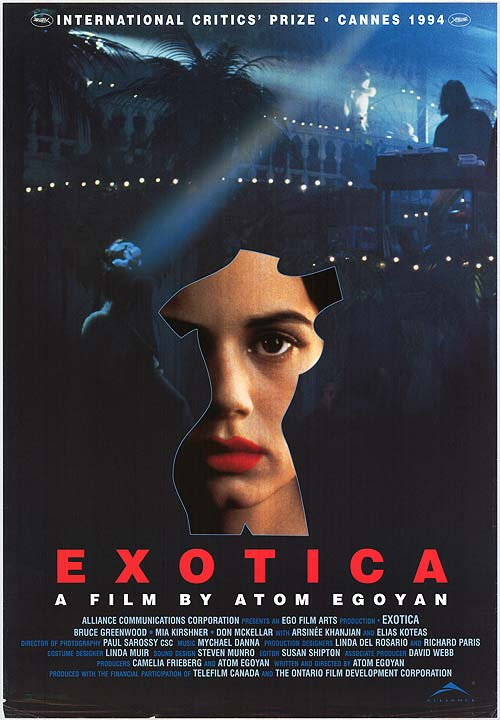
Exotica (1994)

exotica

By Richard Winters

My Rating: 8 out of 10

4-Word Review: Obsessed with a stripper.

This is a fascinating and engrossing character study interweaving different characters and stories together until they become one. Bruce Greenwood plays Francis an accountant who frequents a strip bar and becomes fixated on a particular dancer named Christina (Mia Kirshner). Elias Koteas is the club D.J. who notices this obsession and becomes jealous since he at one time had a relationship with her. Thomas (Don Mckellar) is the nebbish pet shop owner who has a secret as well as a key between the three.

This is thoroughly compelling stuff that’s impossible to predict. The characters are believable, exposing traits you just don’t see in them at the start. Much like people you’d meet and get to know in real life each scene becomes like a piece to the puzzle.

Director Atom Egoyan may be a little too obsessed with tying everything together taking the final scene one step too far. Yet he still creates an interesting subtext. He seems to show how interconnected we all are to one another and how we can relate on different levels. The simple fact that we are human connects us no matter how ‘disconnected’ we may feel or be.

The sex club atmosphere is also taken from a different angle. He shows a much more complex and psychological motive behind it and how sex is only one element in it.

Like with Egoyan’s other films this thing is filled with a lot of philosophical banter and is quite humorless with a tendency to be a bit ‘heavy’. However, unlike The Sweet Hereafter it keeps moving and doesn’t get completely bogged down in it.

On the technical end the lighting is too washed out. The music selection is good, but oppressive. Overall though the film achieves what it wants too. It keeps your attention and remains thought provoking throughout.

My Rating: 8 out of 10

Released: May 16, 1994

Runtime: 1Hour 43Minutes

Rated R

Director: Atom Egoyan

Studio: Miramax

Available: VHS, DVD, Blu-ray
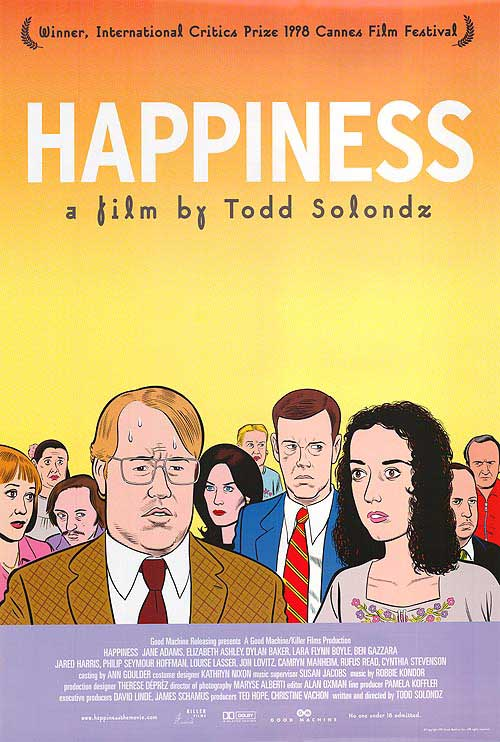
Happiness (1998)

happiness 1

By Richard Winters

My Rating: 8 out of 10

4-Word Review: Happiness can be elusive.

Sharply tuned, interweaving group of vignettes all pertaining to that elusive paradox known as happiness. Jane Adams plays the single woman who is never able to find Mr. Right. Then when she thinks she does he turns into very much of a Mr. Wrong. Louise Lasser and Ben Gazzara, who are in what is probably the funniest segment, play an older couple whose marriage has lost its zing. Phillip Seymour Hoffman, in another dynamic performance, plays the composite nerd who gets off on giving obscene phone calls. Then there’s Camryn Manheim a woman everyone overlooks, but shouldn’t because she holds a dangerous secret.

There are times when this otherwise good film tries to be a little too hip and trendy, which doesn’t help. Although the characters are quite interesting in their eccentricities, they never seem to interact with each other like real people even if they are a little strange. In the case of Lara Flynn Boyle her affected way of talking becomes quite annoying.

On the whole though this film is quite compelling and has moments that really pack a punch. Although billed as a dark comedy it is really more of a drama. In the case of the affluent psychiatrist (Dylan Baker), who has a sexual penchant for his young son’s friend, it becomes downright unsettling and disturbing.

Yet it is the inner angst of these characters and how they deal with modern daily life that truly is what hits home. These people are complex and at times very confused with themselves. They are socially and sexually dysfunctional. They may, despite your reluctance, remind you or your own friends, co-workers, and family or even yourself. It truly shows how fragmented our society is and even gives us a hint as to why. After all how can one connect with someone else when they are so disconnected with themselves?

This is, as a whole, a great movie. It has scenes and characters that will stay with you long after it is over. However, only a select few will really enjoy it. Namely those who enjoy seeing things torn down and then exposed for what they really are.

My Rating: 8 out of 10

Released: October 16, 1998

Runtime: 2Hours 14Minutes

Rated R

Director: Todd Solondz

Studio: Good Machine

Available: DVD

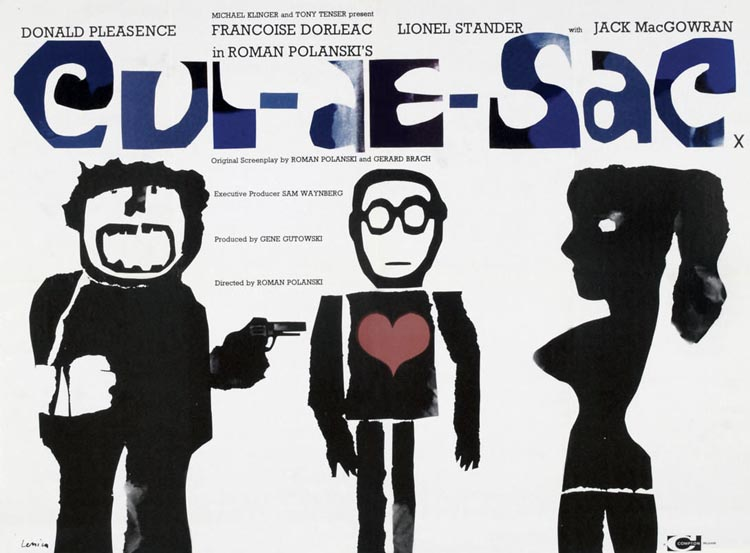
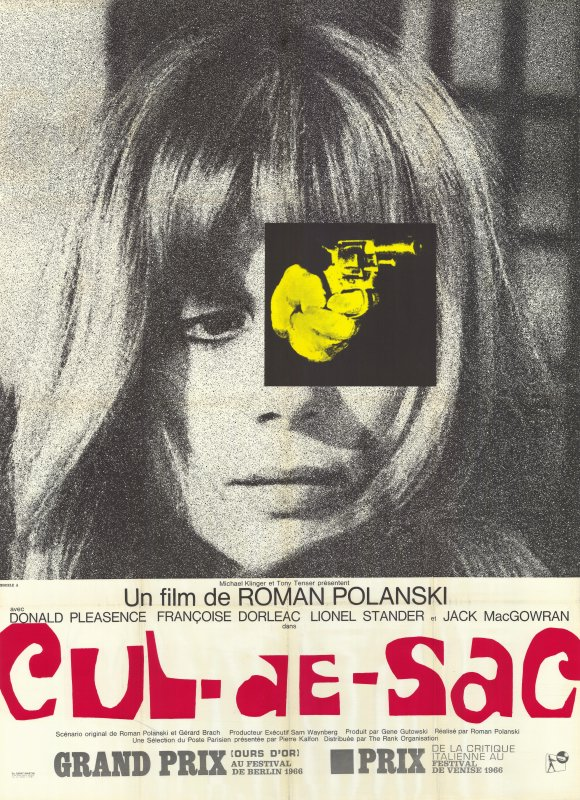
Cul-De-Sac (1966)

cul de sac 2

By Richard Winters

My Rating: 8 out of 10

4-Word Review: Bubbling beneath the surface.

Albie and Richard (Jack MacGowran, Lionel Stander) are two gangsters on the run. Albie is injured with a gunshot wound and their getaway car has broken down. They come upon an isolated castle owned by George (Donald Pleasance) who lives there with his new wife Teresa (Francoise Dorleac, who tragically died in a car accident just one year after this film was released). George is very passive and timid and pretty much allows Richard to have his way as he takes over the place and his wife and yet as the situation progresses different shades of the character’s personalities begin to come to light.

Roman Polanski leaves his strong directorial touch from the exquisite opening shot, which shows an old car being pushed along on a desolate road amidst a very flat landscape until the end. In the hands of any other director this otherwise odd story probably would not have worked. Like with A Knife in Water Polanski makes great use of the quiet and serene atmosphere and as a viewer you feel like you are right there with the characters.  Filmed on-location at the Lindisfarne Castle on Holy Island in Northumberland, England the movie makes great use of the tranquil setting. I found it almost hard to believe that there was a film crew there as the isolation really grabs you and sucks you in. The quiet moments are the film’s strongest and I just loved the hooting owl heard in the background. The idea of filming it in black and white nicely compliments the film’s dark psychological undertones.

The film’s novelty is watching how the characters evolve and interact with one another. Donald Pleasance gives one of his best performances as the cowardly George. There have been many weak and frighten characters in cinema history, but Pleasance makes the character here quite interesting and the way he finally shows some bravado at the least likely moment is fascinating. Stander also excels with a character that initially comes off as a brute, but at strange times reveals a trusting and even child-like manner.

The movie can be viewed in different ways and doesn’t fit distinctly into any type of genre. To a degree it can work as a dark psychological character study, a mystery, film noir, a thriller, or macabre comedy. Approaching it as a comedy works best Polanski has not always had great success in that area and some of his comedies in particular the ill-advised Pirates have been complete disasters, but this one works. The best scene is when some of George’s old friends come to visit and bring along their bratty son who becomes an absolute terror to everyone.

The odd ending is open to interpretation and leaves a lasting impression. This is also a great chance to see Jacqueline Bisset in her film debut. She appears during the second half wearing glasses and saying little, but is as beautiful and alluring as ever.

cul de sac 1

My Rating: 8 out of 10

Released: November 7, 1966

Runtime: 1Hour 57Minutes

Not Rated

Director: Roman Polanski

Studio: Tekli British Productions

Available: DVD (The Criterion Collection) Blu-ray, Amazon Instant Video, Netflix streaming

My Dinner with Andre (1981)

my dinner with andre

By Richard Winters

My Rating: 5 out of 10

4-Word Review: Talking can be interesting.

 
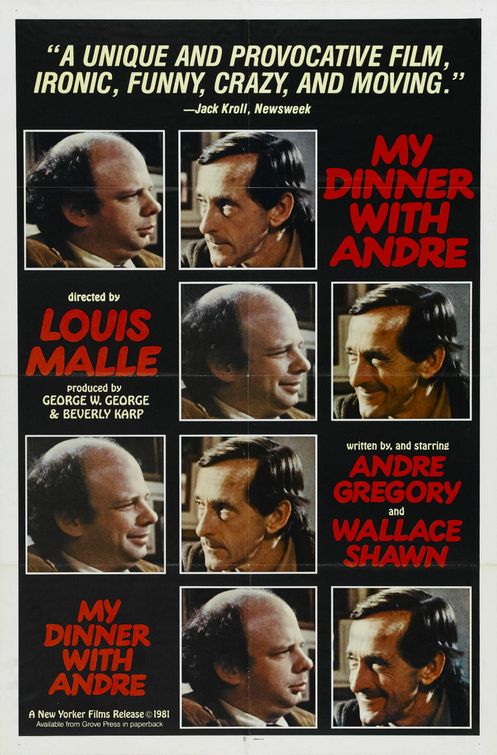
Rare is a film that can be categorized as being daring by what it doesn’t do than by what it does yet this is a film that fits that instance. This is a story about two old friends (Wallace Shawn, Andre Gregory) who meet at a fancy restaurant and have a long, pleasant conversation. That’s it. No big revelations, no cutaways, no side story, no fights, no jokes, and certainly no added cinematic effects. The men merely have the same type of conversation that two educated men on the same intellectual level might also have. Then after two hours they call it a night and go home.

Does this mean that this is a poor or boring movie? No, not really. Sometimes the best directing is just the guts to stick with a concept that is unusual. That is what Louis Malle does here and you have to give him credit. On its own simple terms it actually does succeed. One’s mind certainly does wander at times, but somehow you never lose complete interest. The simple framing and editing are actually effective.

The two stars are competent for what they are doing yet they do not seem to be the best of actors. At times they seem to be simply mouthing their lines and there is no nuance in their delivery. Gregory has a nice deep, resonate voice that almost seems like a radio announcers. He does most of the talking so at least he is pleasant to the ears. Shawn is the exact opposite. His voice is screechy and annoying. Yet he does supply an engaging voice-over narrative at the beginning, which is so fun you wished they had kept it going throughout.

The idea of following a real, genuine conversation is a good one. Sometimes it is interesting to observe all the threads a conversation between any group of people takes. However the conversation here isn’t real. It is clearly scripted out and that hurts it. The first hour is especially poor. It consists mainly of Gregory talking about some wild, fantastical experiences of his. It comes-of as forced and extended. Having some cutaways throughout his talking would have helped because a lot of what he talks about is very visual.

The second hour is better because Shawn gets more involved and they have a real discussion. The topics are more expansive and philosophical. They range from how one perceives reality to the very essence of our being. Of course anyone with some existential friends could have the same conversation, but at least it makes the film more stimulating.

In the end this is an interesting experiment that halfway succeeds. It would have helped had the two men, who seem to be playing themselves anyway, been allowed to have a more natural and impromptu discussion. Even adding a few more people into the mix wouldn’t have hurt. They could have also given it just a little bit more of a visual flair. Although watching the very good way that they listen to one another is a sight in itself. Their listening skills are so good that it almost seems unreal. It is unfortunate that everyone can’t have these same types of skills

My Rating: 5 out of 10

Released: October 11, 1981

Runtime: 1Hour 50Minutes

Rated PG

Director: Louis Malle

Studio: New Yorker Films

Available: VHS, DVD (The Criterion Collection), Amazon Instant Video

The Birthday Party (1968)

the birthday party 3

By Richard Winters

My Rating: 8 out of 10

4-Word Review: Tear up the newspaper.

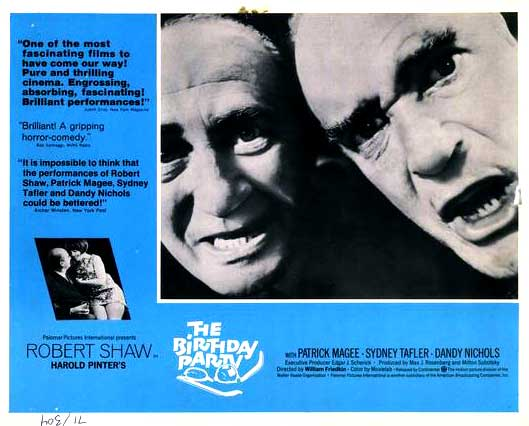
Since tomorrow will be my birthday I wanted to come up with a film that had birthdays as its theme and found this bizarre but fascinating obscurity. It is the story based on the play by Harold Pinter of Stanley Webber (Robert Shaw) a mysterious and private man who takes up lodging in a rundown British seaside house. He rents an upstairs room from Mr. and Mrs. Bowles (Moultrie Kelsall, Dandy Nichols) who are quite odd themselves. One day two men dressed in black suits (Patrick Magee, Sydney Tafler) come to pay Stanley a visit. They know something about Stanley’s past and their presence frightens him to the extent that it causes him to have a nervous breakdown.

On the surface this film shouldn’t work. There is an excessive amount of talking with dialogue that doesn’t say much and at times seems absurd. The set is drab and dirty with the camera seemingly locked down inside of it. There is never any explanation about Stanley’s past or what he is running from nor who the men are or what they know about him. The ending is elusive and the viewer will go away feeling more confused than they did at the start.

However, it is these ingredients that make the film so thoroughly intriguing. The seemingly banal dialogue is simply a façade for underlying thoughts and feelings. What Stanley is trying to run from is unimportant because it is really not about him at all and is instead more about ourselves, human nature and the quandary of our existence. It’s an examination of people’s futile attempts at trying to escape from who they are only to have society and life catch up with them. The set could be a metaphor for the inside of Stanley’s head. The grimy and decayed place symbolizes his decayed soul and the men in black suits are his conscience coming to haunt him.

Once you adjust to the eccentric narrative it then becomes a fantastic film for observing subtitles and nuance. Director William Friedkin shows a keenness for detail not only visually, but with the sound as well. The way the Magee character tears up a newspaper and the sound used for it could actually unnerve some viewers. Stanley’s meltdown scene is very unique and overall the direction is superb for such difficult material.

This movie was years ahead of its time, but for some it may be off-putting. However, it should be enjoyed by those who crave the avant-garde. It is also a rare chance to the see the normally strong-willed Shaw playing a very weak and vulnerable character. Nichols is also a stand-out playing an Edith Bunker type with a perverse streak lying just beneath the surface.

the birthday party 1

My Rating: 8 out of 10

Released: December 9, 1968

Runtime: 2Hours 3Minutes

Rated G

Director: William Friedkin

Studio: Palomar Pictures International

Available: VHS, DVD (Region 2)

The Caretakers (1963)

the caretakers 2

By Richard Winters

My Rating: 6 out of 10

4-Word Review: Doctors with opposing viewpoints.

Two doctors working at a psychiatric hospital come at odds with each other over how to treat their patients. Dr. Donovan MacLeod (Robert Stack) believes in a more humanistic approach in treating mental illness including group therapy and more patient freedoms. Dr. Lucretia Terry (Joan Crawford) is hard-lined and exacts rules on her patients that have severe penalties if broken. The film examines their infighting and how it affects their patients.

Director Hall Bartlett has a nice cinema-verte style to the material that manages to avoid being ‘Hollywoodnized’ or overtly sanitized. The subject is approached in a matter of fact way and the patients are not portrayed as ‘crazy’ or ‘scary’, but instead as sick people looking to get well and learning how to do it. The opening sequence done over the credits and featuring all sorts of moody artsy drawings have an excellent avant-garde flair.

Polly Bergen is effective as Lorna a middle-aged mother and housewife who suffers a nervous breakdown and begrudgingly becomes a member of Dr. MacLeod’s therapy group. Some of her acting particularly when she is having her breakdown is theatrical and over-the-top, but I did like the way Bartlett shows things from her perspective allowing the viewer in a visual sense to feel what she is going through and makes one compassionate and sensitive to her condition.

It is great to see Crawford as always and the scene showing her in a leotard and teaching the other nurses judo lessons is a gem and much too brief. I was hoping to have her play up the part of the heavy more making her almost like a Nurse Ratched, which she could have easily done to perfection, but unfortunately the script doesn’t take advantage of it. I was also disappointed that we never see Crawford ever dealing directly with her patients, which seemed to me should have been necessary.

Stack in the lead is terrible and completely wrong for the part. The role required a man with a more youthful appeal instead of the middle-aged Stack who never displays the kind of sensitivity and compassion that his character supposedly has. Instead he delivers his lines in a stiff and monotone fashion and comes off like he came from the old school of acting.

The scene where his character allows the patients to go to an outdoor park for a picnic and mingle with the staff unsupervised seemed to be pushing the plausibility meter to the extreme. It also makes him look like a complete schmuck who should have known better especially when one of his patients leaves the picnic and runs away while he chases after her in a panic.

The supporting cast is outstanding showcasing many up and coming stars and is one of the major highlights for watching the film. Barbara Barrie is great as the silent and troubled Edna. Janis Paige is excellent as the brassy prostitute Marion. Susan Oliver gives one of her best performances as a young nurse who is just learning how to deal with those with mental illness and Robert Vaughn is also effective as Lorna’s long suffering and confused husband. This is also a great chance to see a young Van Williams before he starred as the Green Hornet as well as the beautiful Sharon Hugueny whose promising acting career was cut short when she was hit years later by a speeding police car.

If you come to this film looking for genuine insight into the illness you will be disappointed as it goes only to the most elementary level into the area of psychiatry. MacLeod’s speeches about how his group therapy can be a ‘cure’ to mental illness are shallow and almost laughable. However, for the era the film manages to be gritty and slick enough to pass as entertainment.

My Rating: 6 out of 10

Released: August 21, 1963

Runtime: 1Hour 37Minutes

Not Rated

Director: Hal Bartlett

Studio: United Artists

Available: VHS, DVD, Amazon Instant Video, Netflix streaming

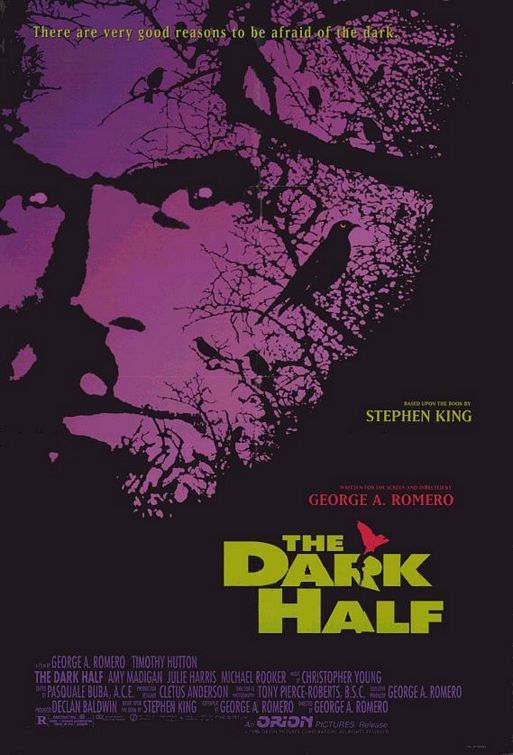
The Dark Half (1993)

By Richard Winters

My Rating: 3 out of 10

4-Word Review: Cure for writer’s block.

Thad Beaumont (Timothy Hutton) is a novelist who writes under the pen name of George Stark, but then decides to do away with it. Unfortunately this pen name slowly starts to take on a life and identity of its own. When George is ‘killed’ he becomes angry and starts to seek revenge.

Some of the things that I liked about the movie were the theme, which is interesting because it examines the idea that we are all two people. The one we want people to know and the other we repress. It also gives a thoughtful look at just how difficult writing a book can be. The climactic sequence is one of the most unique ‘showdowns’ you will ever see as both our hero and his dark half sit down across from each other to write a book of their own and the first one to finish lives while the other will die. There is also a nice creepy little nightmare segment.

However, there are a lot of things that don’t work in this movie and the majority of it looks like reprocessed stuff you’ve seen before. For one thing the musical score that gets overplayed. It’s like we are back in the silent film era and need it played in every segment just to keep the film going. The use of the sparrows as some symbolic reference seems awkward. They are not scary even when shown in flocks and having to see a shot of them flying around every other scene becomes annoying and redundant. The basic premise itself has potential, but gets stretched too far.

Hutton was not a good choice for this. He doesn’t display enough fear or emotion with the scenario. He approaches everything like a properly trained student of drama instead of as a method actor and playing the character’s dark half isn’t much better. He is supposed to be a creepy southern guy, but instead comes off as a bad, campy version of Elvis. The make-up effects never look realistic. It’s also irritating how these super smart, super clever bad guys always get so gosh darn dumb at all the right moments.

Amy Madigan makes a good non-glamorous wife, but accomplished actress Julie Harris is pretty much wasted although she does get the film’s best line.

Overall this is an offbeat idea that is given routine treatment. Having George Romero as the director doesn’t seem to add anything and he certainly has been slumming for quite a while.

My Rating: 3 out of 10

Released: April 23, 1993

Runtime: 2Hours 2Minutes

Rated R

Director: George A. Romero

Studio: Orion Pictures

Available: VHS, DVD

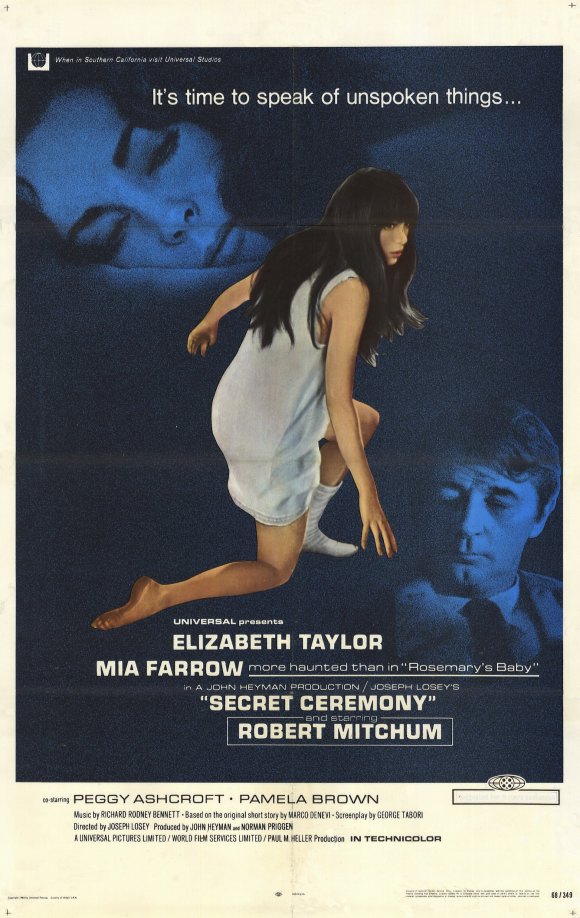
Secret Ceremony (1968)

By Richard Winters

My Rating: 5 out of 10

4-Word Review: Women in weird relationship.

Lenora (Elizabeth Taylor) is a lonely woman who lost her young daughter tragically years before and now finds herself strangely attracted to Cenci (Mia Farrow) a young woman who resembles her. The two move into a large mansion only to have things begin to unravel upon the arrival of Cenci’s weird and menacing father (Robert Mitchum).

The story is bizarre and perverse enough to keep you watching all the way through although it will certainly test the tolerance to those who do not have an affinity for the offbeat. The cinematography is excellent as is the mansion setting. The use of Peggy Ashcroft and Pamela Brown as sneering elderly sisters gives the film some added flavor.

Farrow is genuinely convincing as a grown woman stuck in a childlike trance, but Taylor doesn’t seem completely right for her part. A different actress, especially a character actress would have been much better.

Although the film does manage to come together in the end it does take a long time to get there. There are a lot of slow spots and the patience of some viewers may be tested. There are also many intriguing elements simmering underneath the surface that the film fails to follow through on, but should have.

Fans of Joseph Loosey should find this satisfying while others may be put off by the odd characters and style of narrative.

My Rating: 5 out of 10

Released: October 23, 1968

Runtime: 1Hour 45Minutes

Rated NR (Not Rated)

Director: Joseph Loosey

Studio: Universal

Available: VHS

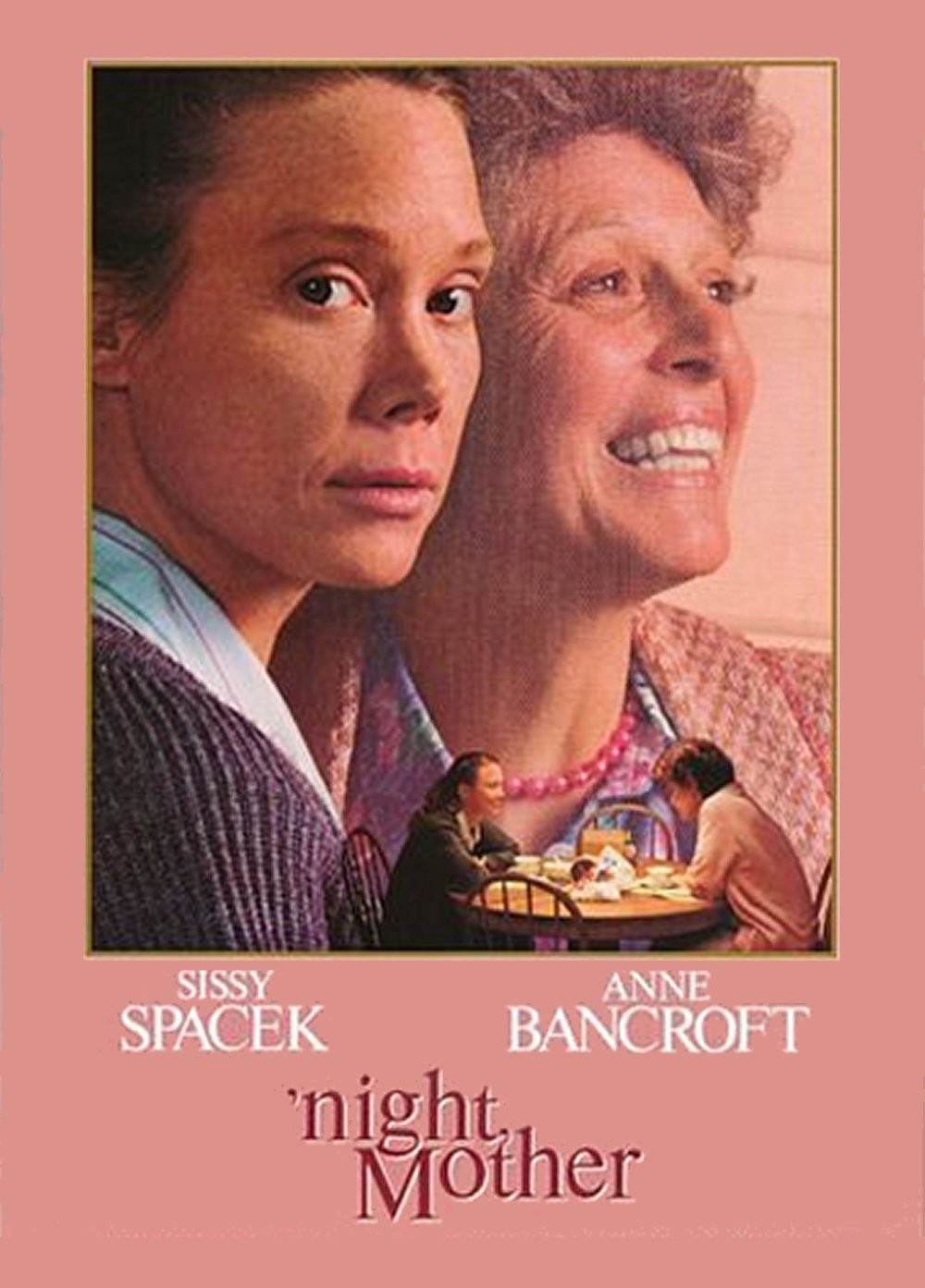
‘Night Mother (1986)

By Richard Winters

My Rating: 6 out of 10

4-Word Review: Please don’t kill yourself.

Jessie Cates (Sissy Spacek) informs her mother Thelma (Anne Bancroft) that she plans on killing herself during the night and her distraught mother spends the rest of the evening trying to convince her not to do it.

It is hard to imagine a more maudlin and static production. The film consists of just two people talking inside a small, isolated house with no cutaways, flashbacks, inventive camera angles, interesting scenery, music, or editing. Louis Malle once did a film entitled My Dinner with Andre that featured two men sitting at a table and filling the film’s entire runtime with one long conversation, but at least there the topics were fascinating while here it is depressing. I was expecting some profound intellectually stimulating talk dealing with the meaning of life much like the one in Igmar Bergman’s classic The Seventh Seal, but instead it is general and banal. Part of the problem is that the Thelma character lacks sophistication and is unable to debate Jessie on any type of deeper level. The result then is a rather rhetorical 95 minute banter revolving around Thelma pleading with Jessie not to do it ‘because she needs here’ while Jessie glibly replying ‘I can if I want to’. The screenplay, written by Marsha Norman, who also penned the play from which it is based, fails to deliver that lyrical, poetic quality of dialogue that most films based on stage plays seem to have.

I kept wondering what the point to this was.  We never seem to get to the bottom of what is bothering Jessie and only seem to skim the emotional surface. The film does not dig deep enough into the human psyche but should’ve as her issues here are rather derivative and typical. Her main complaints is that she suffers from epilepsy, which is now under control through medication, and she has gone through a painful divorce, but there a lot of people with similar problems and worse who are not trying to kill themselves. Most viewers might be disgusted and appalled at Jessie’s selfish nature and the way she callously ignores her mother’s emotional pleas and insists on moving forward with the suicide despite how clearly devastating it will be to her mother. In the end the film will probably leave most people cold and unable to connect to either character.

The one thing that does save the film and even makes it riveting to an extent is the brilliant performances. Although I could’ve done without her southern accent I still found Bancroft to be fantastic and was impressed with the way she hit all the right emotional peaks. Spacek is superb in every facet and I liked that she wore no make-up and her face had a natural and worn look.

Tom Moore’s direction has a few nice touches. I liked the opening shot showing the remoteness of the home and how the rugged western landscape helped accentuate the hard-living of the characters. The music although only played at the beginning at end has an ominous tone to it that effectively hits the mood and theme of the material.

Of course suicides are always an on-going issue and if this film had given some insight into it I would have given it more credit, but it really doesn’t. I was surprised that Aaron Spelling who was usually known for producing shallow, glitzy stuff like the TV-show ‘Dynasty’ was the producer here.

My Rating: 6 out of 10

Released: September 12, 1986

Runtime: 1Hour 35Minutes

Rated: PG-13

Director: Tom Moore

Studio: Universal

Available: VHS, DVD, Netflix streaming

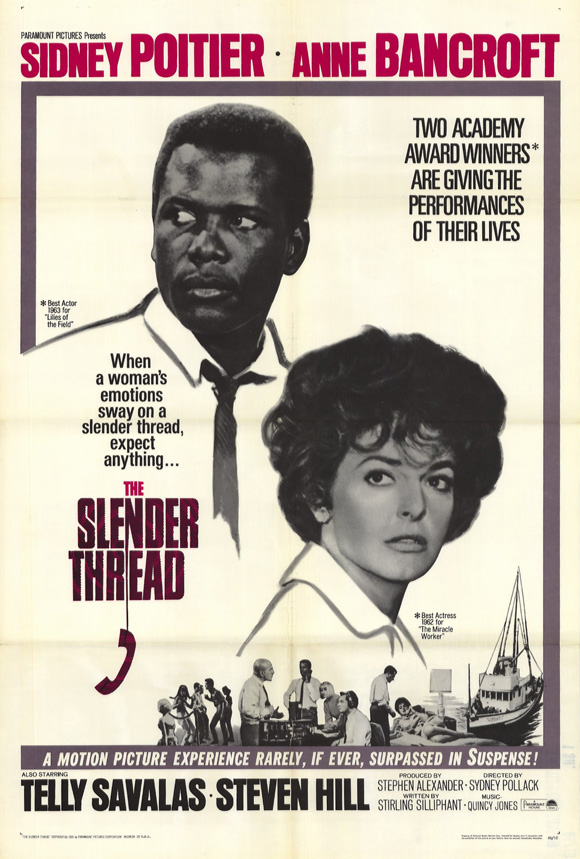
The Slender Thread (1965)

By Richard Winters

My Rating: 7 out of 10

4-Word Review: Desperate cry for help.

Inga (Anne Bancroft) is a middle-aged woman who has fallen into despair. She swallows a bottle of barbiturates and then in a last plea for help calls the local suicide hotline. On the other end is college student Alan Newell (Sidney Poitier) who is volunteering his time at the center and ill prepared for such a call. Despite this he manages to build a connection with her and the rest of the film deals with their conversation and Alan’s attempts at finding her location as well as flashbacks showing what brought Inga to such a desperate state.

This film will finally get its much awaited release onto both DVD and Blu-ray on October 16th and I highly recommend checking it out especially for those that can appreciate great film directing. This was Sydney Pollock’s directorial debut and his calculated touch is clearly what makes what could have otherwise just been a talky script into an intriguing visual showcase. The opening sequence showing an aerial shot of sprawling Seattle is excellent and sure to connect with those that live there. Pollock nicely adds some of the city’s unique architecture into the shots giving the fragmented narrative distinction. He also makes full use of the stark black and white photography. One of the most emotional and memorable scenes in the film is when Inga walks along a lonely beach and tries to help a crippled bird, which wouldn’t have been half as effective had it been done in color. Even the small things like watching a phone technician walking through rows and rows of telephone switchboards is captured with a pristine style that makes it intriguing. The pacing and editing is perfect and at no time does the film ever drag despite the fact that it could have done so if it had been put in less competent hands.

Poitier is exceptional in the lead. Initially I was put off with the idea of a 38 year old man still trying to play a college student, but Poitier is completely believable. It was nice seeing him in a role where the race card never came into play. The film cuts back and forth to the dramatic search by the police to find the woman, but in many ways I found Poitier’s banter with Inga and the many different psychological ploys he uses to try to connect with her far more riveting. Bancroft is equally as good and her distraught facial expressions leave an imprint. Steven Hill lends terrific support as her unhappy husband.

In the complaint department I felt that the music at the beginning seemed much too upbeat and jazzy for a film with such a somber subject. The Inga character gets unraveled too easily and quickly and certain viewers may be put off by her selfishness of trying to kill herself and abandoning her young son. The biggest issue though was with the ‘Hollywoodnized’ ending that devolved a bit too much into the cliché. Otherwise this is a sleeper waiting to be discovered.

Twenty-one years later Bancroft again starred in a film dealing with suicide only this time she played the person trying to talk the other one out of it. That film was entitled ‘Night Mother and will be reviewed on Monday.

My Rating: 7 out of 10

Released: December 23, 1965

Runtime: 1Hour 38Minutes

Rated NR (Not Rated)

Director: Sydney Pollock

Studio: Paramount

Available: VHS, DVD, Blu-ray