Category Archives: Police Drama

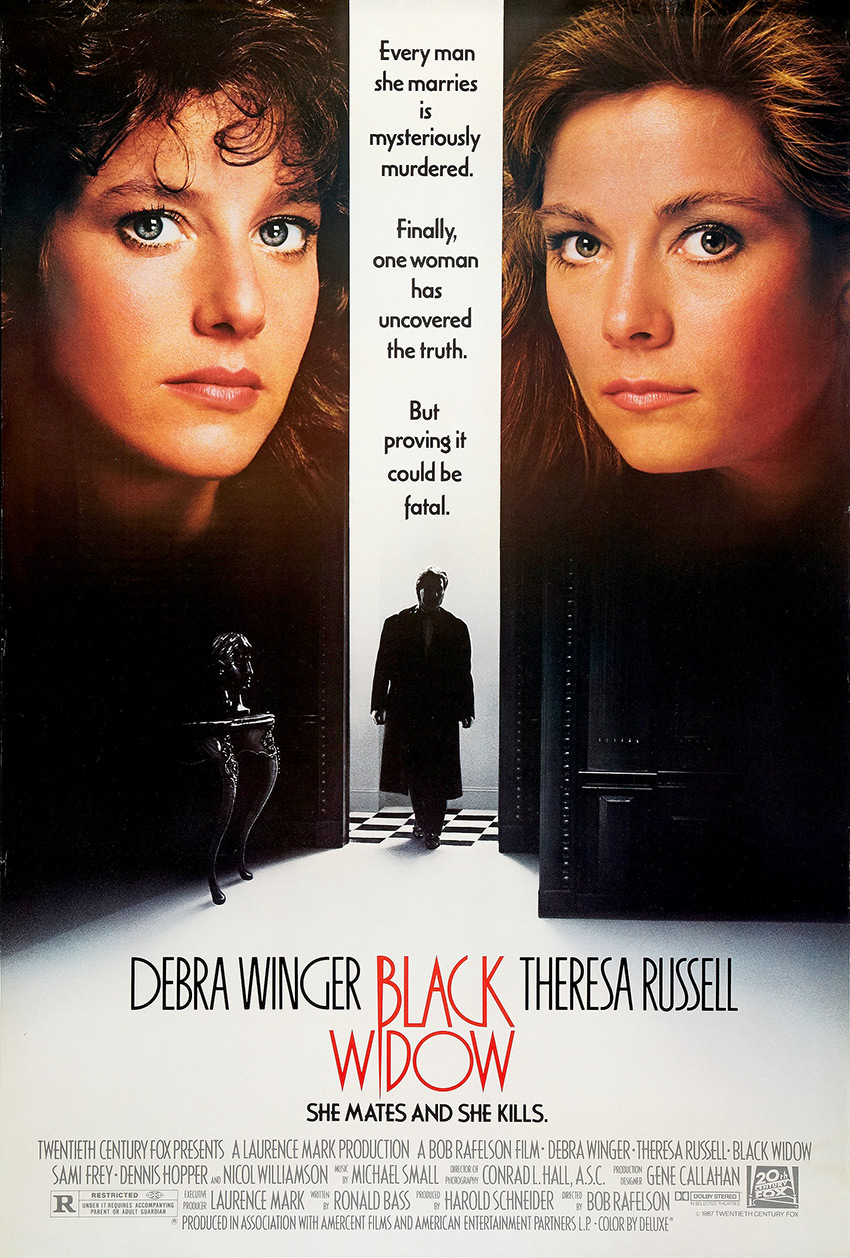
Black Widow (1987)

black widow

By Richard Winters

My Rating: 4 out of 10

4-Word Review: She kills her husbands.

A federal agent named Alexandra (Debra Winger) tracks an elusive woman named Catherine (Theresa Russell) who marries rich men and then kills them off to inherit their fortune. Catherine is constantly changing her identity making it tough for her to track and Alexandra’s superiors do not share her same passion for the case nor believe there’s even a case at all. Finally while in Hawaii Alexandra manages to make contact with the woman and the two become fast friends only to have Alexandra become the next target when Catherine starts to suspect that she’s been double-crossed.

The film’s biggest asset is Conrad L. Hall’s cinematography, which is uniformly gorgeous and breathtaking. I loved the outdoor shots of Hawaii most notably the open terrain and the volcano as well as the scuba diving underwater sequence. The shots of the Seattle skyline and woodsy cabin are equally good making this on a visual level a top notch production. Winger is great in the lead even if her character lets down her guard a few too many times. I also enjoyed James Hong a perennial character actor who gets his most memorable role as a sleazy private investigator. It’s also fun to go back to what life was like before the internet, cellphones and debit cards and where ‘disappearing’ was so much easier.

Ronald Bass’s script though is shallow and formulaic. Just as it should be getting exciting it instead becomes boring and the slick twist at the end cannot overcome all of its loopholes. I found it surprising that Alexandra would be the only person in the world that would be on to this woman. Wouldn’t the relatives of the deceased start to suspect her as well? One segment has Catherine agreeing to give some relatives a large sum of money as a ‘gift’ to get them off her back, but what about the relatives of the first two husbands? The police work is also extremely sloppy. One of the husbands was allergic to penicillin, which is what Catherine uses to kill him, but they never think to test for it or investigate to see if Catherine had recently acquired a prescription for it, which she had. I also couldn’t figure out why Catherine would want to robotically go right back out and marry another rich man just after killing another. Why not ‘enjoy the fruits of her labor’ as it was and live it up with the money she already acquired from the last one before going through all the stress and planning of nabbing the next?

In fact the most frustrating thing about the film is the Catherine character as we never learn what motivates her or anything about her background. Alexandra is asked at one point what she thinks motivates this woman and she responds that it’s ‘not important’, but actually it is because it helps create a three-dimensional character instead of this evil prototype that gets increasingly more boring as the film progresses.

There is also a twist in the film where Catherine has one of her husband’s sign over his fortune to charity in his will, which helps him believe that she is not after him for his money, but then after he is killed it is learned that his legal residence was actually Florida, which has something called a ‘Mark Main’ statute that invalidates any bequest to charity that is made in a will six months before his death and thus allows the inheritance to go back to the surviving spouse, which Catherine takes full advantage of, but are we the viewer really expected to believe that Catherine knew about this loophole all along? Who researches that kind of stuff or even thinks to research it? Okay, so maybe she had some area of legal expertise in her background, but then why is she also such an expert at poisons and forgery and all the other stuff that she does and gets away with in order to stay ahead of the police? Haven’t these filmmakers ever watched an episode of ‘Columbo’ where even the smartest of killers will eventually screw up because it is simply humanely impossible to be ontop of everything like the character here is? By making the villain so over-the-top cunning and conniving while also cool under pressure hurts the tension instead of heightening it because it throws the believability factor out the window and ultimately makes this otherwise slick thriller empty and forgettable.

My Rating: 4 out of 10

Released: February 6, 1987

Runtime: 1Hour 42Minutes

Rated R

Director: Bob Rafelson

Studio: 20th Century Fox

Available: VHS, DVD, Amazon Instant Video
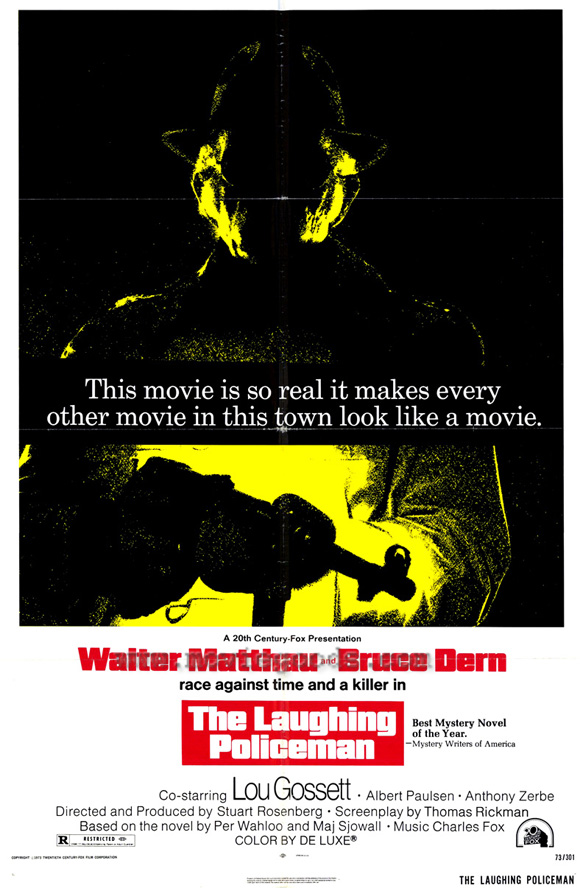
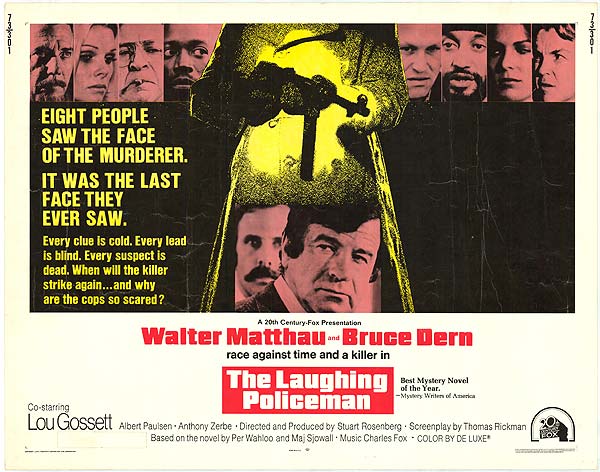
The Laughing Policeman (1973)

the laughing policeman 1

By Richard Winters

My Rating: 7 out of 10

4-Word Review: This policeman isn’t laughing.

8 passengers on a San Francisco bus are slaughtered to death by a mysterious gunman for no apparent reason. When Police Sargent Jake Martin (Walter Matthau) investigates he finds that his patrol partner is one of the victims. He soon learns that his partner was working on another case during his off hours dealing with a murdered prostitute that Jake had also worked on, but couldn’t crack. He begins to believe the two cases are somehow connected, but his brash department head (Anthony Zebe) doesn’t agree and thinks it is a waste of time to pursue the possible connection while also sticking him with Leo (Bruce Dern) a younger cop who doesn’t always like to play within the rules and whose manner and methods conflicts with Jake’s.

The film, which is based on the novel by Per Wahloo and Maj Sjowall who also did the book version for Man on the Roof, has a finely detailed gritty nature about it that looks at the methods of a police investigation in a realistic and unglamorous fashion, which significantly helps this one stand out from the usual cop dramas. I loved the way they searched for clues on the bus and the autopsies of the victims as well as pursuing leads that never pan out, which is a very common occurrence in most police investigations, but rarely is ever shown in movies. There is even a shot of a tow truck removing the disabled bus from the accident scene once the investigation is completed.

Although the novel’s setting was Stockholm the movie transplants the action to San Francisco making the Bay City almost like a third character. Director Stuart Rosenberg manages to nicely capture the eclectic vibe of the area and the disdain many people had for the police during that era. The movie also uses very little music, which is a major asset and helps accentuate the realism. Outside of the closing credits the only time there is really any other music is near the end when Jake and Leo start following a suspect, which comes off as jarring and should’ve been left out.

Matthau who’s mostly known for his comedic parts does well in an atypical role, which due to his casting and the film’s strange title may make some think it is a comedy though this is far from it. Dern is terrific in a role that takes full advantage of his edgy acting style and I liked how the two characters don’t get along at first, but eventually get past their differences and use each other’s unique strengths to their advantage. I was disappointed though that there is a side-story dealing with Jake’s tumultuous relationship with his teenage son that gets introduced early on, but then dropped and completely forgotten during the second half.

Louis Gossett Jr. gets a star making turn as a brash street cop and Zerbe is superb in support as the gruff police chief. Joanna Cassidy has a brief, but interesting bit as a witness and I liked the shot showing her and Dern sitting amidst a row of tables with table legs made to look like human ones. It’s also amusing to note that Albert Paulsen’s character who becomes the main suspect in the film never utters a single word of dialogue.

Spoiler Alert!

The film’s biggest downfall though is with its ending. It is very hard to believe that a character such as Paulsen’s that is portrayed as being rich and having a lot of connections would feel the need to shoot and kill the bus passengers himself as most if not all rich people simply hire someone else to their dirty work. I also didn’t think that someone who walks down the street surrounded by lawyers would crack as quickly as this one does when Matthau comes to question him about the case. A typical well-off businessman would simply ‘lawyer-up’ and trust that the minimum evidence that the police have would not hold up in court instead of jumping into his car and racing down the city streets in a panic such as he does here. The finale becomes too conveniently Hollywood-like and seems to sell out on the film’s original concept, which left this viewer with a flat and ambivalent feeling towards it when it was over.

the laughing policeman 2

End of Spoiler Alert!

My Rating: 7 out of 10

Released: December 20, 1973

Runtime: 1Hour 52Minutes

Rated R

Director: Stuart Rosenberg

Studio: 20th Century Fox

Available: DVD

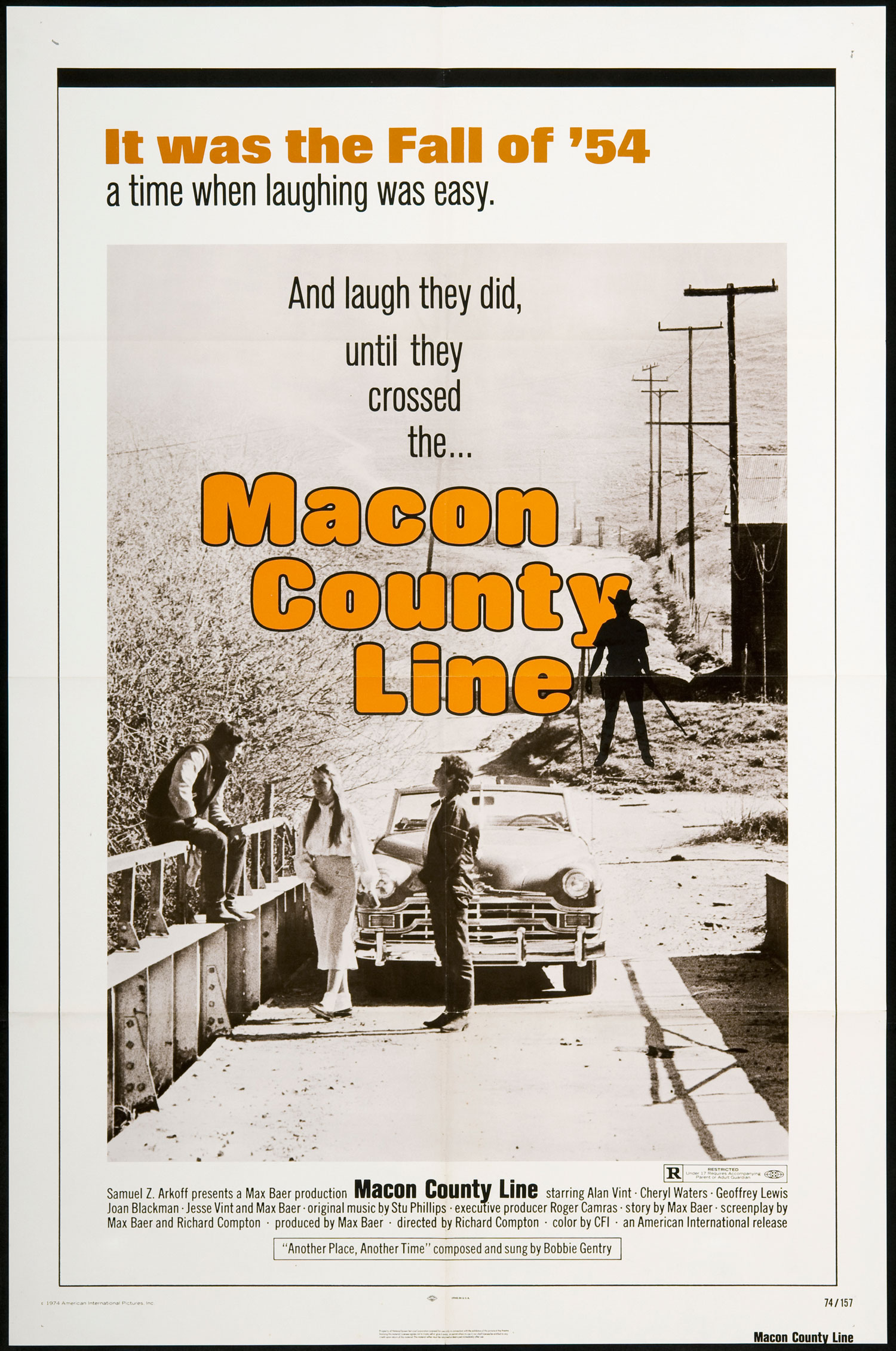
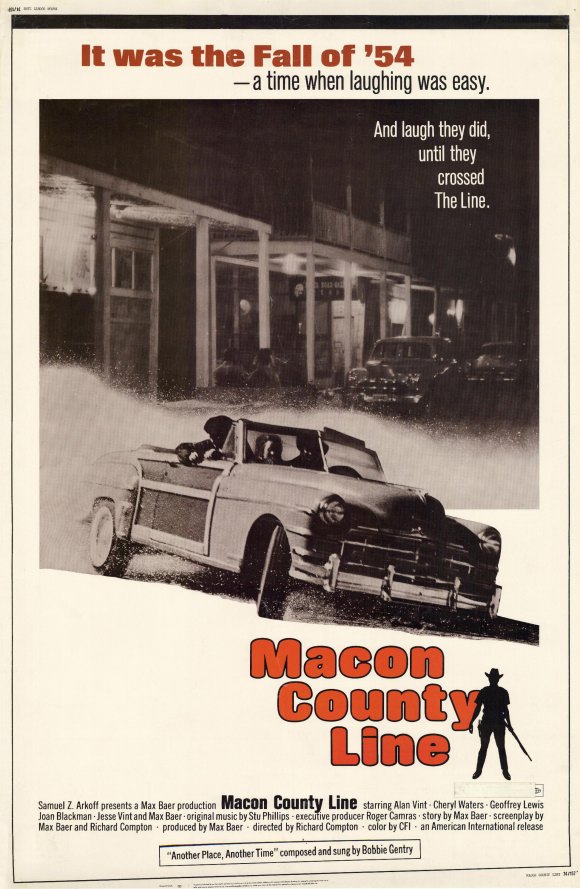
Macon County Line (1974)

macon county line 3

By Richard Winters

My Rating: 6 out of 10

4-Word Review: Sheriff attacks innocent trio.

The year is 1954 and Chris and Wayne Dixon (played by real-life brothers Alan and Jesse Vint) are two brothers traveling through the Deep South for one last hurrah before joining boot camp. Along the way they pick up attractive hitch-hiker Jenny (Cheryl Waters) and the three appear ready to party it up when their car suddenly breaks down in front of an isolated country home. Unbeknownst to them the home’s inhabitant (Joan Blackman) has been murdered and when her husband, who just so happens to be the county sheriff, (Max Baer Jr.) arrives to find the carnage he immediately suspects it’s the kids sleeping in the nearby car. Thus begins a wild night chase through the country backwoods as the three try desperately to outrun a man with an unrelenting rage while pleading with him that they are innocent.

The film is a definite step above the average drive-in fare of that era with characters that manage to avoid the usual stereotypes and clichés. The 1950’s are painted in a little more of an edgier way and populated by people that are much more crass than what you will find in an old episode of ‘Leave it to Beaver’ or some sanitized recreation of that period, which I found to be refreshing. The music, particularly La Vern Baker’s gospel tinged opening song and Bobbie Gentry’s closing one is great and really helps to create a definitive mood. There are also two really good flashback sequences including a dimly lighted, moody one dealing with police brutality of a criminal and an ‘interrogation’ scene done at a police station that isn’t bad either.

Unfortunately the story is thin and hinges solely on the frantic chase that takes up the movie’s final 20 minutes, which is well edited and even features a twist ending, but up to then it is rather uneventful with too much time spent on the trio’s visit with a dimwitted auto mechanic (played by Geoffrey Lewis) that adds unnecessary comic relief.  There is also an ill-advised, dream-like segment where Jenny and Chris decide to take off their clothes and make love in some stagnant water found inside an old, rusted circular drinking trough in an abandoned barn that not only takes away from the film’s grittiness, but also seemed extremely unhygienic as well. I was also expecting more car chases especially with all he nicely refurbished vintage cars that appear, but the only one that they do have gets shot at night and the camera focuses more on the driver’s nervous faces in a cheesy melodramatic style than on the automobiles.

The film was produced and co-written by Max Baer Jr. who is better known as Jethro from the hit 60’s TV-series ‘The Beverly Hillbillies’ and in fact he wrote the story for this movie on the back of some Hillbilly scripts during breaks in filming. Although this was filmed in Sacramento the location is supposed to be the south and could’ve been either Georgia, Tennessee, or Alabama as all three of those states have a Macon County, but the real irony is that the two brother are from Chicago and we even see a close-up of their Illinois plate, which also has a Macon County although it’s likely the story wasn’t set in that one.

macon county line 4

My Rating: 6 out of 10

Released: August 8, 1974

Runtime: 1Hour 28Minutes

Rated R

Director: Richard Compton

Studio: American International Pictures

Available: DVD

Cruising (1980)

cruising2

By Richard Winters

My Rating: 4 out of 10

4-Word Review: Cop infiltrates gay underground.

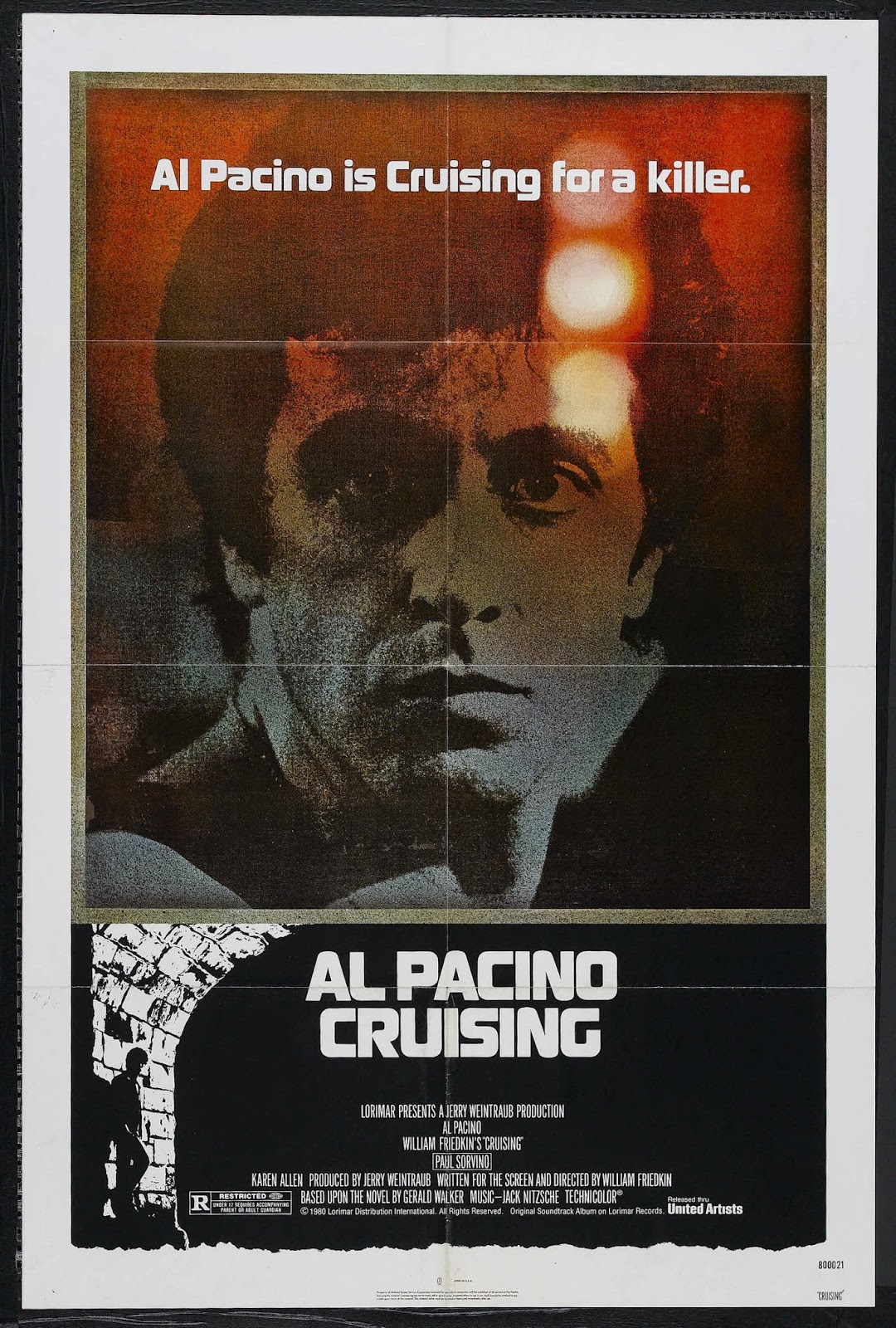
A serial killer is attacking gay men who frequent New York’s S&M bars and young cop Steve Burns (Al Pacino) is chosen to go undercover as a gay and infiltrate these ‘leather clubs’ in order to bring out the killer. However, the job requirements demand that he must be completely isolated from the rest of the force and not carry a gun, which eventually causes a strain on his personal life particularly in his relationship with his girlfriend Nancy (Karen Allen).

The film, which is loosely based on actual events that occurred during the late 70’s and captured in Gerald Walker’s novel of the same name, was considered quite controversial at the time of its production. Protestors who felt the film accentuated the gay stereotype tried to create loud noises during filming and even shine reflective lights on the actors in an attempt to mess up the scenes. In retrospect it is hard to imagine that director William Friedkin is in anyway homophobic as just ten years earlier he did the brilliant adaptation of The Boys in the Band, which remains to this day one of the better films dealing with gay issues. The story certainly does wallow in ugly elements, but also makes the point to describe this as an extreme subculture and  not reflective of the gay lifestyle as a whole, which in my opinion made the film seem more enlightening to New York’s gay underground of a bygone era and less propaganda as its critics ascertained.

To some degree I liked the explicit uncompromising approach, but after a while it became one-dimensional and predictable. The scenes of the killings are unnecessarily prolonged and some of the segments showing large groups of men having sex at a bar come off as overly-stylized and looking reminiscent of a homoerotic scene from a Fassbinder film.

Friedkin does manage to add a few unique touches including having a well-built black man wearing nothing but a jock strap enter the room during police interrogations and violently slap suspects who he felt weren’t telling the truth, which according to one of the film’s advisors was an actual technique used by police at the time.  The way the movie captures the monotony and frustrations of investigating a complex case such as this and leaving open that there may have been more than one killer is also well done and helps elevate this a bit from the usual formulaic cop thriller.

Pacino gives a gutsy performance including one scene showing him tied up in bed naked during some kinky S&M play, but the character’s motivations are confusing particularly the way he so quickly accepts this difficult assignment that most others would be very reluctant to do. The fact that his experiences ends up affecting him psychologically isn’t compelling since that becomes a foregone conclusion right from the start.

Paul Sorvino is perfect as the police captain. His gray hair dye was a little overdone, but his limp was great. Allen has a good moment at the end when she tries on Pacino’s leather hat and coat that he brought home with him and Joe Spinell makes the most of his small role as a corrupt cop who harasses gays only to end up patronizing gay bars on his off hours. You can also spot Powers Boothe in an early role as a hankie salesman and Ed O’Neil as a police detective.

The idea of exposing the dark side of police life is no longer original or interesting and the film’s shock value has lessened through the years and thus failing to leave any type of lasting impression or message.

My Rating: 4 out of 10

Released: February 15, 1980

Runtime: 1Hour 42Minutes

Rated R

Director: William Friedkin

Studio: United Artists

Available: VHS, DVD, Amazon Instant Video
Partners (1982)

partners

By Richard Winters

My Rating: 2 out of 10

4-Word Review: Pretending to be gay.

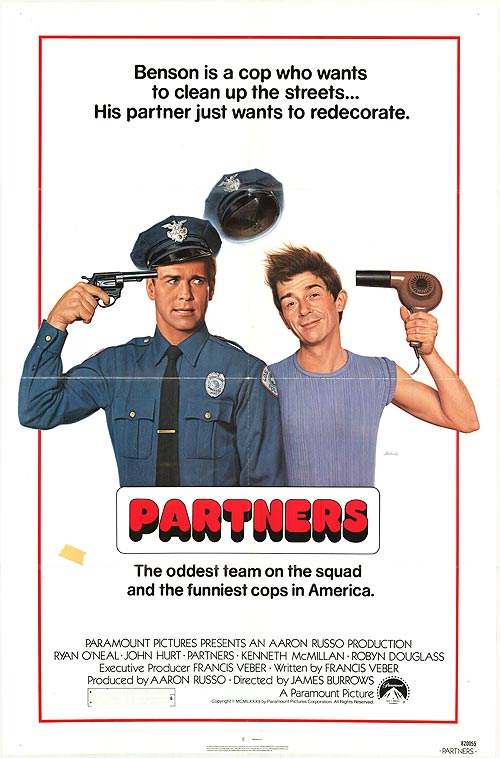
A serial killer targeting gay men is on the prowl. When one of his victims turns out to be the son of an influential politician pressure is put on the police force to find the culprit. The police chief (Kenneth McMillan) feels he has no choice but to pair Sgt. Benson (Ryan O’Neal) a straight cop with Kerwin (John Hurt) who is a gay desk clerk at the station. They are to masquerade as a gay couple in hopes of infiltrating the gay underground and find clues to the elusive killer, but their contrasting personalities and lifestyles threaten to blow their cover before they can make headway.

This film was controversial at the time of its release for its overuse of gay stereotypes and there are indeed some especially at the beginning, but the film’s biggest offense is that it is just plain boring. The idea that two cops could be forced to pretend to be a gay couple or have one of them pose naked for the cover of a gay men’s magazine as part of their investigation is dubious enough, but had it been funny I might have forgiven it. Unfortunately this thing can’t even elicit a few chuckles.

The idea that Kerwin would automatically fall in love with Benson while working together simply because he is another man is absurd and makes about as much sense as a heterosexual male falling for every woman that he meets, which of course doesn’t happen. The Benson character is also quite callous and disrespectful to Kerwin while showing blatant homophobic tendencies and being a confirmed ladies’ man, so I didn’t see what there was about him that Kerwin would have fallen in love with anyways.

Benson’s transformation to being more sensitive to gays and their issues during the course of the story might have been more compelling had it been better written. However, his liberal use of the word ‘faggot’ makes the film seem quite dated and wouldn’t be heard in a movie today especially from a character that is supposedly a protagonist.

Hurt plays the gay caricature well, but the idea of placing someone on such a dangerous mission without having any undercover experience of even knowing how to use a gun seemed stupid and unrealistic. Out of all the characters McMillan’s comes off best and he even manages to be slightly amusing, but unfortunately isn’t seen enough. Character actors Jay Robinson and Sydney Lassick can be spotted very briefly.

This was intended to be a parody of Cruising, which was released 2 years earlier and was a much more serious and graphic look at a true life killer of gay men. That film starred Al Pacino and will be reviewed next Monday.

My Rating: 2 out of 10

Released: April 30, 1982

Runtime: 1Hour 32Minutes

Rated R

Director: James Burrows

Studio: Paramount

Available: VHS, DVD

Wolfen (1981)

wolfen 1

By Richard Winters

My Rating: 4 out of 10

4-Word Review: Wolves on the attack.

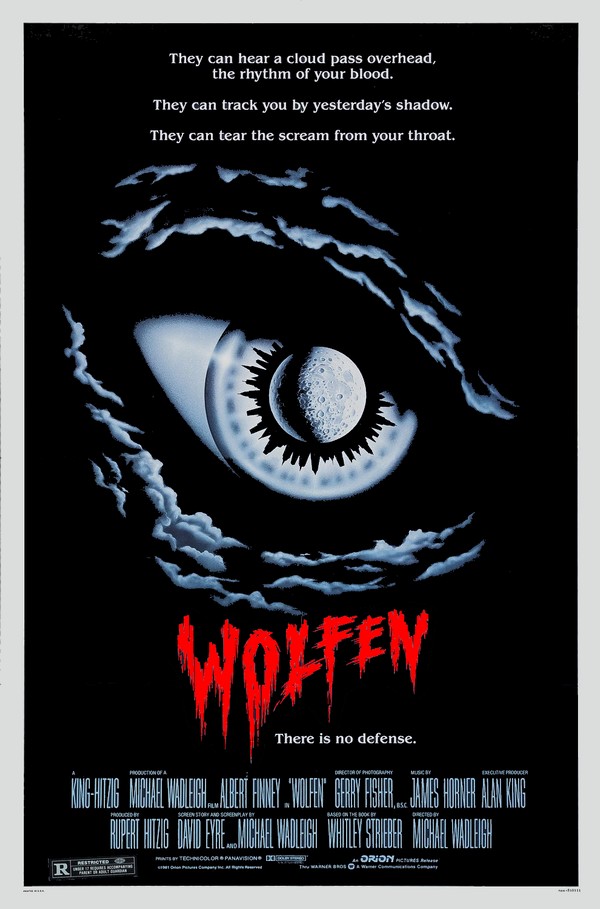
Dewey Wilson (Albert Finney) is assigned to investigate a particularly savage attack that occurred in Battery Park in New York City where a real estate magnate and his wife and bodyguard where gruesomely killed by some mysterious being that the police initially peg as a terrorist act. As Wilson investigates further and in talking with some experts he comes to the opinion that it may be wolves that killed them, but not the everyday wolf instead they are ghostly spirits intent on protecting their sacred ground. As the body count continues Wilson tries unorthodox methods to understand and stop these strange animals that remain invisible and elusive to the human eye.

For a horror film, which is based on the novel by Whitley Streiber, it has a refreshingly different approach to the material making it seem more like a modern-day drama and character study. Director Michael Wadleigh nicely captures the ambience and attitude of the city. The authentic feel and multi-dimensional lead character helps make the story more compelling. The use of showing things from the wolves’ point-of-view that gets captured through a unique colored lens is initially captivating and creepy.

Unfortunately the film does the P.O.V. thing too often, which eventually becomes redundant and boring. The genteel tone does not create enough tension and the film is barely ever suspenseful. There is one good decapitation scene, but otherwise the gore and special effects are minimal. The runtime is too long and the pacing could have been better. A good horror film or even a thriller needs a good scary image of the threat at hand to hold onto and create the fear for the viewer, but we are never shown the wolves at all until the very end. I did like the one part where the Diane Venora character goes roaming around an abandoned church and almost gets attacked by one of the wolves whose red eyes we see, but I wanted to see more of this since it was the only time I got even slightly frightened.

Finney is an odd choice for the lead. Simply because he has a reputation as being a great actor does not mean he is perfect for every role and having a grizzled New York cop speak with a British accent is off-putting. He is also too old and his relationship with a female cop that is clearly 20 years younger looks weird. I did like Edward James Olmos who takes off his clothes at one point and effectively acts like a real wolf and the scene where he has a menacing conversation with Finney while high on top of a bridge is memorable.

Spoiler Alert!!

My biggest beef comes with the ending in which Finney finds himself surrounded by the wolves and in an attempt to appease them smashes the model of the construction site that was going to be built on their sacred ground, which satisfies them enough to leave him alone and go away, but it came off as corny, farfetched and anti-climactic to me. It also makes the wolves who the viewer has feared throughout the film suddenly look like the ‘good guy’  and thus stripping all the ‘horror’ from this supposed thriller and makes sitting through it a pointless waste of time.

End of Spoiler Alert!!

My Rating: 4 out of 10

Released: July 24, 1981

Runtime: 1Hour 55Minutes

Rated R

Director: Michael Wadleigh

Studio: Orion Pictures

Available: VHS, DVD, Amazon Instant Video
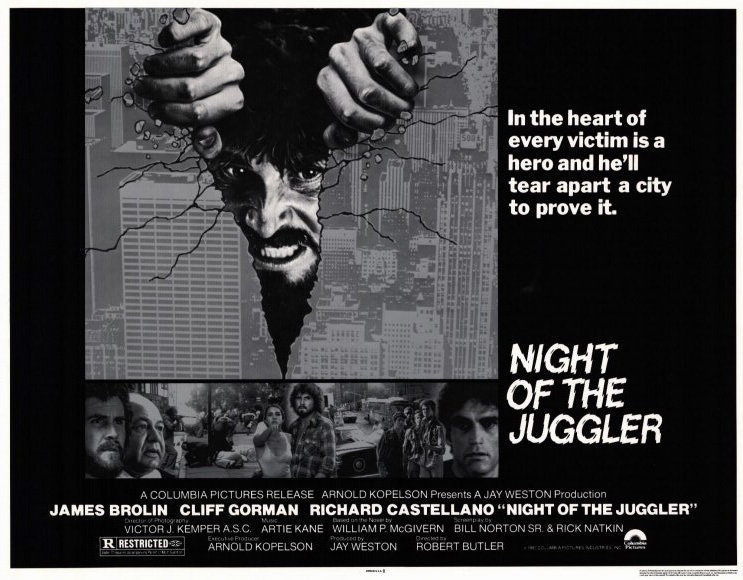
Night of the Juggler (1980)

night of the juggler 2

By Richard Winters

My Rating: 4 out of 10

4-Word Review: A father’s relentless search.

Sean Boyd (James Brolin) is a divorced man and retired cop now working as a truck driver and raising his twelve-year-old daughter Kathy (played by Abby Bluestone who now works as a talent agent) in the not-so-nice section of New York City. Gus Soltic (Cliff Gorman) lives in a rundown building slated for destruction and kidnaps Kathy mistakenly thinking she is the daughter of a rich man who can pay him a high ransom. Instead he now must contend with Sean who will stop at nothing to get her back and stalks Gus with a relentless determination to find her.

The film is based on the William P. McGivern novel who was a noted mystery writer who brought an extra degree of realism to his stories. Director Robert Butler nicely keys in on this by not having a loud, pounding music score and instead relying on the natural ambience to create the tension. The film has an incredible amount of action that almost seems non-stop. The car chase that goes through park pathways and even crowded city sidewalks is amazing. The climatic foot chase in the catacombs of the underground city tunnels is atmospheric as is the foot chase through abandoned properties where Sean not only pursues Gus, but must also fight off a Hispanic street gang that are right on his heels. The scene where Dan Hedaya seemingly destroys every display window in the city with his automatic rifle aimed at Sean’s head is both effective and amusing.

Despite its strong gritty nature the film does manage to have a few amusing scenes including Sean stealing a street preacher’s car with the preacher still in it as he pursues Gus.  I also liked the scene where Lieutenant Tonelli (Richard S. Catellano) is enjoying a dish of yogurt until the vendor tells him how it gets made. Unfortunately there are a few moments that end up being funny in an unintentional way including Sean’s intense confrontation with strippers (played by famous 70’s/80’s porn stars Serena and Sharon Mitchell) while inside an adult peep show.

Brolin physically looks perfect for the role especially with his black beard and mustache that gives him a Charles Manson-like quality, but overall he is a bit sterile. Gorman is effective as the psycho and even has a few moments of unexpected tenderness. Castellano comes off best as the tubby, but stoic detective.

The film has its share of flaws including having Gus grab the girl in broad daylight in the middle of a park with dozens of other people around, but no one except for her father does anything to try and stop him. I realize that the city was still under the stigma at the time of the Kitty Genovese case in which a woman was raped and murdered and many witnesses either saw or heard it and did nothing to help, but this scene  is still a bit unrealistic. Also, Gus kidnaps the wrong girl because both girls were wearing blue overalls, but the chances of two pre-teen girls living in a cosmopolitan city wearing overalls especially when one of them is from a rich and snooty area seems slim-to-none.

Overall despite all the action the film still comes off as jarring and jumbled and strangely uninvolving. The incessant focus of showing New York as bleak and apocalyptic becomes one-dimensional. The story itself is run-of-the-mill and forgettable.

My Rating: 4 out of 10

Released: June 6, 1980

Runtime: 1Hour 41Minutes

Rated R

Director: Robert Butler

Studio: Columbia Pictures

Available: VHS

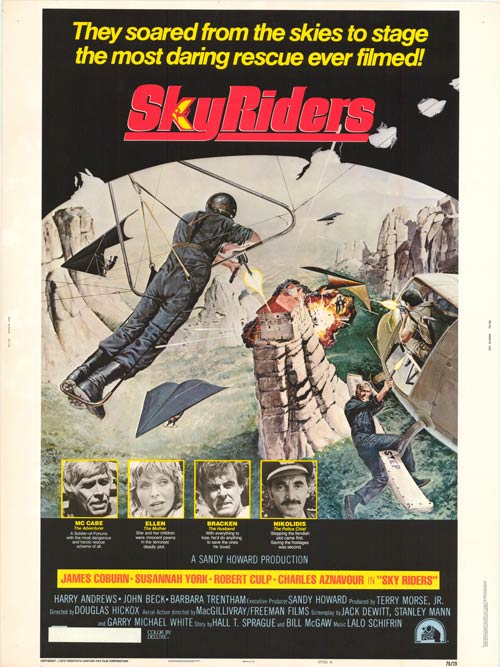
Sky Riders (1976)

sky riders

By Richard Winters

My Rating: 5 out of 10

4-Word Review: Rescued by hang gliders

Businessman Jonas Bracken (Robert Culp) living in Greece comes home one day to find his wife Ellen (Susannah York) and three children kidnapped by a terrorist group. The police can seem to make no headway so Ellen’s ex-husband Jim (James Coburn) gets involved. After analyzing the background of one of the photos of the victims taken by the kidnappers he realizes that they are being held hostage inside a mountaintop monastery and the only way to get to it is by air, so he hires a crew of hang gliders to fly into the locale and rescue the family.

The film is fast-paced it gets right into the story from the very beginning and never slows down. The kids are pretty cute especially the precious little girl, which helps the viewer emphasize with their predicament and urgency to get out. The Greek locations are exotic and help give the film an extra flair.

The biggest problem is the script. The Coburn character has never hang glided before and yet somehow manages to be trained well enough in only a couple of days to fly into the steep mountaintop location without a hitch, which seemed farfetched. It also seemed highly implausible that this group of hang gliders who work at the local circus would be willing to take on such a dangerous mission or even know what to do once they landed and had to take on the gun toting bad guys. I would have expected a lot more missteps and mistakes from this novice bunch and yet they handle everything like they were a group of seasoned commandoes.

Coburn’s performance is misguided as well. Normally I love his toothy grin and throaty chuckle, but here he does it while watching the hang gliders perform at the circus even though his ex-wife and son are being held hostage. I would have thought he should have been so nervous and tense that he wouldn’t have smiled at all and been instead in a perpetually serious manner.

The scene of when they fly into the locale is done with a darkened lens to simulate nighttime, which beside being annoying makes it hard to see and lessens the dramatic effect as well as the excitement.

On the whole it’s a very basic action flick and an empty-headed one at that. The terrorist group and their ‘cause’ are quite generic and the thin plot and cardboard characters barely camouflage the fact it’s just an excuse to show off some nifty hang gliding footage and nothing more.

My Rating: 5 out of 10

Released: March 26, 1976

Runtime: 1Hour 27Minutes

Rated PG

Director: Douglas Hickox

Studio: 20th Century Fox

Available: DVD (Regions 1 & 2)

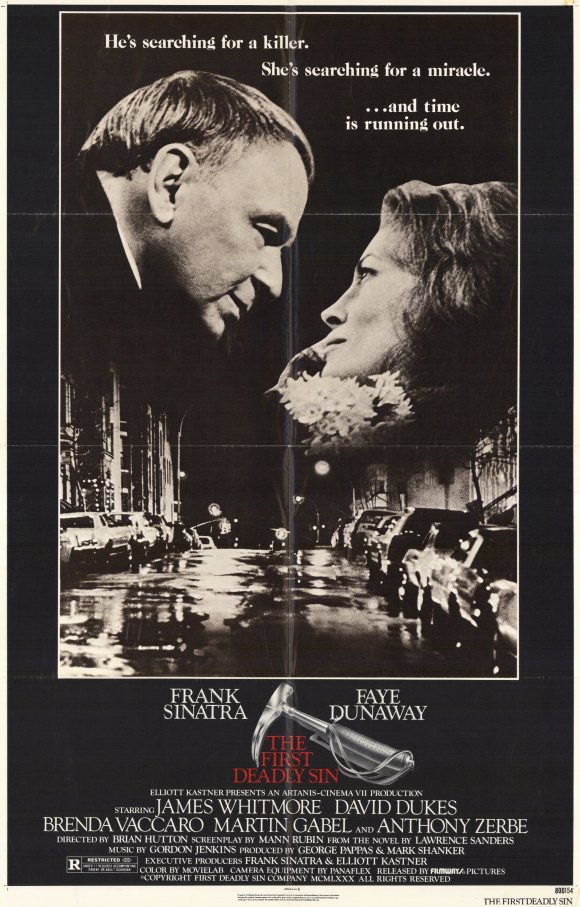
The First Deadly Sin (1980)

the first deadly sin

By Richard Winters

My Rating: 4 out of 10

4-Word Review: Aging cop tracks killer.

Based on the best-selling novel by Lawrence Sanders the story centers around Edward Delaney (Frank Sinatra) a cop only weeks away from retiring who becomes obsessed with tracking down a serial killer who hits people on the back of their heads with a sharp edge hammer as they are walking down the street. The problem is he has only a few clues to go on and his wife Barbara (Faye Dunaway) is in the hospital suffering from a mysterious illness that causes him additional stress and strain.

The film takes a refreshingly different approach to police work than what you will usually find in most Hollywood cop pictures. Instead of emphasizing exciting car chases and thrilling shoot-outs it instead analyzes the meticulous and often times tedious work that goes into following up every little lead while working inside a rigid system and under superiors that aren’t always supportive.  For the most part this is done quite well and at times it is even enlightening, but the whole first half is spent with Delaney trying to figure out what type of weapon was used in the killing even though we the viewer know what it is since we are shown the actual murder at the very beginning thus making the first hour seem quite derivative.

Having the film cut back and forth between scenes of Delaney and the killer doesn’t work. The psycho is played by David Dukes probably best known for playing the man who tries to rape Edith Bunker in a classic episode of ‘All in the Family’. He is a good actor, but scenes showing him alone are clichéd and at times even unintentionally funny. Director Brian G. Hutton should’ve cut them out completely as having the viewer come to realize who it is along with Delaney would have deepened the mystery angle and made it overall more intriguing.

The scenes with the sick wife don’t work either. For one thing we never find out what the mysterious illness is, which is highly frustrating and annoying. It also doesn’t make the plot or character any more interesting. Dunaway is a superior actress and she makes the most of the role’s limitations, but I felt an actress who was more Sinatra’s age would have made it more realistic instead of casting a woman who was 27 years younger.

I have always enjoyed Sinatra in his detective roles, but the character here isn’t as caustic as in some of his older films. For the most part he is pretty benign and even kind of boring. Joe Spinnell though makes the most of his bit part as an overzealous doorman who believes in rigidly following the rules and taking great pride in his doorman duties, but quickly willing to bend them the minute he is given some bribe money.

The final showdown between Delaney and the killer is quite unusual and much more low-key than you might expect. I enjoyed the twist that comes with it, but it lacks a strong impact and the film would have been better served had it had just a little more action.

This movie is also famous as being Bruce Willis’s film debut. He can be seen at the 1Hour 34Minute mark coming into a bar as Delaney walks out. He has a cap over his head and covering his eyes, but you can clearly see just by looking at his mouth that it is him.

My Rating: 4 out of 10

Released: October 3, 1980

Runtime: 1Hour 52Minutes

Rated R

Director: Brian G. Hutton

Studio: Filmways Production

Available: DVD, Amazon Instant Video

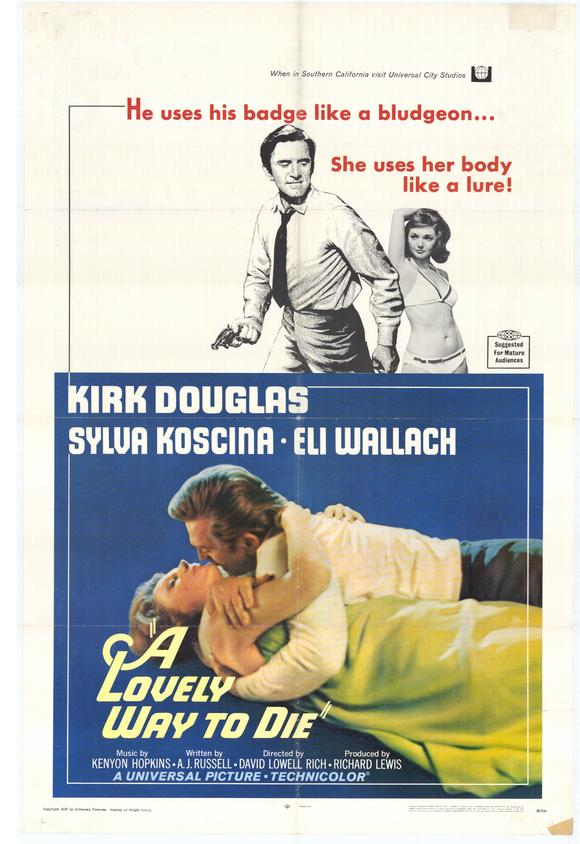
A Lovely Way to Die (1968)

a lovely way to die

By Richard Winters

My Rating: 6 out of 10

4-Word Review: Cop protects sexy defendant.

Jim Schuyler (Kirk Douglas) is a tough guy cop who leaves his job after his superiors put pressure on him to change the brutal way he treats criminals, which he refuses to do. Tennessee Fredericks (Eli Wallach) a high profile defense lawyer hires Jim to protect his client Rena Westabrook (Sylva Koscina) who is on trial for conspiring with her lover (Kenneth Haigh) to murdering her rich husband. Jim takes a liking to Rena and the two soon begin a torrid affair while he tries desperately to prove that Rena is innocent even though everything points against her.

This film sat in complete obscurity for almost 4 decades having never gotten released on either VHS or DVD until Universal finally made it part of their Vault Series. Why it took so long to get out I don’t know why as it is on the most part pretty good. The mystery is intricate and entertaining and full of unusual twists. The woodsy New Jersey scenery isn’t bad and the large mansions where most of the action takes place are impressive. This film isn’t any different from any of the other myriad crime noir mysteries of that era, but it manages to be slick enough to keep it intriguing until the very end.

The opening credit sequence is a definite drawback as it shows freeze frames of scenes from the film and seems almost like an ad or movie preview that does not help the viewer get into the mood of the story. The music also gets overplayed to the point of being distracting and irritating. It also has too much of a playful tone to it that does not coincide with the dark, moody overtones of the plot or characters.

Douglas who was already in his 50’s at the time of filming looks too old for the part and his love scenes with Koscina look almost like a father and daughter, which comes off as creepy and unnatural. The part would have been better served had it been played by an actor that was at least 20 years younger, which would have made the romantic angle much more believable. Wallach’s attempts at a southern accent are futile, but his arguments and theatrics during the trial are still fun.

The film also offers a great chance to see young up-and-coming stars including Conrad Bain as the prosecuting attorney, Doris Roberts as a snoopy housekeeper and Ralph Waite as the star witness. There is also Philip Bosco and John P. Ryan as bad guys. Richard Castellano is a bartender and David Huddleston is one of his patrons. You can even spot the beautiful Ali MacGraw in her film debut at the very beginning.

My Rating: 6 out of 10

Released: July 12, 1968

Runtime: 1Hour 43Minutes

Not Rated

Director: David Lowell Rich

Studio: Universal

Available: DVD (Universal Vault Series)