Category Archives: Obscure Movies

Sticky Fingers (1988)

sticky fingers 1

By Richard Winters

My Rating: 1 out of 10

4-Word Review: Roommates spend drug money.

Hattie (Helen Slater) and Lolly (Melanie Mayron) are two struggling musicians who share a crummy apartment run by slumlord Stella (Eileen Brennan). They are having trouble making ends meet when their friend Diane (Loretta Devine), who is a drug dealer, asks them to hold onto a bag for them while she is out of town. Inside the bag is $950,000. The girls decide to ‘borrow’ some to help pay their rent and then they continue to take more until they have spent $224,000 of it and when Diane comes back she is not too happy nor are the people that she works for.

For a film that is written and directed by a woman and co-scripted by Melanie Mayron it has every conceivably negative female stereotype placed on its two leading characters and if this had been done by a man he would be accused of being a sexist. The two women are ditzy shopaholics who lack any common sense are indecisive and greatly insecure and have no level of sophistication.

They spend tons of money on clothes and needless gadgetry, but then remain in the same rat hole of an apartment. If they had any brains they would have bought a house on the other side of the country and then escaped. The drug money couldn’t get reported to the police as stolen and since this was the 80’s and before cellphones and the internet it was a lot easier to ‘disappear’.

The strained arguments the two have about derivative issues, which are supposed to be funny, become annoying and unending instead. Their shouting over which color of sponge to use for dish washing was so ridiculous it almost made me want to turn it off.

Slater who was just a few years removed from her Billie Jean character gives a decent performance despite the limitations of the character. Mayron with her curly carrot top hairdo looks downright ugly and the fact that her character remains with her boyfriend even though he continues to have a not so subtle relationship with his previous girlfriend makes her seem pathetic.

I did like Brennan and some of her sardonic lines. If she had been cast in the lead the film would have been helped immensely.

There are definite shades of an independent movie trying to break out, but it lacks the style, attitude and hipness. The attempt at trying to revive the screwball comedy is a dismal failure and not even good for a few laughs. The only two things I liked was the concert the two perform in while wearing glow in the dark costumes and the crawl of the closing credits that rotates at different angles, which only proves how bad this movie is when the closing credits becomes the highlight!

My Rating: 1 out of 10

Released: May 6, 1988

Runtime: 1Hour 37Minutes

Rated PG-13

Director:  Catlin Adams

Studio: Hightop Productions

Available: VHS
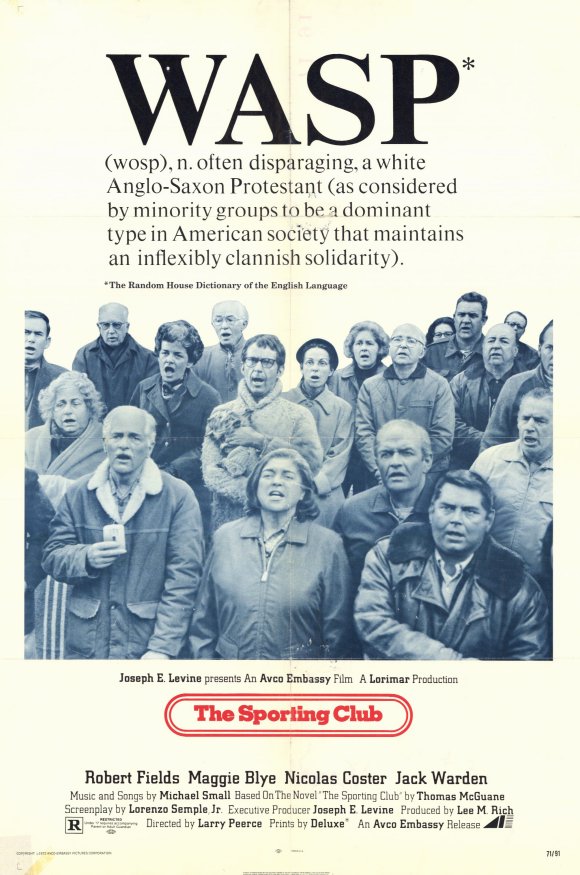
The Sporting Club (1971)

the sporting club 2

By Richard Winters

My Rating: 4 out of 10

4-Word Review: Haves versus have-nots.

Jim (Nicholas Coster) finds out that his business is going under and he barely has any money left. To escape the stress he decides to take a trip to the wilderness of northern Michigan for a little R&R. Unfortunately once there he meets his friend Verner (Robert Fields) who has built a shooting range in his basement and wants to challenge everyone to a duel. The snotty sporting club that Jim belongs to wants to boot him out when they realize he is no longer making an income and rebel- rouser Earl Olive (Jack Warden) gets into a war with the elitist at the sporting club, which sends things spiraling out-of-control between the two sides with Jim right in the middle.

Based on the Thomas McGuane novel the film has the right concept, but not the fluid essence or wry humor of his writing. Some of his later work that was brought to the screen fared better. This film version is too uneven and takes too long to get anywhere. It becomes somewhat intriguing when we are given the idea of this set-up of a wild shoot-out between Olive’s biker gang and the elderly members of the club, but just as things seem to be getting interesting the film veers into a radically different direction and has all the sporting club members getting into a bizarre sex orgy. This may sound funny or even sexy, but it really isn’t as all the people were in their 60’s or 70’s and seeing their naked bodies cavorting around comes off as gross and sick.

The satirical jabs at the snotty club members are funny to some extent. They represent society’s old order people still clinging to age-old traditions and values even though the rest of the world around them is changing. They boast about their exclusive club membership even though it no longer has any allure and their stubbornness only makes them more insignificant and absurd. The scene where they stare blankly like lost children at the blown-up remnants of their cottage is probably the best moment in the film. However, their caricatures end up going overboard they become too illogical and ridiculous like crazed stupid creatures instead of human beings.

Most anti-establishment films of the era, which in the end is what this is, usually cast young stars in the lead, but here we have Coster who was already middle-aged making it look too much like the old guard vs. the old guard, which did not connect with the young filmgoers and they stayed away. The middle-age audience of the time was the establishment themselves and they found the film’s crass humor and scenarios off-putting and thus the film alienated everybody and bombed terribly at the box office.

Robert Fields gives an excellent performance as a budding sociopath and his scenes have an added tension. Warden is also very good in an unusual role for him as a joint smoking trouble maker who loves to rock-the-boat. The gun duel he has with Fields is interesting and his presence helps give the film a few extra points. Margaret Blye has a beautiful face making her a pleasure to look at no matter what she is doing. Jo Ann Harris is also sexy and the scene where she strips down to her panties with the phrase ‘my grandmother loves me’ stenciled on the rear is fun.

The film is weird enough to be worth a look as a curio. Director Larry Peerce infuses some interesting camera work into the proceedings and Michael Small’s moody folk rock score deserves its own album. Despite the locale looking very much like Michigan it was actually filmed near Hot Springs, Arkansas.

My Rating: 4 out of 10

Released: February 28, 1971

Runtime: 1Hour 45Minutes

Rated R

Director: Larry Peerce

Studio: Avco Embassy Pictures

Available: None at this time.

Perfect Friday (1970)

perfect friday

By Richard Winters

My Rating: 7 out of 10

4-Word Review: Kooky trio robs bank.

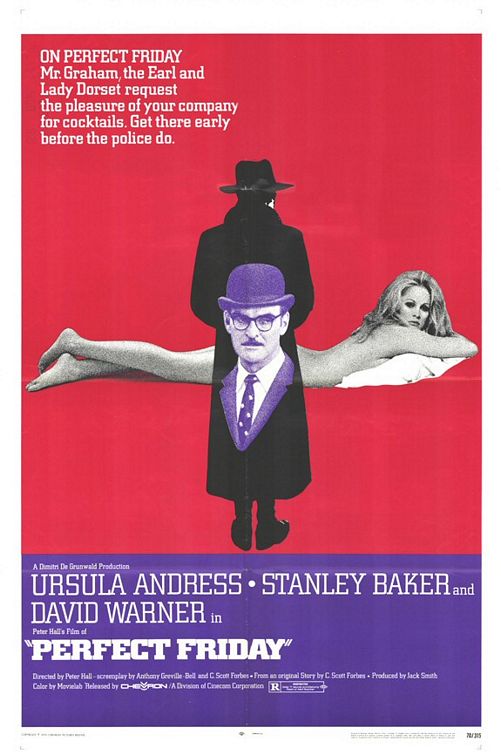
This uniquely structured and offbeat sleeper details an elaborate bank heist where staid bank employee Mr. Graham (Stanley Baker) uses his inside knowledge to pull off an ingenious robbery. Unfortunately he is dependent on the oddball couple of Nick (David Warner) and Britt (Ursula Andress) to help him.

This film is probably more of a kooky character study than it is a heist flick. The three characters are intrinsically different from each other and their constant bickering, feuding, and interplay are a treat. In fact they never get into the actual robbery or even the details of it until the last forty minutes.

Baker is fun in the lead. He is the perfect caricature of the stuffy British businessman. His contained pomposity and cryptic deliveries are right on-target. Warner makes for a good contrast. He is lazy and undisciplined with a tendency to wear outrageous looking outfits. It is interesting though that he can get serious when he needs to particularly during the crime itself.

Andress is the scene stealer and this is a perfect role for her limited acting abilities. She plays a greedy woman prone to outrageous extravagance and indulgence even if she lacks the funds for it. Her caricature of the materialistic woman gets taken to the extreme and is hilarious. In most cases she would be disliked, but here her beauty and innocuous way she delivers her lines make her amusing instead.

Director Peter Hall seems to pride himself on making it offbeat and full of many twists and succeeds most of the way even with his use of the glass offices that the bank employees have to work in. The robbery itself is intricate and believable and full of mounting tension. The film’s only real problem comes with its ending that is too abrupt and in many ways almost like a cop-out. There is such a fun chemistry between the three characters that it really could have been played out much more.

My Rating: 7 out of 10

Released: November 10, 1970

Runtime: 1Hour 34Minutes

Rated R

Director: Peter Hall

Studio: Chevron Pictures

Available: None at this time.

Tattoo (1981)

tattoo

By Richard Winters

My Rating: 2 out of 10

4-Word Review: He tattoos her body.

Karl Kinsky (Bruce Dern) is a tattoo artist hired to put tattoos on some models for a fashion shoot. There he becomes obsessed with one of the models named Maddy (Maude Adams). The two begin dating, but when he starts to show signs of being too possessive she breaks it off, which angers him. He then drugs and kidnaps her and takes her to an abandoned house where he becomes determined to put his ‘mark’ on her by spending weeks creating a tattoo that will eventually covers her entire body.

Bob Brooks who was best known for directing award-winning commercials particularly in the U.K. shows a rather lifeless effort here in his one and only cinematic effort. I thought it would have been more interesting to have given the viewer a close-up and clinical understanding of how a tattoo is implemented and the basic overall procedure, but unfortunately the film breezes past this part and tries turning it into a conventional thriller, which lacks tension or intrigue.

Dern’s character resembles that of a psycho caricature and the way he unravels so quickly is uninteresting. The story and pace meander badly and Joyce Bunuel’s script is more like an outline than a character or plot driven story.

Adams is badly miscast. For one thing she is a weak actress that fails to add any extra dimension to either the character or role. She is also too old. Most stalkers tend to prey on younger women and equate their perceived virginal innocence with a better ability to dominate and control them not a jaded 35-year-old woman who has already openly slept with a lot of different men and whose incessant, vapid yammering would be a turn-off to any guy.

When we finally get to see the finished tattoo at the end it looks like the most garish thing imaginable and second only to the awful one that he has on his back. Watching their tattooed bodies gyrate together during sex seems almost comical.

The film achieved some notoriety during its initial release when Dern stated during interviews that the sex the two had was real even though Adams insisted that it was simulated. Personally I think it was faked and Dern merely said this as a way to generate more interest in the movie. Either way it doesn’t matter because it’s a lousy movie anyways.

My Rating: 2 out of 10

Released: October 9, 1981

Runtime: 1Hour 43Minutes

Rated R

Director: Bob Brooks

Studio: 20th Century Fox

Available: VHS

Nothing But the Best (1964)

nothing but the best 2

By Richard Winters

My Rating: 6 out of 10

4-Word Review: Maybe crime does pay.

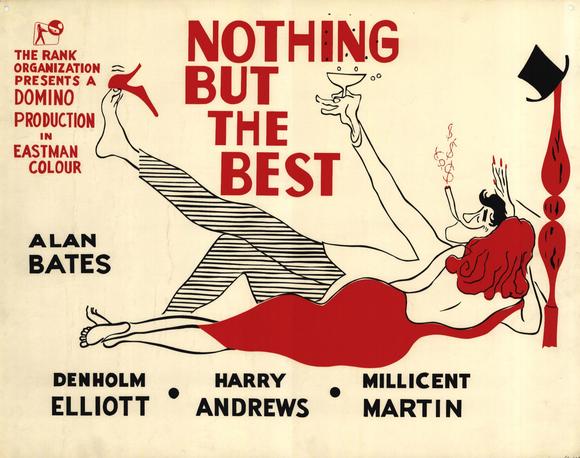
James Brewster (Alan Bates) is a young ambitious man who will do anything to not only climb the corporate ladder, but raise his social standing as well. He works at a large company and finds things tough. Everyone else is competing for the same thing and James finds himself being boxed out and unable to get the attention and recognition he feels he deserves. Then he meets Charles (Denholm Elliot) a master con-man and forger and he realizes the only way to move up is by doing it the criminal way. The two move in together where Charles teaches James all the tricks of the trade. James becomes so good at it that he realizes he no longer needs Charles so he murders him and stuffs his body inside a large trunk, which he has hidden. Then he becomes engaged to the beautiful Ann Horton (Milicent Martin), but her extended family has connections he is not aware of, which could put a kink to his otherwise lofty plans.

The screenplay was written by Frederic Raphael who has had a distinguished career in screenwriting including penning the script to Stanley Kubrick’s last film Eyes Wide Shut. Although there really isn’t any one particularly funny moment and some of the criminal activity is a bit complex and hard-to-follow the dialogue is still snappy and the less than honorable characters surprisingly engaging. Clive Donner’s direction gives the proceedings a breezy pace and the characterizations of the upper British crust are on-target and fun.

Elliot, who is one of the best character actors ever and had a long and distinguished career playing a wide variety of them, is terrific. Somehow this guy has always had an ability to make conniving, immoral people engaging, funny and even somewhat likable and his part here is no exception. His presence is a major plus and helps give the film its drive and it’s a shame he couldn’t have remained through the whole duration. I also enjoyed Pauline Delaney as James’s landlady Mrs. March who becomes aware of his illegal activity and extorts sex out of him in order to keep quiet.

There are a couple of twists at the end that are interesting, but not what you expect. James never really gets the comeuppance that you think he should, which to some degree is disappointing, but on the other hand kind of refreshing. We are so used to seeing films have a moral theme of some kind where bad guys are eventually punished and justice prevails that having one pretty much get away with it is intriguing simply for its novelty.

The color on the print I watched was horribly faded making it look almost like a cheap computer colorized attempt even though it really wasn’t. This film, which was widely hailed by critics and audiences alike, deserves a Criterion release and a thorough restoration and I am shocked that it hasn’t already.

My Rating: 6 out of 10

Released: March 10, 1964

Runtime: 1Hour 39Minutes

Not Rated

Director: Clive Donner

Studio: Royal Films International

Available: None at this time.

The Tiger Makes Out (1967)

tiger makes out 1

By Richard Winters

My Rating: 5 out of 10

4-Word Review: Mailman kidnaps suburban housewife.

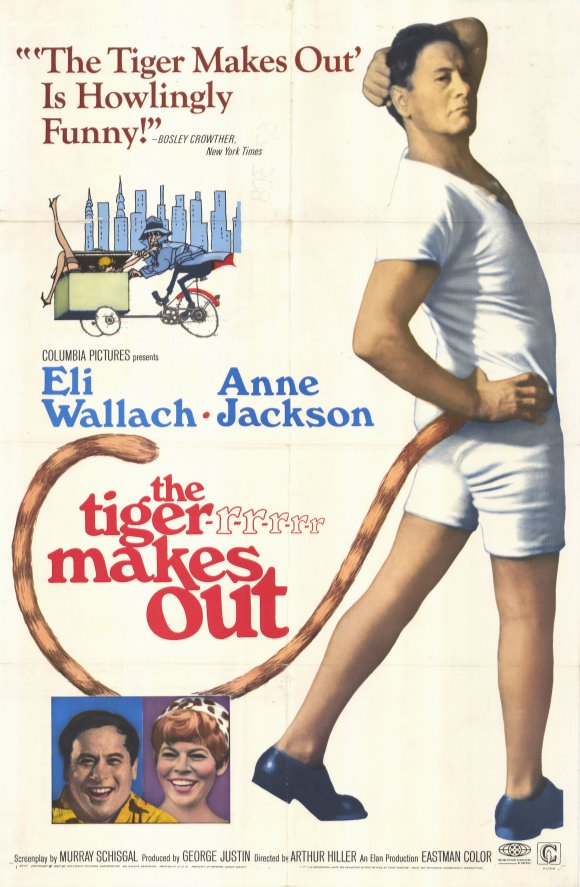
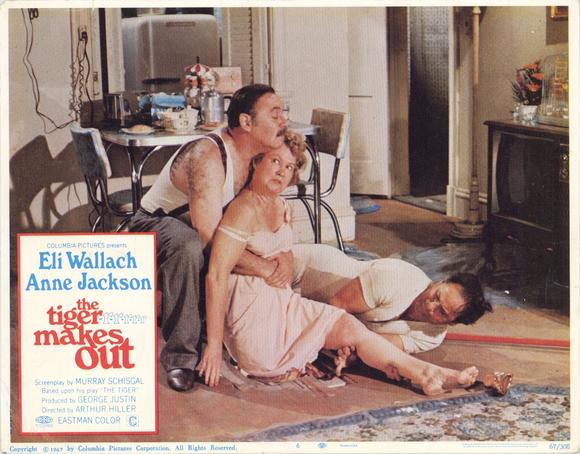
Ben Harris (Eli Wallach) is a middle-aged mailman living in a crummy, rundown basement apartment. He is bitter and angry at the world around him, which he feels is filled with a lot of vapid followers to a rigid and dehumanizing system. When his upstairs neighbor puts a hole in his roof and both his landlord and the housing authority refuse to do anything about it he decides to kidnap a young beautiful women as a form of insurrection. Instead he mistakenly nabs middle-aged housewife Gloria (Anne Jackson) who has similar issues and the two slowly form a budding friendship.

The screenplay is written by Murray Schisgal and is based on his one-act, two-character off-Broadway play ‘The Tiger’. The film is filled with a lot of diverting, offbeat humor some of which works and some of it doesn’t. I liked the part where Gloria’s neighbor Leo (John Harkins) gets his entire family on their knees to pull out crabgrass from their otherwise ‘perfect’ lawn and we eventually see them tear the entire lawn to bits from a bird’s-eye view and in fast-motion. Wallach’s confrontation with Sudie Bond inside the housing authority office is also amusing, but his attempts at kidnapping a woman come off too much like Wiley E. Coyote trying to get the roadrunner and turn the film into an ill-advised live action cartoon.

Director Arthur Hiller does a fabulous job of disguising the fact that this was originally a play. The editing is quick and the locales varied particularly at the beginning. The pace has a kinetic late 60’s feel, which gives it a certain time capsule quality. However the choice of music, which includes a studio group singing the film’s theme, is quite sterile.

Wallach gives a flawless performance and Jackson is also good. The two have been married since 1948 making them Hollywood’s longest lasting couple. Unfortunately the scenes of the two of them inside the apartment are rather stagnant and the one-time that the film gets boring.

There are also some great supporting performances including Rae Allen as a paranoid woman who thinks every man is a potential stalker and Charles Nelson Reilly as a goofy college registrar. The film also marks the film debuts of Dustin Hoffman and Mariclare Costello as his jilted girlfriend, Bob Dishy as an exasperated husband and John P. Ryan as an escort to a female impersonator. You can also spot a young Joe Santo inside the housing authority office and Frances Sternhagen as a passenger on a bus as well as Barbara Colby who in 1975 ended up getting murdered in mysterious and yet unsolved circumstances.

The one error that I noticed in the film is the gaping hole in Ben’s apartment ceiling somehow gets strangely taken care of and is nonexistent when he comes back to the place with his victim. I realize this movie borders on the bizarre and quirky to begin with, but I still felt there needed to be some explanation for that and none is given.

tiger makes out 2

My Rating: 5 out of 10

Released: August 18, 1967

Runtime: 1Hour 34Minutes

Not Rated

Director: Arthur Hiller

Studio: Columbia Pictures

Available: None at this time.

Hail (1973)

hail 2

By Richard Winters

My Rating: 6 out of 10

4-Word Review: The President goes nuts.

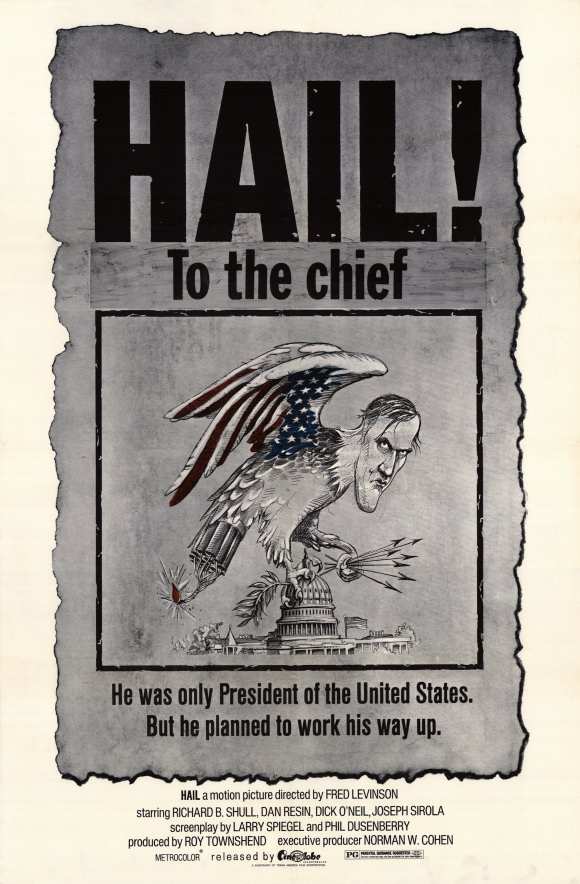
The President of the United States (Dan Resin) is going insane and it has become painfully obvious to all those around him. He wants to suspend congress and elections and has created concentration camps where hippies and other ‘liberal subversives’ are taken and he even drowns mice in buckets of water for relaxation. His staff decides it is up to them to take him out before he puts the country at risk. They hold a gumball lottery and whoever picks the gumball that has the number one on it will be chosen to carry out the assassination. The oldest member of the group who is 90 gets it, but when he chokes on the gumball while chewing it before putting in his dentures it is then up to the Secretary of Health (Richard B. Shull), but the President has spies that have infiltrated the group and is fully aware of what they are trying to do and has a secret plan of his own.

This film is satire the way it should be. It makes fun of both sides and manages to get more hits than misses. It was made in an age before political correctness and wasn’t afraid of who it might offend and thus throws it all out there in a creatively reckless and experimental fashion making it enjoyable all the way through. The pace is breezy and a terrific time capsule to a bygone era.

There are some unique scenes here that you won’t see anywhere else. Some of the highlights include a 4-man ‘hand band’ where a group of men get together to play ‘The Yellow Rose of Texas’ for an audience by cupping their hands together. The scene where the President’s army attacks and beats hippies at a commune that is done in slow motion and to the tune of ‘Amazing Grace’ by Judy Collins is effective and the twist ending involving a wooden leg isn’t bad either.

Director Fred Levinson shows great potential. The variety of camera angles, stylish editing and knowing humor are all first-rate and should have been the start of a great career. Unfortunately the rumor is that Richard Nixon didn’t like the film and considered it a personal insult and used his connections to put pressure on the studios not to distribute it, which eventually led to it falling into complete obscurity. The only other thing that Levinson did afterwards was directing the famous Hertz commercials that featured O.J. Simspson sprinting through an airport terminal, which is a real shame and waste.

Gary Sandy, who later became famous for playing Andy Travis in the classic TV-series ‘WKRP in Cincinnati’ is highly engaging as a radical hippie leader who disguises himself as an army general. Brandon Maggart is also amusing as a nervous National Guard Sergeant.

The only weak link is Resin as the President. He is probably best known for playing the Tidy Bowl man in some TV-commercials during the 70’s. Here his performance is sterile and one-note. Shull and Dick O’Neill come off as much more interesting simply because they are far better actors.

The film is dated, but in a fun way. It brings back to life the chaotic atmosphere of the era and makes you feel like you are being thrown into the middle of it. The film is extremely rare and hard-to-find, but worth a look if you can locate it.

My Rating: 6 out of 10

Alternate Title: Hail to the Chief

Released: July 27, 1973

Runtime: 1Hour 25Minutes

Rated PG

Director: Fred Levinson

Studio: Cine Globe

Available: None at this time.

The Public Eye (1972)

the public eye 1

By Richard Winters

My Rating: 3 out of 10

4-Word Review: He follows her around.

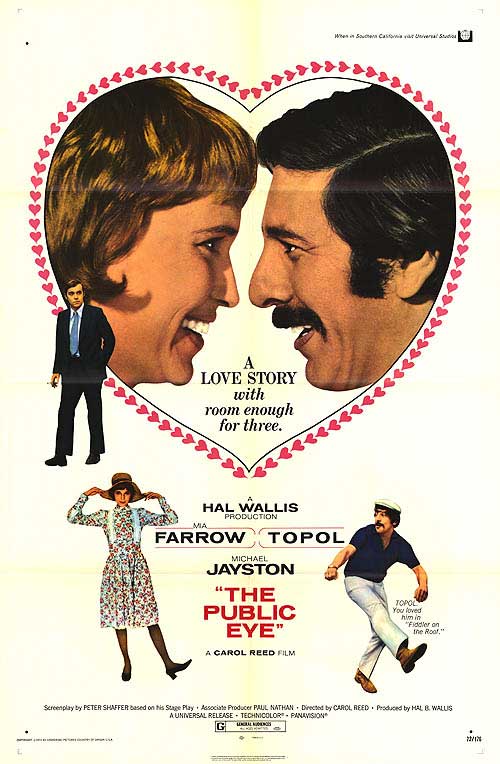
This film, which is based on the Peter Schaffer play, deals with Charles (Michael Jayston) an uptight British accountant who thinks that his wife Belinda (Mia Farrow) is having an affair. He hires Julian (Topol) a goofy private detective to follow her around and see where she is going and what she is doing everyday while he is at work. Unfortunately for Charles Julian starts to fall in love with Belinda as he is following her and she in him, which only further complicates matters since she was initially not seeing anyone and all those trips that Charles thought were so suspicious were simply innocent excursions.

The biggest problem with this film is that it is too lightweight probably more so than even other lightweight films. Nothing really happens. Julian just follows Belinda around much to her amusement, but the two don’t share any dialogue nor ever consummate their pseudo-relationship. The film simply spends long drawn out sequences showing the two following each other throughout the streets of London and occasionally giggling at their ‘little game’ and that is about it. You keep waiting for that second act to kick in, but it never does, which after 95 minutes starts to make the whole thing almost pointless.

Topol is miscast in the lead and ends up being the film’s weakest link when he should have been the strongest. He was fresh off his award winning performance in Fiddler on the Roof and this movie was supposed to make him into a leading man, but the attempts at turning him into a variation of Inspector Clouseau fail badly. His bright white suit that he wears looks garish and ridiculous especially for an undercover spy. Watching him constantly stuffing his face with food starts to get obnoxious and his buffoonery becomes more annoying than engaging.

Farrow is appealing and her natural child-like fragility is perfect for the part. The scene where she states to the shock of an upper-crust crowd at a formal dinner party that rapists should be punished by having their ‘thing’ cut off publicly is amusingly edging and the film would have been better had it gone a little more in this route.

Jayston is the one that comes off best. He plays the proper British gentlemen with all his staid mannerisms perfectly. What I really like though about him is the fact that he does love Belinda, but just doesn’t know how to show it effectively.

This was an odd project for legendary director Sir Carol Reed whose final film this was. The story doesn’t allow for much visuals although the way Reed captures London both from aerial shots as well as the downtown streets that Belinda visits is excellent. The movie almost seems to work as a tour guide of London, which in some ways is the best thing that can be said about the film.

My Rating: 3 out of 10

Alternate Title: Follow Me

Released: July 18, 1972

Runtime: 1Hour 35Minutes

Rated G

Director: Carol Reed

Studio: Universal

Available: Netflix streaming

Middle Age Crazy (1980)

middle age crazy

By Richard Winters

My Rating: 5 out of 10

4-Word Review: Not Ready for 40.

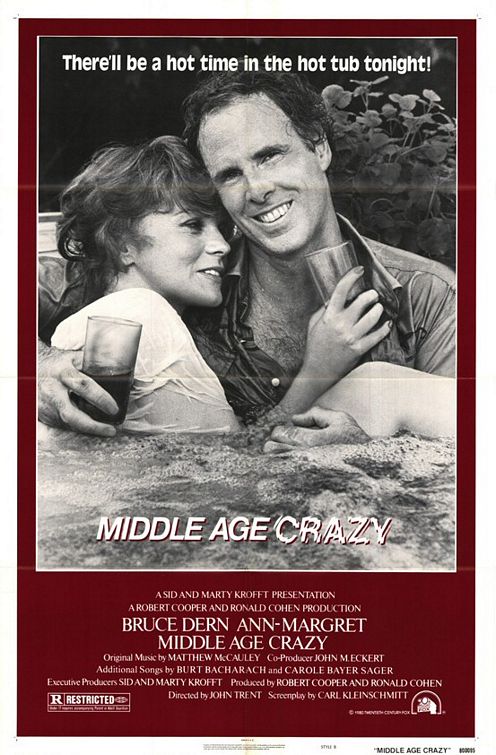
Bobby Lee (Bruce Dern) is a Texas businessman who builds taco stands for a living. Although he is genuinely happy with his life he finds his job boring and dealing with the demanding clients to be frustrating. He loves his wife Sue Ann (Ann-Margret), but her constant smothering him with love makes him feel suffocated. Turning 40 becomes a major milestone and one he wishes would go away. To compensate he starts to act erratically by buying himself an expensive sports car, telling off his obnoxious clients and even having an affair with a much younger woman, but it all makes him feel empty and just as lost and confused.

Having turned the wrong side of 40 myself now several years back I can vouch for what this character is feeling and some of the points it makes are certainly relatable to anyone the same age especially males. The first half of the movie is the best as it has several dream-like segments where the character fantasizes about seeing himself in different situations. The one where he sees himself presiding over his own funeral is amusing, but the best one is where he imagines having sex with his college-aged son’s girlfriend in the backseat of a car while the tune ‘Good Girls Don’t’ by the Knack plays on the radio.

The dialogue is equally funny with some politically incorrect lines that really hit-the-mark with the strongest one coming during a commencement speech that he imagines giving to a graduating class of high school seniors. It was so good I felt obligated to print a slightly condensed version of it here:

“Every year thousands of you kids put on these silly, fucking hats to hear some other kid in a silly, fucking hat tell you that you are the future, but there is not enough future to go around. If you want to know your real future look at your folks in the stands. Fat butts and sagging tits that’s your future. If you had any sense you would give back your diplomas and silly hats and stay 18 the rest of your lives. You don’t want the future because the future sucks!”

The acting is a real grab bag. Graham Jarvis a balding actor best known for playing uptight characters scores here as Bobby’s foul mouthed over-sexed friend J.D. Dern who is almost always engaging especially in bad guy roles seems too restrained and even boring. Ann-Margret is much too clingy as the wife and would probably drive any man away and Michael Kane’s caricature of an obnoxious Texas businessman is irritatingly clichéd.

The film veers into heavy-handed drama during the second half and ultimately limps along to a flat finale. Had the film stayed with the lighthearted, quirky tone that it had at the beginning it might have worked, but instead comes off as rather amateurish and disjointed.

The film is based on a Jerry Lee Lewis song and has a hard time taking a basic idea, which is what a song really is and trying to turn it into feature length material. It is also interesting to note that despite being filmed on-location in Texas the movie was financed by a Canadian production company, which technically makes it a foreign film.

My Rating: 5 out of 10

Released: July 25, 1980

Runtime: 1Hour 37Minutes

Rated R

Director: John Trent

Studio: 20th Century Fox

Available: VHS

Nasty Habits (1977)

nasty habits 2

By Richard Winters

My Rating: 2 out of 10

4-Word Review: Watergate in a convent.

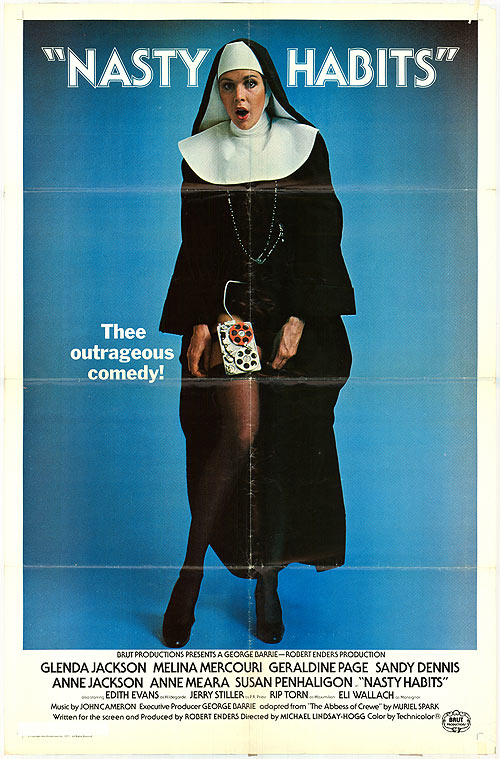
It’s the Watergate scenario all over again only this time inside a convent with nuns. It’s a unique idea for sure that unfortunately doesn’t work because the screenplay by Robert Enders, which is based on the novel by Muriel Sparks keys in on only one angle and then plays it out until it’s boring. It’s a one-joke movie with nothing standing out as funny. There is also no action to speak of and the dialogue is too dry to elicit even a chuckle.

The once in a lifetime cast is wasted. Dame Edith Evans, in her last film appearance, gets hit the worst as she is given the typical old lady treatment and shown for only a few minutes looking feeble and then promptly dying. Jerry Stiller, Anne Meara, Rip Torn, and Eli Wallach are on so briefly that their appearances seem almost non-existent.

Glenda Jackson comes off best as she manages to give her character an added dimension. The forcefulness of her personality comes through quite clearly for the viewer. However her adversary, which is played by Sue Penhaligon, doesn’t have that same type of strong presence and therefore there is no chemistry or confrontation between the two.

Even the always reliable Sandy Dennis becomes a problem. They have her playing a sort of extended version of her tipsy persona from Who’s Afraid of Virginia Woolf?, but her off- key voice and overall kooky behavior gets overplayed and eventually becomes annoying.

The electronic music score by John Cameron is obtrusive. The pacing is terrible and the lack of momentum will have people turning this off long before it is over, which is good since the climactic sequence falls horribly flat.

There are a few surprise cameos. One is by the late newscaster Jessica Savitch another by former talk show host Mike Douglas, but nothing that helps make this entertaining or memorable.

My Rating: 2 out of 10

Released: March 18, 1977

Runtime: 1Hour 36Minutes

Rated PG

Studio: Brut Productions

Director: Michael Lindsay-Hogg

Studio: Brut Productions

Available: VHS