Category Archives: Obscure Movies

The Ragman’s Daughter (1972)

the ragmans daughter

By Richard Winters

My Rating: 5 out of 10

4-Word Review: Reminiscing about old times.

Tony, who is a middle-aged man (Patrick O’Connell) working a boring job at a cheese factory and stuck in an equally dull marriage with two kids, reminisces about his younger years when he met a beautiful woman named Doris (Victoria Tennant) and they committed petty thievery while also riding around on his motorbike. The film then intercuts between scenes of him when he’s younger, which is played by Simon Rouse in his film debut, and his life now where he struggles to make ends meet.

This film marks the directorial debut of Harold Becker as well as the acting debut of the lovely Tennant. It also marked the last of the British ‘kitchen-sink’ dramas that focused on the hardships and struggles of the working class. The story is a strange mix of gritty reality and romantic fantasy that has a few good moments, but as a whole doesn’t really work and if there is one thing that holds it all together its Kenny Clayton’s soothing and distinctive melodic score.

Part of the problem is that not enough happens. Tony is able to break into shops with too much ease and the way he is able to crack open a safe in less than a minute would make even a professional safe cracker jealous. Their robberies needed to have a little more tension or comedy to help keep it interesting instead of sliding into a pace that meanders so leisurely that it eventually becomes boring.

Tennant’s character is another issue. She is incredibly gorgeous and looks ripe for a magazine cover as a fashion model, which made me wonder why she would so quickly fall head-over-heels for Tony who has no money or job and is average looking at best. To some degree I could understand her need to break free from her oppressive and strict parents, but a beautiful woman like that would have many other potential suitors in her life and not simply dependent on Tony as being her only outlet.

Spoiler Alert!

The final twenty-minutes improves as Tony ends up getting caught and going to jail, which helps add some genuine drama. However, when he finally gets out he learns that Doris died tragically in a motorbike accident, which seemed unnecessarily severe. A much better ending would’ve had them reuniting for just one day and although now married to other people still managing to share some sort of special bond.

End of Spoiler Alert!

The film, which had a very limited release, has some potential, but suffers from a visual approach that at times looks too much like a shampoo commercial and a premise that doesn’t have enough action elements to keep it compelling.

My Rating: 5 out of 10

Released: November 11, 1972

Runtime: 1Hour 34Minutes

Not Rated

Director: Harold Becker

Studio: 20th Century Fox

Available: DVD (Through Netflix)
Tag: The Assassination Game (1982)

tag 1

By Richard Winters

My Rating: 6 out of 10

4-Word Review: Playing with dart guns.

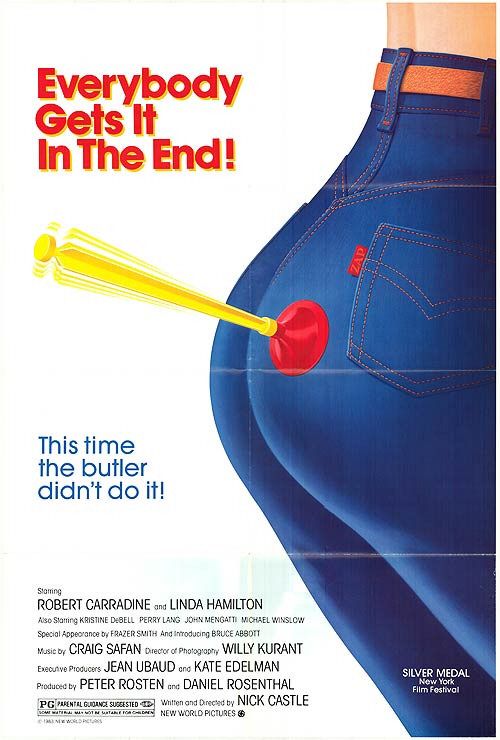
A new fad has caught on at a nondescript college campus where students play an assassination game by killing off other students with dart guns. The one who assassinates the most while still surviving wins. Alex (Robert Carradine) who writes for the school newspaper decides to do an expose on the game in an attempt to better get to know its star player Susan (Linda Hamilton). Unfortunately for them the game’s 5-time champion Gersch (Bruce Abbott) has gone over to the dark side and now using real bullets in his gun. As the game whittles down to just Susan and Gersch the tension mounts for her to catch on to his murderous plans before it is too late.

For a low budget film with only the most modest of settings this thing isn’t too bad. The dialogue is snappy and the story proceeds at a good pace. The opening credits, which is a parody of the ones done on James Bond films is cute and it’s great to see Linda in her official film debut playing the same type of strong-willed female that brought to greater prominence in The Terminator franchise. Carradine is good too as her awkward suitor and the fact that this film plays against sexual stereotypes by having the male in more of a passive role is refreshing.

The film’s playful parody and the way the players take this silly game so very seriously is funny and having the second half shift to more of the conventional ‘psycho-on-the-loose’ plot made it less original and more formulaic. I understood why Gersch kills the first player using a real bullet, but was confused why he would keep on killing them and not go back to just using darts. He could’ve still retained his champion title and passed off the first killing as being possibly just an accident, but by continuing to kill people and harboring their corpses in the closet of his room was clearly going to lead to an eventual long jail sentence that even the craziest of persons could see coming. It also might have been more interesting had the identity of who was using real bullets was kept a mystery until the end.

Even with these drawbacks I still found myself entertained and the film has strong cult potential for fans of low budget 80’s flicks. It’s also interesting to note that Hamilton and Abbott, who first met while filming this, later ended up getting married and having one child.

My Rating: 6 out of 10

Released: April 20, 1982

Runtime: 1Hour 30Minutes

Rated PG

Director: Nick Castle

Studio: New World Pictures

Available: VHS

The Driver’s Seat (1974)

drivers seat 1

By Richard Winters

My Rating: 3 out of 10

4-Word Review: Crazy lady goes traveling.

Lise (Elizabeth Taylor) is a middle-aged woman with seemingly no past who travels to Rome looking for someone to kill her. Her erratic behavior and weird motivations confuse those that she comes into contact with. She then meets Bill (Ian Bannen) a man who’s more interested in her sexually than anything else and he follows her around in a veiled attempt to get ‘lucky’ despite her repeated rebuffs.

The film is basically a mess that goes nowhere. It was based on a novel by Muriel Spark, who had written some acclaimed stuff in her day including ‘The Prime of Miss Jean Brodie’, so I can only imagine that the book made more sense and only bits and pieces of it were taken to create this screenplay. In either case it was a highly strange career move for Miss Taylor who made a lot of weird movie choices in the 70’s, which helped to destroy her once megastar status and tainted her other stellar work.

Her performance by itself isn’t too bad and it’s the one thing that helps keep things watchable. The way that she can go from being passive and helpless to snippy and bitchy within seconds is kind of fun and on a purely camp level even enjoyable. The whole thing seems almost like an extension of the character that she played in Who’s Afraid of Virginia Woolf? , which became her signature role during her later years.

Bannen lends good support as his leering Cheshire cat grin is a perfect counterpart to Taylor’s crazed glare and he effectively equals her nuttiness. I also loved his so-called macrobiotic diet in which he must attain one orgasm a day for it to work and if he misses one then he must make up for it by having two the next day, which ultimately gives him ‘indigestion’. Mona Washbourne a character actress noted for playing delightfully daffy old ladies is also on hand as one of the people Taylor befriends and their encounter inside the stall of a public bathroom is a gem.

Director Giuseppe Patroni Griffi manages to infuse some interesting visuals, which along with its fragmented narrative helps keep things cheaply alluring, but it eventually plays itself out and by the end becomes quite tiring and tedious. The biggest issue is that there never is any explanation for who this woman is or why she’s doing this, which makes the whole thing quite empty and pointless.

My Rating: 3 out of 10

Released: May 20, 1974

Runtime: 1Hour 42Minutes

Rated R

Director: Giuseppe Patroni Griffi

Studio: AVCO Embassy Pictures

Available: DVD-R, Amazon Instant Video

Paternity (1981)

paternity

By Richard Winters

My Rating: 1 out of 10

4-Word Review: Bachelor wants a son.

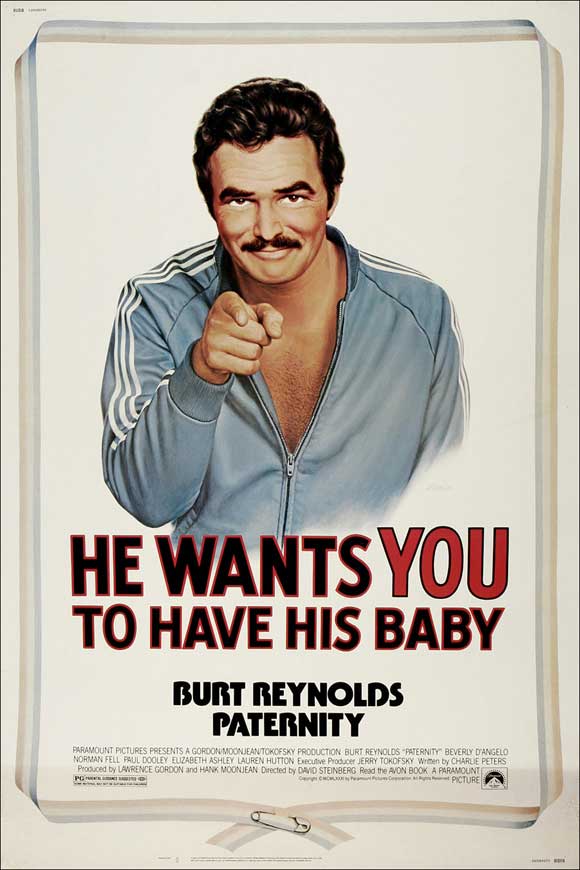
Despite managing Madison Square Garden, having lots of money and good looks Buddy Evans (Burt Reynolds) is still single at 44. He is happy with his bachelorhood, but still longs for a having a son. He comes up with the idea of paying a woman to have his child while treating it solely as a business proposition without any romance or relationship attached to it, after interviewing several ‘candidates’ he finally settles on Maggie (Beverly D’Angelo) a waitress who can use the money to further her education. Things are expectedly awkward at first, but as the process continues Maggie finds herself falling in love with him and trying to turn it into a relationship despite his reluctance.

Reynolds is a dynamic star with an engaging onscreen presence particularly in comedies, but his appearance here hurts the picture more than it helps it. For one thing it doesn’t make sense why this great looking guy with tons of cash can’t find a woman. And just why is he so reluctant to get into a committed relationship? What about this character’s background makes him the way he is? It never gets explained, but would’ve helped give the film more depth had it been. A better concept would’ve been portraying the character as being a rich guy who is also short, fat, bald and lacking in the romantic graces, but woman still tolerate because of his money, which would’ve ultimately made this more realistic, edgier and funnier.

I really liked D’Angelo and considered this her best performance, but having her fall in love with the guy and turning this into just another formulaic, sterile romantic comedy was a ridiculous stupid idea and makes it almost excruciating to watch. The guy spends the whole time acting like he owns her by telling her what to eat and do while being outrageously ambivalent to her feelings or needs. Any woman that would fall in love with a guy that her treats that way should see a psychiatrist and get some self-respect.

Comedian David Steinberg makes his directorial debut here and I liked the way he begins the film by having pictures of baby’s faces lining the screen during the credits all to the sound of them cooing and crying. He also pays loving tribute to his adopted city of New York by having some fabulous shots of the skyline and some scenic moments in Central Park that accentuate the fall foliage. In fact it is for these two reasons only that I generously give this thing a measly 1-point.

My Rating: 1 out of 10

Released: October 2, 1981

Runtime: 1Hour 34Minutes

Rated PG

Director: David Steinberg

Studio: Paramount

Available: VHS

Welcome Home, Soldier Boys (1971)

welcome home soldier boys

By Richard Winters

My Rating: 5 out of 10

4-Word Review: War veterans destroy town.

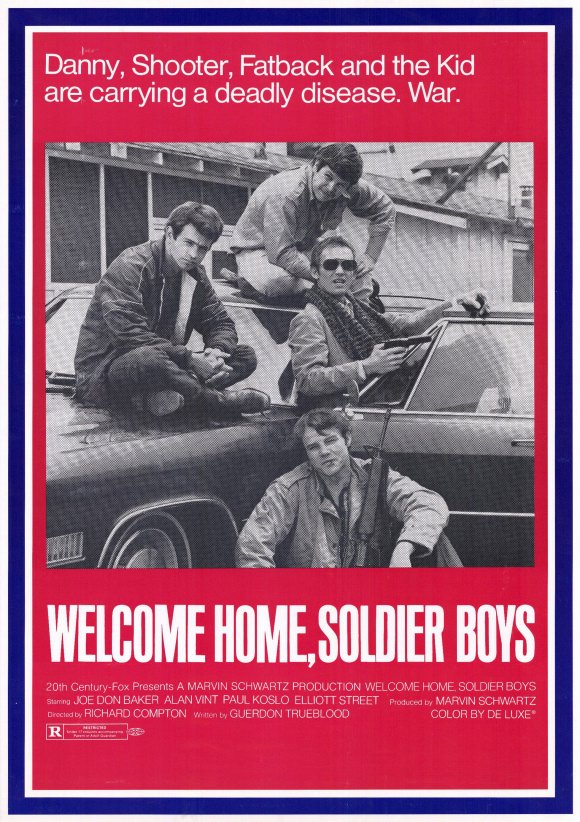
Four Green Berets (Joe Don Baker, Allan Vint, Elliot Street, Paul Koslo) return home from a stint in Vietnam. Initially they stop off at the home of one of the men’s parents, but find that none of them are ready to settle down, get a job, and play ‘within-the-rules’, so they set out on a cross country road trip, but when their car breaks down they end up paying more than they should for the repairs by an unscrupulous mechanic (Timothy Scott). This along with dealing with a society that does not seem to appreciate what they did for their country gets them angry. When they arrive in a small town ironically called Hope their simmering frustrations boil over. Using their army ammunition they go on a rampage destroying the town and everyone in it causing the National Guard to come in to try and stop them and creating for them a war zone all over again.

For a low budget 70’s flick this isn’t too bad. Richard Compton’s direction is slick, nicely photographed and paced well enough to retain a passing interest. The music, which features songs written and sung by actress/singer Ronee Blakely is okay and to a degree fits the mood. The script by Gordon Trueblood has believable dialogue and doesn’t seem intent on being purely exploitive.

Unfortunately the film fails to show much insight into the personality or experience of being a veteran. No flashbacks or discussions about it. In many ways these characters could simply have been regular, non-descript young men from any background who were not yet ready to enter into the adult world and take on adult responsibilities, which in the end is what makes this whole thing rather generic and its ‘statement’ more self-important than it really is.

Baker does quite well in the lead and although he sometimes gets a bad rap for his acting I’ve come to feel that it is unfair. The way his character here is so diametrically opposite from the one that he played in Walking Tall just two years later proves without a doubt that he is a talented thespian if given the right material.

Jennifer Billingsley though is wasted in a thankless role as a prostitute who rides with them for a little ways before getting thrown out of the vehicle at high speeds. Leonard Maltin incorrectly states in his book that her character is gang raped, which isn’t too true. She has consensual sex with one of the men, but then gets kicked out when she demands $500 for her services instead of $100 that they were willing to pay her.

The violent, climatic ending is the film’s most notorious claim to fame, but it takes too long to get there, lasts for only a couple of minutes and then ends too abruptly. It’s also absurd and outrageous to believe that these men would end up killing innocent people simply as a way to vent their anger at being cheated by a car mechanic. After all if everyone responded the same way when a car mechanic overcharged them then there would be no small towns left anywhere.

My Rating: 5 out of 10

Released: December 10, 1971

Runtime: 1Hour 30Minutes

Rated R

Director: Richard Compton

Studio: 20th Century Fox

Available: DVD-R (20th Century Fox Cinema Archives)

Some of My Best Friends Are… (1971)

some of my best friends are 2

By Richard Winters

My Rating: 3 out of 10

4-Word Review: Patronizing a gay bar.

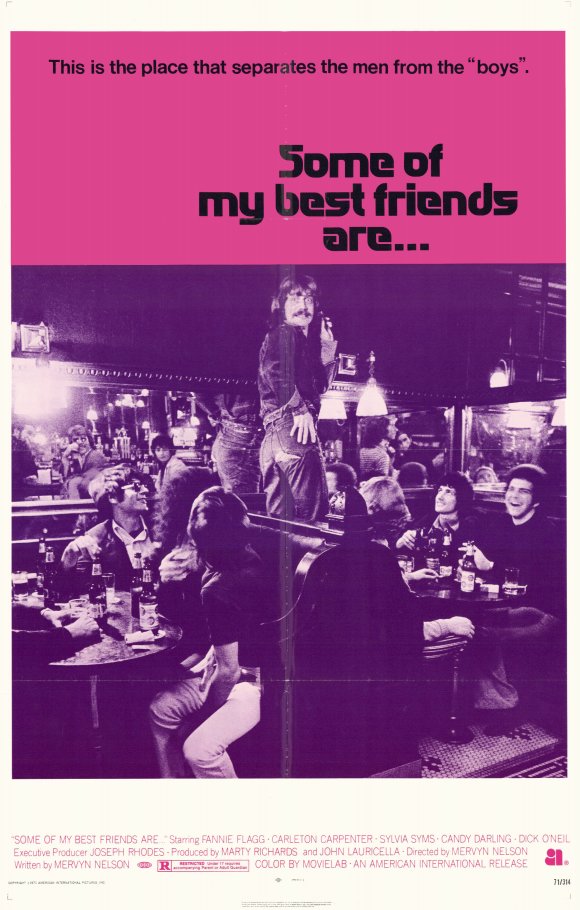
It’s Christmas Eve 1970 and a year and a half after the Stonewall Riots that first brought gay rights issues into the national spotlight. However, the patrons of the local Blue Jay Bar are still feeling like second class citizens where dancing between two men is prohibited and those who have come out about their homosexuality are being rejected by their family and friends.

The film certainly does bring up some great issues, but unfortunately pales badly when compared to The Boys in the Band that came out just a year earlier. The direction lacks style and the dialogue is too generic to be riveting. The film also has no momentum as the camera simply cuts from one group of conversing people to another. The on-location shooting done at the Zodiac Bar gives the production a static, claustrophobic feeling since almost the entire thing takes place in one building. The lighting is also dark and shadowy and at certain points even out-of-focus making it all seem quite amateurish.

The action is minimal in what is otherwise a very talky 110 minute runtime. The best moment is when Gary Sandy, who’s excellent in his film debut, and playing a man in denial about his homosexuality becomes enraged when he finds that the woman he has been dancing with (played by Candy Darling who is also excellent) is actually a man, which causes him to drag her into the bathroom and beat her that in turn creates a huge riot that is genuinely tense and startling. The scene where a mother enters the bar and openly disavows her son after finding out that he is gay is also quite good, but should’ve been extended.

Fannie Flagg gets kudos for her highly engaging performance as a snarky lady who never seems at a loss for words or verbal comeback. The way she dances by giggling her large breasts up and done like they are rubber balls is a crazy sight. Rue McClanahan is also good as a bitchy, aging blonde and so is Dick O’Neill as a conservative old-timer who shows great disdain for the ‘pansy pad’ once he finds out that it is a gay bar, but then strangely is still reluctant to leave it. This also marks the film debut of Gil Gerard who appears briefly in a small role.

The film’s few good moments and overall impactful message are badly outweighed by Mervyn Nelson’s dull direction as well as its rambling narrative that lacks a central character and makes for a flat and tedious viewing experience.

some of my best friends are 1

My Rating: 3 out of 10

Released: October 27, 1971

Runtime: 1Hour 50Minutes

Rated R

Director: Mervyn Nelson

Studio: American International Pictures

Available: Amazon Instant Video

The Catamount Killing (1974)

catamount killing 2

By Richard Winters

My Rating: 3 out of 10

4-Word Review: They’re wracked with guilt.

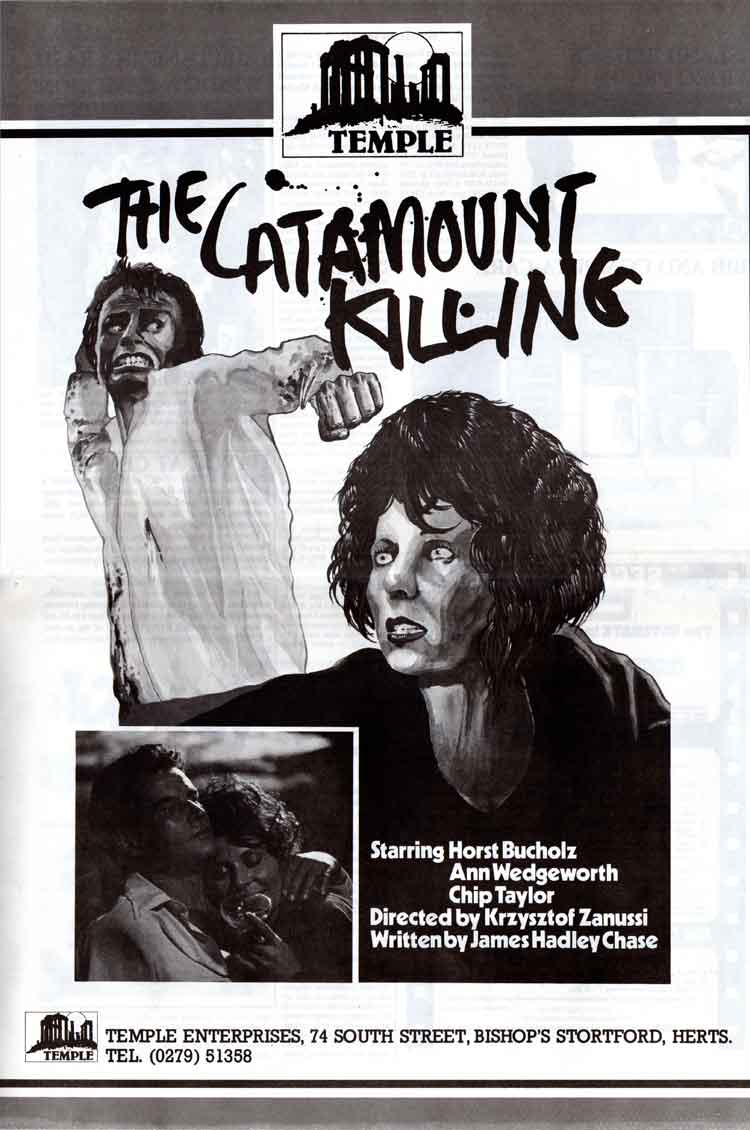
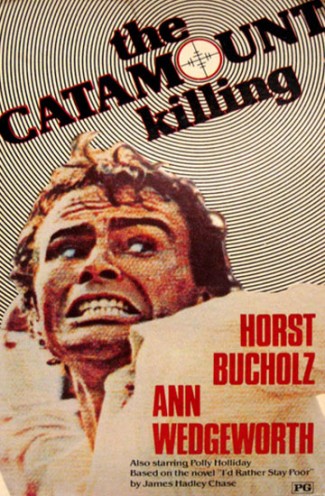
Mark (Horst Buchholz) is a recent divorcee who has moved to a small town and gotten a job as the new bank manager. The bank is small and not adequately guarded giving him the idea to pull off a robbery as an inside job. He seduces the emotionally fragile Kit (Ann Wedgeworth) into helping him with his plan. Initially things go smoothly, but then they begin feeling guilty over what they’ve done especially since the robbery involved the death of someone else. Then Kit’s daughter Iris (Louise Caire Clark) becomes suspicious that her mother might’ve been involved, which causes the couple to unravel in dramatic fashion.

I hate to use the fact that this is a low budget film as a reason for why it’s poor as not every movie has to have state-of-the-art special effects to be entertaining and good story telling and competent direction are still the foundation of a good movie and that can be accomplished on the most miniscule of budgets. However, this film, which was filmed on location in Bennigton, Vermont, looks cheap and stale. The camera work is unimaginative and it does not take advantage of some of the historical landmarks in the town where it was filmed making the background and setting look blah and uninteresting. Its loud, crashing orchestral music score would be better suited for a Hollywood epic and is pretentious and out-of-place here.

The set-up moves too fast and could’ve been the result of watching the American version, which is 11 minutes shorter than the European one. Either way it’s poorly constructed with the two falling in love and plotting the crime without much background information given about them making it all seem forced and rushed. The robbery itself isn’t unique and when compared to other bank robbery movies this one is weak and forgettable.

Buchholz gives a strong performance, which helps the limp material to some degree. Wedgeworth is outstanding. Somehow her soap opera-styled histrionics and Texas accent is something I’ve always found appealing and makes for a fun performance. This also mark the film debut of Polly Holliday who appears briefly sporting a foreign accent that does not sound too believable.

There are enough twists to keep it plausible and mildly engrossing, but the ending lacks impact and like the rest of the movie falls flat. The plot is based off the novel ‘I’d Rather Stay Poor’ by James Hadley Chase, which I suspect would be a far superior version to this.

catamout killing 1

My Rating: 3 out of 10

Released: August 11, 1974

Runtime: 1Hour 22Minutes (American Version)

Rated PG

Director: Krzysztof Zanussi

Studio: Starlight

Available: VHS, DVD-R, Amazon Instant Video

Mr. Sycamore (1975)

mr sycamore 1

By Richard Winters

My Rating: 4 out of 10

4-Word Review: Mailman becomes a tree.

Bored with his job as a mailman and unhappy in his marriage John Gwilt (Jason Robards) decides one day to turn himself into an oak tree. He digs a hole in his backyard and ‘plants’ himself into it where he stands there day and night waiting to become a tree while his wife Jane (Sandy Dennis) tries desperately to talk him out of it, his neighbor Fred (Robert Easton) laughs at him and his minister (Mark Miller) tries to have him committed.

The film, which is based on a 1942 Broadway play, has a certain whimsical tone to it that might be pleasing to some if in the right mood and there is a certain strange intrigue at wondering just how this thing will end and whether he will eventually turn into a tree or not. However, the material would be better suited as a film short and the offbeat quality gets lost in a script that deals solely with a long parade of people who come into contact with John and their predictably shocked and confused responses when finding out what he is trying to do. The low budget is also an issue and outside of showing the inner-workings of a mail processing machine at the beginning there is no visual style at all.

Robards is a natural for the part, but he had already played a nonconformist looking to drop out of society earlier in the film and stage play A Thousand Clowns making his appearance here seem almost like typecasting. Jean Simmons gets wasted in a small bit as John’s secret love interest. Dennis, who usually plays kooky characters, becomes the most rational one here, which ultimately is the film’s weirdest element.

This definite curio does have a few amusing moments, but it lacks a second act or interesting side story and eventually talks its strange concept to death until it becomes boring.

My Rating: 4 out of 10

Released: December 12, 1975

Runtime: 1Hour 28Minutes

Rated G

Director: Pancho Kohner

Studio: Film Ventures International

Available: VHS

Gentle Savage (1973)

gentle savage 2

By Richard Winters

My Rating: 3 out of 10

4-Word Review: Indian accused of rape.

Camper John (William Smith) is an Indian living in a small town who gets accused of raping a white girl (Betty Ann Carr) by Ken (Kevin Hagen) her stepfather even though it was actually Ken who did it. The hidden prejudices of the predominantly white folks come to light against the nearby Indian community. Both sides take up arms and become intent on crushing the other causing hysteria and violent outbreaks while Camper John tries hiding out until it blows over.

If there is anything distinctive about this otherwise formulaic and predictable low budget drama is the fact that it paints vigilantism as more of a problem than a solution even if the one side feels completely justified, which I found to be a refreshing and more realistic take on the issue especially as the Indian group becomes as vindictive, violent and hateful as the people they are trying to fight. However, it would’ve been nice had there been at least one white person who wasn’t portrayed as being completely narrow-minded and bigoted, which in a lot of ways comes off as reverse racism by the filmmakers.

The music is loud and overly dramatic, which gives the proceedings a very heavy-handed feel. In a lot of ways it comes off as a poor man’s Billy Jack, which was already pretty amateurish and one-dimensional to begin with although still far better than this thing. The 75 minute version that I viewed had an abrupt ending that seemed incomplete and failed to tie up many loose ends, but I wasn’t complaining as even with the abbreviated runtime it was still highly protracted, overblown and tedious with the scene of a water tower tank exploding and dousing everyone on the street with tons of water being the only slightly diverting moment.

Smith is intense in the lead, but he should’ve been given more dialogue especially at the beginning as the viewer barely gets to know or understand him before being jettisoned into his quandary. Character actor R. G. Armstrong who normally plays menacing characters is quite wimpish here as a bartender who gets held down and forced to swallow drink after drink when he tries closing down the bar before the patrons were ready. Hagen is competent as the bad guy, but casting Gene Evans and Joe Flynn as a bumbling sheriff and deputy in an attempt at misguided ‘comic relief’ in the Last House on the Left-type vein was a big mistake. One scene even has them handcuffed together wearing nothing but their underpants while forced to walk across the desert, but it all adds little and takes away from the tension, which is the only time that this flat film ever becomes mildly diverting.

My Rating: 3 out of 10

Alternate Title: Camper John

Released: March 7, 1973

Runtime: 1Hour 25Minutes (Full Version)

Rated R

Director: Sean MacGregor

Studio: Cinemation Industries

Available: None at this time.

Static (1985)

static 1


By Richard Winters

My Rating: 5 out of 10

4-Word Review: Everybody sees only static.

Ernie Blick (Keith Gordon) works at a crucifix factory, but dreams of making it big with his secret invention. The whole town that he lives in is abuzz about it and many take bets as to what it is. However, once Ernie unveils it no one is impressed. Ernie insists that he has created a device that can show live images of heaven, but all anyone else can see on the TV screen is static. Ernie becomes frustrated that no one can appreciate what he has done so he hijacks a bus carrying a group of senior citizens in order to create a media event that will allow him to share his invention with the rest of the world, but things don’t go as planned.

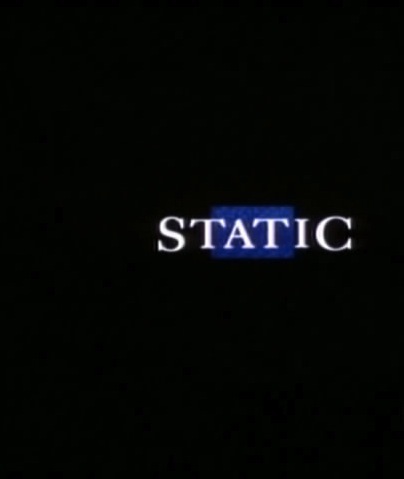
The film has that refreshing look and feel of an authentic indie flick made long before it was trendy and still in its infancy of being a trailblazer for original ideas. It’s fun and clever most of the way including a memorable shot of Ernie’s weird crucifix collection. The humor is subtle and hip with a cool music selection from lesser known 80’s bands. Director Mark Romanek shows great visual flair with his use of unique settings and color designs. The dialogue and characters are both engaging and quirky. I also loved the opening credits, which features a small, static filled TV screen in the distant background along with the sound of a low hum, which I found to be strangely hypnotic.

Gordon, who co-wrote the screenplay, does well in a difficult role where the viewer is supposed to find him likable and appealing despite the fact that he is clearly a bit unhinged. Amanda Plummer as his girlfriend gets a rare turn as being the most normal one in the film, which is interesting. Bob Gunton has a few choice moments as a conniving preacher man named Frank and Jane Hoffman is amusing as a senior citizen who tries to help Ernie on his mission.

Unfortunately the story doesn’t carry the quirky idea to a successful completion. It might have worked better had there been some image of some kind seen and then everyone could’ve debated whether that was indeed heaven or not instead of just seeing static, which comes off like a big buildup to nothing. The satire is too obvious and its overall message frustratingly vague. The violent and completely unexpected tragic ending is jarring and unnecessary and ruins its otherwise pleasant, whimsical tone.

There is also a scene where Gordon and Plummer go to a restaurant and order food, but when it gets served they barely touch it and then a minute later get up and leave after paying the bill, but why pay for something or even order if you’re just going to leave it there untouched? This is an annoying thing that I’ve seen happen in other films as well. I hate to sound preachy, but sometimes when I see these types of scenes I feel like screaming ‘There’s kids starving in Africa, so don’t waste your food people’!

static 2

My Rating: 5 out of 10

Released: October 1, 1985

Runtime: 1Hour 33Minutes

Rated R

Director: Mark Romanek

Studio: Siren

Available: VHS