Category Archives: Obscure Movies

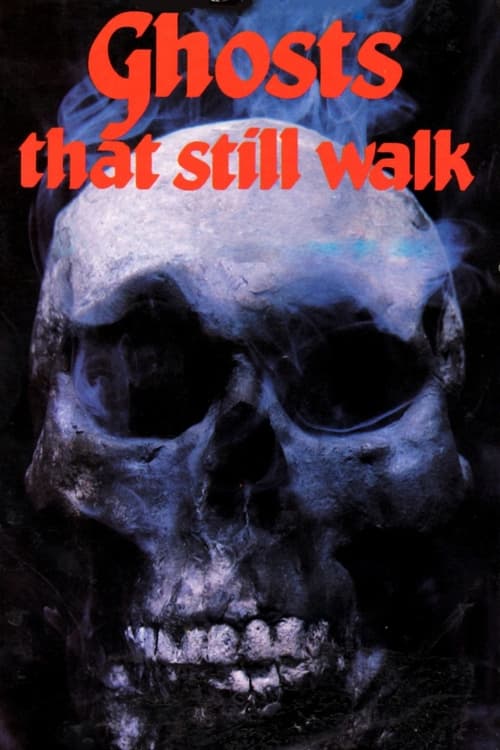
Ghosts That Still Walk (1977)

ghosts

By Richard Winters

My Rating: 3 out of 10

4-Word Review: Teen possessed by ghost.

Mark (Matthew Boston) is the 15-year-old son of Ruth (Caroline Howe) who is a researcher that specializes in astral projection. She goes out one day to an abandoned cave and brings home the decayed corpse of an ancient Indian Medicine Man and attempts to speak to the ghostly spirit that she feels is still inside it. Mark catches her talking to it when he comes home early from school and this sight spooks him enough that he runs away. When he eventually does return he begins to behave erratically and his concerned grandmother (Ann Nelson) sends him to a psychiatrist (Rita Crafts) who tries to get to the bottom of the matter.

This film, while not very good, is unique in several ways in that it’s one of the few horror movies that could be watched by the entire family. The mild frights are in the supernatural vein that may spook a child, who I believe was the intended audience, slightly, but won’t traumatize. This is also a rare horror film that features no blood, no gore, no nudity or swearing, and no psychos, or monsters. It also has virtually all of the scenes taking place outside in the bright sunlight versus doing them in the dark of night like with most scary movies. This marks as well the film debut of Ann Nelson, an elderly actress who went on to play a lot of old lady roles in TV-shows and movies during the 80’s and here as a hyper-anxious, deeply religious grandma is entertaining and helps give the film a few more points.

Reviewers on IMDb all seem to remember one specific scene that stands-out that stood out to them, which is the moment where boulders roll across the flat desert terrain by a invisible force, which is indeed a cool visual. However, I didn’t like the way they would conveniently bounce-up and avoid the camper that the old couple are driving in versus having one of the boulders come directly towards the camera and crash into the windshield, which would’ve been effectively dramatic.

Other scare segments don’t work as well. The scene where the camper begins driving itself goes on too long and isn’t as intense as it could’ve been as it’s done on a deserted highway and would’ve been more exciting had we seen the vehicle going into oncoming traffic. Cutting back-and-forth to the grandma getting bounced around on the interior walls as it drives crazily elicits unintended laughs instead of tension.

It’s also confusing as to who the main character is supposed to be. It starts out with the kid, who’s likable enough, but then he goes away for a long period and we get stuck exclusively with the elderly couple in a flashback bit and then it segues to the mother and in-between there’s extended scenes, with voice-over, of the psychiatrist as she researches the case. The kid, who I liked best, finally comes back near the end, but it’s not enough to save it and the way it gets structured here makes it seem like 4 different stories that get awkwardly merged instead of having one protagonist throughout.

The ending peters-out with a fizzle giving the viewer no climactic pay-off at all. The title is also goofy as I didn’t think ghosts walked, but instead floated.

My Rating: 3 out of 10

Released: September 25, 1977

Runtime: 1 Hour 32 Minutes

Not Rated

Director: James T. Flocker

Studio: James Flocker Enterprises

Available: VHS, DVD-R (dvdlady.com)
The Meateater (1979)

meateater1

By Richard Winters

My Rating: 1 out of 10

4-Word Review: A haunted movie theater.

Mitford (Peter Spitzer) is a middle-aged father of two who decides he’s had enough of being a shoe salesman. Much to the reluctance of his wife Jan (Dianne Davis) he buys an old movie theater and decides to reopen it. The theater had remained closed since the previous owner showed the movie Carnal Knowledge, which was considered too racy for the conservative citizens of the town, but Mitford promises to schedule only G-rated fare. While opening night is a sell-out it proves fatal when the projectionist (Richard Nathan) gets electrocuted and dies. Then from behind the screen it’s revealed that someone from years ago had hanged himself. No one knows for sure who it is, particularly the vulgar police detective (Joe Marmo), but the new owners begin to suspect that the weird, stuttering man (Arch Joboulian) who lives nearby and always appears in the theater at odd times may know more about what’s going on than he’s letting-on.

Regional filmmaker David Burton Morris, who has shot the majority of his films in the Twin Cities area where he’s from, has had some acclaim with his dramas, but his foray into horror is a disaster. The only redeeming quality are the quirky characters. Raymond, as a hyper nervous, geeky projectionist is funny and I hated seeing him go. The crass investigator is good for a few chuckles too and in some ways probably not all that different from a gruff policemen of that era.

The film’s downfall is the fact that there aren’t any scares. It starts out creepy enough, but that vibe soon gets lost and the soundtrack plays like something better suited for a comedy. The extraneous conversations really bog it down. Discussions about Jimmy Dean sausages and having the family singing the Oscar Meyer wiener song as they drive home has no place in this story, or any other for that matter. It also suffers from poor framing where the husband and wife are sitting on a porch to one side and the detective on the opposite end, but despite all three being involved in a conversation only the couple are seen while all we see from the detective are his legs.

Spoiler Alert!

The third act is where it really goes south as the brother of the crazy stuttering man (both played by Joboulian) kidnaps the couple’s teen daughter (Emily Spindler) because she reminds him of Jean Harlow his favorite movie star. However, the teen girl wasn’t in much of the movie up until then, so the viewer has no emotional connection with her and therefore no care whether she gets away, or not. Since the mother had taken up most of the screentime it really should’ve been her as the kidnap victim. Either way it’s not very tense and Jobulian, who comes-off as a cross between Angus Scrimm in Phantasm and Richard O’Brien from The Rocky Horror Picture Show, is not a good enough actor to make the villain role even remotely interesting. The attempt to borrow from the ‘Hunchback of Notre Dame’ theme where this deformed being falls for a young beauty is both stale and contrived.

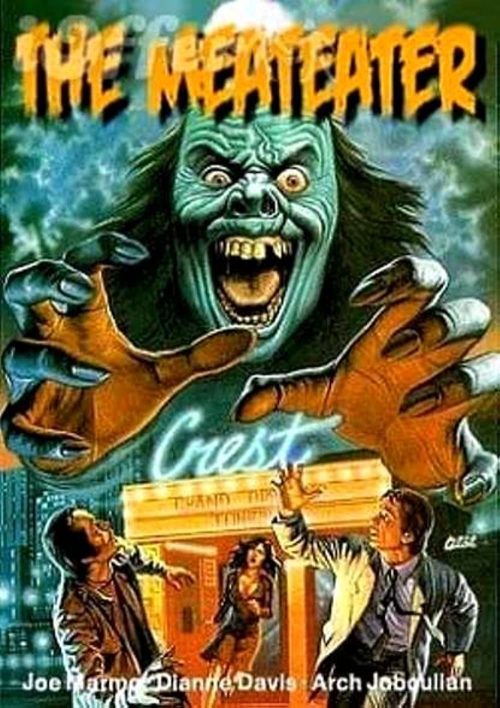
The story also has no connection with the title. We do see a man biting down on a rat at the beginning and the theater does show some documentaries of animals attacking other animals, of which we see a few snippets of, but the title leads one to believe this will be about cannibalism and there’s none. The film’s promotional poster seen above is misleading as well and far scarier than anything you’ll witness in the movie.

My Rating: 1 out of 10

Released: November 16, 1979

Runtime: 1 Hour 25 Minutes

Not Rated

Director: David Burton Morris

Studio: Hollyco

Available: DVD-R (dvdlady.com)

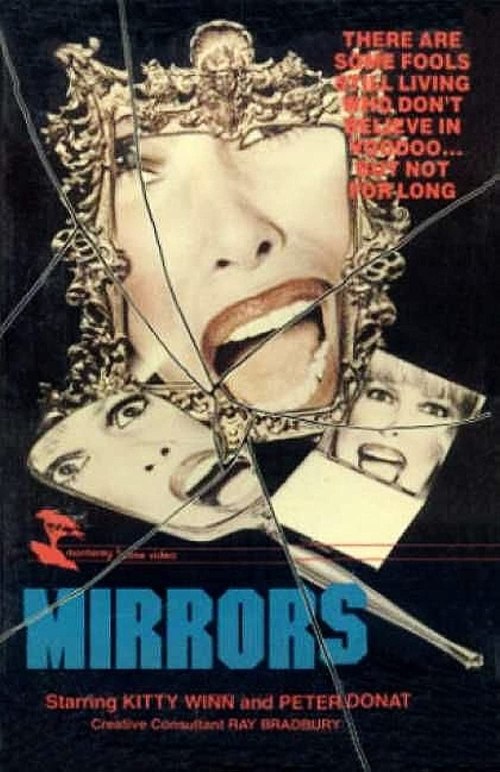
Mirrors (1978)

mirrors

By Richard Winters

My Rating: 4 out of 10

4-Word Review: Woman haunted by voodoo.

Marianne (Kitty Winn) and Gary ( William Paul Burns) are a newlywed couple who travel to the French Quarter of New Orleans for their honeymoon. Little do they know that a secret group of people, including the owner of the hotel that they’re staying at, have decided to possess Marianne with the spirit of a dead black woman. Soon after arriving Marianne begins having frightening dreams and the reflections of someone else when she looks in the mirror. Strange occurrences happen around her including the deaths of dogs and even her husband. Eventually she gets taken to a psychiatric hospital where Dr. Godard (Peter Donat) listens to her case and agrees to try and help her.

This was the third feature film of director Noel Black. He attained the attention of film critics with his 1965 movie short Skaterdaterwhich lead to funding for his second project Pretty Poison, which starred Anthony Perkins and Tuesday Weld and garnered a cult following. Soon after he became highly in-demand, but he made the mistake of deciding it was more important to stay busy in the business than holding out for a good script. He took on directing the notorious Cover Me Babewhich features what may be the most unlikable protagonist in film history, and a movie Black later admitted “should never have been made”. He followed this up with Jennifer on My Mindwhich met with equal disdain by both the critics and at the box office. By 1974, when this film was shot, Black was just trying to remain relevant as the studios that initially adored him were now no longer calling. This film was meant to showcase his visual talent, but he and the producers could never get on the same page as to what direction to take the story culminating in a muddled script that goes nowhere.

That’s not to say there aren’t things about this movie that I liked. The music score by Stephen Lawrence is haunting and the on-location shooting of the French Quarter offers a nice ambiance. I liked the point-of-view shots done when Marianne first gets wheeled into the hospital and the scenes inside an abandoned train station are spooky.

The story though lacks focus. The film opens right away with us seeing the notorious voodoo group in action, but it would’ve been more interesting had we not been given this information right away and instead made it more of a mystery for the viewer as to whether she was going insane, like the other characters in the movie think she is, or not. Winn’s performance is good. She’s better known for her part in a much more famous horror movie The Exorcist, where she appeared more youthful while here her hair is cut short and with make-up given a middle-aged demeanor. Her character though is poorly fleshed-out and shows no unique qualities and in that respect she’s quite boring, but as she becomes repeatedly terrorized by the group the viewer softens to her, mostly due to her good acting, and ultimately cares about her fate.

Spoiler Alert!

The story has similar themes with the cult hit Let’s Scare Jessica to Death and had it been better realized could’ve been a minor success, but the ending is too ambiguous. Winn turns to the camera in the final shot and shows a weird expression making us believe, I guess, that she’s been possessed by a spirit, but why was she chosen? There’s many people that come to New Orleans, so why does this group pick her to go through all this and not someone else? What’s the purpose, or end game of the group and what do they hope to achieve? None of this gets answered making the viewer feel afterwards that it was a big pointless waste of time. Black admitted that it didn’t work out right, but blames the fact that it was taken out of his hands and revised in a way that he didn’t approve of. All of this may be true, but in either case it’s best not to come into it with high expectations as you’ll leave gravely disappointed afterwards.

My Rating: 4 out of 10

Released: February 8, 1978 (Filmed in May of 1974)

Runtime: 1 Hour 28 Minutes

Rated PG

Director: Noel Black

Studio: First American Films

Available: DVD-R (dvdlady.com)

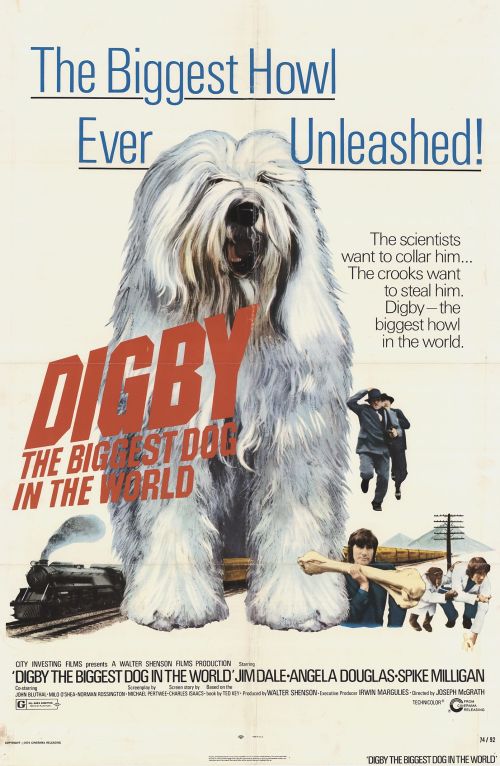
Digby: The Biggest Dog in the World (1973)

digby2

By Richard Winters

My Rating: 2 out of 10

4-Word Review: Dog grows really big.

Billy (Richard Beaumont) is a young boy who buys an Old English Sheepdog from a local dog home manager ( Victor Maddern). However, when he brings the dog home his grandfather (Edward Underdown) doesn’t want it in the house, so his mother (Angela Douglas) tells him to give the pet to someone else. He then leaves him at the home of Jeff (Jim Dale), a researcher who works at a defense lab that is experimenting in growth formulas. Jeff is smitten with Billy’s mother, but too shy to ask her out. He ultimately agrees to take the dog as an excuse to be around the mother more. Things though turn chaotic when Jeff decides to borrow some of the growth formula at his lab, in order to feed it to his tomato plants, but instead it gets accidentally given to the dog, who then grows to gigantic proportions.

This is the type of movie that’s clearly meant for kids, but kids today, with the advanced computerized special effects seen in modern films, will quickly be turned-off by the cheesy effects here. The attempt to make the dog seem bigger by placing him in a miniaturized kitchen doesn’t exactly work. Other segments where he’s seen outdoors and at a circus don’t work either because it’s obvious that the animal was simply put in front of a green screen. The segment that has Jeff sneaking the dog outside while having him wear an outfit meant for a horse is stupid too because a horse’s head is shaped differently than a dog’s, so there would be no way it would fit over the dog like it does.

The only inspired effect is when Billy crawls into the dog’s giant mouth in order to feed it a formula that will supposedly get the animal to shrink back to normal size. The recreation of the dog’s mouth to a large size is impressive though a dog’s tongue is thinner and longer than a person’s and yet the tongue in this mouth is styled much more like a human’s. Having the kid command the dog not to swallow, as if he did it would’ve sucked the boy down the throat, is dumb because swallowing is a natural reflex when liquid is poured in, so I’m not sure it could’ve been prevented, or that the dog would’ve understood what the command ‘don’t swallow’ would’ve even meant.

The story is based on the novel by Ted Key, who besides creating the comic strip ‘Hazel’ also wrote the screenplays for Gusabout a mule who kicks field goals, The Million Dollar Duckabout a duck who lays golden eggs, and The Cat from Outer SpaceThose movies fared a bit better as they were more imaginative and had better character development. Outside of a circus scene, which features an elderly and near-sighted knife thrower played by Bob Todd, there is nothing that is funny, or even slightly amusing.

A good story should have a protagonist that the audience can root for and and a clear antagonist that the audience hates, or at least fears. This film though doesn’t have that.  Jim Dale is a likable enough, but a scientist nerd who’s awkward around women is a tired stereotype that isn’t interesting. The kid had more appeal and could’ve easily been the hero without the Jeff character even being present. The supporting cast is essentially the same person; deluded, wacky folks who are lost in their own little worlds and clueless about what is really going-on. It’s okay to have one dumb character, but when everybody is goofy it gets tiring fast. There’s no bad guy either just a bunch of buffoons running around saying buffonish things and getting into cartoonish predicaments. If that’s your idea of entertainment then have-at-it, but most will find this to be a dated and silly though those that remember watching as a kid may for nostalgic purposes like it a bit more.

My Rating: 2 out of 10

Released: December 6, 1973

Runtime: 1 Hour 25 Minutes

Rated G

Director: Joseph McGrath

Studio: 20th Century Fox

Available: DVD (Region 2)

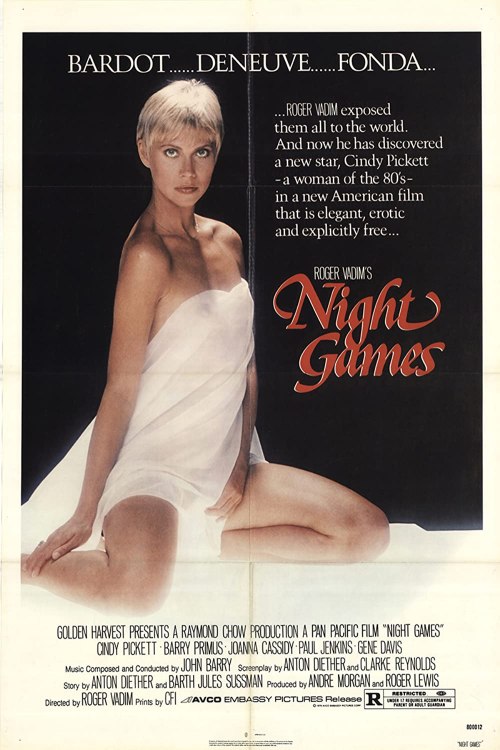
Night Games (1980)

night

By Richard Winters

My Rating: 0 out of 10

4-Word Review: Sex with masked stranger.

It’s not often that I can say this, but I personally know the man, Anton Diether, that’s credited with writing the screenplay (and story idea) for this film. He’s a member of the Austin Screenwriter’s group that I also attend. He’s harshly critical of everyone else’s screenplays, so I was intrigued to see something that he had written in order to ascertain if his stuff was any better. To give him credit I’ve asked him about this film many months back before I had seen it. He stated that director Roger Vadim had ‘ruined it’ and that he had a big fight with him on opening night when he realized how much Vadim had changed the original story. For his sake I hope he’s telling the truth because this thing is nothing I’d ever want my name to be attached to.

This was also intended at being a star making vehicle for Cindy Pickett, who’s excellent and seen quite a bit in the nude. Vadim was famous for directing films that turned his lady stars into international sex symbols like Bridgitte Bardot, Catherine Deneuve, and Jane Fonda as well as dating them and even marrying two of them. While Pickett did date Vadim as the film was being shot they quickly broke-up once it was over and it failed to make her a superstar like the other three, but much of that can be blamed on the lame script more than anything.

The story centers on Valerie (Cindy Pickett) who’s married to Hollywood producer Jason (Barry Primus). While their marriage may seem perfect to an outsider it’s filled with turmoil behind-closed-doors mainly because Valerie cannot have intimate relations with her husband due to still suffering from bad flashbacks of a rape that happened to her several years before. She is supposed to see a therapist to help her get through the traumatic experience, but she feels it’s not helping her enough, so she quits going. With their sex life stagnant Jason moves-out and goes on an extended ‘vacation’. Home alone Valerie begins hearing strange noises at night and convinced that an intruder has broken-in. She searches around, but doesn’t see anyone, but then the next night the intruder comes back wearing a mask and suit that makes him resemble a giant bird. Valerie finds herself put at ease with his presence and able to enjoy sex again without being tormented by her ugly memories.

The one thing that I did like was showing how difficult it is for the victim to get over a sexual assault. Sometimes people may never full recover from these types of events and this is one of the first films to tackle the post traumatic stress of it, so in that realm it should be applauded, but it never gives any details about the assailant, or whether he was ever caught, which I found frustrating.

The film though fails when it shows Valerie change into this promiscuous vamp who during the first half was hyper-paranoid about any man getting near here and yet when one appears in tacky costume late at night she’s cool with it and lets down her defenses completely. Most women who hadn’t been raped would be panicked at seeing a strange man wearing a wild getup in their home, so why isn’t Valerie and why the sudden flip in her personality, which are never answered (at least not sufficiently).

She also allows a man, played by Gene Davis, that she only knows very casually, to come-over to her place where she is all alone, so that she can paint a portrait of him in the nude. You’d think that if she has such anxiety around men that she wouldn’t do this. Anyone else would be concerned, at least a little, about the man taking advantage of the situation, but Valerie doesn’t until it’s too late, which again given her past doesn’t make any sense.

Spoiler Alert!

The twist ending, where it’s found that the guy in the bird suit is really Sean (Paul Jenkins) a friend and collaborator to Valerie’s husband, is by far the stupidest thing about it. For one thing Sean is shown downing large amounts of alcohol constantly making it seem like he’d barely be able to stand-up let alone make love, or beat-up another man who is much younger and better built. It’s also quite clear that even with his clothes on Sean is middle-aged with a potbelly, but when he’s playing the bird man his stomach is flat and muscular. This is because these scenes were done by a stand-in named Mark Hanks, but the viewer is supposed to believe that it’s really Sean, so why is the body type so different?

For these reasons and for the incredibly corny wrap-up, which should win the award for corniest ending ever, is why this movie was a definite career killer for Vadim whose talent was already considered overrated even before this one came-out.

My Rating: 0 out of 10

Released: April 11, 1980

Runtime: 1 Hour 40 Minutes

Rated R

Director: Roger Vadim

Studio: AVCO Embassy Pictures

Available: DVD-R (j4hi.com)

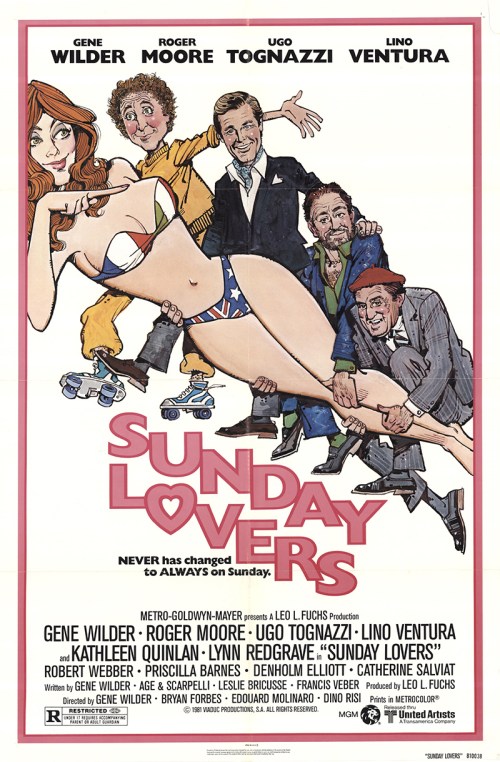
Sunday Lovers (1980)

sunday1

By Richard Winters

My Rating: 4 out of 10

4-Word Review: Stories about illicit sex.

International production has 4 stories taking place in a different country with a famous male movie star and director native to that region. The stories central theme revolves around love-making, or attempts thereof, and all outside of marriage. The concept sounds like it should’ve been a creative experiment especially with all the big-name talent, but the results are flat and forgettable.

The first story, ‘An Englishman’s Home’, stars Roger Moore as Harry Lindon, a rich man who owns a villa that Winston Churchill once resided in. He meets by chance a beautiful young blonde named Donna (Priscilla Barnes), who’s an airline stewardess in London on layover and who becomes impressed with Harry’s home and goes with him to visit it. It’s there that Harry plots with his loyal butler (Denholm Elliot) to get her to go to bed with him, but his plans are disrupted when his lady friend Lavina (Lynn Redgrave) comes for a unexpected visit. He and his butler spend the evening trying to avoid having the two meet by creating a scheme where Harry will be ‘forced’ to leave the dinner table with one to answer a phantom phone call, which allows him to then visit the other one before being informed by his butler of yet another ‘phone call’.

Moore is funny with his glib and sarcastic delivery and Barnes is amusing playing-up the ditzy blonde persona. The plot though is neither original, or entertaining and becomes boring quite quickly. The ending has a novel twist, but this is where I felt the story should’ve begun, which would’ve been more interesting.

The second segment, ‘The French Method’ was written by the prolific Francis Veber and deals with Francois (Lino Ventura), a French businessman, trying to close a deal with an American businessman named Henry (Robert Webber) The problem is that Henry is a middle-aged lech who’s got the hots for Francois’ attractive receptionist Christine (Catherine Salviet). Henry insists that before any deal is made he must have dinner with both Francois and Catherine. Francois is reluctant to ask Catherine to come along, but he’s so desperate for the deal to go through he becomes willing to do almost anything. Christine agrees despite disliking Henry. Once the dinner engagement commences Henry makes clear that he wants Francois to come-up with a polite excuse to leave, so the two can be alone together. Francois does as he’s asked, but then returns to have a confrontation with Henry, which leads to unexpected results.

This segment is expertly played by the three leads particularly Ventura and the characters are fleshed-out enough to keep it intriguing. The final twist is fun making this easily the best of the four.

The third segment, ‘Skippy’, was written and directed by Gene Wilder who also stars in the lead. It’s about a suicidal patient who’s allowed a weekend pass out of a mental hospital. He then meets-up with a younger woman (Kathleen Quinlan) at a disco. They hit-it-off especially after finding that each of them are ‘nutcases’. They go back to her place and share a passionate night of lovemaking only for him to have his heart broken the next day when she confides in him a surprising revelation.

This story is helped greatly by Quinlan who is young and beautiful and you even get to see her topless though you also have to put up with Gene’s bare bum too. Either way she gives a sprightly performance, but the story is odd and takes too long to play out. I was expecting it to go in a different direction than it does and the ending offers no pay-off.

The final segment, ‘Armando’s Notebook’, stars Ugo Tognazzi as a married man whose wife goes off on a trip to visit her sick mother. Armando uses this as an excuse to hook-up with old girlfriends from the 60’s by using his little black book that still lists their addresses and phone numbers. Unfortunately when he meets them he finds that things have changed quite a bit and not for the better. Many have aged to the point that they’re no longer attractive, or have become ‘liberated’ through feminism and won’t allow him to take advantage of them like they used to. One turns-up dead while yet another has become a high class prostitute who even accepts credit cards.

While this story is watchable it’s also too jokey and features a weird bit where one of the women, played by Sylva Koscina, has acquired the ability to suck in a massive amount of air and then blows it out with hurricane force, which has a strange supernatural vibe that doesn’t fit with the rest of the material.

My Rating: 4 out of 10

Released: October 31, 1980

Runtime: 2 Hours 5 Minutes

Rated R

Directors: Bryan Forbes, Edouard Molinaro, Dino Risi, Gene Wilder

Studio: Viaduk Productions

Avaliable: None

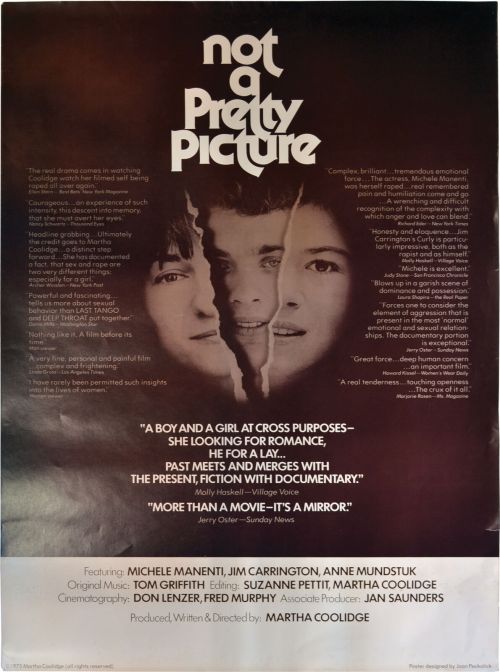
Not a Pretty Picture (1976)

not

By Richard Winters

My Rating: 5 out of 10

4-Word Review: Reenacting a rape incident.

While Martha Coolidge is known today for having directed such 80’s classics as Valley Girl and Joy of Sex she started her career in the 70’s doing documentaries mainly about high school students. After having done three of those she decided to do one that was more personal and dealt with a real-life incident that occurred to her when she was 16 when she got raped on a date with a college student who was 20. While she went about casting the actress to play her as a teen she was shocked to learn that the actress, Michele Manenti, had a similar experience. The film then weaves between reenactments of the date rape and the situations that lead up to it as well as the aftermath. There’s also interviews with the cast members who talk about the emotions they go through while playing the characters including Jim Carrington, who plays the rapist named Curly, who confesses that he thought women secretly wanted to be raped due to his belief that they fantasize about it.

What I got out of the film and enjoyed the most was looking at the acting process and how the performers used elements of their own experiences to help shape the characters that they play. I was genuinely surprised that only one of the cast members, Amy Wright who has a small role as Cindy, ever went on to do another movie. The two stars, who I felt were both outstanding, never acted in anything at least film or TV wise even though I felt they should’ve had long careers. I realize that the acting profession is a very competitive business and what may seem like the cream-of-the-crop in college may not be able to rise to the top in the real-world, but it still seemed sad that they weren’t able to do more, or at least more in front of the camera. It’s also surprising how non-dated this is. The conversations they have both about dating and acting is something that could’ve easily been shot today and just as topical. If it weren’t for them openly smoking indoors in a public setting, which is a major no-no now, you would never have known this was done in the 70’s.

While the conversations that Coolidge has with the cast proves to be insightful the reenactments aren’t as compelling. The scene involving the conversations that the four friends have inside a car has some interesting points, but it goes on too long and gets static. The aftermath where Martha is ridiculed by the other girls at her school and called a ‘whore’ because of the rumors that Curly spreads stating that she was a ‘willing participant’ and the stressful moments she has when she doesn’t get her period and fears she may be pregnant are quite dramatic, but the most important scene, the rape itself, gets botched. All the other recreated scenes where done as if in real-time and with sets that replicated the era, which was 1962, but with the rape it’s staged as a rehearsal with Martha and the other stagehands clearly in view as it occurs and Coolidge constantly stops the action to have them redo the scene several times in order to get it right, but this takes the viewer out of the moment and mutes the emotional impact. In hindsight I think they should’ve done the entire recreation, both the rape and what lead up to it as well as the aftermath, first and then went to the behind-the-scenes footage afterwards instead of inter-cutting it, which may have been novel for the time, but eventually gets off-putting.

The film’s focus was apparently intended to be on Martha and her reactions at seeing her own rape get played-out as the camera keeps panning back to her face as she watches the actors perform it and then at the end she describes her feelings in a emotional way. While I’m sure this was a tough thing for her to do I still felt it would’ve been more encompassing to have it about all the other women, including the actress in this film, that this has happened to and how men in that time period were able to get away with it and never had to be accountable. That to me was more disturbing and the film ends up missing that point, or not hitting-it-home hard enough, and thus isn’t as strong, or ground-breaking as it could’ve been.

My Rating: 5 out of 10

Released: March 31, 1976

Runtime: 1 Hour 23 Minutes

Not Rated

Director: Martha Coolidge

Studio: Coolidge Productions

Available: Vimeo

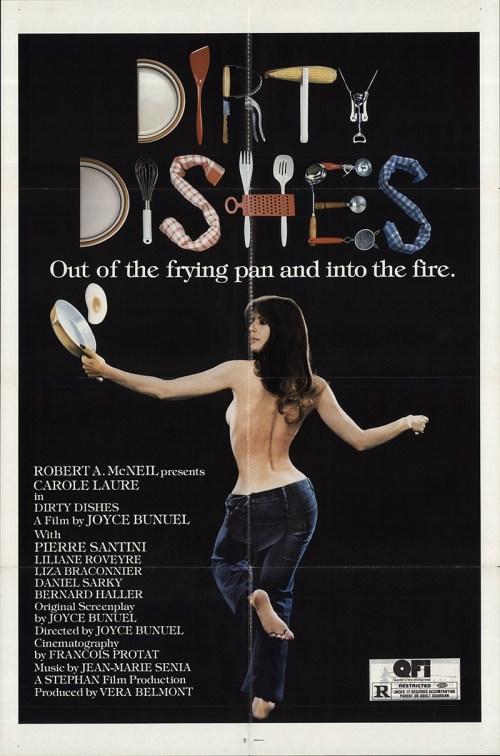
Dirty Dishes (1978)

dirty1

By Richard Winters

My Rating: 5 out of 10

4-Word Review: Housewife has nervous breakdown.

Armelle (Carole Laure) is a full-time housewife taking care of 2 young boys while her husband Marc (Pierre Santini) works a job designing car tires. Armelle is bored with the mundane chores that she must do day after day and looks forward to Thursday evenings, which is the one night that her and husband can go out, but since Marc’s job has become very demanding he can no longer do that, which makes her feel even more shut-in. She occasionally goes out with her two friends (Liliane Rovere, Liza Braconnier), but they’re trapped in the same thankless domestic routine as she is. One day she snaps and has a sexual tryst on her cluttered kitchen floor with an architect (Daniel Sarky) who works across the street, but this doesn’t subside her feelings of rebellion, so she steals a car, which almost gets her in an accident. Eventually her husband realizes her frustrations and promises that things will be different, but will this really bring the change that she wants?

Written and directed by the daughter-in-law of the legendary filmmaker Luis Bunuel, the film is a mixture of Diary of a Mad Housewife that came out 8 years earlier and Women on the Verge of a Nervous Breakdown, which was released 10 years after this one. There’s even a bit of Jeanne Dielman mixed in for good measure. The one thing that this film does do well is focusing on the mundane tasks that she does each day, which gives the viewer a clear impression of her trapped feeling. Unfortunately it doesn’t go deeper than that and ends up just being another feminist comedy that fails to have anything unique to say from the other films from that era with the same theme.

There are a some amusing lines uttered here and there, but the laughs are sporadic and there should’ve been tighter editing, which would’ve given it a frenetic pace and made the absurd moments seem less out-of-place. There’s also a few really weird tangents that come out of nowhere including a psychotic man that invades the families picnic at a park and tries running them down with his car that has no connection to the main story and wasn’t needed as was the segment at a grocery store where Arnelle breaks up a fist-fight between two men only to find that she’s been a victim of a candid camera-like prank.

There are a couple of good poignant moments particularly the scene where the couple is lying in bed and Armelle states to her husband that she feels scared and he replies: “Why, are you afraid something is going to happen to you?” and she responds: “No, I’m afraid nothing will happen and everything will remain the same.”, which hits home the characters quandary perfectly.

Laure’s is radiant and soaking in her beauty helps smooth over the slow spots. The scene where she gets rejected as a model of a dish detergent ad because she’s ‘too beautiful and no one would ever believe she does her own dishes’ is quite funny as that’s all we’ve seen her do since the film began.

The ending however offers no conclusion or answers. The character remains stuck in the same situation that she was at the start with only vague promises from the spouse that things ‘would be different’, but in cases like these that usually means things will eventually just go back to the way things were. The viewer needs to see the change for themselves, or how the character learns to adapt to the problem by finding ways to make the monotony seem more interesting, but the film shows none of this making it feel ultimately like a waste of time as both a satire and character study.

My Rating: 5 out of 10

Released: April 19, 1978

Runtime: 1 Hour 35 Minutes

Rated R

Director: Joyce Bunuel

Studio: Planfilm

Available: VHS

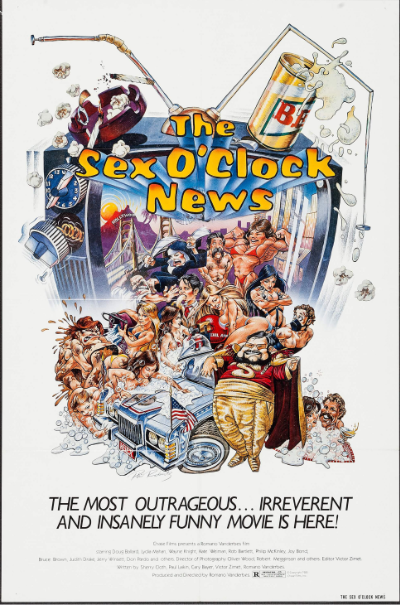
The Sex O’Clock News (1985)

sex4

By Richard Winters

My Rating: 4 out of 10

4-Word Review: News stories about sex.

KSEX is a TV-station that’s modeled like an ordinary broadcast station that has a 2-person anchor team (Doug Ballard, Lydia Mahan) that delivers the news and a show similar to ‘Entertainment Tonight’ that talks about the latest gossip in Hollywood and is hosted by Bill Wright (Wayne Knight) and Wanda Bennett (Kate Weiman). It even has a sports desk lead by Marty Cohen (Rob Baartlett). The only difference between these news shows and the regular ones is that the reports deal exclusively with sexual topics from nude car washes to abusive game shows.

This was yet another attempt to replicate the success of Kentucky Fried Movie that worked off of a collection of short raunchy skits loosely based around a bawdy theme. The unique genre began with The Groove Tube in 1974 and got imitated by many other independent filmmakers throughout the ’70’s who liked the format because it could be made on a low budget and yet still attract attention due to the outrageous humor. Some of them, which are too many to list here, were mildly funny while others fell flat. By the 80’s this type of movie had pretty much burnt itself out and was no longer in vogue. Only one other Amazon Women on the Moon was made, but since 1987 this genre has gone dark and most would probably say, due to the dubious quality, is probably for the best.

This one is borderline. Not all the skits work, but it does go for a darker edge, which helps. This was part of the problem with the others is that they had this idea that just showing breasts, or making a sexual reference would be enough to get a titillated giggle from the audience, like everybody is just a perpetual 7th grader, but by the 80’s with the proliferation of porn easily attainable at video stores, just making a movie with nudity was no longer provocative enough, so this one digs deeper with material of a very political Incorrect nature.

Some of the ones I found amusing, though others might find offensive especially in this day and age, was the bit promoting suicides by having people jump off the Golden Gate Bridge and captured for posterity on either VHS or Beta. There’s also the report dealing with violent nuns trained to beat-up and even kill anyone that doesn’t convert to Catholicism. A vacation cruise for overweight people is kind of amusing as is a wrestling match between Joan Rivers and Elizabeth Taylor (lookalikes not the actual celebrities) where there’s a lot of quips dealing with Taylor’s weight. There’s also a segment dealing with a transsexual beauty pageant, that might’ve offended more if it were actually funny and a skit dealing with a clinic that does experimental surgery on gay men to turn them straight, or as the anchor states: “they walk in a fruit and leave a vegetable”.

Sprinkled in-between are ads like the Jesse James School where people are sent training materials through the mail on how to become a successful bank robber. There’s also a long segment dealing with a game show called ‘You Bet Your Ass’ where a family, whose father is on death row, must answer each question correctly, or their dad gets fried on the electric chair, which has a decent payoff though it takes too long to get there.

Like with the other films from this genre there’s spotty laughs here and there, but it lacks momentum. Despite the short running time I kept glancing at my watch waiting for it to be over. The production values are cheap giving it a home movie quality and the overall design of the news studio is unimaginative there also isn’t any young future comic star that eventually rose to the top as no one from this cast ever became famous. Unless you like seeing a movie with tasteless humor of a bygone era that could clearly never be made today, there’s really no other reason to watch it.

My Rating: 4 out of 10

Released: August 9, 1985

Runtime: 1 Hour 17 Minutes

Rated R

Director: Romano Vanderbes

Studio: Chase Films

Available: DVD-R (dvdlady.om)

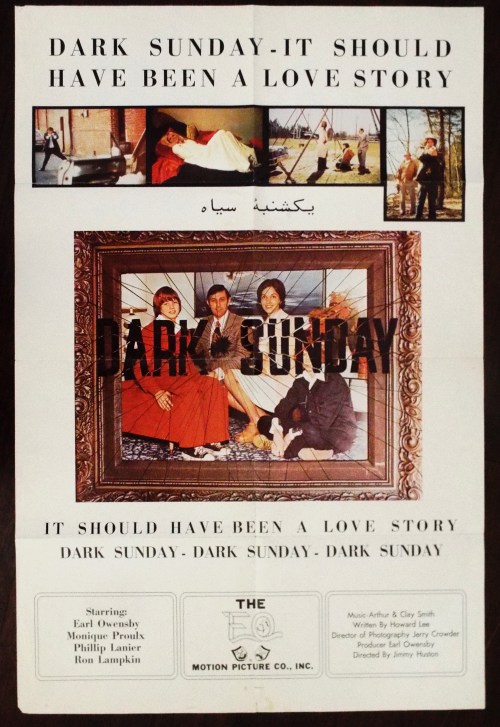
Dark Sunday (1976)

dark1

By Richard Winters

My Rating: 6 out of 10

4-Word Review: Preacher versus drug dealers.

Reverend Lowery (Earl Owensby) works to get teens hooked-on drugs off the city streets and sober, which annoys local drug dealers who order a hit on him. When his family are on a camping trip two hit men (Ron Lampkin, Jac Cashin) shoot both of Lowery’s sons (Todd Reep, Jeff Reep) and his wife (Maggie Lauterer). When Lowery tries coming to their aid he gets shot several times, but manages to survive though with a severe limp and inability to speak. Once out of the hospital he goes on a silent mission to get revenge on those that killed his family while also stopping the dealers from selling anymore drugs and getting them off the streets once and for all.

This is third film of Earl Owensby who in 1973 decided to take a stab at filmmaking by building a studio near Shelby, North Carolina and making movies that he deemed to have ‘old-fashioned values’ and away from the sex and violence of Hollywood. While his movies didn’t have any nudity they did have its fair share of violence, which his critics considered to be hypocritical, but in any event they made money especially on the grindhouse circuit and enough of a profit that it allowed him to continue making movies up to 1991. While other regional directors like John Waters and Charles B. Pierce where able to gain enough attention with their movies to ultimately get a Hollywood contract Owensby never did. Some say it was because he labeled himself a conservative, which automatically made him an outsider with Tinseltown.

Whatever the reason this movie really wasn’t all that different from the Hollywood revenge dramas like Dirty Harry and Walking Tall and I was surprised how watchable it was. It does go on longer than it should and the opening features several jump cuts, which gives it an extreme amateur feel. There’s also way too many scenes that take place in back alleys. Granted it works with the plot, but I still got the feeling it was shot at these locations because it was less likely to get noticed by the authorities for shooting without a permit.

The film was controversial for the amount of violence and was banned from several countries. The shootings could be considered extreme when you see little kids shot directly in the chest and then violently thrown backwards. There’s also a nifty death where one of the drug dealers known as Candyman (Chuck Mines) drowns by having his face shoved into a toilet bowl though this would’ve had better effect had it been shot from above versus to the side. In either case the shootings get redundant and there should’ve been more creative deaths instead of just at the hands of a rifle.

What I did like was that the protagonist suffers lasting injuries and doesn’t just miraculously recover like heroes in a Hollywood movie do. However, with that said, the limp that he gets stuck with, which forces him to walk with a cane, completely disappears during the final foot chase where he’s able to climb ladders connected to buildings even better than the able bodied detective who’s chasing after him.

You would’ve also thought that since he was such a well-loved preacher in his community and lead a big  congregation that they would’ve come to his aid after he was injured by finding him some housing and maybe even a job instead of him becoming this lonely homeless person that no one seemed to know. If he had grown bitter and lost his faith due to what happened to his family and thus rejected their offers of help that’s fine, but a scene showing this needed to be inserted.

It might’ve worked better too had it started from the perspective of the prostitute (Monique Prouix) who takes the homeless Lowery into her apartment because she feels sorry for him and considers him harmless. Then the violent deaths of the drug dealers would force the viewer to connect the dots to Lowery and ultimately through flashback show what happened to his family at the end, which then would’ve given the film an element of mystery and more layers. I was also taken off-guard by the very downbeat ending, which I hadn’t expected and didn’t feel was necessary, but does conform to the ‘everything is terrible’ theme, which was a prevalent in most 70’s movies.

My Rating: 6 out of 10

Released: August 17, 1976

Runtime: 1 Hour 42 Minutes

Rated R

Director: Jimmy Huston

Studio: Intercontinental Releasing Corporation

Available: DVD-R (dvdlady.com)