Category Archives: Mystery

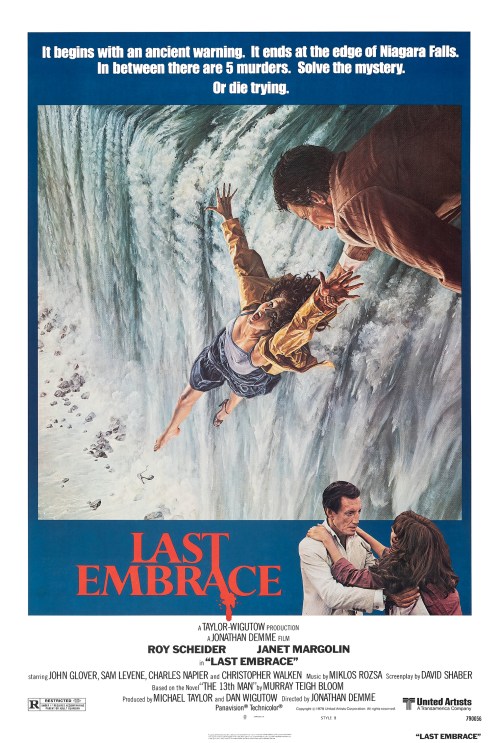
Last Embrace (1979)

lastembrace

By Richard Winters

My Rating: 7 out of 10

4-Word Review: Someone wants him dead.

Loosely based on the novel ‘The 13th Man’ by Murray Teigh Bloom the story centers around Harry (Roy Scheider) a government agent who has a nervous breakdown after his wife gets killed during a shootout while he was on a secret mission. After spending time in a sanitarium he gets out to realize that his agency no longer has any assignments for him and he fears they may want him dead while trying to make it look like an accident. When he gets back to his apartment he finds that it’s been sublet to Ellie (Janet Margolin), a doctoral student at Princeton University. He tries to get her to move-out, but can’t and then starts to receive threatening notes in Hebrew and uses Ellie’s background in that language to help him decipher what they’re saying. Soon the two go on the run convinced that the same person after Harry may also now be targeting Ellie, but nothing is exactly as it seems.

Jonathan Demme, despite his immense talent and admirable film output, never received name recognition and for the greater part of his career failed to have a hit at the box office. In fact it wasn’t until the success of The Silence of the Lambs that he even became a sought after Hollywood commodity. Even then when most people think about that movie it’s Anthony Hopkins, or even Jodie Foster that comes to mind while Demme’s directorial efforts seem overlooked. In many of his interviews this was his biggest complaint and that no matter what he did he could never break-out of the bubble to have his name put over the title like with Spielberg, Scorssese, or Hitchcock. I could understand his frustration as his movies were step above your basic indie flick and while not perfect still had far more going for it than a usual B-picture and if anything this film should’ve been the one that got him noticed.

There’s been many Hitchcock imitations with a lot of them done by Brian Di Palma, but those seemed overdone while this one gets just the right balance. The on-location shooting is splendid with my favorite moments being at Princeton University bell tower and of course the climactic sequence at Niagara Falls. I’ve personally been to the falls, but found this movie made me feel closer and more immersed in it than in person especially with the sequences shot inside the Robert Moses Niagara Power Plant and another done in the Cave of the Winds, which is what really makes the film stand-out. The music score by Miklos Rozsa, has the perfect blend of what would’ve been used by Bernard Herrman, which was Hitch’s main composer, which helps to make this seem like a movie Hitch himself could of very well done himself.

Scheider’s acting is good as he’s constantly cranky and irritable, which anyone going through his situation would be, so it was realistic and relatable, but I really hated the white suits that he wore. For one thing the guy was out of work and no longer a professional agent, so why he felt the need to dress-up all the time when he really wasn’t on the job anymore didn’t make much sense. Why they were all white was even more head-scratching. Outside of Pat Boone I don’t know of anyone who wears a white suit and it made him stand-out in all the wrong ways. If this guy is afraid that he’s being targeted then he should be dressing down so he could then blend-in, which in this movie he definitely wasn’t.

Margolin, best known for her work in the landmark indie flick David and Lisa, is good too especially with her dual personalities where she plays a nerdy student and her alluring, sexy vamp alter ego at other points. She though was not the original choice for the part as Demme wanted Lynn Lowry, who had been in his previous film Fighting Mad, but Scheider, who was dating Margolin at the time, preferred her and studio backed him on it forcing Demme to drop Lowry, but out of guilt he still paid her and allowed her to collect residuals despite her never appearing in any of it.

Spoiler Alert!

The plot is fast-moving and well crafted and keeps you guessing while also introducing a wide array of new twists without ever getting too confusing. The final twist though, in which we find that Ellie is the one after Harry and has been murdering other men as well in a revenge plot for what Harry’s and the other men’s grandfathers did to her grandmother who was gang raped by them at age 15. The idea was to tie the Ellie character to the Biblical avenger of Goel, which sounds cool, but ultimately an overreach. Had Ellie been raped directly by these men then I could see her going out of her way to seek rough justice, but doing it all for a grandmother she barely knew just didn’t seem all that believable. Also, how does this then ‘right the wrong’ by taking vengeance out on the grandchildren of the men who committed the actual crime? The grand kids had no control over what their grandparents did and weren’t even around when it happened, so how is any of this fair, or even make sense?

A better way to have ended it was to have Ellie portrayed as being a crazy kook going after these men due to a belief in some conspiracy theory only for the viewer to finally realize that she was an actual rape victim and Scheider, who we thought was this good guy, was instead the villain. Since she was raped at 15 her features could’ve changed, which would thus explain why Scheider didn’t recognize her initially. With a movie so compelled to have one twist after the other, this would’ve been the ultimate jaw-dropper. It’s just a shame they hadn’t chosen this route as the film, as slick as it is most of the way, leaves the viewer with an empty feeling after it’s over.

My Rating: 7 out of 10

Released: May 4, 1979

Runtime: 1 Hour 42 Minutes

Rated PG

Director: Jonathan Demme

Studio: United Artists

Available: DVD, Blu-ray, Tubi

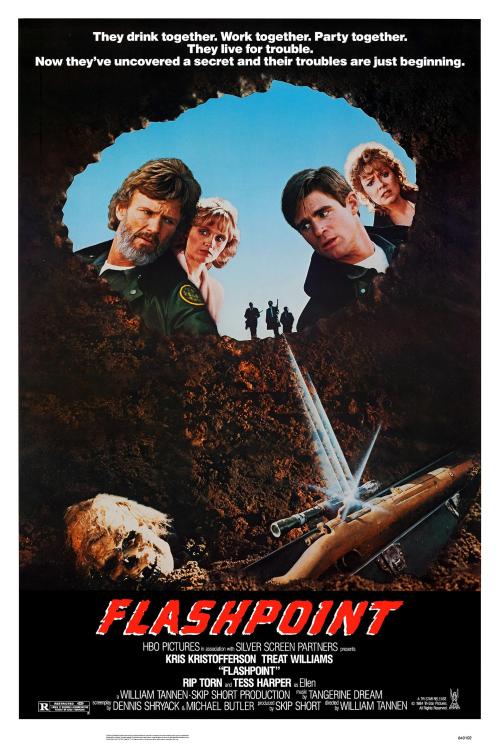
Flashpoint (1984)

flashpoint

By Richard Winters

My Rating: 4 out of 10

4-Word Review: Digging up hidden money.

Bobby (Kris Kristofferson) and Ernie (Treat Williams) are border patrol agents who stumble upon a jeep buried in the sand. Once Bobby digs it up he finds a skeleton in the driver’s seat, a scoped rifle, and $800,000 inside a rusted toolbox. Both of them are unhappy in their jobs and Bobby thinks this would be the perfect time to skip town with the loot, but Ernie thinks it’s stolen money and needs to be investigated. Since the bills are all marked with the dates of 1962 and 1963 they presume this is around the time when the bank robbery, which is where they think the deceased driver got the money from, occurred, but upon an old newspaper research at their local library they can find no such robbery happening in the amount that they recovered. Soon they face more problems when a federal man named Carson (Kurtwood Smith) takes over the agency they work at and exerts extreme control over everything they do. Bobby feels Carson is somehow aware of the money they found and knows more about the driver’s identity than he lets on. While Bobby and Ernie hide the money they find Carson and his team of secret agents hot on their path as he sends them on dangerous missions in an attempt to kill them, so they won’t let on to anyone else about what they’ve found.

This is another example where an intriguing story idea, based on the novel of the same name by George LaFountaine, almost gets ruined by lackluster direction. The mystery is interesting enough to keep you invested but there are definite lulls and cheesy side stories that seem to be challenging the viewer to turn it off before it’s over. This was also another case where the setting is supposedly Texas, which gets mentioned quite a bit, and yet it was all filmed in and around Tucson, Arizona, which is a travesty especially since the deserts of Arizona and Texas have noticeably different characteristics. I also felt that if you’re going to have a story based in the desert you should then have the time period during the summer, instead of the winter like here, where the scorching heat could be used as an added element.

Kristofferson isn’t particularly well cast here in a part that was originally intended for Paul Newman. His laid-back style of acting isn’t riveting enough though I’ll give him props for the scene where he gets shot and must crawl several yards in the dirt with one arm that he can’t move due to it being paralyzed by the bullet, which looks quite arduous to do though he does it effectively and realistically. Williams is by far the superior actor and his distinct personality where he’s the idealist, plays-off well from Kristofferson’s more jaded mindset. You even get a full view of Treat’s bare ass, which comes near the beginning and while nobody necessarily asked for it and wasn’t needed to propel the plot some may enjoy it and as male asses go it’s not too shabby.

Rip Torn, whose hair is dyed gray, does well in support where his strong Texas drawl works nicely in the supposedly Texas setting. While he’s only seen sporadically during the first two acts, to the point where I started to wonder why he even bothered to take the role as it seemed miniscule and pointless, he does come on strong during the finale. Kurtwood Smith though is dull, which isn’t exactly his fault as the part is written too much like caricature, and every successful movie needs an interesting and memorable villain, which this one clearly isn’t.

While the action is fleeting it does have one good stunt, which features Treat trying to prevent a plane, which they think holds drugs, from taking-off by reaching in through the window of the cockpit and forcing the pilot to land it. It had me holding by breath, but it got ridiculous when the plane crashes and explodes, but Treat gets saved when he supposedly jumps off and into a lake, but you don’t see this occur and the other men all presume he went down with the plane only to have Treat jump out of the water intact, but if he had dived into the pool then the water would’ve had a ripple effect from where he went in instead of it being calm and placid like it is.

Spoiler Alert!

The twist at the end in where the money and driver of the jeep are connected to the assassination of John F. Kennedy is cool though it leaves more questions than answers. Of course that might’ve been the intention, but still I feel this is a good enough story idea that it should be revisited with a better director and hopefully one day someone talented will decide to remake it in a way that’s more intriguing than what we get here.

My Rating: 4 out of 10

Released: August 31, 1984

Runtime: 1 Hour 33 Minutes

Rated R

Director: William Tannen

Studio: TriStar Pictures

Available: DVD-R

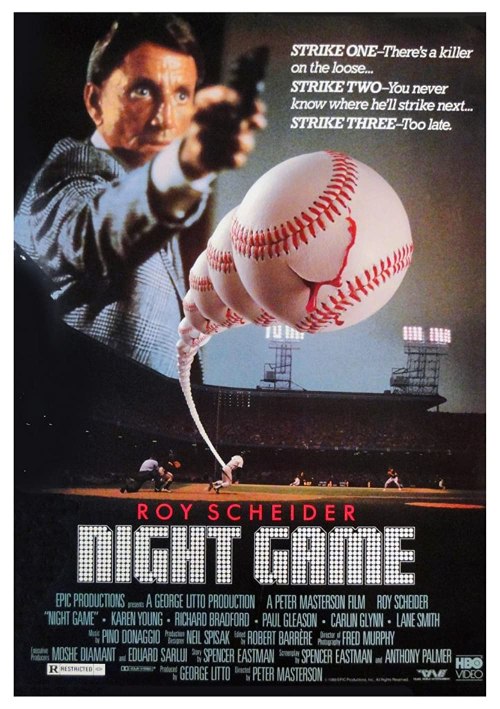
Night Game (1989)

nightgame1

By Richard Winters

My Rating: 4 out of 10

4-Word Review: Baseball score and murder.

Mike Seaver (Roy Scheider), a police detective, is put in charge of investigating a series of bizarre murders where women, some of them prostitutes, are murdered along the beaches of Galveston, Texas after each Houston Astros home game where pitcher Silvio Baretto achieves a victory. There are initially no suspects and it all seems to be a coincidence until Seaver ties the clues together and hones in on the killer while quarreling with Witty (Lane Smith) a state investigator brought in to help him with the case, but who has opposing ideas as to how to approach it.

The story is a strange mixture wanting to feed-off of the slasher films of the 80’s while also tying it to a sports themed flick, that was also popular during that decade, but manages to fail on both ends. The killings aren’t imaginative enough to attract a horror audience while the gore is much too graphic for those just looking for a slick thriller and thus both types of viewers will get put-off with this pretty quickly. Fans of sports movies won’t like it either as the baseballs scenes are brief and fleeting. While it’s kind of fun to see the Astros old color bar uniforms as well as watching actual game footage shot inside the old Astrodome, which at one time was coined ‘the 8th wonder of the world’ it hardly seems necessary especially since a TV-movie ‘Murder at the World Series’, which came out in 1977, had a very similar storyline that also included the Astros and Astrodome making this seem like a cheap, uninspired rip-off of that one.

The plot at least, while still dated especially on the technology end, takes a realistic approach to being a detective and how hard it is to find clues that can help piece the case together and lead to an actual suspect. Scheider, who was 57 at the time and looking it, manages to give it some energy and this was helped no less than by casting Richard Bradford as his nervous and pensive superior whose white hair and old school ways helps to offset Scheider’s wrinkles despite the fact that Scheider was in real-life 2 years older. The side stories though dealing with Smith coming in to butt heads with Roy doesn’t get played-up enough to be interesting and Scheider squabbling with his mother-in-law over a color TV that he got her drags the pacing down and hurts the tension of the mystery, which is where the sole focus of the script should’ve stayed.

Spoiler Alert!

What really ruins it though is the stupid ending. For one thing people in big cities, and Houston is the 4th largest one in the US, get murdered all the time, so having a cop able to somehow tie it to when a pitcher wins a game was too much of a stretch as technically there’s likely to be a murder happening somewhere whenever ANY pitcher wins a game and there needed to be more direct clues, like the killer sending cryptic notes to the police, or media, stating what his intentions were for it to realistically come together for the investigators.

The man playing the murderer, Rex Linn, who is supposedly a former pitcher who got cut from the team and then ultimately loses his hand in an accident and has it replaced with a hook, looks more like an disheveled, beer bellied truck driver who never played a sports game in his life. His motivations, to kill someone whenever the pitcher, who replaced him on the rotation, wins a game, in order to steal media attention away from the new pitcher’s success, is poorly thought out. It would’ve made more sense had the disgruntled man gone after the pitcher directly by either threatening his life, or those of his family, or maybe even attempting to kill the general manager, or owner, since they were the ones directly responsible for cutting him instead of no-name hookers who usually don’t get a lot of news attention anyways when they’re killed and thus making the whole premise pretty vapid.

My Rating: 4 out of 10

Released: September 15, 1989

Runtime: 1 Hour 35 Minutes

Rated R

Director: Peter Masterson

Studio: Epic Productions

Available: DVD, Blu-ray, Amazon Video, Tubi

Phobia (1980)

phobia1

By Richard Winters

My Rating: 3 out of 10

4-Word Review: His patients are dying.

Dr. Peter Ross (Paul Michael Glaser) is a Canadian psychiatrist who has come up with a radical new therapy to help cure those who suffer from phobias. The program includes having them watch their fears played out visually on the big screen and thus forcing them to conquer those irrational thoughts and be able to go on living normal lives. Peter feels he’s making great progress with his patients only to suddenly have them start to die-off one-by-one with each perishing in ways that reflects their private phobia that they had hoped to overcome.

This is definitely one of those movies where what happened behind-the-scenes had to be far more interesting than anything that occurred in front of the camera. Having John Huston, the legendary director who helmed such classics as The Maltese Falcon and Key Largo doing this one, which is nothing more than a cheap thriller with 80’s slasher instincts, has to be the most baffling thing about it. It wasn’t like his career was on the outs either as he went on to direct several more critically acclaimed flicks in the 80’s that were well financed with big name stars and he had just 5 years earlier did the well received The Man Who Would Be King, so why he decided to take a weird foray into doing this inept thing, which just by reading the script you could tell was a mess upfront, I don’t know.

It starts out with some visual panache, but otherwise could’ve easily been directed by a no-name, two-bit director and no one would’ve known the difference. The one segment dealing with a car chase down the city streets that culminates with a man falling from a tall building had some potential though I would’ve framed the shot differently showing it from a bird’s-eye view where the viewer could see how far off the ground the victim really was versus having the camera on the ground looking up, which is less dramatic. I suppose it might’ve given away the safety net that’s clearly present as you never see him hit the ground, it cuts away while he’s still in mid-air, but in either case it’s the only mildly diverting moment of the whole film.

Everything else is run-of-the-mill including the numerous deaths, which despite the tagline don’t all have to do with their phobias either. For instance one woman fears being in big crowds, so in order to ‘cure’ her, the doctor has her go onto a crowded subway, but she panics and runs back to his place where she ultimately dies when a bomb explodes. The segment dealing with a woman who fears men gets pretty ridiculous as he has her watch a movie of a woman getting gang raped, which would appall anyone and yet when she runs out of the room in disgust and shock he’s confused. The very fact that he talks about ‘curing’ his patients is a major red flag altogether as in psychiatry you never really ‘cure’ anybody, which just shows how poorly researched and shallow the script really is.

Paul Michael Glaser, better known for his work in the TV-show ‘Starsky and Hutch’, makes for a wretched leading man and it’s no surprise that he decided to get into directing after this one and has never starred in a theatrical film since. It’s not completely his fault as his character exudes a cold demeanor, so you never really care about him, or his quandary. John Colicos, as the police detective, is far superior and helps enliven the film with the few scenes that he is in though his interrogation techniques are highly unethical and the fact that he only focuses on one angle as to who the culprit is makes his character come-off as unintentionally inept.

The film does feature a twist at the end as to who the killer really is, but it’s dumb and not worth sitting through. In fact the ultimate reveal is so bad that it ruins everything else that came before it, as it had been watchable up until that point, but the climax solidifies it as a bomb.

My Rating: 3 out of 10

Released: September 26, 1980

Runtime: 1 Hour 30 Minutes

Rated R

Director: John Huston

Studio: Paramount Pictures

Available: Blu-ray

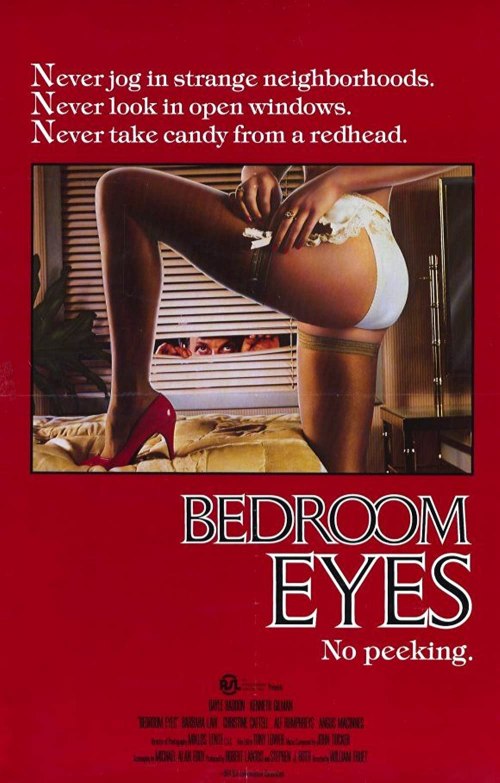
Bedroom Eyes (1984)

bedroom1

By Richard Winters

My Rating: 1 out of 10

4-Word Review: Voyeur witnesses a murder.

Harry Ross (Kenneth Gilman) is a businessman who enjoys taking a late night jog in the Toronto neighborhood in which he lives. One night he steps in dog poo and as he’s trying to scrape it off he notices a light coming from a nearby window. Out of curiosity he peers in and sees a half-naked woman (Jayne Catling) dancing provocatively. It turns him on and he decides to make it a point to peer into the window each night when he goes for a run. He though begins to feel guilty about what he’s doing and thinks he may be a ‘pervert’ and thus schedules an appoint with Alex (Dayle Haddon), who is a psychiatrist, so that they can talk it through. During their sessions he also becomes attracted to her and things slowly work into a relationship. While this is going on he continues to look into the window each night, but eventually witnesses the woman getting murdered and now must go into hiding inside Alex’s apartment as not only the police, who mistakenly think he did it as they get his prints off of the window, are after him, but so is the killer.

This film was directed by William Fruet, a prolific writer/director from Canada, who shot to fame with the excellent Wedding in White and then followed that up with a lot lame thrillers and horror films. While some of those were diverting this one isn’t and the tacky set-up is the biggest problem. The fact that Harry isn’t portrayed as being a life long voyeur, but instead quite literally just ‘stumbles’ upon it is farfetched and the character would’ve had more depth if this had been a constant trait that he had to deal with. Having him ‘panic’ that he was afraid this made him a ‘pervert’ was ridiculous too as I’d think just about any heterosexual guy would get aroused seeing a hot lady cavorting around erotically. The way he peers in, the camera captures it from the inside looking out, is quite obvious as his face is fully light, from the indoor lamps, and thus all the people needed to do was glance up briefly to see him, which I would think would’ve occurred at some point especially since he continues to do it over multiple nights. The fact that they always leave the window shade half open seems like they’re inviting someone to look in though the movie acts like this is unintentional and just a ‘coincidence’. The place is lit in a way that makes it seem like it’s a set for soft core porn flick and the woman behaves like an adult actress, which completely ruins any sliver of plausibility.

Initially I liked seeing Haddon, who was at one time a super model before she got into acting, cast as the therapist as this was traditionally at that time still more of a man’s profession, so she was playing against type, but having Harry immediately asks her out on a date was dumb. Due to this being a professional doctor and patient relationship he should’ve at least waited until after several sessions before he got up the nerve to do it and even then it’s putting her in an unethical spot and he should’ve known that. Fortunately she tells him ‘no’ the first couple of times, which is what she should’ve done, but I knew, going by how stupid this script had already been, that she’d eventually cave and of course she does, which makes the whole premise become even more ludicrous. Having her spot him at a fancy restaurant was too coincidental in such a big city and having his girlfriend perform a sexual act while inside the place with all sorts of people around was over-the-top. If anything Haddon should’ve just been cast as his girlfriend, who just happens to work as therapist, and he could’ve still spoken to her about his voyeurism in private when they were together and this would’ve helped made it more believable.

It does get a bit intriguing for a few minutes when the police begin to close-in on Harry and I enjoyed the inner-rivalry of the police department where the two lead detectives became irritated at how a young ‘wet-behind-the-ears’ kid (Alf Humphreys) was always coming up with new leads and clues before they did, but other than that there’s very little to recommend. The climactic sequence in which the killer ties Harry up while he’s inside Haddon’s apartment, is quite boring and the female actor who plays the culprit shows no panache and thus making her scenes quite dull. In 1989, at the request of no one, this was made into a sequel, but with a completely different writer, director and actors with the only thing connecting the two being the Harry Ross character.

My Rating: 2 out of 10

Released: November 30, 1984

Runtime: 1 Hour 30 Minutes

Rated R

Director: William Fruet

Studio: Pan-Canadian Film Distributors

Available: DVD-R

Nightkill (1980)

nightkill1

By Richard Winters

My Rating: 5 out of 10

4-Word Review: Somebody is listening in.

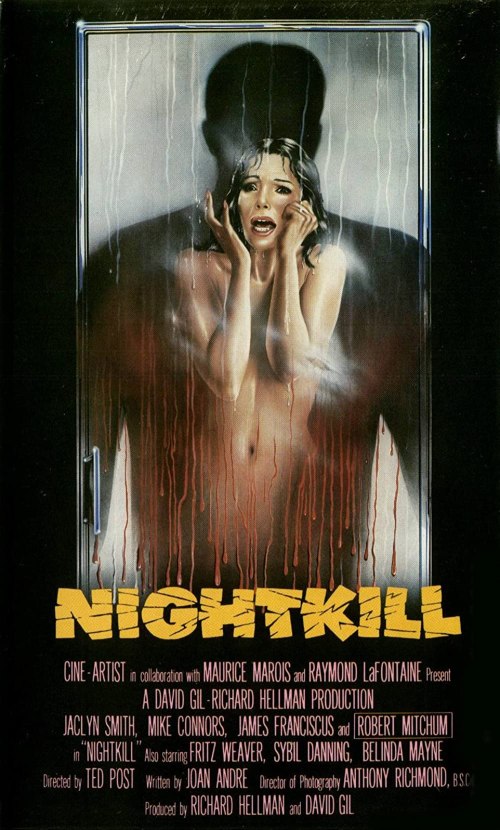
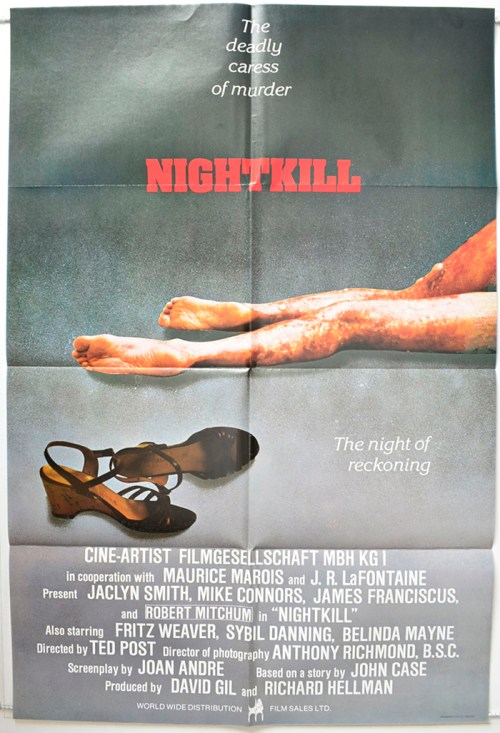
Kathy (Jaclyn Smith) is married to Wendell (Mike Connors) a wealthy, but unethical businessman living in Arizona. She’s unhappy in the marriage and wants a divorce, but Wendell promises to make things hard for her if she does, so she reluctantly stays in it, but on the side has an affair with Steve (James Franciscus) his close business associate. Steve poisons Wendell and sticks his body inside the freezer of Wendell’s home and then impersonates him on a flight to Washington to make it appear that he’s still alive. Kathy remains at home only to become harassed by a aggressive detective Donner (Robert Mitchum) who’s suspicious that Wendell has become a victim of foul play. Kathy decides she must get rid of the body, but when she opens up the freezer she discovers it’s no longer Wendell’s corpse that’s inside, but instead Steve’s.

Odd thriller that was produced by a German film company, but filmed in the US. The film succeeds with having a distinct score and great location shooting of Arizona in which it’s dry, desolate landscape helps reflect the empty, inner nature of the characters. It was directed by Ted Post, who’s best known for the cult hit The Baby, which is famous for its twist ending, and there’s a lot of story twists here too, but for whatever reason fails to be captivating and this is mostly due to the dull characters.

Kathy was the one that got on my nerves the most. One minute she’s telling him that she can’t stand him and then the next minute she’s upset and sobbing over his unexpected death, so which is it? It seems like she should’ve been elated when he keeled-over and having her played-up as being this innocent is unrealistic. When you spend your life associating with bad people it tends to rub-off and it’s hard to imagine she wouldn’t have been tainted by the corruption of not only her spouse, but lover and Smith’s poor attempt at crying just makes it all the more worse. I rather have openly bad people going after each other and seeing which one is left standing then some idealized angel who’s completely out-of-place in the setting and would have to be extraordinarily naïve not to have caught-on to the shenanigans that were going on long before she does. If anything Sybil Danning, who is seen in a much smaller role, should’ve been given the lead as her conniving, sauciness was exactly what the character needed to have made it interesting.

Franciscus isn’t in it long enough to make much of an impression and Mitchum sleep walks through his part and thus making his onscreen presence quite bland and his big name, star status adds nothing. The only one that is fun is Connors, best known for his starring role in the cop TV-show ‘Mannix’. Here he plays against type by being an obnoxious jerk that delights in upsetting some caged monkeys that they have in his home. The rotten personality of his character is over-the-top enough to be fun and it’s just a shame he had to die-off so quickly.

Spoiler Alert!

An mentioned there are some nifty twists, but it ultimately adds up to little. The biggest problem is that Mitchum, who’s just as shady as Connors and Franciscus, ends up getting away with it, by stealing the stolen money that Connors has in his airport locker and flying out of the country, which isn’t exactly an audience pleaser. Smith doesn’t completely die either as we see her injured body on the bathroom floor calling the police making it seem that with her information there was still a chance he could get caught and the film should’ve played this out to completion and not left it open to guessing.

Lots of logistical issues too. For instance Mitchum kills Francsicus supposedly at the airport, but for some reason, we never see it but can only presume, drags the dead body back to Smith’s home just so he can put it into the freezer, but why bother? Also, where does he put Connor’s body when he replaces it with Franciscus’? Where does he get the mask of Mike Connors’ face that he uses to disguise himself that he is him? Does he know a manufacturer that makes specially made masks  to resemble someone they know and if so what company is this because I’ve never heard of it? Also, how does he know there’s a cop inside the police department named Donner as he pretends to be this man when he investigates the case even though he’s really a private eye named Rodriguez? These along with several other questions never get answered, which significantly hurts the plausibility.

Original Cinema Quad Poster - Movie Film Posters

Original Cinema Quad Poster – Movie Film Posters

My Rating: 5 out of 10

Released: December 18, 1980

Runtime: 1 Hour 35 Minutes

Rated R

Director: Ted Post

Available: DVD-R, Blu-ray

Too Scared to Scream (1984)

tooscared3

By Richard Winters

My Rating: 3 out of 10

4-Word Review: Who’s killing the tenants?

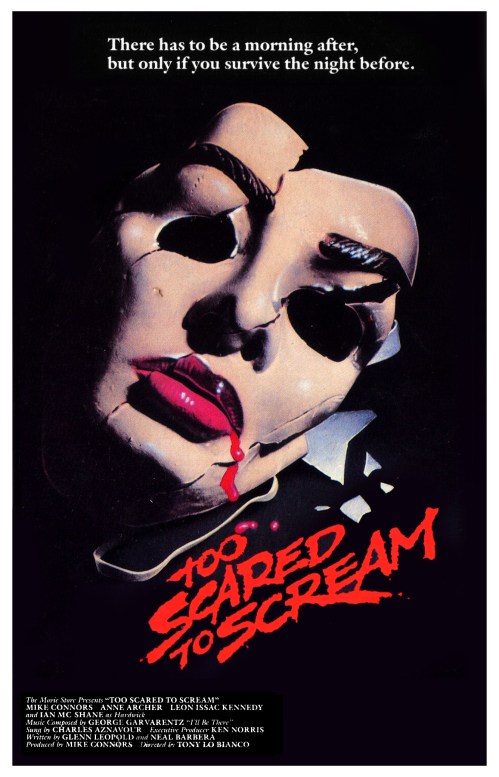
Female tenants living in a New York City high-rise building are turning-up dead in brutal fashion. Lieutenant Alex Dinardo (Mike Connors) and his younger, female partner Kate (Anne Archer) are convinced that the culprit is Vincent (Ian McShane) who works as the overnight watchmen at the apartment building and since all the crimes happen during his shift he quickly becomes suspect number one. Though getting enough evidence in order to arrest him becomes a delicate matter. Alex then decides to asks Kate to move-in to the building as a new tenant and thus keep tabs on what Vincent is doing and hopefully lure him into a situation where he’ll incriminate himself, but Kate soon finds herself in over-her-head as the killer is on-top of what’s going on and he soon bates her into a dangerous game of cat-and-mouse where Alex and the other policemen are not able to help her.

The film was an attempt at creating an American version of an Italian giallo complete with gory murders and an intricate mystery where you don’t know who the real killer is until the final twist ending. It’s also the only film to date to be directed by actor Tony Lo Bianco. Severely straddled during production as it was shot in 1982, but due to the production studio that financed the project going bankrupt it was never released until 3 years later where it was given little fanfare and came and went with few people seeing it.

The biggest problem with it is that it plays-up McShane’s role too much. Granted he’s a gifted actor who’s best known today for his work in the TV-series ‘Deadwood’, but by overemphasizing his character it makes it seem right from the start that he’s the culprit and thus making the investigation uninteresting because you feel it’s just a matter of time before he’s found out and thus little mystery, or intrigue. Granted there are a couple of other suspects, but they seem thrown-in simply as red herrings and aren’t seen much. The story would’ve had better tension had the suspects shared equal screen time and a more balance of clues making it seem like any one of them could’ve done it and thus some genuine interest at getting at what the truth is versus having it seem like it’s all spelled-out from the start. If anything Maureen O’Sullivan, who plays McShane’s near comatose mother whom he takes care of, is far more captivating, despite the fact that she doesn’t speak any line of dialogue and trapped in a wheelchair, then anything McShane himself does.

The unusual pairing of a 60-something male cop alongside a female one that appears to be only around 30 should’ve been what the film focused on as I found their contrasting personalities and different ways they approached their police work to be something that could’ve been played-off of more. Unfortunately the film taps into this just slightly and then quickly moves on and thus misses the opportunity for what could’ve lead to captivating confrontations and debates. Connor does seem a bit too old for this kind of thing and seeing him trying to chase down a young athletic man who was only 20 came-off as almost laughable and I was surprised he didn’t just fall over from a heart attack, or exhaustion before he ever managed to get near the guy. Having him lose a fight to the younger guy and have to depend on his partner to bail him out of it was realistic, so it gets props there, but the way he goes about his police work, which includes physically beating-up on suspects, is highly unethical and should’ve gotten him demoted, or fired.

Spoiler Alert!

I had issues with Archer’s character as well. This comes when she agrees to move into the apartment and work undercover, but seems woefully unprepared for it. She manages to carry a gun with her when she goes down to the basement of the building to do laundry, but then when she gets back to her place she does a goofy aerobics workout where she gets caught off-guard, but wouldn’t a seasoned cop know to carry a weapon on her at all times especially when she’s intentionally making herself a target to the killer? Also, what kind of person walks into their apartment and then doesn’t turn around and immediately lock the door once they’re inside? If you want to argue that this was intentional (I don’t think it was) because she wanted to lure the killer inside, so as to apprehend him, then fine, but she should then make damn sure she was a gun in-hand, pointed at him, when he does, which in this case she didn’t.

You must likely won’t be able to guess who the true killer is, but it’s not worth sitting through. The script doesn’t offer any clues, or hints either, so even an alert viewer won’t figure it out, but that doesn’t mean it’s a good mystery because it really isn’t. The story is sloppily put together without much imagination, or character development. Unlike a true giallo the murders are quick and without much blood, so if you’re a gorehound this thing won’t suffice. The concept had potential, but the execution is half-hearted.

My Rating: 3 out of 10

Released: September 28, 1984

Runtime: 1 Hour 40 Minutes

Rated R

Director: Tony Lo Bianco

Studio: International Film Marketing

Available: Blu-ray (Import), DVD-R

The Naked Face (1984)

naked1

By Richard Winters

My Rating: 7 out of 10

4-Word Review: Is psychoanalyst being targeted?

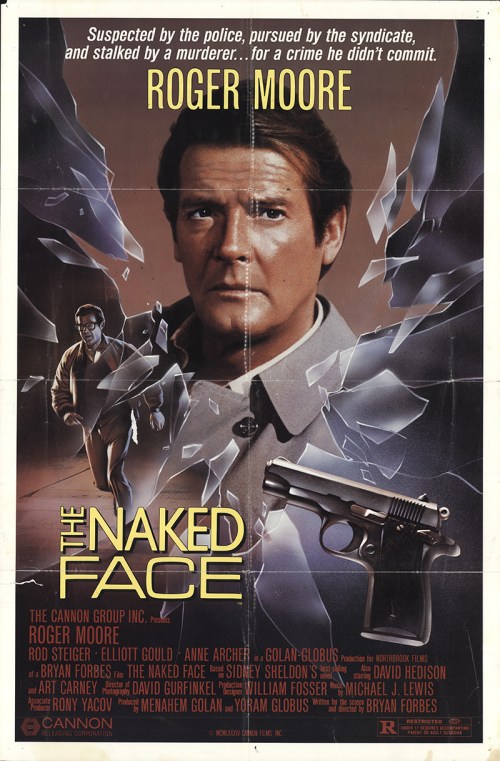
Judd Stevens (Roger Moore) is a psychoanalyst residing in Chicago who suddenly finds that people he knows are turning up dead. First it was one of his patients, whom he let borrow his raincoat. Then it’s his secretary and soon the police are suspecting him of the killings. Lieutenant McGreavy (Rod Steiger) doesn’t like Judd as it was Judd’s expert testimony that got a cop killer sent to an institution versus a jail cell where McGreavy felt he belonged. In order to get the cops off his back and find the real killer Judd  hires Morgens (Art Carney), private investigator, who seems to get a lead when he calls Judd and tells him that a ‘Don Vinton’ is behind it, but then Morgens ends up dead too, so Judd puts his trust in another police detective named Angeli (Elliot Gould) only to learn that he has ulterior motives.

The story is based on the Sidney Sheldon novel of the same name that was written in 1970 and besides this one has been remade two other times: in 1992 in Ukraine as Sheriff’s Star and then again in 2007 in India as Kshana Kshana. This version was produced by the notorious Cannon Group, which always makes me hold my breath in apprehension every time I see their logo come up before the movie begins as I’m never sure if this is going to be one of their cheaper productions, or one that was given a decent budget. While Leonard Maltin, in his review, describes it as ‘low budget’ I’d say this was one of their passable efforts as the production standards aren’t compromised in any way and if anything is rather slick. The on-location shooting done in Chicago, this was changed from the novel where the setting was Manhattan, is excellent and the plot is well paced with incremental twists to keep it flowing.

The film’s main selling point is seeing Moore playing against type as he was known as an action star, but here plays an intellectual. For the most part he does quite well and even able to hold his own when sharing a scene with Steiger, who otherwise likes to chew up the scenery and everyone else in it, but I didn’t like the big Harry Caray-type glasses that he wears. I guess this was done to make him look ‘smart’, but it wasn’t needed. The best part is seeing him get beat-up by the bad guys. When Moore was playing Bond it always seemed a bit absurd that this aging 50-something would be able to take-on virtually any villain, no matter the size, and come-out on top every time. Here he gets flattened with one punch and it’s kind of funny.

Steiger, with  his intense delivery, dominates. He’s given a lot of screen time during the first half almost making him seem like he’s the star and his stewing anger lends adequate tension, but his good-cop/bad-cop routine doesn’t work because he’s the type of character who’s impossible to like, so he needed to stay bad all the way. I also couldn’t stand the wig. He supposed to be an ugly, unlikable guy, so might as well have him naturally bald, as the rug gives him a campy look.

Gould is the outlier. He was during the 70’s a major headlining star, so seeing him pushed to the background where Steiger takes center stage is almost shocking. I remember him saying once in an interview that he didn’t like the pressure of being a leading man, so maybe this supporting bit was right for him. His character does become more prominent towards the end, but for the most part he comes-off like a faceless walk-on  and a sign of a career decline.

Spoiler Alert!

The twist ending in which it’s found that the crime syndicate was behind the killings due to the wife (Anne Archer) of the crime boss seeing Judd and fearing she may be giving him secret information during their sessions was not particularly original. It also opened up some loopholes. For instance Judd’s patient at the beginning is stabbed on the streets because he was mistaken for being Judd, but later when Judd is kidnapped and in the crime boss’ presence he isn’t immediately killed as they first want him to divulge what his wife told him, but if the idea was to extract information then why was the patient offed right away instead of taken somewhere for interrogation?

At the very end Moore is walking with Archer outside and suddenly she gets hit with a bullet, but not Moore. If she was shot by a hit man for giving out secret info then Moore should’ve received a bullet as well because it was he that she had confided in, or at least that was what they had presumed.

My Rating: 7 out of 10

Released: June 6, 1984

Runtime: 1 Hour 45 Minutes

Rated R

Director: Bryan Forbes

Studio: Cannon Film Distributors

Available: DVD, Tubi

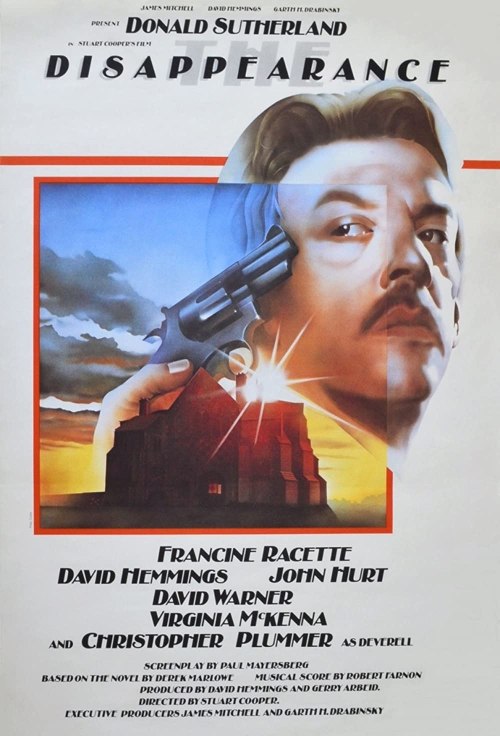
The Disappearance (1977)

disappearance

By Richard Winters

My Rating: 7 out of 10

4-Word Review: Where is his wife?

Jay Mallory (Donald Sutherland) is a professional assassin who works for a secret organization that contracts him out to do hits all over the world. After returning home from his latest assignment he finds that his wife Celandine (Francine Racette) is not there. Since they had a tumultuous relationship he initially presumes she left on her own accord, but then his friend and fellow hit man Burbank (David Warner) informs him that her disappearance may have something to do with his last hit. The organization that employs him now calls with another assignment, but this time they’re reluctant to give any details, which is unusual. Jay is afraid he’s being set-up as Burbank told him that the company is known to ‘retire’ those that are deemed no longer useful or trustworthy. He decides though to go through with the assignment as he’s curious how it will play-out and confident enough in his ability to get out of any jam, but soon finds himself faced with an entangling twist he never expected.

The film is a fascinating portrait of what can be done with creative direction. Stuart Cooper, who’s not exactly a household name and in fact this was his last theatrical film until 2010 when he did Magic Man, lends some interesting directorial touches that makes the story and characters more interesting than they might otherwise. What I especially liked was the non-linear narrative in which the movie cuts back and forth between the past to the present day. These types of storylines are typically frowned upon by Hollywood studios as they’re considered to be ‘too confusing’ for mainstream audiences to follow, but I had no such difficulty and felt it allowed in added nuance that would not have been present had the plot been approached in the conventional way. Nonetheless when the film tanked at the box office upon its initial release the studio insisted that the film be re-cut where the story would be presented in the standard linear format, but this version did even worse, so fortunately for the DVD/Blu-ray release it was brought back to its original way and labeled as being the ‘director’s cut’ though Cooper actually had no input on it, but eventually approved once he viewed it.

It’s also highly atmospheric particularly with the way it captures the cold, wintry climate of Montreal in the dead-of-winter. Having been born and raised in Minnesota I can tell a fake winter scene done on an indoor sound stage using artificial snow within seconds, but here the cold, including the mounds of snow drifts and nasty hollowing wind, is quite vivid and helps to symbolize the cold nature of the characters and the business they’re in.

I was a little more lukewarm with the acting. Sutherland can certainly be an outstanding leading man, but he seems too kind and sensitive for a person making a living killing others for money though I did like the scene where he plays memory games with his wife while at home, which brings out how crucial paying attention to detail is for his line of work. The supporting players are all familiar faces though I felt Warner was a bit wasted and underused. Virginia McKenna, best known for her starring role in the classic Born Free, is seen for only a brief bit though her interaction with Sutherland is quite pivotal while Christopher Plummer doesn’t appear at all until the final 15-minutes, but still manages to come-off with a memorable presence.

Spoiler Alert!

The film’s biggest downfall though is with the ending, which becomes one twist too many. Up until that point the twists had been a logical fit that made sense when you went back and thought about it. Then at the very end Sutherland gets shot and killed while walking home from the grocery store, but it’s never shown who did it, or why. Maybe it was the secret organization that wanted to ‘retire’ him, but this needed to be shown and explained. Just leaving the viewer hanging with a violent, but vague scenario isn’t satisfying and cheapens the rest of it.

My Rating: 7 out of 10

Released: September 17, 1977

Runtime: 1 Hour 31 Minutes

Rated R

Director: Stuart Cooper

Studio: Trofar

Available: DVD (Region 2), Blu-ray

Impulse (1984)

impulse

By Richard Winters

My Rating: 3 out of 10

4-Word Review: The townspeople act crazy.

Jennifer (Meg Tilly) and her boyfriend Stuart (Tim Matheson) return to the small town she grew up in to help care for her mother (Lorinne Vozoff) who suddenly and quite impulsively shot herself in the head while talking to Jennifer over the phone. When they arrive they find the people behaving in strange ways by acting on their inner impulses without any social restraint. Stuart, who is a chemist, believes it may have something to do with what’s in the water, but when he tests it he finds nothing unusual. The people though continue to behave in a more aggressive manner where even the kindly old doctor (Hume Cronyn) who was looking after Jennifer’s mother in the hospital begins showing homicidal tendencies. The couple fear they might not be able to get out of there alive and begin to suspect that the ultimate cause has some connection to the earthquake that shook the town just days before they arrived.

The premise is certainly intriguing and there are a share of weird moments, but director Graham Baker approaches the material in the wrong way. The original screenplay by Nicholas Kazan, which was entitled ‘Animals’, was intended as a horror film and closely inspired by George Romero’s similarly themed The Crazies, which came out 11 years earlier. For whatever reason Baker didn’t pursue it with a horror bent and that in my opinion is where it all goes wrong. It’s hard to actually know what genre to place it in. At times it seems a little bit like sci-fi and other moments like a drama, but either way the tension is lacking. You see the townspeople doing crazy stuff, which initially piques your interest, but then it goes nowhere with it. The weird acts just continue to go on and on until it becomes redundant and ultimately boring until you really don’t care what the explanation is behind it.

Spoiler Alert!

It’s not until 45-minutes in before even gets slightly suspenseful when Jennifer finds herself trapped in a burning garage, but even this goes by too quickly. There was one moment where Jennifer’s former boyfriend, apparently jealous at seeing her with Stuart, decides to bend his own fingers back, as a sort-of self mutilation, until they break, which I found genuinely shocking and cringy. However, there are other moments, which I found to be unintentionally funny making me believe it might’ve worked better as a quirky comedy.

The ending though is the most annoying. The explanation for why this all occurred is that chemicals from a nearby toxic waste dump got into the facility that produced the milk that the townspeople drank. The leak apparently caused by the earthquake that jostled one of the overhead pipes that then leaked the toxins into the milk vat. Since Jennifer didn’t like the milk she wasn’t affected, but I felt it was a stretch that all 900 of the other people in the town did drink it, as there are many folks who aren’t into milk, so there should’ve been others like Jennifer, who didn’t behave nutty instead of her remaining the only normal one.

What I found really stupid though is that the movie acts like 900 people suddenly dying in a town is apparently ‘no big deal’ and the rest of the country just ‘moves-on’, which I found preposterous. There is simply no way the media would let something like this go unchecked and the rest of the nation would be demanding answers and a federal investigation. It would become the news story of the year if not the decade and something that would be heavily talked about.

Somebody would have to be held accountable at some point, which then brings up the final issue of who the hell was the organization that dropped the crop dusting poisons onto the town via airplanes that ultimately is what killed everybody? The movie doesn’t bother to answer this, which is really frustrating making the whole thing a big build-up to nothing and not worth anyone’s time.

End of Spoiler Alert!

On a lighter note I couldn’t end this review without mentioning Tim Matheson. As an actor I found his performance here to be incredibly dull. Granted the character he played was benign to begin with, but he certainly didn’t do anything to make him interesting. However, with that said, his bare ass steals it. Many ass aficionados have felt, and even debated, that Dabney Coleman’s bare behind seen in Modern Problems wins the prize for best ass put onscreen in a Hollywood movie, but Matheson’s exposed tush, seen at the 17:49 mark, definitely deserves honorable consideration.

My Rating: 3 out of 10

Released: September 28, 1984

Runtime: 1 Hour 31 Minutes

Rated R

Director: Graham Baker

Studio: 20th Century Fox

Available: DVD-R, Blu-ray