Category Archives: Movies with Nudity

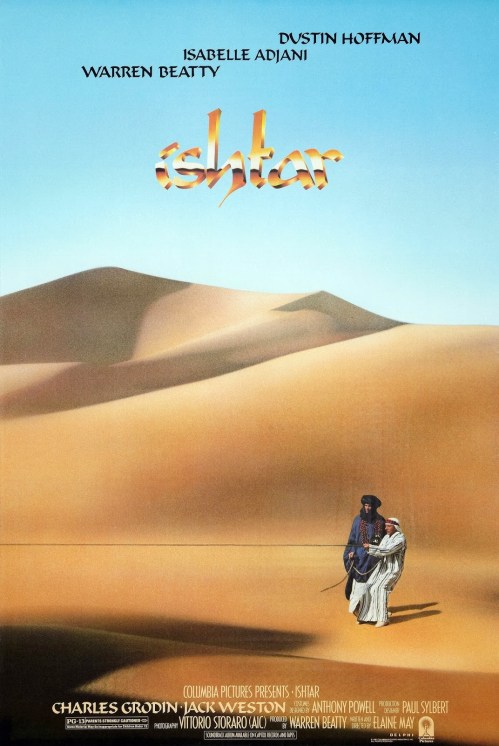
Ishtar (1987)

ishtar

By Richard Winters

My Rating: 2 out of 10

4-Word Review: Songwriters travel to Morocco.

Clarke (Dustin Hoffman) and Lyle (Warren Beatty) are losers-at-life that now in their middle-age years are convinced that they have talent as songwriters even though this opinion is shared by no one else. They manage to get themselves a talent agent (Jack Weston) who tells them that the only place he can get their act booked is at a club in Morocco. The two, desperate for any attention they can get, decide to take him up on the offer, but once they arrive they become swept up in international intrigue with the Emir of Ishtar and the CIA.

This film was a notorious flop in its day not only with its cost overruns, production delays and box office receipts, but with its behind-the-scenes discord between star Beatty and writer/director Elaine May. It seemed that critics and film goers alike considered it a bomb, but I came into this thing with an open mind. May has written some great scripts in the past and is known for her impeccably dry humor. I was convinced that in this day-and-age of broad comedy and over-the-top farces American audiences were simply not geared to pick up on the subtleties of the humor.

Unfortunately five minutes in it becomes painfully clear this thing is every bit as bad as its reputation states. The humor relies too heavily on the two main characters spending what seems like hours on end sitting around trying to come up with bad lyrics for their already dumb sounding songs and then singing them in an off-key, tone deaf kind of way. This may elicit a mild grin for a minute or so, but after spending the first twenty minutes on it, it gets really annoying. Even at the end as the two crawl on the desert floor they continue to work on these same lyrics, which by that time has become as dried up as the desert itself.

The insane, almost incoherent plotline is another issue. It’s like two diametrically different stories clashed precariously into one with only the thinnest of threads holding it together. What starts out as a sardonically amusing look at two middle-aged men chasing an elusive dream suddenly becomes the second reel of Raiders of the Lost Ark without warning. The wild array of loosely structured coincidences that the two go through as they reluctantly find themselves more and more inadvertently involved with the intrigue around them is so flimsily plotted and poorly thought out that it’s not even worth the effort to describe other than to say it makes little sense, is unexciting and most of all not funny.

The main characters are a turn off as well and not comically engaging as intended. The idea that two men hitting 50 would suddenly decide to chuck their relationships and jobs to chase after a songwriter career despite not getting any positive feedback from anyone else to convince them that they even possessed the ability to do it and which usually doesn’t pay well anyways seems weird and bordering on mental illness. Having the characters in their early 20’s and just starting out and willing to take any remote venue they could in order to get their first ‘big break’ would’ve worked better, or portrayed these middle-aged men as once being famous and now desperate for a comeback, or even has-been CIA agents caught up in one last case of intrigue. Just about any other scenario would’ve made more sense than the one that ultimately gets used.

Hoffman is a great actor, but his efforts here are wasted on the weak material. Beatty does well playing a dimwit and the scene where he ‘beats up’ on Adjani who he thinks is a boy is probably the only funny moment in the film. Isabelle Adjani though, who was dating Beatty at the time, is miscast in a role that doesn’t convey her talents and seems almost degrading especially the scene where she lifts up her dress at a crowded terminal and exposes her breasts in effort to prove to Hoffman that she is really a female.

This movie is in some way so amazingly bad that I was almost convinced that it was intentional and if that was the case then at least in that area it can be considered a success.

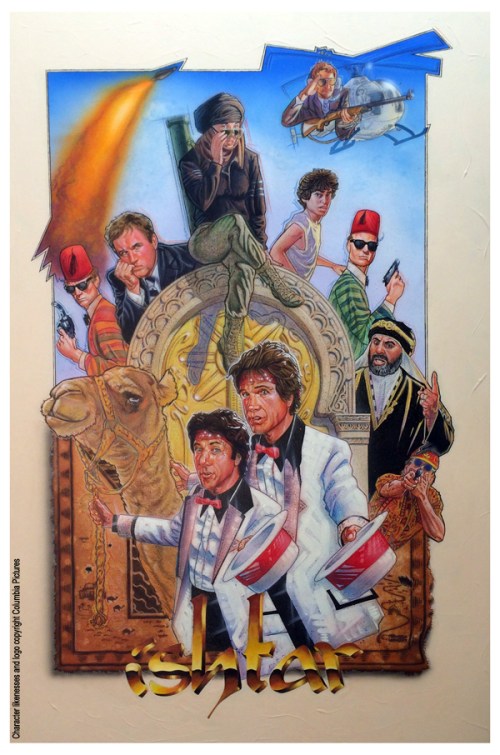
ishtar 2

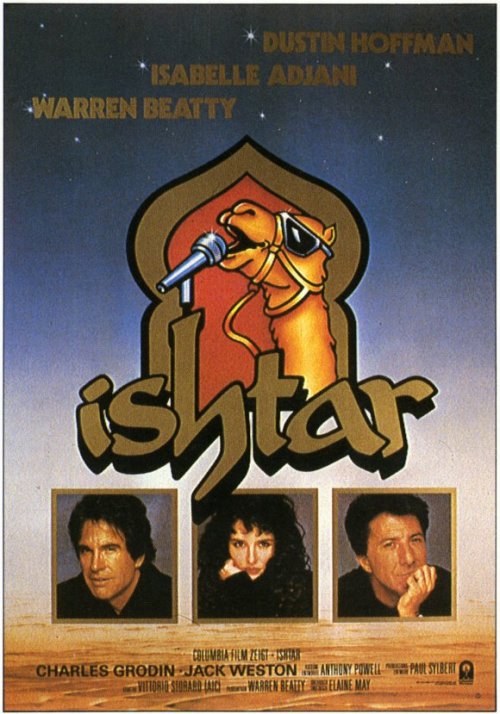
ishtar 3

My Rating: 2 out of 10

Released: May 15, 1987

Runtime: 1Hour 47Minutes

Rated PG-13

Director: Elaine May

Studio: Columbia Pictures

Available: DVD, Blu-ray, Amazon Instant Video

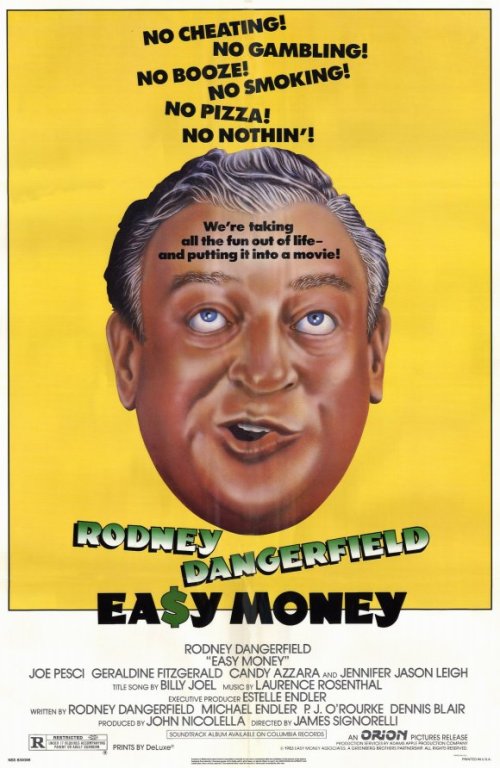
Ea$y Money (1983)

easy money

By Richard Winters

My Rating: 4 out of 10

4-Word Review: Breaking his bad habits.

Monty Capuletti (Rodney Dangerfield) is a married man with two teenage daughters who is trying desperately to make ends meet while working as a child photographer. His oldest daughter Allison (Jennifer Jason Leigh) is set to get married to a man named Julio (Taylor Negron) that Monty does not approve of. Attending the wedding is Monty’s rich, but hateful mother-in-law (Geraldine Fitzgerald) who promptly dies on her way back home. At the reading of her will she stipulates that she will give her entire fortune to Monty, but only if he gives up all of bad habits, which includes his drinking, gambling and drug use. Monty isn’t sure he can do it, but his eager family members try to coach him into trying.

This was Rodney’s first starring vehicle after his breakout success in Caddyshack, but the script doesn’t take advantage of his comic ability. The opening sequence in which the viewer gets an understanding of the character’s personality visually by having the camera pan through his cluttered work area is great and probably the best part of the whole movie, but trying to confine his edgy persona into the sterile role of a suburban dad isn’t effective. His wife, played by Candice Azzara, is much too young and good looking a woman and would typically be way out of his league. His daughters are also too attractive and he was already in his 60’s at the time, which made him much better suited for a grandfatherly role. A much funnier plot would’ve had him stuck with his adult daughters still living at home because they were too ugly to find suitors and his desperate attempts to con someone into marrying them just so he could get rid of them and be able to enjoy  his ‘golden years’ in peace.

The script is limp and doesn’t get going with its main premise until the second half with the first part dealing with the daughter’s on-again, off-again relationship with her new husband that goes nowhere and seems added in solely to pad the running time. The idea of Monty having to give up his bad habits is poorly thought out as well as there is no third party coming in to observe that he sticks with it, or hidden cameras placed somewhere to monitor him. It leaves everything up to his family members to ‘keep him on track’ even though they could’ve lied and covered up for him and his ability to cheat at any time was wide open.

The film also does not take enough advantage of the jokes that it does have. One scene has him, in a bout of frustration, swearing at a fat kid that is not behaving, but the camera never cuts back to the parent’s shocked expression, which would’ve been the best part. Another segment has Julio and his friend trying to sneak into Rodney’s house late at night in an attempt to win back Allison, but in the process they snap off the power lines connected to the home and knock out the electricity yet the film never gets the response of the rest of the household when this occurs and instead quickly cuts away and never comes back to it making it seem almost like it never happened. Last, but not least is a scene where Rodney gets an exercise bike for Christmas and tries it out only for him to go crashing into the Christmas tree and hitting his head against the window and yet no one jumps up to see if he is alright even though I would think that would be the most natural response for someone, especially family members, to do.

There is also a scene involving drunk driving, which I found interesting only because 5 years later the movie License to Drive also had a similar scene, but in that one it was somehow considered more controversial and labeled in bad taste even though the scene here I thought was worse because it was done by the main characters, or in this case Joe Pesci who plays Rodney’s best friend.

The segment where Rodney gets shot in the buttocks and forced to hang in midair at the hospital while his injuries are allowed to heal is quite funny as is the scene involving male runway models showing off Rodney’s latest ‘regular guy’ fashions, but outside of these two segments the film falls flat in a script that never gains any traction and is wildly unfocused. Billy Joel of all people sings the film’s title tune in a song that is catchy, but I’ve never heard played on the radio even though all the rest of his tunes seemingly are.

My Rating: 4 out of 10

Released: August 19, 1983

Runtime: 1Hour 35Minutes

Rated R

Director: James Signorelli

Studio: Orion Pictures

Available: DVD, Blu-ray

Grunt! The Wrestling Movie (1985)

grunt

By Richard Winters

My Rating: 4 out of 10

4-Word Review: Who is masked wrestler?

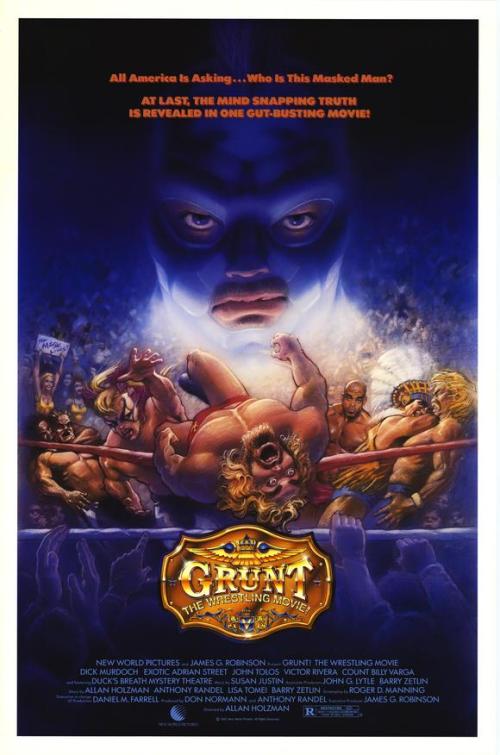
On October 13, 1979 Mad Dog Joe De Curso (Greg ‘Magic’ Schwarz) has a violent wrestling match with defending champion Skull Crusher Johnson (Greg Rivera). During the melee Johnson accidently gets his head stuck in the ringside ropes where Mad Dog decapitates him with one swift kick. The wrestling world then goes into an uproar with the biting question on everyone’s mind ‘Does a defending champion lose his title when he loses his head?’ that nobody, not even the commissioner seems willing to answer. After spending 90 days in jail Mad Dog gets released, but suffers from severe depression and eventually jumps to his death off of a bridge. Yet documentary filmmaker Leslie Uggams (Jeff Dial) thinks that Mad Dog is still alive and working under the disguise of a masked wrestler whose identity is unknown. Uggams begins a crusade of trying to unravel the mystery by interviewing those who knew Mad Dog best while also following the masked wrestler around to his events and trying to get to know both him and his French lady manager Angel Face (Lydie Denier).

The first 10 minutes of this thing is brilliantly bizarre that has just the right mix of offbeat humor, wrestling action and cinematic quality to make it interesting, original and hilarious. I am no wrestling fan myself, but director Allan Holzman manages, at least in the opening segment, to draw the uninitiated into the wrestling world by unfolding all the side dramas, storylines and over-the-top characters that fans of the spectacle find so enjoyable. The bit is also filmed in black-and-white with a sort-of foggy back drop that helps give it a surreal effect while also playfully making fun of the event and those who watch it.

Unfortunately the remainder of the movie is unable to sustain that same momentum becoming instead an overplayed one-joke that goes nowhere. It also spends too much time in the ring where the viewer is forced to watch one wrestling bout after another until it becomes more like a pay-per-view event than a movie.

One of the few non wrestling segments that I did enjoy is when the masked man and Angel Face go onto Wally George’s ‘Hot Seat’ TV-Program. George was a notoriously combative conservative talk show host during the ‘80s and the precursor to Rush Limbaugh and Bill O’Reilly. He was also the father to actress Rebecca De Mornay who has spent her entire career trying desperately to downplay that fact. Liberal guests would come onto his show and almost immediately be berated before being thrown off, which is what happens to the masked man and Angel Face, but not before George gets into the masked man’s face and demands he take it off, which is pretty funny.

Adrian Street, a wrestler who dresses in drag, is a scene stealer and the segment with the masked man being interviewed on his show is equally good. I also enjoyed Denier as the rambunctious manager who flashes an opposing player during one of the mask man’s wrestling matches and carries around a pet poodle who wears a mask similar to her clients.

The scene involving a bout between two lady wrestlers with the song ‘She Was a Mighty Big Girl for Her Age’ is good and the match where the masked man takes on four dwarf wrestlers is an absolute howl, but the film is geared too much to the hardcore fan and those with very little interest in the ‘sport’ will find it off-putting and overtly silly.

My Rating: 4 out of 10

Released: November 24, 1985

Runtime: 1Hour 29Minutes

Rated R

Director: Allan Holzman

Studio: New World Pictures

Available: VHS, DVD-R, Amazon Instant Video

The Happiness Cage (1972)

mind snatchers

By Richard Winters

My Rating: 5 out of 10

4-Word Review: They control his mind.

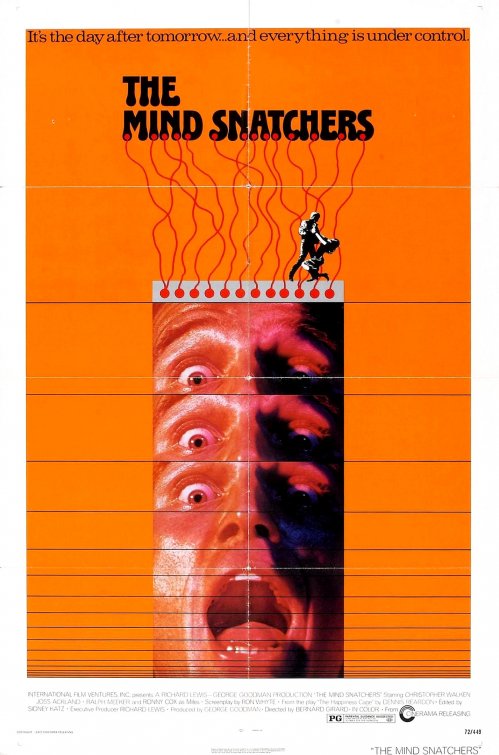
Christopher Walken plays James Reese a veteran of the Vietnam War who has issues with aggression. After numerous arrests he gets shipped off to a hospital in Europe run by Dr. Frederick (Joss Ackland) and overseen by a U.S. General (Ralph Meeker). There they do tests on the patients by implanting special devices into their brains that connects to their pleasure centers and can quell their aggressive behavior by having them feel a pleasurable sensation every time a button is pressed from a remote.

Walken’s performance is outstanding and Ronny Cox as his fellow patient is also quite good especially the part where he has the device implanted into his own brain, which turns him into a sad, pathetic, child-like state. Bette Henritze gives an interesting performance as well as a naïve, middle-aged nurse hired to make the patient’s stay more ‘happy’ by supplying them with books and board games only to be attacked and raped by Cox and then forced to play a game of checkers with him afterwards.

The story, which was based on a play by Dennis Reardon, certainly has its moments. In fact I was surprised how caught up into I got since the production values are close to appalling. The film was shot in Denmark in a building that looks like it was formerly a rundown mansion converted into a makeshift hospital for the sake of the movie. It all looks embarrassingly cheap and the idea of having a big hospital with a full-time staff and even a barbed wire fence and guard dogs, but only three patients is quite hard to believe.

Had the budget been bigger it might’ve been able to reach a broader audience. Bernard Girard’s direction is okay for the limitations that he was given, but the film’s faded, grainy stock and overall amateurish look becomes a turn off from the beginning and something that it cannot overcome. The plot itself is interesting, but the concept has been filmed before and with better results.

Alternate Title: The Mind Snatchers

My Rating: 5 out of 10

Released: June 28, 1972

Runtime: 1Hour 32Minutes

Rated PG

Director: Bernard Girard

Studio: Cinerama Releasing Corporation

Available: DVD, Amazon Instant Video

When You Comin’ Back, Red Ryder? (1979)

when you comin back red ryder 2

By Richard Winters

My Rating: 5 out of 10

4-Word Review: Terror at a diner.

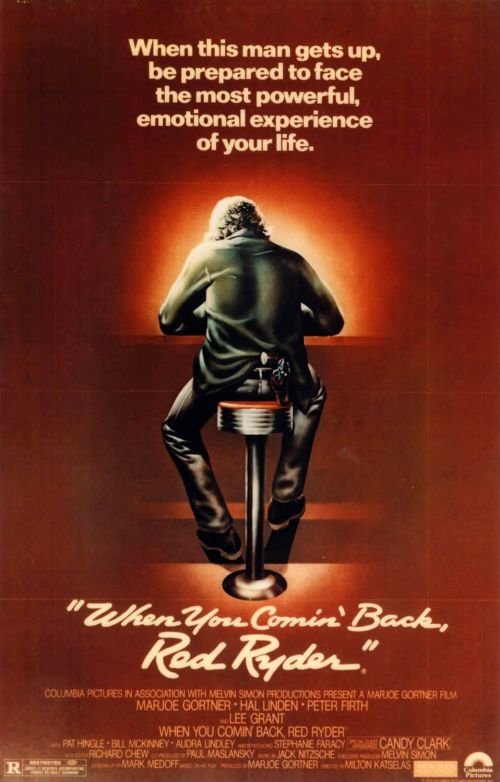
The year is 1968 and the setting is a small, lonely diner nestled at the border of Texas and New Mexico. Richard (Hal Linden) and his violinist wife Clarissa (Lee Grant) arrive for a morning cup of coffee. There is also Angel (Stephanie Faracy) the diner’s lone waitress and Stephen (Peter Firth), who was nicknamed Red during his youth due to his red hair at the time, but besides them the place is empty and peaceful. Then Teddy (Marjoe Gortner), an unhinged Vietnam vet and his hippie girlfriend Chery (Candy Clark) enter. They are without money and stranded with a broken down van, which makes Teddy particularly volatile as he begins harassing the others with evasive questions before eventually terrorizing them all by trapping them inside the place and forcing them to do whatever weird, sick thing he asks.

The film is based on the 1973 Off Broadway play by Mark Medoff, who also wrote the screenplay. In many ways it’s similar to the 1967 black-and-white drama The Incident in which Tony Musante and a young Martin Sheen trap several subway riders inside a subway car and spend the rest of the night terrorizing them simply for their own personal amusement.  Both films are structured the same with the first part examining the characters before they arrive at the scene and revealing a bit of the personal dramas that each of them face and then spending the second half showing them trapped in a claustrophobic setting and forced to deal with their reluctance at confronting their fears.

The 1967 film though outshines this one as there were more characters, which gave it a better variety of personalities as well as bad guys that were menacing and believable. Gortner is too much of a ham making him more irritating than scary. The part was originally played by Kevin Conway during its Off Broadway run and his performance won many accolades, which should’ve been enough for them to have offered him the chance to reprise the role here. Gortner, who also produced seemed intent at trying to use this as a vehicle to promote himself as being a ‘serious’ actor, but he was too old for the role from the beginning since he was already in his mid-30’s at the time this was shot while vets coming back from the war during the ‘60s where only in their late teens or early 20’s.

The film only gets mildly interesting during the confrontation sequence inside the diner, which takes 45 minutes of the film’s 2-hour runtime just to get there. The way the characters respond to Gortner’s scare tactics and the supporting cast’s performances, who are all far better actors than Gortner, is the movie’s only compelling element, but even here there are issues. The biggest one being that the people seem too wimpy and today’s viewers will get frustrated at how overly compliant they are to Gortner’s demands and never once try to overpower him despite having ample opportunity.

The movie is also notorious for featuring some rather shocking moments of nudity. It starts out with a full body shot of Candy Clark in the buff, who was married to Gortner in real-life at the time this was made and that isn’t too bad, but then it proceeds to later show 48-year-old Linden in nothing but speedo shorts doing sit ups with his butt crack clearly exposed. Still later there is a scene where 52-year-old Lee Grant has her shirt hoisted all the way over her head with her breasts in full view and then paraded around the diner in mocking fashion. The film’s most over-the-top moment though comes when Gortner himself is stripped naked and bent over a table while having a proctoscope shoved up his rectum as he continues to have a conversation with the man who’s doing it.

Filmed on-location in Fabens, Texas, which was also the site of a famous scene in The Gateway, and Las Cruces, New Mexico the movie just doesn’t convey enough tension to make it compelling or worth catching. It would’ve worked better had it skipped the first half dealing with the backstories of the characters, which was never a part of the original play anyways and just gone straight into the diner sequence while also casting a leading actor that had some actual acting training.

when you comin back red ryder 1

My Rating: 5 out of 10

Released: February 9, 1979

Runtime: 1Hour 58Minutes

Rated R

Director: Milton Katselas

Studio: Columbia Pictures

Available: VHS

A Zed & Two Noughts (1985)

zed 3

By Richard Winters

My Rating: 6 out of 10

4-Word Review: They’re really into decay.

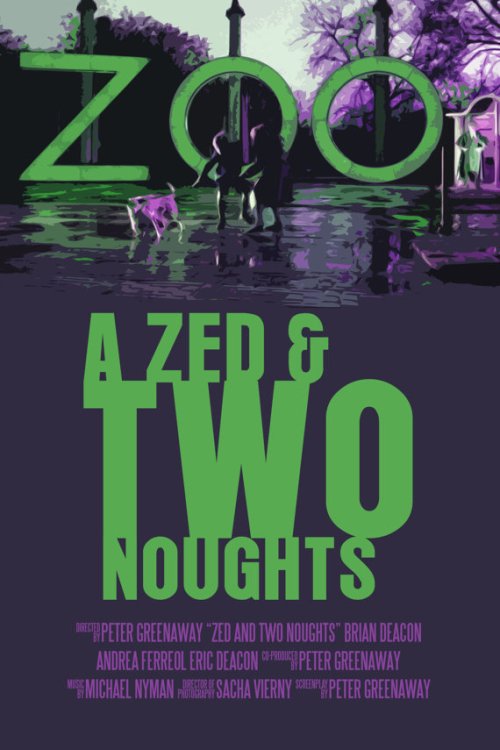
Oswald and Oliver (Brian and Eric Deacon) are twin brothers working at a zoo who become devastated to learn that both of their wives have died in the same freak accident in a car driven by Alba (Andrea Ferreol) who survives, but without her leg. Initially the brothers’ are angered with her, but this slowly grows into a strange attraction, which eventually forms into a ménage a trois. To help with their grief they begin doing time-lapse photography of the decaying process. They start with dead animals before deciding on a human subject with Alba as their chosen ‘star’.

From a completely visual level this film can be considered a great success. This was the first of ten projects that Director Peter Greenaway and cinematographer Sacha Vierny collaborated on and the result is stunning. The vivid contrasting colors, lighting and symmetrically designed sets make each and every shot look like its own painting. This is also one of the few films that completely transcend its era. Usually one can tell what decade a movie is from by watching it for only a few minutes, but this film is unlike any other ‘80s movie made, which is an achievement unto itself.

The best part of the movie is its depiction of the real-life decaying process captured in time-lapse form. I realize this may sound extremely morbid and ‘sick’, but it’s a natural process of the world we live in and if taken from a purely scientific perspective quite an interesting and fascinating phenomenon to watch. It gives the film a unique one-of-a-kind edge and something I wished had been shown even more.

The film’s drawbacks are the characters that come off as too weird and twisted, which is an issue in a lot of Greenaway’s movies that are always technically brilliant, but lacking in emotion or empathy. A good movie, no matter how ‘artistic’ it may be still needs relatable characters to help propel it and instead this movie has what amounts to mouth pieces in disguise as people who are simply used to relay a concept, but in no way connected to anyone you’d ever meet in real life. This results in leaving the viewer cold and making the film more of an ‘Avant-garde experiment’ than an actual story.

My Rating: 6 out of 10

Released: October 4, 1985

Runtime: 1Hour 55Minutes

Not Rated

Director: Peter Greenaway

Studio: British Film Institute

Available: VHS, DVD, Blu-ray

Harrad Summer (1974)

harrad summer

By Richard Winters

My Rating: 6 out of 10

4-Word Review: Bringing sexual liberation home.

The school year is over and now the students of Harrad, which is the college that teaches and promotes open sexuality, go home for the summer and put what they’ve learned into action in their everyday lives. Like in the first film this sequel focuses on just four of the students who find that their parents and friends are not as broad minded as they are, which causes friction in not only their relations with them, but with each other as well.

This film for the most part works surprisingly well. Director Steven Hilliard Stern takes more of a playful approach to the material and mixes in some funny moments that overall are quite entertaining. The wide variety of locales elevates the stagnant feeling that the first one had and it also manages to address a wider variety of issues.

The story is broken up into three segments with each one focusing on the student’s home lives as they visit each of their parents for 2-weeks at a time as a group. The first part, which deals with Stanley’s (Robert Reiser) folks isn’t too interesting and is fortunately pretty brief. The visit to Harry’s (Richard Doran) is the most comical and the film’s highlight while Stanley’s conflicts with Sheila’s (Laurie Walters) father (Walter Brooke) during their visit to her folks seem contrived and pointless. The film never manages to get to Beth’s (Victoria Thompson) parents, which is probably just as well.

The film’s biggest drawback is that neither Don Johnson nor Bruno Kirby, who were so good in the first film, reprises their roles here and their absence is sorely missed as  Reiser and Doran don’t have the same acting talents and are quite weak in comparison. Thompson, who was blonde in the first film, now has, with no explanation, jet black hair, which makes her look exactly like her sister and fellow actress Hilary Thompson. Also, Emmaline Henry, who was best known for playing Mrs. Bellows in the ‘60s show ‘I Dream of Jeannie’ replaces Tippi Hedren who was unavailable for the sequel and James Whitmore’s role gets taken out completely.

The supporting cast is what gives the film its spark. Comedian Marty Allen, whose hair looks like the ultimate bird’s nest and usually gets more attention than his comic ability, is fun as a drunken party guest. However, Pearl Shear, who plays his wife, is the real scene stealer as an overweight middle-aged woman, who in Mrs. Roper-like fashion, eagerly wants to get involved with the kids and their new found sexual liberation and even takes part in a nudist session with them.

Bill Dana, famous for creating the Jose Jimenez character, is quite good as well playing Harry’s staunchly conservative father who can’t deal with the open sexuality of the younger generation only to surprisingly come around to it at the very end. He also gets the film’s best line when after denying to Harry that he ever had any affairs finally admits “Maybe I did a couple (women) in Vegas and a few in Cleveland, but what else is there to do in Cleveland.”

My Rating: 6 out of 10

Alternate Title: Love All Summer

Released: August 6, 1974

Runtime: 1Hour 43Minutes

Rated R

Director: Steven Hilliard Stern

Studio: Cinerama Releasing Corporation

Available: DVD

Hamburger: The Motion Picture (1986)

hamburger

By Richard Winters

My Rating: 1 out of 10

4-Word Review: Receiving a hamburger education.

Russell (Leigh McCloskey) has flunked out of several colleges and has no future plans while being deemed a failure by his parents (Robert Hogan, Lillian Garrett). Then he meets a franchise owner of Busterburger who tells him about how much money he can make as an owner of one of their restaurants, which convinces him to train to become a franchisee. The problem is that he must attend Burger U, which is run by the no-nonsense Drootin (Dick Butkus) who has strict rules and won’t even allow the students to leave the campus during the school semester. They are forced to sleep in beds that look like giant hamburgers and if they do get into trouble they are locked into cells made to resemble giant pickles and sprayed with hot sauce.

There are schools out there that train people on how to own their own fast food franchise and had this film toned down the silliness and keep it solely on a satirical level it might’ve worked. The opening 10 minutes has an over-the-top campy quality, which isn’t bad, but then it devolves into the crude, cartoonish mindset that drags the thing down until it becomes a forgettable waste of time.

The film was written by Donald Ross who penned many teleplays for TV-series from the ‘70s through the ‘90s. He is also the husband of Patti Deutsch a red haired, nasal voiced woman who was a quirky contestant on game shows during the ‘70s including ‘Match Game’, which is my favorite. They also appeared together as a couple on ‘Tattletales’ and in those instances he came off as a reasonably intelligent person, so I was expecting a little bit more from this than what I got.

Unfortunately there’s nothing funny about it and just proceeds to get dumber and dumber as it progresses. It’s also insulting to overweight people as it includes a highly offensive and gross scene where a busload of them come into a restaurant and eat everything in sight like they’re animals instead of humans and then proceed to all have a flatulence attack, which ultimately blows the whole place up.

Former Chicago Bears linebacker Butkus is alright and the one highpoint of both the film and his otherwise unimpressive acting career. Chuck McCann, who is almost unrecognizable as an eccentric professor, is okay too, but star McCloskey is dull and looks more like a man in his 30’s, which he was, than a college aged student while the rest of the cast of characters are too exaggerated to be either interesting or funny.

Clearly the producers were trying to tap into the Police Academy formula, but it doesn’t work and is a complete embarrassment to all those involved.

My Rating: 1 out of 10

Released: January 14, 1986

Runtime: 1Hour 29Minutes

Rated R

Director: Mike Marvin

Studio: Busterburger Limited Partnership

Available: VHS

The Harrad Experiment (1973)

the harrad experiment

By Richard Winters

My Rating: 6 out of 10

4-Word Review: College promotes sexual freedom.

Based on the novel by Robert H. Rimmer the story centers on a group of students who attend a socially progressive college where sex between multiple partners is expected and promoted. The school is run by Phillip and Margaret (James Whitmore, Tippi Hedren) who feel conventional marriage is an unrealistic ideal that creates the idea of ‘ownership’ over someone else, which in turn causes jealousy. They hope to end these problems and change the cultural norms by having the next generation accept more of a group marriage mentality.

The film nicely avoids the smarmy T&A factor by portraying nudity in a natural non exploitative way while also having characters that are believable and a good representation of the young generation from that era. The different ways that the students respond to the unique environment and the realization that they aren’t quite as sexually liberated as they thought remains the story’s focal point of interest.

The film also allows for a great chance to see young stars in the making. Laurie Walters, who later went on to star in the TV-show ‘Eight is Enough’, gives a sensitive portrayal of a young woman who’s still shy about her body and not quite ready to enjoy sex outside of the bounds of romance as she had initially thought. Bruno Kirby is good as well playing a student who’s so filled with insecurities that it prevents him from having any sex at all. Don Johnson though gives the best performance as a cocky student who uses the program simply as a way to ‘score’ with women only to later learn that even he needs some emotional bonding too.

The always reliable Whitmore is solid as the stoic instructor and Hedren gets one of her best roles outside of her most famous one in The Birds with her titillating moment coming near the end when she strips off her clothes and tries to entice Johnson to make love to her right out in the open and in front of everyone. Actor Ted Cassidy, who co-wrote the script, can also be seen briefly sitting at the counter of the local café.

Although the film does manage to bring out a few provocative elements I still felt even without having read the novel that is was only skimming the surface. Having the story focus on only a few of the couples isn’t as captivating as it could’ve been had it instead taken a broader look at all of the students. The low budget gives the production a cheap look and a few too many sappy love songs get thrown in an attempt to turn it into a ‘70s romance instead of keeping it more of a psychological drama that it should’ve been.

A sequel called Harrad Summer, which follows these same students who take what they’ve learned and try to implement it into their adult lives, was released one year later and that will be reviewed later on this week.

My Rating: 6 out of 10

Released: May 11, 1973

Runtime: 1Hour 37Minutes

Rated R

Director: Ted Post

Studio: Cinerama Releasing Corporation

Available: VHS, DVD

The Visitors (1972)

visitors 1

By Richard Winters

My Rating: 3 out of 10

4-Word Review: His past comes back.

Vietnam veteran Bill (James Woods) has moved back into civilian life while enjoying the quietness of the country with his girlfriend Martha (Patricia Joyce) and her infant son. One day in the dead of winter while Bill is away shopping two of his former war buddies Tony and Mike (Chico Martinez, Steve Railsback) come by for an unexpected visit. When Bill returns he is not happy to see them and when Martha asks him why he tells her of how while in Vietnam he had witnessed the two raping a woman and later he decided to report it, which got the two men sent to prison. Now that they are out he is afraid they may be looking for revenge. Tony insists that he’s forgiven Bill for what he did, but Mike’s intentions are much more ominous especially with the way he eyes Martha. As the night wears on the tensions mount until festering over into anger and mayhem.

The story is loosely based on an actual crime that occurred in Vietnam on November 19, 1966 when five American soldiers kidnapped and gang raped a 21-year-old Vietnamese woman who they later killed. One of the soldiers, who did not take part in the crime, but did witness it, reported the incident to his superiors, which eventually got the other men convicted and imprisoned.

The incident was first made into a movie in 1970 in Michael Verhoeven’s o.k. and then 19 years later Brian De Palma did another version of it called Casualties of War, which starred Michael J. Fox. This version differs from the other two in that it only alludes to the crime, but never shows it. Instead it hypothesis on what might’ve happened had those who were convicted came back to revisit the one that had turned them in.

Story wise the film works to a degree as it reveals things in layers, which helps hold the mystery and filming the majority of it inside one lonely, isolated house gives it an effectively claustrophobic feeling, but the production values are extremely low and resembles more someone’s lost home movie than a feature film directed by a one-time Hollywood legend. The background sound is mainly made up of a howling wind noise, which helps heighten the creepiness, but then during the second half director Elia Kazan inserts music, which becomes a distraction.

The ending leaves open a wide array of unanswered questions along with a lot of murky character motivations that makes the whole thing seem pointless and ill-conceived. The only interesting element to get out of it is seeing Woods and Railsback in their respective film debuts. Railsback is especially good in a part he seems born to play and one he honed to even greater success years later in The Stunt Man.

My Rating: 3 out of 10

Released: February 2, 1972

Runtime: 1Hour 28Minutes

Rated R

Director: Elia Kazan

Studio: United Artists

Available: Amazon Instant Video