Category Archives: Movies with a rural setting

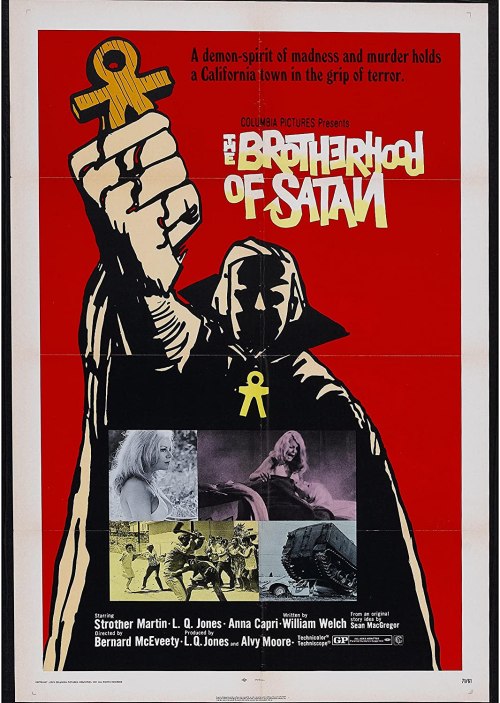
The Brotherhood of Satan (1971)

By Richard Winters

My Rating: 7 out of 10

4-Word Review: Devil worshippers kidnap children.

Ben (Charles Bateman) and his girlfriend Nicky (Ahna Capri) along with Nicky’s 9-year-old daughter K.T. (Geri Reischl) are driving through the New Mexico desert when they come upon a gruesome car accident where the vehicle and people inside it were crushed by some unknown force. When they go into the nearby town to report it they find the people there to be acting strangely and showing an unhealthy liking to their daughter. This causes them to get back into their car and drive away, but a blow-out tire forces them to return and face head-on a secret group of Satanists lead by Duncan (Strother Martin) the town’s doctor.

This movie, with a script written by Sean MacGregor who would later go on to direct another horror movie dealing with children called Devil Times Fiveis interesting in that it gives very little away. The viewer is as confused as the lost family about what is going on, which makes for a refreshing change-of-pace from the conventional horror, which always seems to feel the need to spell everything out instead of forcing the viewer to try and piece things together on their own. It also makes one feel like they’re in the same shoes as the family and more sympathetic to their quandary since you’re essentially going through the same confused state as they are.

Director Bernard McEveety allows the creepiness to take precedent over the plot. I loved the way it takes full advantage of the isolation of the town, filmed on-location in Hillsboro, New Mexico, which sits in the southwest portion of the state. I’ve driven through New Mexico several times and have always found the desert landscape there to be boring, but McEveety puts this to good use especially when the daughter goes missing and the camera does a full 180 degree turn showing how vastly desolate the region is and making the parent’s desperate search even more frantic.

The plot’s drawbacks centers around the unlimited cosmic power that these devil worshippers seem to have where they’re able to kill people through children’s toys without the culprits themselves being physically present. They’re also able to trap people in the town, and not allow any outsiders in, in ways that is never made completely clear. Having limits to the powers and showing how the group is able to implement them would’ve helped fill-in-the-blanks that is otherwise missing. To a great extent I felt it would’ve worked better had there been no magical powers at all and members of the group, the majority of them being elderly, would’ve had to do the evil deeds themselves. Watching otherwise harmless looking old people kill the various parents of the children they kidnap would’ve been far more startling to see then just having people fall over dead after looking at a child’s toy.

The idea that the sheriff and the deputy (L.Q. Jones, Alvy Moore) would be completely in the dark and not know about a satanic group secretly meeting in the town they lived in didn’t seem believable. I was born and raised in a small town, that was slightly more populated than the one portrayed here, and believe me word travels fast in those locations. Rumors and gossip are the way of life. It’s simply impossible to keep any type of secret, especially one as massive as this. The fact that the sheriff and deputy could live there and mingle with everyone and not get some inkling of suspicion is just too hard to believe. Since the group had all these massive magical powers anyways that they used to kill everyone else why didn’t they also then use it on the sheriff to get rid of him and then their problems would’ve been over, but they don’t, which creates a major plot hole.

However, if you approach the film for its creepy atmosphere alone then it’s still a winner. I liked too that very little music gets used and when it does it’s very subtle. Too many other horror films feel the need for a loud, booming score that usually gets in the way. If the atmosphere is done right there should be no need for excessive music in fact one of the creepiest moments in the movie for me is watching a brainwashed young child, played by the director’s young son, walk out of his own home and into the dark stillness of the night, with only the sound of the night breeze being heard.

My Rating: 7 out of 10

Released: August 6, 1971

Runtime: 1 Hour 32 Minutes

Rated PG

Director: Bernard McEveety

Studio: Columbia Pictures

Available: DVD, Amazon Video, YouTube
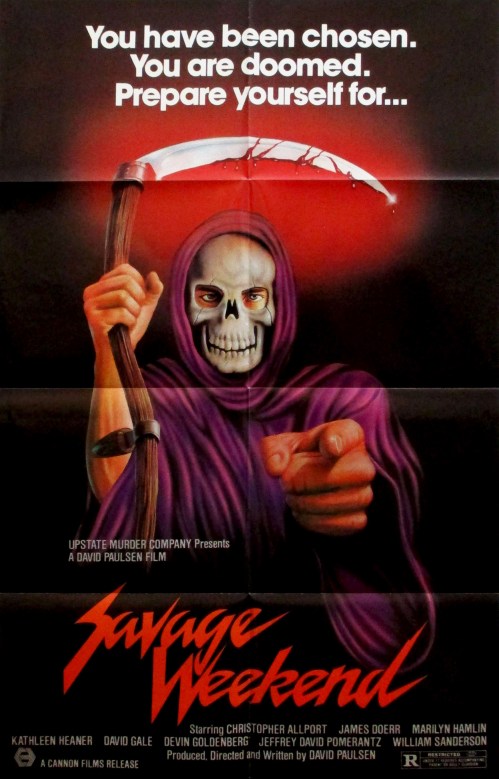
Savage Weekend (1980)

By Richard Winters

My Rating: 6 out of 10

4-Word Review: The first slasher movie.

Maria (Marilyn Hamlin), who has a very contentious relationship with her ex-husband Greg (Jeff Pomerantz), but who is now in a relationship with Robert (Jim Doerr) a successful businessman, decides to take a weekend trip with some friends to upstate New York. Robert is having a large boat built there and wants to see its progress. The quiet country atmosphere seems like the perfect spot to getaway until a masked killer shows up killing each of them one-by-one.

While Halloween typically gets credited as being the forerunner to the modern day slasher film it’s actually this one that was the first and don’t let the release date fool you. This was filmed in the summer of 1976, a full two years before Halloween came out, but was shelved by its distributors as they thought the concept of a mysterious masked killer was ‘too weird’ and wouldn’t catch on only to eventually release it to theaters once they saw the success of Halloween.

The concept for this came about completely by accident. Writer/director David Paulson was originally hired to write a screenplay for a completely different type of movie, but the investor then retracted the majority of the money he promised leaving Paulson with a mere $20,000 to work with. He decided with such little funds he’d be forced create a story that required a single setting and then came up a scenario that would make the characters stay there and thus the killer-on-the-loose idea was born.

The critics were originally not kind: TV Guide subscribed this as a ‘reprehensible exploitation film’ and ‘the gore effects are extremely gruesome’, which just isn’t true. At best the blood is quite minimal especially when compared to today’s slashers. In fact you’ll find more explicit gore in modern dark comedy films like Shaun of the Dead than you will here.

Critic Joe Baltake criticized the Nicky (Christopher Allport) the gay character stating that he ‘set gay rights activism back several decades’, which I totally disagree with. I actually liked Nicky and was impressed at the way he walked into a backwoods bar and when the rednecks tried to hassle him he single-handedly kicked their asses, which to me worked completely against the gay stereotype.

Through the years critics have become much kinder to this film and its attained a strong cult following and deservedly so. Despite being made 4 decades ago it actually comes off as fresh and inventive because it’s not stifled by the conventional ‘rules’ of the formula, which we’ve become so accustomed to now. I liked how the film opens with a point-of-view shots of our heroine running madly through the forest making the viewer feel they’re the ones being chased.

The fact that the majority of it takes place during the daytime actually makes it scarier especially with it’s weird yellowish tint that permeates every shot. I’m not sure if this was intentional or just a poor film transfer, but it helps to create a surreal look. I also really loved seeing the skeleton of the large boat that was being built inside an abandoned shed. I presume with the low budget this was not made for the story and instead simply worked into the script when the producers came upon it while scouting for locations, but the effect is cool especially when the cast walks around inside it.

The soundtrack is way different from the conventional horror film as well with a country tinged sound and at one point even a classical dance piece, but after watching soooo many scary movies with the same old Friday the 13th-like sound I was more than happy to hear something different. The characters are also multi-dimensional with distinctive personalities. Usually I more than happy to see a cardboard slasher film cast get hacked-up, but here I kind of wanted them to stay around as they were interesting. The murders also don’t work in a mechanical way, but instead start occurring suddenly to the shock of everyone else, which gives it more of a real-time feel.

The only real negative is that despite having a strong beginning and ending the middle part is slow. There’s still enough interactions between the characters to hold mild interest, but there’s no running tension. A good horror movie should be creepy to some degree from beginning to end, but the second act veers off too much making it at times seem more like a soft core porn flick, but overall for the horror connoisseur I’d still recommend this.

My Rating: 6 out of 10

Released: November 14, 1980

Runtime: 1 Hour 28 Minutes

Rated R

Director: David Paulsen

Studio: Cannon Group

Available: DVD, Blu-ray (Region 1), Amazon Video

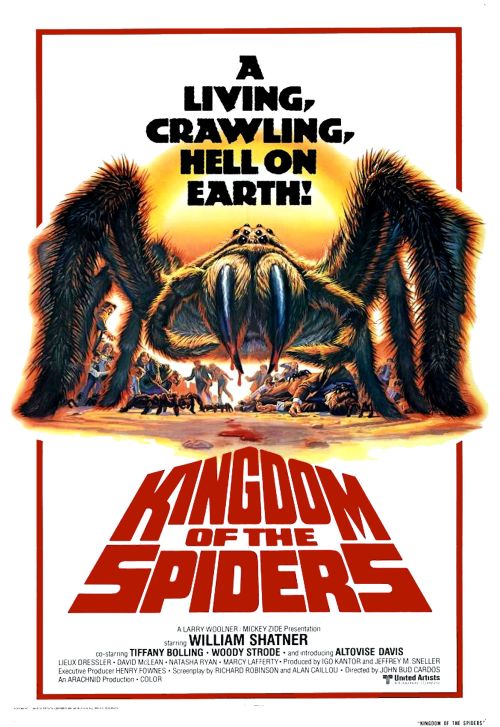
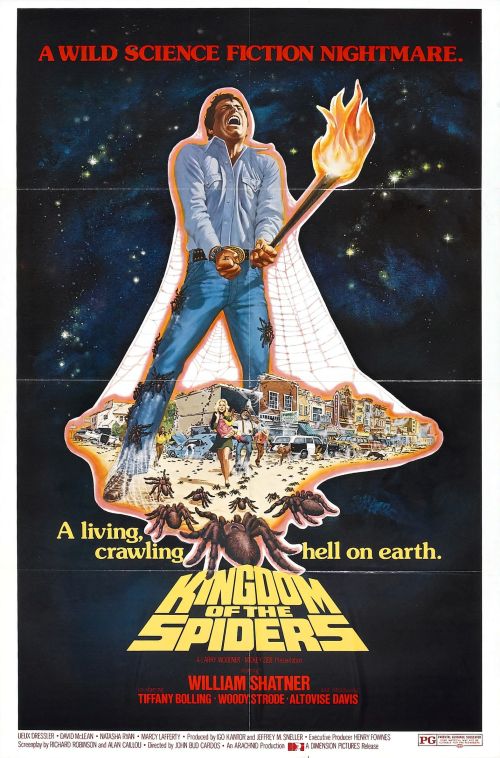
Kingdom of the Spiders (1977)

By Richard Winters

My Rating: 4 out of 10

4-Word Review: Tarantulas take over town.

Rack (William Shatner) is a veterinarian residing in a rural Arizona town who gets a call one day from a local rancher (Woody Strode) complaining that his prize calf has come down with a mysterious illness. Rack examines the animal, but can’t come to any conclusion so he sends the animal’s blood sample off to a university lab. Diane (Tiffany Bolling) a arachnologist then arrives telling him that the animal was killed by a massive dose of spider venom. At first Rack does not believe her, but as more animals and then eventually people start to fall prey to the same aggressive spiders the two soon pair up to help try to save the rest of the town and themselves.

Over $50,000 of the film’s $500,000 budget was spent on procuring 5,000 tarantulas for the film’s shoot, but personally I didn’t think it was enough. Shots showing the spiders ‘invading’ by having them lining the town’s roadways weren’t really all that frightening because there was still ample space between the spiders that a person could easily step around them and not get bit. The spiders are also very slow, so a potential victim should have plenty of time to get out of the area once they saw them converging.

The idea that the spiders are doing this is because of the heavy use of pesticides doesn’t logically work. For one thing spiders are not like ants and do not create working colonies. They are anti-social and do things alone. They can even be cannibalistic, which is why the production crew was forced to keep each of the 5,000 tarantulas in separate containers to avoid having them eat each other. With this all in mind why then would they begin behaving in ways that’s so unnatural to their species? Being desperate for a new food source is one thing, but how could the spiders communicate with each other to get them all to work together that are completely alien to their nature? Sometimes it’s very hard to get humans to work together even when they know it’s in their best interests, so suddenly getting an anti-social species to do it is breaking astronomical odds.

Another issue is how do these spiders suddenly get so smart? For instance the spiders sneak onto a crop duster plane and kill the pilot (Whitey Hughes) who was going to spray down a pesticide that would’ve destroyed their spider hills, but how would spiders have the sophistication to know that was what he was doing? Spiders cannot speak or understand English, so it’s not like they could’ve ‘overheard’ what the people were planning to do and then went on the counter-attack though that’s ultimately what the movie tries to convey happened.

The film is too dependent on viewers being creeped out at the sight of spiders and hoping that will be enough to carry through for the entire movie as pretty much nothing else happens that’s genuinely scary. Just a lot of shots of spiders slowly moving around while the actors scream in horror and try to flick them off and that’s about it. The ultimate irony is that tarantula bites are not lethal and will cause only a minor irritation similar to that of a bee sting.

Spoiler Alert!

I did however like the film’s ending which has the spiders covering the entire town with a giant cobweb. While it’s obvious that the shot of the cobweb over the town is clearly that of a painting I still felt it was a cool concept, but this needed to come in to play during the second act. Showing how the people fought through this new dilemma would’ve given the story a more creative direction instead of just waiting to the very finish to introduce it and then abruptly ending just when it finally started to get interesting.

My Rating: 4 out of 10

Released: August 24, 1977

Runtime: 1 Hour 35 Minutes

Rated PG

Director: John ‘Bud’ Cardos

Studio: Dimension Pictures

Available: DVD, Blu-ray, Amazon Video

Fright (1971)

By Richard Winters

My Rating: 4 out of 10

4-Word Review: Psycho torments a babysitter.

Amanda (Susan George) is a college student who earns money part-time by working as a babysitter. One night she takes a job with the Lloyds (Honor Blackman, George Cole) who assign her to watch after their sleeping toddler (Tara Collinson) at their isolated wooded estate while they go off to a dinner party. Once the couple leaves Amanda begins hearing strange noises and becomes convinced that someone outside is watching her unaware that Mrs. Lloyd’s ex-husband (Ian Bannen) has escaped from the nearby insane asylum and now looking to attack anyone inside.

While the babysitter-terrorized-by-a-psycho theme may now be considered a cliché with such popular films as Halloween and When a Stranger Calls having successfully done it it’s important to realize that this film did it first and to some extent does pretty well although it does veer off from the formula. I did like the creepy set-up where an extended amount of time is given to building up the atmosphere. Some of the best moments are seeing the shadowy images on the other side of the window and not knowing who it is. The film is most effective when it’s seen from Amanda’s point-of-view making the viewer feel trapped inside the home alongside her, but weakens when it cuts away to the outside, which lessens the tension.

Having Amanda’s boyfriend Chris (Dennis Waterman) arrive doesn’t help. The fear hinges on Amanda feeling that she is all alone in this big strange house in the middle-of-nowhere and entering more people into the mix takes that element away.

The film is unusual in that unlike the other thrillers with a similar plotline the parents here figure heavily into the story. Instead of just focusing exclusively on the babysitter the films consistently cuts between her scenes and the scenes of the couple at the party. In many ways its the mother that becomes the real star, which is fine to an extent, but the part is played by Honor Blackman, a very gifted actress, but at age 46 was looking way too old to be the mother of such a young child.

The film is also unusual in that when the police arrive it doesn’t just end in fact that’s when it starts to get going with the entire third act filled with this long protracted stand-off. To some degree I felt this made it more realistic as real-life hostage situations can happen with long ‘negotiating’ session between the police and the person inside. Police aren’t always able to immediately take control of a situation either and can sometimes be just as helpless as the victim, but in the process this approach takes away the confrontational element between Amanda and the psycho, which would’ve been more interesting at seeing how she could use her wits to outsmart the bad guy that never really gels.

Susan George really doesn’t figuring in as much of the action as you’d initially expect spends most of the time just crying and looking scared. The 3-year-old child, which was played by the daughter of the film’s director Peter Collinson, doesn’t help matters either. I found it very hard to believe that any child could remain asleep such as this one when Amanda and the psycho stood over her crib talking and at certain points even shouting. The child never screams or cries either even when a sharp piece of a broken-off mirror is put to her throat.

Bannen can be amazingly creepy, I enjoyed his work in The Offence where he played a suspected child killer being interrogated by Sean Connery, but here he’s given a bit too much latitude and becomes a caricature. Having him seesaw between being child-like to behaving aggressively comes off as manufactured and more strained than frightening.

Spoiler Alert!

The ending, in which Amanda shoots and kills the psycho, does not work. For one thing Bannen had already handed over the child to the mother and at that point was completed surrounded by the police with nowhere to run, so killing him wasn’t needed. It’s questionable how and where Amanda got the gun, supposedly it was the one that an officer had put down earlier, but how she was able to sneak up and get it from him is never explained. Also, she had most likely never shot a gun before, in Great Britain most people don’t own guns, so she’d probably not have been able to hit him, especially in her shaky emotional state, at a long distance, which makes this scene dumb and unnecessary.

My Rating: 4 out of 10

Released: September 18, 1971

Runtime: 1 Hour 27 Minutes

Rated PG

Director: Peter Collinson

Studio: British Lion Film Corporation

Available: DVD, Blu-ray, Amazon Video

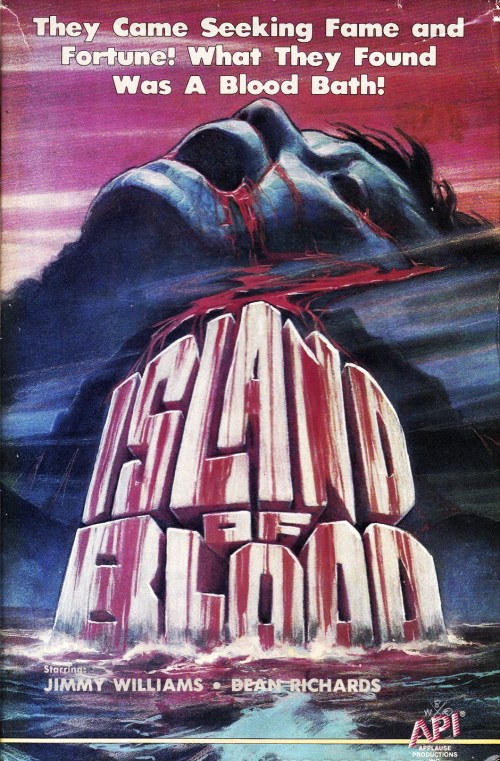
Island of Blood (1982)

By Richard Winters

My Rating: 3 out of 10

4-Word Review: Killer stalks film crew.

The cast for an upcoming horror film travel to an island where the film is to be made. Since the film’s producer and director won’t arrive until the next day they get ready for their parts, but find that each of them is getting offed one-by-one by a mysterious killer that they cannot see, but who leaves a portable tape player hanging near the body of his latest victim that plays a rock song with violent lyrics.

This low budget attempt had potential, but goes about it in all of the wrong ways. One of the things that really stood out to me since I’ve worked as a crew member on several low budget films myself is that the characters here act in a completely opposite way from how a cast and crew would normally behave on a real set. I have found most people when thrown together onto a crew of people that they do not know would make attempts to form friendships and potential contacts with their fellow crew/cast members. Here though the cast members, who are made up of young adults, act like they’re still in high school and more concerned with putting up pretentious facades to prove how ‘cool’ they are while putting down everyone else around them.

I also couldn’t believe the amount of open apathy these same characters show the screenwriter when he hands out the script and describes to them what the plot is about. Someone should’ve advised these ‘up-and-coming’ young starlets that when you’re starting out in the business it might be a good idea to at least fake enthusiasm for what you’re going to be working in, or it just might be the last film you’ll ever be asked to be in. Word-of-mouth travels fast in this business and if you get a reputation of being someone who really doesn’t care to be there then you’ll never get hired again as there’s plenty of other people out there willing to take your place.

As for the killings they’re not very impressive although the shot of a dead woman with nails going through her forehead, via a nail gun, would’ve been creepier had her eyes remained open instead of closed. The fact that we never see the killer does actually make it a little bit scarier simply because it’s completely left up to the viewer’s imaginations about who this person is. The chase sequences though don’t work as they all take place in these darkened buildings, the result of a power outage, so you really can’t see exactly what’s going on. I also thought that having the arriving producer die by having his boat explode, which was apparently caused by the killer, was a bit ridiculous because how could the killer go from being on an island one minute to on a boat at sea the next in order to plant the bomb?

The film does have a twist ending, which reviewers over at IMDb seemed to like and while it is a surprise to some extent it really doesn’t completely work. Way too many unanswered questions and loopholes get thrown in that never get explained.

The concept would’ve worked better, and been ahead-of-its-time, had it taken the BLAIR WITCH PROJECT  approach where a centralized cast member would film the behind-the-scenes action of this upcoming production and interview the other cast members as they got ready for it. She could then use her camera later on to do detective work to try and catch the killer.

My Rating: 3 out of 10

Released: July 9, 1982

Runtime: 1 Hour 22 Minutes

Not Rated

Director: William T. Naud

Studio: Action International Pictures

Available: Amazon Video

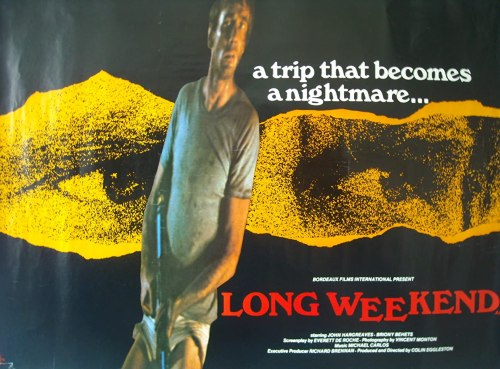
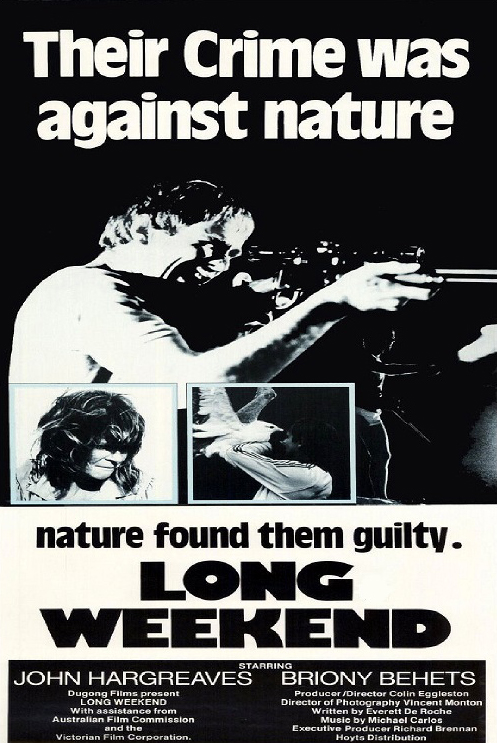
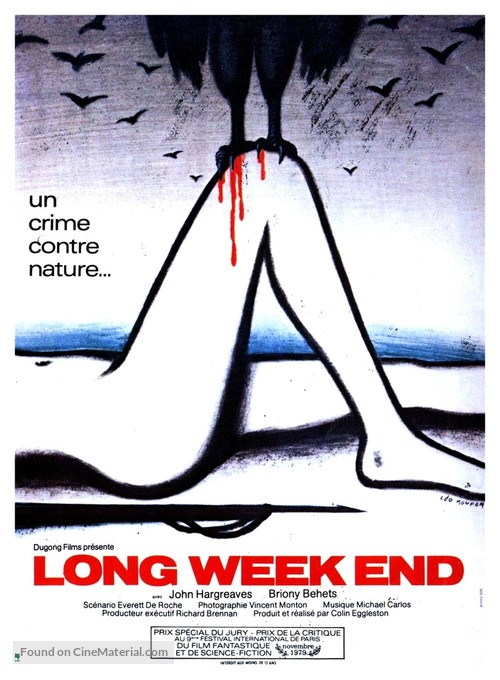
Long Weekend (1978)

By Richard Winters

My Rating: 7 out of 10

4-Word Review:  A couple battles nature.

Peter (John Hargreaves) and Marcia (Briony Behets) are a young couple who are constantly at odds with each other. To help smooth things over they decide to take a trip into the wilderness and enjoy the beauty of the outdoors. Along the way they accidently hit and kill a kangaroo with their vehicle. This sets off a chain-of-events that puts them under the increasing attack of various animals. First Peter must fight off an angry eagle who swoops down at him without warning. Then a possum and even a sea cow who stalks Peter while he is swimming. The two decide they must leave the area in order to save their lives, but everywhere they turn there’s another animal waiting for them.

The story idea is certainly an interesting one, but the concept is too wide-open. Scriptwriter Everett De Roche stated that the premise was all about how Mother Earth had her own auto- immune system and when humans started acting like cancer cells she’d attack, which is great, but why just this couple? There are millions of people who behave just like them, so why don’t they end up getting the same treatment?

The plot needed an extra spin to hold it all together, but it never comes. Having this small remote place hold a mystical power that allowed animals to behave differently than they would normally do elsewhere would’ve at least given it some needed focus. Perhaps a backstory too where other people would’ve gone to this same locale and complained about being attacked. Any extra plotline would’ve helped because the idea that these animals would just randomly attack a generic couple in some isolated moment in time that they never did before or after just doesn’t cut-it.

I didn’t like either that the couple bicker right away, but then later on become lovey-dovey only to proceed back to bickering, which is too bipolar. A better approach would’ve had them getting along at the start and then with the stress of the animal attacks tear their relationship apart, which would’ve created a more interesting character arc, which otherwise is non-existent.

I would’ve preferred that the lead characters been played by macho men who arrogantly tear up the wilderness with their SUV’s and kill the animals for shameless sport. Watching these ‘tough guys’ then unravel once the animals went on the offense turning them into sniveling, frightened cowards would’ve been far more of an entertaining payoff while hitting-home the importance to respect nature  in a more stark way.

The animal attacks aren’t all that riveting and take up very little of the runtime, but the creepy atmosphere is amazing. Filmed on the island of Tasmania I enjoyed the point-of-view shots of the SUV driving through the long, tangled unique looking trees that grow down there where when captured at night and through the beams of the vehicle’s headlights come off looking like gnarled fingers protruding from the ground. The intense music and haunting call of the sea cow are also quite unsettling and get even more so as the couple continues to hear it, which helps to make this a memorable horror flick despite the few drawbacks and a great example at how strong directing can help overcome a flat script. Remade in 2008.

My Rating: 7 out of 10

Released: October 2, 1978

Runtime: 1 Hour 35 Minutes

Not Rated

Director: Colin Eggleston

Studio: Hoyts Distribution

Available: DVD, Blu-ray (Spanish), Amazon Video, YouTube

Stroszek (1977)

By Richard Winters

My Rating: 8 out of 10

4-Word Review: Germans relocate to Wisconsin.

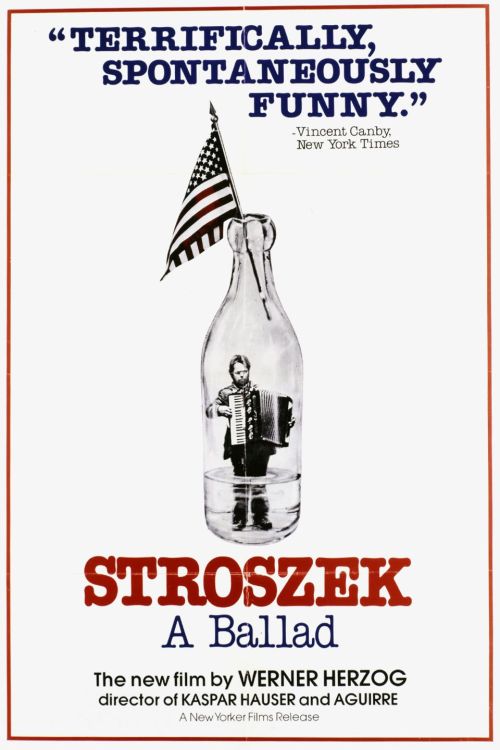
Bruno (Bruno S.) has recently been released from prison and while warned to stop drinking as a condition for his parole he immediately goes to a local bar. It is there that he meets Eve (Eva Mattes) a prostitute in an abusive relationship with her husband (Burkhard Driest). Bruno offers to allow her to move into his apartment, but this angers her husband and her pimp (Wilhelm von Homburg)  who break into the apartment and terrorize Eva and Bruno making them believe that the only way they can escape the harassment is by moving to America, which we they do along with their elderly neighbor Scheitz (Clemens Scheitz). They presume everyone is the USA is rich and life will be easy, but find that not to be the case.

The story was based loosely on the real-life experiences of its star and the script  written specifically for him by director Werner Herzog as a conciliation for not casting him in Woyzeck as originally intended. Since Bruno had already taken a leave of absence from his job at a steel mill to star in that one Herzog decided to make it up to him by writing this script in a matter of 4 days and then filming it on-location in Plainfield, Wisconsin because that was where the notorious serial killer Ed Gein had lived.

The story should’ve been a complete downer as it focuses on some very depressing realities, but instead, thanks to the genius of Herzog, one comes away from it feeling almost upbeat at all the quirky humor that gets incorporated in. The most memorable moment, which the rest of the crew found highly offensive and refused to film forcing Herzog to do it himself, happens near the end when Bruno travels to North Carolina and uses the last of his money to insert coins into arcade exhibits featuring chickens inside cages that dance and play the piano. The amusing element from this comes when the police finally arrive on the scene and are more concerned with getting the chicken to stop dancing than with the welfare of Bruno.

I also enjoyed the moment when an auto mechanic (Clayton Szalpinski) decides to do his own oral surgery by using the same pliers that he fixes cars with to remove a painful tooth in his mouth. While more blood was needed, as there should’v been streams of it coming out of his mouth, but isn’t, it’s still quite darkly funny and was ‘inspired’ by a true-life scene in the  1972 documentary Spend it All in which a Cajun in Louisiana does the same thing to his teeth, which amazed Herzog so much when he saw that movie that it compelled him to work the scene into one of his stories.

The jabs at America are expectedely negative and to some degree are on-target while at other points goes too far. Watching the trio become overly excited at seeing their new trailer home driven onto a vacant lot and acting like this was a sign that they had finally ‘made it big in America’ is certainly sardonically funny. Yet the scene with two farmers holding rifles as they plow a field in their tractors ready to shoot the other one if either dared touch a small strip of disputed land played too much into the stereotype that Europeans have of Americans and really wasn’t needed especially since it had nothing to do with the main story.

Bruno S.’s performance, who was never formally trained as an actor, is boring as he conveys the same facial expression all the way through where a more seasoned actor could’ve given the role more needed nuance. Scheitz was an amateur actor as well, but his short stature and overall goofy appearance made him a fun part of every scene he’s in while with Bruno that same quality doesn’t exist. If anything Eva has the widest character arc and the film should’ve evolved around her instead.

Herzog casts a lot of non actors in secondary roles as well. I’m not sure if this was done for budgetary reasons, or just played into his long-standing desire to be experimental, but the results aren’t completely effective. I did however enjoy Scott McKain, an auctioneer in real-life, who plays the part of a bank employee that comes to visit the trio in their trailer home to inform them of their delinquent payments and yet no matter how bad the news is that he must convey he always manages to remain upbeat and peppy when he says it.

The film, which has been rightly placed in Steven Schneider’s ‘1001 Movies You Must See Before You Die’ is original in so many ways that it deserves to be seen just for the oddity it is and I really have no complaints with its avant-garde style, which even today comes off as fresh and inventive, but I was confused about why the Glen Campbell song ‘By the Time I Get to Phoenix’ got played so much. The lyrics are never heard, but the melody is and yet there’s no connection to the city of Phoenix in the story, for awhile I thought that was where they’d ultimately end-up, but they never do, so hearing it played so much is out-of-place.

My Rating: 8 out of 10

Released: May 20, 1977

Runtime: 1 Hour 48 Minutes

Not Rated

Director: Werner Herzog

Studio: New Yorker Films

Available: DVD, Amazon Video, YouTube
Sometimes a Great Notion (1971)

By Richard Winters

My Rating: 6 out of 10

4-Word Review: Never give a inch.

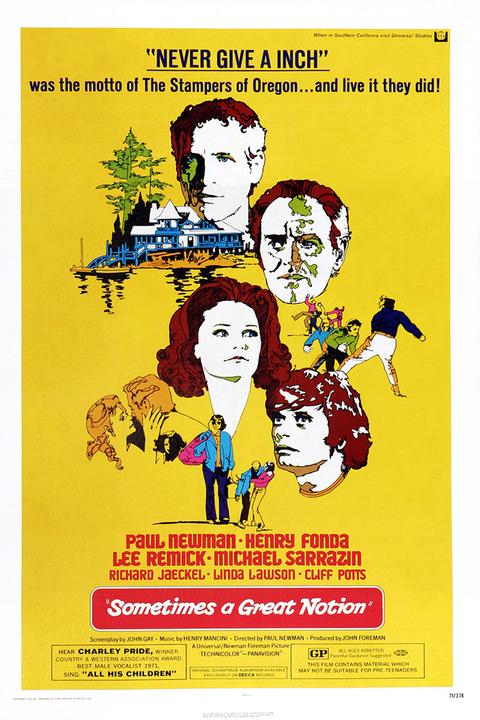
The Stampers are a proud logging family who’ve run their business out of the small Oregon town of Wakonda for years, but now find that may be in jeopardy when the local union strikes against a large lumber conglomerate. The Stampers, headed by their stubborn, bull-headed father (Henry Fonda) refuse to go along with the other loggers and continue to run their business. The rest of the townspeople consider them to be traitors and get their revenge by burning their equipment and doing whatever they can to make their business fail, but despite all the obstacles and setbacks the Stampers prove to be a resilient bunch.

The story is based on the Ken Kesey novel and while the book spawned many accolades the movie pretty much fizzled and today is only remembered as being the first film ever shown on HBO when it began broadcasting on November 8, 1972. However, that doesn’t mean it doesn’t have its share of good points as I really did enjoy the vivid way it captures the logging business showing first-hand what it takes to cut down the large trees and move the timber. Everything is captured with an in-your-face style that makes you feel like you’re right there working alongside the others and all the stages of tree cutting are explored including the many potentially dangerous accidents that can occur within the blink-of-an-eye.

The film also features a few memorable scenes including a bird’s-eye view of a large barge of logs being tugged down the river, which is an impressive sight. There’s also the infamous drowning scene unique because I’m not quite sure how they were able to pull it off without the actor drowning.

The characters though are quite boring, don’t display any type of arc and instead convey a very one-dimensional cantankerous attitude all the way through, which isn’t fun. Lee Remick is the only one who shows a softer, more introspective side, but she’s not in it enough. The scene involving her in bed with Michael Sarrazin, who plays the younger brother to Paul Newman, could’ve given things a much needed spark and should not have been left on the cutting room floor.

Fonda though is an exception. I’m always amazed at how in his later years he had to take small roles in films that weren’t always A-list material, but would still steal the film away from the leading actors anyways and his answer as to why the family continues to work while clearly causing tension with the rest of the town is a gem.

The plot though gets presented in a sporadic way. So much attention gets put into the aesthetics that the story becomes largely forgotten and only trickles through at certain intervals. The perspective is a bit odd for a Hollywood film too especially for that time period where the idea was always a David vs. Goliath formula that would take it to the establishment and yet here instead of punching up it punches down. As a viewer I felt sympathy for the townspeople and their need to create a strong union to make life better for themselves, so watching this family arrogantly ignore their needs and forge on with their business seemed to be me selfish and not something that was noble or interesting.

Spoiler Alert!

The film’s final shot, which features Newman tying his dead father’s severed arm on top of his tugboat, with the hand of the arm giving the finger to the town’s people on shore, is quite ghoulish. There’s no explanation for how he obtained the arm, but I’d imagine it would’ve required him digging up his father’s grave and cutting the limb off, which is pretty sick and twisted and thus loses the humorous quality that was intended and becomes just plain repulsive instead.

Alternate Title: Never Give A Inch

My Rating: 6 out of 10

Released: December 17, 1971

Runtime: 1 Hour 54 Minutes

Rated PG

Director: Paul Newman (Replaced Richard A. Colla)

Studio: Universal

Available: DVD (Universal Vault Series)

I Walk the Line (1970)

By Richard Winters

My Rating: 8 out of 10

4-Word Review: Sheriff covers for moonshiners.

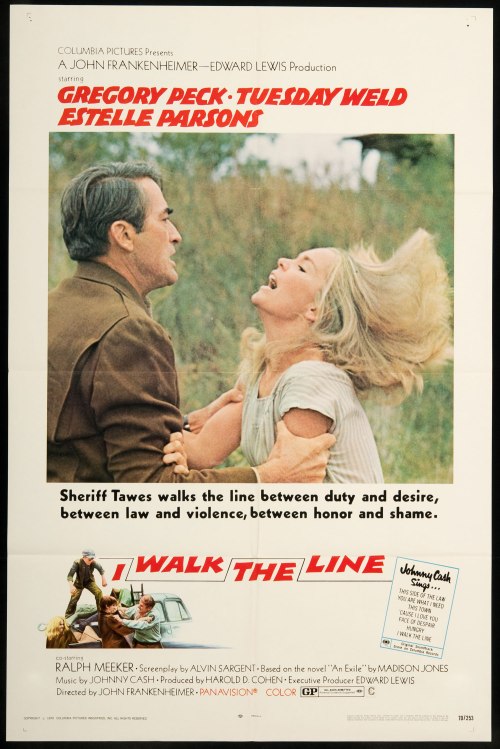
Aging Sheriff Henry Tawes (Gregory Peck) has always been a strong pillar of his community, but recently has found himself bored with his domestic life and looking for diversion. He becomes smitten with Alma (Tuesday Weld) a young woman half his age, who lives on the poor side of town with her father (Ralph Meeker) who runs an illegal distillery. Despite the risks Henry begins an open affair with her with her family’s blessing as long as Henry agrees not to report their distillery, but then a federal agent (Lonny Chapman) arrives in town threatening to shut down every moonshiner he finds. Henry’s deputy Hunnicutt (Charles Durning) also becomes suspicious of Henry’s shady actions, which forces Henry to take some calculated risks, which all backfire on him in shocking ways.

This film is a perfect testament to something that I’ve mentioned before on this blog, which is how shooting a film on-location in an actual small town versus one being built on a studio backlot can make all the difference on whether it succeeds at the box office, or not. This one was done in the tiny hamlet of Gainesboro, Tennessee, which has just over a 1,000 people and in fact its downtown, which includes the prominent courthouse, barely looks any different now then it did when principle photography took place in October of 1969. Director John Frankenheimer makes good use of the townsfolk focusing in on their old, weathered faces at the beginning and glum expressions, which helps accentuate Henry’s bored and static life as well as the abandoned, decrepit house the lovers meet-in, which illustrates their empty, vanquished souls.

The script by Alvin Sargent, which is based on the novel ‘An Exile’ by Madison Jones, allows the visuals and action to do most of the talking while keeping the dialogue subtle and concise. I even enjoyed the music interludes by Johnny Cash. Some critics at the time complained that there was no need for this as Johnny’s words that he sings seem to be simply explaining what the viewer is already seeing onscreen, but the music still conveys a raw southern flavor and Cash’s singing style makes it seem more like he’s talking to the viewer and like he’s another character in the film.

Peck’s performance is good here despite the fact that Frankenheimer wanted Gene Hackman for the role, but was forced to settle with Peck because he was already under contract with the studio. Normally Hackman would’ve been the better choice, but here Peck’s usual stiffness and detached delivery brings out convey his character’s inner turmoil. Durning is outstanding as his nefarious deputy and with his energetic and impulsive presence because an interesting contrast to Peck’s more reserved one.

Spoiler Alert!

Weld is great too even though the part she plays seems very similar to the one that she did in Pretty Poison although here at least the character isn’t portrayed as being completely evil, but instead somewhat naive and sheltered, which helps make her more multi-dimensional. Her motivations though are confusing and the film’s one major drawback. I could not understand, and the film never bothers to make clear, why she’d want to stay stuck with her family and their dismal, impoverished situation. Granted she didn’t really love Henry, which is obvious, but she had already manipulated him quite a bit,  and even had sex with him,so why not run off with him like he wanted and use his money to live a better life while also siphoning some of it back to her family to help them too?

Even if one would argue that she had a close-knit bond to her family it still doesn’t make sense. Many young woman have close ties to their family, but at some point they still leave the nest especially when vanquished to abject poverty otherwise. With her good looks a lot of doors could be opened, so why not see what else is out there? It comes out later that she’s married to another man who’s in jail, but the film glosses over this like she’s not any more in love with him than Henry and still doesn’t help to explain much. It also would’ve worked better had the viewer been left in the dark until the end as to whether she was really in-love with Henry or not instead of making it obvious that she was playing him, which lessens the shock effect for what occurs at the end.

My Rating: 8 out of 10

Released: October 12, 1970

Runtime: 1 Hour 37 Minutes

Rated GP

Director: John Frankenheimer

Studio: Columbia Pictures

Available: DVD, Amazon Video, YouTube
Heartbeeps (1981)

By Richard Winters

My Rating: 1 out of 10

4-Word Review: Robots fall in love.

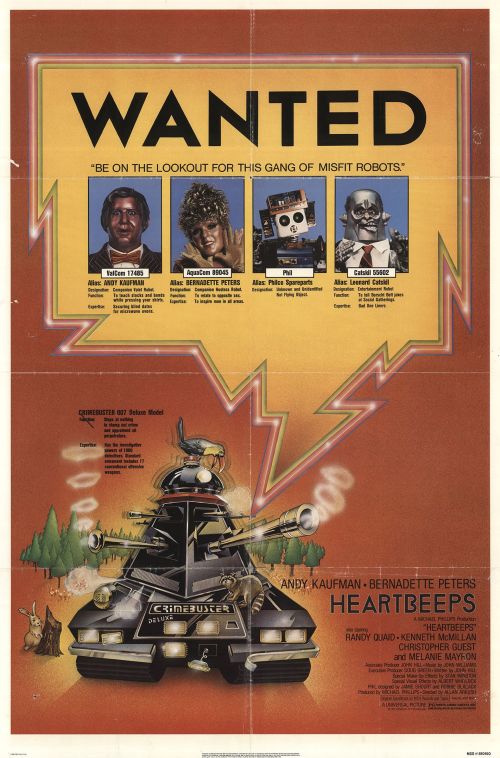
Val (Andy Kaufman) and Aqua (Bernadette Peters) are two robots who meet one day at the factory while awaiting repairs. They quickly fall in love and decide to escape out into the wilderness while bringing alone Phil a small robot who does not speak as well as Catskill (voice of Jack Carter) a robot made to resemble a cigar smoking vaudeville-type stand-up comedian. However, two employees from the factory, Max (Kenneth McMillan) and Charlie (Randy Quaid) go on a pursuit to retrieve them. There’s also the malfunctioning law enforcement robot known as Crimebuster who also chases after the robots and will stop at nothing to bring them back.

This is a highly unusual film in that it uses robots as its main characters and has their point-of-view the whole way through. Other films have had robots of course, but they are put in supporting roles to the humans.  Here director Allan Arkush was determined to keep it authentic to the ‘robot experience’, by implementing a computer-type logic to everything that goes on, which creates  some surreal moments, but ultimately falls flat.

To be a successful film you still need to have characters that the viewer finds relatable and the robots are too, pardon the pun, mechanical. They never say anything that is interesting or funny and while they at times have an endearing child-like quality they do not create any emotional bond with the audience.

There still needed to be a human as the centerpiece, maybe someone the robots met during their escape, who takes them in and helps them in their quest to hide from those that are after them while also having the robots in some way help their new human friend in whatever personal challenges or battles they were going through.  They are a couple of times that the robots do come into contact with people with one occurring when they crash a party at a swanky hilltop resort with Paul Bartel and Mary Woronov playing two of the partiers, but the guests at the party are broadly played caricatures and the scene itself too brief. They also later meet-up with a couple, played by Melanie Mayron and Christopher Guest, who run a junkyard, but this occurs too late in the movie and should’ve been introduced earlier.

While the wilderness setting is scenic it fails to add much in the way of either excitement or comedy. Having the two escape into a big city would’ve been more compelling. The crimebuster robot that chases after them is too goofy and offers no tension or intrigue. Sometimes even in a comedy it’s good to have a little bit of that, or at least a bad guy that is competent enough to make the viewer wonder, if even for a second, whether our heroes are going to safely outsmart him or not, which doesn’t occur here.

It would’ve been nice too had there actually been some genuine laughs. The only attempts at humor are when Catskill cracks one of his long line of incredibly dumb jokes, which are intended to be lame, but having a few that were actually clever, would’ve helped. Even the talented Kaufman flounders as he uses the same accent of his famous foreign man character that he did during his stand-up routines as well as in the TV-show ‘Taxi’ ultimately making it seem like Latka in a robot disguise.

The make-up effects by Stan Winston are impressive especially the opening credit sequence at the beginning where the camera focuses onto the robots’ various parts close-up. Winston used a gelatin substance that gave off a authentic looking metallic appearance versus how it had always been done before where it had been painted on. However, two holes where created around the robots eyes, which gives it a mask-like appearance and ultimately ruins the attempt although it gets kudos for at least making a strong effort. I also liked the  clicking sound effect every time one of the robots blinked their eyes, which resembled the noise of a camera taking a picture. but it’s not consistent as it’s heard during the first half, but not during the second part.

My Rating: 1 out of 10

Released: December 18, 1981

Runtime: 1 Hour 18 Minutes

Rated PG

Director: Allan Arkush

Studio: Universal

Available: DVD, Blu-ray, Amazon Video, YouTube