Category Archives: Movies that take place in the Big Apple

Ghostbusters II (1989)

ghostbusters 3

By Richard Winters

My Rating: 2 out of 10

4-Word Review: Called back into action.

It’s been 5 years since our team of Ghostbusters (Bill Murray, Harold Ramis, Dan Aykroyd) saved New York City from impending ghostly doom only to be thanked by getting sued for all the damage they created in the process, which promptly sent them out of business. Now though there are signs of an even worse attack from the supernatural in the form of an ectoplasmic river underneath New York, which is being strengthened by all of the negative energy from the citizens that live there. Can our team of heroes put on their uniforms once more and save the city from yet another ghostly attack while also coming to the aid of Dana (Sigourney Weaver) who finds that an ancient sorcerer (Wilhelm Von Homburg) is trying to possess her newborn child?

The premise pretty much starts the film out on bad footing and it’s never able to recover. The idea that they’d be driven out of business by a barrage of lawsuits didn’t make much sense to me. The ghosts that were terrorizing Dana’s apartment building in the first film were witnessed by thousands of spectators as they stood outside on the ground and watched the three men drive them away, so they should’ve been viewed as heroes and those that tried to sue them would’ve been vilified. Besides it was the mayor (David Margulies) who gave them the permission to do whatever they needed to do to take the ghosts out, so if anyone was to be a target for the lawsuits it would’ve been his office and the city. What is even worse is that after the first 40 minutes the story eventually goes back to the original premise where the team becomes popular again and their services are in-demand, so why couldn’t the film simply started from that point as it makes the entire first act come off like a complete waste of time otherwise.

Although it’s great to see Janet Margolin, who plays a prosecuting attorney, in her last film appearance, the court room scenes are static and not right for this type of genre. The ghosts are not scary or frightening like they were in the first one either and instead come off as cartoonish and boring.

Murray gets pigeonholed in a dull routine where he spends most of the time trying to desperately rekindle his romance with Dana, which isn’t interesting. Ramis and Aykroyd seemed more intent on stealing back some of Murray’s thunder by not having him come along on a few of their missions including a long segment where they discover the evil river underneath the city, which is just not as funny without Murray there.

Weaver pretty much just goes through the motions in a part that really does not allow her much to do. I was also confused as to why she had been a musician in the first film, but in this one she had strangely crossed over into being a painter. Rick Moranis and Annie Potts are equally wasted and forced into a makeshift romance simply because the writers didn’t know what else to do with them.

William Atherton, who was so good at playing the prissy, arrogant heavy in the first film, gets sorely missed. Kurt Fuller tries to take up his slack, but he is not as effective. Former wrestler von Homburg plays the evil sorcerer, but his voice ended up being dubbed by Max von Sydow, which made me wonder why they didn’t just cast him in the villainess role to begin with since he was the far better actor.

Just about all the jokes fall flat and the climactic finish which features an animated Statue of Liberty is really lame. The story is never able to gain any traction or momentum, doesn’t add any new or interesting angle to the theme and should’ve been trashed before it was even made.

My Rating: June 16, 1989

Runtime: 1Hour 48Minutes

Rated PG

Director: Ivan Reitman

Studio: Columbia Pictures

Available: DVD, Blu-ray, 4K Ultra HD, Amazon Instant Video

Ghostbusters (1984)

ghostbusters 2

By Richard Winters

My Rating: 9 out of 10

4-Word Review: Who ya gonna call?

Due to this film’s recent reboot set for official release tomorrow I thought it would be great to look back at the one that started it all. I haven’t seen the remake and have no plans to, so this review will concentrate solely on the original. However, if you have seen both feel free to leave a comment comparing the two and telling us which one you liked better.

The story here centers on Peter (Bill Murray), Ray (Dan Aykroyd) and Egon (Harold Ramis) who are three parapsychologists who lose their jobs at Columbia University and decide to open up their own paranormal extermination service out of an old, abandoned firehouse. At first business is slow, but it quickly picks up once they capture a particularly pesky ghost known as slimmer from a ritzy Manhattan hotel. Soon they find themselves the center of demand and media attention. Dana (Sigourney Weaver) is a cellist who finds her apartment to be haunted and the womanizing Peter becomes smitten with her and is quick to come to her aid only for her to end up becoming possessed by the demon. The three then must use all of their abilities and weapons to try and stop it as well as the plethora of other ghouls who were mistakenly released into New York’s atmosphere when an aggressive EPA agent (William Atherton) forced them to shut down their ghost containment system.

I saw this film when it was first released and found it to be hilarious, but was worried that after all these years it might not come off as well, but to my surprise it hasn’t aged at all and is still quite fresh and inventive. Usually even in the best of comedies there will be jokes that fall flat, but here every one of them hits-the-bullseye and I enjoyed how the creative script see-saws the humor from the subtle to the over-the-top. The plot is imaginative, but manages to create and stick to its own logic that is consistently clever and amusing, but never silly.

The special effects are also impressive. Usually in comical films the ghosts or monsters are made to be benign and goofy, but here they are frightening, which again helps keep the story from ever getting one-dimensional.

Murray’s glib and detached persona is at a peak level and his throwaway lines, which were almost all improvised, are gems. Aykroyd and Ramis, who wrote the script, wisely step back and give Murray full control to steal the spotlight, which he does effortlessly.

The supporting cast is equally great. I never considered Weaver particularly suited for a role as a love interest, but her sharp, caustic manner works as a nice contrast to Murray’s smart-ass presence. She also becomes quite sexy during the scenes when she turns into a demon. Rick Moranis as her nerdy neighbor is hilarious and has some of the funniest moments in the film particularly the scene he has at a party he throws in his apartment and the way he introduces each guest as they arrive.

Ray Parker Jr.’s theme song is the icing-on-the-cake in a film where amazingly everything clicks perfectly. Why the studio heads felt there was a need to revamp this franchise is a mystery. I realize they are running out of ideas and feel the urge to retool what has been successfully done before in order to appeal to the ‘new generation’ of filmgoers, but this is one classic that should’ve been left alone.

ghostbusters 1

My Rating: 9 out of 10

Released: June 8, 1984

Runtime: 1Hour 45Minutes

Rated PG

Director: Ivan Reitman

Studio: Columbia Pictures

Available: DVD, Blu-ray, 4K Ultra HD DVD, Amazon Instant Video, YouTube

The Hot Rock (1972)

hot rock

By Richard Winters

My Rating: 6 out of 10

4-Word Review: Stealing back stolen gem.

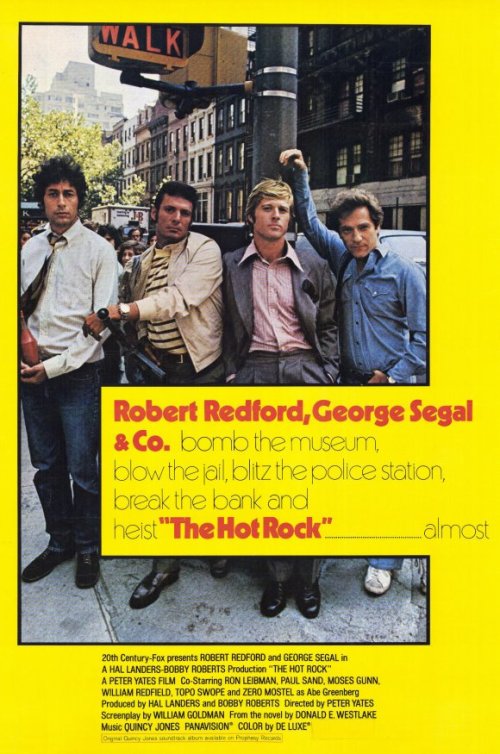
Having just been released from prison Dortmunder (Robert Redford) has no intention of ever going back because if he does it will be life, but even so he still can’t help but get caught up with the enticing offer that his brother-in-law Kelp (George Segal) has planned. The idea is to steal a valuable jewel from a New York museum where Dr. Amusa (Moses Gunn) will pay top dollar for what he believes was stolen from his African ancestors during colonial times. He even offers to help fund the mission and everything goes well until Greenberg (Paul Sand), who is one of the men on Dortmunder’s team, gets caught with the diamond and forced to swallow it. He then hides it inside the police station after he was forced to relieve himself. Now sitting in prison he promises the others he’ll show them where it is, but only if they agree to break him out of jail, which they do only to find further complications involving Greenberg’s dubious, double-crossing father (Zero Mostel).

Based on a Donald E. Westlake novel this film has all the trappings of being a fun, breezy outing and for the most part it is. The actors are game and Redford gives a surprisingly strong performance and maybe one of the best of his career while the supporting cast fall into their roles perfectly especially Mostel who easily steals it from the rest despite having only limited screen time. Director Peter Yates nicely paces the material although the set-up could’ve been more extended as the film spends only a few minutes on the planning phase and then jumps jarringly right into the actual crime making me feel more scenes of the preparation were filmed and then excised for possible shorter runtime purposes.

Spoiler Alert!

The actual crime is where the film falls apart as it starts getting a little too creative for its own good by incorporating too many offbeat touches that it can’t logically get its characters out of without going overboard into the implausible. The first issue comes when Dortmunder and Kelp try to break into prison in order to break Greenberg out of it. To me it just seemed too easy and they routinely open up prison doors that should certainly sendoff loud alarms almost immediately, but strangely don’t. I also couldn’t believe that Dortmunder would ever break into a place he so dearly wanted to stay out of. One misstep and he’d be stuck there for the rest of his life, so why even take the chance?

Later we learn, after they manage to get Greenberg out, that he has hidden the diamond inside the police station, which involves them flying a helicopter onto the roof of the police building, cutting off the power and phones lines and then releasing smoke bombs in order to get the officers out, which they do only to find that someone else has already gotten to the diamond, which was hidden inside the grimy sewage pipes. Later they find that it was Greenberg’s father, but how could some old man have been able to get to it when it took these four men a lot of effort just to get into the building?

The biggest implausibility though and the one that ‘jumped-the-shark’ for me is when, in an attempt to retrieve the diamond which Greenberg’s father has hidden in his safety deposit box in the bank that only he can access, they have a hypnotist hypnotize one of the bank employees, so that all Dortmunder needs to do is say a magic word and the bank employee will open up the father’s box for him.

I’ve tried hypnotism in the past and I can assure you that there is no way that someone can put anyone else into a trance-like state like they do here. It just doesn’t work that way a person’s conscious state doesn’t shut off nor can they be ‘tricked’ to do something against their will or that they are not aware of. If it was so easy to manipulate people in this way then we’d have robberies all over the world committed like this, but we don’t.

It also brings out more questions than answers like how were they able to get this woman to help put this bank employee into a trance? Did they offer her a part of the cut in order to keep her quiet and how would they know that they could trust her to begin with?

End of Spoiler Alert!

I really wanted to like this movie and the production is slick with a nice jazz score by Quincy Jones and a thrilling look at New York’s skyline from a helicopter, but the numerous plot holes became too much to overlook and ultimately made the story impossible to believe at all.

hot rock 3

My Rating: 6 out of 10

Released: January 26, 1972

Runtime: 1Hour 40Minutes

Rated GP

Director: Peter Yates

Studio: 20th Century Fox

Available: DVD

Fame (1980)

fame 3

By Richard Winters

My Rating: 4 out of 10

4-Word Review: School of Performing arts.

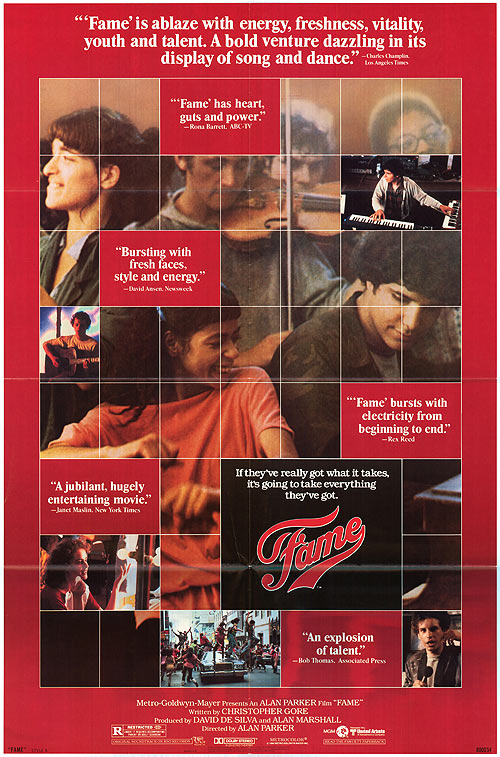
Filmed at the now demolished Haaren High School the film is intended to be a showcase of New York’s famous Fiorello LaGuardia High School that specialized in training students in the arts, dance and drama. The story centers on an eclectic mix of teens that join the school. There’s Doris (Maureen Teefy) who is pushed by her mother (Tresa Hughes) into becoming a singer/actress despite suffering from horrible stage fright. Leroy (Gene Anthony Ray) wants to become a dancer despite not being able to read while Ralph (Barry Miller), Montgomery (Paul McCrane) and Bruno (Lee Curreri) all suffer from personal demons/insecurities of their own.

I’m sure in its day this came off as fresh and exhilarating, but time has not been kind to it. The film starts out with the teens auditioning to get into the school, which might have been interesting had it not come off as a poor man’s version of ‘American Idol’, which has dulled our senses so much to the audition process that anything else now seems second-rate. I think what surprised me most about these scenes is how patient the judges/instructors were as all of the teen’s auditions were quite poor and they should’ve been politely escorted out a minute into them instead of being allowed to continue on with something that was clearly not working. What shocked me even more though is that several of the main characters gave horrid auditions that made it look like they had no talent at all and yet somehow they were accepted into the school anyways making it look like this wasn’t necessarily a place for gifted students after all, but instead just someplace willing to bring in any loser that wanted in.

The characters aren’t appealing either. Doris is much too neurotic; Montgomery is boringly benign and Ralph comes off as an obnoxious, attention-seeking clown. There are many scenes showing the students being highly disrespectful to their instructors that normally would’ve gotten them kicked out of any other school, but here for some reason they don’t. Out of all the students Coco (Irene Cara) was the only one I liked as she had genuine talent and also seemed much more dedicated, but the film ends up degrading her by having her character go to a rundown apartment of some slimy producer who wants to ‘audition’ her for his next film even though it is quite obvious to any viewer that the guy is a first-rate sleazebag and his audition is clearly just a set-up to a scam, or in this case an underground porno.

The script is filled with a lot of unresolved storylines and loopholes. For instance Leroy is unable to read and when this gets discovered he tears up the school in a fit of rage and yet somehow still remains a student for the full four years. Did he eventually teach himself how to read and pay for the damages that he caused? These pertinent questions never get answered, but really should’ve.

I enjoyed the shots capturing the New York’s busy and sometimes dangerous city sidewalks as well as a bird’s-eye shot of Times Square. The scene where a couple of students go to a showing of The Rocky Horror Picture is great, but the rest of the movie is just one long mish-mash. At certain points it tries to be a gritty drama and then at other times it breaks out into tacky dance routines. Instead of being a compelling drama it’s more of a broad overview and would’ve worked much better had the number of main characters been paired down to just one or two and the time span cut from four years to just one.


My Rating: 4 out of 10

Released: May 16, 1980

Runtime: 2Hours 13Minutes

Rated R

Director: Alan Parker

Studio: MGM

Available: DVD, Blu-ray, Amazon Instant Video, YouTube

Baby Boom (1987)

baby boom

By Richard Winters

My Rating: 5 out of 10

4-Word Review: Yuppie inherits a baby.

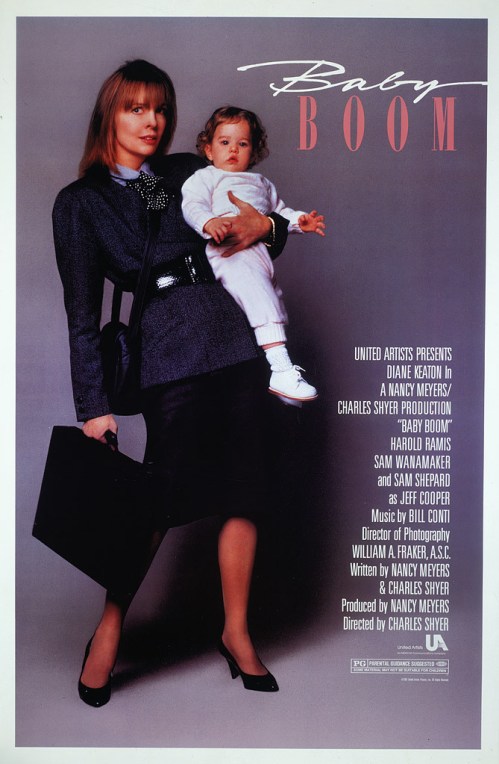
J.C. Wiatt (Diane Keaton) is a successful businesswoman who has risen to the top of the corporate world by being quite literally ‘married-to-her-job’, which is just fine with her boss (Sam Wanamaker) as he is the same way and demands nothing less. Out-of-the-blue she gets a call that a distant relative has died and sent her an inheritance. She initially thinks it’s money only to find to her shock that it’s a baby girl instead. J.C. lacks any parenting skills and has difficulty even putting on a diaper, let alone knowing the right sized one to buy. Her annoyance slowly grows to bonding as she finds raising a young one has rewards far greater than her previous yuppie lifestyle could offer.

The premise for this thing is whacked. What kind of halfway normal parent would write a will that has their child shipped off to a distant relative that they haven’t had contact with since 1954 in the event of their death? Certainly there had to have been some close friend or family member that they knew of who would’ve been far more appropriate and could’ve been forewarned that they were the intended god parent. It’s almost like the parents just threw the child off a cliff and hoped someone down below would catch her.

The Harold Ramis character should’ve been chucked from the beginning. He plays her live-in boyfriend, but if someone is working 70 to 80 hours a week then they would have little time for a social life let alone a normal, healthy romantic relationship. The idea is to show that this character’s life is imbalanced, so might as well portray her as being alone and desperate need for genuine human contact making the baby’s presence all the more significant.  Ramis disappears quickly as he bails on her the minute she decides to keep the kid, so why bother introducing him at all?

Although likable I didn’t feel Keaton was the best choice for the part. The character is given the nickname of ‘tiger lady’, but to me that would signify having traits that are cold, steely and bitchy, but Keaton never displays these. Cybil Shephard or Candice Bergen with her Murphy Brown persona would’ve been a better pick and made the character’s transition from cutthroat businesswoman to loving mommy all the more vivid.

The film does have some funny bits and the twin girls who play the part of the infant are cute and respond well to the camera. I even enjoyed when J.C. begins to bond with the girl, but Bill Conti’s musical score gets overplayed during these segments and his cutesy melody gives these otherwise  touching moments too much of a heavy-handed feel.

I certainly liked the message, but writer/director Charles Shyer tries too hard to get it across. Having the character suddenly move out to the country seemed too severe of a shift. This is the type of person who thrived in a big city atmosphere and I don’t think she’d ever fully adjust to the slow pace of the rural lifestyle, which makes this plot twist, in a movie that goes on too long to begin with, come off as a misguided tangent that isn’t interesting or believable and the ending itself is too idealistic.

My Rating: 5 out of 10

Released: October 30, 1987

Runtime: 1Hour 50Minutes

Rated PG

Director: Charles Shyer

Studio: United Artists

Available: DVD, Amazon Instant Video

Portnoy’s Complaint (1972)

portnoys complaint 1

By Richard Winters

My Rating: 4 out of 10

4-Word Review: Jewish man digs prostitute.

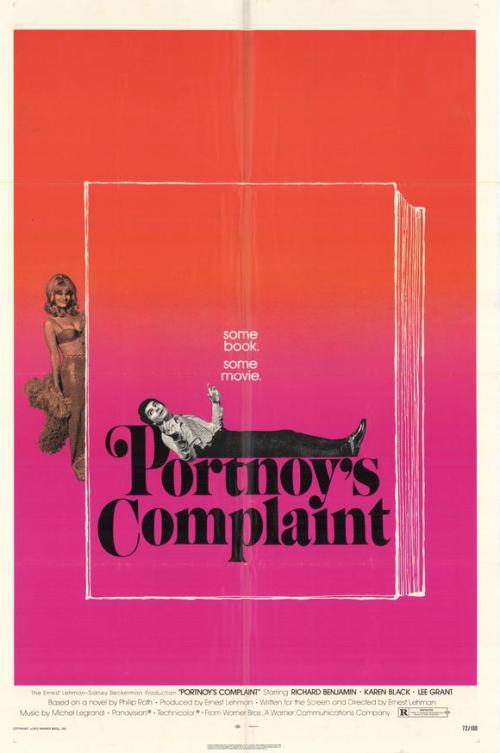
Alexander Portnoy (Richard Benjamin) is a man who no longer believes in a God or any of the other conventional ways of life taught to him by his old-fashioned Jewish parents (Jack Somack, Lee Grant). He enjoys the ‘art’ of masturbation and will routinely find excuses to go do it when his parents aren’t looking. As he grows older he finds that his sexual appetite broadens in a way that regular women won’t be able to fulfill. Then he meets Mary Jane (Karen Black). She’s a prostitute nicknamed ‘The Monkey’ due to all the wild positions that she can get her body into during sex. The two enjoy a lot of kinky times, but then she ends up falling in love with him and wanting to get married, but Portnoy resists as he considers her to be intellectually inferior and fears she’ll become an embarrassment to him with his other friends.

Philip Roth’s landmark and controversial novel comes to the big screen with only lukewarm results although it does start out funny. I laughed-out-loud at the scene where Portnoy pretends to have a bout of diarrhea just so he can sneak into the bathroom to get-off and his parents misinterpret his moans of ecstasy as being that of gaseous agony. The dream segment where Portnoy finds that his penis has fallen off and onto the kitchen floor while his parents come into to inspect it is pretty good as is the bit where Jeannie Berlin tries to give Portnoy a hand-job.

Unfortunately the film shifts too much in tone. It starts out as this quirky, dark-humored, sex-laden comedy only to end up being a brooding drama. The novel was written as a continuous monologue spoken by Portnoy while talking to his therapist, which doesn’t effectively come off here. We see a few scenes in his therapist’s office, but they are brief and I didn’t like the fact that his therapist never speaks a word of dialogue, which seemed weird and unnatural.

Screenwriter Ernest Lehman, in his one and only foray behind the camera, implements too much of a slow pace to the proceedings. Many scenes go on far longer than they should and at certain points the camera gets nailed to the ground giving it a static presence. He also hired Michel Legrand to do the film score, which is beautiful and majestic, but the lush tones are better suited for a romantic flick, which this definitely isn’t.

Karen Black gives an outstanding performance as ‘The Monkey’, but her character is too one-dimensionally dumb almost to the point that she seems mentally handicapped, which I don’t think was the intention. Either way it is never funny, touching, or even real while bordering into the stereotype that all prostitutes ‘must be really stupid’.

One of the most annoying elements of the film is that it keeps cutting back to a matted image of Black jumping from a skyscraper and towards the viewer while she screams. The image looks very hooky while giving the film a real amateurish feel. I also didn’t like how at the very end we spot Black walking amongst a crowd of people from a bird’s eye perspective. The supposed demise of the character was meant to be murky as she threatens to jump from a building and Portnoy leaves her without ever knowing if she ended up doing it or not, which then causes him a major source of guilt afterwards. By having her suddenly appear at the very end ruins the mystery and brings up far more questions than answers.

Roth’s novel was very much ahead-of-its-time and deserved a film that could match it, but Lehman’s staid approach doesn’t do it justice.

My Rating: 4 out of 10

Released: June 19, 1972

Runtime: 1Hour 41Minutes

Rated R

Director: Ernest Lehman

Studio: Warner Brothers

Available: DVD (Warner Archive), YouTube

Enter Laughing (1967)

enter laughing

By Richard Winters

My Rating: 2 out of 10

4-Word Review: Acting is his dream.

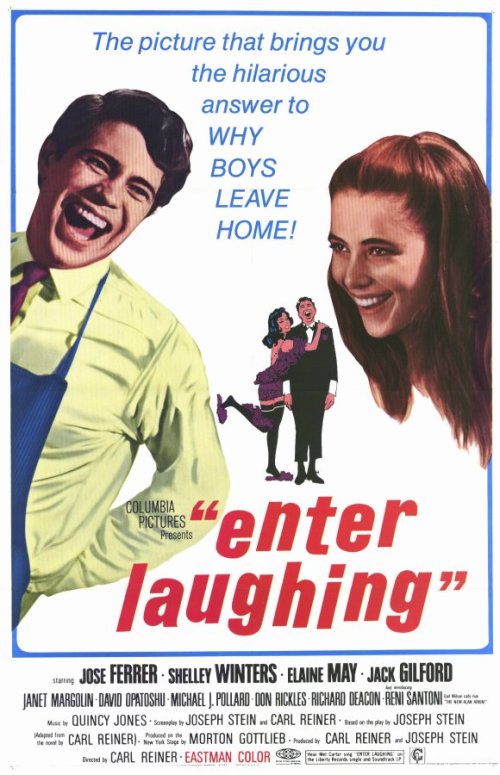
Loosely based on writer/director Carl Reiner’s experiences as a fledgling actor trying to work his way up into the business circa 1938. The story centers on David Kolowitz (Reni Santoni) who works as an apprentice at a machine repair shop, but dreams of one day making a living as a stage actor. He gets his break when he auditions for a part in a low budget stage production run by an aging, alcoholic actor named Harrison Marlowe (Jose Ferrer). Marlowe is not impressed with David’s acting ability, which is marginal at best, but at the insistence of his daughter Angela (Elaine May), who thinks David is ‘cute’, he decides to give him a try under the condition that David must pay them to perform in it and also must come up with his own costume.

Although this was a big success on Broadway as a film is has not aged well and is quite bland. The story is better suited as an episode for a sitcom and stretching out such a thin one-dimensional plot to an almost two-hour runtime becomes quite boring particularly with its plodding pace and direction. The only time it ever gets even mildly funny is during David’s audition scene, but even this ultimately falls flat particularly with the idea that David would be dumb enough to think that words in a script that are in parenthesis would be part of the dialogue and not a stage direction. You would think someone who has spent his entire life dreaming of being ‘the next Ronald Coleman’, who was a big movie star during the ‘30s, would know how a basic script is constructed and therefore this attempt at humor fails.

Santoni, in his first major film role, is terrific and despite being of Hispanic heritage, which Reiner is not, still manages to resemble Carl quite well during Reiner’s younger years. However, the character is too painfully naïve and dumb as he clumsily walks himself into messy situations long after the viewer, or anyone else with some common sense, would clearly see the obvious red flags.

Janet Margolin is beautiful playing David’s girlfriend Wanda and her presence gets an ‘A’ simply for her attractive face alone, but the romantic scenes do nothing but bog this already slow moving film down even further. Also, having David be so oblivious to her insecurities about him working with an attractive leading lady onstage makes him seem insensitive and not funny as intended.

Elaine May is good and so is Jack Gilford as David’s boss at the repair shop. It’s also fun seeing Carl’s real-life son, Rob Reiner, who later became famous for playing Mike Stivic on ‘All in the Family, making his film debut as a nerdy, would-be actor, but overall the film is dated and contrived.

My Rating: 2 out of 10

Released: February 25, 1967

Runtime: 1Hour 52Minutes

Not Rated

Director: Carl Reiner

Studio: Columbia Pictures

Available: VHS

Who Killed Mary Whats’ername? (1971)

who killed mary 2

By Richard Winters

My Rating: 3 out of 10

4-Word Review: Who killed the prostitute?

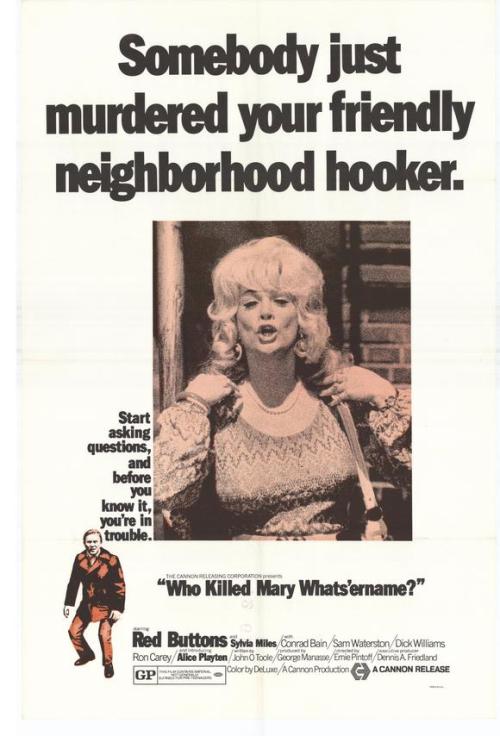
Mickey (Red Buttons) is a retired diabetic boxer who is appalled to learn that a prostitute was killed in her apartment and no one seems to care. He decides to do the investigation himself and even moves in to her old place. He inquiries about her amongst the locals and begins to get a few leads including that of a young filmmaker named Alex (Sam Waterson) who may have inadvertently filmed her leaving with her eventual killer. Soon Mickey’s grown daughter Della (Alice Playten) and Val (Conrad Bain), a man he meets at a bar, are helping him in his quest, but the things they learn only reinforce how unpleasant and dangerous a hooker’s life can be.

I commend the attempt at taking a gritty look at a seedy lifestyle and its open-minded approach to the women who are in it, but the film’s poor execution makes the whole thing come off as quite amateurish and even laughable. Why a man in his 50’s would become so obsessed with finding the killer of a woman he has never known and only reads about in a newspaper is quite hard to fathom. There are probably hundreds of prostitutes that share similarly sad fates, so why get so revved up about this one? The fact that he is able to get his grown daughter and another man he meets randomly at a bar to help him investigate seems equally unbelievable and the way they are conveniently able to find clues and connect-the-dots before solving the case comes off as too easy.

The action sequences, especially the opening one in which we see the prostitute getting killed, are poorly staged and filled with chopping editing that makes it hard-to-follow and phony looking. When the 50-year-old Buttons takes on a gang of young bikers, which are led by Earl Hindman who later became famous for playing the neighbor on ‘Home Improvement’ whose face was always obscured by a fence, it becomes downright silly. Sure the Buttons character has a background in boxing, but that still doesn’t mean he can take on four guys who are twice his size and the sound effects used for the punches are overdone and cartoon-like.

A similar issue occurs when Buttons saves a prostitute from an abusive pimp while Alex films it. The first time this occurs it is mildly diverting, but then when he saves another one, who is being beaten up by some of the old ladies in the neighborhood, it becomes redundant and corny.

The resolution, in which the killer turns out to be someone no one suspected, is flat and forgettable. It is also poorly thought out as he admits to the Buttons character that he killed the two women because he didn’t want any potential witnesses, but then doesn’t bother to kill Buttons or at least make sure he is dead even after he divulges his secret to him. The killer then just casually walks away without ever allowing the viewer to know if he was caught and charged with the crimes.

My Rating: 3 out of 10

Released: November 12, 1971

Runtime: 1Hour 30Minutes

Rated GP

Director: Ernest Pintoff

Studio: Cannon Film Distributors

Available: None at this time.

The Flamingo Kid (1984)

flamingo kid

By Richard Winters

My Rating: 7 out of 10

4-Word Review: Get rich selling cars.

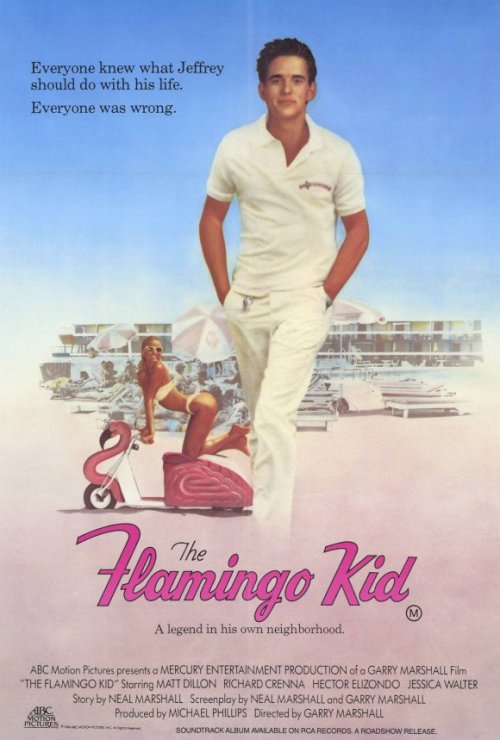
The year is 1963 and Jeffrey (Matt Dillon) is an 18-year-old still looking for direction. While working a summer job at the Flamingo Club he meets Phil Brody (Richard Crenna) who fills his head with big dreams of getting rich while selling cars. Jeffrey’s father (Hector Elizondo) wants him to go to college, but Jeffrey finds that idea to be boring and likes getting on the ‘fast-track’ to success better. After many arguments he finally moves out only to realize that Phil’s promises are empty and full-of-strings.

The movie is entertaining mainly because it manages to successfully suck you into a whole different time period. I loved the colorful cars with fins, the snazzy outfits and bouncy tunes. Most movies recreate a bygone era with an air of contempt about it, but this film makes the early ‘60s seem fun, nostalgic and full of opportunity. It also does a great job of exposing the different layers of American capitalism from those that feed off of it and exploit it, as with Crenna’s character, to those that are just happy to get by and not take any undue risks as with the father and then to the teens who are always convinced that attaining the American Dream is much easier than it really is.

The best part of the movie though is the way in analyzes the relationship between the son and father. So many movies seem to prefer looking at conflicts between mother and daughter, but fathers and sons can have just as many quarrels and this film delivers them in a way that is relatable and believable while also being a bit touching as well.

Dillon is terrific and I liked the way the character isn’t overly cocky or crude like in most ‘80s teen movies, but instead clumsy and socially awkward only to finally find the confidence when he needs it the most. Crenna is outstanding as is Elizondo, but I thought it was unusual that he got cast in the role since he is clearly Puerto Rican and Dillon, as is son, isn’t.

Jessica Walter as Crenna’s perpetually crabby wife is wasted even though she does look fine in a bikini despite already being in her mid-40s at the time of filming. Peter Costa is a scene stealer playing the same type of role that he later did in the ‘The Cosby Show’ as a shy child who doesn’t say anything, but still manages to get into everyone’s way.  John Turturro and Marisa Tomei can also be spotted in non-speaking bit parts.

My Rating: 7 out of 10

Released: December 21, 1984

Runtime: 1Hour 40Minutes

Rated PG-13

Director: Gary Marshall

Studio: 20th Century Fox

Available: DVD


Coming Apart (1969)

coming apart 1

By Richard Winters

My Rating: 2 out of 10

4-Word Review: Psychiatrist secretly films people.

Rip Torn plays a psychiatrist living in a Manhattan apartment who has a camera secretly film everything that goes on there. Many of his female patients including Joann (Sally Kirkland) talk about their intimate desires and his ex-wife Monica (Viveca Lindfors) shares her darkest secrets thinking he is the only one hearing it, but instead a glass box resembling an antique camera sits in the living room and takes it all down.

The film’s concept is novel and if executed in a slightly better manner could’ve been brilliant. Without a doubt it breaks all the old filmmaking conventions and was year’s ahead-of-its-time. The sexual openness of its characters and tawdry subject matter make it quite voyeuristic and real. The actors have an amazingly natural quality to their delivery giving one the idea that it was ad-libbed when in actuality it wasn’t.

Kirland gives an emotionally over-the-top performance that is both remarkable and riveting. Her meltdown at the end in which she proceeds in slow motion to tear up the apartment is quite memorable and the best part of the whole film.

Writer/director Milton Moses Ginsberg manages to keep things relatively fresh by continuously introducing situations that become increasingly more provocative including a party that turns into a sex orgy and explicit love making between Torn and Kirkland that could almost be considered pornographic. There’s even an interesting scene involving a young lady looking to be barely 18 coming to the apartment with her baby in a carriage and propositioning herself to Torn and then having the two make love on the floor while the baby, still in the carriage, cries next to them. There is also a segment featuring recorded phone conversations that Joe has with his fellow psychiatrists that I found to be revealing as well.

Unfortunately despite these creative efforts the film is agonizingly boring to sit through. No matter what is going on in the scene the viewer is still forced to stare at the same wall, same mirror, and same skyline for almost two-hours. The scenes needed to be broken up with cutaways that would’ve taken the viewer out of the apartment and given them some other visual element to look at. Simply turning on a camera that’s nailed to the floor and then filming whatever happens in front of it is not a movie, but more like C-Span and the ultimate result is a failed experiment lacking the necessary cinematic touches that would have made it come off as a fluid whole.

My Rating: 2 out of 10

Released: October 26, 1969

Runtime: 1Hour 51Minutes

Not Rated

Director: Milton Moses Ginsberg

Studio: Kaleidoscope Films

Available: DVD