Category Archives: Movies Based on Novels

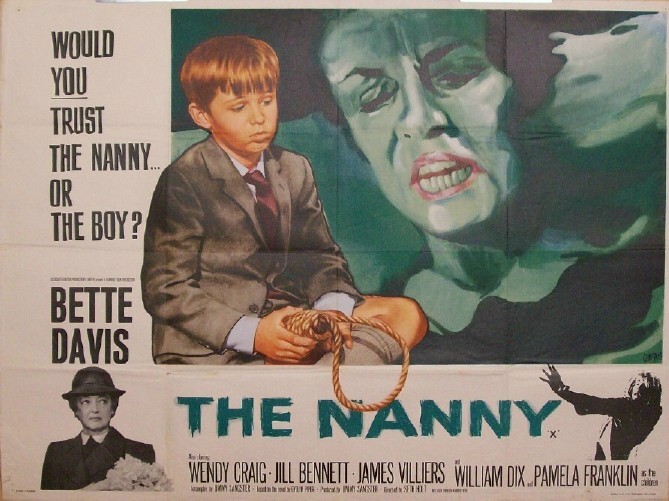
The Nanny (1965)

By Richard Winters

My Rating: 5 out of 10

4-Word Review: Kid doesn’t like nanny.

            Bette Davis plays a nanny to an upper-class British family whose oldest son Joey (William Dix) is accused of accidently killing his younger sister. Joey, who is only 10, is sent away to a home for disturbed children. When he returns he accuses the nanny as the one who did the killing and a psychological game of cat-and-mouse ensues.

Davis is sensational. She plays a type of character that she has never done before and the results are fascinating. She is much more subdued and evasive than usual and she falls into the role of the unassuming nanny in a seamless fashion. The different setting works well for her and I commend her tenacity for taking on a project that was not glamorous. She even puts on some thick eyebrows for her part and at times, especially at the beginning, she starts to resemble her most hated rival Joan Crawford.

Dix is amazingly good as the kid and it is a shame that he did only one other picture after this one. I liked the independent nature of the character and he plays off Davis quite well and showed no signs of being intimated by her. Making the adversaries have such extreme age difference and personalities gives the story an interesting edge that helps carry the picture.

The evocative black and white photography helps accentuate the dark-tone. The British setting along with the expected formalities of that culture, particularly that from the father character Bill (James Villers) give the film some distinction.

The first act though goes on way too long. We are given the general premise right up front and then have to spend the whole first hour going through the scenario that Joey doesn’t like his nanny and is suspicious of her again and again until it becomes derivative. When the second act does finally come about it seems too late. The revelation isn’t all that clever or creative and the climactic sequence desperately needed more action and punch. The final result is unsatisfying. The viewer is given an intriguing premise that it can’t sustain to the end ultimately making this a misfire despite the outstanding presence of Davis and some high production values.

There is also the issue of the three-year-old girl who is adorable and an absolute scene stealer and yet right up front you are made aware that she is killed, which makes the proceedings rather depressing. Having to then watch her actual death is disturbing and, for its time period, rather vivid and startling.

My Rating: 5 out of 10

Released: October 27, 1965

Runtime: 1Hour 31Minutes

Rated: NR (Not Rated)

Director: Seth Holt

Studio: Hammer Productions

Available: DVD

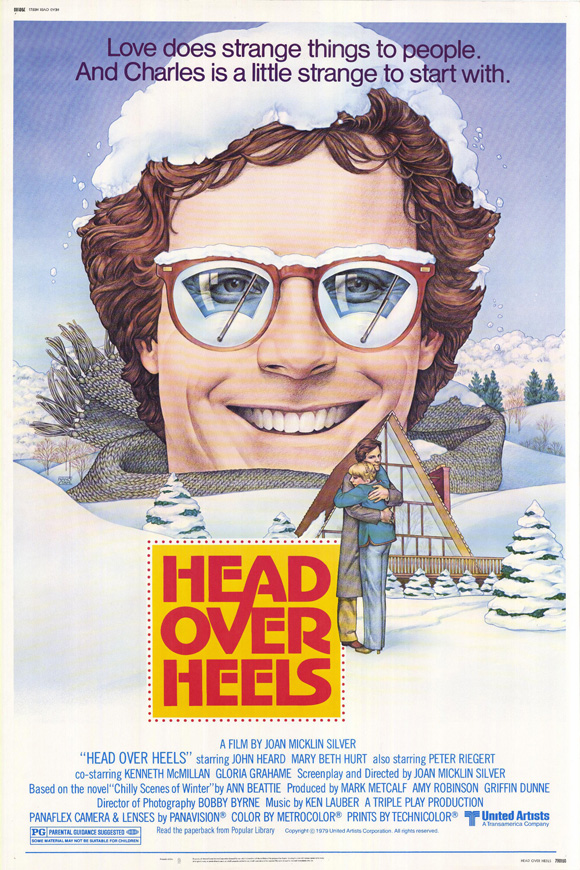
Chilly Scenes of Winter (1979)

By Richard Winters

My Rating: 8 out of 10

4-Word Review: Can’t get over her.

            Charles (John Heard) meets Laura (Mary Beth Hurt) at his job and immediately becomes smitten.  She is married and upfront about it, but since it is not going well she decides to go out with him. They soon move-in together, but it only lasts for a couple of months before Laura goes back to her husband. This is a crushing blow to Charles who obsesses about her constantly and tries any way he can to win her back.

This is in many ways a dated movie and normally I would consider that a detriment, but here I found it to be an asset. It is refreshing and fun to see a person drink a little on the job, or playfully touch a female co-worker as he walks past them and not have it become an immediate sexual harassment lawsuit. There is also the part where Laura invites Charles back to her home after only their first date, which could be considered reckless, but it’s nice to go back to an era that was more trusting and not everyone was labeled a potential psycho until proven otherwise.

There is of course the subject of stalking which is what Charles does, but here it is natural and actually kind of sweet. Some of it may be considered a little ‘creepy’, or even pathetic, but none of it is menacing, or done with criminal intent. To me this makes more sense and is more realistic to expect that when someone has strong feelings for someone else and spent special times with them that they would have trouble ‘moving-on’ when the other person breaks it off and their inability to do so shouldn’t necessarily make them ‘crazy’, or ‘maladjusted’ and this film very effectively shows that.

This is a terrific movie about relationships. The characters are real and relatable. The situations they go through are universal and the best thing is that it stays that way until the bitter end without pulling any punches. Anyone who has gone through difficult relationships will appreciate the honesty and it’s a real shame they don’t make movies like this anymore.

Heard is excellent and plays an extension of the same 60’s radical character begrudgingly moving into adult life that he did in Between the Lines, which was his first collaboration with writer-director Joan Micklin Silver. A young Peter Reigert is appealing as Charles’s roommate Sam. Kenneth McMillan, a looks- challenged character actor who usually plays slimy people, is surprisingly likable as Charles’s stepdad. Legendary screen actress Gloria Grahame, in one of her last roles, is highly amusing as Charles’s crazy mother. I was never quite sure what any of her scenes had to do with the main story, but her presence was fun anyways.

The film also contains some offbeat scenes and an original sense of humor. This includes the scene where Charles makes a miniaturized replica model of the home that Laura lives in and then uses dolls to play the parts of Laura and her husband and child. There is also the part where Charles meets Laura’s husband under the guise of being a home buyer and then stands up in front of him and states his undying love for his wife as well as a goofy conversation that he has with a wacky elderly lady roommate when he visits his mother in the hospital. The best though is the running conversation that Charles has each day with the blind cashier at a candy counter that gets better and better as the movie progresses.

The film nicely captures the wintry Utah landscape and although the original title for the film was Head over Heels this other title works much better and not only fits the season in which the story takes place, but also the ever difficult and complicated dating scene as well.

My Rating: 8 out of 10

Alternate Title: Head over Heels

Released: October 19, 1979

Runtime: 1Hour 32Minutes

Rated PG: (Brief Nudity, Adult Theme)

Director: Joan Micklen Silver

Studio: United Artists

Available: VHS, Netflix Streaming

The Little Girl Who Lives Down the Lane (1976)

By Richard Winters

My Rating: 3 out of 10

4-Word Review: She is all alone.

Rynn (Jodie Foster) is a 13-year-old girl living alone in a big house in the countryside. Her father has leased the place for three years from nosy landlady Mrs. Hallet (Alexis Smith) and her adult son Frank (Martin Sheen) who continually makes lecherous advances towards Rynn. No one has seen her father and when anyone asks for him she comes up with excuses, which starts to make everyone in town suspicious. She meets fellow teen Mario (Scott Jacoby) who she lets in on her secret and the two devise a plan that will rid them of the meddlesome Hallets.

Although she has stated in interviews that this is the least favorite out of all the movies that she has done I can’t think of anyone more perfect for the part of an independent headstrong young woman than Foster, who has always carried that persona. Despite the vast age difference she easily carries the picture from her older co-stars. There is even a nude scene involving her character although it was done by her older sister Connie working as a body double. This was done despite her adamant protests as was a scene where she goes to bed with Jacoby, which she has said made her extremely uncomfortable and probably explains her dislike for the film.

Sheen is menacing as the perverted Frank, who enjoys ‘younger girls’ and his ongoing banter and advances with Rynn is consistently creepy and tense. Alexis Smith is excellent as the mother and her worn face and attitude gives her a witchy presence and it is too bad she couldn’t have remained for the entire movie. I also found Jacoby engaging and amiable and I really enjoyed his character, which I found a bit surprising since he is best known for playing dark, sinister characters in Rivals and the TV-movie Bad Ronald.

The on-location shooting, which was done in both the Canadian province of Quebec and in Maine, is excellent and gives one a nice taste of small town life on the east coast. There is some nice synthesized music that gives the film a dark tone. The premise is offbeat and to some extent, at least during the first half, it is enough to keep you intrigued.

My main issue with the film is the fact that not enough happens. Almost all the action takes place in the main room of the house, which eventually becomes dull, especially visually. There are no scares, or shocks and the twists aren’t all that clever, or surprising. In fact the final twist I saw coming long before it happens. There are times when cutaways would have been helpful and spiced things up particularly when Rynn talks about a visit from her mother and her ‘long red finger nails’, which we never see and is just described. The conclusion leaves A LOT of unanswered questions making this thing empty and incomplete. The final shot is one very long take of a close-up of Foster staring at a subject while the credits role by, which eventually becomes annoying and it would have been better had they done a freeze-frame instead of forcing her to sit and stare at something way longer than humanely possible. Also, composer Mort Shulman is badly miscast as the policeman. His acting abilities are clearly limited and he shows no presence or authority and makes the scenes he is in weak.

It is hard to know what genre to put this in. It is really not scary and the mystery angle has too many loopholes to being taken seriously. The story, based on a novel by Laird Koenig, seems rather tame despite some dark elements and geared more for teens, or young adults.

My Rating: 3 out of 10

Released: December 25, 1976

Runtime: 1Hour 40Minutes

Rated PG (Brief Nudity, Mild Cursing)

Director: Nicholas Gessner

Studio: American International

Available:  VHS, DVD, Netflix Streaming

The Notorious Landlady (1962)

By Richard Winters

My Rating: 4 out of 10

4-Word Review: Landlady could be killer.

            William Gridley (Jack Lemmon) is an American who has arrived in London and looking for a place to stay. He rents a room from a home owned by Carly Hardwicke (Kim Novak) a gorgeous woman who Bill immediately becomes smitten with. The problem is that many people think Carly has killed in her husband even though his body has not been found. When Bill gets word of this he becomes determined to investigate the case and prove her innocence.

You would think a script written by Larry Gelbart and Blake Edwards would be funnier and full of zany scenarios and slapstick, but instead it gets grounded in a lot of dialogue for much of the first hour and forty-five minutes and only starts to get interesting during the final fifteen. The conversations lack any wit, or sharp one-liners, and the premise plods along at a much too leisurely pace. There is a segment where Bill accidentally sets fire to the patio, but I think this was simply thrown in for some action as there is very little else of it. The plot is formulaic and fails to add any new twist or perspective and once it is over it is easily forgettable. Lemmon’s character is bland and transparent and more than a little naïve since he falls in love with her immediately and is then convinced that she is innocent even though he has only known her for a day.

The best part comes at the very end where the two find themselves at a recital for a group of senior citizens that are all sitting in covered wheelchairs. This scene gets drawn out amusingly and includes a bit where an old lady named Mrs. Dunhill (Estelle Winwood) is pushed down the side of a hill, which is nicely captured in a silhouette style with Bill chasing after her. Winwood, who was already seventy-nine at the time, hams it up perfectly as the daffy old woman.  Of course all this comes much too late to really help the picture, or story, but at least it saves the film from being a complete bore, which it otherwise would have been.

Novak gives a surprisingly strong performance and a convincing British accent that I wish she had spoken in for the entire duration.  She was always a stunner, but here she may look her all-time best. One scene taken with her in the bathtub was highly risqué at the time and doesn’t leave much to the imagination. British character actor Lionel Jeffries is engaging as the inspector, but Fred Astaire is essentially wasted as Bill’s boss. The production values are decent, but the results are middling.

My Rating: 4 out of 10

Released: July 26, 1962

Runtime: 2Hours 3Minutes

Rated: NR (Not Rated)

Director: Richard Quine

Studio: Columbia

Available: VHS, DVD (Region 1 & 2)

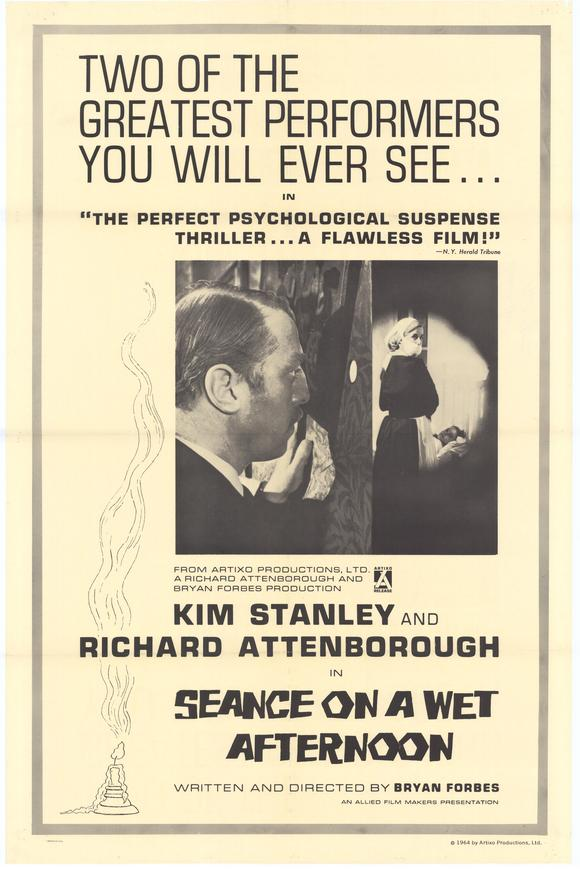
Seance on a Wet Afternoon (1964)

seance on a wet afternoon

By Richard Winters

My Rating: 6 out of 10

4-Word Review: Psychic is a phoney.

Myra Savage (Kim Stanley) is an emotionally unbalanced woman and failed psychic who comes up with an idea that she hopes will revive her career. The plan is for her husband Billy (Richard Attenborough) to kidnap Amanda Clayton (Judith Donner) who is the young daughter of a rich businessman. They will then place her at a strategic location and hold a public séance at which time Myra will ‘miraculously’ predict her whereabouts. This will then, they hope, make her famous and world renowned, but of course things don’t work out as expected.

This is indeed a unique and unusual film that taps into some rare qualities. First and foremost is the black and white cinematography. Every camera shot and angle has a certain evocative flair that is well captured and vivid. The on-location shots pick up just the right amount of ambiance and lighting with each setting. The music score is great and helps create excellent tension. You also will love the little girl that they kidnap. She is adorable without it being forced. Her matter-of-fact sensibilities are a great contrast to Attenborough and Stanley whose characters are child-like and pathetic.

Yet the film doesn’t completely work. The story is handled in a plodding and methodical way without any twists or surprises. There is very little action, some definite slow spots and the conclusion is limp.

If you watch it for the performances then you will be more intrigued. Stage actress Stanley gives a rare film appearance here. It is easy to see why she took the role even though she was known to dislike doing films. The takes are long and give almost unlimited possibilities in creating a character, which is what all stage actors enjoy. She does well and at times may remind one of another legendary actress Geraldine Page who would have also been perfect for the part. Attenborough proves almost her equal. His expressions of shock and worry are memorable. The interplay between the two is fun especially towards the end when this otherwise passive man stands up to the domineering woman.

Overall there are some unique moments, but it is just not suspenseful enough and results in being only slightly above average.

My Rating: 6 out of 10

Released: November 5, 1964

Runtime: 1Hour 55Minutes

Rating: NR (Not Rated)

Director: Bryan Forbes

Studio: Artixo Productions

Available: VHS, DVD (Region 1 & 2)

Venom (1982)

By Richard Winters

My Rating: 3 out of 10

4-Word Review: Kidnappers versus deadly snake.

            Phillip Hopkins (Lance Holcomb) is an 8-year old boy and son of a wealthy couple. When his parents leave for a trip the family’s maid and chauffeur (Susan George, Oliver Reed) conspire to kidnap the boy and hold him for a ransom with the help of a ruthless gunman (Klaus Kinski).  Unbeknownst to any of them the boy has mistakenly acquired a black mamba snake that escapes from his cage. As the culprits try to pull off their crime they become trapped in the house by the deadly reptile that starts to attack them one-by-one.

For starters the cast is one of a kind. Besides the performers listed above the film also has Sarah Miles as a Dr. with a serum to help fight the snake’s poisonous venom. Nicol Williamson appears as the police negotiator and Sterling Hayden, in his last film role, plays the boy’s grandfather.  How anyone could manage to direct a cast with such legendarily huge egos and eccentric personalities seems hard to fathom and probably explains why original director Tobe Hooper left the production after only ten days of shooting and was replaced by Piers Haggard. Supposedly Reed and Kinski were at odds with each other during the entire production and their animosity clearly shows on screen. For the most part the talents of the cast is wasted with a script that is limited and filled with characterizations that allow for no range.

I did like Hayden in the scene where he is forced to go searching for the snake in a darkened room and armed with nothing more than a lamp and a makeshift weapon. George is also fun playing a duplicitous character for a change and I was disappointed that she gets killed off so soon. However, she does make the most of it with a very theatrical death scene. Probably the best performance in the whole film is that of the boy. He has a very sweet, young looking face and the widest most innocent pair of blue eyes you’ll ever see and the kind that most casting directors would kill for. The kid plays the frightened part well and does an effective asthma attack. He hasn’t done much since, but I am sure that if he wrote a book dealing with his experiences on the set and his interactions with that cast that if would most assuredly be a best-seller.

The set-up is good and I found myself riveted to it for the first half-hour. I liked the idea that an actual mamba snake was used. There is a part where the snake is slithering towards the camera and opens its wide, black mouth and hisses straight at the camera, which could be enough to get most viewers to jump out of their seat. Director Haggard uses the novel idea of shooting scenes from the snake’s point-of-view and he does it through a fuzzy and slightly distorted lens to help replicate the snake’s vision. The only problem I had in this area is that the snake is seen slithering throughout the picture inside the home’s venting system, which is shown to be very clean and spotless, which didn’t make sense to me since the home was old making me think that the metal piping would be more corroded and rusted.

Despite the excellent concept the film’s second hour is quite boring. The characters don’t have enough to do and spend most of the time standing around. The interplay between Kinski and Williamson brings no tension. There is one cringe inducing scene where the snake crawls up Reed’s pant leg, but overall the scares are quite sparse. The climatic sequence is too convenient and becomes more of a disappointment then a shock. It is hard to say if the film would have been better if Hooper had stayed on or not. Reportedly none of the footage that he shot is in the final cut. The film is based on a novel by Alan Scholefield, which I suspect is probably more intriguing and after watching this makes me interested in reading it.

My Rating: 3 out of 10

Released: January 29, 1982

Runtime: 1Hour 33Minutes

Rated R (Mature Theme, Violence, Language) 

Studio: Paramount

Director: Piers Haggard

Available: DVD

Lady in Cement (1968)


My Rating: 4 out of 10

4-Word Review: Tony solves the case.

Frank Sinatra returns as detective Tony Rome in this sequel to the 1967 hit. Here, while going on a diving expedition off the coast of Florida, he finds a naked woman underwater with her feet encased in cement.  He then meets a large and mysterious man by the name of Gronski (Dan Blocker) who hires him to find the girl’s killer, but he is not so sure that Gronski himself may have something to do with it.

            One of the things I really liked about the film as well as in the first one is the very cynical, world-weary, streetwise nature of the detective character. It seems to be a part that Sinatra was born to play and he does it well. I don’t think it was too far off from Sinatra’s real personality, which is why it works. I loved the cryptic dialogue and snappy one-liners. The banter is fun and intoxicating. It was the best thing about the first film and continues to be the case in this one. If anything it is the one thing that really carries it.

            The mystery itself is dull.  In the first film the case was more intriguing and complex. Here it seems mechanical and uninspired. It gets played out in a formulaic way with the standard suspects that seem borrowed from other, better stories. The twists and turns aren’t exciting, or surprising. The movie is more concerned with being amusing and filled with hip banter making the case itself seem like a side-light and not allowing the story to move forward. Yes, the bickering is fun, but there still needs to be a plot to match it and that was not the case here. The suspense is lacking with a final denouncement that is nothing special. The climatic fight sequence is particularly clichéd and forced.

            The opening bit where Tony finds the dead woman underwater is poor as well. It happens right away with no build-up even though I felt one was needed. I would think if a dead person had been trapped underwater for any period of time there would be some discoloration and decay. Instead the woman looks gorgeous, wearing a provocative expression one would find on an erotic model. Her skin is unblemished and she even still has her lipstick and make-up on, which I thought was unrealistic and pretty much ruins the story’s validity before it even gets going.

            The presence of actor Dan Blocker is a major asset and helps the film’s appeal. Blocker was probably better known for playing the character Hoss in the hit TV-series ‘Bonanza’. The fight sequences that he is in are amusing because he can simply throw the other men around like they are toys and seems unstoppable in the process. Like in the TV-series he exudes a lot of charm and is very engaging. There is even a brief in-joke where he is sitting in his room watching an episode of ‘Bonanza’. He and Sinatra make an unlikely, but interesting pair although when shown together he does make Frankie look puny, out of shape, and even a bit washed-up by comparison.

            One of the biggest issues I had with the first film was that there were a lot of loopholes. Particularly one scene where Tony kills a man and then he glibly tells the police that it was ‘clearly self-defense’ and he is never brought in for questioning, or arrested. That just didn’t jibe with me as there are many cases where a person kills someone in self-defense, but the case still ends up being brought to trial. Tony is very good friends with the police chief (Richard Conte), but I still didn’t think that would make him untouchable. At least here when Tony gets framed for a murder the police tell him they are going to have to take him in, which seems more plausible.  This culminates into an extended car chase sequence, which due to the long edits, slow speeds, bird’s eye view camera shots, and laid-back music, make it one of the least riveting and most uninteresting car chases you’ll ever see.

The production values are high and I have no real complaint on it from a technical stand point.  Everything is slickly handled despite a weak story.  There are some strong homophobic undertones, which may offend some, but I felt it fit the era. If you like Sinatra then you will find this passable, but if you enjoy a good mystery then don’t bother because in that area this thing falls flat.

My Rating: 4 out of 10

Released: November 20, 1968

Runtime: 1Hour 33Minutes

Director: Gordon Douglas

Studio: 20th Century Fox

Available: VHS, DVD

The Detective (1968)

detective

By Richard Winters

My Rating: 8 out of 10

4-Word Review: Up against the system.

Many people may not realize that Frank Sinatra was the original choice of Harry Callahan for Dirty Harry.  Due to various reasons he turned down the part despite the fact that he was interested.  You can’t help but wonder what that film might have been like had he accepted.  A good indication may be the character of detective Joe Leland that he plays hereIt has a similar theme of a tough cop tired of ‘the system’ and breaking off on his own to solve a bizarre case.

The murder itself is particularly gruesome and ahead of its time as it deals with the killing of a gay man found nude on the floor of his apartment with his genitals cut off. The actual shot of the victim is conveniently framed so that a fern, yes a fern, is strategically placed over the offending area, which is a little corny.  Yet the dialogue and description of the case seems incredibly graphic for the time. Ol’ Blue Eyes even says the word penis, which I think has to be a movie history first.

The way it deals with the homosexual topic is also surprisingly enlightening. Gays are not labeled as ‘sick’ and ‘perverse’, at least not by the Leland character. In one good bit the Sinatra character even slugs another officer, played by Robert Duvall, in retaliation for getting  rough with a gay man that he was questioning for no apparent reason except that he was gay.

There is another electrifying sequence involving Leland questioning the victim’s live-in lover and chief suspect. The part is well played by actor Tony Musante who gives his character all sorts of weird body gestures and nervous ticks, which makes the viewer feel uneasy but still compelled to keep watching until it becomes a fascinating experience. The Leland character again shows an amazing amount of compassion and enlightenment for the gay lifestyle during the interrogation, which should be enough to give this film a landmark status.

However, for all of its apparent sophistication, there are also things that hold it back and make it dated. One is reverting to what was a trend in the 40’s and 50’s, which was to film a person driving their car while sitting in front of a blue screen and holding onto a steering wheel that is not connected to any dashboard. It was considered a ‘ingenious’ way to stay under budget and not having to go through the ordeal of mounting a camera onto an actual car, but for today’s sharp audiences it comes off looking obvious and cheesy.

The casting of Sinatra is another drawback. He was already 53 at the time and he looked it.  The part seems to be screaming for a younger, more rugged method type of actor like Steve McQueen or Paul Newman, who would have done better.  Sinatra overplays the tough guy thing too much until it becomes one-dimensional and boring. The character needed more personal quirks and odd habits in order to make him more filled out and interesting.  He also wears outfits worn by the ‘old school’ investigators of yesteryear even though the character is one looking to break from tradition and fighting the mainstream.

I also wasn’t quite sure why Lee Remick’s role as Sinatra’s love interest was necessary. I usually dislike it when crime dramas feel the need to work in a romance angle as a side story because it usually bogs everything down and in this case was no different. Now Remick is always reliable and her character was interestingly flawed, but how that was supposed to connect with everything else was not clear.

The story works in three different parts. The first deals with the murder and the homosexual community of the period.  The second analyzes the politics of the police department while the third involves a mysterious suicide of a successful businessman. The third part, which doesn’t start until the second hour of the film, was the most intriguing for me. The suicide is shown from the point-of-view of the victim. They literally took a camera and heaved it over the edge of a building until it crashes directly onto the pavement below, which actually made me flinch. It is not until the very end where you see how all three of these parts come together, but the twist is excellent and made viewing this film well worthwhile.

Overall the cinematography, editing, writing, directing, and supporting acting are first rate.  There are a lot of familiar faces in supporting roles including: Jack Klugman, William Windom, Lloyd Bochner, Jacqueline Bisset, Horace McMahon and Al Freeman Jr. They all do splendidly. The subject matter and the way it is handled easily elevates this from other melodramas of the period.  The resolution should make this entertaining even for today’s viewers and enough to overlook a few dated elements.

My Rating: 8 out of 10

Released: May 28, 1968

Runtime: 1Hour 54Minutes

Rated R

Director: Gordon Douglas

Studio: 20th Century Fox

Available: VHS, DVD

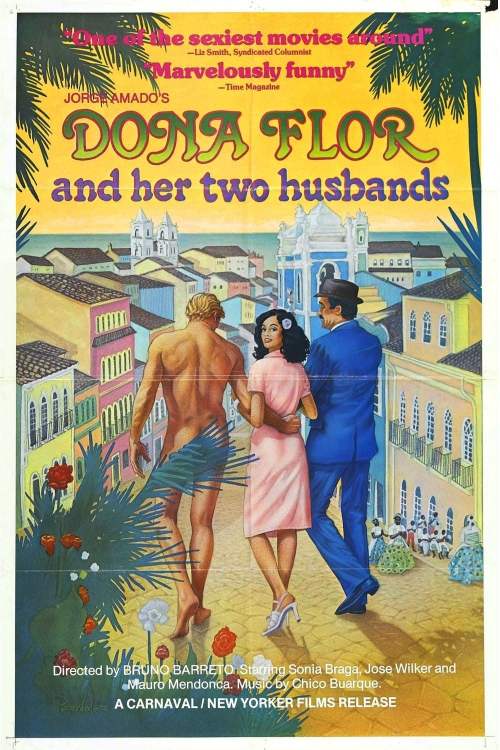
Dona Flor and Her Two Husbands (1976)

dona1

By Richard Winters

My Rating: 6 out of 10

4-Word Review: One is not enough.

This is an oddly structured Brazilian film that became a world-wide hit due to its explicit, edgy storyline.  It details the account of a woman named Dona Flor (Sonia Braga) whose first husband Valdomiro (Jose Wilker), was a bit on the wild side. After gambling away all of their money he dies. She becomes determined not to make the same mistake twice, so she remarries another man who is a doctor (Mauro Mendonca) and a much more responsible mate, but also stiff and boring. Problems ensue when the first husband, who she misses because he was more erotic and exciting in bed, comes back in the form of a ghost who only she can see.

The movie on a whole is well made. The characters are all likable and the theme music, which is played throughout the film, is appealing. The on location shooting is also quite distinctive. It really gives you a genuine, rare flavor of a small Brazil village and the people who inhabit them.

My main complaint with the film is that it takes the entire first hour just too illustrate her marriage with her first husband and the second hour to show her mourning and eventual remarriage. It’s not until the FINAL FIFTEEN MINUTES that the scenario the whole film is based on actually happens. When it does it is lively and funny, but the majority of the movie is surprisingly low key and melodramatic. The highly touted sex scenes are overrated. They are too brief and spread out very thinly.

Braga does well in her star making vehicle. She is able to convey both a simple, sweet nature as well as a sultry, sensual one. She has a pretty face and really does look great naked.

My Rating: 6 out of 10

Released: November 22, 1976

Runtime: 1Hour 50Minutes

Rated R

Director: Bruno Barreto

Studio: Embrafilme

Available: VHS, DVD (Director’s Cut)

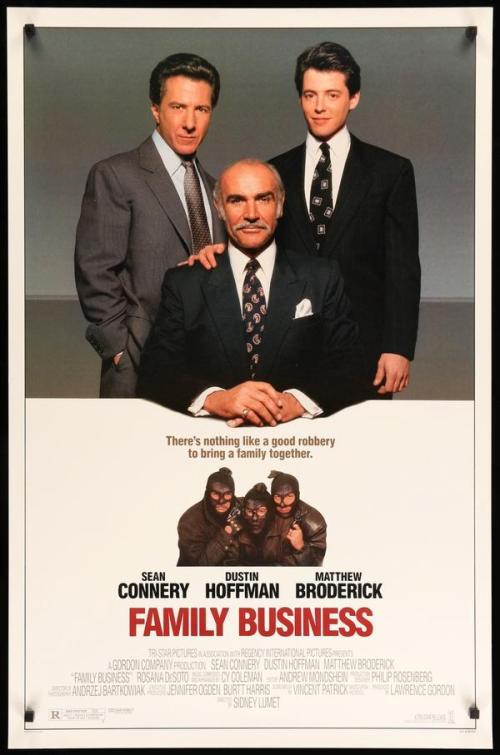
Family Business (1989)

family1

By Richard Winters

My Rating: 4 out of 10

Any movie that casts Dustin Hoffman, Sean Connery, and Mathew Broderick as a father, son, and grandson team of robbers has me hooked before I have even seen the first frame. It was a great bit of inspired casting even if Connery was playing Hoffman’s father and in reality was only seven years older than him.  Throw in the fact that it was directed by the late, great Sidney Lumet and you should have a sure fire winner.

The story involves the grandfather Jessie (Connery) getting out of jail and trying to rekindle relations with both his son Vito (Hoffman) and grandson Adam (Broderick).  Vito wants nothing to do with his father as he has done time himself by getting mixed-up in some of his father’s old schemes and is now trying to go straight by working as a manager at a meat packing facility. However, Adam, who is going to college and has a promising career ahead of him, idolizes his grandfather and relishes the idea of pulling off a robbery himself. He has even come up with one that all three of them can do together. The robbery is unique in that they aren’t stealing from a bank, jewelry store, home of someone rich, or even a priceless artifact at a museum, but instead some important research materials at a science lab.

The crime itself is not elaborate and could have been easily pulled off with just one person. I was anticipating something a little more daring and exciting especially since Jessie and Vito were career criminals. It also takes too long to get to it. The first fifty minutes are spent with them endlessly arguing and rehashing the same old points.

The second part is a little more interesting as it deals with Adam getting caught while the other two are able to get away and all the dilemmas that they then face. Even here the drama becomes strained and talky.  The ending fizzles and leaves no emotional impact.  I saw a lot of similarities with this film and Sidney Lumet’s last film that he did before he died, which was Before the Devil Knows You’re Dead.  Both of these movies deal with robberies and the consequences of family members betraying one another and yet that film was far more gripping while this one falls flat.

I thought Connery was highly engaging and would have enjoyed seeing him take over the movie. Hoffman gives a solid dramatic performance, but his character is bland.

The Adam character got on my nerves. He had been given everything in life and yet refuses to appreciate it and seems almost ungrateful to his father for working so hard to give him a better life. He acts cocky about going through with the robbery and yet when they get there he is ill-prepared and confused. I understand sometimes people become curious about those that live a different lifestyle than they do and that they don’t fully understand, but I still felt there needed to be a little more balance.  I just didn’t understand why this kid would want to throw it all away just so he could be like his career criminal grandfather.

The film gives one a good taste of New York. I liked how it showed the different neighborhoods and boroughs. Not only do we get a good feel of the Bronx, but we also see Flushing, Brooklyn, and downtown Manhattan. Most films that take place in the Big Apple seem to concentrate in only one section of it while this one tried to give a broader feel.

The indoor sets are nicely realized. Everything from the trashed halls of the prison to Vito’s modernistic, sleek apartment, to the science lab and even Jessie’s small, cramped apartment looked authentic and distinct.

I did notice a few logistical errors. One is the fact that they discuss plans of the robbery in a lot of public places, which seemed just plain careless to me especially since these were ‘professional’ thieves. One discussion takes place at a bar, another on a busy sidewalk with pedestrians going by, and the third at a funeral with mourners standing right behind them. There is also the fact that they park their car on the side of the road in front of the lab and put a sign in the windshield stating that they are out of gas and will be back in one hour. I thought this seemed dumb because a policeman could come by and do a check on the license plate to find out who the owner is. Then, the next day when the robbery is reported, they would only have to put the two together to trace the culprits. There is also a scene were Vito fires one of his employees at his plant for stealing. He punches him violently in his office that is surrounded by windows and is in full view of the other workers.  The man leaves with a broken nose and bloodied face, but the workers do not react and go on with their tasks like nothing happened, which didn’t strike me as believable.

The music score is another problem.  It has a big band, show-tune type melody and sound, which might have worked for a Broadway production, but here it seems completely out-of-sync with the mood and tone of the story.

Although competently done this thing still seems like a misfire namely because the material isn’t diverting, or interesting enough for the cast that it has. I was expecting a little more razzle-dazzle and a lot more action and excitement. I almost felt that if this same story had been approached in a comic vein it might have done better.

My Rating: 4 out of 10

Released: December 15, 1989

Runtime: 1Hour 50Minutes

Rated R

Director: Sidney Lumet

Studio: TriStar Pictures

Available: VHS, DVD, Amazon Instant Video