Category Archives: Movies Based on Novels

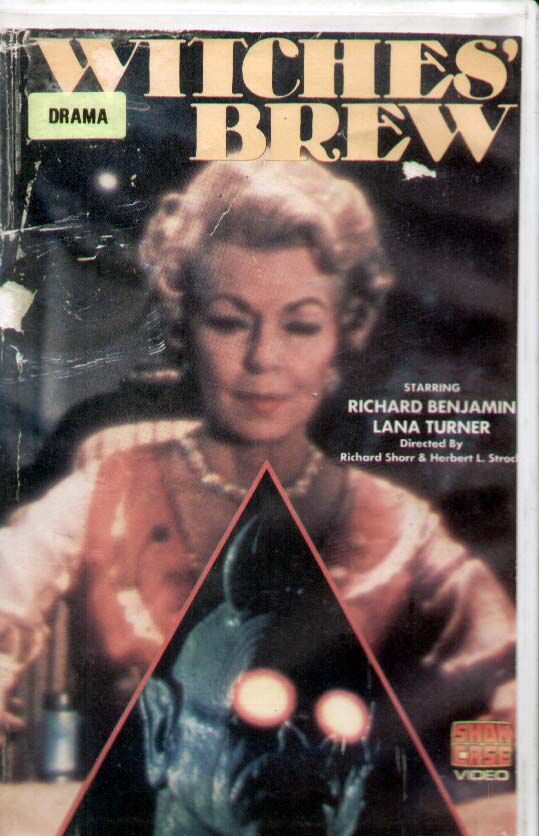
Witches’ Brew (1980)

witches brew 1

By Richard Winters

My Rating: 4 out of 10

4-Word Review: Witch has ulterior motives.

Margaret (Teri Garr) will do anything to help her husband Joshua (Richard Benjamin) get a promotion at a local college, so she decides to resort to witchcraft with the help of Vivian (Lana Turner) who is an expert on the matter. The problem is that two of Margaret’s closets friends Susan (Kathryn Leigh Scott) and Linda (Kelly Jean Peters) also have husbands that are vying for the same position, so they begin to practice witchcraft of their own, which conflicts with Margaret’s and causes Joshua to have a streak of terrible luck and even near tragedy. Vivian comes to their aid, but only because she harbors a dark secret that could cause Margaret her life.

This is a remake of 1944’s Weird Woman that starred Lon Chaney Jr. and Evelyn Ankers, which also got remade before in 1962 with Burn, Witch, Burn! Out of the three versions this one is considered the weakest. The set-up is alright, but the second half in which the cynical Joshua slowly comes to terms with the reality of witchcraft goes on way too long. The comedy and effects are much too restrained and do not take enough advantage of its wild concept. The final third does manage to have some interesting twists, but the climatic sequence is full of loopholes and unfinished story threads that left this viewer feeling unsatisfied and confused when it was over.

I’ve enjoyed Richard Benjamin and his sarcastic wit in other films, but here he comes off as a borderline jerk and has such a radically different temperament from his wife you wonder how they ever got married in the first place. Garr is far more appealing and should’ve been given the most screen time. Turner whose last film this was, doesn’t have all that much to do and locked into a role that is limited and rather thankless.

Director Richard Shorr was fired midway through the production and replaced by Herbert L. Strock, which may explain the film’s disjointed feel that never really comes off as the intended spoof that it wants to be and in some ways far edgier than you’d expect including one scene that has a disgruntled former student climbing to the top deck of a parking ramp and shooting at Joshua below in a Charles Whitman-like attack. There is also another segment that has a giant devil-like bat hatch from an oversized egg that might’ve worked had the special effects been better. In either case this film, which starts out with good potential never comes together and becomes rather flat and forgettable.

My Rating: 4 out of 10

Released: March 10, 1980

Runtime: 1Hour 38Minutes

Rated PG

Director: Richard Shorr, Herbert L. Strock

Studio: United Artists

Available: VHS

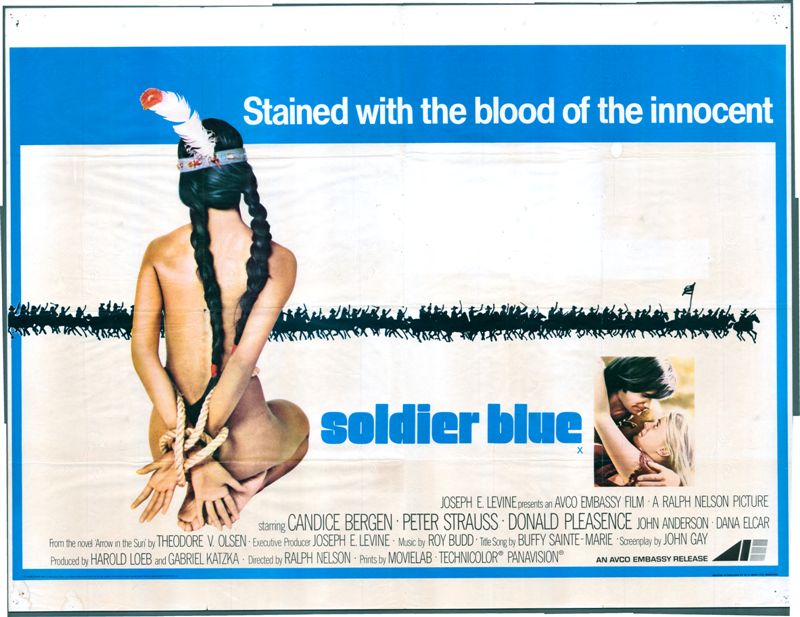
Soldier Blue (1970)

soldier blue 1

By Richard Winters

My Rating: 5 out of 10

4-Word Review: They massacre the Indians.

Two survivors of a Cheyenne Indian attack, the young and beautiful Cresta (Candice Bergen) and Honus (Peter Strauss) a private from the Calvary must travel through treacherous western terrain avoiding other attacks while also finding the Calvary’s base camp. Along the way the two start a romance despite wide differences in their temperaments and perspectives. Honus supports the position of his country and government without question while Cresta is more sympathetic to the Indians, but this all comes to a crashing halt when they witness an assault by the U.S. army on a peaceful Indian camp, which shocks Honus and changes his perspective on things forever.

The film is mainly known for its notoriously violent ending, which at the time was unprecedented for its use of explicitly savage imagery and remains controversial to this day, but before we get to that I’d like to go over what I did liked about the movie, which for the most part is still watchable.

Filmed in Mexico in October of 1969 the stunning views of the wide open terrain  is sumptuously captured by cinematographer Robert B. Hauser, which is enough to keep one enthralled with it despite its otherwise flimsy plot. I also enjoyed Buffy Sainte Marie’s rousing opening title tune, but the rest of the music score by Roy Budd seems misplaced. During the attack that starts out the film it is booming and orchestral almost like it wants to replicate the sound and mood of a conventional western even though this is supposedly a revisionist one. At other times it takes away from the potential grittiness by being played when it was not needed and sounding too modern for the time period.

Strauss in only his second film is marvelous and makes his naïve and rigid character believable and likable, but I was perplexed how someone lost in the wild for days and weeks and sometimes without food or even a gun could still remain clean shaven. Bergen as his female counterpart is great as well and beautiful. The fact that she is foul mouthed and very self-sufficient while Honas is more timid makes for a nice reversal of the sexual stereotypes, which helps propel the film during the first half. However, it eventually gets overplayed as Bergen’s character starts to display too many attitudes and behaviors from someone that was ahead-of-her-time until it seemed like she was really a late ‘60’s student radical that somehow got pulled into a western setting instead of a person that had actually lived during that era.

Donald Pleasence, a highly talented character actor who played many varied roles during his career, gets one of his best ones here while wearing false teeth that make him almost unrecognizable. His chase of the two when they destroy his wagon lends some much needed tension in what is otherwise a dull romance.

The Indian massacre that climaxes the film is based on the Sand Creek Massacre that occurred on November 29, 1864. Although the film incorrectly states during its denouncement that is was led by Nelson A. Mills it was actually U.S. Army Colonel John Chivington who ordered a band of 700 men to attack a peaceful Indian village where between 150 and 200 Indians were killed most of whom were women and children.

The film portrays Bergen’s character as being the only white person outraged at the slaughter, which isn’t true as many people from the era where appalled by the news when it was found out and the attack was condemned by the army after it was investigated.  Chivington was then forced to resign where he lived out the rest of his life in almost total ostracism by every community he moved to. There were also two officers in the Calvary who refused Chivington’s orders to attack and told the men under their command to hold their fire, which doesn’t get shown at all.

Although the movie does leave some effective haunting images it would’ve worked better had it been a documentary, or a reenactment that concentrated fully on the attack while also showing its aftermath and what lead up to it. It should’ve also been better researched, accurate and balanced instead of feeling the need to pander to the political fervor of its day with stagy over-the-top dramatics and a clumsily attempt to tie it into the My Lai Massacre that has forever stigmatized this as being nothing more than dated emotionally manipulative propaganda.

soldier blue 2

My Rating: 5 out of 10

Released: August 12, 1970

Runtime: 1Hour 55Minutes

Rated R

Director: Ralph Nelson

Studio: AVCO Embassy Pictures

Available: VHS, DVD, Blu-ray (Region 2), Amazon Instant Video, YouTube

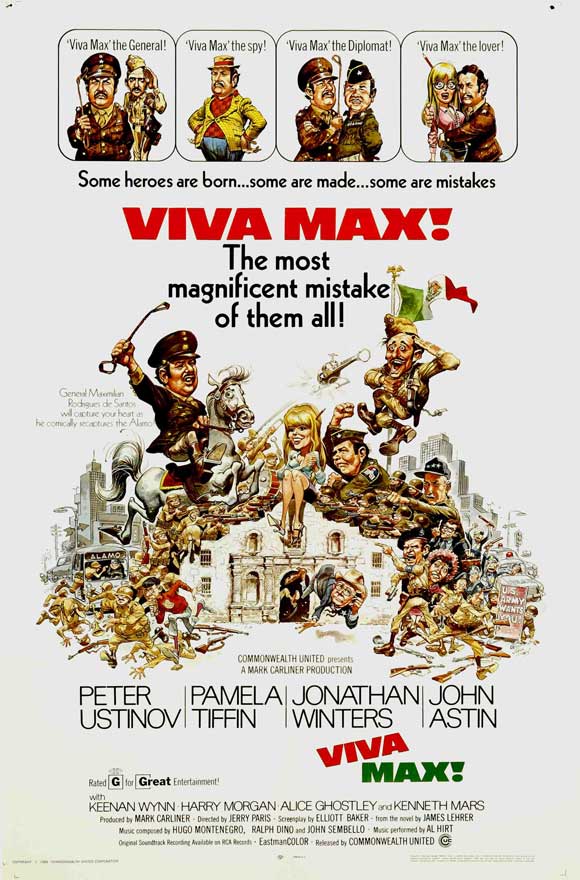
Viva Max! (1969)

viva max 2

By Richard Winters

My Rating: 3 out of 10

4-Word Review: Taking back the Alamo.

A small ragtag Mexican army led by the affable, but incompetent General De Santo (Peter Ustinov) decides to cross the border and recapture the Alamo. The process goes much easier than expected despite the fact that the army used no bullets in their guns. The National Guard is then sent in to weed them out, but they too decide not to load their guns with bullets leading to some unusual results.

The film is based on the novel written by PBS newsman Jim Lehrer and the movie’s behind-the-scenes politics ends up being much more interesting than the plot itself. Filmed in April of 1969 the production initially had permission from the state to film right on the actual site of the Alamo and a major portion was done there before various citizen groups became aware of it and began protesting the crew’s presence in what they considered to be sacred ground. Some of their protests was captured on film and incorporated into the story, but their loud presence eventually disrupted the production forcing some scenes to be done on an indoor studio soundstage while still others were completed in Italy.

The commotion and ‘controversy’ was not worth the effort as the film is an overall bore. The first 15-minutes are amusing and even mildly engaging, but once it gets inside to the actual Alamo the action and pace come to a screeching halt and kill any possible potential that the film may have had.

The script also has some illogical loopholes one of them being the army deciding to invade a place, but without using any ammunition, which is never explained and highly improbably. What is even more ridiculous is that the National Guard would decide not to use bullets in their guns either since this is the U.S. of A. where guns and force are considered a national birthright and thus makes this ill-conceived plot twist to be unbelievable to the extreme. The fact that De Santos and his men and able to freely leave at the end and go back to their country without dealing with any type of consequence for their actions is equally absurd.

Ustinov is funny and speaks in an authentic Mexican accent, but he’s unfortunately limited by the broad caricature of his role. John Astin comes off best as the Sergeant that’s second in command and does most of the actual disciplining and leading and Jonathan Winters is good as a clueless American general. Alice Ghostley lends some energy as an innocent bystander that becomes one of the army’s prisoners and Pamela Tiffin looks great wearing glasses and having her hair tinged in blonde.  Gino Conforti, Paul Sand, Jack Colvin, Anne Morgan Guilbert and Kenneth Mars can also be spotted in small roles, but even with their competent performances it fails to mask the film’s otherwise glaring inadequacies.

My Rating: 3 out of 10

Released: December 16, 1969

Runtime: 1Hour 34Minutes

Rated G

Director: Jerry Paris

Studio: Commonwealth United Entertainment

Available: VHS

The Driver’s Seat (1974)

drivers seat 1

By Richard Winters

My Rating: 3 out of 10

4-Word Review: Crazy lady goes traveling.

Lise (Elizabeth Taylor) is a middle-aged woman with seemingly no past who travels to Rome looking for someone to kill her. Her erratic behavior and weird motivations confuse those that she comes into contact with. She then meets Bill (Ian Bannen) a man who’s more interested in her sexually than anything else and he follows her around in a veiled attempt to get ‘lucky’ despite her repeated rebuffs.

The film is basically a mess that goes nowhere. It was based on a novel by Muriel Spark, who had written some acclaimed stuff in her day including ‘The Prime of Miss Jean Brodie’, so I can only imagine that the book made more sense and only bits and pieces of it were taken to create this screenplay. In either case it was a highly strange career move for Miss Taylor who made a lot of weird movie choices in the 70’s, which helped to destroy her once megastar status and tainted her other stellar work.

Her performance by itself isn’t too bad and it’s the one thing that helps keep things watchable. The way that she can go from being passive and helpless to snippy and bitchy within seconds is kind of fun and on a purely camp level even enjoyable. The whole thing seems almost like an extension of the character that she played in Who’s Afraid of Virginia Woolf? , which became her signature role during her later years.

Bannen lends good support as his leering Cheshire cat grin is a perfect counterpart to Taylor’s crazed glare and he effectively equals her nuttiness. I also loved his so-called macrobiotic diet in which he must attain one orgasm a day for it to work and if he misses one then he must make up for it by having two the next day, which ultimately gives him ‘indigestion’. Mona Washbourne a character actress noted for playing delightfully daffy old ladies is also on hand as one of the people Taylor befriends and their encounter inside the stall of a public bathroom is a gem.

Director Giuseppe Patroni Griffi manages to infuse some interesting visuals, which along with its fragmented narrative helps keep things cheaply alluring, but it eventually plays itself out and by the end becomes quite tiring and tedious. The biggest issue is that there never is any explanation for who this woman is or why she’s doing this, which makes the whole thing quite empty and pointless.

My Rating: 3 out of 10

Released: May 20, 1974

Runtime: 1Hour 42Minutes

Rated R

Director: Giuseppe Patroni Griffi

Studio: AVCO Embassy Pictures

Available: DVD-R, Amazon Instant Video

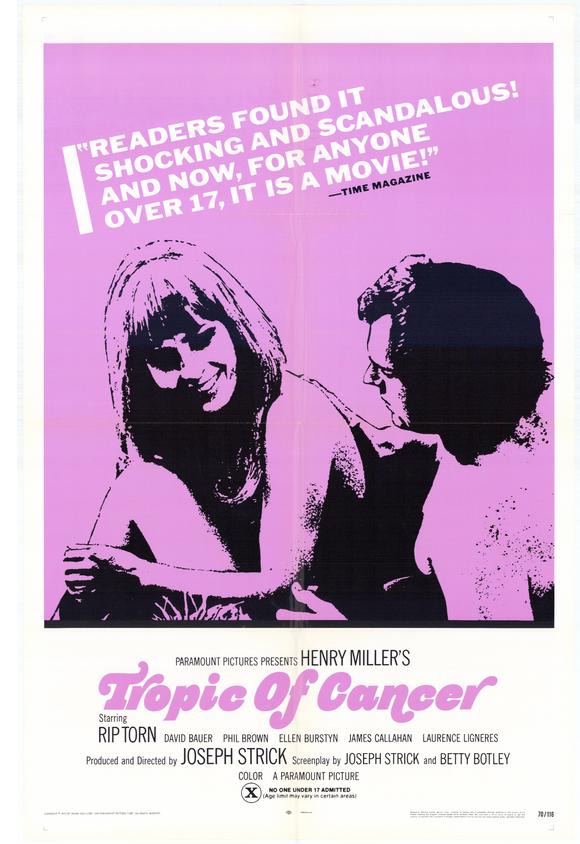
Tropic of Cancer (1970)

tropic of cancer

By Richard Winters

My Rating: 4 out of 10

4-Word Review: Writer living in Paris.

Rip Torn plays author Henry Miller living in Paris during the 1930’s and struggling to find work, shelter and money. He spends his time shoplifting items from food stands while also having sexual conquests with prostitutes and even the wives of his friends.

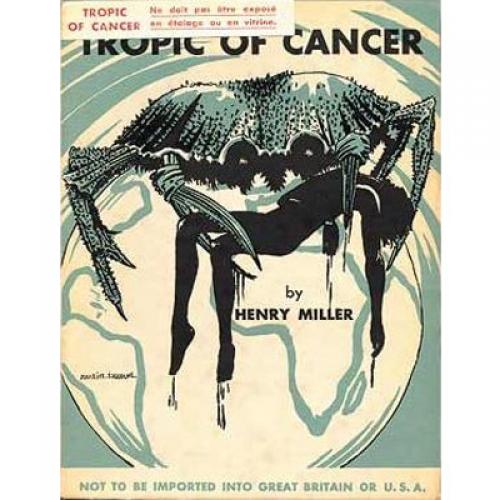
The film is based on Miller’s landmark novel that was published in France in 1934, but banned in the US until 1961 and even then went through several obscenity  lawsuits, which were finally all dropped in 1964 when the US Supreme Court deemed the book to have artistic merit. The novel, which is considered highly influential and won wide critical acclaim, has an odd mixture of stream-of-consciousness elements as well as autobiographical ones that works well in book form due to Miller’s first person narrative, but fails on the big screen. It was never meant to be made into a movie and director Joseph Strick’s ambitious attempt to make it into one, who just three years earlier tried to do the same thing with James Joyce’s equally unfilmable novel Ulysses seems futile and ridiculous.

The production looks cheap and lacks any type of atmosphere or visual flair. The setting is supposed to be the late 20’s, but it hardly seems like it. The acting is weak particularly by the supporting actresses playing the prostitutes who almost come off like people pulled off the street with no acting training of any kind.

The film’s most notorious claim to fame like with the book was its explicit sexual content that by today’s standards seems quite tepid. There are some nude scenes here and there including seeing actress Ellen Burstyn fully naked from the front, but it adds little. The best stuff is Torn’s voice over-narration describing his character’s sexual fantasies much of which was lifted directly from the novel. This was the first film to ever use the word ‘cunt’ and it gets said frequently. In fact it’s the character’s sexual conversations and the caustic way women get described in them that are the most amusing thing about the movie.

A few other funny moments include Miller having sex with a prostitute while she is also taking care of her sick mother and who would sometimes leave the bed to look in on her and although Miller initially pays the woman for her ‘services’ he eventually steals it back when she is away during one of her trips to her mother’s room. Miller’s roommate Carl (David Baur) has a great scene where he writes love letters to a woman he wants to have sex with and the two finally meet only to have the actual encounter not live up to the fantasy.

This was filmed at the same time as Quiet Days in Clichy, which was also based on the same novel. Both films were made in Paris and Henry Miller would routinely sit-in on the productions, which were done not far from the other. However, despite an admiral attempt the movie comes off as flat and boring and the viewer would be far better off skipping this and reading the source material instead as the only time it ever gels is when it uses text taken directly from the book.

tropic of cancer 2

My Rating: 4 out of 10

Released: February 27, 1970

Runtime: 1Hour 27Minutes

Rated X (Reissued as NC-17)

Director: Joseph Strick

Studio: Paramount

Available: DVD, Amazon Instant Video, YouTube

The War of the Roses (1989)

war of the roses

By Richard Winters

My Rating: 7 out of 10

4-Word Review: Yuppie couple destroys home.

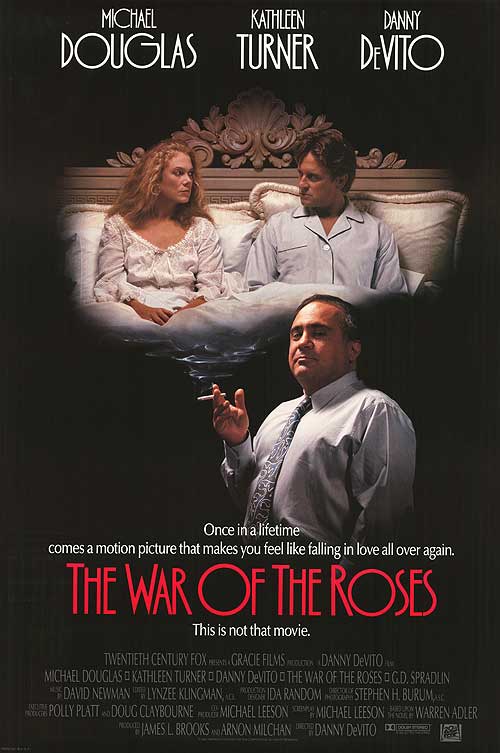
Oliver and Barbara Rose (Michael Douglas, Kathleen Turner) are a married couple with contrasting personalities who find that they no longer get along and in fact can’t even stand each other. They agree to a divorce and all of the assets except for the house. Both of them want to keep it and Oliver’s attorney Gavin (Danny DeVito) has found a loophole in the law that allows Oliver to remain there even after the separation is final. The problem is that they continue to get on each other’s nerves, which culminates with them locking themselves into the home one dark, harrowing night and using whatever prop available to vent their anger onto the other while inadvertently destroying the house in the process.

Some consider this to be one of the darkest comedies to ever be financed by a major Hollywood studio and when you think about it, it really is amazing. Most major studios shy away from edgy material and water it down until it becomes benign, but this film, which is based on the 1981 Warren Adler novel of the same title, stays quite true to its source material. The humor is on-target while making a great trenchant statement towards capitalism and yuppies in general. DeVito’s direction is visual and imaginative and there are some truly funny moments including the one where Turner destroys Douglas’s British Morgan Roadster with her 4-wheel drive truck.

The reuniting of Douglas and Turner from the Romancing the Stone films was perfecting casting. The two seem to have genuinely distinctive personas and it’s fun to imagine this as simply an extension of their earlier characters of Jack Colton and Joan Wilder and what happens when their rosy romance turns into the realities of marriage. The scene where Douglas’s character saws off the heels of Turner’s shoes is a great connection to their earlier film as his character did the exact same thing there, but it was unfortunate that we never get to see Turner’s reaction to it.

The production is slick, but having DeVito act as the film’s narrator seemed a bit distracting at times and the film might’ve worked better without him although he does have a few verbal gems during the second hour that almost makes up for it. I also didn’t like that the character who he tells this story to never says a single word, which to me seemed unnatural and weird as did his green painted office. Having the two kids of the couple turn out to be pudgy and fat was amusing and helped in a metaphorical way to symbolize the parent’s gluttony for materialism, but then the filmmakers end up ruining their own joke by having the kids later on become thin and attractive for no reason.

Spoiler Alert!!

The knock-down ending inside the home is great and DeVito’s use of Hitchcock overtones is inspired. Seeing the couple trapped on a ceiling chandelier while the camera travels up the wires of the light and into the attic where we see how the added weight bursts the bolts that anchors it is quite clever and even ingenious, but I was disappointed that the two end up crashing to the floor and dying. For one thing I didn’t think it was a big enough fall to have killed both of them. Maybe one, but most likely they both would’ve survived, but with injuries. Either way it would’ve been more interesting to see how they responded to each other after the incident and whether it helped to change them or their love/hate relationship, which to some degree is the film’s most unsatisfying aspect

End of Spoiler Alert!!

Adler wrote a sequel to his novel in 2004 that dealt with a messy divorce of the Rose’s grown son Josh to his wife. That book has now been put into production as a movie entitled The War of the Roses: The Children although no release date or cast has been announced as of yet.

My Rating: 7 out of 10

Released: December 8, 1989

Runtime: 1Hour 56Minutes

Rated R

Director: Danny DeVito

Studio: 20th Century Fox

Available: VHS, DVD, Blu-ray, Amazon Instant Video, YouTube

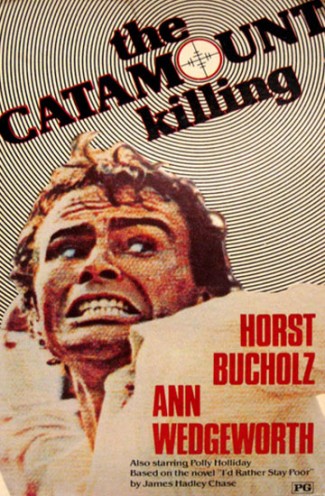
The Catamount Killing (1974)

catamount killing 2

By Richard Winters

My Rating: 3 out of 10

4-Word Review: They’re wracked with guilt.

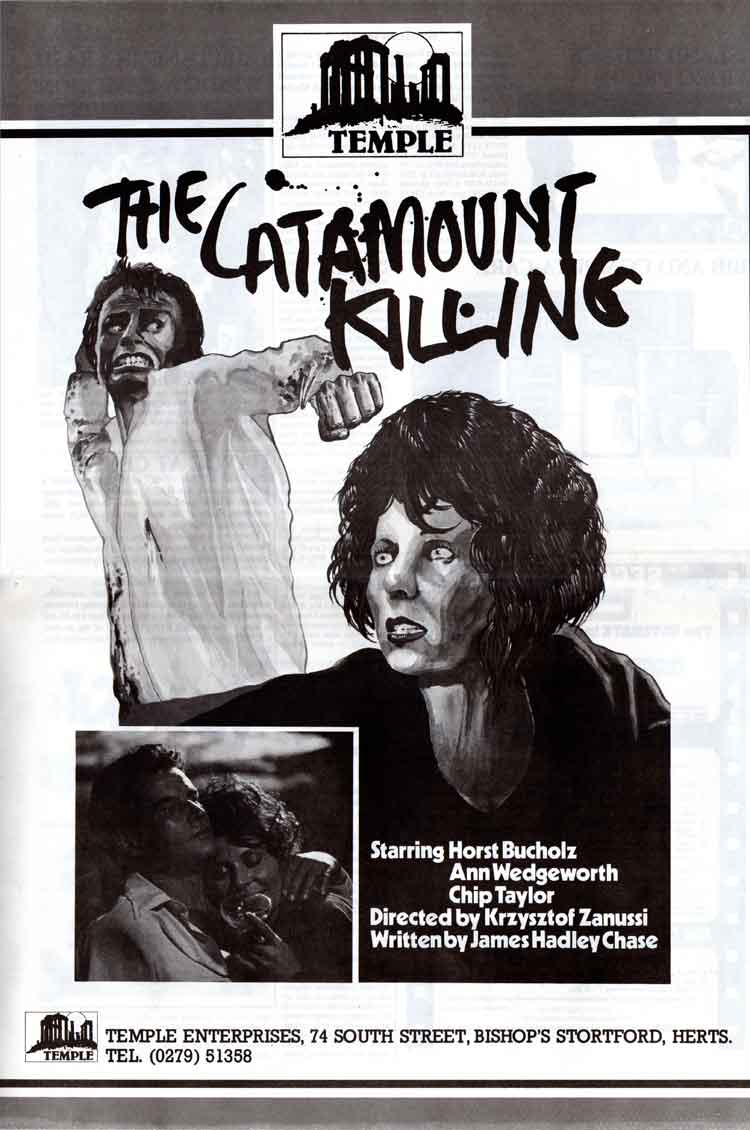
Mark (Horst Buchholz) is a recent divorcee who has moved to a small town and gotten a job as the new bank manager. The bank is small and not adequately guarded giving him the idea to pull off a robbery as an inside job. He seduces the emotionally fragile Kit (Ann Wedgeworth) into helping him with his plan. Initially things go smoothly, but then they begin feeling guilty over what they’ve done especially since the robbery involved the death of someone else. Then Kit’s daughter Iris (Louise Caire Clark) becomes suspicious that her mother might’ve been involved, which causes the couple to unravel in dramatic fashion.

I hate to use the fact that this is a low budget film as a reason for why it’s poor as not every movie has to have state-of-the-art special effects to be entertaining and good story telling and competent direction are still the foundation of a good movie and that can be accomplished on the most miniscule of budgets. However, this film, which was filmed on location in Bennigton, Vermont, looks cheap and stale. The camera work is unimaginative and it does not take advantage of some of the historical landmarks in the town where it was filmed making the background and setting look blah and uninteresting. Its loud, crashing orchestral music score would be better suited for a Hollywood epic and is pretentious and out-of-place here.

The set-up moves too fast and could’ve been the result of watching the American version, which is 11 minutes shorter than the European one. Either way it’s poorly constructed with the two falling in love and plotting the crime without much background information given about them making it all seem forced and rushed. The robbery itself isn’t unique and when compared to other bank robbery movies this one is weak and forgettable.

Buchholz gives a strong performance, which helps the limp material to some degree. Wedgeworth is outstanding. Somehow her soap opera-styled histrionics and Texas accent is something I’ve always found appealing and makes for a fun performance. This also mark the film debut of Polly Holliday who appears briefly sporting a foreign accent that does not sound too believable.

There are enough twists to keep it plausible and mildly engrossing, but the ending lacks impact and like the rest of the movie falls flat. The plot is based off the novel ‘I’d Rather Stay Poor’ by James Hadley Chase, which I suspect would be a far superior version to this.

catamout killing 1

My Rating: 3 out of 10

Released: August 11, 1974

Runtime: 1Hour 22Minutes (American Version)

Rated PG

Director: Krzysztof Zanussi

Studio: Starlight

Available: VHS, DVD-R, Amazon Instant Video

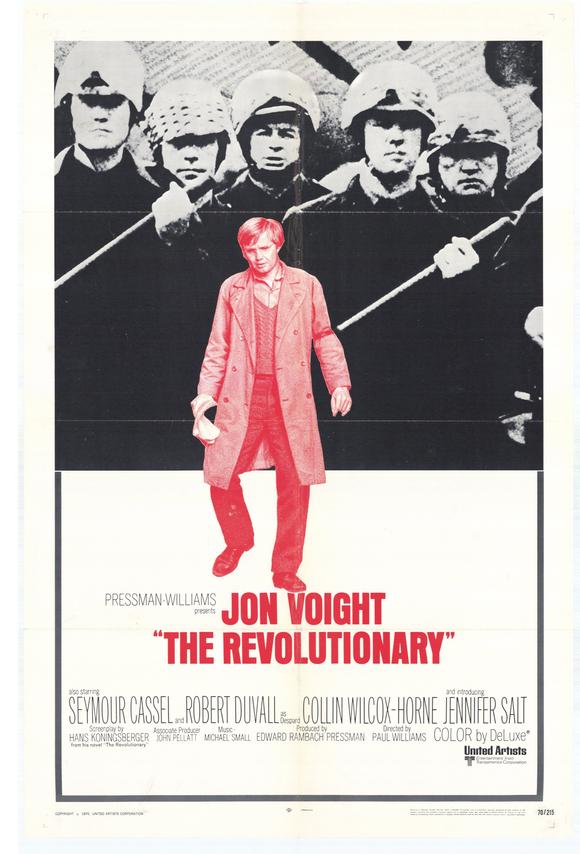
The Revolutionary (1970)

the revolutionary 2

By Richard Winters

My Rating: 6 out of 10

4-Word Review: He fights against capitalism.

Jon Voight plays a college student involved in a student protest group called The Radical Committee. They push for social change particularly with a more communist/socialist style of government, which he becomes fonder of after working with Despard (Robert Duvall) a nearby factory worker who’s trying to start a union up at his plant. After being suspended from the school for his radical views he becomes frustrated at seeing how his work and actions seem to have very little influence or effect. He then meets up with Leonard (Seymour Cassel) who is a more seasoned radical and not shy about using violent or unethical methods to make his point and pressures Voight to start doing the same.

On the whole despite its slow pace this is a slickly produced intriguing character study. I enjoyed the grainy pictures of the 1917 Bolshevik Revolution shown over the opening credits, but I didn’t like the film’s choice of on-location shooting. Supposedly it takes place in a small American city, but it doesn’t resemble one since it was filmed in London, which gives everything from the old buildings to roadways and sidewalks a European look that you never see in any American town or city. There is also no explanation initially about what the students are protesting against or why they are at odds with the school, which makes the storyline seem generic and hard to get into at first.

I loved Voight’s character as it is similar to his Joe Buck one in Midnight Cowboy with all of the social awkwardness, but fortunately he is not as painfully dumb. It is interesting to see how such a highly intellectual man with strong opinions and ideals can still at times be quite timid. I was looking forward to seeing the character go through a transition and was disappointed that it took so long to get there.  To me the ending should’ve been the beginning and the fact that it isn’t hurts the film’s overall impact. I was also confused as to why the Jennifer Salt character, who plays a young lady from an affluent family, would find Voight so appealing, or why she wanted to continue to go out with him, which to me demanded more of an explanation.

The scene in which a mob gets attacked by some riot police is photographed in a way that makes it intense and startling and could’ve been extended even more. The ending is nerve wracking and great example of how complete silence without any music can sometimes create far more tension. Unfortunately the ambiguous resolution is a disappointment and after such a long and deliberately slow build-up comes off almost like a cop-out.

My Rating: 6 out of 10

Released: July 15, 1970

Runtime: 1Hour 40Minutes

Rated R

Director: Paul Williams

Studio: United Artists

Available: DVD (MGM Limited Edition Collection), Amazon Instant Video

Such Good Friends (1971)

such good friends 1

By Richard Winters

My Rating: 8 out of 10

4-Word Review: Her husband fools around.

Julie (Dyan Cannon) is a well-off New York Housewife living in a swanky Manhattan apartment with her husband Richard (Laurence Luckinbill) who is the successful editor of a New York fashion magazine. Her life seems fulfilled and happy until Richard goes into the hospital for routine surgery, which has unexpected complications that sends him into a coma. While going through some of his personal belongings she comes upon his little black book that lists all sorts of sexual conquests he has had with her friends, which first leads the devastated Julie into considering suicide, but then ultimately into revenge.

This film can be considered Otto Preminger’s swan song as the two movies he made after this weren’t worth watching. This movie also proves to be a giant improvement from the awful Skidoo that he did just three years before where he tried unsuccessfully to get with the ‘hip generation’, but failed miserably. It has the same irreverence and satire as that one, but it is much more disciplined and sophisticated and makes its point without going overboard. It also shows that despite his renowned cantankerous nature behind-the-scenes he was still a gifted director who managed to span five decades with movies that had vastly different styles and themes and he deserves to be labeled a filmmaking legend.

I loved the way the camera spins around in a circle during a scene inside a New York art museum as well as some breathtaking shots of the New York skyline while on top of Jennifer’s and Richard’s condominium. The fractured narrative that deals heavily with flashback sequences is also nicely handled though the scenes showing a middle-aged Cannon trying to look like she is an adolescent while wearing pigtails looks tacky and should’ve been scrapped.

The film is based on the Lois Gould novel of the same name and while that book had a much more serious tone the movie gives the material more of a satirical spin much like Diary of a Mad Housewife, which Preminger had scriptwriter Elaine May (who gets credited as Ester Dale) watch before writing this one. The result is endlessly witty dialogue and some near brilliant conversational exchanges between the characters. Some of the best bits are Jennifer’s discussions with Richard’s doctors who seem reluctant to take responsibility for their medical blundering as well as Jennifer’s awkward sexual encounter with her friend Cal (Ken Howard) when he is unable to ‘rise to the occasion’.

Although she has a face that can show pain and sadness well Cannon may not have been the best choice and some other actresses would’ve been more interesting in the part. Apparently Preminger had her in tears already on the first day and she has in subsequent interviews called him a ‘horrible man’. The scene showing her naked in a snapshot is actually that of another nude model with Cannon’s face cropped on it.

James Coco is great in support and I was genuinely shocked that it didn’t get him nominated for best supporting actor. The scene where Cannon is undressing him for some sex and he tries desperately to distract her while he takes off a corset that he is wearing underneath is frickin’ hilarious. Burgess Meredith has an outrageous moment where he is seen nude while attending a posh party and only his genitals are covered by a book hung from a belt that he is wearing.

The only real negative is the ending that is too serious and somber and deflates the energy from the film’s otherwise snarky tone. Some of the music used doesn’t work with the scenes either including the O.C. Smith song played over the closing credits. Otherwise it’s as fresh, original and timely as it was when it first came out and ripe to be rediscovered by the right audience. The title sequence created by Saul Bass that is used to open the film is diverting and I wished it had been extended.

My Rating: 8 out of 10

Released: December 16, 1971

Runtime: 1Hour 42Minutes

Rated R

Director: Otto Preminger

Studio: Paramount

Available: DVD, Blu-ray, Amazon Instant Video

The Laughing Policeman (1973)

the laughing policeman 1

By Richard Winters

My Rating: 7 out of 10

4-Word Review: This policeman isn’t laughing.

8 passengers on a San Francisco bus are slaughtered to death by a mysterious gunman for no apparent reason. When Police Sargent Jake Martin (Walter Matthau) investigates he finds that his patrol partner is one of the victims. He soon learns that his partner was working on another case during his off hours dealing with a murdered prostitute that Jake had also worked on, but couldn’t crack. He begins to believe the two cases are somehow connected, but his brash department head (Anthony Zebe) doesn’t agree and thinks it is a waste of time to pursue the possible connection while also sticking him with Leo (Bruce Dern) a younger cop who doesn’t always like to play within the rules and whose manner and methods conflicts with Jake’s.

The film, which is based on the novel by Per Wahloo and Maj Sjowall who also did the book version for Man on the Roof, has a finely detailed gritty nature about it that looks at the methods of a police investigation in a realistic and unglamorous fashion, which significantly helps this one stand out from the usual cop dramas. I loved the way they searched for clues on the bus and the autopsies of the victims as well as pursuing leads that never pan out, which is a very common occurrence in most police investigations, but rarely is ever shown in movies. There is even a shot of a tow truck removing the disabled bus from the accident scene once the investigation is completed.

Although the novel’s setting was Stockholm the movie transplants the action to San Francisco making the Bay City almost like a third character. Director Stuart Rosenberg manages to nicely capture the eclectic vibe of the area and the disdain many people had for the police during that era. The movie also uses very little music, which is a major asset and helps accentuate the realism. Outside of the closing credits the only time there is really any other music is near the end when Jake and Leo start following a suspect, which comes off as jarring and should’ve been left out.

Matthau who’s mostly known for his comedic parts does well in an atypical role, which due to his casting and the film’s strange title may make some think it is a comedy though this is far from it. Dern is terrific in a role that takes full advantage of his edgy acting style and I liked how the two characters don’t get along at first, but eventually get past their differences and use each other’s unique strengths to their advantage. I was disappointed though that there is a side-story dealing with Jake’s tumultuous relationship with his teenage son that gets introduced early on, but then dropped and completely forgotten during the second half.

Louis Gossett Jr. gets a star making turn as a brash street cop and Zerbe is superb in support as the gruff police chief. Joanna Cassidy has a brief, but interesting bit as a witness and I liked the shot showing her and Dern sitting amidst a row of tables with table legs made to look like human ones. It’s also amusing to note that Albert Paulsen’s character who becomes the main suspect in the film never utters a single word of dialogue.

Spoiler Alert!

The film’s biggest downfall though is with its ending. It is very hard to believe that a character such as Paulsen’s that is portrayed as being rich and having a lot of connections would feel the need to shoot and kill the bus passengers himself as most if not all rich people simply hire someone else to their dirty work. I also didn’t think that someone who walks down the street surrounded by lawyers would crack as quickly as this one does when Matthau comes to question him about the case. A typical well-off businessman would simply ‘lawyer-up’ and trust that the minimum evidence that the police have would not hold up in court instead of jumping into his car and racing down the city streets in a panic such as he does here. The finale becomes too conveniently Hollywood-like and seems to sell out on the film’s original concept, which left this viewer with a flat and ambivalent feeling towards it when it was over.

the laughing policeman 2

End of Spoiler Alert!

My Rating: 7 out of 10

Released: December 20, 1973

Runtime: 1Hour 52Minutes

Rated R

Director: Stuart Rosenberg

Studio: 20th Century Fox

Available: DVD