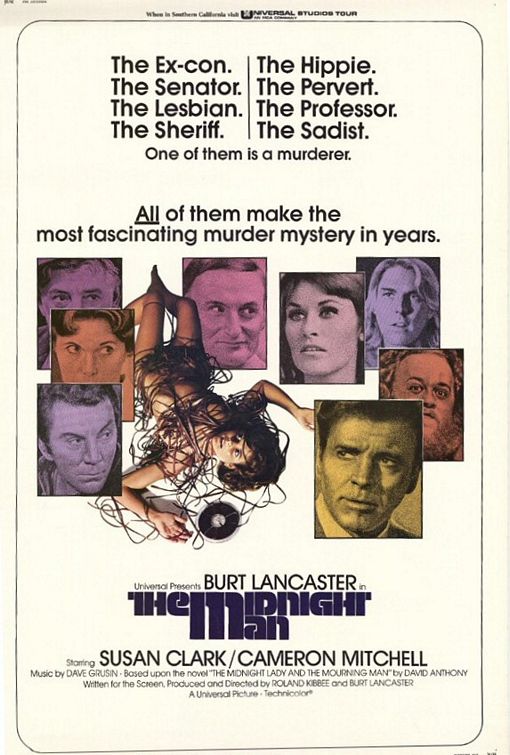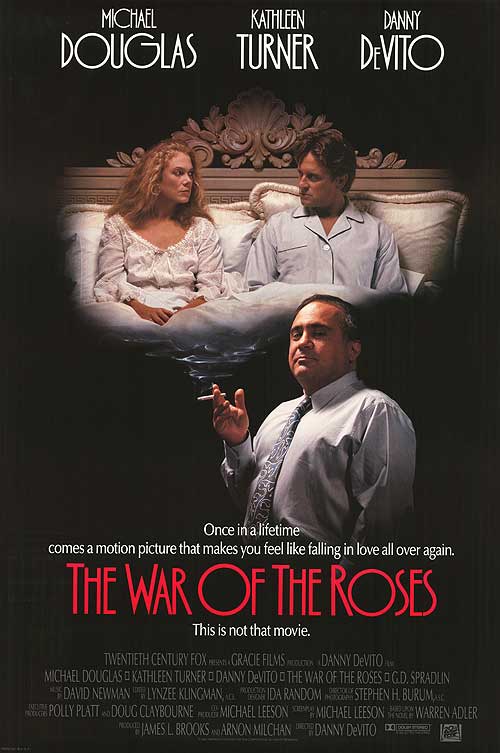
Category Archives: Movies Based on Novels

The War of the Roses (1989)

war of the roses

By Richard Winters

My Rating: 7 out of 10

4-Word Review: Yuppie couple destroys home.

Oliver and Barbara Rose (Michael Douglas, Kathleen Turner) are a married couple with contrasting personalities who find that they no longer get along and in fact can’t even stand each other. They agree to a divorce and all of the assets except for the house. Both of them want to keep it and Oliver’s attorney Gavin (Danny DeVito) has found a loophole in the law that allows Oliver to remain there even after the separation is final. The problem is that they continue to get on each other’s nerves, which culminates with them locking themselves into the home one dark, harrowing night and using whatever prop available to vent their anger onto the other while inadvertently destroying the house in the process.

Some consider this to be one of the darkest comedies to ever be financed by a major Hollywood studio and when you think about it, it really is amazing. Most major studios shy away from edgy material and water it down until it becomes benign, but this film, which is based on the 1981 Warren Adler novel of the same title, stays quite true to its source material. The humor is on-target while making a great trenchant statement towards capitalism and yuppies in general. DeVito’s direction is visual and imaginative and there are some truly funny moments including the one where Turner destroys Douglas’s British Morgan Roadster with her 4-wheel drive truck.

The reuniting of Douglas and Turner from the Romancing the Stone films was perfecting casting. The two seem to have genuinely distinctive personas and it’s fun to imagine this as simply an extension of their earlier characters of Jack Colton and Joan Wilder and what happens when their rosy romance turns into the realities of marriage. The scene where Douglas’s character saws off the heels of Turner’s shoes is a great connection to their earlier film as his character did the exact same thing there, but it was unfortunate that we never get to see Turner’s reaction to it.

The production is slick, but having DeVito act as the film’s narrator seemed a bit distracting at times and the film might’ve worked better without him although he does have a few verbal gems during the second hour that almost makes up for it. I also didn’t like that the character who he tells this story to never says a single word, which to me seemed unnatural and weird as did his green painted office. Having the two kids of the couple turn out to be pudgy and fat was amusing and helped in a metaphorical way to symbolize the parent’s gluttony for materialism, but then the filmmakers end up ruining their own joke by having the kids later on become thin and attractive for no reason.

Spoiler Alert!!

The knock-down ending inside the home is great and DeVito’s use of Hitchcock overtones is inspired. Seeing the couple trapped on a ceiling chandelier while the camera travels up the wires of the light and into the attic where we see how the added weight bursts the bolts that anchors it is quite clever and even ingenious, but I was disappointed that the two end up crashing to the floor and dying. For one thing I didn’t think it was a big enough fall to have killed both of them. Maybe one, but most likely they both would’ve survived, but with injuries. Either way it would’ve been more interesting to see how they responded to each other after the incident and whether it helped to change them or their love/hate relationship, which to some degree is the film’s most unsatisfying aspect

End of Spoiler Alert!!

Adler wrote a sequel to his novel in 2004 that dealt with a messy divorce of the Rose’s grown son Josh to his wife. That book has now been put into production as a movie entitled The War of the Roses: The Children although no release date or cast has been announced as of yet.

My Rating: 7 out of 10

Released: December 8, 1989

Runtime: 1Hour 56Minutes

Rated R

Director: Danny DeVito

Studio: 20th Century Fox

Available: VHS, DVD, Blu-ray, Amazon Instant Video, YouTube
The Catamount Killing (1974)

catamount killing 2

By Richard Winters

My Rating: 3 out of 10

4-Word Review: They’re wracked with guilt.

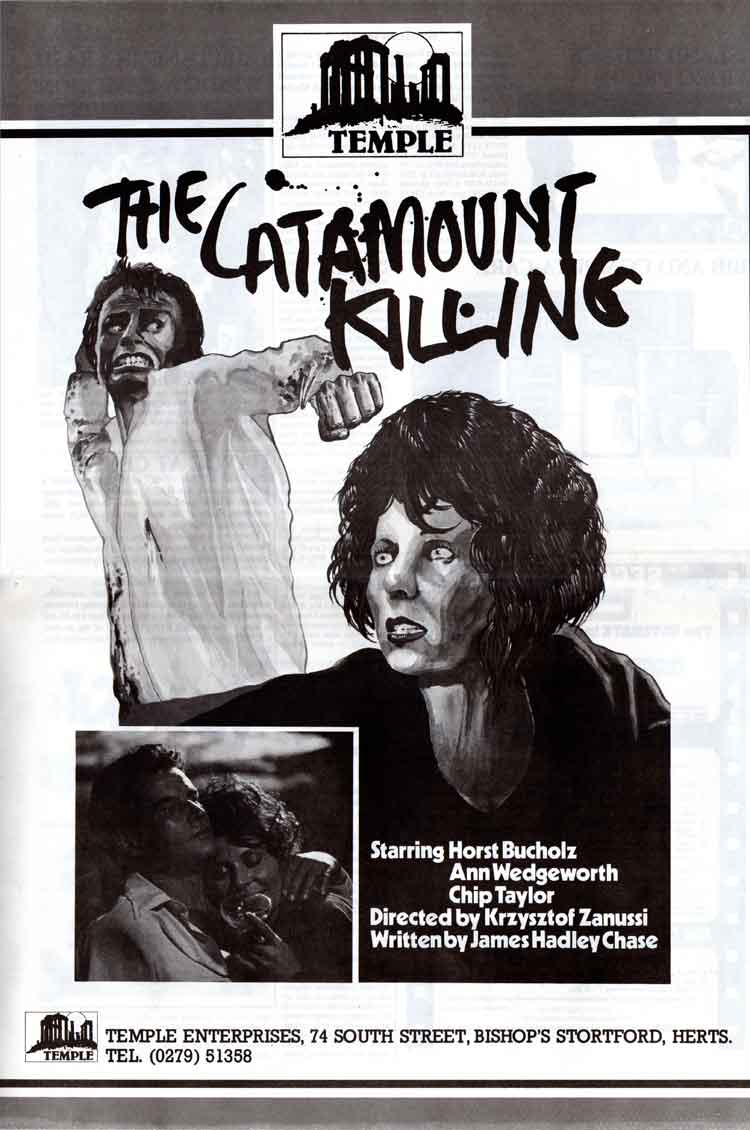
Mark (Horst Buchholz) is a recent divorcee who has moved to a small town and gotten a job as the new bank manager. The bank is small and not adequately guarded giving him the idea to pull off a robbery as an inside job. He seduces the emotionally fragile Kit (Ann Wedgeworth) into helping him with his plan. Initially things go smoothly, but then they begin feeling guilty over what they’ve done especially since the robbery involved the death of someone else. Then Kit’s daughter Iris (Louise Caire Clark) becomes suspicious that her mother might’ve been involved, which causes the couple to unravel in dramatic fashion.

I hate to use the fact that this is a low budget film as a reason for why it’s poor as not every movie has to have state-of-the-art special effects to be entertaining and good story telling and competent direction are still the foundation of a good movie and that can be accomplished on the most miniscule of budgets. However, this film, which was filmed on location in Bennigton, Vermont, looks cheap and stale. The camera work is unimaginative and it does not take advantage of some of the historical landmarks in the town where it was filmed making the background and setting look blah and uninteresting. Its loud, crashing orchestral music score would be better suited for a Hollywood epic and is pretentious and out-of-place here.

The set-up moves too fast and could’ve been the result of watching the American version, which is 11 minutes shorter than the European one. Either way it’s poorly constructed with the two falling in love and plotting the crime without much background information given about them making it all seem forced and rushed. The robbery itself isn’t unique and when compared to other bank robbery movies this one is weak and forgettable.

Buchholz gives a strong performance, which helps the limp material to some degree. Wedgeworth is outstanding. Somehow her soap opera-styled histrionics and Texas accent is something I’ve always found appealing and makes for a fun performance. This also mark the film debut of Polly Holliday who appears briefly sporting a foreign accent that does not sound too believable.

There are enough twists to keep it plausible and mildly engrossing, but the ending lacks impact and like the rest of the movie falls flat. The plot is based off the novel ‘I’d Rather Stay Poor’ by James Hadley Chase, which I suspect would be a far superior version to this.

catamout killing 1

My Rating: 3 out of 10

Released: August 11, 1974

Runtime: 1Hour 22Minutes (American Version)

Rated PG

Director: Krzysztof Zanussi

Studio: Starlight

Available: VHS, DVD-R, Amazon Instant Video

The Revolutionary (1970)

the revolutionary 2

By Richard Winters

My Rating: 6 out of 10

4-Word Review: He fights against capitalism.

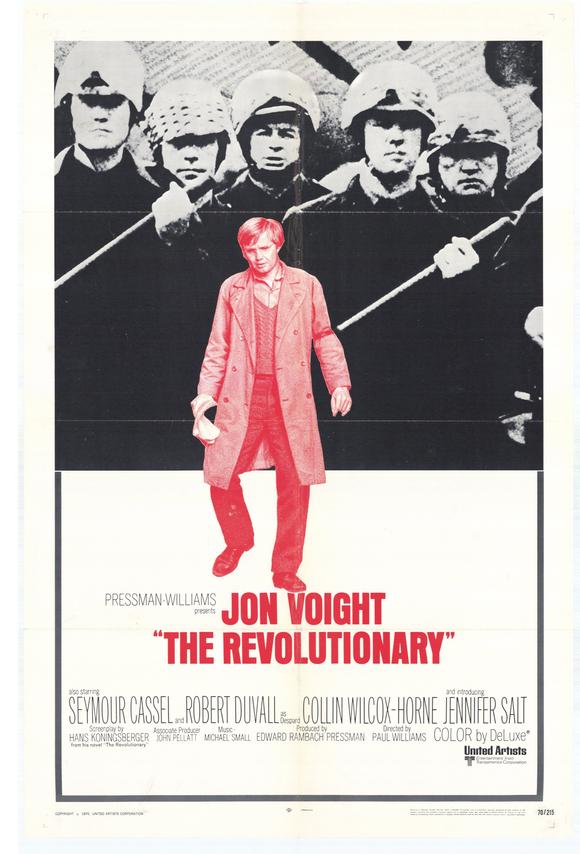
Jon Voight plays a college student involved in a student protest group called The Radical Committee. They push for social change particularly with a more communist/socialist style of government, which he becomes fonder of after working with Despard (Robert Duvall) a nearby factory worker who’s trying to start a union up at his plant. After being suspended from the school for his radical views he becomes frustrated at seeing how his work and actions seem to have very little influence or effect. He then meets up with Leonard (Seymour Cassel) who is a more seasoned radical and not shy about using violent or unethical methods to make his point and pressures Voight to start doing the same.

On the whole despite its slow pace this is a slickly produced intriguing character study. I enjoyed the grainy pictures of the 1917 Bolshevik Revolution shown over the opening credits, but I didn’t like the film’s choice of on-location shooting. Supposedly it takes place in a small American city, but it doesn’t resemble one since it was filmed in London, which gives everything from the old buildings to roadways and sidewalks a European look that you never see in any American town or city. There is also no explanation initially about what the students are protesting against or why they are at odds with the school, which makes the storyline seem generic and hard to get into at first.

I loved Voight’s character as it is similar to his Joe Buck one in Midnight Cowboy with all of the social awkwardness, but fortunately he is not as painfully dumb. It is interesting to see how such a highly intellectual man with strong opinions and ideals can still at times be quite timid. I was looking forward to seeing the character go through a transition and was disappointed that it took so long to get there.  To me the ending should’ve been the beginning and the fact that it isn’t hurts the film’s overall impact. I was also confused as to why the Jennifer Salt character, who plays a young lady from an affluent family, would find Voight so appealing, or why she wanted to continue to go out with him, which to me demanded more of an explanation.

The scene in which a mob gets attacked by some riot police is photographed in a way that makes it intense and startling and could’ve been extended even more. The ending is nerve wracking and great example of how complete silence without any music can sometimes create far more tension. Unfortunately the ambiguous resolution is a disappointment and after such a long and deliberately slow build-up comes off almost like a cop-out.

My Rating: 6 out of 10

Released: July 15, 1970

Runtime: 1Hour 40Minutes

Rated R

Director: Paul Williams

Studio: United Artists

Available: DVD (MGM Limited Edition Collection), Amazon Instant Video

Such Good Friends (1971)

such good friends 1

By Richard Winters

My Rating: 8 out of 10

4-Word Review: Her husband fools around.

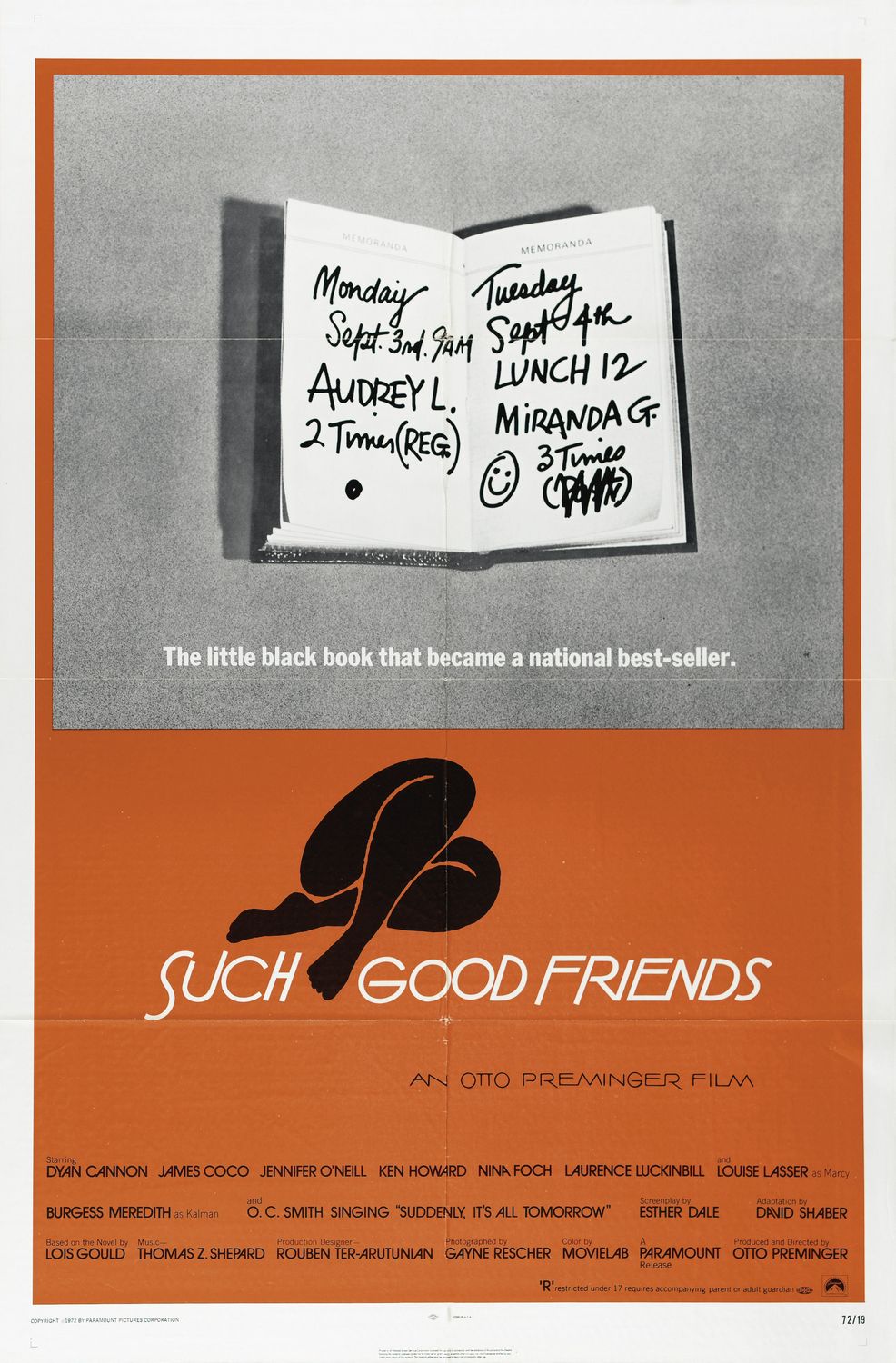
Julie (Dyan Cannon) is a well-off New York Housewife living in a swanky Manhattan apartment with her husband Richard (Laurence Luckinbill) who is the successful editor of a New York fashion magazine. Her life seems fulfilled and happy until Richard goes into the hospital for routine surgery, which has unexpected complications that sends him into a coma. While going through some of his personal belongings she comes upon his little black book that lists all sorts of sexual conquests he has had with her friends, which first leads the devastated Julie into considering suicide, but then ultimately into revenge.

This film can be considered Otto Preminger’s swan song as the two movies he made after this weren’t worth watching. This movie also proves to be a giant improvement from the awful Skidoo that he did just three years before where he tried unsuccessfully to get with the ‘hip generation’, but failed miserably. It has the same irreverence and satire as that one, but it is much more disciplined and sophisticated and makes its point without going overboard. It also shows that despite his renowned cantankerous nature behind-the-scenes he was still a gifted director who managed to span five decades with movies that had vastly different styles and themes and he deserves to be labeled a filmmaking legend.

I loved the way the camera spins around in a circle during a scene inside a New York art museum as well as some breathtaking shots of the New York skyline while on top of Jennifer’s and Richard’s condominium. The fractured narrative that deals heavily with flashback sequences is also nicely handled though the scenes showing a middle-aged Cannon trying to look like she is an adolescent while wearing pigtails looks tacky and should’ve been scrapped.

The film is based on the Lois Gould novel of the same name and while that book had a much more serious tone the movie gives the material more of a satirical spin much like Diary of a Mad Housewife, which Preminger had scriptwriter Elaine May (who gets credited as Ester Dale) watch before writing this one. The result is endlessly witty dialogue and some near brilliant conversational exchanges between the characters. Some of the best bits are Jennifer’s discussions with Richard’s doctors who seem reluctant to take responsibility for their medical blundering as well as Jennifer’s awkward sexual encounter with her friend Cal (Ken Howard) when he is unable to ‘rise to the occasion’.

Although she has a face that can show pain and sadness well Cannon may not have been the best choice and some other actresses would’ve been more interesting in the part. Apparently Preminger had her in tears already on the first day and she has in subsequent interviews called him a ‘horrible man’. The scene showing her naked in a snapshot is actually that of another nude model with Cannon’s face cropped on it.

James Coco is great in support and I was genuinely shocked that it didn’t get him nominated for best supporting actor. The scene where Cannon is undressing him for some sex and he tries desperately to distract her while he takes off a corset that he is wearing underneath is frickin’ hilarious. Burgess Meredith has an outrageous moment where he is seen nude while attending a posh party and only his genitals are covered by a book hung from a belt that he is wearing.

The only real negative is the ending that is too serious and somber and deflates the energy from the film’s otherwise snarky tone. Some of the music used doesn’t work with the scenes either including the O.C. Smith song played over the closing credits. Otherwise it’s as fresh, original and timely as it was when it first came out and ripe to be rediscovered by the right audience. The title sequence created by Saul Bass that is used to open the film is diverting and I wished it had been extended.

My Rating: 8 out of 10

Released: December 16, 1971

Runtime: 1Hour 42Minutes

Rated R

Director: Otto Preminger

Studio: Paramount

Available: DVD, Blu-ray, Amazon Instant Video

The Laughing Policeman (1973)

the laughing policeman 1

By Richard Winters

My Rating: 7 out of 10

4-Word Review: This policeman isn’t laughing.

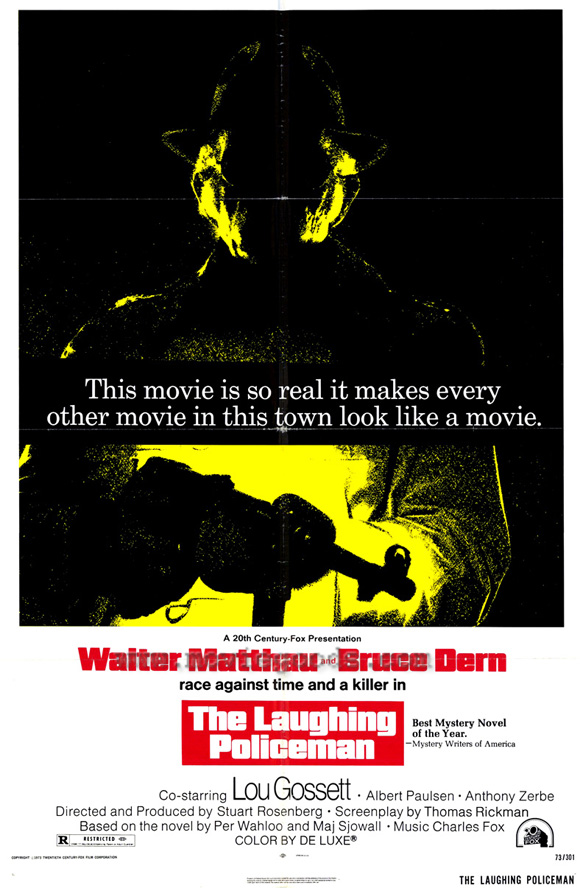
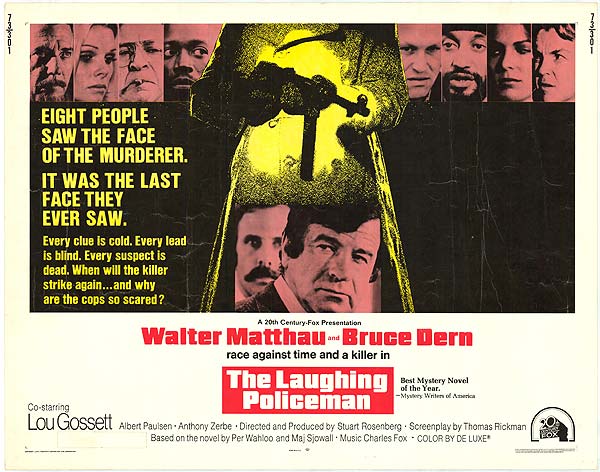
8 passengers on a San Francisco bus are slaughtered to death by a mysterious gunman for no apparent reason. When Police Sargent Jake Martin (Walter Matthau) investigates he finds that his patrol partner is one of the victims. He soon learns that his partner was working on another case during his off hours dealing with a murdered prostitute that Jake had also worked on, but couldn’t crack. He begins to believe the two cases are somehow connected, but his brash department head (Anthony Zebe) doesn’t agree and thinks it is a waste of time to pursue the possible connection while also sticking him with Leo (Bruce Dern) a younger cop who doesn’t always like to play within the rules and whose manner and methods conflicts with Jake’s.

The film, which is based on the novel by Per Wahloo and Maj Sjowall who also did the book version for Man on the Roof, has a finely detailed gritty nature about it that looks at the methods of a police investigation in a realistic and unglamorous fashion, which significantly helps this one stand out from the usual cop dramas. I loved the way they searched for clues on the bus and the autopsies of the victims as well as pursuing leads that never pan out, which is a very common occurrence in most police investigations, but rarely is ever shown in movies. There is even a shot of a tow truck removing the disabled bus from the accident scene once the investigation is completed.

Although the novel’s setting was Stockholm the movie transplants the action to San Francisco making the Bay City almost like a third character. Director Stuart Rosenberg manages to nicely capture the eclectic vibe of the area and the disdain many people had for the police during that era. The movie also uses very little music, which is a major asset and helps accentuate the realism. Outside of the closing credits the only time there is really any other music is near the end when Jake and Leo start following a suspect, which comes off as jarring and should’ve been left out.

Matthau who’s mostly known for his comedic parts does well in an atypical role, which due to his casting and the film’s strange title may make some think it is a comedy though this is far from it. Dern is terrific in a role that takes full advantage of his edgy acting style and I liked how the two characters don’t get along at first, but eventually get past their differences and use each other’s unique strengths to their advantage. I was disappointed though that there is a side-story dealing with Jake’s tumultuous relationship with his teenage son that gets introduced early on, but then dropped and completely forgotten during the second half.

Louis Gossett Jr. gets a star making turn as a brash street cop and Zerbe is superb in support as the gruff police chief. Joanna Cassidy has a brief, but interesting bit as a witness and I liked the shot showing her and Dern sitting amidst a row of tables with table legs made to look like human ones. It’s also amusing to note that Albert Paulsen’s character who becomes the main suspect in the film never utters a single word of dialogue.

Spoiler Alert!

The film’s biggest downfall though is with its ending. It is very hard to believe that a character such as Paulsen’s that is portrayed as being rich and having a lot of connections would feel the need to shoot and kill the bus passengers himself as most if not all rich people simply hire someone else to their dirty work. I also didn’t think that someone who walks down the street surrounded by lawyers would crack as quickly as this one does when Matthau comes to question him about the case. A typical well-off businessman would simply ‘lawyer-up’ and trust that the minimum evidence that the police have would not hold up in court instead of jumping into his car and racing down the city streets in a panic such as he does here. The finale becomes too conveniently Hollywood-like and seems to sell out on the film’s original concept, which left this viewer with a flat and ambivalent feeling towards it when it was over.

the laughing policeman 2

End of Spoiler Alert!

My Rating: 7 out of 10

Released: December 20, 1973

Runtime: 1Hour 52Minutes

Rated R

Director: Stuart Rosenberg

Studio: 20th Century Fox

Available: DVD

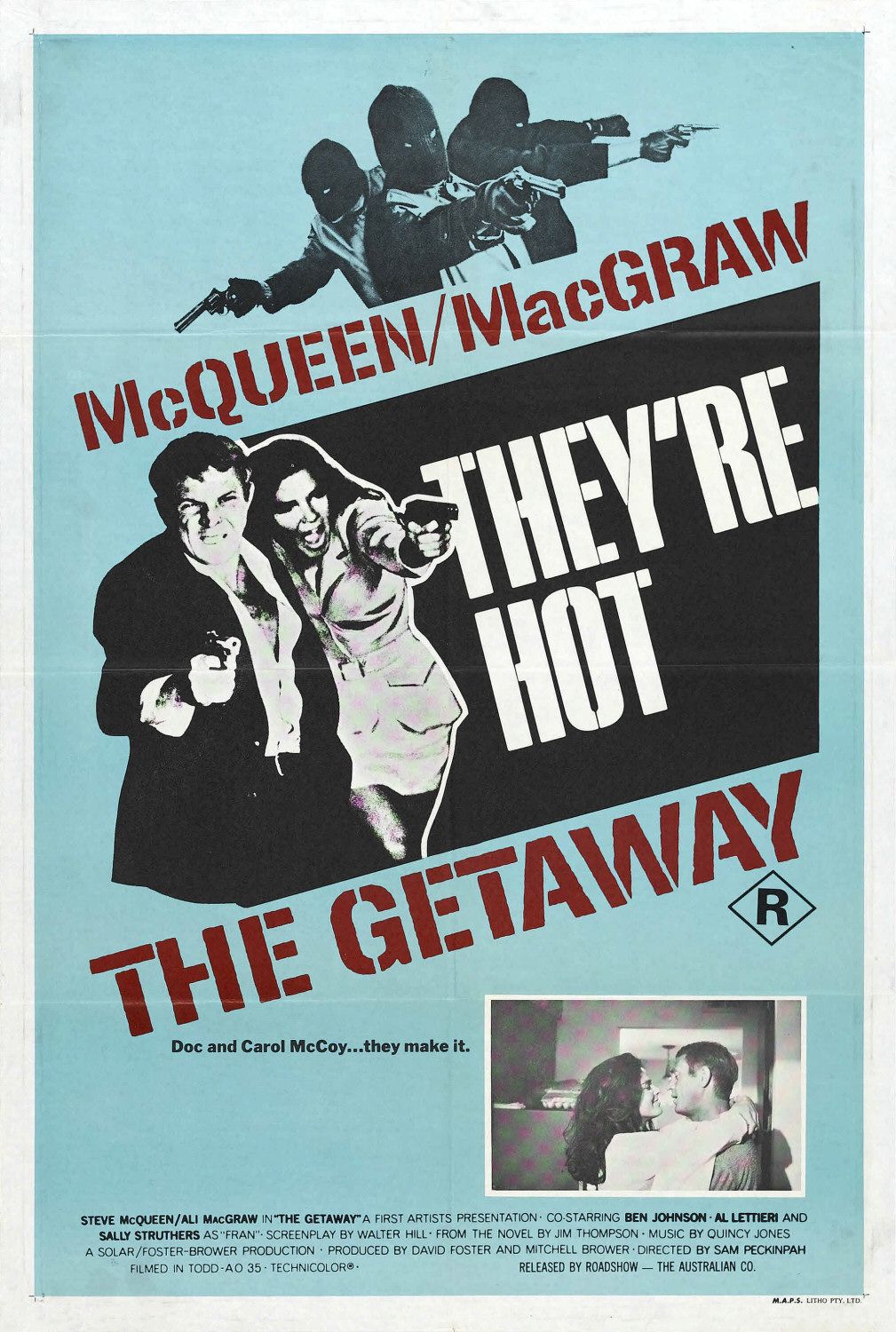
The Getaway (1972)

getaway 1

By Richard Winters

My Rating: 8 out of 10

4-Word Review: Bank robbery goes bad.

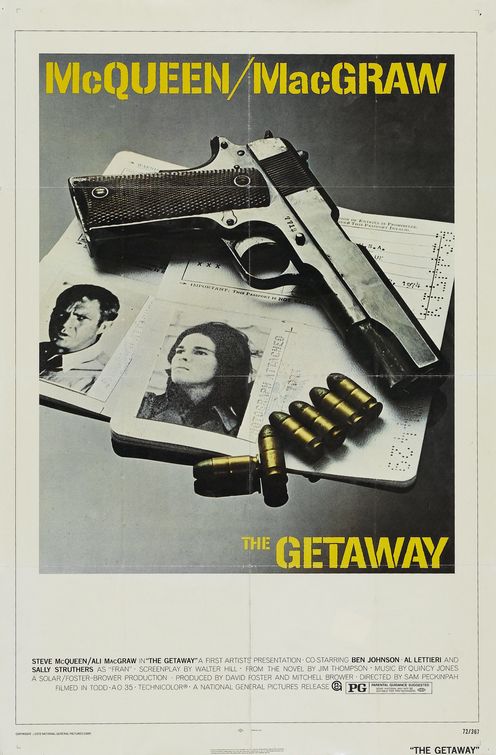
Based on pulp writer Jim Thompson’s novel the story centers on Doc McCoy (Steve McQueen) who is stuck in the Texas State Prison and itching to get out. He gets his wife Carol (Ali MacGraw) who is on the outside to strike a deal with Sheriff Jack Benyon (Ben Johnson) where he will get a release as long as he agrees to rob a bank using Benyon’s men. Doc is somewhat reluctant, but agrees to go along with it only to find that after the robbery he has been double-crossed and now along with his wife must make a dash for Mexico while being chased by the cops and going through a wide assortment of unexpected obstacles.

Action director guru Sam Peckinpah has done many classic films most notably The Wild Bunch and Straw Dogs, but this one has always been my favorite as it’s a nice mix of action, character study and comedy. In fact it’s the subtle humor that I like best. I get a kick out of the shot showing Benyon’s brother’s henchman riding in a convertible down a highway while having their hands on their cowboy hats in order to keep them from blowing off. I also chuckled at the book actor Dub Taylor has in his back pocket while cowering under a table during a shootout or what actor Al Lettieri immediately does after finding a dead man hanging in a bathroom.

Peckinpah also makes great use of sound particularly at the beginning where during the opening credits we hear no music, but instead the monotonous sounds of the machines inside the prison workshop, which helps convey Doc’s increasing frustration and this sound doesn’t stop until the exact second that the prison doors open up and allows him out. When there is music it’s effective and distinct particularly the harmonica solos by Toots Thielemans.

Of course Peckinpah’s trademark action sequences are excellent and maybe even superior to his other films because the situations are more unique including an exciting segment showing the couple trapped inside a garbage truck as well as an impromptu shootout along the main street of Fabens, Texas. The only complaint is the scene where Doc’s car goes crashing through someone’s front porch and yet the car shows no visible damage; one shot does show a crack in the corner of the windshield, but then in the next shot it has magically disappeared.

McQueen’s ability to show effortless cool and make an edgy character likable proves what a legendary actor he is and it’s a shame that he doesn’t get placed with the best of them amongst casual movie fans because he really should. MacGraw is at the peak of her beauty here and her moments of vulnerability are great. Struthers gives the best performance of her career as an unfaithful wife of a kindly veterinarian (Jack Dodson) and Lettieri, who unfortunately died at the young age of 47 just 3 years after this film’s release by a heart attack brought on by severe alcoholism, which was already painfully apparent to the cast and crew during the filming of this adds great tension as Doc’s double-crossing partner.

The film also makes great use of its Texas locations bringing out the ruggedness of the region without overdoing it. I particularly liked the scenes in the junkyard as well as footage shot on-location inside the Huntsville prison using actual prisoners and the longshot showing the flat, barren landscape that Doc first sees when he gets out.

I’ve watched this movie many times and never cease to grow tired of it. In fact it seems even more original after multiple viewings. It was unwisely remade in 1994 that starred Alec Baldwin, who doesn’t come close to McQueen’s stature. This version is by far the better one and the other should be avoided.

getaway 2

My Rating: 8 out of 10

Released: December 13, 1972

Runtime: 2Hours 2Minutes

Rated PG

Director: Sam Peckinpah

Studio: National General Pictures

Available: VHS, DVD, Blu-ray, Amazon Instant Video, YouTube
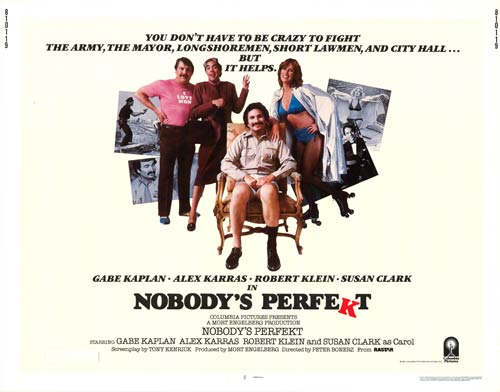
Nobody’s Perfekt (1981)

nobodys perfekt 1

By Richard Winters

My Rating: 0 out of 10

4-Word Review: Crazies fight city hall.

Dibley (Gabe Kaplan) who suffers from unpredictable memory loss, Swaboda (Alex Karras) who thinks his mother is still alive and with him at all times even when she really isn’t and Walter (Robert Klein) who has a split personality that can turn him from a gangster to Bette Davis at any given moment decide to steal an army tank and use it to force the mayor (Arthur Rosenberg) to pay for a new car when their old one gets damaged after driving through one of the city’s potholes. They get Dibley’s girlfriend Carol (Susan Clark) to go along with the scheme and in the process get caught up with a robbery of an armed bankroll truck.

If it was possible to give this thing a negative number rating I would and I seriously considered it, but decided to be generous and give it a 0 even though this thing has to be one of the dumbest comedies ever made. I’ve seen a lot of them, but at least they usually had one or two funny gags even if the rest fell flat, but this one has none. The humor is at a 6-year-old’s level and is painfully stupid from beginning to end without a shred of believability. It also features what has to be one of the slowest, most drawn out and boring car chases ever to be put on film

Mental illness is no laughing matter and the way it gets portrayed here could be considered offensive. Screenwriter Tony Kenrick, who also wrote the novel from which this film is based as well as director Peter Bonerz have clearly not done any research on the topic and portray those afflicted with it in the most sophomoric and benign way possible. In reality these characters would not have been able to hold down regular jobs like they do here and even if they did they would have been quickly fired once their mental problems became easily apparent. They would also most likely be on medications and even institutionalized instead of freely gallivanting around and only seeing an inept shrink (portrayed by Paul Stewart in a very clichéd send-up of Sigmund Freud) once a week who seems to have no insight on how to help them.

The ‘normal’ characters are just as annoyingly stupid. When the trio decide they want to steal a tank from a local plant that makes them they have Kaplan pretend to be from a ‘top secret’ government organization that tricks one of the employees, which is played here by director Bonerz, into believing that his company is secretly selling the tanks to the Soviets without him ever demanding any evidence or proof.

Kaplan may have been a great stand-up comedian and in recent years a good poker player, but as an actor he is one of the worst. In fact I always felt he was  the weakest link in the Welcome Back Kotter show as he always said his lines like he was reading them off of cue cards while constantly conveying a sheepish grin and here he is no better. Former football player Karras and fellow comedian Klein are equally weak. Only Clark is good, but why she would choose to do this after appearing in so much critical acclaimed stuff during the 70’s is a mystery, but she most likely did it to stay close to her then husband Karras and still manages to look great in a bikini.

If the filmmakers really thought that the American public would find this funny then they are the ones suffering from mental illness as only a mentally ill person could possibly find it amusing and if you watch it all the way through you more than likely will become one.

My Rating: 0 out of 10

Released: August 7, 1981

Runtime: 1Hour 36Minutes

Rated PG

Director: Peter Bonerz

Studio: Columbia Pictures

Available: VHS, DVD-R, Amazon Instant Video

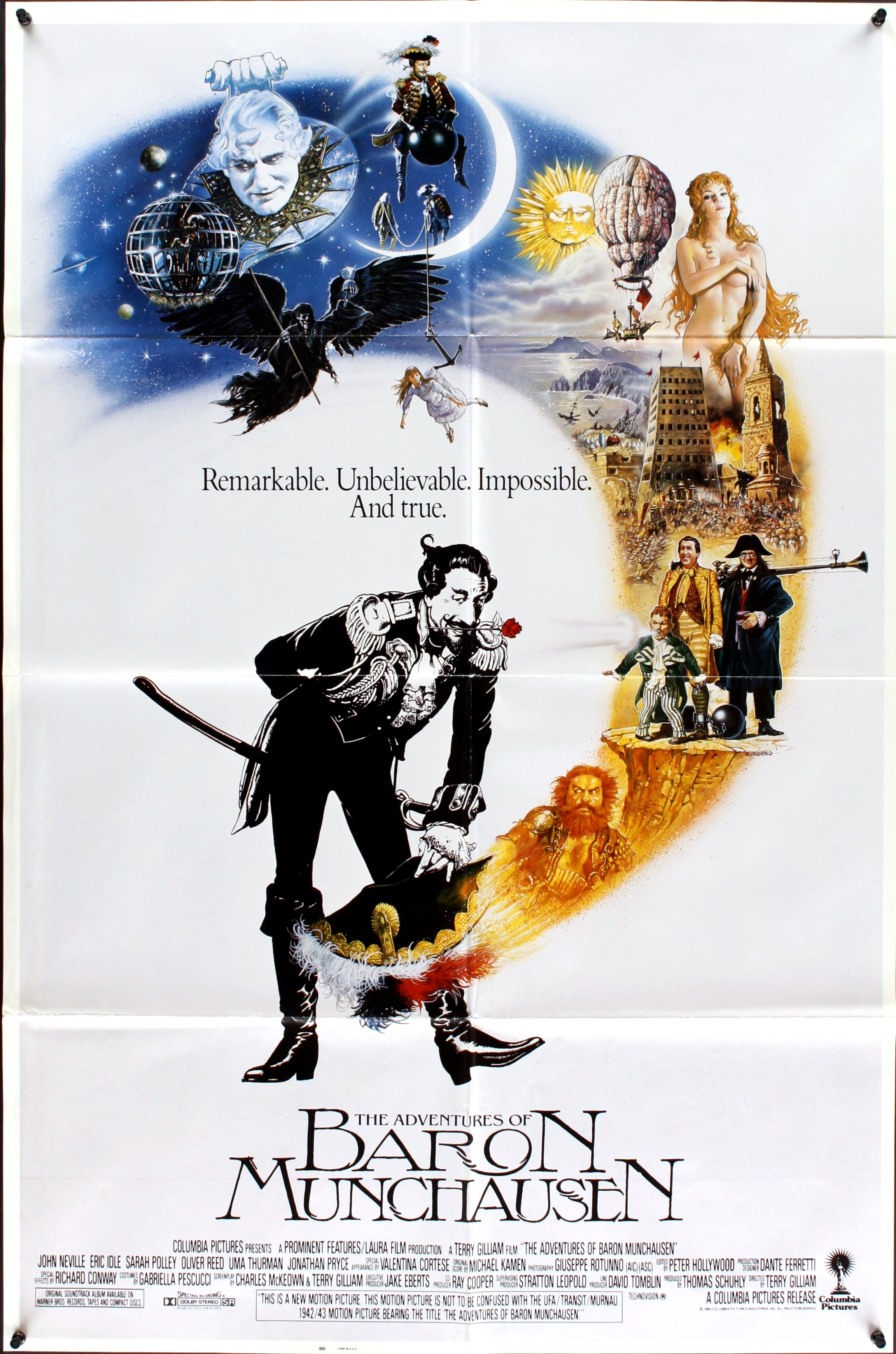
The Adventures of Baron Munchausen (1989)

adventures of baron 1

By Richard Winters

My Rating: 7 out of 10

4-Word Review: Where fantasy meets silliness.

A touring stage company in some unnamed European city during the 18th century is putting on a production of fictional character Baron Munchausen’s fanciful life when it gets interrupted by an elderly man (John Neville) insisting that he is the real Baron and who then takes center stage to narrate his adventures from his perspective. Unfortunately an army of Turks are also invading the city at the same time, which forces him to escape via a hot air balloon made of women’s undergarments.  With him is a young stowaway named Sally (Sarah Polley) and together they try to round up a group of elite men with unique abilities, which they will use to team up against the Turks and hopefully win back the city while also meeting many odd characters and going through a myriad of zany, mystical scenarios.

The film’s dazzling production ran 24 million over budget only to then bomb at the box office but the intoxicating special effects almost make it worth it while it also remains kid friendly with action sequences that are pleasantly cartoonish and innuendos that are too subtle for them to catch. The balloon made of women’s underwear is great and as well as watching the trio get swallowed up by a giant sea monster whose head resembles that of an island. I also liked the angel of death scenes and wished those had been played up more. Even the little things like seeing a tiny grain of sand slither its way down the thin glass tube of an hourglass is fun. The colorful sets are dazzling and the whole thing gets saturated with a visual flair that is quite impressive.

Although she has complained in subsequent interviews about her experience working in this film and dealing with director Terry Gilliam Polley’s presence adds a lot with a performance that is completely on-target the whole way. She’s one of those child characters that is cute without it being forced, which is a major feat in itself. Robin Williams is hilarious as a giant floating head in a part that was intended for Sean Connery who I don’t think would have done it half as well.  I also got a real kick out of Oliver Reed as a jealous god and Uma Thurman as his stunning wife Venus, which is technically her film debut, but due to budget delays this came out after two of her other films had already released.

The only real complaint about the movie is the plot or lack thereof. I loved the creativity, but after a while it starts to become dizzying and senseless. Gilliam’s other films like Time Bandits, which like this movie is part of his trilogy of imagination, at least had a discernable story that sucked you in and in Brazil it made great satirical jabs at modern day society, but here we get none of that. It becomes silly and surreal for no reason, which when factored in with its giant production cost and manpower turns it into a supremely wasted effort. Don’t get me wrong it’s amusing and engaging enough to be entertaining, but when it’s all over it is also quite forgettable.

adventures of baron2

My Rating: 7 out of 10

Released: March 10, 1989

Runtime: 2Hours 6Minutes

Rated PG

Director: Terry Gilliam

Studio: Columbia Pictures

Available: DVD, Blu-ray, Amazon Instant Video, YouTube
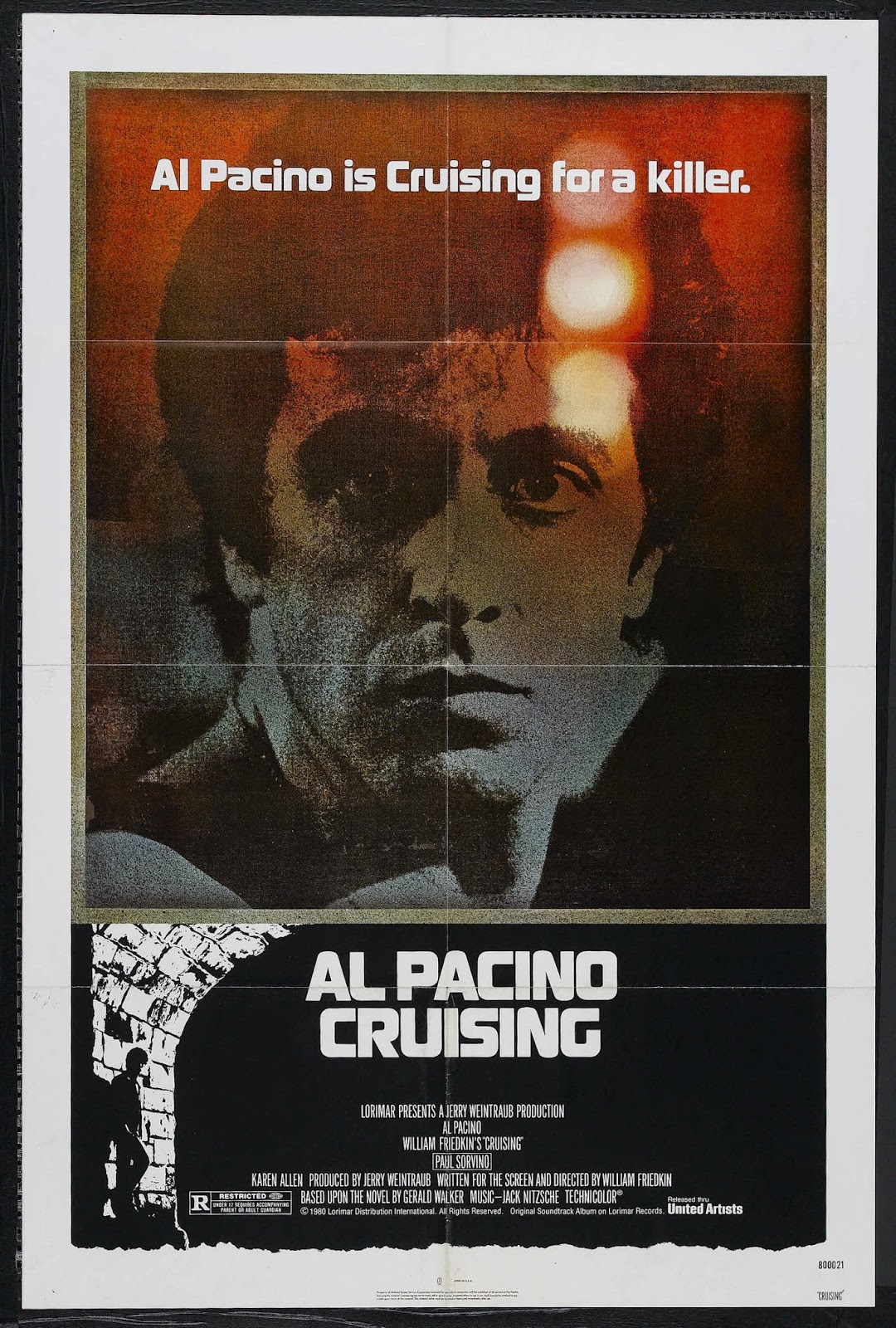
Cruising (1980)

cruising2

By Richard Winters

My Rating: 4 out of 10

4-Word Review: Cop infiltrates gay underground.

A serial killer is attacking gay men who frequent New York’s S&M bars and young cop Steve Burns (Al Pacino) is chosen to go undercover as a gay and infiltrate these ‘leather clubs’ in order to bring out the killer. However, the job requirements demand that he must be completely isolated from the rest of the force and not carry a gun, which eventually causes a strain on his personal life particularly in his relationship with his girlfriend Nancy (Karen Allen).

The film, which is loosely based on actual events that occurred during the late 70’s and captured in Gerald Walker’s novel of the same name, was considered quite controversial at the time of its production. Protestors who felt the film accentuated the gay stereotype tried to create loud noises during filming and even shine reflective lights on the actors in an attempt to mess up the scenes. In retrospect it is hard to imagine that director William Friedkin is in anyway homophobic as just ten years earlier he did the brilliant adaptation of The Boys in the Band, which remains to this day one of the better films dealing with gay issues. The story certainly does wallow in ugly elements, but also makes the point to describe this as an extreme subculture and  not reflective of the gay lifestyle as a whole, which in my opinion made the film seem more enlightening to New York’s gay underground of a bygone era and less propaganda as its critics ascertained.

To some degree I liked the explicit uncompromising approach, but after a while it became one-dimensional and predictable. The scenes of the killings are unnecessarily prolonged and some of the segments showing large groups of men having sex at a bar come off as overly-stylized and looking reminiscent of a homoerotic scene from a Fassbinder film.

Friedkin does manage to add a few unique touches including having a well-built black man wearing nothing but a jock strap enter the room during police interrogations and violently slap suspects who he felt weren’t telling the truth, which according to one of the film’s advisors was an actual technique used by police at the time.  The way the movie captures the monotony and frustrations of investigating a complex case such as this and leaving open that there may have been more than one killer is also well done and helps elevate this a bit from the usual formulaic cop thriller.

Pacino gives a gutsy performance including one scene showing him tied up in bed naked during some kinky S&M play, but the character’s motivations are confusing particularly the way he so quickly accepts this difficult assignment that most others would be very reluctant to do. The fact that his experiences ends up affecting him psychologically isn’t compelling since that becomes a foregone conclusion right from the start.

Paul Sorvino is perfect as the police captain. His gray hair dye was a little overdone, but his limp was great. Allen has a good moment at the end when she tries on Pacino’s leather hat and coat that he brought home with him and Joe Spinell makes the most of his small role as a corrupt cop who harasses gays only to end up patronizing gay bars on his off hours. You can also spot Powers Boothe in an early role as a hankie salesman and Ed O’Neil as a police detective.

The idea of exposing the dark side of police life is no longer original or interesting and the film’s shock value has lessened through the years and thus failing to leave any type of lasting impression or message.

My Rating: 4 out of 10

Released: February 15, 1980

Runtime: 1Hour 42Minutes

Rated R

Director: William Friedkin

Studio: United Artists

Available: VHS, DVD, Amazon Instant Video

The Midnight Man (1974)

the midnight man 2

By Richard Winters

My Rating: 4 out of 10

4-Word Review: Security guard solves case.

Jim Slade is a 60-year-old out on parole after serving time for killing his wife’s lover. He finds a ho-hum job as a security guard at a local university and soon gets swept up in a murder mystery when a coed (Catherine Bach) is found dead. The local cops nab the town pervert (Charles Tyner) and take him into custody, but Slade is convinced they have the wrong man and goes on a crusade to find the right one only to realize that there are far more suspects than he initially expected and no one no matter who they are is quite innocent.

Many critics at the time and some viewers complained that the mystery was too involved and a bit confusing however I was able to follow it and it manages to remain intriguing enough to be entertaining, but it’s still no better than an average episode of Columbo. The film also doesn’t have enough action although the part where Lancaster finds himself trapped in a rural barn and must use whatever implement he can find to fight off a trio of rednecks and their ferocious dog is nifty.

On the technical end the film is a bore and looks unsuitable for the big screen. Writer Roland Kibbee in his only directorial effort shows no flair for visual style filming scenes in places with dull and ordinary backdrops and fails to capitalize on its South Carolina location where it was shot. The soundtrack though by Dave Grusin is distinctive and the one thing that shows verve, energy and I wished it had been played more, particularly the part at the beginning.

Lancaster, who also co-produced and co-wrote the script, walks through his part in an almost comatose state and the fact that his character seems so very on-top of his game in this investigation leaves little doubt in the viewer’s mind that he will ultimately solve the case, which isn’t as interesting. For a character that is so savvy he does make one glaring error when he finds a dead body in his car and fearing that he will be fingered for it decides to put the body inside a nearby hotel room, which seems foolish. For one thing to check into the room he would have to have faced a hotel clerk who could’ve easily recognized him for the police later and he also doesn’t wear any gloves leaving his fingerprints all over the room when simply dumping the body in a wooded area would have made much more sense.

Out of the entire cast Cameron Mitchell shows the most energy and it certainly is fun to see Bach in her film debut and years before she became Daisy Duke playing a foul-mouthed, snippy college student. Although she has no nude scenes there is a painting of her naked likeness shown at one point, which may be good enough for some viewers.

My Rating: 4 out of 10

Released: June 14, 1974

Runtime: 1Hour 54Minutes

Rated R

Director: Roland Kibbee

Studio: Universal

Available: None at this time.